The oldest things in the Ocean: Explained.
The oldest things in the Ocean: explained by Ocean Generation.

What do we mean when we say the “age of the Ocean”?  

It could mean many things, from the oldest living thing in the Ocean to the time at which the Ocean first formed. Since there is no official definition, we can have some fun with stretching the definition of “age of the Ocean” by looking at some of the oldest things in the Ocean.

What are the very young things in the Ocean? 

First, we stop off what I will call the “very young” section. These are on timespans of one to just above one thousand years. While these things are by no means short on a human timescale, they definitely are relative to the oldest things on this timeline. Most of this section is made up of animals, though not all.

We can interpret the “age of the Ocean” as meaning the oldest living thing in the Ocean.

What’s the oldest vertebrate in the Ocean? 

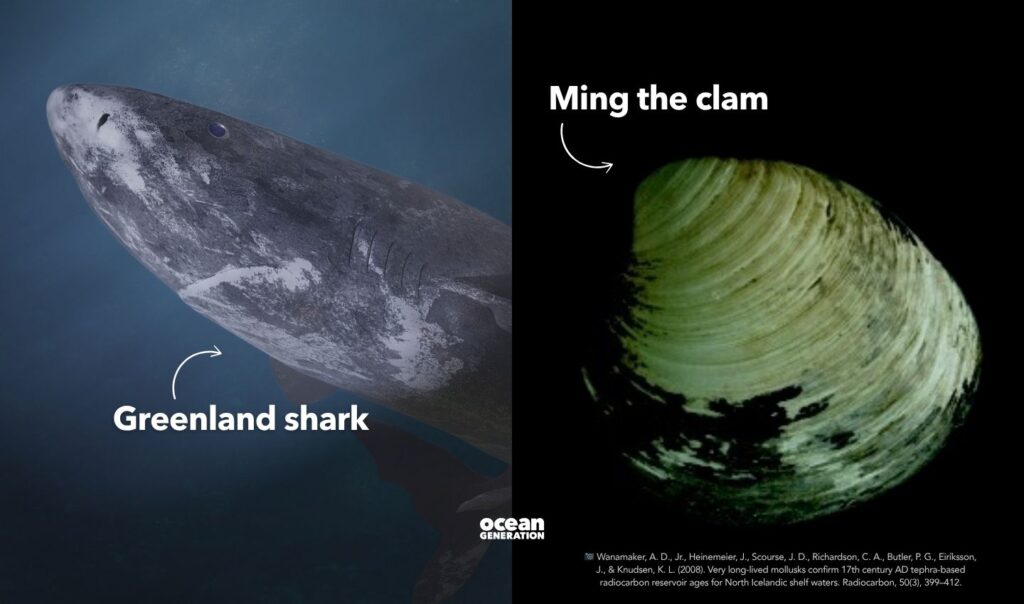
One contender is the Greenland shark. The oldest measured was 272 years, but they are thought to be able to live to 500 years. For perspective, the oldest person ever lived to 122 years old. The Greenland shark can be found in the North Atlantic, being the largest fish to live in Arctic waters. The females of the species can grow to 4-5 metres, about the length of a small car!

These animals grow incredibly slowly and live for a long time. However, this age takes us nowhere near even the oldest living animal. We can still give the Greenland shark the title of “the oldest vertebrate” though.

One of the oldest living Ocean animals is a clam! 

A similarly long-lived animal is Ming the clam. Ming was 507 years old, being born during the Ming Dynasty of China (hence the name), or the Tudor period of the UK (it was born in the same decade as Henry VIII). The story of Ming ended quite sadly and unexpectedly, as to measure the age of clams, they must be killed. The scientists doing this experiment hadn’t realised how old Ming was until it was too late, and so in an unfortunate turn of events, Ming had its life cut short.

Ming still gets the title of “the oldest animal with a precisely measured lifespan” though. While this may seem like a long-winded title, the next animal, in the “young” section, will give an idea as to why it’s important.
Before we get onto the next animal, we move to the “age of seawater”.  

How old is Ocean water? 

The “age of water” is essentially a measure of how long water has gone since its last exposure to the atmosphere. This age depends on the speed of Ocean circulation, as faster circulation means younger overall water. The oldest water on Earth can be found in the deep Pacific, currently around 1400 years old.

Looking at our timeline:
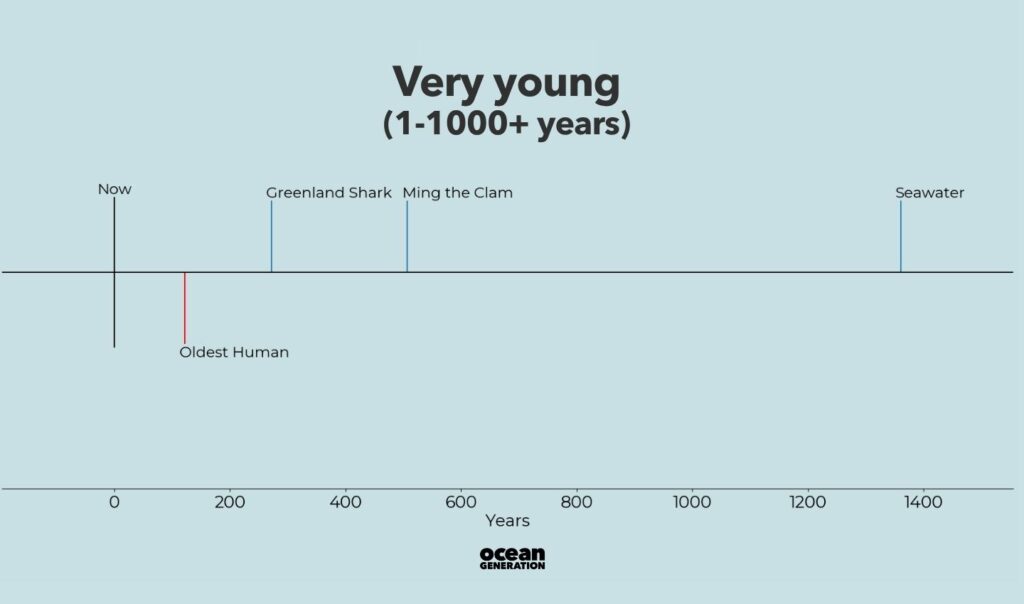
Very young things in the Ocean. A timeline by Ocean Generation.

What are the young things in the Ocean? 

We now head into the “young” section; the things that date from one thousand to one million years. While it is definitely weird to describe these as young, one million years old is less than 0.1% of the age of the oldest thing on this list.

What’s the oldest animal? 

The title of oldest animal goes to the glass sponge (yes, sea sponges are animals). The oldest of these lives up to about 15 kyr (thousand years) old. That’s more than three times as old as the oldest (verified and non-clonal, it gets complicated) tree (about 4,900 years old) ever.

As a quick aside, this tree had a very similar story to Ming the clam, as the scientist who measured its age cut it down to count the rings, as other methods were not working.

The uncertainty on the age of these organisms is large (13 kyr – 40 kyr), due to the measurement method, there is a useful upper constraint on the sponge’s age. We know how sea level has changed in the past, and that the sponge lives at a certain depth below sea level. This means that the sponge cannot have been born below sea level at the time, and so must have been born after the sea level was at its current position.

This pick for oldest animal may be controversial, as some animals are functionally immortal (jellyfish). Despite this, this is a theoretical age limit, which is not what we are looking at. Either way, the oldest animal is in the Ocean.
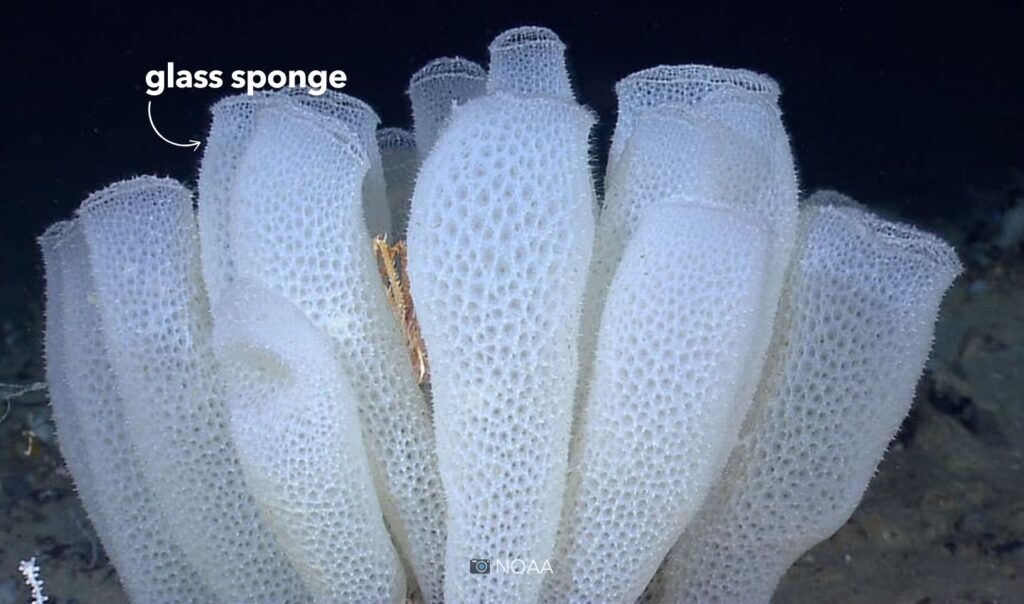
The title of oldest animal goes to the glass sponge.
Glass sponge picture via NOAA

One of the oldest and largest coral ecosystems 

Making a big skip from 15 kyr to 600 kyr, we find ourselves in Australia, in the Great Barrier Reef. While the individual corals aren’t necessarily 600 kyr old, the ecosystem started growing that long ago. For perspective, the oldest human (Homo sapiens) fossil was 300 kyr old.

This means that it’s possible for the Great Barrier Reef to have been around for twice as long as modern humans have been on the planet. It’s uncertain whether this age makes the Great Barrier Reef the oldest living reef in the world, as there isn’t enough literature on reef ages. Despite this, the reef is still significant in age and has definitely been going for a long time.

Our updated timeline:
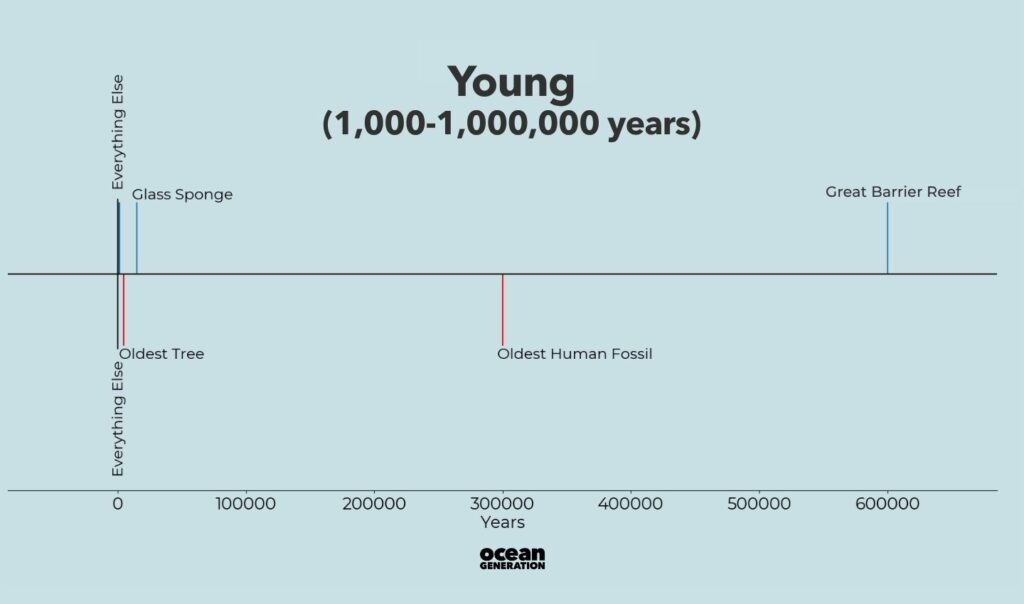
Young things in the Ocean. Posted by Ocean Generation, leaders in Ocean education.

What is middle-aged in the Ocean? 

We finally break a million years, and we’re only into the “Middle-aged” territory. 

How old can ice get? 

We start off with the oldest ice found on Earth, which is about 5 Myr (millions of years) old. You may think that this ice should have melted, as this ice predates the start of the last glaciation event. However, the way that this ice was preserved was being insulated under sediments and rocks, which kept it cool for long enough to be found in the modern day. Imagine trying to keep a block of ice frozen for a single year, never mind five million. That’s impressive!

How old is the Ocean crust? 

Next, we pass through the K-Pg mass extinction (66 Myr ago, read about what happened here), where all the dinosaurs died, into the birth of the oldest Ocean crust, 300 Myr ago. If we’re looking for the “age of the Ocean”, then surely the rocks that hold the Ocean can count in that definition.

The Ocean crust is the supporting basin underneath the Ocean but does not last forever. New crust is constantly being made, while old crust is being removed (called subduction), and so the maximum age of Ocean crust is limited. This oldest crust is thought to have been from a past Ocean that has now closed (yes, regions of the Ocean close up) and is found in the Mediterranean.
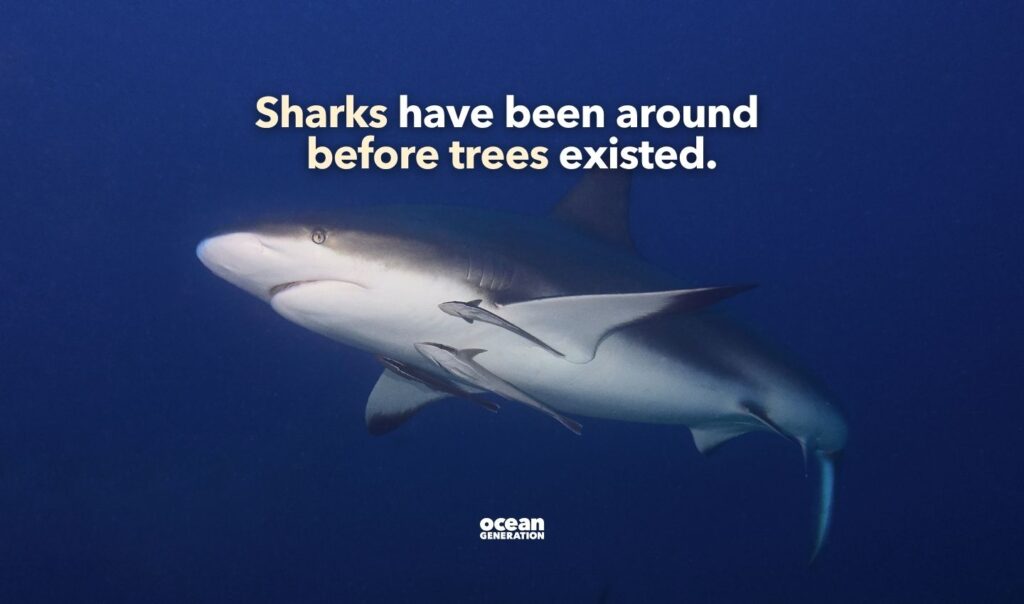
Sharks have been around before threes existed. Posted by Ocean Generation.

Ancient fish fossils 

Rounding out our middle-aged section, we have the oldest fossil of cartilaginous fish, the group including sharks and rays. A fun fact is that the common ancestors of rays and sharks were around before grass and trees were on land. The fossil has been dated to be about 440 Myr old. While these may not be a part of the definition of “age of the Ocean”, they’re still fun to think about.

Our new timeline:
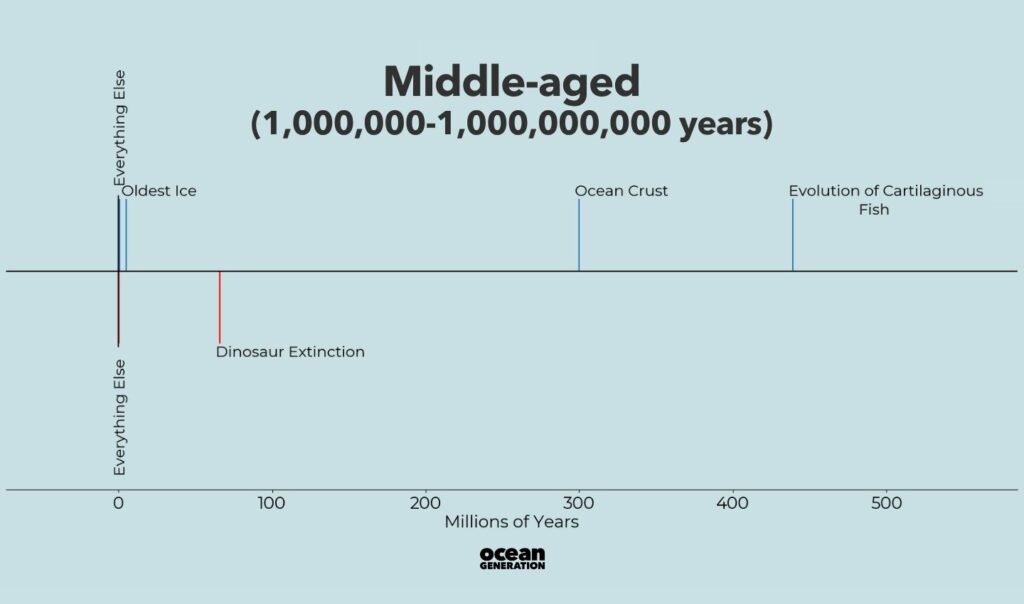
Middle aged things in the Ocean, a timeline by Ocean Generation.

What are the oldest things in the Ocean? 

Now onto the very oldest parts of the Ocean, we look at things that are billions (with a b) of years old.

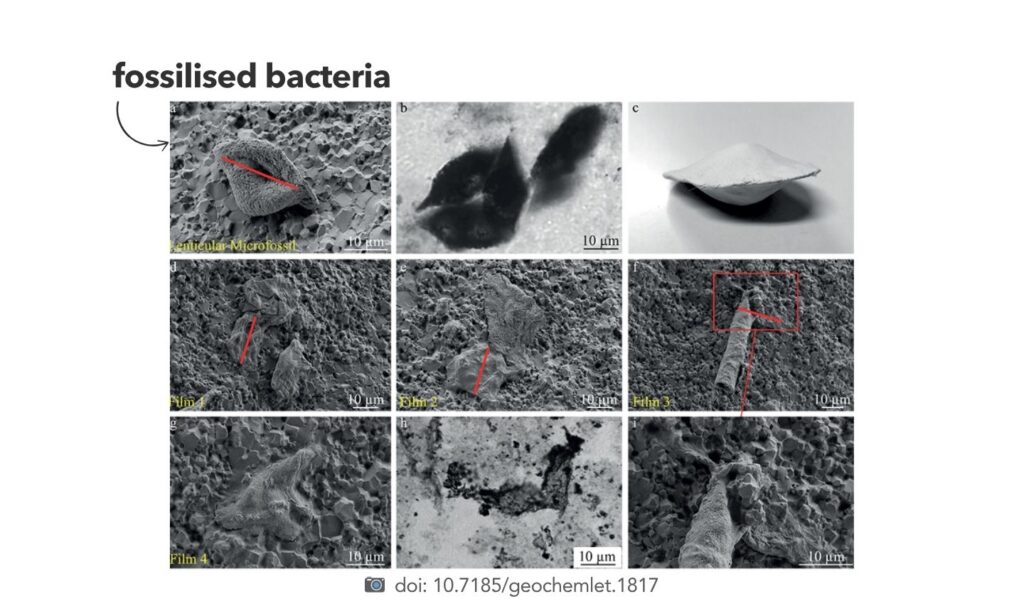
We have talked a couple of different fossils, but the very oldest of these fossils are found at the Strelley Pool Formation in Australia, dating back to 3.4 Gyr (billions of years) ago. These are fossilised bacteria, which predate even oxygen being on Earth in significant amounts (the Great Oxidation Event, 2.4 Gyr ago). They even had a hand in filling the atmosphere with oxygen! Finding the first fossil evidence of life is a challenge, as early life was made up of bacteria, which are difficult to preserve.

The Strelley Pool fossils are the oldest (largely) undisputed fossil evidence of life. As life is theorised to have started in the Ocean (around hydrothermal vents), perhaps we can say that the “age of the Ocean” is how long life has been in the Ocean for.
How long has water existed on Earth? 

The very last definition of how old the Ocean is, is naturally how long water has existed on Earth as pools of water.

To see this, we can look at some of the oldest rocks on Earth, again from Australia. These rocks from Jack Hills contain minerals which date back 4.4 Gyr ago, which was quite early into the Earth’s lifetime (4.567 Gyr). Looking at the composition of these minerals, it’s possible that these minerals interacted with liquid water upon formation, suggesting the presence of at least liquid water at the time.

This water wouldn’t have been in the shape of the Ocean that we’re familiar with, rather taking a different shape due to plate tectonics. This fact emphasises that we have one Ocean that has been with us for billions of years.

The final timeline:
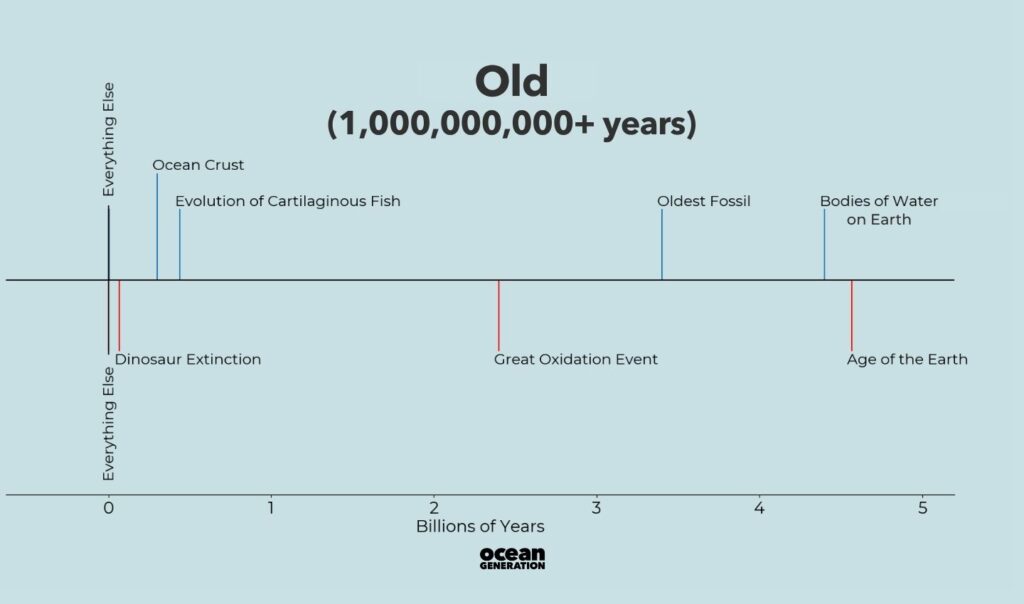
Old things in the Ocean, a timeline by Ocean Generation.

It should be noted that even though this seems like a complete list, these are only the oldest that we know of in each of their categories. The Ocean is largely unexplored in space (and time, for the cartilaginous fish), and so all ages should be taken with a pinch of salt.

How do we know the ages of things in the Ocean? 

A question arises from all of these – how do we know all of these ages? Well, there are many different methods of what we call “dating”, which is measuring the age of something.

Counting growth lines 

The simplest, and possibly the most familiar one to you, is counting growth lines. Trees famously grow rings for every year of their life, making counting their age relatively easy. Trees aren’t the only organism that this is useful to, with Ming the clam having a similar dating method.

Ming had annual growth lines that could be found on the inside of its shell (hence the scientists’ need to kill it to measure its age). This helped it be “precisely measured”.

Radiometric dating 

With the simple method out of the way, we turn to “radiometric dating”, which uses the behaviour of radioactive atoms to see how old a specimen is. There are several atoms that are useful to us, depending on the timescale that we are working on.

Carbon-14 is an isotope (type of atom) of carbon that is radioactive. This means that the number of carbon-14 atoms decreases over time, with half of the carbon-14 in a sample decaying over 5730 years. We say that carbon-14 has a half-life of 5730 years. This means that we can use it as a clock. Carbon-14 dating is particularly useful for dating life, as all life contains carbon, therefore in some small amounts, carbon-14.

This was particularly helpful when figuring out the age of the Greenland shark, as they have a part of their eye that is formed on birth and does not change afterwards, meaning that from measuring the age of the eye, the age of the shark can be found. This method is also useful in finding the age of seawater, as seawater contains dissolved carbon within it.

A similar method can be done with uranium. The difference between uranium and carbon-14 is that uranium’s half-life is much longer, reaching billions of years. This means that it is useful in dating our very oldest samples. For the Strelley Pool fossils, we know the ages of the rocks around the fossils, and so can infer the age of the fossils, and for the Jack Hills minerals, we can directly find their age with uranium dating.
Dating methods in the Ocean. Posted by Ocean Generation.

Correlative or model-based dating 

The last method of dating is “correlative” or model-based dating. For this one, we set up a model, effectively a link between an aspect of a sample and its age and figure out its age from that model.

The Greenland shark age also uses this method of dating. A link between the size and age of the sharks that have had their eye ages measured can be made. This can then be applied to other Greenland sharks. The advantage of this method is that it is much easier to measure the size of a shark than to carbon date its eye age. A model is also used for the glass sponges.

Why is the age of the Ocean important? 

While stretching the definition of “age of the Ocean” may be for fun, each individual story in this article is important.

Diving deeper into the oldest members of each category can lead us to many conclusions. Understanding why some animals live longer than others can give us insights into why some creatures live as long as they do.

The age of seawater gives us an idea about Ocean circulation, while Ocean crust tells us about plate tectonics. The big story of the “age of the Ocean” lets us explore the smaller stories important to different aspects of science.

Who are the orca outlaws sinking boats, and why are they?

Subscribe

Monthly: Impact in your inbox.

OceanGeneration-Join

What is coral bleaching?

What is coral bleaching?

What you need to know about coral bleaching:

White branches reaching out, stark against the blue. Where there was colour, now only ghostly white. This haunting transformation isn’t just a visual tragedy – it’s the silent SOS of some our Ocean’s most spectacular ecosystems. This is coral bleaching.

Coral reefs aren’t just beautiful — they’re nurseries for fish, protect coasts from storms, and feed millions of people. When coral reefs bleach, their whole ecosystem is at risk. But what is coral bleaching? What causes it, and why does it damage reefs? 

Are corals animals, plants or rocks?  

Corals are animals. Some may have stone skeletons and live with plants. But all corals are animals.

Corals are tiny animals called polyps. Each polyp has a soft body and a mouth surrounded by tentacles, like a little sea anemone or an upside-down jellyfish. All these animals are related – they are cnidarians (silent c), named after their cnidocytes – special cells that can sting.  

Where does coral’s colour come from? 

Corals are incredible animals. They build immense structures that provide homes for marine species, protect the coast and create oases in the ‘desert’ of tropical seas (there are very few nutrients in the waters of the tropical Ocean).  

To be able to do all this, they need some help. Corals have symbiotic algae called zooxanthellae living in their skin cells. Think of zooxanthellae as tiny solar-powered chefs living inside coral homes. 

Where does coral's colour come from? Explained by Ocean Generation.

They catch sunlight, cook up energy, and share over 80% of the meal with their coral landlords. The coral provides protection and prime real estate with an Ocean view. It’s a win-win (this is what symbiotic means) – until climate change cranks up the thermostat.  

It’s zooxanthellae that gives coral its colour. The magical, vivid world of coral reefs is painted by these little algae. Without them, corals are translucent, and the white of their calcium carbonate skeleton shines through.  

Why do corals bleach?  

The happy relationship between coral and zooxanthellae can be disrupted. When it is, this can lead to the expulsion of the algae from coral tissues, leaving the coral gleaming white (it is a spectrum, coral can partially bleach).  

The most common cause of coral bleaching is thermal stress AKA temperature. If conditions aren’t right, the systems that make photosynthesis (plants turning sunlight into food) can break.  

When these systems break, they can produce reactive oxygen species (ROS). ROS are produced in normal function, but too many ROS harm the coral. When the coral detects this build up, it acts in self-defence and throws the algae out

Usually, this is from it being too hot, but the system can be broken when it is too cold, or in too much sunlight, or exposed to harmful pollutants.

That’s a bit abstract. Let’s make an analogy.  

Imagine the coral as a battery, and the algae as a solar panel. Normally, the algae are providing energy to the battery from the sunlight. But if the solar panel gets too hot or is exposed to too much sunlight under a magnifying glass, it might start to malfunction. It starts to spark, so to protect itself the battery disconnects. Without its solar panels, our coral battery can only run on emergency power for so long before it’s completely drained. 

Why does coral bleaching happen? Explained by Ocean Generation.

History of coral bleaching – how long has bleaching been about? 

We’ve known about coral bleaching for nearly a century. In 1929, scientists first described it during extreme low tides. But it wasn’t until 1984 that a mass bleaching was documented, linked to unusually warm waters.  

Then came 1998 — the first global mass bleaching event, when around 16% of the world’s coral reefs were lost.  

Places like the Maldives, Seychelles, and reefs in the Indian Ocean lost nearly half their coral cover. 2023 saw the start of the fourth global coral bleaching event, that over the next two years saw an estimated 84% of the worlds coral reef areas bleached. 

Sounds bad, but this isn’t the end. 

Why do corals bleach?
Image credit: Great Barrier Reef Foundation

Does bleaching mean coral is dead? 

No. A bleached coral is still alive, it just doesn’t have its friend feeding it. This leaves the coral more vulnerable to disease, but also to starvation. Unless our battery reconnects to its solar panel, it will eventually run flat.  

Having repeated bleaching events reduces corals’ ability to recover. It’s like punching them while they are down.

When the coral eventually dies, it loses its white look and will begin to get covered with other algae and seaweed.

However, corals have shown us again and again they have an amazing ability to recover when given the chance.  

Different species of coral are more tolerant, and different species of zooxanthellae can take more heat too.  

Some species of coral bounce back faster than others; the marine equivalent of those friends who somehow recover from a night out while you’re still nursing a headache. The massive boulder corals? They’re the slow-but-steady marathon runners. The branching corals? More like sprinters – quick to bleach, but sometimes quicker to recover. 

After bleaching, it is possible that coral acquire more heat-tolerant photosynthesising friends, chefs that can take the heat in the kitchen. Corals aren’t going down without a fight.  

How can we help prevent coral bleaching? Explained by Ocean Generation, leaders of Ocean education.

How can we help the corals? 

There is a lot of work going into understanding corals, and reef restoration methods continue to be tested and implemented (read here for more.)

Corals are the poster child of Ocean health. They are impacted by all our Ocean threats, which means you can help wherever you are.

Every time you switch off an unnecessary light, choose a reef-safe sunscreen (free from oxybenzone, octocrylene or octinoxate), or select a sustainably caught fish dinner, you’re casting a vote for coral survival.

The future of coral reefs could be written in bleached white, or in vibrant technicolour. The pen, rather excitingly, is in your hands.  

Who are the orca outlaws sinking boats, and why are they?

Subscribe

Monthly: Impact in your inbox.

OceanGeneration-Join

What is the water cycle?

Why there is no water cycle without the Ocean.

Our planet is known as the blue planet, over 70% of it is covered in water, most of which is the Ocean.

This water shapes our landscapes, influences where life thrives, affects the health of our Ocean and the weather in our skies. 

The Ocean is always closer than you may think (not in a sinister, about-to-jump-out-at-you way. It’s more of a realising-it-is-Thursday-and-the-weekend-is-only-round-the-corner-kind-of-way). 

Take a moment, think: what is different from the water you drank this morning (if you haven’t had any, this is your reminder to drink some) and the water lapping up a warm tropical beach? Every drop of water, from what’s come out of your tap to the water five kilometres deep in the middle of the Pacific, is connected.   

It is all just at different points in the water cycle. 

How does the water cycle work? 

There are four processes that drive the water cycle: evaporation, transpiration, condensation and precipitation.  

How does the water cycle work? Explained by Ocean Generation.

Water is warmed and evaporates, becoming water vapour. Amongst the many good things plants do, they release water into the atmosphere through transpiration. These two processes are responsible for putting water vapour in our air, our atmosphere.  

Water vapour is invisible.  

The steam we see when we boil the kettle (or the clouds in the sky) is water becoming liquid again, on contact with the cooler air. That is condensation, the transition back from gas to liquid. When enough of this cloud cools and turns to water, it will clump together and fall as precipitation (snow, hail and rain).  

How is the Ocean connected to the water cycle? 

This water then starts its journey back to the centrepiece of the cycle: the Ocean. 

The Ocean holds 97% of the Earth’s water – approximately 1.34 billion cubic kilometres. 86% of evaporation is from the Ocean, and 78% of precipitation re-enters the Ocean, directly. You can’t have the water cycle without the Ocean. 

Ice holds 2% of global water and just 0.001% is in the atmosphere – that is all the clouds in the sky.  

But if we add all that up, there’s a little still on the table – or more accurately, on land. That is the groundwater, lakes, swamps and the rivers. Rivers make up only 0.0002% of the total water on Earth.

The Ocean holds 97 percent of water. Posted by Ocean Generation, leaders of Ocean education.

What does the water cycle do? Why is it important? 

There are five main points of importance for the water cycle: 

1. Regulating Climate:  
The water cycle helps distribute heat around the globe, influencing weather patterns and climate conditions. It absorbs and releases energy during evaporation and condensation, which affects temperature and weather. 

2. Sustaining Ecosystems:
The water cycle provides the water necessary for plant growth and supports all forms of life by delivering freshwater to ecosystems through precipitation.

3. Shaping Landscapes:  
The water cycle contributes to erosion and sedimentation, reshaping geological features over time. 

4. Circulating Minerals and Nutrients:
Water transports minerals across the globe, enriching sea and soil and supporting plant life. 

5. Maintaining Freshwater Supplies:
The cycle replenishes freshwater sources, such as rivers and lakes, which are essential for human consumption and agriculture. 

Imagine a world without a water cycle – what would it look like?  

Why is the water cycle important? Explained by Ocean Generation.

How is the water cycle changing 

Human activity is interfering with the hydraulic cycle at every stage.  

Deforestation means less trees to transpire and absorb rainfall. Urbanisation interrupts drainage and can increase surface runoff. When it rains, the water that would have been absorbed by the ground now hits tarmac and runs down the road. 

The single greatest threat to the water cycle, and therefore to all life on Earth, is climate change.  

How is climate change impacting the water cycle?  

Climate change is intensifying the hydraulic cycle. Higher temperatures lead to more evaporation, more water vapour in the atmosphere, which results in more intense storms and rainfall. At the same time, droughts are becoming harder to predict and more severe.

These changes directly threaten our lives. 

Water related events from 2024
2024 Summary Report – Global Water Monitor

Water is the life blood of our planet, and the water cycle is the pulse that keeps it alive. 

The hydraulic cycle regulates our climate, fertilises and maintains our ecosystems and shapes our world. We are changing it through our actions and activities.  

Understanding this cycle is the first step, but acting to protect it is the most important. The question is: what will we do to safeguard the blue heart of our planet? 

Who are the orca outlaws sinking boats, and why are they?

Subscribe

Monthly: Impact in your inbox.

OceanGeneration-Join

Why is the Ocean salty?

Why is the Ocean salty? Explained by Ocean Generation

Everyone knows the Ocean is salty. But how did it get salty? Where did the salt come from? Is it getting more salty?  

These are all great questions to bring up as you ask for the salt over dinner. And after this explainer, you can answer them.  

Why is the Ocean salty: Explained 

Imagine a bowl. Now pour some slightly salty water into the bowl and put it into the sun on a hot day. Eventually, the water will evaporate, leaving that little bit of salt behind.  

Now, add some more slightly salty water to the bowl. The left-behind salt dissolves and mixes, making saltier water. Leave it in the sun again, the water will evaporate and leave salt behind. If you now attach a constant stream of slightly salty water into the bowl, you have a little model of our Ocean.  

Just like in the above example, rivers (the stream) bring tiny amounts of salt into the Ocean (the bowl) and the sun evaporates the water, leaving behind the salt. These amounts have built up over huge periods of time.  

Why is the Ocean salty: Explained by Ocean Generation

Where does the salt in the Ocean come from? 

Most of the salt in our Ocean comes from rocks on land. Carbon dioxide in the atmosphere dissolves into rainwater, making it slightly acidic. When it rains, this slightly acidic water can dissolve the rocks it falls on and over, in the form of ions (charged molecules).  

These ions, mostly sodium and chloride, are carried into rivers, which carry them into the Ocean.  

Some salt also comes from volcanic activity, where elements from the Earth’s core can be released into the Ocean through underwater volcanoes and hydrothermal vents.  

Why aren’t rivers salty? 

Rivers are, very slightly salty. Depending on what the water has run over on its journey (rocks, decomposing plants, your ex’s belongings etc.), the contents of each river, including salt levels, varies. 

For water to be considered freshwater, its salt content must be less than 0.05% salt (saltiness is also commonly shown as parts per thousand or ppt: 0.05% is 0.5ppt). This means freshwater can still have a little salt in. 

Between 0.05 and 3% salt content is brackish water, and saltwater is between 3 and 5% salt. Above 5% (or 50ppt) salt is brine.

Where does the salt in the Ocean come from: Explained by Ocean Generation.

What are the saltiest bodies of water in the world?  

One of the saltiest bodies of water is the Dead Sea. It was cut off from the river Jordan by damming in the 1950s, so there is no significant freshwater input. This means the water is gradually disappearing, as the water level drops close to 1.21 metres (4 feet) every year.  

Think back to our bowl of water example – the water evaporating leaves its salt behind, so the sea is getting more salty. Salinity is roughly 337ppt (33.7% salt) – ten times the average of the Ocean.  

But it isn’t the saltiest – that title goes to the Gaet’ale Pond in Ethiopia. It is a volcanic spring, with a salinity of 433ppt. You wouldn’t want to swim there – CO2 bubbling up presents the risk of suffocation and the hot, acidic water could leave painful burns.    

The saltiest bodies of water on Earth
Gaet’ale Pond photo by A.Savin

Does the Ocean vary in saltiness? 

Yes. Where there is more freshwater entering the Ocean, it’s less salty. This can be in places that rain a lot, have lots of rivers entering, or have ice melting. On average the Ocean has a salinity of 35 ppt. 

Have a look at the picture below. The red areas show high salinity, purple areas are low salinity. Try and work out why each area is the colour it is.

Snapshot of Ocean salinity
Snapshot of salinity on 2 March, 2025 as observed on SOTO.

The Baltic Sea is very enclosed, has lots of river input and rain, and little evaporation, so the Ocean surface can be around 10ppt. The Red Sea is much higher, 40ppt. This is due to very little rain or river input, and high evaporation.  

Is the Ocean getting saltier? 

The Ocean is now more in balance. If we go back to our bowl example, there is a bit we didn’t tell you about. Salt can mineralise at the bottom of the bowl – solidifying into rock, leaving the water. The amount of salt that mineralises is the same as the amount entering, so the Ocean stays the same level of salty.

So, with the next salty mouthful of Ocean water you get – thank the rocks and the rivers (and the rain and the sun).

Who are the orca outlaws sinking boats, and why are they?

Subscribe

Monthly: Impact in your inbox.

OceanGeneration-Join

How can we protect and restore our coastlines?

Protecting and restoring coastlines starts with us.

Coastlines are the gateway to the Ocean.

Vital ecosystems like mangrove forests, seagrass meadows, coral reefs and tidal marshes exist almost exclusively in coastal regions.  

They support a high biodiversity of life and provide key nursery and breeding areas for migratory species.

They’re also essential to the livelihoods of coastal populations, and we all rely on the important services they provide, such as carbon sequestration and protecting the coast from erosion.

Our coastlines are under threat. 

If you’re wondering which of the five key Ocean threats impact our coastlines, the answer is all of them.

Because coastlines are the boundary between land and sea, our impacts are often amplified in coastal regions due to their proximity to the cause…us.  

With more than one third (2.75 billion) of the world’s population living within 100km of the coast, it’s no surprise that coastal regions are heavily concentrated.

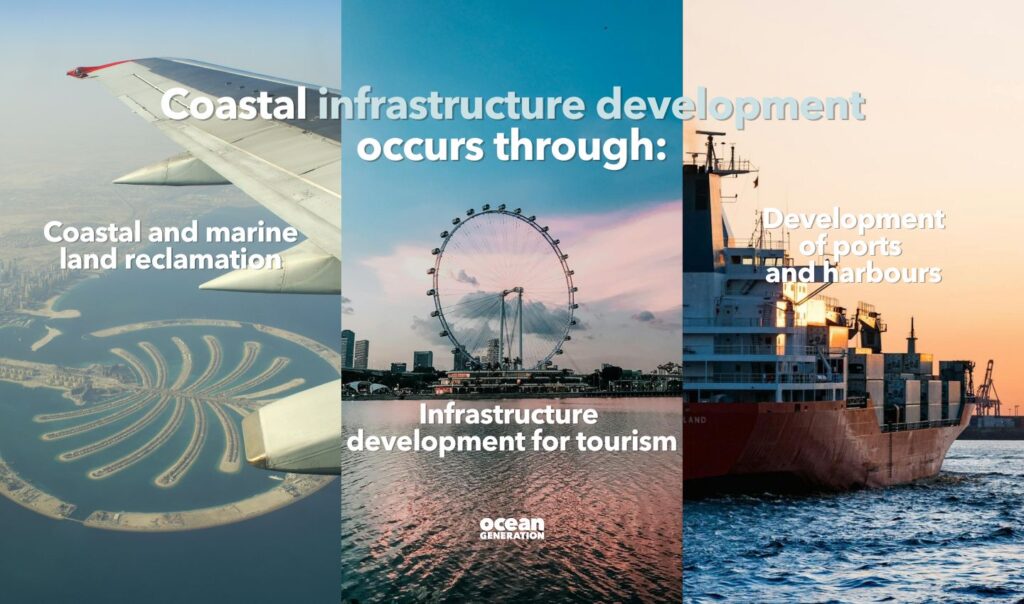
To supply the needs of this ever-growing population, coastal infrastructure development happens through:

  1. Coastal and marine land reclamation, the process by which parts of the Ocean are formed into land. 
  1. Infrastructure development for tourism, such as resorts and recreational facilities.  
  1. Development of ports, harbours, and their management.
Coastal infrastructure development, posted by Ocean Generation.

This is a key driver for habitat destruction (when a natural habitat can no longer support the species present) and biodiversity loss. It also increases the vulnerability of coastal communities to climate change impacts.

With higher frequencies of natural events like cyclones and hurricanes, risk of erosion, saltwater intrusion, flooding and other cascading climate change impacts, coastal regions have never been this vulnerable.

How can we protect and restore our coastlines? 

Enter: Nature Based Solutions (NBS). These are described by the IUCN as:

‘Actions to protect, sustainably use, manage and restore natural or modified ecosystems, which address societal challenges (such as climate change, food and water security) effectively and adaptively, while simultaneously providing human-wellbeing and biodiversity benefits.’ 

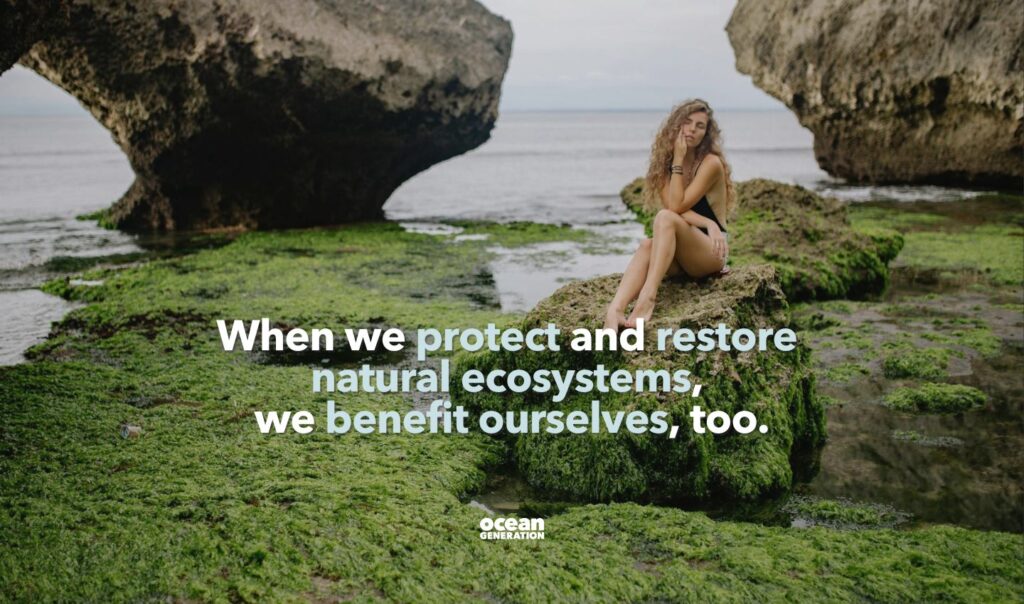
In other words, when we protect and restore natural ecosystems, we provide a whole host of benefits to ourselves, too.  

This can be done by restoring degraded ecosystems to their former glory and halting further loss of existing ecosystems.

When we restore natural habitats we protect ourselves too.

Ocean Solution: Habitat restoration.

Habitat restoration is the process of actively repairing and regenerating damaged ecosystems.

Restoring coastal ecosystems such as mangrove forests, coral reefs, oyster beds and seagrass meadows allow us to address environmental challenges (such as biodiversity loss). It reduces risks to vulnerable communities (like flooding, erosion, and freshwater supply). It also contributes to sustainable livelihoods by providing job opportunities.

That’s why at Ocean Generation, we support a mangrove restoration project in Madagascar, led by Eden Reforestation.

In 2022 alone, this project contributed to: 

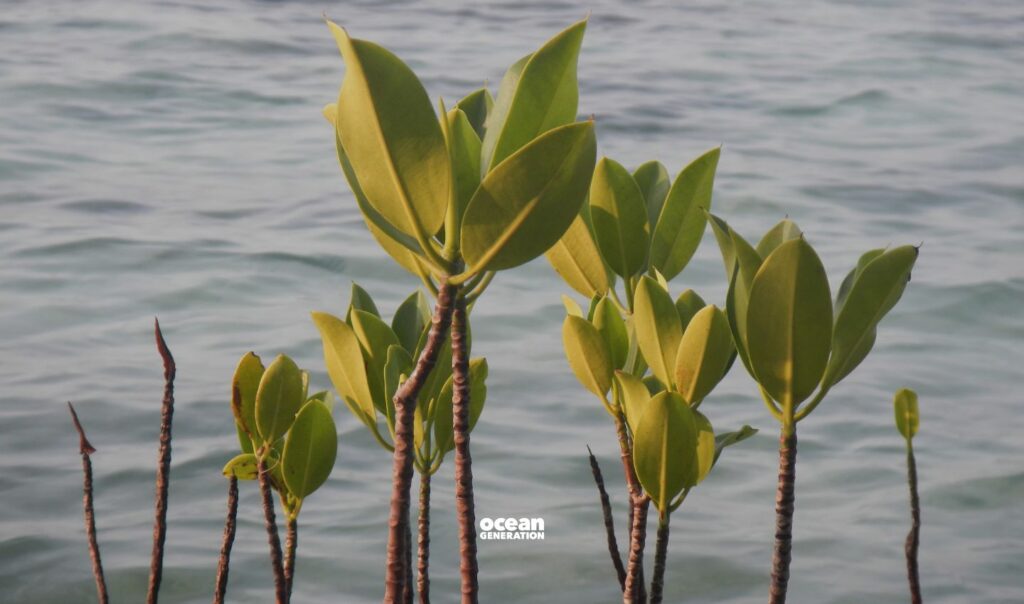
  • Carbon sequestration and habitat restoration by planting over 4.3 million young mangrove trees.  
  • Creating sustainable livelihoods by employing around 70 people per month at the Maroalika site, with a total of 1,468 working days generated over the year.  

PSA: We plant a mangrove for every new follower on Instagram and newsletter subscriber. Sign up to our newsletter or follow us on our socials to be part of the change today. 

Interest in nature based solutions have surged lately. Posted by Ocean Generation, leaders in Ocean education.

Ocean solution: Marine Protected Areas. 

To halt ecosystem destruction and prevent further habitat loss, we must take measures to protect remaining coastal ecosystems.

One mechanism to achieve this is by implementing Marine Protected Areas (MPAs). These are designated areas of the Ocean established with strict regulations to protect habitats, species and essential processes within them.

If implemented and monitored effectively, Marine Protected Areas can provide a range of benefits across biodiversity conservation, food provisioning and carbon storage

What is the 30 by 30 target? 

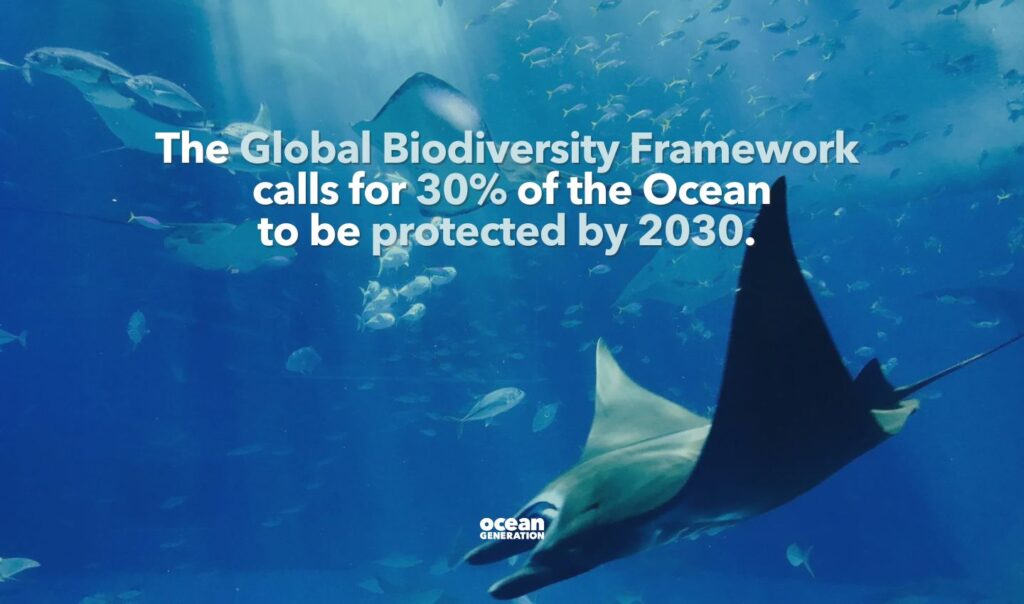
In recognition of the importance of healthy and thriving ecosystems, the Global Biodiversity Framework have established a “30×30” target. This calls for the conservation of 30% of the earth’s land and sea through the establishment of protected areas by 2030.

The Global Biodiversity Framework calls for 30 percent of the sea to be protected.

Spoiler alert: We’re not on track to meet this goal.

According to the Marine Protection Atlas (2024), only around 8% of the global Ocean area has been designated or proposed for MPAs, and only 2.9% of the Ocean is in fully or highly protected zones.  

Research also shows that 90% of the top 10% priority areas for biodiversity conservation are contained within coastal zones (within 200-miles of the shore). We must ramp up our efforts to preserve these vital coastal ecosystems and ensure that MPAs continue to benefit both people and planet.

What are the main challenges to implementation? 

Over the past 10 years, interest in the potential of Nature Based Solutions to help meet global climate change and biodiversity goals has surged, as we have begun to truly appreciate the importance of natural ecosystems.  

Despite this knowledge and an abundance of opportunities for implementation worldwide, marine and coastal regions still lack uptake.  

We must address the barriers to implementation to accelerate the rate of success of coastal protection worldwide, including (but not limited to):

  • Conflict of interest between stakeholders i.e. blocking of protective legislation by fishing and other extractive industries.  
  • Marine and coastal ecosystems are ‘out-of-sight, out-of-mind’. This results in a lack of public and policy awareness of their value. As a result, Nature Based Solutions are often overlooked in favour of grey infrastructure such as seawalls.  

Increasing our understanding of the vital services provided by coastal ecosystems is critical to overcoming these barriers. 

The more we appreciate what these incredible ecosystems do for us, the more likely we are to succeed in protecting and restoring our coastlines.  

Restoring coastal ecosystems help address environmental challenges

Who are the orca outlaws sinking boats, and why are they?

Subscribe

Monthly: Impact in your inbox.

OceanGeneration-Join

How deep is the Ocean? Explore fascinating creatures of the deep.

Explore how deep actually is our Ocean, and what fascinating creatures live in it.

Long regarded as an empty, desert-like environment with conditions too extreme for life to survive, the deep sea was historically considered insignificant.

However, our outlook on the deep-sea shifted when the HMS Challenger set off to circumnavigate the globe in 1872. It uncovered a diversity of deep-sea life previously thought impossible, and we’ve been making new and exciting discoveries ever since.  

And we’re not finished yet.

According to Ocean Census, we’ve only discovered 10% of Ocean life. It’s estimated that 1-2 million marine species remain undiscovered.

What’s more, a staggering 50% of the Earth’s surface is deep-seafloor below 3,000m. 

The deep sea was historically considered insignificant, until we discovered a diversity of life.

We’re constantly finding pieces of the puzzle to improve our understanding of this vast and complex world. From new underwater mountain ranges to previously undescribed species of deep-sea octopus, almost every deep-sea exploration mission yields mind-blowing new discoveries.  

When we consider the scale of the deep sea, we realise that it’s not an unusual habitat at all. In fact, it’s the norm for much of our blue planet, and it’s our land-based habitats that are comparatively rare.

So, how deep is the Ocean?

Let’s dive into the deep Ocean and explore this weird and wonderful world. 

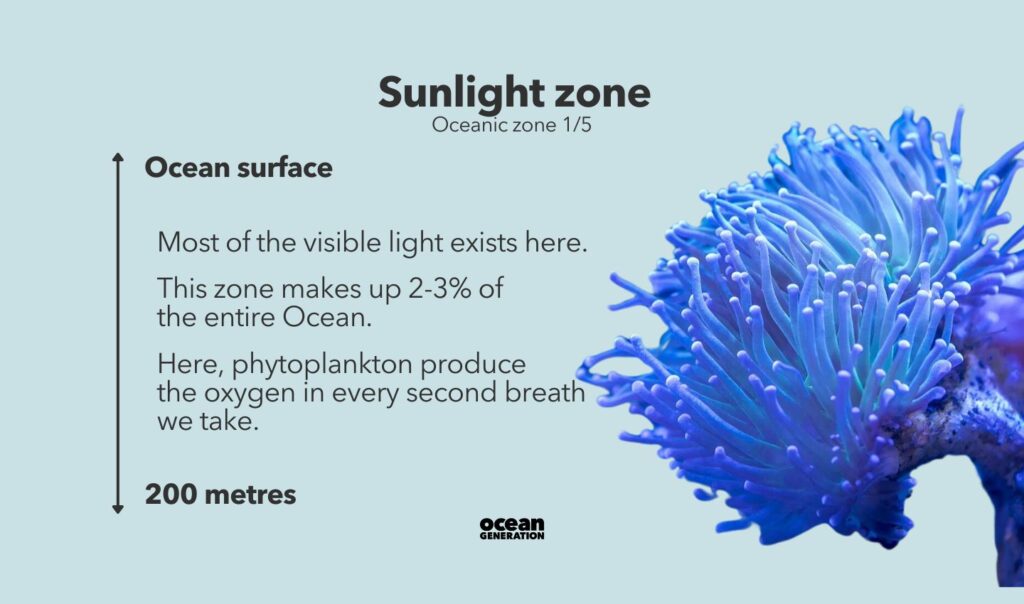
Sunlight zone

We begin our voyage at the surface, in the sunlight zone. This Ocean surface layer extends from 0 – 200m (656 feet) and is where most of the visible light exists.

There’s enough sunlight here for photosynthesis, which forms the basis of the food chain. 

Despite only making up 2-3% of the entire Ocean, the oxygen in every other breath we take is produced in the sunlight zone by photosynthetic plankton (phytoplankton).   

The sunlight zone has the most-visible light in our Ocean. Posted by Ocean Generation, leaders of Ocean education.

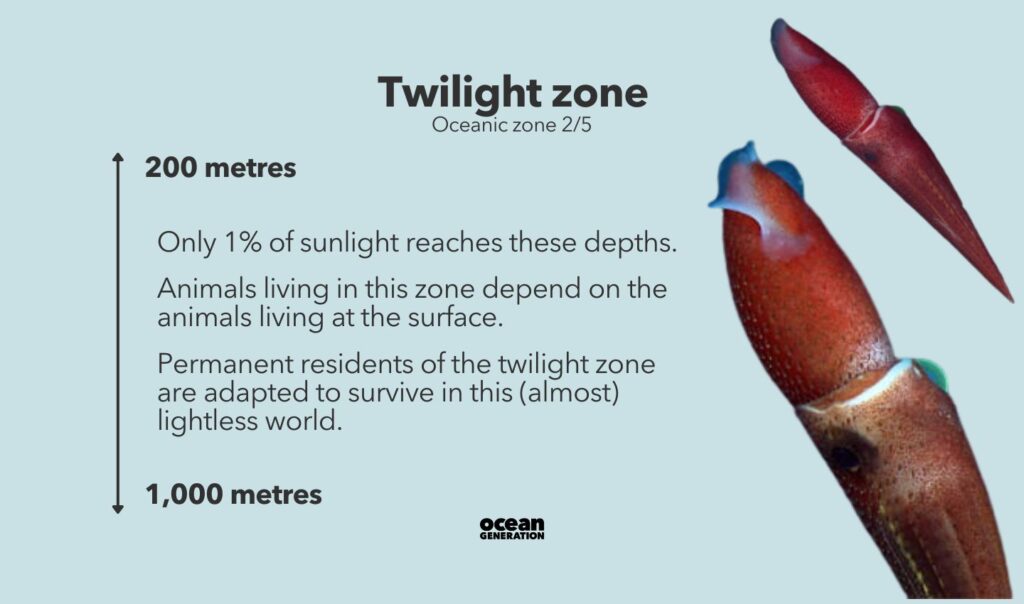
Twilight (Mesopelagic) zone

As we descend below 200m, we enter the twilight zone. Only 1% of sunlight reaches these depths, so light is very faint.

Want to see how light disappears as you dive into the Ocean? Watch this. 

Due to the lack of sunlight, there are no primary producers (organisms that get their energy from sunlight or other non-living sources). Animals that inhabit this zone depend entirely on those living at the surface.

Some scavenge on organic waste material that rains down from above, providing a vital source of nutrition. This “marine snow” largely consists of decaying matter from dead organisms, faecal matter, detritus and other inorganic particles. 

Only 1 percent of sunlight reaches the Twilight zone in the deep Ocean.
Image credit: Monterey Bay Aquarium Research Institute

Other marine life undertake a daily mass-migration to and from the deep known as diel vertical migration.

Like commuters making their way into the city, trillions of tiny deep-sea creatures ascend to more abundant waters during the night to feed. They then descend back to the deep Ocean during daylight hours to avoid predators and UV radiation.

This daily surface-to-deep commute is the largest daily migration of life on Earth, and is mostly carried out by zooplankton, krill, and other small amphipods (crustaceans). 

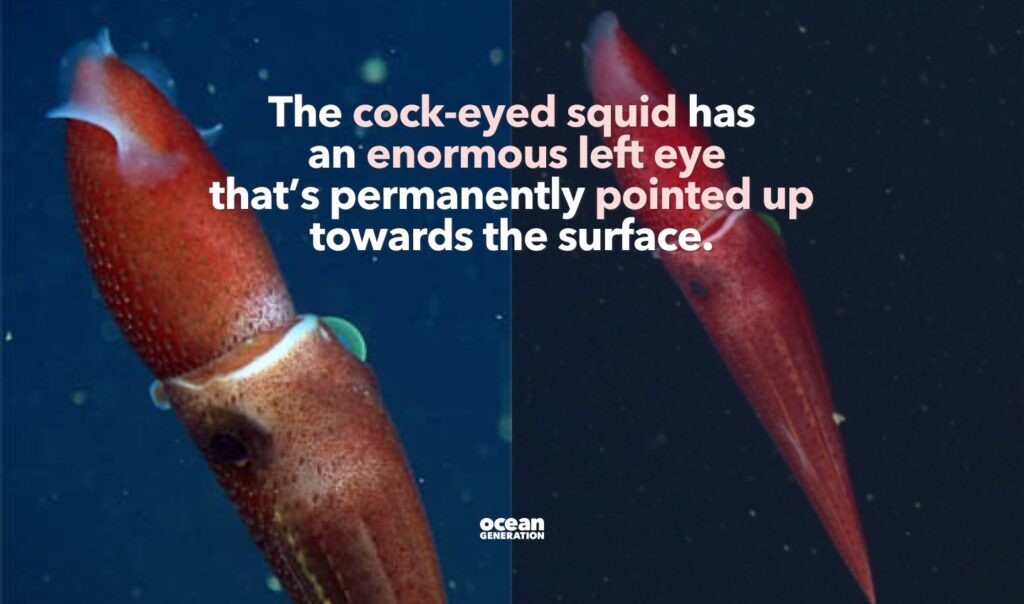
Permanent residents of the twilight zone are adapted to survive in this (almost) lightless world. One of the most notable features are their eyes.  

For example, the cock-eyed squid live between 200-1,000m. These lobsided creatures have an enormous left eye that’s permanently pointed up towards the surface, allowing them to spot the silhouettes of prey against the light from above. 

The cock-eyed squid have an enormous eye that's permanently pointed towards the surface.
Image credit: Monterey Bay Aquarium Research Institute

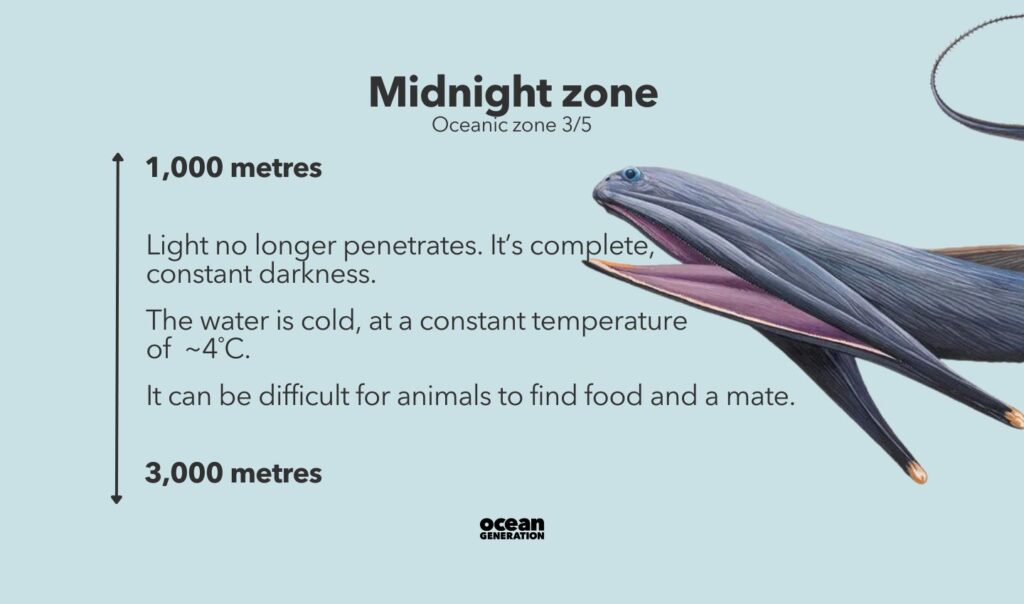
Midnight (Bathypelagic) zone

At 1000m (3,280 feet), light no longer penetrates, and we’re left in complete, constant darkness.

We have now entered the Ocean’s midnight zone.

It’s cold down here, at a constant temperature of around 4˚C, and the only light comes from the bioluminescence of animals themselves.

In this vast, lightless world, it can be difficult for animals to find food and a mate.

Light no longer penetrates the Midnight zone.
Image credit: BBC Science Focus

Some extraordinary species have adapted to overcome these challenges in astonishing ways.   

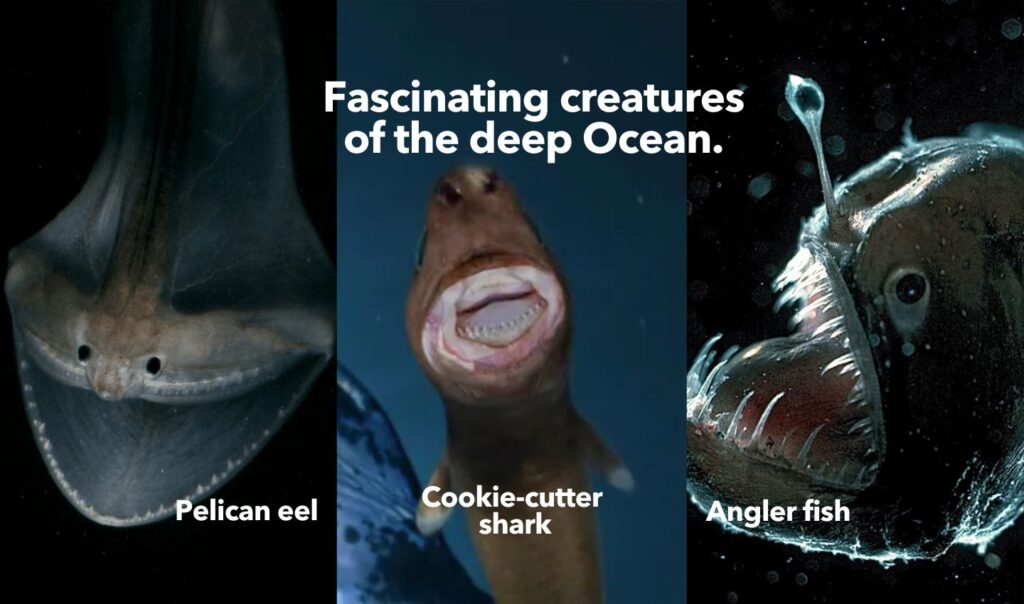
1. Pelican eels have an enormous jaw relative to their body size.  

This can unfold to engulf prey much larger than the eel itself, allowing them to bypass the size-based food web structure (individuals generally only consuming food smaller than their own body size) that usually exists in surface waters. 

2. Cookie-cutter sharks have special suction-cup-like lips and bandsaw-like teeth.  

Their specialised jaw allows this parasitic attacker to attach to much larger animals and gouge out a round chunk of flesh (yes, like a cookie-cutter).  

3. Finding a mate can be equally as challenging: This is how angler fish have adapted. 

Female deep-sea angler fish are famous for their bioluminescent fishing-rod-like lure which extends out from the top of their heads (think *Finding Nemo*). Male variants, however, are much smaller in comparison.

These “dwarf males” spend their lives scouring the darkness in search of a female counterpart. When he finds her, the male latches on to the female with sharp teeth.

This attachment is followed by fusion of the epidermal (skin) tissues, and eventually his circulatory system fuses with hers. He becomes a permanent appendage to her body, in a process known as sexual parasitism.  

A female angler fish can have multiple males attached to her at any one time. 

Meet fascinating creatures of the deep Ocean: pelican eel, cookie-cutter-shark and angler fish.
Image credit: Pelican eel: Breathing Planet, Cookie cutter shark: Pally/Alamy Stock Photo, Angler fish: Monterey Bay Aquarium

Abyssal (Abyssopelagic) zone

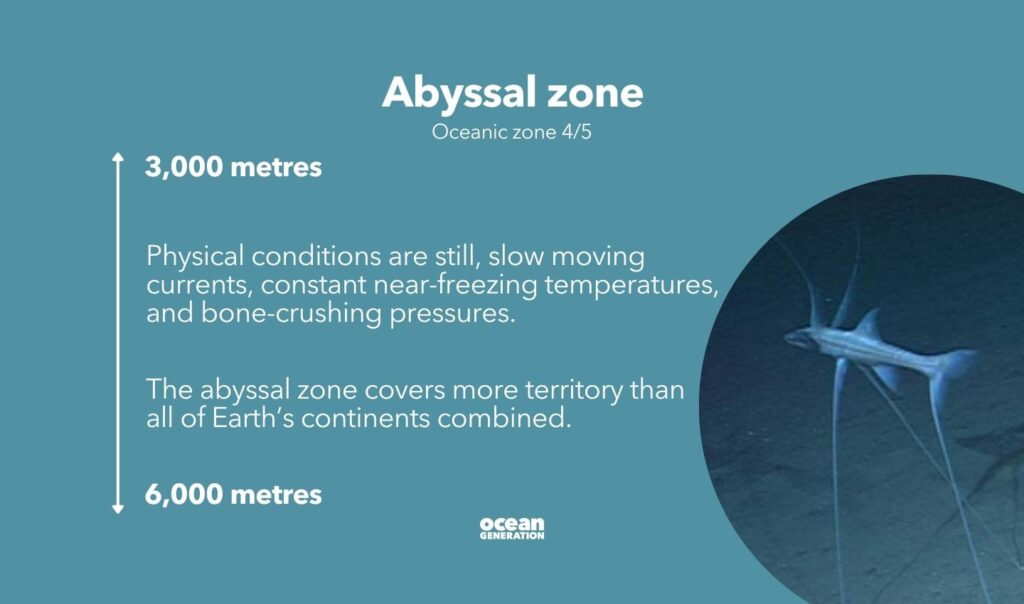
As we descend below 3,000m (9,843 feet) in the Ocean, we reach the pitch-black bottom layer known as the Abyssal zone. Physical conditions down here are still, with slow moving currents, constant near-freezing temperatures, and bone-crushing pressures. 

Time seems to stand still. There’s no primary production and most organisms depend almost entirely on the marine snow that slowly rains down from above. 

Physical conditions are still in the abyssal zone.
Image credit: Monterey Bay Aquarium Research Institute

But it’s far from being a lifeless desert: The abyssal zone stretches across wide plains, towering seamounts and hydrothermal vent systems, covering more territory than all of Earth’s continents combined. 

Inhabitants of the abyss move and grow very slowly to minimise energy needs. 

Some individuals have specific adaptations to maximise their chances of survival. Tripod fish have modified pelvic and lower caudal fins which can extend up to a metre.  

This allows the fish to stand on stilts above the seafloor, so that it’s perfectly positioned to eat any small fish or crustacean that come travelling along the currents.  

The slow-growing nature of these abyssal ecosystems means that they take a long-time to recover from any disturbance events (if ever). Consequences of overfishing and proposed deep-sea mining of the abyssal zone will therefore cause devastating, irreversible losses to habitats and biodiversity. 

The slow-growing nature 
of the abyssal ecosystems means that they take 
a long-time to recover

The Trenches (Hadalpelagic zone)

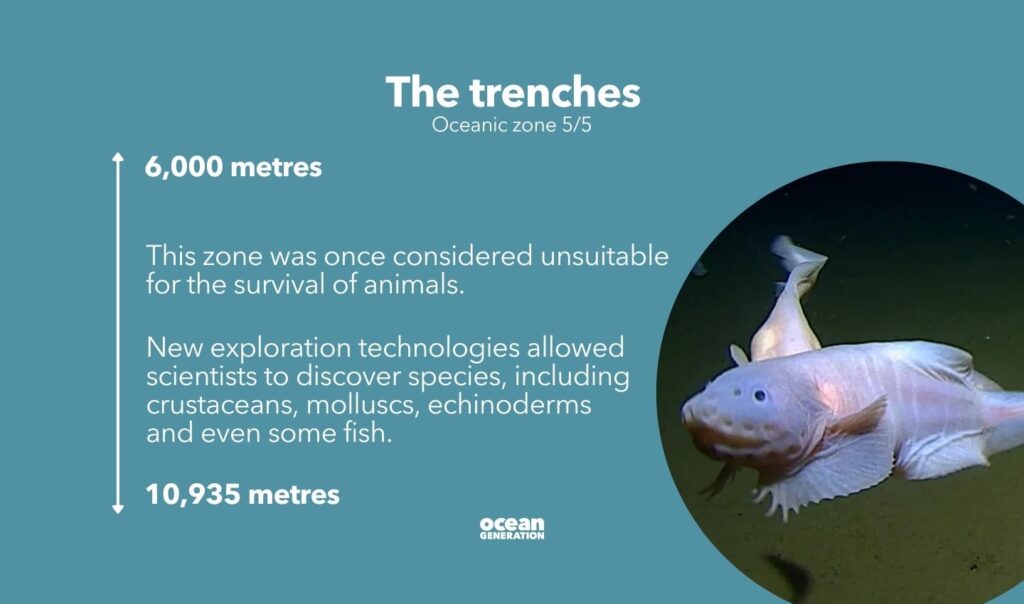
We continue our journey below 6,000m (19,685 feet) to enter the trenches (hadal zone): The deepest part of the Ocean.  

The hadal zone was once considered unsuitable for the survival of animals. However, the rapid development of exploration technologies has allowed scientists to discover species belonging to many of different taxonomic groups at these depths, including crustaceans, molluscs, and echinoderms. 

The Pseudoliparis snailfish is the deepest known fish. It was discovered close to the very limit of survival for all fish in August 2022 at 8,336m (27,349 feet).  

Its adaptations include a flexible skeleton to tolerate extreme pressure, a gelatinous coating to improve energy efficiency, and a large stomach for opportunistic feeding.  

The hadal zone was once considered unsuitable for the survival of animals. Posted by Ocean Generation, leaders in Ocean education.
Image credit: The Guardian

We continue down to surpass the inverted height of Mount Everest at 8,849m. A further two kilometres on, we reach the bottom of the Mariana Trench and the deepest known point in the Ocean (and Earth):  

The Challenger Deep – 10,935m (35,876 feet)

The weight of all the water overhead here is over 8,000 kg per square inch. That’s roughly 1,000 times the pressure at the surface, and equivalent to 1,800 elephants on top of you! 

In 1960, Don Walsh and Jacques Piccard made history by becoming the first people to reach the bottom of the Challenger Deep in the manned submersible Trieste. This record was broken on 26th March 2012 when James Cameron made the first ever solo dive to the Challenger Deep in the Deepsea Challenger.

To this day, reaching the deepest known part of the Ocean remains a challenge for any explorer, and every expedition yields new discoveries as well as other, more ominous findings. 

During the Fendouzhe deep-sea expedition in 2020, researchers discovered plastic bags, electric wire, a beer can and fibre-optic tethers among other forms of plastic pollution in the Challenger Deep.  

This shows that even the most remote, hard-to-reach place on Earth is still not safe from human impacts. 

We can’t treat the deep-sea as out of sight and out of mind. More work needs to be done to safeguard these precious ecosystems and ensure that life in the deep doesn’t disappear before we even have the chance to understand it.  

Every expedition to the deepest part of the Ocean yields new discoveries.

Who are the orca outlaws sinking boats, and why are they?

Subscribe

Monthly: Impact in your inbox.

OceanGeneration-Join

Why there’s no health without the Ocean.

A healthy Ocean is our greatest ally against climate change.

Our health depends on the Ocean.  

This statement is true, of course, but it’s very easy to become desensitised to this idea when it all seems so abstract. 

In this modern world, it’s easy to overlook the fundamental basis of our survival that we often take for granted.

It can be hard to directly link our everyday lives and habits to the Ocean, especially for those of us who don’t live anywhere near the coast, and don’t interact with the sea on a regular basis. 

This can leave many of us feeling disconnected and disengaged from Ocean action. 

A quote saying "Our health depends on the Ocean" in a science article discussing why a healthy Ocean is key to our survival.

But let’s dive deeper into this statement to find out what a healthy Ocean really means to us (humanity), and why we should must care.

A healthy Ocean is key to our survival 

In fact, the Ocean provides all the fundamental resources that we need to survive:

1. Air: The oxygen in every second breath we take comes from the Ocean.

It’s also believed that tiny, single-celled algae called Cyanobacteria provided the atmospheric conditions suitable for our very existence around 2.4 billion years ago.  (That’s referred to as the Great Oxidation Event.)  

2. Water: All water on the planet is connected by a system known as the hydrological cycle.

Water evaporates from the Ocean’s surface to form clouds, which provide us with the fresh water that we use to drink, shower, and cook with.  

It’s all connected via rivers, streams, and groundwater tables.

Even the water that makes up 60% of your own body was part of the Ocean at some point. 

Our Ocean provides air, water, food and shelter for our survival.

3. Food: Seafood provides a primary source of protein for over 3.3 billion people.

That’s over 40% of the global population (8.1 billion in 2023). The Ocean also drives the rain systems and climate patterns which help our crops to grow.

So even if you don’t eat fish, the Ocean still indirectly provides the food that you eat.

4. Shelter: The Ocean has been present during every element of our evolutionary history as human beings and continues to shape the way our society functions. 

River basins, where land meets the sea, represent the earliest relationship between human society and nature. These areas of fertile plain fields, rich soil and abundant water resources allowed for the very first human civilisations to thrive.  

Over time, the development of ports also provided a gateway of connectivity and transportation between societies.  

This relationship continues today.  

As of 2020, almost 1 billion people live within 10km of the coastline, and more than one third of the world’s population (2.75 billion people) live within 100km from the coast. 

What’s more, over 3 billion people depend on the Ocean as a primary source of income, the majority of these from Ocean-based industries such as fisheries and tourism in developing countries. 

Why healthy people need a healthy Ocean: explained by Ocean generation, leaders in Ocean literacy.

Healthy people need a healthy Ocean 

The Ocean contains a vast biodiversity of life, with over 250,000 known species and many more (at least two thirds) yet to be discovered.  

Each life form has a unique method of adaptation against disease and pathogens. We’re constantly learning from this strange and alien world to apply these mechanisms to our own needs.  

We depend on this marine biodiversity to develop modern medicines. In fact, between 1981-2008, around 64% of all drugs used to fight infection, and 63% of anti-cancer drugs were derived from natural sources.  

For example, the Horseshoe Crab is commonly referred to as a “living fossil” and has survived almost unchanged for around 200 million years. Its blue blood contains special cells called “granular amoebocytes” which can detect and clot around even the tiniest presence of toxic bacteria.  

Humans harness the special property of this blood to test whether the drugs and vaccines that we produce are free from contamination.

A healthy Ocean is our greatest ally against climate change.

A healthy Ocean is our greatest ally against climate change. 

A healthy Ocean stabilises our entire planetary system and acts as a buffer against the worsening impacts of climate change.  

It regulates global air temperatures by absorbing 26% of total CO2 emissions and storing over 90% of the excess heat from the atmosphere.  

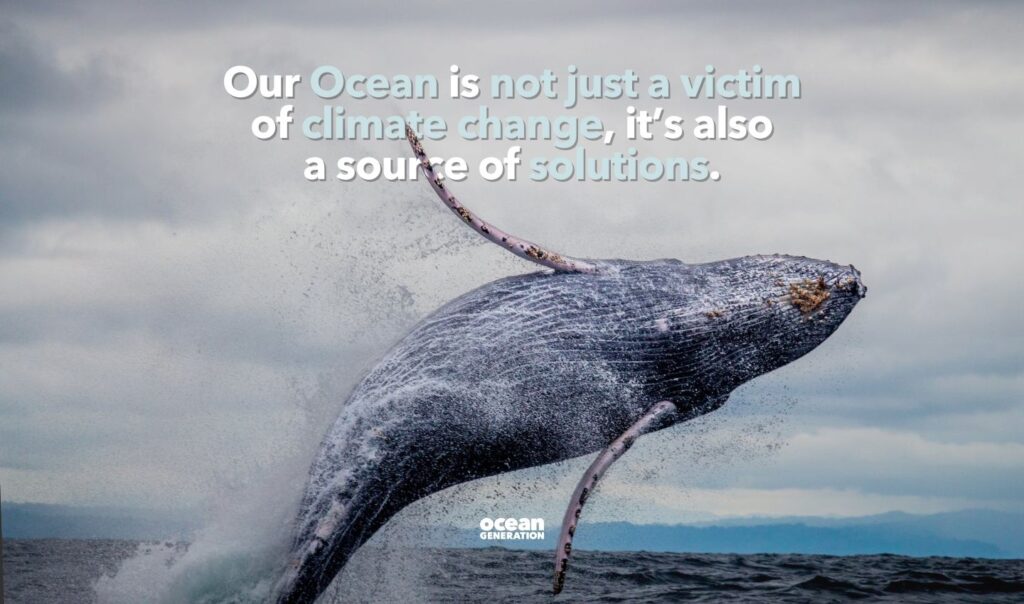
But the Ocean is not just a victim of climate change, it’s also a source of solutions.

Our Ocean provides all the fundamental resources that we need to survive. Written by Ocean Generation.

Coastal “blue carbon” ecosystems, such as mangroves, tidal marshes and seagrass meadows remove and store carbon dioxide from the atmosphere. These ecosystems can lock away carbon in their soils at rates up to an order of magnitude faster than terrestrial forests.

Protecting and restoring these vital coastal ecosystems offers us a chance to ensure a sustainable future for people and planet.  

If the Ocean thrives, so do we.  

So, next time you’re having a drink of water, catching your breath after exercising, or waiting at the doctor’s surgery for some medicine, take a moment to stop and thank the Ocean for providing the fundamentals to make all this possible. 

Our Ocean is not just a victim of climate change, it's a source of solutions.

Who are the orca outlaws sinking boats, and why are they?

Subscribe

Monthly: Impact in your inbox.

OceanGeneration-Join

Why is the Ocean so important?

Ocean wave crashing on a rock. Shared by Ocean Generation in an article about why the Ocean is important.

Introducing the Ocean: Our most precious, life-giving, climateregulating, yet recklessly exploited, undervalued, and underfunded resource.  

Covering over 70% of our blue planet and holding roughly 97% of the world’s water, the Ocean provides the foundation for all living things. From the smallest plankton to the largest animal to have ever lived (the blue whale). And that’s just the beginning of why the Ocean is important.

Energy is cycled across its single, interconnected system; keeping everything in balance. It allows all life to exist together in harmony. 

The Ocean makes up over 90% of all habitable space on Earth.  

Just think about that. All the rainforests, grasslands, mountain ranges and deserts combined with every town, city and village of human civilisation make up less than 10% of the liveable space on our planet.  

Everything else is Ocean.  

The Ocean exists on a scale beyond our understanding. ocean facts shared by Ocean Generation: Experts in Ocean health.

An Ocean which is home to the world’s largest mountain range (the Mid Ocean Ridge is over seven times longer than the Andes).

And the world’s deepest canyon. (Challenger Deep is six times deeper than the Grand Canyon and could easily swallow Mount Everest.) 

This vast, interconnected body of water exists on a scale so large that it’s almost beyond the realm of our understanding. 

But we need to understand why the Ocean is important.  

The Ocean defines our planet and provides the very foundation of our existence 

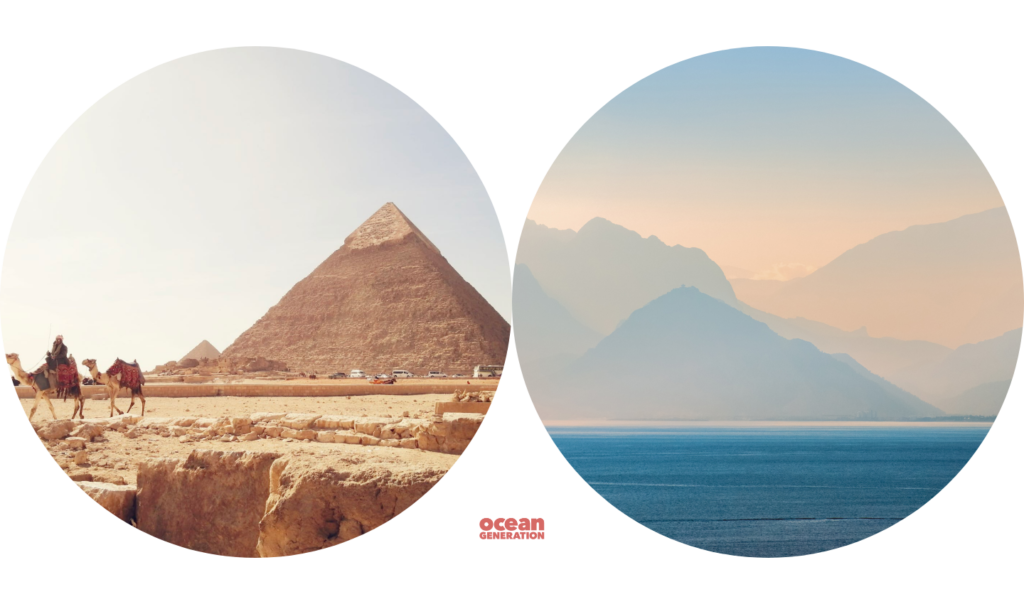
If it could talk, the Ocean would be able to tell us all about the dinosaurs, the ice age, and how Stonehenge or Egypt’s pyramids were really built. The Ocean watched as the earliest Homo Sapiens (that’s us) took our first footsteps. It may even hold the secrets to the very beginning of life on Earth.  

Two circle images beside each other: One of the pyramids in Egypt and another of a calm Ocean scene. Ocean Generation is sharing why the Ocean is so important in this article.

To look back at the history of the Ocean is to look back at the history of life itself.  

For millions of years, the Ocean has provided the conditions required for the evolution of all living things. The Ocean burst into life during the Cambrian explosion (the *relatively* sudden radiation and divergence of complex life forms) around 538.8 million years ago and has seen all five mass extinction events since. 

Make that six.  

At this very moment, we are living through the sixth mass extinction event. Research shows that species are now going extinct between 100 and 1,000 times faster than natural, background extinction rates.  

The delicate balance of life which has been slowly ticking along for millions of years has taken decades to unravel.  

According to the IUCN Red List, over 44,000 assessed species are threatened with extinction.  

It’s almost impossible to comprehend that we are hurtling towards destruction on a scale comparable to that caused by a colossal asteroid collision 66 million years ago. (That, the last mass extinction event, wiped out the dinosaurs).   

Except this time, humanity are both the asteroid and the dinosaurs.  

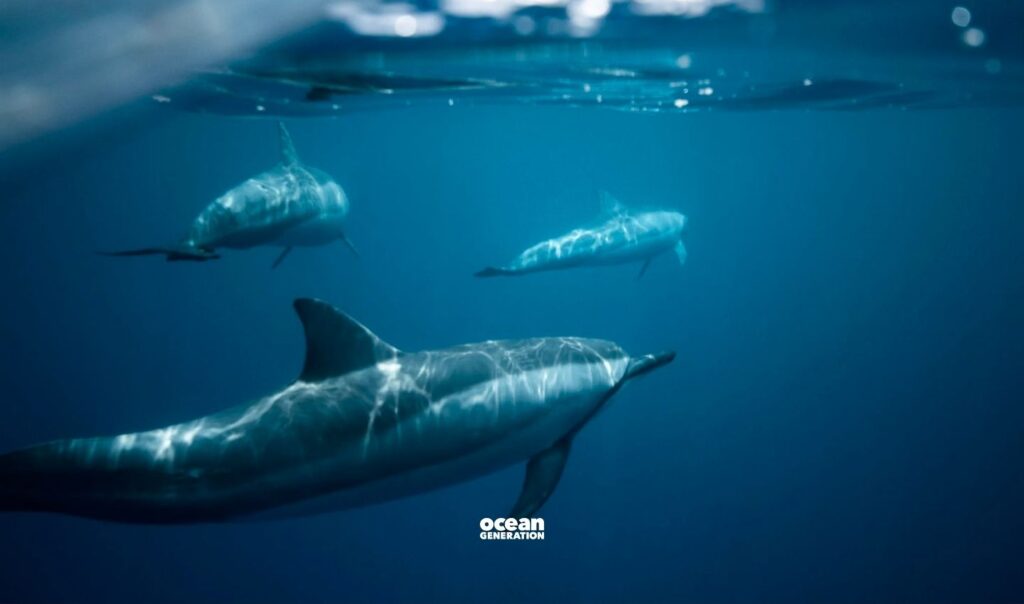
A pod of dolphins swimming in the Ocean shared by Ocean Generation.


Is the Ocean too vast to feel our impact?  

People used to think the Ocean existed on such an infinite, untouchable scale that nothing we, people, could do would affect its limitless bounty.  

“Man marks the earth with ruin – his control stops with the shore…”

– Lord Byron, Nineteenth Century.
Sunset image of the Ocean and a pink sky. Shared by Ocean Generation the global charity providing Ocean education to everyone, everywhere.

We now know that this is wrong.  

Throughout the last decades, our Ocean has been heating up. It’s becoming more acidic, choking in plastic, drained of its fish stocks, and pumped with toxic chemicals at a rate far beyond which it can sustain.  

We have borne witness to record breaking temperatures, mass coral-bleaching and glacial melting events. Now, we are hurtling towards a ‘new normal’ in which instability and volatility are centre stage. 

We have been recklessly exploiting our Ocean system.  

We have watched as records are broken time and time again.  

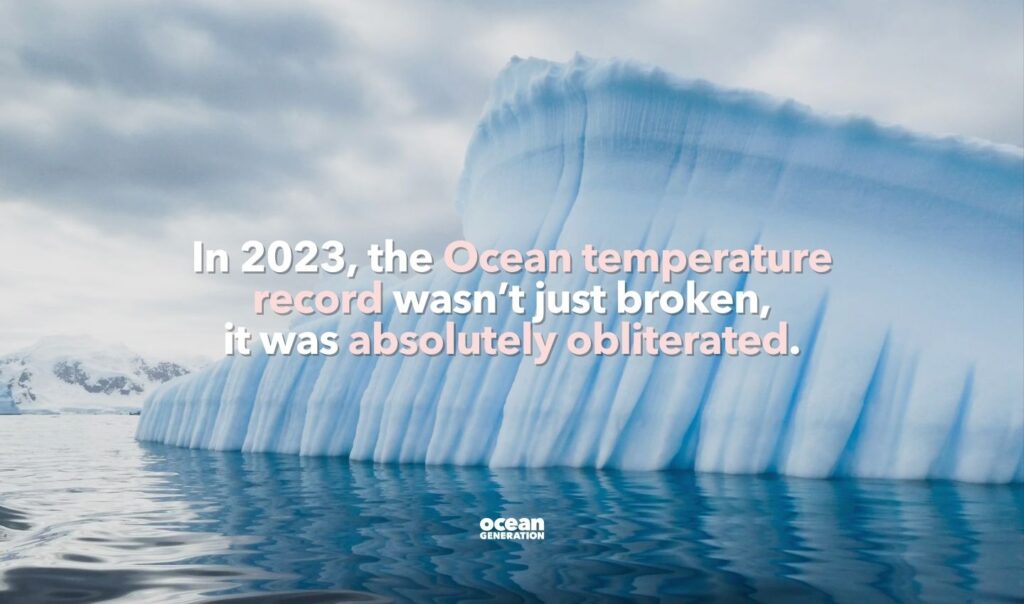
But in 2023, the Ocean temperature record wasn’t just broken, it was absolutely obliterated. 

In fact, the entire upper 2000m of the Ocean experienced shatteringly high temperatures. As this surface layer heats up, it’s less able to mix with deep water below. As a result, surface oxygen content has decreased.  

Image of a glacier in the Ocean with the quote: In 2023, the Ocean temperature record wasn’t just broken, it was absolutely obliterated.

This isn’t only detrimental to marine ecosystems, but it also slows the Ocean’s life-saving ability to sequester (remove and store) atmospheric carbon dioxide.  

The global water cycle has also been amplified by our warming Ocean. For us on land, this means stronger, longer droughts as well as intensified rainfall, storm, and flooding events.  

Restoring the Ocean starts on land – with us.

Just like how people once thought the Ocean was too large to feel our impacts. Now, it may seem like our impacts are too large to solve. But we know this isn’t true.  

We have the technology, the knowledge, and the power to turn the tide and reverse our trajectory. 

We know this because we’re in many parts of the world, it’s already happening.  

Effectively managed Marine Protected Areas, Maximum Sustainable Yields (the maximum catch size that can be removed from a population to maintain a healthy and sustainable fish stock), and the rise in renewable energy technologies are all ways in which humanity has learned to collaborate more fairly with nature.  

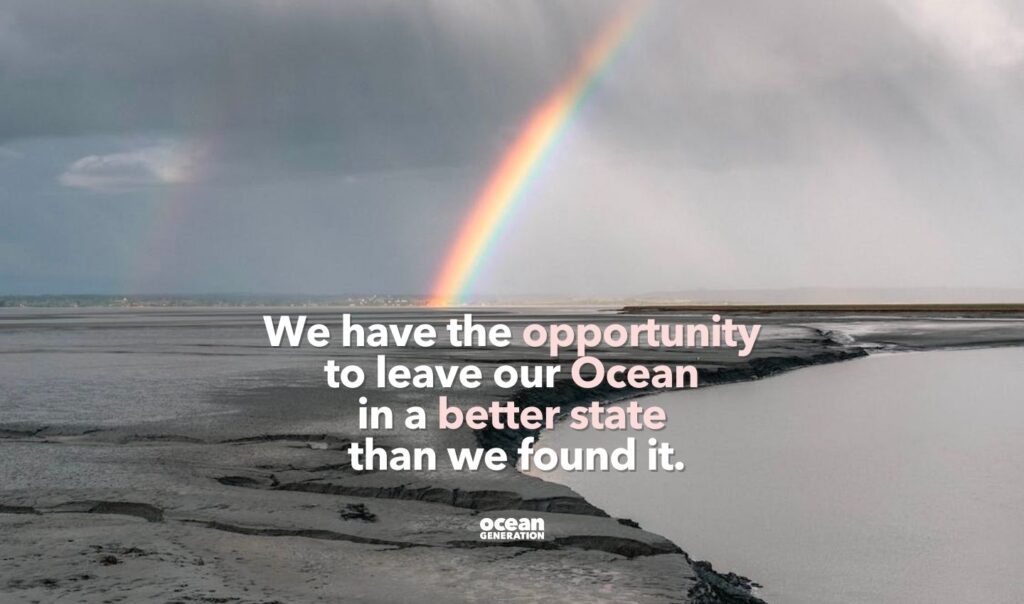
Rainbow over a beach and the Ocean with the quote: We have the opportunity to leave our Ocean in a better state than we found it. Shared by Ocean Generation, leaders in environmental education.

Working with the Ocean rather against it can reap limitless benefits for both people and planet. If the Ocean thrives, so do we.

This knowledge is power.  
Power to be part of the solution, to consider the cost of inaction and unite to ensure our Ocean’s health is considered in all decisions – personal, business, and government policies.  

We have a unique opportunity to be the first generation to leave our precious Ocean in a better state than we found it. 

Your actions may feel like a drop in the Ocean, but together we can make waves of change.  

Start by signing up to our newsletter and reading about 15 climate actions you can take to restore our Ocean. Learn more about why the Ocean is important by adding it to your scroll via your favourite social platform:

Who are the orca outlaws sinking boats, and why are they?

Subscribe

Monthly: Impact in your inbox.

OceanGeneration-Join

How to Be a More Conscious Consumer 

Asian woman surrounded by neutral coloured clothing, emphasising our overconsumption mentality. Ocean Generation is sharing 5 strategies to become a more conscious consumer in this article.

5 Tips to become a more conscious consumer.

Overconsumption is one of the hallmarks of modern societies. We are quite literally sold the idea that consumption will boost our happiness. Clever marketing campaigns and the media champion this ‘more is better’ lifestyle.  

It can be easy to be caught up in this world of overconsumption. It’s easy to forget the impacts that our consumption habits have on both people and the planet.

We’re sharing a brief overview of these impacts below. Take a deeper dive into the impact of both appliances and textiles as part of our “What we Purchase” series. 

Man in a simple t-shirt and jeans handing off a bag to an extended hand while reaching for a new bag that looks exactly the same. The image symbolises how we over-consume fast fashion. To protect the planet, we need to address our more is best mindset. Ocean Generation is sharing tips to be a more conscious consumer.

The products that we consume impact the environment throughout their lifespans. From the sheer volume of water used in textile production to the generation of vast amounts of e-waste.

Waste from discarded products not only contaminates the environment, but also puts human health at risk. 

Globally, there is uneven distribution of these environmental and societal impacts of product consumption. Most impacts are felt in developing countries which receive exports of discarded products. This is despite developed countries being the primary product consumers.  

We need to start taking responsibility for our overconsumption.   

What we purchase directly impacts the use of natural resources, production practices, and the quantity of waste accumulated.

So, making more sustainable decisions about what we purchase has the power to reduce not only greenhouse gas emissions, but also wider environmental impacts.    

How to be a more environmentally conscious consumer:    

We’re all taught in school to reuse, reduce and recycle but there’s much more we can do to tackle overconsumption.

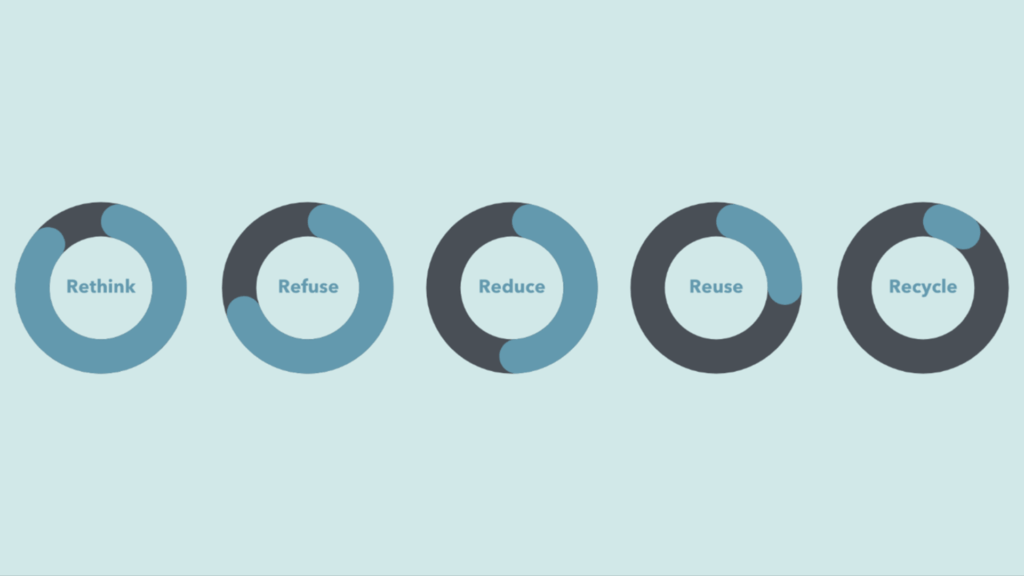
Our Plastic Intelligence Framework – which breaks down a hierarchy of actions; The 5 R’s: rethink, refuse, reduce, reuse, and recycle – can be used to guide consumer decision making around plastics

Ocean Generation has developed a Plastic Intelligence Framework that outlines the most impactful ways individuals can make a positive impact and curb their waste generation. The 5 most impactful ways we can address plastic pollution in order of positive impact are: Rethink, refuse, reduce, reuse and recycle.

The order of these actions is deliberate, with the most impactful change being to rethink, followed by refuse, reduce, reuse, and finally recycle.  

Utilising the 5R framework, we can also address broader sustainable consumption. How? What do these steps actually involve? Let’s start from the top.  

How to be a more environmentally conscious consumer:    

1. Rethink your relationship with products 

To do this, we need to remember that our ‘needs’ may differ from our ‘wants’. Have a think about what items you consider to be essential for your well-being and happiness.  

Advertising and media influence the perception what we ‘need’. It is our responsibility to acknowledge this and form our own opinions about what items are necessary in our lives.  

If you decide that you do really need an item, then that’s okay! The focus of rethinking is to slow down consumption. This is achieved by taking a moment to consider our relationship with items. 

2. Refuse to purchase unnecessary items.  

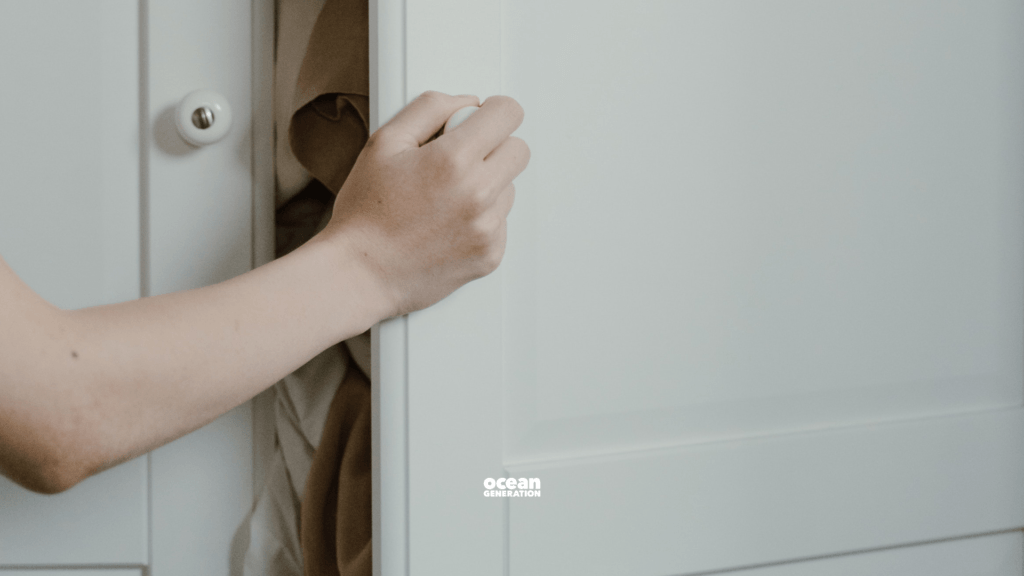
Female hand trying to force and over-full closet closed. The image symbolises our overconsumption habits when it comes to fashion and shopping.

Is an item of clothing part of a fast fashion trend, destined to be worn once then live at the back of your wardrobe until it is discarded?  

Do you really need multiple devices, or will one do the job? 

Refusing to purchase unnecessary items minimises waste produced.  

3. Reduce your overall consumption. 

If you find yourself needing to buy something, then where possible, opt for quality over quantity.  

If a product is low-quality, it is likely to be less durable and have a shorter useful lifespan. Question if you need the low-quality item. Can you wait until you have the resources to buy a better-quality product; built to last longer?

The result? Less waste. 

4. Reuse products to extend their lifespan.  

Reuse can take many forms.  

In the world of textiles, renting, remaking, repairing, and reselling are all part of the transition to ‘slow’ fashion. Online resale and rental platforms are becoming increasingly popular, along with second-hand shops and upcycled items.  

Explore repairing your damaged items before discarding them. It is never too late to learn how to sew a button. For more complex repairs, such as of household appliances, try checking out a local repair workshop.  

Before buying new appliances, consider refurbished items (products that are repaired/restored to working condition) or remanufactured items (used products that get dismantled, their worn parts replaced, and reassembled to like-new condition).  

Ultimately, reusing items decreases demand for resource extraction and minimises waste. 

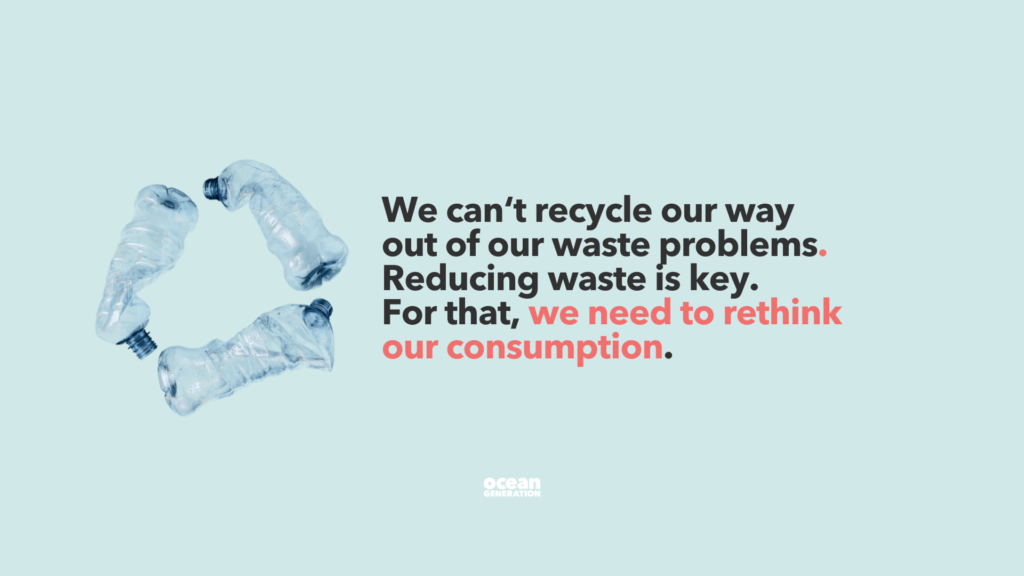
We can't recycle our way out of our waste problems. Reducing waste - at its source - is key. To achieve that, we need to rethink our consumer behaviour.

5. Recycle at designated points.  

Remember that while the rethinking, refusing, reducing, and reusing are more impactful, recycling is still a valuable process. This is because again it reduces the amount of waste generated.  

If an item is truly at the end of its lifespan, recycle it at a designated recycling point.  

We don’t have to be perfectly zero-waste or plastic-free consumers to make a positive difference   

However, what we all must do is start making changes. Here are 20 ways to address your daily plastic waste on a daily basis to get you started.


Who are the orca outlaws sinking boats, and why are they?

Subscribe

Monthly: Impact in your inbox.

OceanGeneration-Join

10 Ocean actions from the Ocean Generation team

Hand cupping water presumably from the Ocean.

Every decision we make has an environmental impact

This means everyone can do something (or more than one something) to make our planet a bluer, healthier place to call home.

Our Ocean plays a critical role in regulating the climate and absorbing carbon emissions – most notably, through blue carbon ecosystems. So, taking Ocean action is in the best interest of all life on Earth.

Ocean action is climate action.

We asked the team at Ocean Generation – from those in our science team; to our founder, Jo Ruxton MBE; to those who manage our youth engagement programmes – to share the ways they take Ocean and climate action each day.

10 daily actions our team of Ocean lovers takes to protect the Ocean:

1) Omit unnecessary car travel

10 ways you can take action to fight climate change. Tip: Omit unnecessary car travel.

2) Don’t pour cooking oil down the drain

Ocean health tip from Ocean generation: Don't pour cooking oil down the drain.

3) The best way to take Ocean action? Educate your inner circle about how important our Ocean is.

10 ways you can protect the Ocean shared by the Ocean Generation team. Tip: Educate the people around you about the importance of the Ocean.

Wondering where to start?
Incredible Ocean facts for you:

4) Shop second-hand

Sustainable living tip: Shop second hand and rethink your relationship with fast fashion.

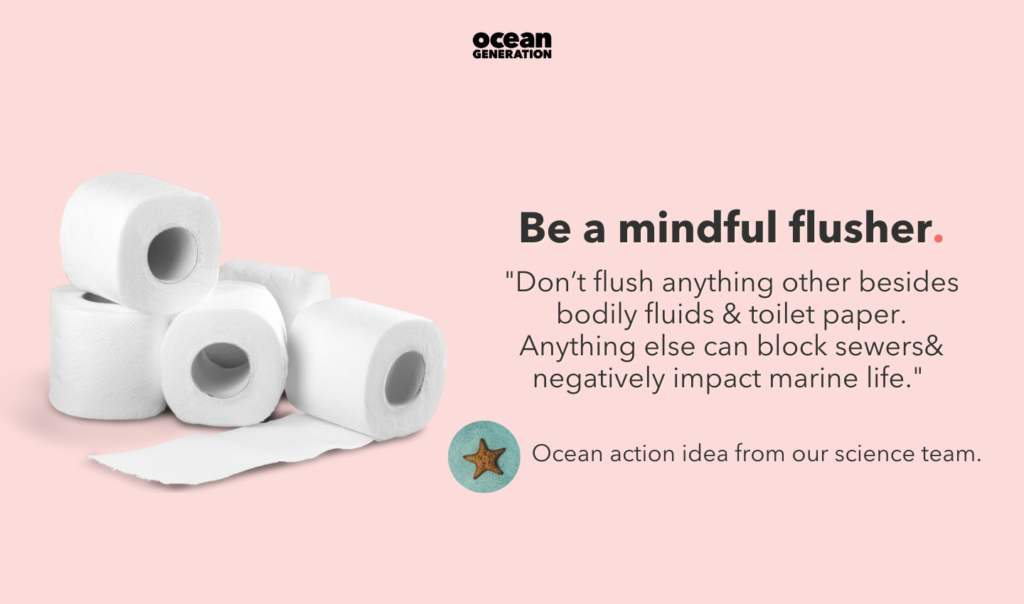
5) Be a mindful toilet flusher

Ocean action tip: Don't flush anything down the drain besides toilet paper and bodily fluids. What goes down the drain ends up in the Ocean.

6) Share what you love about the Ocean with others

You can connect with the Ocean by visiting it in person or using digital means to explore the depths under the sea.

Fun fact: 2.5 billion people live within 100km of the coast. But, of course, not everyone can take a dip in the Ocean every day.

What you can do from afar is go on a virtual Oceanic expedition. Dive into Ocean ecosystems across the world on Google.

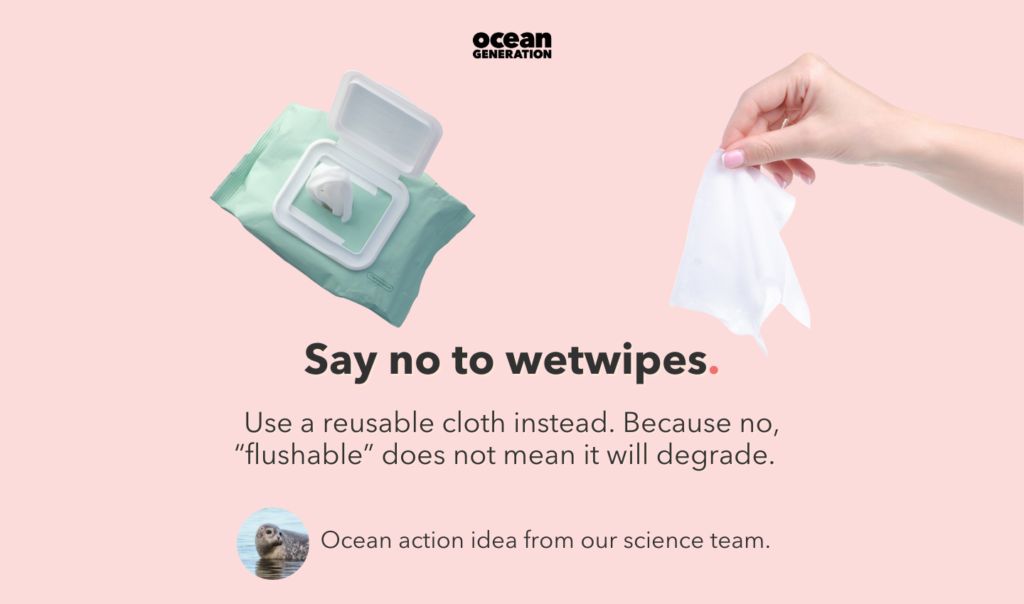
7) Say no to wet-wipes

Ocean protection tip: Say no to wet wipes. They don't degrade!

8) Integrate environmentalism into your career

10 ways you can fight climate change shared by the Ocean Generation team. Tip: Integrate environmentalism into your career and start talking about climate at work.

Easy ways to incorporate environmentalism into your work-life:

  • Bring the Ocean’s health and welfare of the planet into conversation.
  • Can you promote a paperless office?
  • How about suggesting old devices get recycled instead of tossed?
  • Try suggesting the use glasses instead of styrofoam cups at your next meeting or conference.
  • Send e-cards during the festive season and for birthdays – you can even donate the price of a paper card to a cause you care about.

9) Make these easy plastic swaps – and then swear off unnecessary plastic items forever.

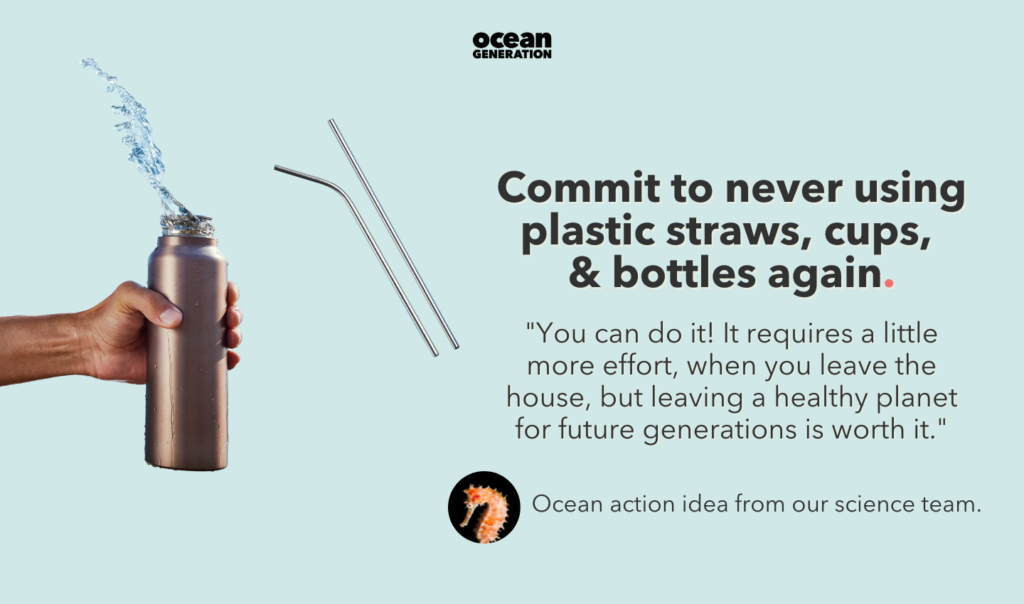
Protect the Ocean by committing to never using a plastic straw, bottle or cup again. There are so many eco-alternatives out there.

At Ocean Generation, we promote an inclusive approach to sustainability. We recognise that zero-waste, plastic-free, vegan, and zero-carbon lifestyles don’t work for everyone – and that’s okay. The world needs all of us to do what we can, within our means.

But in saying that, it’s also important to recognise that too many of us still use single-use plastics too easily. When did you last purchase a plastic bottle, a take-out coffee mug or use a single-use plastic straw?

Most single-use plastic items are unnecessary. There are (excuse the pun) an Ocean of eco-alternatives available.

It’s time to break up with unnecessary plastic. Identify what unnecessary single-use plastic you use. ✅ Make the switch to eco-alternatives. ✅ Commit to never going back. ✅

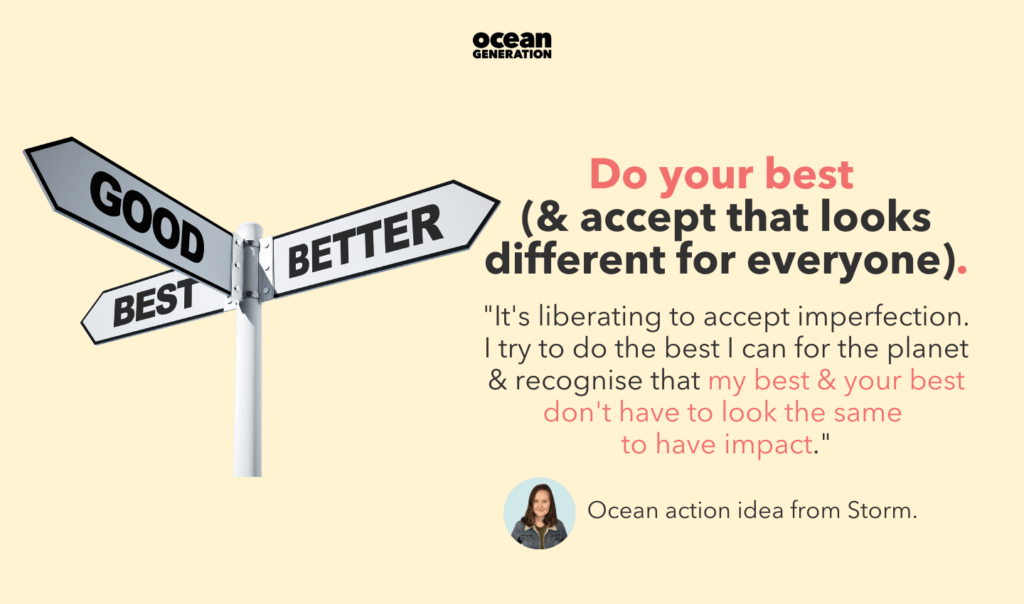
10) Do your best to take environmental action daily, and accept that ‘your bestlooks different for everyone.

10 ways you can fight climate change and protect the Ocean shared by the Ocean Generation team. Tip: Do your best to take environmental action and recognise that your best and someone elses best look different. We don't have to take the same action to make a positive difference.
Who are the orca outlaws sinking boats, and why are they?

Subscribe

Monthly: Impact in your inbox.

OceanGeneration-Join

15 Climate actions you can take to restore the Ocean’s health 

15 simple actions you can take to fight climate change and protect the Ocean, shared by Ocean Generation. Dark blue, foamy wave washing onto a beach.

What can I do about climate change?”

We’re regularly asked for practical climate actions. Thankfully, there’s a lot we can do to look after our blue planet.  

Every decision we make – from what we eat to how we move to the clothes we wear – has an environmental impact. But when faced with fear-mongering headlines and science-backed alarm bells that we’re reaching a climate tipping point, individual actions don’t feel like enough.  

Do individual climate actions actually make a difference?  

Yes. Think about it: Swapping out your plastic straw for a metal one may not feel like much, but if everyone in Europe did the same, 701 tonnes of plastic could be prevented from entering the environment every year.  

Collectively, individual actions are powerful propellers of positive change.  

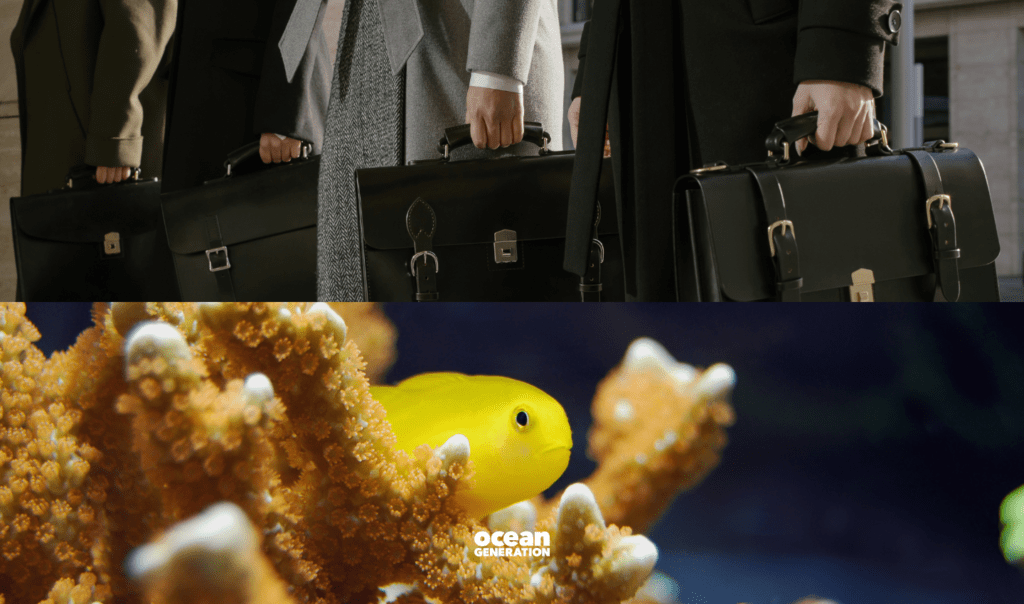
The image is cut horizontally down the middle. The top image is four men and woman dressed for work in suits and coats, holding briefcases. The bottom image is of a bright yellow fish in an organge coral in the sea. Shared by Ocean Generation.

Why should the Ocean have a seat at climate conversations?  

The Ocean is a powerful climate change mitigator.

Here’s 3 ways our Ocean mitigates the impacts of climate change: 

  • The Ocean absorbs 90% of excess heat from our climate system, making it an impressive heat sink. In fact, the Ocean is the largest heat sink on Earth. 
  • 30% of human-made carbon emissions are absorbed by our Ocean.  
  • The Ocean plays a major role in climate adaption. (Said differently: the Ocean supports our planet’s adjustment to the effects of climate change, for example, through blue carbon ecosystems).  

But as much as our Ocean tackles climate change, it is also directly affected by it. (Read: Ways climate change impacts Ocean health.)

When we take climate action, we are simultaneously taking Ocean action and vice versa.  

From reducing your use of single-use plastics to addressing your carbon footprint, there are many effective ways to make a positive difference.
Here are 15 climate actions you can take to restore the Ocean’s health: 

1) Skip single-use coffee cups

Many of us start our day with a cup of coffee on the go. It’s a comforting routine that sets the tone for the rest of the day. 

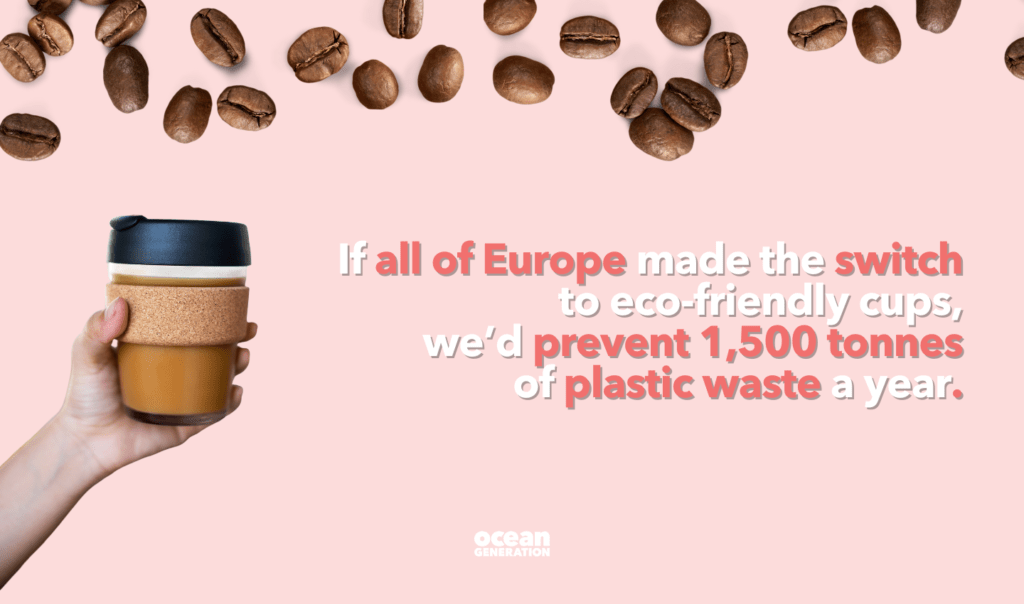
If all of Europe made the switch from single-use plastic cups to eco-friendly alternatives, we’d prevent 1,500 tonnes of plastic waste a year.

Hand holding a reusable coffee cup, shared by Ocean Generation. The accompanying text says 'if all of Europe made the switch to eco-friendly cups, we'd prevent 1,500 tonnes of plastic waste a year.'

2) Understand the main 5 human-made threats the Ocean faces 

We can’t restore the health of the Ocean if we don’t understand what threatens it.

The UN released a 2,000-page document breaking down the various threats our Ocean faces. Understandably, most people don’t have the time (or desire) to read it. So, we transformed it into 5 easy-to-follow articles about Ocean threats. 

3) “What is my climate footprint?” 

Your carbon footprint is the measure of greenhouse gases produced by your daily activities.  

This includes things like driving a car, using electricity, the emissions linked to what you wear, and even eating food.  

When we understand our carbon footprint, we can shift our behaviours for the better. Here’s an online carbon footprint calculator (we can’t endorse any resource as ‘the most accurate measure of your CO2 footprint’ but this will give you a rough idea of your environmental impact).  

It’s important to remember that carbon emission world averages distort the unequal emissions in developed and developing countries. So, it’s helpful to compare your carbon footprint to your national average to assess where you stand. 

4) The food on your plate makes an environmental impact  

One third of carbon emissions comes from food production.  

What you eat tends to matter more than whether it’s produced locally or not, when it comes to decreasing your carbon footprint.  Read: Is locally sourced food better for the environment? 

General tips: Reduce your consumption of high-emission foods like meat and dairy in favour of seasonal fruits and vegetables and snacks that have negative emissions. 

5) Put your money where your heart is: Divest from fossil fuels 

Are your monetary investments benefiting the planet? Divesting from fossil fuels means taking your money out of the hands of the fossil fuel industry, which contributes significantly to carbon emissions and climate change.  
You can start by checking your bank and investment accounts and moving your money to institutions that don’t invest in fossil fuels. Even small divestments make a difference. 
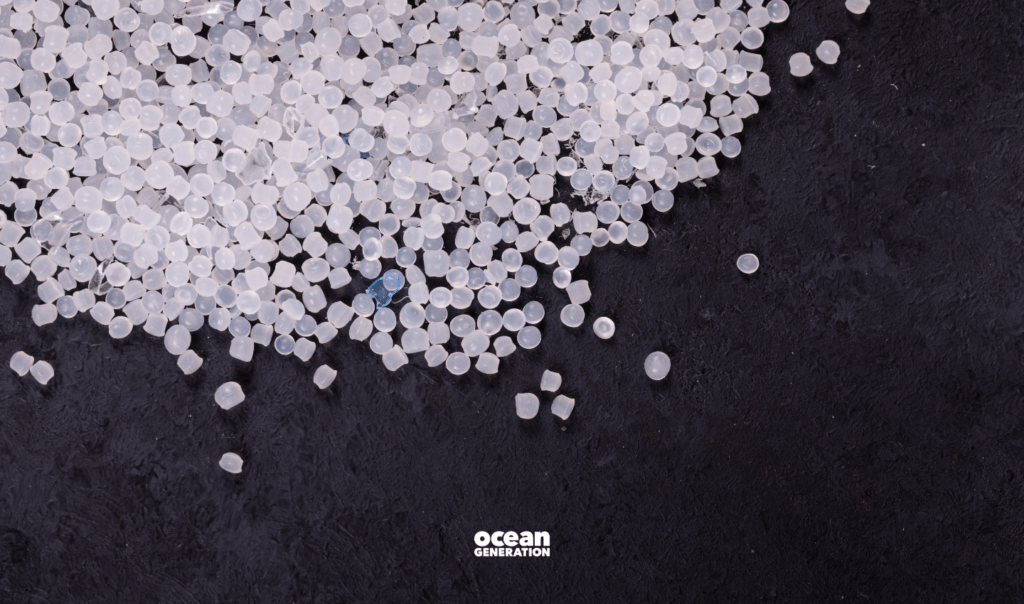
Microplastics on a black background. Ocean Generation is sharing climate actions we can all take.
6) Avoid products with microbeads 

Microbeads are small plastic beads often found in beauty and personal care products. These tiny pieces of plastic easily slip down our drains, through water treatment plants and into the Ocean. 

Most of us purchase products – facial scrubs, toothpaste, nail polish, and abrasive household cleaning products – without realising they contain microbeads.  

Quick solution to the microbead problem: Check ingredient lists and front labels. Microbeads and polyethylene are often listed on packaging, making them easy to avoid. 

7) Think before you toss your clothes into the laundry 

Every time we do an average laundry load of 6kg, 700,000 fibres can be released into our waterways. Before you put something in the washing basket, consider if it can first be worn again.  

Take this a step further by investing in a bag built to capture micro-fibres and choosing sustainable clothing materials when it’s time to purchasing something.  

8) Conserve water  

Only 0.5% of water on Earth is useable and available as freshwater. So, we’re not joking when we say water is liquid gold.  

It’s a key prerequisite for human development and, already, a quarter of all cities are water stressed. Little actions add up: Cringe when you see a character in a movie running water for ages; make sure you turn your tap off while brushing your teeth; install a waster-wise shower-head; fix those leaks.  

You may feel that your climate action is a drop in the Ocean – but the Ocean would be less without that drop.  

Every drop counts.

9) Understand the impact of fast fashion on the environment 

Fast fashion is responsible for 8 – 10% of global carbon emissions (which is more than all international flights and maritime shipping – combined).  

Outfit repeating, sustainable fabrics, shopping second-hand and only purchasing items you know you’ll re-wear over and over again are in fashion this season.  
Scroll: How to take the fast out of fast fashion

Car exhaust pipe with smoke coming out. Shared by Ocean Generation in a article about actions to reduce carbon emissions.

10) What’s the impact of how you travel

No one’s surprised to learn: Flying is one of the most carbon-intensive modes of transportation. But did you know that flying at night is actually worse for the planet than flying during the day? Now you do.

Walking and cycling are both climate-friendly and positively impact our health.  

Suggestions when it comes to catching flights:  

  • Where alternatives exist, don’t fly.  
  • When you need to fly, choose direct flights to maximise fuel efficiency and minimise emissions associated with take-offs.  

11) Plant a mangrove tree – with the click of a button – to take Ocean action 

Mangrove trees are incredible climate solutions.

We’ve written about their impressive carbon sequestering power extensively and have a Mangrove Mandate: A promise to plant a mangrove tree in Madagascar for every new follower on @OceanGeneration’s instagram.  

By planting a mangrove tree, you’re making a direct impact on the environment. Plant (follow).

12) Rethink your relationship with plastic 

You knew it was coming. It wouldn’t be a climate change actions list without mention of plastic.  

Plastic is everywhere – from the clothing you’re wearing to the spot you’re sitting right now and even in the food we eat. There’s no getting rid of a material designed to last forever, but reducing our consumption of single-use plastics is essential for a healthy Ocean and planet.  

Start by rethinking your relationship with plastic. Instead of leaning on recycling, start reusing, reducing, totally refusing plastic options where you can.  

Crashing Ocean wave, shared by Ocean Generation - experts in Ocean health since 2009.

13) Start saying ‘Ocean’ not oceans 

At school, we’re all taught about the Ocean having 5 regions, but our Ocean isn’t separated by borders. It’s one, connected system.  

What happens in one part of the Ocean impacts Ocean health as a whole. 

If we all understood this, we’d be more mindful of what we dump in the Ocean, what we take out of it, and how we use it daily. As you go about your life, start saying Ocean – big O, no s. Not only does it highlight the interconnectedness of the Ocean, but also how our daily actions impact it. 

14) Be a voice for our Ocean 

The Ocean is quite literally keeping us alive. It’s our planet’s life support system, but most people don’t realise that.  

By keeping yourself informed about the importance of the Ocean, the human-made threats it faces, and the various actions we can take to protect it – and then sharing that Ocean intelligence, you can propel a wave of positive change for our planet.

Sign up to our newsletter for monthly Ocean education. Submit a Wavemaker Story to let your voice for the Ocean be amplified on our channels. Share educational posts you come across. Be an Ocean advocate – not just on World Ocean Day but every day. 

15) Accept that you can’t do everything. Start where you are. 

It’s important to acknowledge that no one can do it all when it comes to tackling climate change and restoring the Ocean’s health.  

Striving to be a perfect environmentalist often leads to eco-anxiety and feelings of defeat about the amount of work to be done. The reality is: Imperfection is still helpful, and it’s a lot more inclusive than unrealistic demands for perfection. 

Our blue planet doesn’t need a handful of perfect environmentalists. Earth needs millions of imperfect people doing what they can to make a difference, and always trying to do better.  

Embrace imperfect environmentalism with us by starting where you are. Commit to one – or several – of these items right now. Collectively, we can make waves. 

Who are the orca outlaws sinking boats, and why are they?

Subscribe

Monthly: Impact in your inbox.

OceanGeneration-Join

20 Actions to Reduce and Reuse Plastic

The most effective way you can address plastic pollution is rethinking your relationship with it.

We’re sharing 20 ways you can reduce and reuse plastic.

Making these simple plastic swaps and adopting more sustainable daily habits will reduce plastic use, pollution from reaching our Ocean and ensure a healthier, greener planet.

Enough talk – let’s take action.

1. Buy a reusable shopping bag or tote.

Reduce your plastic use by purchasing reusable tote bags.

2. Use a reusable drinking cup.

3. Buy fruit and vegetables with plastic-free packaging.

4. Buy dry goods using your own reusable containers, instead of buying them in a single-use packet.

5. Buy a plastic-free cosmetics or household products, like bamboo toothbrushes or a bars of soap.

6. Ensure that nothing you purchase contains microbeads. They’re often found in children’s toys, toothpaste, bodyscrubs, and household cleaning products.

7. Make your own lunch instead of buying one wrapped in a single-use plastic wrapper

8. Swap over to reusable milk bottles. Even plant-based milks can get delivered to your doorstep these days.

9. Try having a plastic free period – check out mooncups, period pants and reusable applicators.

10. Use a silicone container or silicone lid instead of cling-film to store food.

11. Buy your butter wrapped in paper – you don’t need a plastic butter dish.

12. Choose cans over bottles when buying fizzy drinks and never buy bottled water.

13. Don’t celebrate events with balloon releases, the chances are the balloons will land in the Ocean.

14. Cigarette filters contain plastic and butts are some of the most frequently-found pieces of marine litter.

15. Wear clothes made from natural fibres like cotton, linen, bamboo or hemp vs polyester, nylon or spandex.

16. Try using pencils instead of pens. If you use a biro – use one that can be re-filled.

17. Ditch the single-use razors, nappies, and lighters. We have so many alternatives available to make sustainable swaps and reduce our daily plastic consumption.

18. Avoid plastic accessories, such as, hair bands, hair clips and jewellery.

19. Say no to plastic straws – use paper or bamboo straws instead.

20.  Pick up litter – even if it isn’t yours! Don’t let it reach our drains and waterways.

Finally: Remember that plastic was designed to last forever,
it has no place as a single-use material apart from in medicine.

Subscribe for simple Ocean Science and pop-culture stories

* indicates required

View previous campaigns.

Ocean Generation will use the information provided here to be in touch with updates and marketing.

You can unsubscribe at any time.

Who are the orca outlaws sinking boats, and why are they?

Subscribe

Monthly: Impact in your inbox.

OceanGeneration-Join