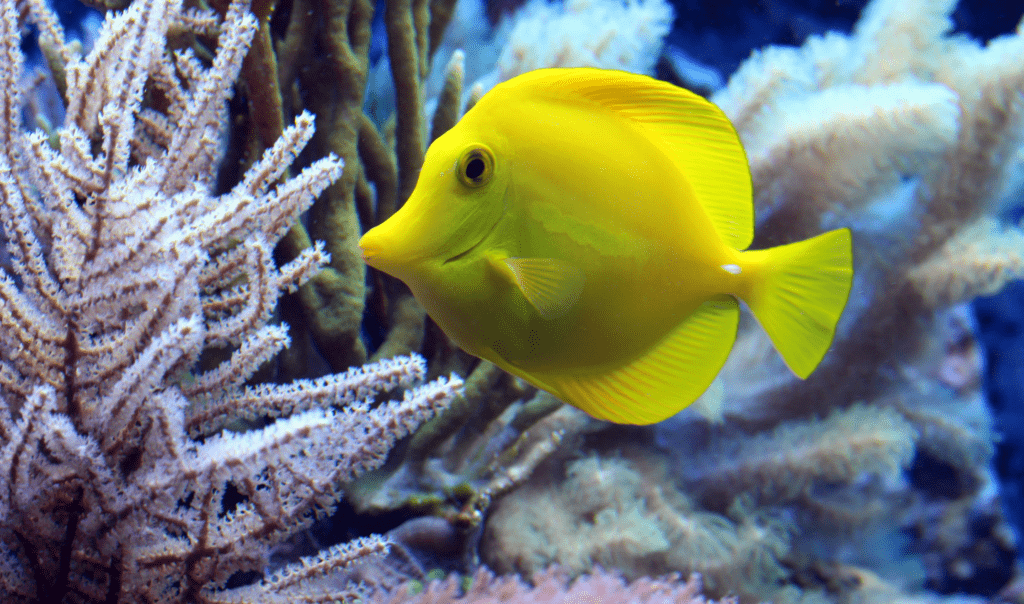
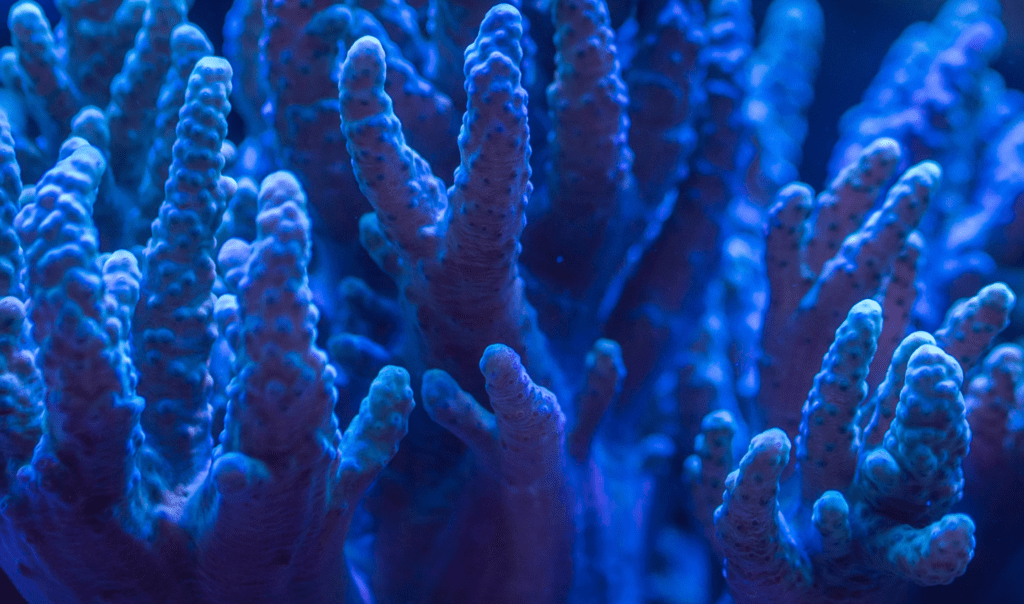
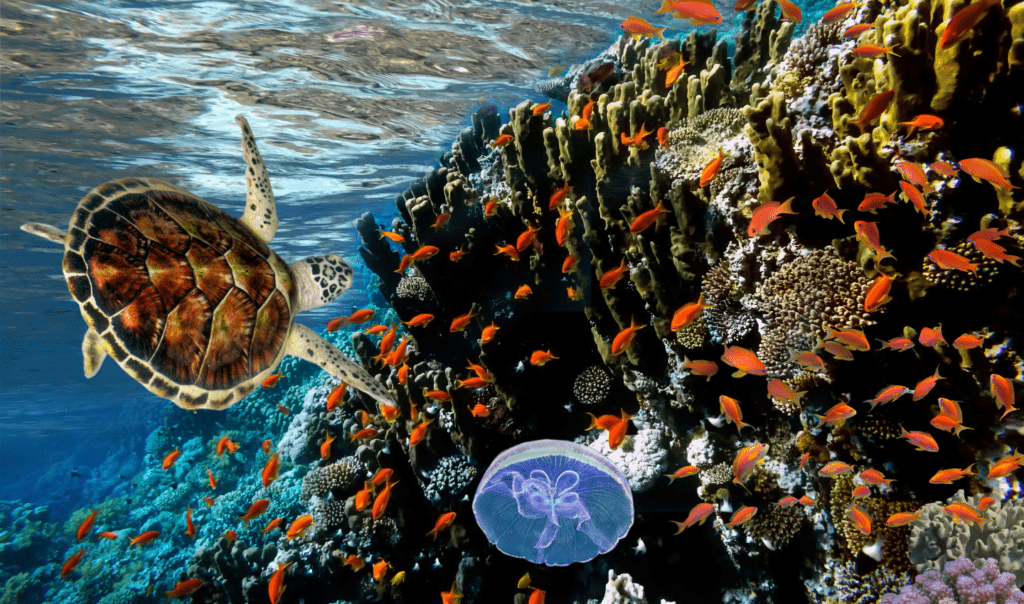
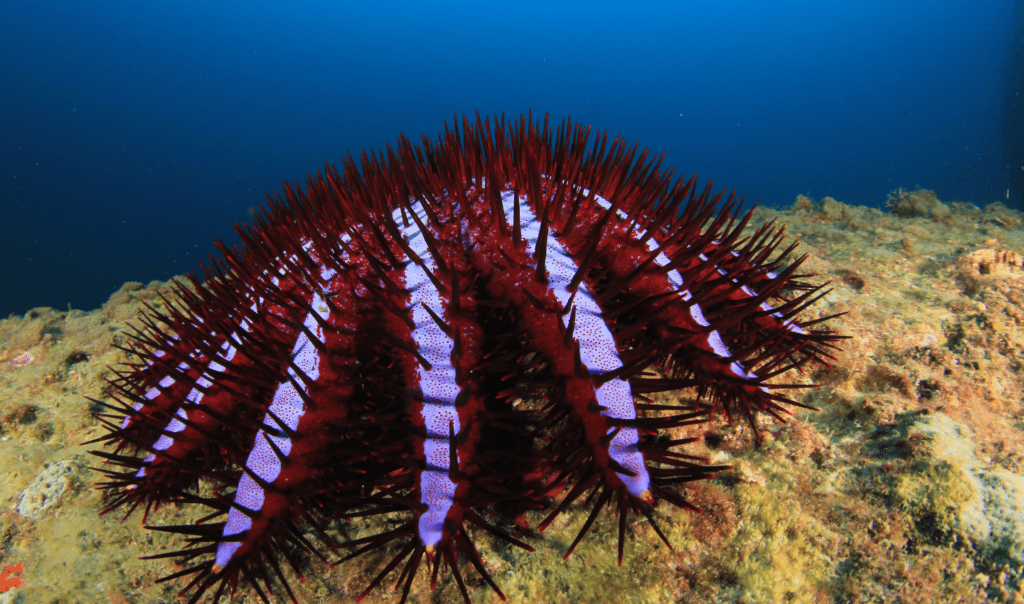
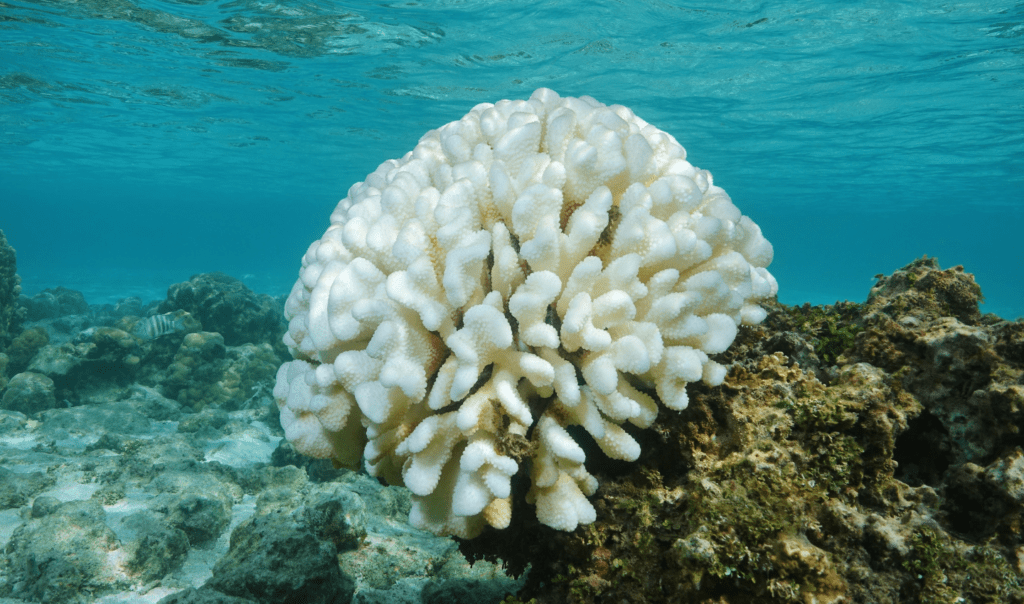
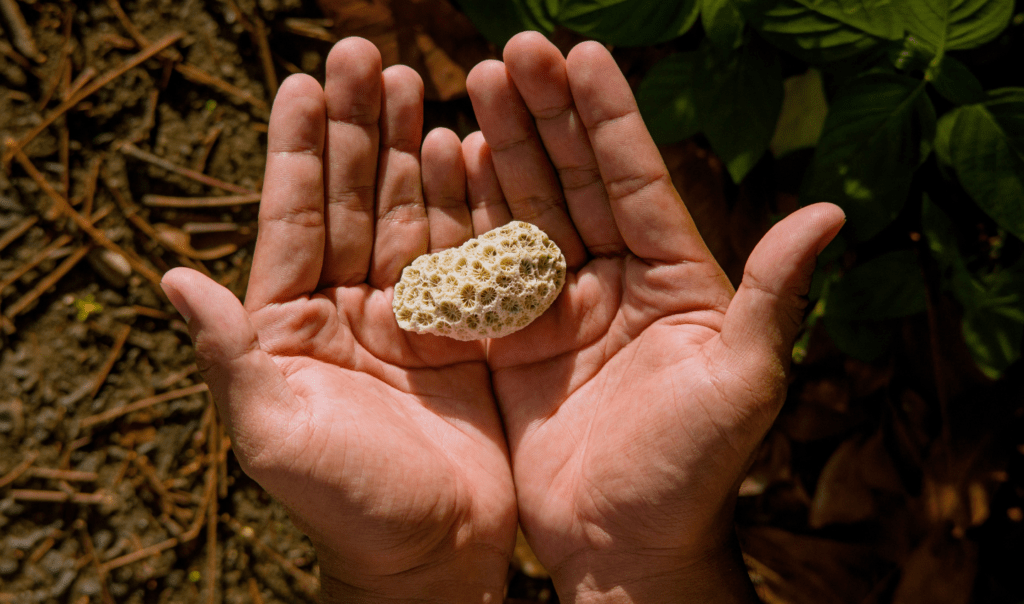
White branches reaching out, stark against the blue. Where there was colour, now only ghostly white. This haunting transformation isn’t just a visual tragedy – it’s the silent SOS of some our Ocean’s most spectacular ecosystems. This is coral bleaching.
Coral reefs aren’t just beautiful — they’re nurseries for fish, protect coasts from storms, and feed millions of people. When coral reefs bleach, their whole ecosystem is at risk. But what is coral bleaching? What causes it, and why does it damage reefs?
Are corals animals, plants or rocks?
Corals are animals. Some may have stone skeletons and live with plants. But all corals are animals.
Corals are tiny animals called polyps. Each polyp has a soft body and a mouth surrounded by tentacles, like a little sea anemone or an upside-down jellyfish. All these animals are related – they are cnidarians (silent c), named after their cnidocytes – special cells that can sting.
Where does coral’s colour come from?
Corals are incredible animals. They build immense structures that provide homes for marine species, protect the coast and create oases in the ‘desert’ of tropical seas (there are very few nutrients in the waters of the tropical Ocean).
To be able to do all this, they need some help. Corals have symbiotic algae called zooxanthellae living in their skin cells. Think of zooxanthellae as tiny solar-powered chefs living inside coral homes.
They catch sunlight, cook up energy, and share over 80% of the meal with their coral landlords. The coral provides protection and prime real estate with an Ocean view. It’s a win-win (this is what symbiotic means) – until climate change cranks up the thermostat.
It’s zooxanthellae that gives coral its colour. The magical, vivid world of coral reefs is painted by these little algae. Without them, corals are translucent, and the white of their calcium carbonate skeleton shines through.
Why do corals bleach?
The happy relationship between coral and zooxanthellae can be disrupted. When it is, this can lead to the expulsion of the algae from coral tissues, leaving the coral gleaming white (it is a spectrum, coral can partially bleach).
The most common cause of coral bleaching is thermal stress AKA temperature. If conditions aren’t right, the systems that make photosynthesis (plants turning sunlight into food) can break.
When these systems break, they can produce reactive oxygen species (ROS). ROS are produced in normal function, but too many ROS harm the coral. When the coral detects this build up, it acts in self-defence and throws the algae out.
Usually, this is from it being too hot, but the system can be broken when it is too cold, or in too much sunlight, or exposed to harmful pollutants.
That’s a bit abstract. Let’s make an analogy.
Imagine the coral as a battery, and the algae as a solar panel. Normally, the algae are providing energy to the battery from the sunlight. But if the solar panel gets too hot or is exposed to too much sunlight under a magnifying glass, it might start to malfunction. It starts to spark, so to protect itself the battery disconnects. Without its solar panels, our coral battery can only run on emergency power for so long before it’s completely drained.
History of coral bleaching – how long has bleaching been about?
Places like the Maldives, Seychelles, and reefs in the Indian Ocean lost nearly half their coral cover. 2023 saw the start of the fourth global coral bleaching event, that over the next two years saw an estimated 84% of the worlds coral reef areas bleached.
Sounds bad, but this isn’t the end.
Image credit: Great Barrier Reef Foundation
Does bleaching mean coral is dead?
No. A bleached coral is still alive, it just doesn’t have its friend feeding it. This leaves the coral more vulnerable to disease, but also to starvation. Unless our battery reconnects to its solar panel, it will eventually run flat.
Having repeated bleaching events reduces corals’ ability to recover. It’s like punching them while they are down.
When the coral eventually dies, it loses its white look and will begin to get covered with other algae and seaweed.
However, corals have shown us again and again they have an amazing ability to recover when given the chance.
Different species of coral are more tolerant, and different species of zooxanthellae can take more heat too.
Some species of coral bounce back faster than others; the marine equivalent of those friends who somehow recover from a night out while you’re still nursing a headache. The massive boulder corals? They’re the slow-but-steady marathon runners. The branching corals? More like sprinters – quick to bleach, but sometimes quicker to recover.
There is a lot of work going into understanding corals, and reef restoration methods continue to be tested and implemented (read here for more.)
Corals are the poster child of Ocean health. They are impacted by all our Ocean threats, which means you can help wherever you are.
Every time you switch off an unnecessary light, choose a reef-safe sunscreen (free from oxybenzone, octocrylene or octinoxate), or select a sustainably caught fish dinner, you’re casting a vote for coral survival.
The future of coral reefs could be written in bleached white, or in vibrant technicolour. The pen, rather excitingly, is in your hands.
Or more accurately: Why do blue-footed boobies have blue feet?
The Galápagos Islands are full of the weird and the wonderful. One of their most iconic species is the blue-footed booby (Sula nebouxii), a marine bird that is found all along the Pacific coast. It is best known for its blue feet (which it was very creatively named after), making it really cool to look at but, why are they blue? To answer this question, let’s break it down into the how and the why.
The how: What are the mechanisms that cause blue-footed boobies’ blue feet?
Our first answer is potentially a killjoy one; they’re not actually blue, they just appear that way!
Colours most often come from pigments, which absorb specific wavelengths of light, but the blue in blue-footed boobies doesn’t seem to come from a blue pigment. Blue pigments are actually very rare in nature – the funky blue mandarin fish is one of the few examples of an animal that makes any.
Instead, the blue in blue-footed booby feet is likely a structural colour which comes from light being reflected. The way different structures on animal surfaces are organised can affect the way that wavelengths of light reflect off their surface – like in the diagram:
The blue-footed booby has a layer of collagen under its foot skin, and the structure of this collagen likely makes them appear blue by reflecting only blue light wavelengths. This is the case for the majority of blue animals.
Pigments might still play a role though because blue-footed booby feet sometimes appear slightly greener which might be due to yellow pigments (blue + yellow = green!). These pigments are carotenoids which animals can’t actually make themselves. Instead, they get them from their diets and the food they eat can influence what colour they are.
For example, flamingos aren’t born pink – they’re born grey but become pink because of the carotenoids in their food. Similarly, if you eat too many carrots you could turn orange (but please don’t, that would be bad for you).
In blue-footed boobies, these carotenoids from their diet can affect how bright their feet are. Biologists tested this by changing how much food blue-footed boobies were given – when they didn’t get food, their feet became duller but when they were fed again with fresh fish, their feet became brighter.. This is super cool and also super important to keep in mind for our next question…
The Why: Why have blue-footed boobies evolved blue feet?
The reason that anything in nature looks or works the way it does is because of evolution. Darwin’s theory of natural selection says that traits that increase survival will be passed on so the fact that blue-footed boobies have evolved blue feet suggests they might be helpful in some way. But what advantage do blue feet give them? To answer this we need to understand sexual selection.
What is sexual selection?
Great question! It can be thought of as a special type of natural selection where traits that increase reproduction (instead of survival)will be passed on. This can include animals choosing a mate based on preferences for certain traits, which increases the chances of animals with those traits reproducing and so, the trait is passed on. For example, peahens prefer peacocks that have larger, more colourful tails which means large colourful tails get passed on over time!
As it turns out, female blue-footed boobies prefer brighter feet!
We know this because biologists carried out some fun experiments – they used make-up to make male feets look duller (who says biology isn’t a very serious science?). When males had duller feet, the females were less likely to mate with them. Brutal!
Biologists also did this to males that had already mated with females (because blue-footed boobies don’t lay all their eggs at once). When the feet of these males were made duller, females actually made their second eggs smaller so that they’d hatch smaller chicks. Even more brutal!
This suggests to us that females are deciding who to mate with based on foot colour and if the blue isn’t as bright as they like they want to reproduce with those males less. So, foot colour might be a sexually selected trait because it increases the chances of reproduction for the males!
Why do female blue-footed boobies like blue feet?
As lovely as the blue is, it’s not just that they really like the colour. The stakes are quite high for them; they are choosing males to father their offspring and want to make a good decision. So, if they are basing this off foot colour, foot colour likely contains information that is quite valuable. It is likely a signal.
What are signals? Signals are behaviours or structures that have specifically evolved to change the behaviour or state of others by conveying information. The response of the receiver must also have evolved due to signals – it is important to understand what receivers have to gain from responding to signals.
As we already know, carotenoids from their diet can influence blue-footed booby foot colour. What’s even more interesting is that these carotenoid changes can influence the immune response and foot colour also correlates to immune response.
Females might also be interested in how good of a parent males might be and foot colour might also signal this. When biologists swapped baby birds between nests, they found that the foot colour of the foster father was a pretty good indicator of condition (even though they weren’t genetically related).
So, to summarise: blue feet have potentially evolved because male foot colour might signal their condition, females want to reproduce with good condition males so they choose males based on foot colour.
What about female blue-footed boobies’ foot colour?
Male blue-footed boobies also seem to prefer brighter feet on females but the story is slightly less straightforward.
When female feet were made duller, the effects are mostly after they’ve already formed a pair, Blue-footed boobies form pairs then lay eggs but there is a courtship period before they lay an egg. In this period, females with duller feet received less courtship nest presentation (when birds add materials to nests) both from males they were paired with, and other males.
In the period after egg-laying, making the female foot colour duller also had impacts on how much males incubated eggs. However, this was also affected by egg colour and size, which can indicate offspring quality. When females had duller feet, males incubated more in nests with a large egg but when they had colourful feet, males incubated both small and large eggs. Males also spent less time incubating small-dull eggs than small-colourful and large eggs.
So it seems that female foot colour is signalling something about their condition (and as an extension, the offspring’s) and the way males respond depends on the phase of reproduction they’re in. However, it also seems that foot colour isn’t the only useful indicator; egg size also is.
One explanation might be that females have to decide between investing in their offspring (egg size) and signalling (foot colour) so foot colour might not give the whole picture. The mechanisms and reasons for this aren’t completely understood yet which just means there’s more left to learn about blue-footed boobies – exciting!
It’s not just blue-footed boobies that use signals
Nature is full of quirks! Beyond blue-footed boobies, evolution has brought about an array of interesting signals throughout nature. Animal signals are incredibly cool and incredibly diverse; they come in all shapes and sizes (literally) and some of them are also less honest than others. For example, some mantis shrimp display a claw that looks threatening to scare off intruders even when they are actually weak.
The signals that animals display will evolve to reflect the context in which animals live, which might be the environment or how they interact with species.
For example, yellow warblers (a species of small bird) produce alarm calls to scare off parasites. However, the yellow warblers that live alongside blue-footed boobies on the Galapagos don’t produce these calls. Why? They don’t need to!
They have been geographically isolated from their parasites for thousands of years, while the warblers on the mainland have not. These alarm calls either evolved before the Galapagos warblers became isolated, and they then lost the behaviour, or the calls evolved only in the mainland warblers afterwards. Either way, they reflect the lack of parasites on the islands!
Understanding why animals look or behave the way they do could be very valuable to us. For example, in the blue-footed boobies, their feet could show when their condition is declining. Since we know feet colour has likely evolved to signal their condition, if the foot colour changes, this could be because their food quality and availability has changed. This could signal to us that they’re in trouble!
So, as well as being incredibly interesting, learning more about nature and how species have evolved could also be important to protecting them.
Fish that break all the rules by living in the Ocean and streams:
Look into a river and you will find very different animals to the Ocean, even if they are just a few miles apart. Why are these wet worlds so different? In short – it is all about osmoregulation (explained below).
Whether you live in the Ocean, in a river, on a mountain or in Thneedville (yes, that’s a Lorax movie reference) – everywhere has its challenges. One of the main challenges of living in saltwater (read more about why the Ocean is salty here) is maintaining the balance of water in an animal’s cells.
What is osmosis? Water will travel from areas of high concentration to low concentration in an attempt to balance them (this is called osmosis). Salty water has lower water concentration than freshwater.
Join us to explore the difficulties of swimming between the two worlds, some of the incredible journeys of the fish, like salmon, eels and bull sharks, that overcome them and crown the winner of the wet.
What is osmoregulation?
All living things need water, and they need salts. Maintaining the balance of both is tricky – too much or too little of either is fatal.
Imagine a balloon full of water, but this balloon can let water in and out of it. This is our cell. The water in the balloon (our cell) has a little bit of salt in.
If you put the balloon in a bucket of freshwater, water enters the balloon (by osmosis) to balance the concentration. This could end up bursting the balloon. Alternatively, putting the balloon in salty water will lead to the water leaving the balloon, shrivelling it.
Animals living in these environments have to adapt to avoid bursting or shrivelling – neither sound particularly fun.
Fish living in freshwater have to hold on to their salts and avoid water intake. Saltwater fish take in as much water as they can and excrete the extra salts.
How do freshwater and saltwater fish stay hydrated AKA: do fish drink the water they live in?
To maintain a good balance of water and salt, fish in different environments alter their drinking, gill function, kidneys and excretion (waste removal).
Marine fish will constantly drink sea water, getting as much water in as possible. They actively remove salt from the water through cells in their gills. The pee of marine fish is highly concentrated urine (if you get dehydrated, your body does the same – your pee will be very yellow, with little water diluting it), minimising water loss.
Freshwater fish, on the other hand, don’t drink water. They don’t need to. Think of the balloon example – they are saltier on the inside, so water wants to move in. Freshwater fish easily absorb water through their gills. They use energy to pump salts in, against the concentration gradient – they actively ingest salts. Their pee is very diluted, ensuring they don’t become swamped by discarding lots of water.
Why can’t freshwater fish live in the Ocean?
Knowing all that, let’s see what would happen now if we put a marine fish in freshwater. A marine fish wants to lose salt from its body and keep water. Think of the balloon – a marine fish invites water in, pushing salt out. This means the balloon will lose all its salts and get over filled with water. That is one unhappy fish.
For a freshwater fish in the Ocean, the opposite happens. Used to a world with plenty of water and little salts, the balloon will shrivel as it is filled with more salts and loses water. The bottom line is the same – an unhappy fish.
Are there fish that can live in both freshwater and salt environments?
Amazingly, yes. There are examples of fish that can live in both marine and freshwater all over the world. There are two main types.
Anadromous fish are born in freshwater, spend most of their lives in the Ocean and then return to freshwater to spawn.
Catadromous fish live in freshwater most of their lives, returning to the Ocean to spawn.
We will explore these groups through a couple of their most famous members, as well as a shark that makes it all look easy.
European eel photo by GerardM
How do salmon survive in both fresh and salt water?
Salmon are incredible fish.
Not all salmon are anadromous: there are Atlantic salmon in North America called sebago, named after one of the lakes they are found in. More Atlantic salmon live in Norwegian, Swedish and Russian lakes; and yamame are a landlocked Japanese masu salmon.
But some salmon travel thousands of miles between fresh and salt water over the course of their lives.
Chum salmon have been estimated to complete total migrations of over 10,000km (6,200 miles) across the North Pacific from feeding grounds to the Yukon river or streams in Japan.
Anadromy appears to have evolved at a similar time that the Ocean cooled and became richer in food. This, coupled with the existence of landlocked variations, suggest that salmon were a freshwater fish that took to the sea, although this is not confirmed. What is certain is the incredible journeys and transformations many salmon go through to mate.
For salmon, the movement from river to Ocean and back to river is integral to their life cycle.
The first few years of a salmon’s life are spent growing in the river, before they go to the food-rich Ocean. Here they gorge themselves, growing very quickly. After travelling many thousands of Ocean miles, they will return to the rivers they were hatched in, to spawn themselves.
But how do they manage to conquer both environments?
Through hormonal changes, salmon make behavioural and physiological changes to the ways they manage their osmotic balance. In freshwater, they won’t drink water – when in salt water they will drink a lot. Hormones change the fish’s physiology, increasing the number of ion transporters in the gills and kidneys to process the salt balance.
The change is a costly one though, as salmon won’t feed during their return to freshwater, relying on fat reserves built up through years in the Ocean. They battle up their rivers, overcoming waterfalls, predators waiting on the banks and their own failing bodies to reach the same spot they hatched in. Here, they will spawn.
For most of these fish, it is the last thing they do.
What can salmon teach us?
Just as rivers are the connection between us and the Ocean, salmon are among the clearest species to bridge that gap. And they feel the impact of people more keenly. Rivers are the frontlines, and salmon are in the trenches.
Salmon rivers are best in old forests, as the tree roots hold the banks together and keep the rivers form – holding it narrow and fast flowing. Where forests are lost, the river can widen and the salmon population diminishes. And as we build dams to harness the power of the rivers, we block the salmon from getting home.
The populations of salmon in different rivers show far more genetic variation than between people. Each salmon is genetically coded for its river home. Climate change, pollution, human development and fishing – salmon deal with a lot.
But their adaptability is shown time and again. The genetic diversity they show allows them to overcome the challenges they face. Just as they are able to thrive in these two different worlds, they can take on the new world we are shaping.
What do you call returning to the Ocean to reproduce?
Catadromy is the mirror of salmon – starting life in the Ocean, living in freshwater and returning to the salt to spawn.
European eels begin life as eggs riding Ocean currents, drifting through the Sargasso Sea near the Bahamas. They hatch into small, transparent, leaf-shaped larvae called leptocephali. Like so many (hungry, well-teethed) leaves in the wind, the Ocean carries the eels to the coasts of Europe, a journey taking 2-3 years.
On reaching the coast, they metamorphose (change body shape) into glass eels – still small and see-through but eel-shaped. After up to a year, they change again into elvers (juvenile eels) and begin to travel up rivers. Here, they change again into yellow eels and can remain in freshwater for up to 20 years until they reach sexual maturity.
This means an eel can be 23 years old before reproducing. When their time comes, they become silver eels, migrating down rivers towards the Ocean.
For many years, European eels were characterised by mystery. They were well known in the rivers of Europe, yet no one could find baby eels. Greek philosopher Aristotle suggested that they just appeared out of the mud, and this was the general belief for almost 2,000 years.
It was Johannes Schmidt, a Danish biologist working in the early 20th century, who began to unveil the elusive eels. By finding progressively smaller eels across the Ocean, he followed the trail of breadcrumbs to the Sargasso Sea. He couldn’t find any spawning, but he drew the metaphorical arrow.
It wasn’t until 2022 that we found the first direct evidence of adult European eels travelling to and reaching the Sargasso Sea. This study also shows us just how far the eels travel – up to 8,000km. If you’re ever lucky enough to see one of these eels, appreciate just how far it has come, and how far it still has to go.
The eels adapt twice, changing their whole bodies to swap salt for fresh and back. On the way back, the silver eels don’t feed. As with salmon, they rely on fat reserves for their journey, and their bodies slowly disintegrate, and once they have reached their spot, they reproduce and then die.
But the switch doesn’t always have such dire consequences.
European eel design on our sustainable apparel. Available in our store. Every purchase supports our charity.
Are bull sharks the best sea-swappers?
Yes. Bull sharks (Carcharhinus leucas) are the aquatic conquerors supreme. As we have seen, moving between fresh and salt water is tough. Most salmon only do it once, some can manage it a couple of times, their bodies failing them under the stress. Eels change their whole bodies when they make the switch. Yet bull sharks can move between fresh and saltwater with apparent ease.
They have been found in unexpected places. In Africa, bull sharks are known as Zambezi sharks as they are found deep into the Zambezi river. They were initially described as a different species* – because no one expected a bull shark there. In Brisbane a bull shark was spotted swimming the streets after flooding in 2011, and they have been to Baghdad up the Tigris. They have even been found in Alton, Illinois, 2,800 km (1,740 miles) from the Gulf of Mexico.
The ultimate tourist? A bull shark was reported in the upper reaches of the Amazon, in the Ucayali River, Peru. Nearly 5,080 km (3,157 miles) from the Ocean.
How do bull sharks do it?
Ready for some high-density science?
They change how salty they are (in the balloon). In the Ocean, bull sharks’ blood is at least as salty as the water they are in due to the levels of urea and trimethylamine oxide (TMAO). But when in freshwater they excrete much more urea, lowering the salt concentration of their blood to minimise the gradient (the difference in saltiness).
However, they are still more salty than freshwater, so they absorb water and lose salts through their gills. They change their salt and water processing to match their environment. All sharks have rectal glands through which they excrete excess salt when in the Ocean. When in freshwater, bull sharks reduce the activity of their rectal gland to preserve these salts. The kidneys of bull sharks in freshwater go into overdrive, producing large amounts of dilute urine to avoid the balloon-popping scenario. Both the kidneys and the gills are triggered to actively uptake salts, while the liver changes urea production.
On top of all this, bull sharks have to deal with the different densities of salt and freshwater. As anyone who has visited the Dead Sea will tell you, more salt = floaty (scientific term). So, bull sharks in freshwater reduce the densities of their livers to counter their reduced floaty-ness. Still, living in freshwater really does drag them down, which may be why they still mostly prefer the Ocean (can’t say we blame them).
Why do these species matter?
These fish, as with our rivers, are great connectors. Their journeys are important to all those they encounter. By travelling between the separate biomes, they transport nutrients and link ecosystems, strengthening them.
They are used as indicators of water quality and ecosystem health and provide food sources. Something harder to measure is their cultural importance, which resonates through many different social histories – they bring us closer together as well.
The challenges of moving between the Ocean and its fresh-water fingers are staggering. Yet these fish tackle it head on.
Which do you find more impressive; the salmon battling bears and waterfalls to return to its river home; eel larvae drifting thousands of miles and swimming back, changing their whole body to tackle each step; or the bull shark that is just as at home in the heart of the Amazon as a reef in the Indian Ocean?
From the legend of the salmon, to the mystery of the eels, to the euryhaline hero the bull shark, these fish are truly conquerors of the coast.
Book recommendations from our Marine Scientist
When I am writing my articles, I use a variety of sources. One of the most engaging are the books. Here are a few I used for this article, do let us know if you have a read, and watch out for more recommendations.
Additional sources: *Peters, W. C. H (1852): Hr. Peter legte einige neue Säugethiere und Flussfische aus Mossambique vor. – Bericht über die zur Bekanntmachung geeigneten Verhandlungen der Königlich Preussischen Akademie der Wissenschaften zu Berlin. Aus dem Jahre 1852. Berlin, pp. 273–276. (not available online)
From the creek whispering through a forest, to the confusion of huge currents twisting against each other in the channel. These flowing waters connect ecosystems, cultures, and continents — and ultimately, they connect us to the sea. Join us to explore why rivers are important.
Read about the wider water cycle and how rivers fit into it here.
Why are rivers amazing? What is an estuary? And what are the threats to these wet wonders?
What are rivers?
Let’s start with a quick definition. Rivers are large, natural flowing streams of water. They have banks on either side, they have a source and a mouth. They meander through every continent, from a few kilometres to thousands long.
Which is the biggest river?
What does ‘biggest’ mean? Let us start with length, and to answer that, let us start with another question: where do rivers start? Finding where a river begins is notoriously difficult.
It’s tricky to work out where that first drop comes from. Some rivers begin from a lake or a melting glacier. Others, like the Danube in Europe, start from a spring (water bubbling out of the ground).
River origin leads to debates over which the longest river is – the Nile or the Amazon.
The Guinness Book of World Records gives the award to the Nile but does concede “which is longer is more a matter of definition than simple measurement”.
The Nile, in Africa, has been estimated as great as 7,088 km (4,404 miles) in length, and the same paper puts the Amazon, in South America, at 6,575km (4,085 miles).
However, a quick search will reveal some debate. 6,650 km (4,132 miles) is more commonly quoted for the Nile, and 6,400 km (3,976 miles) for the Amazon.
Explorers are always trying to prove otherwise, measuring in a different way, from a different point, to a different point. We are #TeamNile.
Next, there is the deepest river in the world: the river Congo.
It reaches depths of 220m. That is about as deep as the world record for SCUBA diving. By that depth there is little light, and the pressure from the water above is equivalent to having three adult orcas lying on top of you.
The Amazon stands alone in the amount of water it gathers.
Once rivers start their journey, they gather in momentum on their mission back to the Ocean. More precipitation and groundwater help fuel their flow, and other streams, known as tributaries, join it along the way.
Approximately 209,000m^3/s of water enters the Atlantic from the Amazon. Imagine 75 hot air balloons filled with water, every second. This is equivalent to almost 20% of the total global river discharge, the total volume of water rivers release into the Ocean.
The Amazon is more than the Nile, the Mississippi, in the USA, and the Chang Jiang (Yangtze), in Asia, combined. The brown waters can be seen as far as 100km (62 miles) out to sea, which provided an important navigation tool for sailors hundreds of years ago.
Where are estuaries?
Where the river reaches the Ocean, the interface is an estuary. They usually have a mix of fresh and salty water, known as brackish (there are some examples of freshwater estuaries in the Great Lakes of North America).
Estuaries are highly productive, unique ecosystems. For many different animals they provide food, places to breed, nursery grounds and hosting migratory species.
But why do rivers matter?
Rivers are important, as fresh water is key to all life. Rivers have influenced our world historically, geologically and culturally. They support life where it would otherwise be unviable, on land and in the Ocean. They are the ultimate connector.
Approximately 40 trillion cubic metres of water enters the Ocean from rivers every year. But it doesn’t come alone.
As water moves over the land, it picks up hitchhikers (such as ions, making the sea salty – see more here). Material dissolves into the river, or the water pulls it along. These can lend colour to the river waters (and often their names).
There is the Rio Negro in Brazil, named due to the humic acid from decomposing vegetation colouring the water black. The Red Rivers in Peru and North America, from the small pieces of rock containing iron oxides. The Drina in central Europe is green due to the limestone it flows over and the Hwang Ho (Yellow River) in China is named so because of the loess (a type of soil or sediment) it carries.
They do more than just look good; these multicoloured masses are changing the world.
How do rivers change the world?
Flowing over rocks, mud and sand, each particle that the waters pick up change the course of the river and the shape of the land. Look around where you live, you can usually find the fingerprints of water at work.
Rivers can cut away land and form new land, depositing the sediment it has picked up on the bank or in deltas where they meet the Ocean.
The Colorado River, in North America, has produced the most remarkable example, carving away the landscape to produce the Grand Canyon, while the Nile Delta shows us how rivers build land too.
The waters are full of nutrients, iron, nitrates and other essential building blocks for life. When these enter the Ocean, life flourishes.
How are rivers and estuaries important for us?
Rivers are incredibly important for one species in particular: us.
The first great civilisations all rose up on rivers. The Nile, the Indus, the Tigris and Euphrates and the Huang all supported some of the earliest great cities in human history. Think of a big city – if it isn’t on the coast, we bet it is on a river.
Rivers provide food: the last two very long uninterrupted rivers in Southeast Asia, the Irrawaddy and Salween, provide 1.2 million tonnes of catch annually and support agriculture of over 30 million people. In the US, approximately 68% of the commercial fish caught were caught in estuaries.
The water rivers carry is crucial for drinking, domestic use and agriculture. More recently, we use it for power and industry, and transport.
Rivers have held a central place in culture as well, connecting us and our world metaphysically.
The Whanganui river in New Zealand has been regarded as an ancestor by the Māori people for centuries, and the Ganges is upheld as a place of healing and purity, personified by the goddess Ganga. In Japan, Shinto beliefs hold that each river has its own divine guardian, the Kawa-no-Kami.
Across many different cultures, rivers have been celebrated and protected.
What are the threats to the rivers?
As much as rivers have impacted human civilisation, we have had our impact on them.
Changes to our water cycle due to climate change have reduced the resilience of our rivers as they experience larger variations in flow. Add that to pollution, developing on their banks, extracting their flora and fauna and even stopping their flow – rivers have had it tough.
In order to harness the power of our rivers, we have been interrupting their flow. Just 23% of rivers over 1000km long flow uninterrupted into the Ocean, broken up by an estimated 2.8 million dams.
How does pollution affect rivers?
It is important to realise there are lots of different types of pollution. The first and most obvious is big pollution – plastic, waste, shopping trolleys – that kind of thing. This rubbish can damage the life in the river itself, spoil the water for use and clog and disrupt the water flow.
The other kind of pollution is the small stuff – chemicals, microplastics and pharmaceuticals. These can disrupt aquatic wildlife, make the water unsafe to drink and accumulate through the food chain.
The Ganges, in India, is now a stark example of river pollution. In Hinduism, the river is personified as the goddess Ganga, the goddess of purity.
Just 37% of sewage is treated before entering the river. The banks are lined with tanneries, slaughterhouses, textile mills, chemical plants and hospitals. The waste that fills the river has an estimated 66% occurrence of waterborne disease and contains super-bacteria resistant to antibiotics.
How are estuaries under threat?
Estuaries face many of the same threats as rivers. An estimated 55% of global wetland areas has been lost since 1900, due to developing coastal areas. These wetlands provide unique habitats for their inhabitants, who often are not suited to either the freshwater or marine environments.
We also benefit from the carbon dioxide absorption, offsetting our emissions, and the reduction in the risks of flooding and coastal erosion.
But we are poisoning them too. Chemicals – pesticides and fertilisers – used in agriculture, are washed into rivers and accumulate in estuaries. This leads to nutrient overloading, or eutrophication, with harmful algal blooms appearing. When these die, the decomposition uses up the oxygen in the water – impacting the animals living there.
How can we look after our rivers?
Everything is connected, which means you can make a difference from anywhere. Simply being aware of the connection you have with the Ocean is an important step. You can look after it, wherever you are.
Rivers connect us directly to the Ocean. A hot take? All life is essentially marine – everything is connected to and dependent on the Ocean.
Along with estuaries, they provide important habitats, give us the water we need to survive and bring us closer together through transport and culture. But they are threatened in our new world. As ever, being aware is such a crucial first step to solving any issue.
Educate others:
Share information about river conservation and encourage others to take action.
Engage in local initiatives that promote sustainable water management practices.
Join community and advocacy events:
Participate in local river clean-up events to help maintain waterways and raise awareness
Advocate for sustainable practices:
Support policies that protect rivers from pollution and over-abstraction
Promote low-impact renewable energy to preserve free-flowing rivers
Be aware of what you use. Harsh chemicals for cleaning and gardening will eventually enter our Ocean. Check your shampoo for harmful chemicals and microplastics.
Next time you are by a river, take a moment. That is a direct line to the Ocean. See if you can understand the connection humans have felt with rivers throughout our history. Wonder at the power and beauty. Appreciate the importance of our rivers.
Galápagos Under Threat: Conservation, Climate Change and Hope
Share this page
Copied
Approximately 926 km (575 mi) off the coast of Ecuador lie the Islas Encantadas: the Enchanted Islands.
Better known as the Galápagos Islands, this collection of islands is named after the tortoises that once covered their shores.
Now, fewer in number (reduced to 15,000 from an original 250,000), these giant shelled residents reflect the degradation that the islands are experiencing.
However, not all hope is lost. As our knowledge and appreciation of these incredible ecosystems has advanced, the Galápagos tortoise and the Galápagos Islands are becoming successful conservation stories.
What is so special about the Galápagos Islands?
Below is a quote from the renown naturalist Charles Darwin. He is attributing the inspiration of his theory of evolution to the animals of the Galápagos Islands. Indeed, they are described as a ‘laboratory for evolution’, as they have a small number of species in distinct habitats, making them easy to study.
Explore who Darwin was and how the Galápagos featured in his work here.
“I have been now ever since my return engaged in a very presumptuous work and which I know no one individual who would not say a very foolish one.
I was so struck with distribution of Galápagos organisms and with the character of the American fossil mammifers (AKA mammals) […] At last gleams of light have come, and I am almost convinced (quite contrary to opinion I started with) that species are not (it is like confessing a murder) immutable.”- C Darwin, 1844 to Hooker
Starting with Darwin’s visit in 1835, the islands have continued to be a focal point for scientific research and tourism.
Carrying his legacy are Peter and Rosemary Grant in 1973. The two scientists lived the dream, moving to a remote island and watching birds. They studied the finches of the Galápagos and how populations responded to environmental conditions (for example, drought). Their observations were the first measurements of evolution in action.
Made a UNESCO World Heritage Site in 1978, the Galápagos Islands are a place that showcases the wonders of the natural world.
The unique species capture the imagination. They also act as a reminder of the stewardship humans have for our natural world.
What threats do the Galápagos face?
The Galápagos biosphere face human-made threats. Invasive species, direct human impacts such as building and pollution, climate change and overfishing all contribute to the decline of the species that make the islands unique.
How do invasive species threaten the Galápagos Islands?
Humans have explored the world, linking remote places like never before, and with us, we have brought some hitchhikers. According to the Charles Darwin Foundation, there have been 1,978 introduced species in the Galápagos, and of these, 1,898 have become established on the islands.
Some were intentional: early pirates left goats and pigs on the islands as a food source they could come back to. Later, ornamental plants were brought for gardens, and cats and dogs for companionship.
Others were stowaways. Rats and fire ants are two examples that managed to catch a ride into this haven, via ships or in delivered goods.
This has made life harder for the residents. The Galápagos tortoises now have to compete with herds of goats for the vegetation they eat and hatchlings can be attacked by fire ants, cats and rats. Blackberry bushes out-compete native plants, killing off more food for the tortoise. Spanish cedars (a mid-sized tree) grow in thick stands making it challenging for the tortoises to gain access.
Their world is changing faster than they can keep up with.
What direct human impacts affect the Galápagos?
More people live on and visit the Galápagos islands than ever before. The population has grown by 300% since 1990 and in the first half of 2024 alone the Galápagos accepted 142,473 visitors.
As humans settle, we use land for agriculture and residence, reducing the land available for resident animals. This phenomenon is called land-use-change and is one of the biggest threats to global biodiversity today.
How is pollution impacting the Galápagos Islands?
The islands waste collection grew 66% over the last decade to 28.6 tonnes per day, which needs shipping back to the mainland.
But it is the waste that isn’t collected that causes more of an issue. According to Plastic Pollution Free Galápagos, over 8 tonnes of plastic is removed from the beaches each year, and 38 species have been entangled in or ingested plastic. Much of this plastic pollution this comes from the mainland, following the same route as the residents’ ancestors.
How is climate change impacting the Galápagos Islands?
The Galápagos thrives because of the Ocean surrounding it. Fed by nutrient-rich currents from the deep, the Ocean is full of life.
However, climate change is slowing Ocean circulation, increasing the acidity and lowering oxygen levels of the water, reducing the amount of food supporting life on these islands. It also interferes with El Nino.
What is the El Nino event?
El Nino is anaturally occurring event, characterised by changes in Ocean upwelling and climate.
Climate change is predicted to vary the strength and frequency of this event. Species on the Galápagos islands have adapted in incredible ways to deal with El Nino. For example, marine iguanas can shrink; reabsorbing bone mass, to deal with the scarcity of food.
Climate change has major influence over the way our planet functions, coupled with the loss of population and resilience caused by other factors, populations will be stressed more than before.
How does overfishing impact the Galápagos?
The waters of the Galápagos are exceptionally rich and contain some of the highest densities of reef fish anywhere in the world.
We suspect this could be the location whale sharks come to give birth – hidden around the Galápagos could be the nursery for baby whale sharks!!
Fishing has destroyed the majority of the coral reefs in this archipelago (an extensive group of islands), and sharks are targeted for their fins. Hammerhead populations have seen a 50% decline since 2000. 13 of 28 species tracked over the last 20 years have declined sharply.
In 2020, the tag of a whale shark called Hope suddenly logged fast movement above the surface of the water, indicating she had been caught by a fishing vessel. In 2017, a fishing boat containing the fins of 6,620 individual sharks was seized.
The fish lover in us doesn’t like this. Losing sharks and habitats can disrupt the ecosystem, meaning less fish for feeding people. Most people like people, so most people also won’t like this.
What is being done to protect and restore the Galápagos Islands?
But the Galápagos is proving we can make a difference.
As a focal point for nature and evolution, it is only fitting that the Galápagos Islands are also a focal point of conservation efforts.
Tourism is utilised to support the islands, with an entry fee of $200 per person. 40% of this goes directly to conservation efforts, ensuring the attraction of the islands is preserved by those attracted to it.
Conservation efforts in the Galápagos:
Conservation efforts use camera traps, satellite tags and intense gardening to give the natives a hand.
The Galápagos Conservation Trust is spearheading an incredible citizen science project, Barcode Galápagos, aiming to describe the genetic profile of all species in the Galápagos. Employing local people, the venture will enable identification of new invasive species, tracking of the health of the Galápagos and tracking of illegal pet or shark fins.
In light of the impacts of overfishing, Ecuador has protected 198,000 square km in the Galápagos Marine Reserve, including a 30,000km2 area where any fishing is prohibited. Research is being used to guide fishing practices. The aims are to reduce by-catch (the accidental trapping of unwanted marine creatures by commercial fishing nets) and waste. This ensures sustainable fishing practice, producing more fish with less effort.
For our Galápagos tortoises, new conservation efforts aim to eradicate the invasive species threatening them, and even bring back species that were driven to extinction.
Genetic analysis of surviving tortoises on the islands has found traces of Floreana tortoises, a species declared extinct in the 1850s. Through selective breeding programs, the Floreana Giant Tortoise could soon be roaming the islands again.
Project Co-Galápagos targets a growing global issue – dependence on tourism and how to make it more environmentally friendly. Co-Galápagos aims to be the global example of developing local communities in symbiosis (what a great word) with nature.
What does symbiosis mean? Symbiosis the interaction of different organisms living in close physical association, but in benefit to them both.
How does the Galápagos help us protect our world?
Our abilities to understand the natural world have increased since Charles Darwin first sketched a marine iguana. We know and understand so much more about the Galápagos Islands, and the world, than we once did.
This enables us to better protect it. The Galápagos are a unique environment due to their isolation, distinct habitats and rich biodiversity. They give us a microcosm of our planet. Charles Darwin realised this, and the islands gave him a chance to better understand the world by observing them.
Now, our world is changing, and again the Galapagos is the perfect place to understand the effects of those changes.
The Galápagos Islands have provided inspiration in our understanding of the natural world, they are giving us the chance to understand how best to protect it.
Charles Darwin’s Galápagos Voyage and Theory of Evolution
Share this page
Copied
A fresh breeze, the sounds of gulls calling, cold sea spray touching the cheeks, the slightest hint of rotten eggs in the air.
What was going through the mind of 26-year-old Charles Darwin on 15 September 1835, as he stood on the deck of HMS Beagle with the shapes of the Galápagos islands approaching?
His letters home suggest two things. First, that he was homesick. Understandable after nearly four years away from England, which he had left at 22 years old – he truly was the pioneer of the gap year. He was also incredibly excited.
What Charles Darwin observed during his five week visit to the Galápagos would plant the seeds that would eventually grow into his Theory of Natural Selection.
In this article we will explore who Darwin was, how he came to be on the Galápagos, and the sparks of inspiration that he found there for his theory of evolution.
Who was Charles Darwin? How did he end up on the Galápagos?
Charles Darwin was nearly a little-known priest in Shropshire, in England. His father wanted Charles to get good employment, either following his footsteps to become a doctor or to become a man of the church. Aged 16, his father sent him to medical school in Edinburgh. His foray into the medical world was brief, however. After witnessing the brutality of surgery without anaesthetic (on a child), Charles knew he was not to be a doctor. He left the course after only two years.
In those two years, Edinburgh did give him some important foundations; Darwin was taught geology, biological classification and taxidermy. He was also exposed to the radical ideas of the day. These denied the Divine design of humans and suggested that animals shared human mental abilities, like thinking, remembering or making decisions.
HMS Beagle image from The Popular Science Monthly, Volume 57
On leaving Edinburgh he went to Christs College, Cambridge University, to complete a degree and take holy orders – ministry beckoned. He breezed through the degree and enjoyed his time at Cambridge. He would go out drinking, shooting and beetle collecting. College folklore claims the sounds of his shotgun would ring out as he fired blanks to extinguish candles in his rooms.
It was at Christs that he met Professor John Stevens Henslow. Professor Henslow encouraged discussion around natural philosophy and introduced Darwin to some of the greatest minds of the era.
It was Professor Henslow who got Charles Darwin on the voyage to the Galápagos. The Professor had been approached to be a naturalist and gentleman companion to accompany Captain Robert FitzRoy on a ship called HMS Beagle. His wife was… unwilling to let him go, so he instead recommended his protege, Charles Darwin.
What was the mission of the HMS Beagle?
The Beagle was sent on a two-year mission to map South America. It ended up being a five-year circumnavigation of the globe. Captain FitzRoy had completed a similar mission the year previous, and had thought a ‘naturalist’ would benefit the scientific productivity of the voyage. Few could argue with the scientific output of the Beagle.
It was the Ocean that really started Darwin’s thinking about evolution.
While at Edinburgh Charles Darwin would collect sea slugs and sea pens, and was mentored by Robert Grant, an expert on sponges who encouraged him to study marine invertebrates. He began exploring classification and gave talks on his findings at the university.
Sea pen image via Britannica
Onboard the Beagle, he made himself a plankton net with which he drew up trawls full of Ocean life. He wrote, “Many of these creatures, so low in the scale of nature, are exquisite in their forms and rich colours. It creates a feeling of wonder that so much beauty should be apparently created for such little purpose”.
If the accepted worldview of the time was correct, and God made everything for humankinds’ benefit, why do these tiny organisms exist out at sea where no one sees them? The Ocean was creating Darwin’s first glimmers of insight.
What are the Galápagos Islands?
About 1,000km off the coast of Ecuador in the Pacific, are a group of islands called Islas Encantas, or Enchanted Isles. They are better known as the Galápagos.
The initial descriptions of the islands are at odds with the image of “enchanted islands”. The first man to discover the Galapagos, Fray Tomás de Berlanga, speaks of the inhospitality and lack of water on the islands.
Captain Fitzroy, leader of the expedition Charles Darwin was part of, describes the first viewing of the Galapagos: “Black, dismal-looking heaps of broken lava, a shore fit for pandemonium”. Darwin himself compares them to the iron-foundries of Staffordshire, or the furnaces of Wolverhampton. Hardly flattering for either party.
So, not a tropical paradise.
The word galápagos comes from the Spanish word for saddle, the shape of some of the shells of the most famous residents of the islands – tortoises.
Darwin reported that locals could determine the island tortoise by the shape of its shell. The implications of this did not occur to Darwin until later.
Unfortunately for science, and the tortoises, they were an excellent food source for long voyages. The Beagle collected 50, none of which made it back to England. Tortoises became extinct on the island of Floreana in the 1840s, just ten years after Charles Darwin’s visit. However, careful genetic analysis and targeted breeding has created the possibility of de-extinction (click here for more).
The names of the islands and the tortoises immediately hint at the special nature of the Galápagos.
From their discovery, the Galápagos were renowned for their rich biodiversity.
Whalers came to benefit off the many sperm whales that gathered there, and tales of the lizards that lived there reached across the globe.
It is important to clarify that Darwin was not struck with a bolt of genius immediately on seeing the islands.
He was inquisitive, curious and observant about the natural world. He saw many things in the Galápagos, and documented and collected evidence he would later use to build and justify his arguments for evolution.
But what was Charles Darwin’s theory of evolution?
Darwin’s thinking was radical at the time. He was opposing the accepted position that species were ‘fixed’ – unchanging. This was tied into the strong Christian influence of the time – God had created all life, and it hadn’t changed since – with humankind superior to all.
His work was an attack on the accepted views of his time: that man was supreme by divine making, and the order of the world was fixed.
Observing the animals of the Galápagos and beyond, Darwin’s theory of natural selection proposed that the natural world was ever-changing, evolving.
Within this, the idea that species change over time. Further, he suggested a world in which animals were not below humans, but simply different, surviving using different strategies.
Darwin himself recognised that his theories opposed widely held beliefs. He likened publishing his work to confessing a murder.
What did Charles Darwin find on the Galápagos?
Darwin was in the archipelago (an area that contains a group of islands) for five weeks. During that time, he explored the islands, at one stage camping for nine days with only a few others, and collected specimens.
Birds, reptiles, plants and plankton were all stashed in crates on board the Beagle. He was intrigued by what he found, writing in his journal, “the natural history of these islands is eminently curious, and well deserves attention”.
What’s the deal with Darwin and finches?
If you have heard of Darwin, you have probably heard something about finches. He collected loads of finches from the Galápagos, and they became an iconic example of his theory of natural selection.
The birds would even come to be named after the naturalist – Darwin’s finches.
Drawing of the finches by John Gould, from “Voyage of the Beagle” , 1845
Far from being an example of his genius, the finches are an example of Darwin being human.
He misidentified many of the finches he collected as blackbirds, wrens and “gross-bills”, and did not write down which bird came from which island. It was ornithologist John Gould of the Zoological Society of London who reported that this collection were all finches.
After this realisation, Darwin looked again, and the differences in their beaks does lead him to comment “one might really fancy… [that] one species had been taken and modified for different ends”. However, his poor documentation meant they could not be used as evidence in his work, and they do not appear in his book.
Modern work has made the beaks of finches a poster child for natural selection. It was a clear visual example of the adaptions that can allow different animals to survive.
On the Origin of Species: Darwin’s work, published
Darwin held the Galápagos dear for the rest of his life. On TheOrigin of Species, his seminal work on natural selection, was not published until 1859, 23 years after returning to England.
The first sentence of the book affirms the importance of the voyage in developing his theory of evolution:
“When on board H.M.S. ‘Beagle,’ as naturalist, I was much struck with certain facts in the distribution of the inhabitants of South America, and in the geological relations of the present to the past inhabitants of that continent. These facts seemed to me to throw some light on the origin of species—that mystery of mysteries, as it has been called by one of our greatest philosophers.”
In the interim, Darwin had been gathering evidence and forming arguments, bracing for the backlash and interrogation his theory would receive.
Page from the 1859 Murray edition of the Origin of species by Charles Darwin.
How was Charles Darwin’s theory of evolution received?
Darwin’s theories certainly made a splash.
The book sold out the first edition before being released, and divided opinion.
Predictably, the Church took a strong stance against it, along with some prominent scientists such as Darwin’s former Cambridge peer, Adam Sedgewick. International press put out cartoons and insults, often focused on the idea that humans descended from apes.
But many scientists, especially geologists, supported Darwin’s work. Atheists were especially enthusiastic.
Charles Darwin kept in close correspondence with supporters and opponents alike. Debate continued for decades after, until his theory was general accepted in the 1940s.
The book went to six editions during Darwin’s lifetime and is now seen as one of the most important scientific books ever written.
It fundamentally changed how people viewed the natural world and the place of humans within it; a lifetime’s work, from a man that explored and observed, inspired by the Ocean and the Galápagos.
Quotes from Charles Darwin: Even the best scientists have bad days
We can all relate to Darwin, on a very personal level, after reading some of his journal inserts and letters. Here are a few quotes that remind us even the brightest minds have down days:
“But I am very poorly today & very stupid & hate everybody & everything.” – C. Darwin, letter to Charles Lyell 1861
“I am rather low today about all my experiments, – everything has been going wrong” – Letter to W. D. Fox 1855
“I beg a million pardons. Abuse me to any degree but forgive me- it is all an illusion (but almost excusable) about the Bees. I do so hope that you have not wasted any time for my stupid blunder. – I hate myself I hate clover & I hate Bees-” Letter to John Lubbock, 1862
“I am very tired, very stomachy & hate nearly the whole world. so good night, & take care of your digestion which means Brain” – Letter to T. H. Huxley, 1860
Thank you to Prof David Norman of Christ’s College for his time and writing.
The impact of overfishing and what you can do about it
Share this page
Copied
Fish is one of the most important food sources on the planet with more than 3.3 billion people relying on it as an important part of their diet.
Fishing is an ancient practice first thought to emerge 40,000 years ago, and for many people, it is central to their culture and way of life.
However, with our population on the rise and the demand constantly increasing, pressure from commercial fleets is causing fishing to become a problem.
Fisheries ideally harvest the Maximum Sustainable Yield (MSY), which is the most that can be continually extracted from a population without causing it to decline.
However, more and more of our wild fish stocks are being harvested at a rate faster than the fish populations can naturally regenerate. This is known as overfishing. Advancements in modern technology have exacerbated this by allowing modern fleets to track, target and process huge amounts of seafood.
According to the 2024 FAO report, 37.7% of global fish stocks are fished at unsustainable levels.
However, a recent study of 230 fisheries has revealed that the computer models used to set catch limits often overestimate the size of fish populations. This new research suggests that 85% more fish populations have collapsed than is recognised by the FAO estimate.
This high level of uncertainty when counting fish stocks poses a greater risk of overfishing and highlights the need for extra precautions to be taken.
Fishing in the open Ocean
Countries are allowed to exploit Ocean regions within 200 nautical miles of their coast, called the Economic Exclusion Zone (EEZ). Beyond these areas is what’s known as the high seas: 60% of our Ocean which lies beyond national jurisdiction.
The risk of overfishing is high here, as there’s great difficulty regulating such a huge expanse of Ocean that belongs to no one.
One of the principles of the high seas is the freedom for any state to have passage and engage in fishing.
However, it’s companies that rule these regions, not countries.
The combined impact of illegal fishing, and legal fishing that fails to follow scientific advice has led to 65% of straddling (fish that migrate between the high seas and EEZs) and high seas fish stocks to become overfished and for species richness to decline.
The challenges of regulating the Ocean and fisheries lead to the damage of one of our most important resources.
Threats such as over-exploitation, destructive fishing methods, and bycatch endanger the health of our Ocean and Ocean biodiversity. Therefore, there’s an immense need for change.
How can we make the fishing industry more sustainable?
Improving the sustainability of fisheries can be done in many ways. Just to name a few: increased regulation on catches and fishing gear, more legislative protection on different areas or cooperation between nations.
One important way is toinfluence the market and demand sustainability, which can be achieved through consumer action.
When you step into your local market, opting for sustainable seafood helps to place pressure on suppliers and drives the industry to improve – as it all comes down to consumer demand.
So, what can I do as a consumer?
1. Check the certification.
The Marine Stewardship Council (MSC) completes an assessment of a fishing operator. They look at the sustainability of their fishing, minimisation of environmental impact and how effective their management is.
Sustainable fisheries will be awarded an MSC blue badge, which appears on the packaging of their fish in store. It’s an easy way to identify sustainably caught fish while shopping. The MSC blue label is found on more than 25,000 seafood products all over the world.
However, it’s worth noting that while the MSC blue badge is the world’s most widely used certification programme for wild fisheries, it’s not without its limitations.
An independent review by ‘On the Hook’ in 2023 argued that the certification process is insufficient as an indicator of sustainable fishing and doesn’t meet consumer and market expectations.
Nevertheless, if consumers favour MSC approved seafood whenever possible, this will encourage fisheries to improve their sustainability and meet standards – as it’s currently the best sustainability certification we have.
2. Educate yourself on your options.
Another way to direct your decision to the most Ocean-friendly option is through education.
The Marine Conservation Society has a Good Fish Guide, designed to have a traffic light system to represent the environmental impact of your food. It uses scientific advice on the species and how and where it was caught to help inform the consumer on the best possible choice. The guide can be downloaded onto a phone and therefore accessed at any time!
Similar resources such as Seafood Watch and GoodFish assess Canadian and U.S markets and Australian markets respectively, who will also help you navigate the most sustainable choices.
3. Choose your supplier.
Rather than asking consumers to make the effort, some retailers will make the choice for them, and only stock sustainably produced goods.
For example, in the UK, M&S has worked with the WWF since 2010, focusing on their supply chains and ensuring traceability and sustainability in their seafood products. Sainsbury’s won both the MSC and ASC (Aquaculture Sustainability Council) awards in 2023, celebrating their achievements in sustainable fishing and responsible aquaculture.
So, if possible, try to consider buying seafood from retailers such as these, as more hassle-free way of making more fish friendly decisions.
The management of our Ocean resources is vital in allowing them to provide for us in the future. For those who choose to, fish is a favourite, but it will taste much better for having made it to your plate in the most sustainable way, minimising the harm to our Ocean.
They support a high biodiversity of life and provide key nursery and breeding areas for migratory species.
They’re also essential to the livelihoods of coastal populations, and we all rely on the important services they provide, such as carbon sequestration and protecting the coast from erosion.
Our coastlines are under threat.
If you’re wondering which of the five key Ocean threats impact our coastlines, the answer is all of them.
Because coastlines are the boundary between land and sea, our impacts are often amplified in coastal regions due to their proximity to the cause…us.
With more than one third (2.75 billion) of the world’s population living within 100km of the coast, it’s no surprise that coastal regions are heavily concentrated.
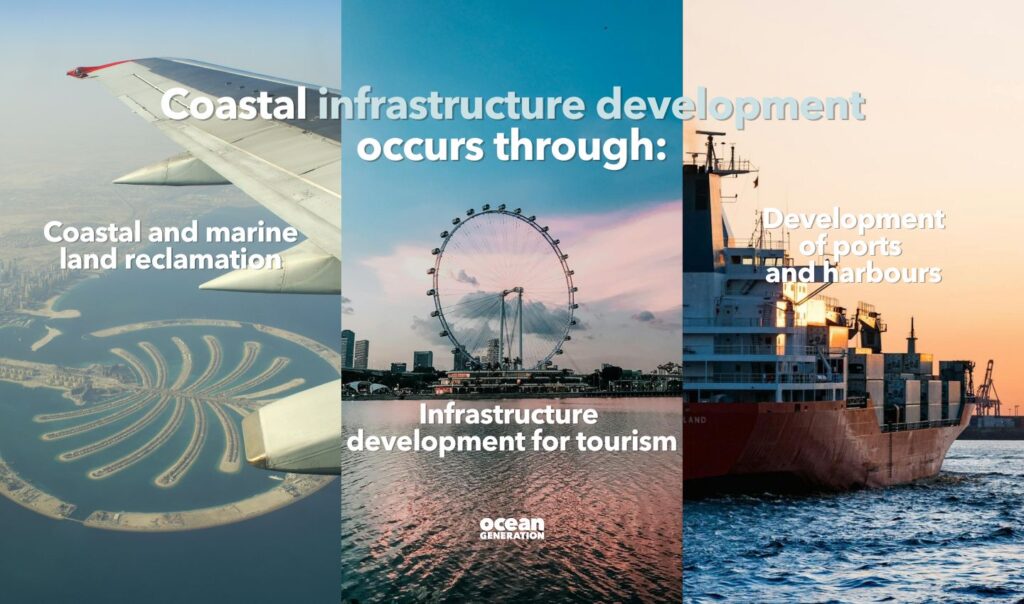
Coastal and marine land reclamation, the process by which parts of the Ocean are formed into land.
Infrastructure development for tourism, such as resorts and recreational facilities.
Development of ports, harbours, and their management.
This is a key driver for habitat destruction (when a natural habitat can no longer support the species present) and biodiversity loss. It also increases the vulnerability of coastal communities to climate change impacts.
With higher frequencies of natural events like cyclones and hurricanes, risk of erosion, saltwater intrusion, flooding and other cascading climate change impacts, coastal regions have never been this vulnerable.
How can we protect and restore our coastlines?
Enter: Nature Based Solutions (NBS). These are described by the IUCN as:
‘Actions to protect, sustainably use, manage and restore natural or modified ecosystems, which address societal challenges (such as climate change, food and water security) effectively and adaptively, while simultaneously providing human-wellbeing and biodiversity benefits.’
In other words, when we protect and restore natural ecosystems, we provide a whole host of benefits to ourselves, too.
This can be done by restoring degraded ecosystems to their former glory and halting further loss of existing ecosystems.
Ocean Solution: Habitat restoration.
Habitat restoration is the process of actively repairing and regenerating damaged ecosystems.
Restoring coastal ecosystems such as mangrove forests, coral reefs, oyster beds and seagrass meadows allow us to address environmental challenges (such as biodiversity loss). It reduces risks to vulnerable communities (like flooding, erosion, and freshwater supply). It also contributes to sustainable livelihoods by providing job opportunities.
That’s why at Ocean Generation, we support a mangrove restoration project in Madagascar, led by Eden Reforestation.
In 2022 alone, this project contributed to:
Carbon sequestration and habitat restoration by planting over 4.3 million young mangrove trees.
Creating sustainable livelihoods by employing around 70 people per month at the Maroalika site, with a total of 1,468 working days generated over the year.
To halt ecosystem destruction and prevent further habitat loss, we must take measures to protect remaining coastal ecosystems.
One mechanism to achieve this is by implementing Marine Protected Areas (MPAs). These are designated areas of the Ocean established with strict regulations to protect habitats, species and essential processes within them.
If implemented and monitored effectively, Marine Protected Areas can provide a range of benefits across biodiversity conservation, food provisioning and carbon storage
What is the 30 by 30 target?
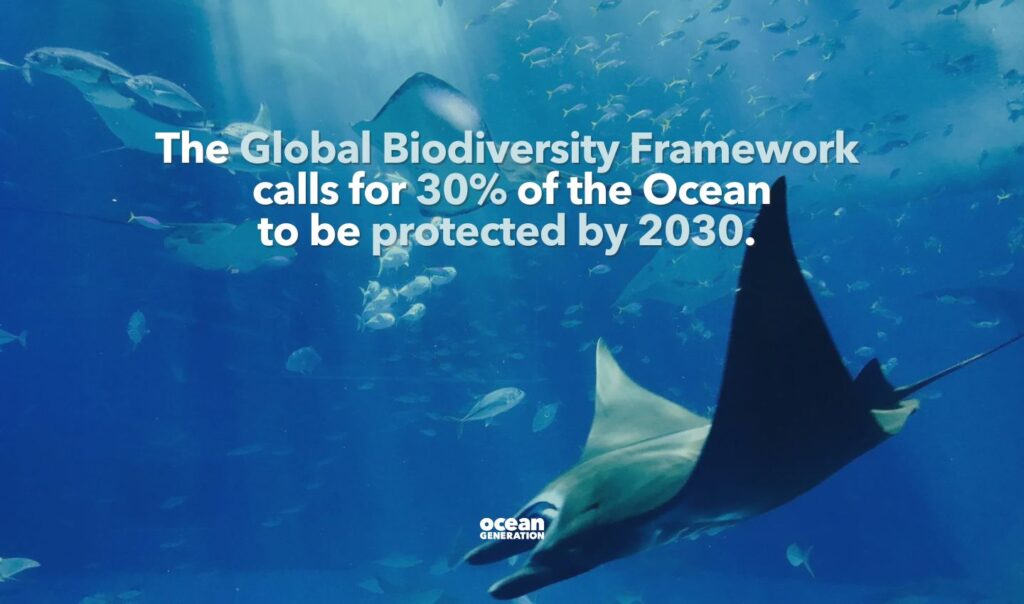
In recognition of the importance of healthy and thriving ecosystems, the Global Biodiversity Framework have established a “30×30” target. This calls for the conservation of 30% of the earth’s land and sea through the establishment of protected areas by 2030.
Spoiler alert: We’re not on track to meet this goal.
According to the Marine Protection Atlas (2024), only around 8% of the global Ocean area has been designated or proposed for MPAs, and only 2.9% of the Ocean is in fully or highly protected zones.
Research also shows that 90% of the top 10% priority areas for biodiversity conservation are contained within coastal zones (within 200-miles of the shore). We must ramp up our efforts to preserve these vital coastal ecosystems and ensure that MPAs continue to benefit both people and planet.
What are the main challenges to implementation?
Over the past 10 years, interest in the potential of Nature Based Solutions to help meet global climate change and biodiversity goals has surged, as we have begun to truly appreciate the importance of natural ecosystems.
Despite this knowledge and an abundance of opportunities for implementation worldwide, marine and coastal regions still lack uptake.
We must address the barriers to implementation to accelerate the rate of success of coastal protection worldwide, including (but not limited to):
Conflict of interest between stakeholders i.e. blocking of protective legislation by fishing and other extractive industries.
Marine and coastal ecosystems are ‘out-of-sight, out-of-mind’. This results in a lack of public and policy awareness of their value. As a result, Nature Based Solutions are often overlooked in favour of grey infrastructure such as seawalls.
Increasing our understanding of the vital services provided by coastal ecosystems is critical to overcoming these barriers.
The more we appreciate what these incredible ecosystems do for us, the more likely we are to succeed in protecting and restoring our coastlines.
Surviving in the Intertidal Zone: The gateway to the Ocean
Share this page
Copied
The intertidal zone is the dynamic interface between land and sea, which is constantly shifting and changing with the tide.
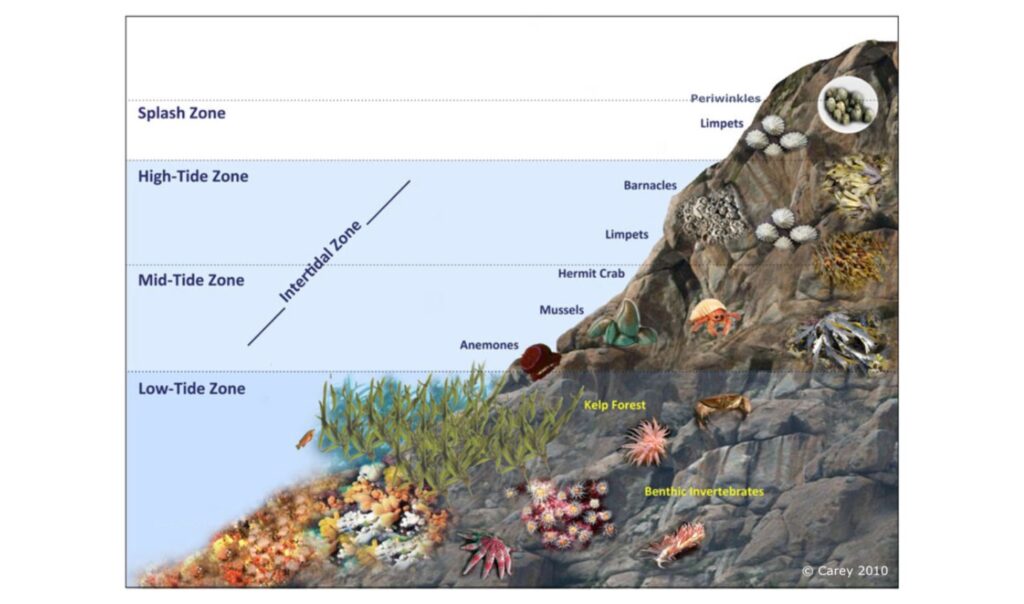
This extreme ecosystem is divided into four vertical zones, based on the amount of time each section is submerged. There are the low tide zone, middle tide zone, high tide zone and splash/spray zone.
Anything that lives in the intertidal zone must withstand dramatic changes in moisture, temperature, salinity, and wave action.
Marine life and ecosystems respond to these challenges either by short-term, reversible adjustments (phenotypic plasticity), or by long-term adaptations that involve heritable genetic changes (evolution).
Let’s explore the challenges of living in this dynamic environment, and some of the ingenious ways that intertidal animals have adapted to survive here.
Intertidal animals are exposed to air for a large portion of their lives
The drying out effect of air exposure poses a challenge for these animals, and they must find ways to reduce water loss to survive here.
The most common adaptation is to avoid water loss altogether. Intertidal molluscs (like mussels and oysters) retain water within their shells and tightly seal them shut. Others seal off their shell opening with a door-like structure called an operculum (snails do this).
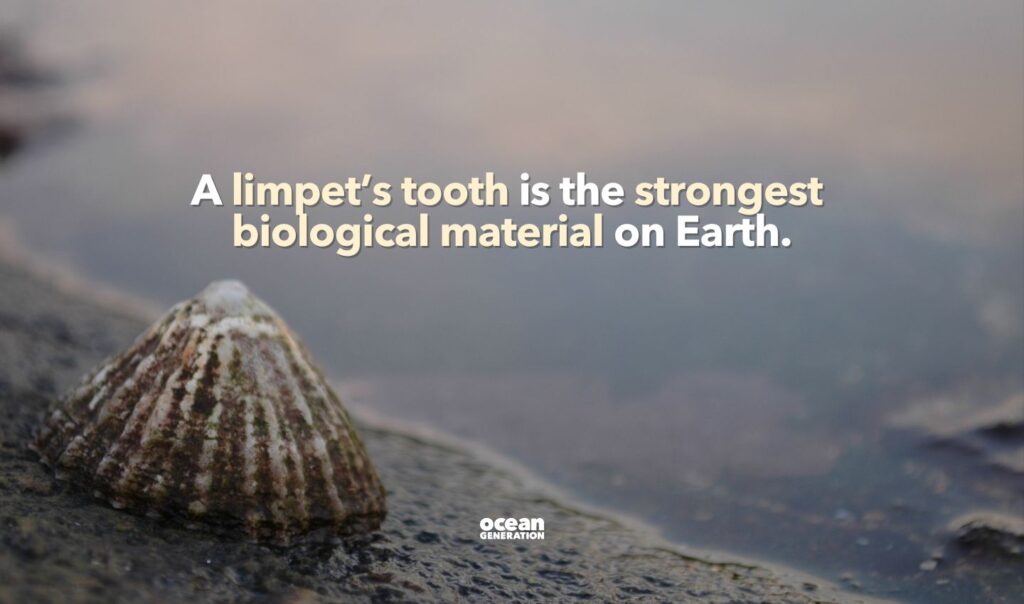
Limpets seal themselves against the hard substrate using suction and produce a mucous layer at this interface to create a watertight seal.
Air exposure leads to greater temperature fluctuations and extremes.
Mobile animals such as crabs avoid the largest temperature changes by shuttling between cooler and warmer environments. This technique is called behavioural thermoregulation.
For less mobile animals, thermal regulation becomes more challenging.
More sensitive animals such as sea stars/ starfish are limited to the low tide zone where they’re more frequently submerged.
Others, such as some species of intertidal mollusc, have evolved internal mechanisms such as heat shock proteins and a high freeze tolerance. These help the animals to cope with extreme temperature variations in the high tide zone.
The intertidal zone is characterised by severe changes in oxygen availability.
Particularly in overcrowded tide pools, when many animals are aggregated together during low tide, increased respiration can reduce water oxygen content to critical levels.
In response to this, some intertidal animals can switch to aerial respiration and take in oxygen from air instead of water.
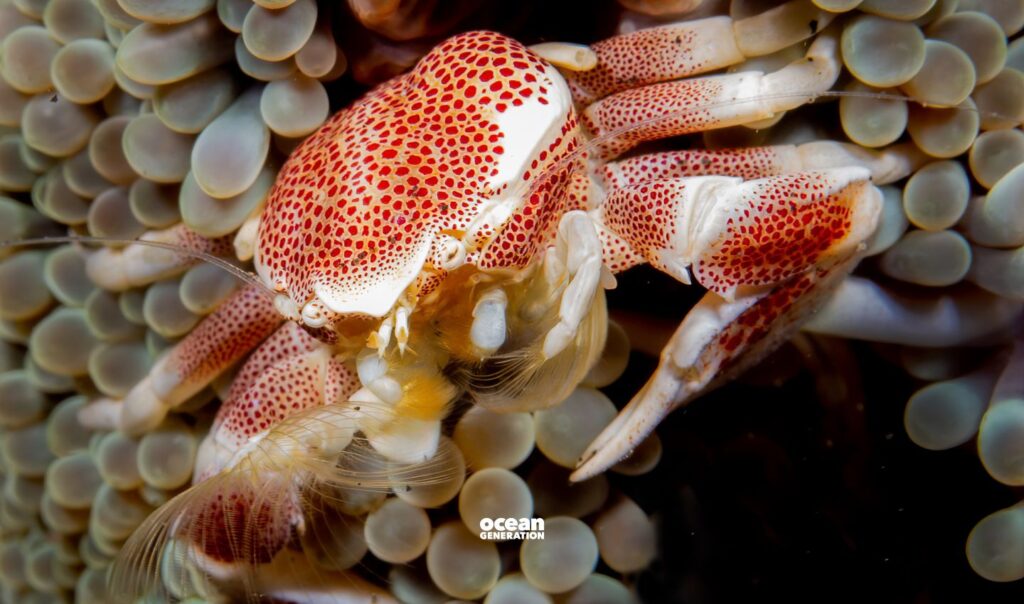
For example, the high intertidal porcelain crab (Petrolisthes) has an aerial gas exchange organ on each of their walking legs for air-breathing during periods of emersion.
On sandy shores, some species of mudskipper will repeatedly emerge at the surface of their burrows and take in mouthfuls of air. They deposit this air into a specialised chamber within their burrows to protect themselves and their eggs against hypoxic (low oxygen) conditions.
On sandy shores, activities of some intertidal creatures can influence local oxygen availability.
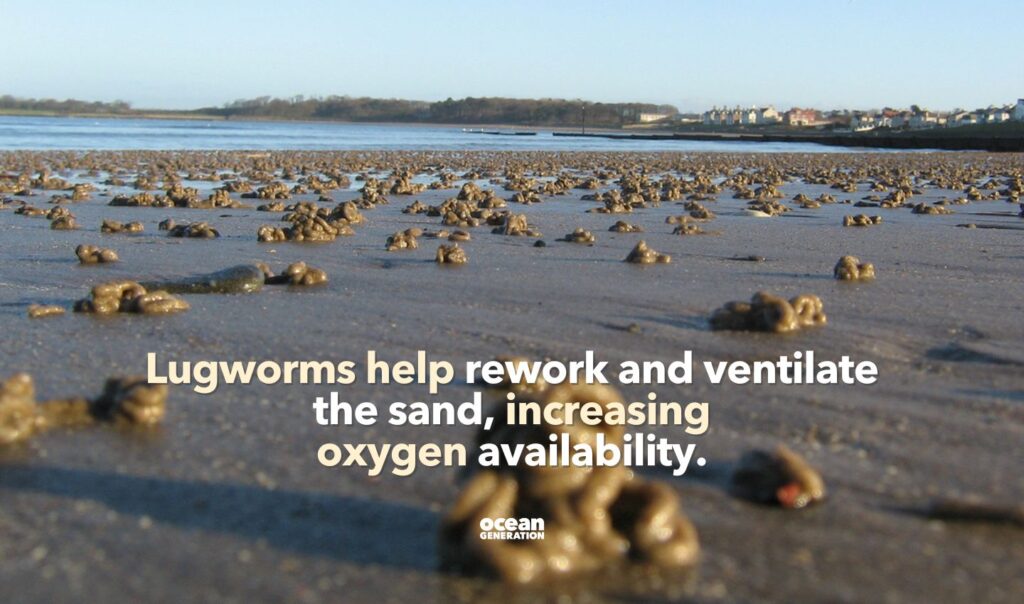
Lugworms burrow deep into the sediment, feeding on organic material in the sand and creating U-shaped burrows deep below the surface. These burrows help to rework and ventilate the sand. This process is known as bioturbation, which increases localised oxygen availability.
They spend their lives filtering out organic material from the sand, pooping out wiggly mounds of undigestible sand to the surface, known as ‘casts’.
All intertidal habitats are impacted by fluctuations in salinity.
Heavy rain or river inputs can make coastal water fresher, and evaporation and droughts can cause hypersaline (saltier) conditions.
On sandy and muddy shores, intertidal worms move vertically up and down their burrows along a salinity gradient until they reach more favourable conditions.
Other animals maintain their internal osmotic (salt and water) balance in the same way that they protect themselves from water loss. Some clamping to the substrate (limpets); others closing their operculum (snails); or moving to more favourable environments (crabs).
The shallows are exposed to ultraviolet (UV) radiation from the sun.
This can cause DNA mutations and damage to molecules needed for key biological pathways.
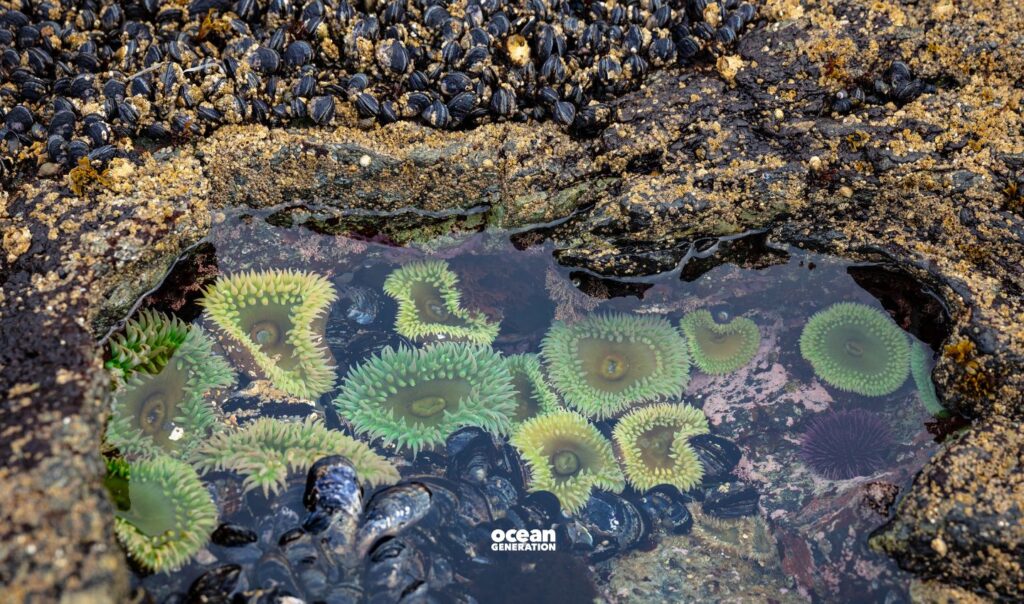
To combat this, the aggregating anemone (Anthopleura elegantissima) contracts during peak levels of UV radiation. It attaches debris to its column for extra protection against harmful sun rays: Just like putting on a sunhat.
Other intertidal animals have even evolved ‘sunscreens’. These are absorptive, reflective, or light-scattering pigments in their skin and mucus which help to protect them from the damaging effects of sun exposure.
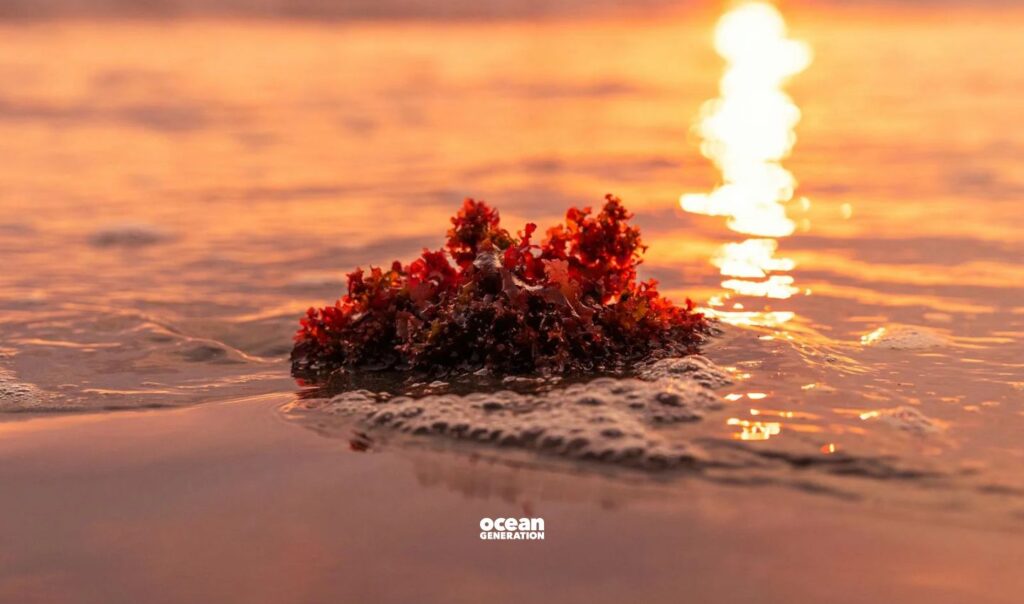
For example, Irish moss (Chondrus crispus) is the reddish leafy seaweed that can be found on rocky shores and tide pools across the UK and Ireland. If you look closely, you’ll see that it looks slightly iridescent in the light.
This is because the tips of the growing fronds are covered in multiple, transparent layers. When sunlight hits these layers, it’s reflected away from these delicate regions, protecting this alga from harmful UV rays.
To avoid being swept away by wave action, intertidal animals must hold on tight.
Barnacles secrete cement, while mussels produce a sticky thread called Byssus threads to attach themselves to the rock. Once attached, these sessile animals remain in position for most of their lives.
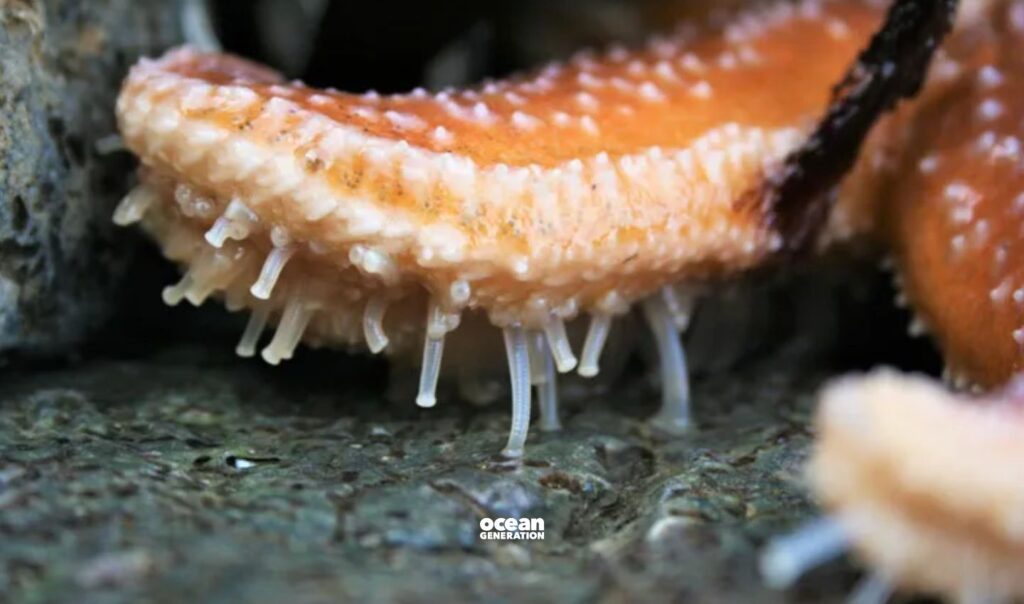
Other intertidal creatures rely on suction. Sea stars (starfish) have rows of tube feet on their underside. Each of their feet has a sticky, suction cup at its end that help it hold on to the rocky substrate. These also come in useful to prise apart the shells of bivalves to eat.
Many adaptations are shared among diverse animal groups.
This is an example of convergent evolution: when similar features independently evolve among different species under the same pressures.
Understanding the challenges overcome by animals living at the interface between land and sea may allow us to better understand our own historical transition from Ocean to land, millions of years ago.
So next time you’re at the coast, see if you can spot some of these creatures and their adaptations. (Remember, they’re under enough stress already, so be respectful and don’t touch, poke or prod at them).
Take a moment to appreciate the incredible feat of survival achieved by the Ocean creatures that not only survive but thrive in this extreme environment.
The motion of the Ocean explained: Waves and tides
Share this page
Copied
The Ocean spends its life in perpetual motion.
From the smallest ripple to the largest storm wave, energy from the Ocean is one of the most powerful forces on our planet. They have carved the shape of our coastlines over thousands of years.
Many of us observe the constant motion of waves and tides, but few of us ever stop to consider how these not-so-simple certainties actually work.
What are Ocean waves, and where do they come from?
First things first, Ocean waves are the transfer of energy across a body of water, not the movement of water itself.
Surface waves are caused by wind out at sea. As the wind blows across the Ocean, particles near the surface are disturbed. Friction and pressure generate ripples, and this wave induced pressure causes each individual water particle to push and pull on its neighbour.
The water molecules begin to move up and down in a circular orbit, creating a wave crest. This motion propagates energy through the water in the direction of the wind.
Once they have enough energy from the wind, these wave crests spread out and begin their journey across the open Ocean as “swells”. These swells can travel uninterrupted for thousands of miles, until they reach the shore and meet their dramatic end.
As the wave approaches shallower water, the circular orbits of the water molecules in the lower part of the water column are disrupted by the seafloor and get slowed down by friction.
The water molecules closer to the surface are less effected by friction, so the energy continues to move through them at its original speed.
The wave grows in height but is left unsupported as the lower part is dragged along the seafloor. Eventually, the wave finds itself with nothing underneath it, and collapses in a dramatic fashion, known as the wave “break”.
Another form of Ocean waves that move across our planet are tides.
The predictable rise and fall of the Ocean along our shores is as certain as the sun rising in the East and the stars coming out at night.
For centuries, humans have learned to predict the tides for navigation, fishing and other recreational activities.
But to fully understand how tides work, we must look up to space.
The moon and Earth both exert a gravitational force and are constantly accelerating towards each other in orbit.
As our planet accelerates towards the moon, the water on the side closest to the moon accelerates faster than the solid rock in the middle and accumulates to form a slight bulge.
This is known as tidal bulge.
As the Earth rotates, this watery swell stays in the same position relative to the moon. The land rotates into this bulge at high tide, and out of it at low tide.
So, when we stand on the beach and watch the tide going out, what we’re actually observing is the Earth rotating away from the Ocean.
But wait a second, why are there two high tides per day?
This is where things get a bit more complicated. Put your scientist hats on, and imagine the following:
While the water on the near side bulges towards the moon, the water on the far side bulges away from the moon.
Remember that the moon and Earth are constantly accelerating towards each other in orbit.
A centrifugal force (a force which acts on an object that’s rotating) acts as a result of this spinning.
On Earth, this centrifugal force is strongest at locations facing away from the moon, causing the water to bulge away from the moon at the far side.
Earth therefore rotates into two tidal swells each lunar day of 24 hours 50 mins.
What is a lunar day?
A lunar day is the time it takes for a specific point on Earth to rotate from an exact point under the moon to return to the same point under the moon.
This explains why there are two high and two low tides per day, and each high tide occurs 12 hours and 25 minutes apart.
The sun also has a gravitational tidal force on our Ocean: It’s called a solar tide.
However, it’s much smaller since the sun is much further away.
When the sun and the moon are aligned, their lunar and solar forces combine to create a larger tide, known as spring tide.
In contrast, when the sun and moon are at a right angle, their opposing tidal forces partially cancel each other out, creating a smaller tide. This is known as neap tide.
Back on Earth, the shape of the coastline can have a dramatic influence on tidal magnitude.
For example, the highest tides in the world can be found in the Bay of Fundy, Nova Scotia, Canada. The size, depth and unique funnel-shape of this coastline causes a natural oscillation (a back-and-forth movement in regular rhythm) of the water in near-perfect sync with the tide, which has an amplification effect.
So next time you’re taking a stroll along the coast and listening to waves crashing against the shore, take a moment to consider the forces in play to make it all possible.
Waves and tides are all part of the continuous movement of energy that has formed and shaped our universe since the beginning of time.
Coral reefs are one of the most important ecosystems on Earth.
What makes coral so brightly coloured? Why do they turn white when they’re unhealthy? We’ve got you covered. Below, we’re sharing 12+ fascinating facts about coral reefs: The most biologically diverse ecosystem on Earth.
Corals reefs are large skeletons (because they’re made up of tiny animals a.k.a. ‘coral polyps’). They’re home to hundreds of plants and organisms, support fisheries and may host the answers needed to develop new cancer medication.
How many of these coral reef facts do you know?
1. Coral reefs occur in more than 100 countries and territories whilst covering only 0.2% of the seafloor. They reside in tropical and semi-tropical waters.
2. The single-celled algae, zooxanthellae, that live in the tissues of the coral polyps can fuel up to 90% of the reef-building coral’s energy requirements for growth and reproduction. Additionally, zooxanthellae are responsible for the vibrant colours of the corals!
3. In return, the corals provide them with a home to reside in and nutrients to aid photosynthesis. Thus, fulfilling a mutually beneficial (‘symbiotic’) relationship!
Coral reefs protect around $6 billion worth of built infrastructure from flooding around the world, from an economic perspective.
5. Large scale losses of coral reefs are due to a warming Ocean and climate change.
Land-based pollution of nutrients and sediments from agriculture, marine pollution, overfishing and destructive fishing practices, and outbreaks of coral diseases and crown-of-thorn starfish (see below image) are all causes of local coral losses.
6. Coral reefs support at least a quarter of all marine species. What’s more: Coral reefs are a home to an average of 830,000 species (550,000 – 1,330,000). The range varies widely due to large populations of small cryptic species being difficult to sample.
7. Astonishingly, scientists estimate that roughly 74% of coral reef species remain undiscovered!
8. Ocean acidification is a major threat to coral reefs.
The decrease in pH (making water acidic) hinders corals and other organisms from forming their skeletons. This makes them especially vulnerable in juvenile stages.
The weakening of these skeletons also results in habitat loss, low reef biodiversity, coastline erosion etc.
9. Coral reefs subjected to higher temperature levels increase the likelihood of abrupt and irreversible changes. According to the IPCC, a record-shattering warming world of 1.5°C would mean a 70-90% decline in coral reefs.
10. Coral reef associated fisheries provide 70% of protein in the diets of Pacific Islanders. These fisheries support around 6 million people and are worth $6.8 billion annually.
11. Corals can turn white due to coral bleaching. Climate change is a major driver of coral bleaching, and this process disrupts the symbiotic relationship with zooxanthellae.
As the algae is dispelled by the corals in an attempt to protect themselves, the corals vulnerability increases and they lose a major energy source. If the heat stress persists, corals are likely to die.
Over half of the our coral reefs are already lost.
12. Coral restoration is a relatively new nature-based solution. Nature-based solutions refers to an umbrella of methods for reviving ecosystems in the face of adversity.
A 2020 review stated that coral restoration projects report a survival rate between 60-70% with a report stating that 1.5C warming would render this solution to be ineffective.
The authors of the review noted that most projects are small-scale and that we’ll still require large-scale climate action to tackle the root of this issue.
With over half of the world’s coral reefs already lost, it is evident that coral reefs are declining due to a multitude of human pressures.
Some warm water corals have reached adaptation limits. Nevertheless, scientists and local communities are working extremely hard to continuously build on existing solutions and quickly adopt innovative approaches.
The existential threat of the rise in global temperatures means that climate change action is urgently needed to establish coral reef resilience.
2. Vaquitas are endemic to the Gulf of California, Mexico.
Vaquitas display no migratory behaviour and have limited themselves to the Northern part of the Gulf of California, as depicted in the figure below.
3. How big do vaquitas get?
They grow up to 1.5m long (5 feet). Vaquitas live in relatively shallow waters (<50m) and have been observed individually, in pairs, and small groups of up to 8-10 individuals.
4. No one really knew what vaquitas looked like until the late 1980s.
Locals, along the Gulf of California, didn’t know much about vaquitas before they were described, based on their skulls in 1958, but anecdotal evidence from locals include references to “vaquita”(meaning little cow), “cochito”(meaning little pig) and “duende”(meaning ghost or spirit).
A dark ring around the eyes is the vaquitas most striking feature, along with a proportionally large dorsal fin. They’re unique among porpoises because they’re the only species of the porpoise family found in warm waters.
6. When did the vaquita become endangered?
In 1978, the IUCN red-listed the vaquita as ‘Vulnerable.’ In 1990, vaquitas became ‘Endangered’ and, in 1996, ‘Critically Endangered.’
7. Why are vaquitas endangered?
The main reason vaquitas are endangered is due to entanglement in gillnets with bycatch in legal and illegal fisheries for shrimp and finfish, and in the last decade, specifically for totoaba.
A gillnet is a wall or curtain of netting that hangs in the water. Image source.
8. How many vaquitas are left?
In 2007, there were an estimated 150 vaquitas in our Ocean but by 2018, that number had dropped to 19.
Gillnet fishing – has been banned – however, illegal fishing of totoaba (an endemic fish) continues. The totoaba is also critically endangered too so, the fate of the totoaba and vaquita are closely linked.
There is always hope.
Scientists suggested imminent vaquita extinction in the mid-2000’s but as of 2023, there are still between 6-19 vaquitas alive.
One study on genetics found that due to low population size and low genetic diversity, if gillnet fishing was 100% stopped, there is only a 6% chance of extinction of vaquitas.
This is possibly the first photo published of a vaquita in nature, on a rather placid sea, taken on 10 March 1979. Photo by R.S. Wells.
10. The vaquita can give birth annually.
And multiple newborns were sighted in 2019.
A note from Ocean Generation: Your support may feel like a drop in the Ocean, but the Ocean would be less without that drop.
We’re known for translating complex Ocean science into engaging content and bringing the Ocean to young people across the world. As a charity, every donation is vital and will directly support our environmental youth programmes that drive social action to safeguard our Ocean.
To provide the best user-experience for our website, we use cookies. Consenting to these allows us to process data such as browsing behaviour on our site.
Functional
Always active
Technical storage or access strictly necessary for the legitimate purpose of enabling the use of a specific service on our site.
Preferences
The technical storage or access is necessary for the legitimate purpose of storing preferences that are not requested by the subscriber or user.
Statistics
Technical storage or access that is used exclusively for statistical purposes.The technical storage or access that is used exclusively for anonymous statistical purposes. Without a subpoena, voluntary compliance on the part of your Internet Service Provider, or additional records from a third party, information stored or retrieved for this purpose alone cannot usually be used to identify you.
Marketing
Technical storage or access is required to create user profiles to track the user on a website or across several websites for similar marketing purposes.
What if £5 could send you on an once-in-a-lifetime Arctic voyage?
The lucky winner, and their guest, will enjoy up to 15 unforgettable days sailing through icy glaciers while spotting whales and polar bears on a sustainable adventure.