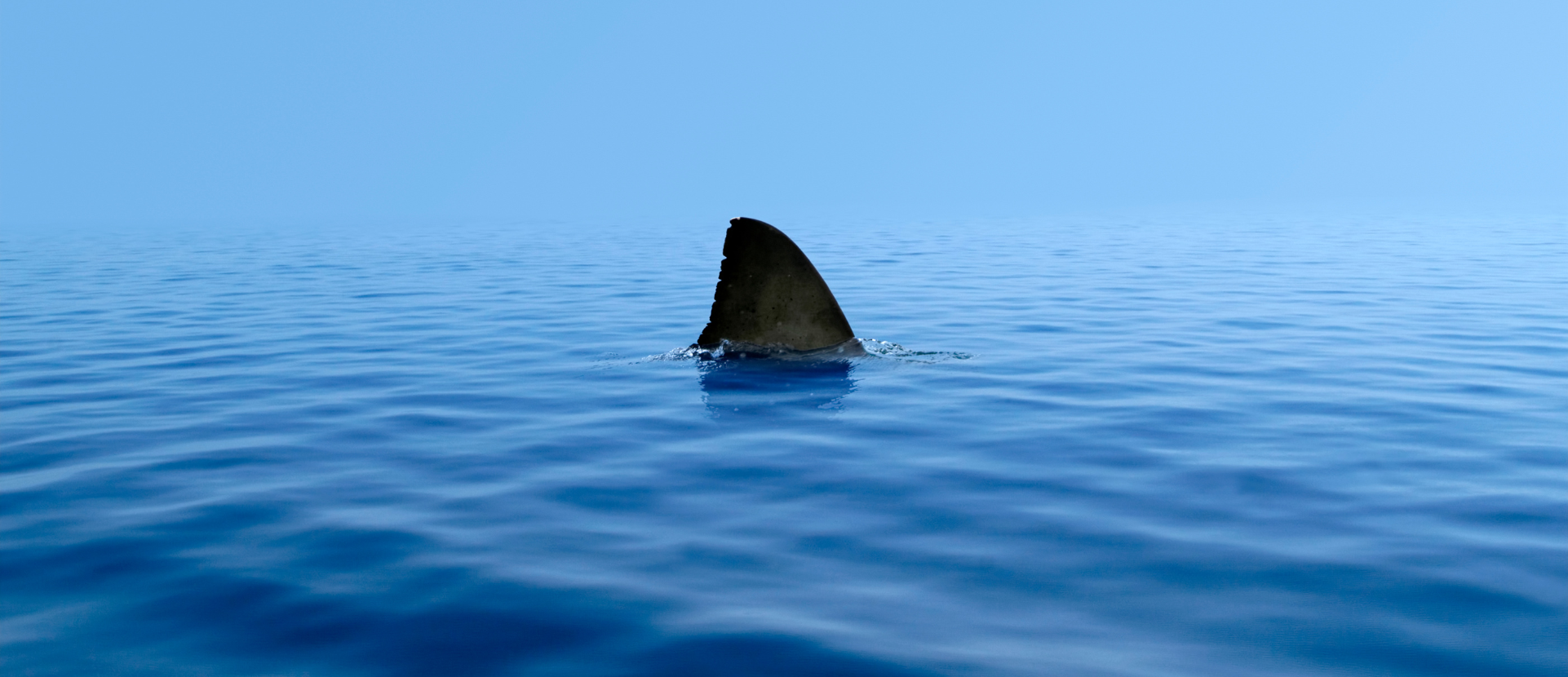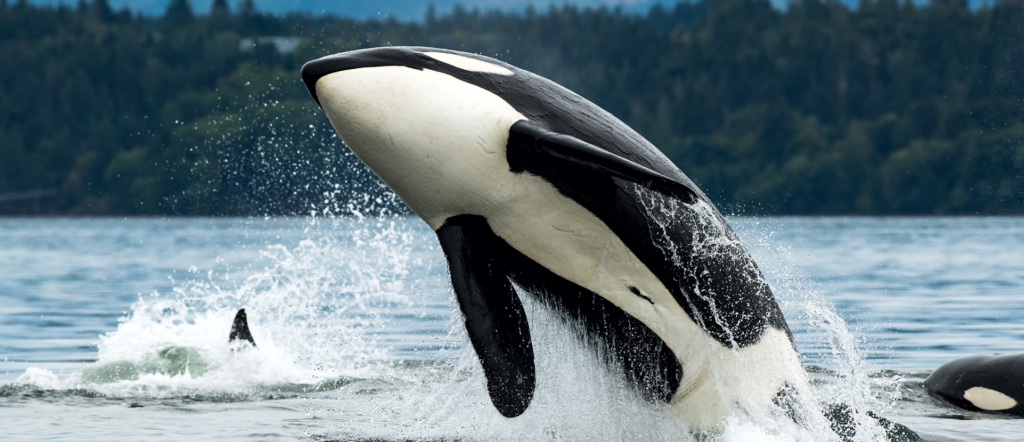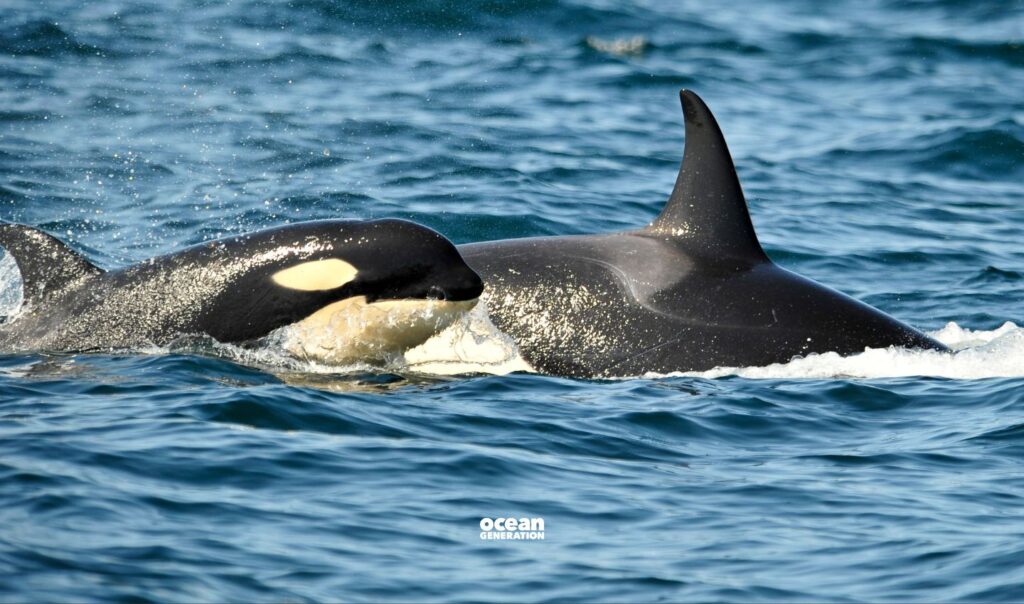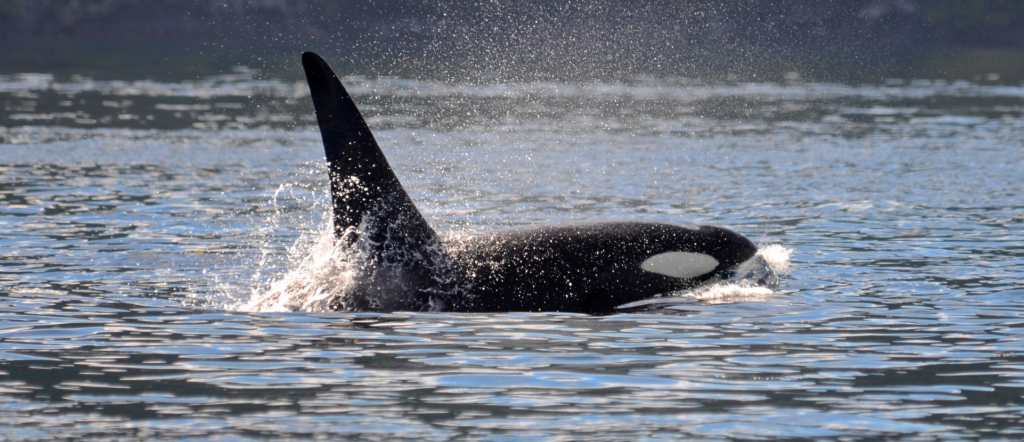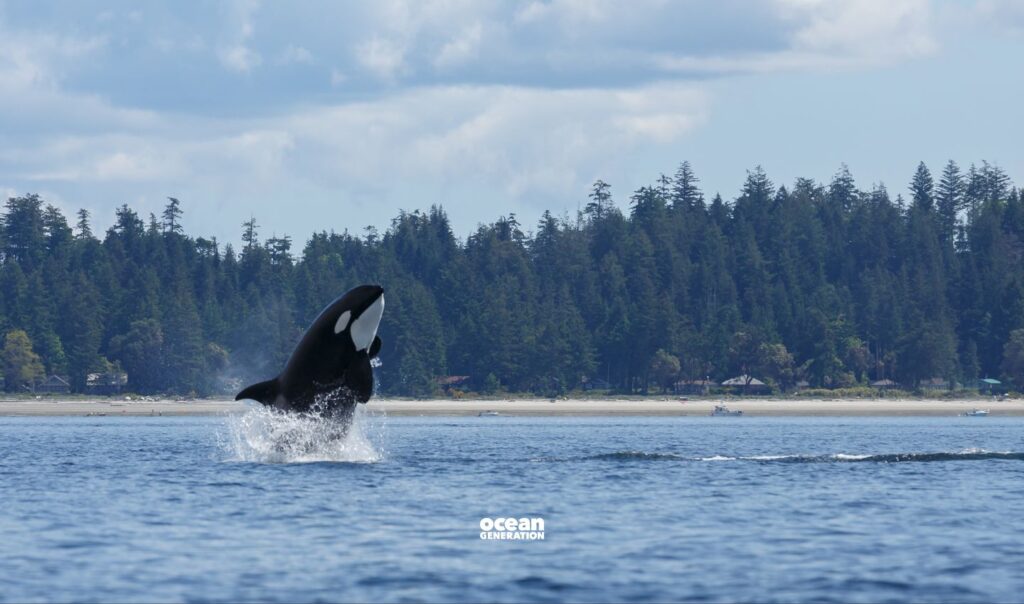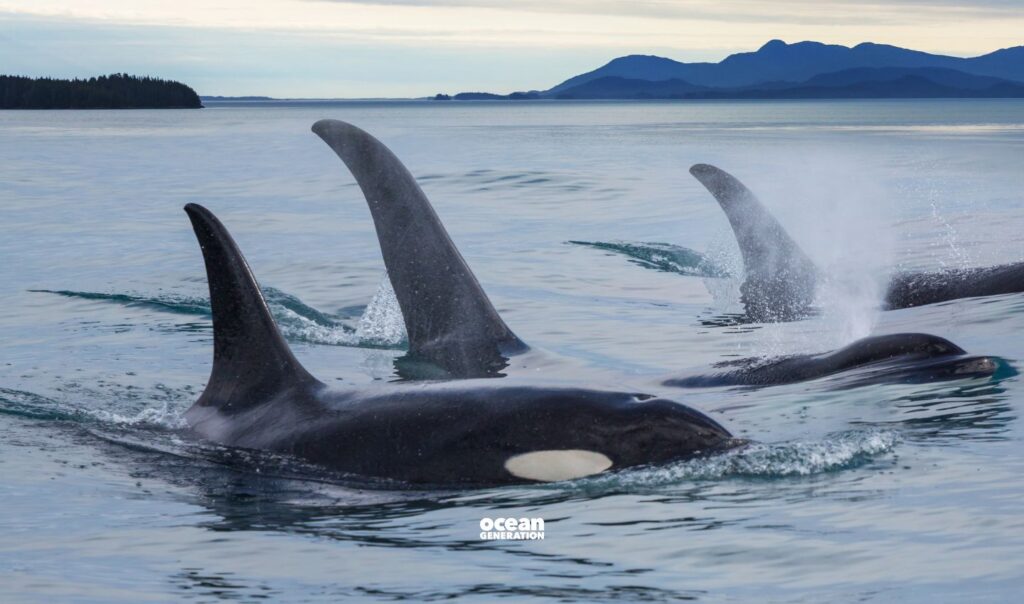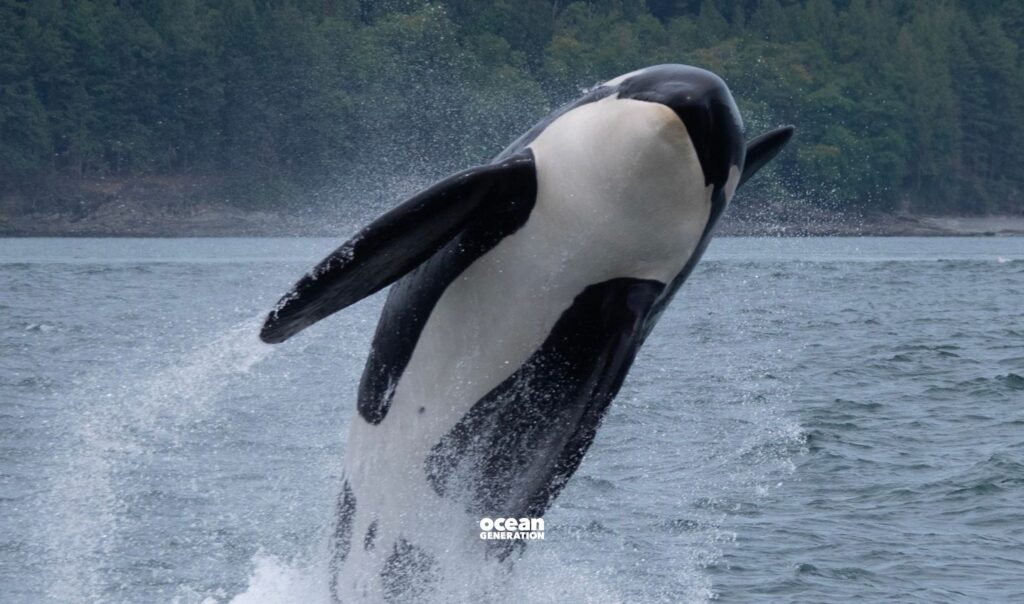
Orca (also known as killer whales) are famous residents of the Ocean. They are fast, fashionable and family-oriented. Frankly, they are fantastic.
Are orcas whales or dolphins?ย
Orcaย arenโt whales, they’re dolphins.
The commonly used name, killer whales, can cause confusion. Early sailors became familiar with orca hunting the great whales, naming them โwhale killersโ. Somewhere in history, that got flipped to become โkiller whaleโ, even though orca are actually dolphins. They are the biggest of the dolphins.
Are all dolphins whales?
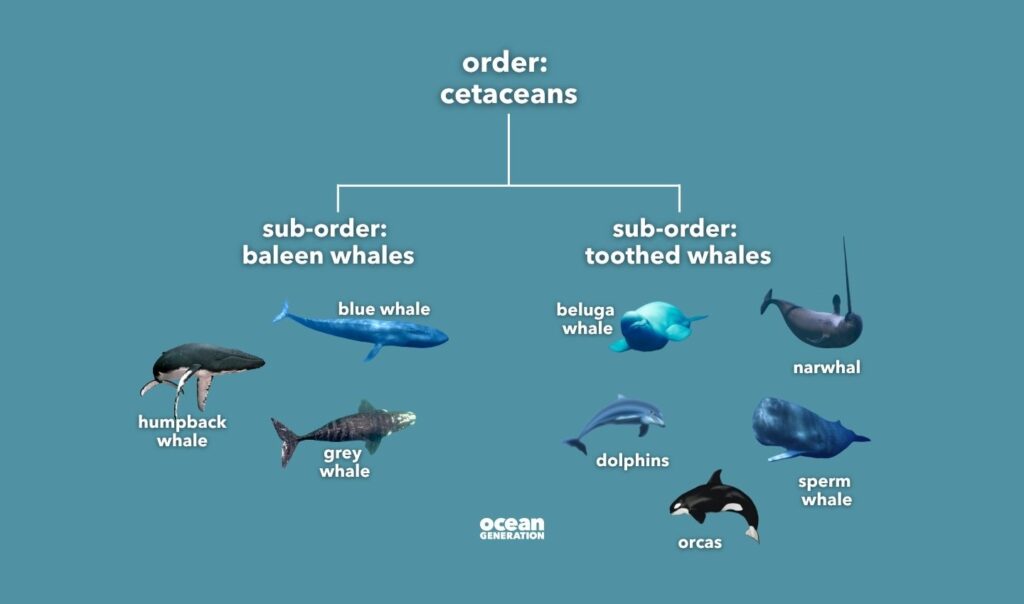
Technically, the whole dolphin family, theย Delphinoidea, belong toย toothed whalesย โ the Odontoceti.ย Along with theย Mysticeti (baleen whales) they make up the cetaceans.ย
So, you could argue allย dolphinsย (and therefore orca)ย areย in factย whalesย but they have dolphin-specific traits so, they’re not ‘true whales.’
Orcinus orcaย isย currentlyย aย single species, although scientists have suggested dividing it intoย races, subย speciesย or evenย different species.ย ย
Different groupsย ofย orcasย are known asย ecotypesย whichย inhabitย different partsย of the Oceanย and show physical and cultural differences.ย Theyย speak different dialects, eat differentย foodย andย grow toย different sizesย with different colouration.ย In many ways they areย much like humans.ย ย
Where do orca live?
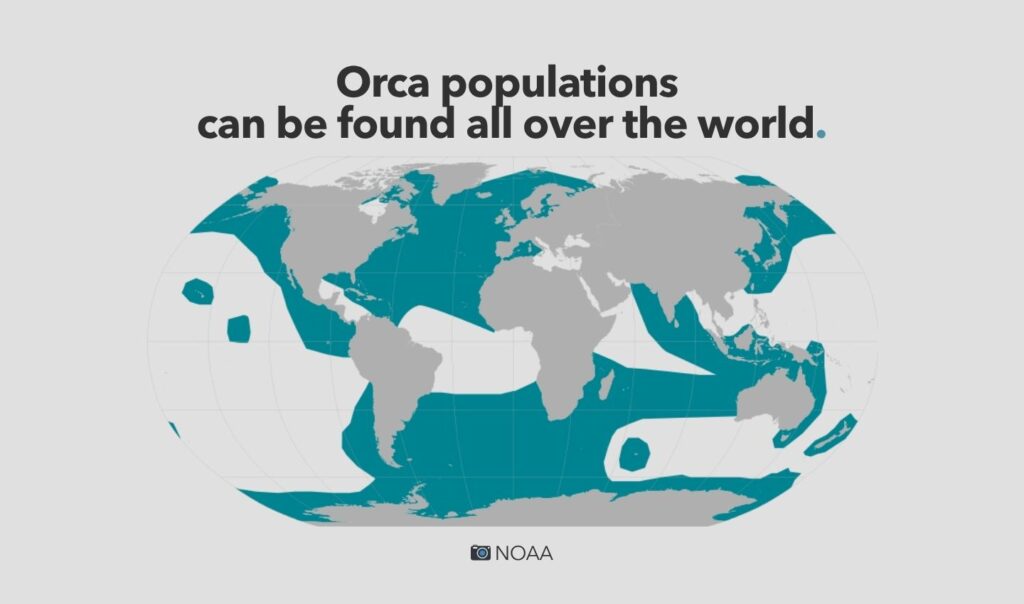
Populations can be found all over the world, typically preferring coastal seas to the open Ocean, and the higher latitudes closer to the poles. The main population centres for orca are in the Southern Ocean, the north-eastern Atlantic and in the northern Pacific, but orca can be found from Hawaii to the Arctic.
How many orcas are there?
There is an estimated global population of 50,000 orca, including 25,000 in the Southern Ocean, and 10,000 in the waters of Norway, Iceland and the Faroes.
The global population of orca has not been assessed by the International Union for Conservation of Nature (IUCN). We donโt know enough to say whether orca populations are increasing, decreasing or stable.
We do know about the different orca sub populations around the world. Some, such as the Iberian orca population which has been sinking boats, are critically endangered. The West Coast Community of the UK is thought to only have two members remaining: Aquarius and John Coe, who at over 60 years old may well be the oldest male killer whale in the world.
Other orca populations are doing better. Antarctic populations are hard to study, but thought to be stable. Northern Resident orca of the west coast of North America are listed as threatened, but their numbers are increasing by an average of 2% per year after protective measures were introduced for them and their main prey โ harbour seals.
All orca are carnivores but different populations of orca have different preferred diets. Norwegian orca have specialised in herring, northeast Pacific orca hunt salmon and New Zealand orca focus on elasmobranch species such as eagle rays, stingrays and shark species.
Two orca brothers in South African waters, Port and Starboard, are infamous for targeting great white sharks, flipping them onto their backs into a trance-like state known as tonic immobility and eating their livers. As a result, great whites leave the area when orcas are about. Other orcas have been recording other shark species such as whale sharks, seven gill sharks, mako sharks and white sharks.
Nothing is off the menu. Orca will hunt marine mammals, including walrus, dolphins, narwhals, beluga and whales. Orca have been recorded recently hunting the largest animal that has even lived: blue whales.
A population off the western coast of North America has revived a fashion fad last seen in the 1980s of swimming around with dead salmon on their heads. Fashion experts compare this to the revival of the bucket hat.
Orca are among the very few species to go through menopause in the wild. Beluga, narwhals, short-finned pilot whales and false killer whales join humans in this exclusive group. This allows orca grandmothers to act as vital sources of knowledge in food location and hunting techniques, while avoiding them competing reproductively with their daughters.
Orca are estimated to eat nearly 800kg a week (roughly 1600 loaves of bread or 8,000 apples).
Who are the orca outlaws sinking boats, and why are they?
Share this page
Copied
Why are orca sinking boats?
Revenge, anti-capitalist revolution, competition, territoriality, a โtide-podโ challenge-esque fad, curiosity โ all suggestions to answer one question: why are orca sinking boats?
Much changed in the world in 2020. We all stayed home, made banana bread and, in the UK, attended Joe Wicks workout classes. There was a change in the Ocean in 2020 too: orca began bumping boats.
Now, almost six years on, 8 boats have sunk and over 250 have been damaged. Looking at the data from these interactions, and through knowing these orca, can we piece together why they might have started down this road of vessel vandalism?
What are orca?
Orca (Orcinus orca) are the apex marine predator. Orcas are the largest of all the dolphins (despite their killer whale nickname, they aren’t true whales; read our orca fact file here).
They are found throughout the Ocean, from Antarctica to Norway, Argentina to New Zealand to South Africa.
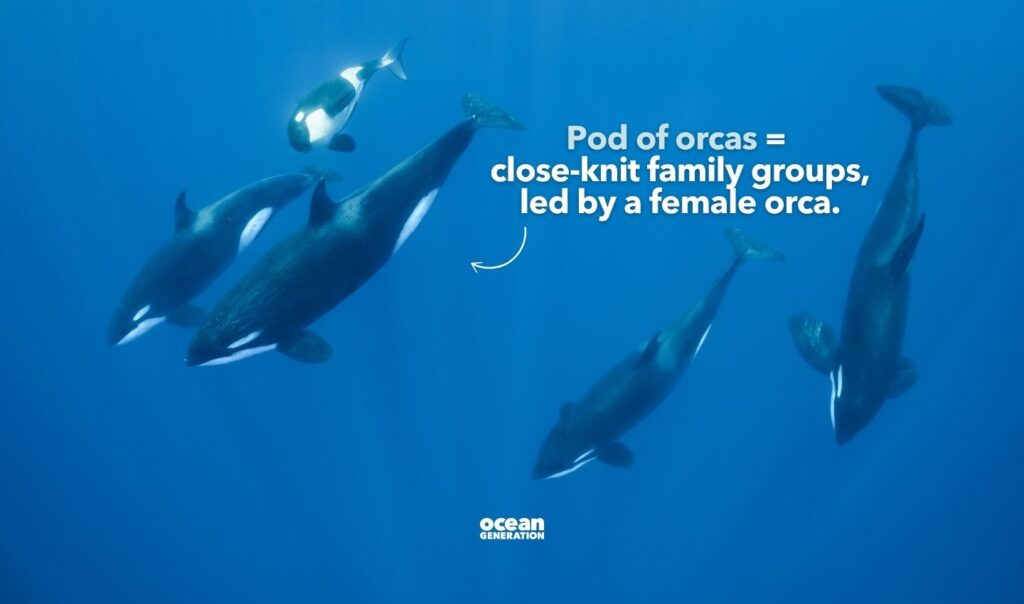
Orca are highly social and highly intelligent, living in large family groups usually led by a matriarch โ an older female. They are capable of advanced communication and coordination, executing intricate, risky and ingenious hunting strategies. Orca are incredible.
They have been recorded hunting whale sharks,white sharks,walrus, and whales (hence their nickname, killer whales). Scientists donโt believe they are particularly affronted by species beginning with W.
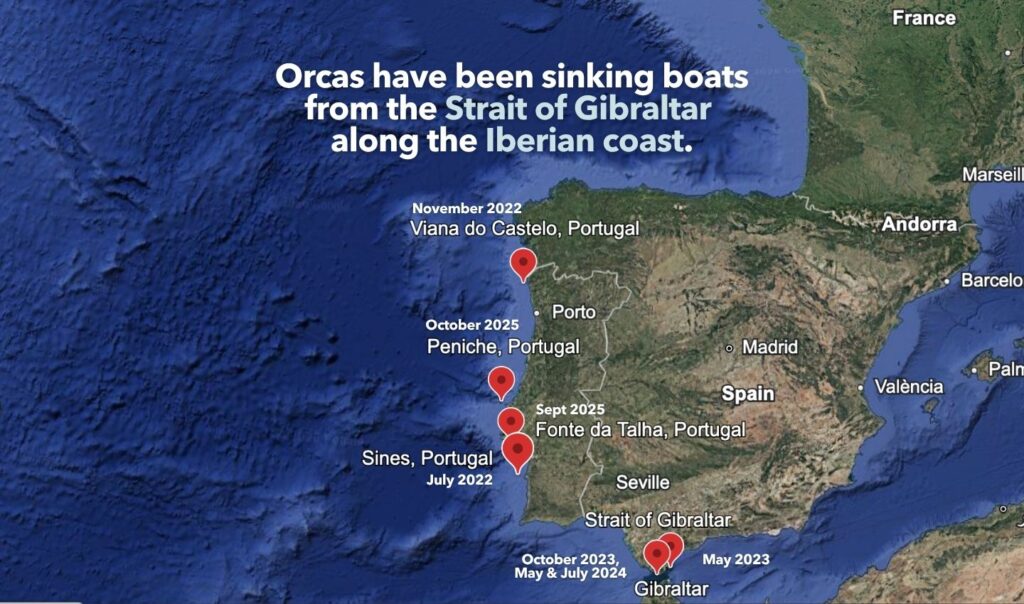
The Iberian orcas are a small population of orca that reside in the western Atlantic from Gibraltar up to the Bay of Biscay. The โsmallโ is a double entendre. They are among the smallest orca on the planet, with females reaching up to a mere 5.8m and males only 6.5m. They are also small in number: the International Union for Conservation of Nature (IUCN) classify this population as critically endangered, with the population estimated to number only up to 50.
Between 1999 and 2011, 47 individuals from 5 different pods were photo-identified and a further 16 in the Canary Islands, which are genetically distinct (they arenโt family) from the Iberian orca. After accounting for deaths, the Iberian population was 33 in 2012.
Of this orca population, 15 individuals have been identified as boat-bumpers from witness accounts, photos and videos. These sailing saboteurs are then given the moniker โGladisโ – derived from gladiator, or fighter.
The Gladises are in two main pods, each led by an older matriarch. Gladis Lamari is estimated to have been born in 1992 and Gladis Herbille in 1993. Neither of them have directly interacted with boats: they are Gladises as they have been observed close by during boat interactions. They seem content to sit back and watch the younger ones.
What do the Iberian orca eat?
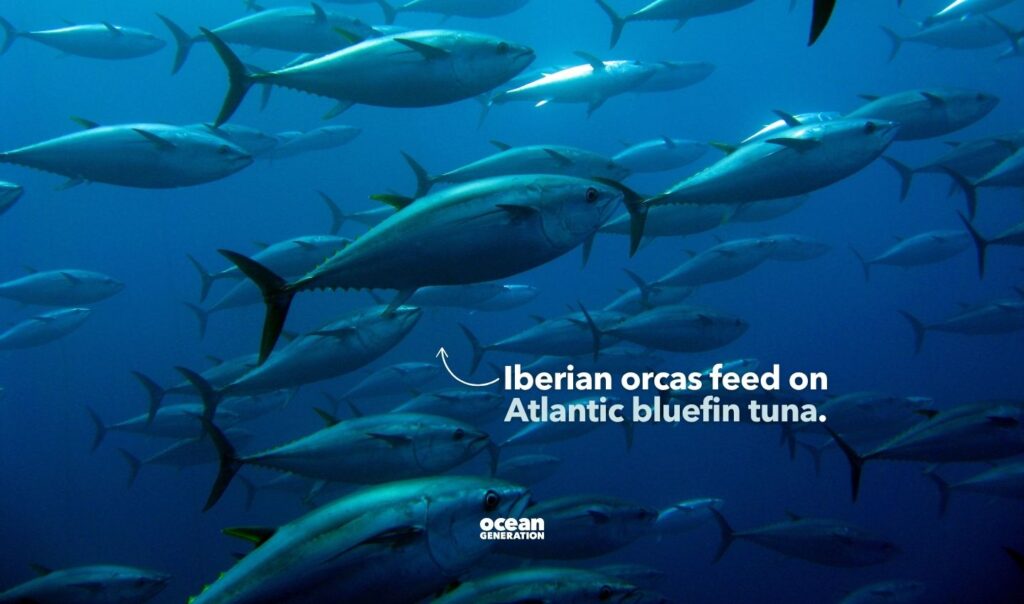
From April to June, the Iberian orcas gather in the shallower waters of the Gulf of Cadiz and the northwestern strait of Gibraltar. Why? Because it is the start of the spawning migration into the Mediterranean of their primary food source: Atlantic bluefin tuna.
In July the orcas shift to the central Strait of Gibraltar as the tuna begin to return to the Atlantic and follow them up the coast of Portugal into September and October.
How do we know the orcas are eating tuna?
By using crossbows, mass spectrometers and following the principle โyou are what you eatโ. A skin sample was collected from biopsy darts, fired from a modernised version of the ancient weapon. To reiterate: a marine biologist, armed with a crossbow, gets a bit of skin and can work out what the orca are eating.
To assess the diet, the orca skin is analysed for the ratios of carbon and nitrogen isotopes.
Isotopes are atoms of the same element with different masses, due to different numbers of neutrons.
Carbon isotopes indicate where an animal feeds, while nitrogen indicates the trophic level (higher trophic level means higher up the food chain โ a predator that eats predators, like orca, have a high trophic level).
In short, the fish an animal eats leave different โsignaturesโ that we can read, telling us what and where our orca are eating.
The Iberian orca showed carbon and nitrogen values reflecting a diet of Atlantic bluefin tuna, with one exception. The female (named Vega) had higher ratios of heavier carbon, showing she was eating more coastal fish species โ everyone has their preferences.
More recently, the tables have turned. Now it is the orca using the fishers for an easier meal, taking tuna caught on fishing lines as they are hauled in. Unfortunately, this is a dangerous strategy, and orca have been seen with deep wounds and amputations, likely from interacting with fisheries.
But before 2020, we have very few instances of orca sinking boats.
In 1820, a whaling vessel, the Essex, was sunk by a sperm whale in the Pacific. In the aftermath, the crew reported orca attempting to sink one of the small boats they had escaped the Essex in.
Luna was separated from his pod when he was just 2 years old. He spent five years around Vancouver Island where he would interact with floatplanes and boats, causing damage to the craft and occasionally hurting himself. Sadly, Luna was killed in March 2006 by a tugboat.
How many boats have orca sunk?
Some social media posts have claimed over 1,000 boats, but as of March 2026, 8 vessels have been sunk.
It is important to underline, everyone sailing on these boats was rescued safely. There have been no injuries or deaths from the orcas, or aggression shown towards humans.
How many boats have orcas interacted with?
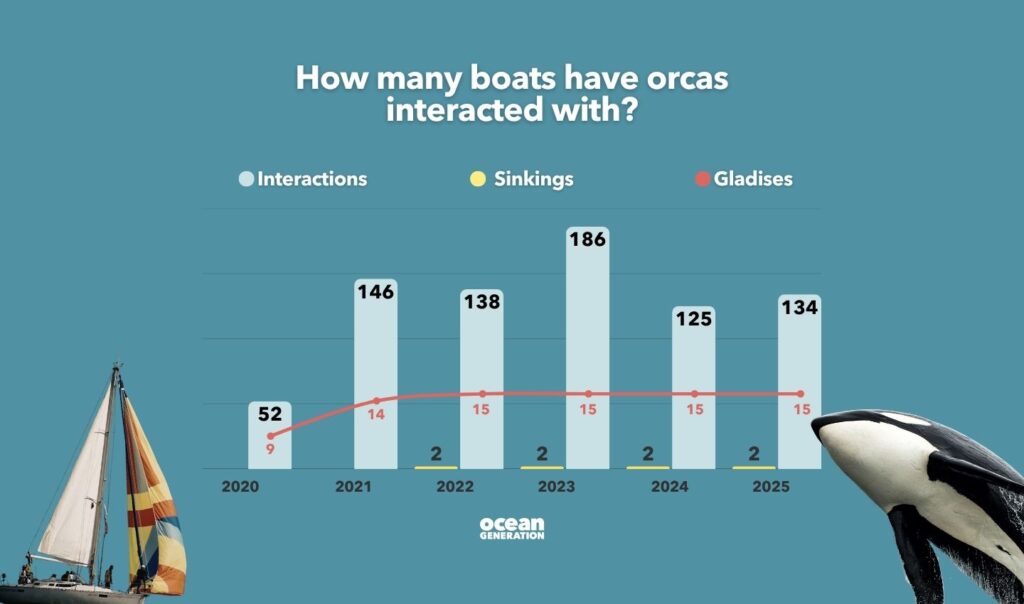
Using the last published data from November 2025, there have been 761 interactions between the Gladises (the nickname for orca seen around boats) and boats around the Iberian Peninsula.
The numbers recorded are from the Cruising Association, a sailing group that have encouraged reporting of incidents, which they verify in their network. These numbers are an underestimate, as not every interaction is reported, especially minor ones.
25 May 2020 โ the first interaction between two unidentified orcas and a rigid-hulled inflatable boat in the Strait of Gibraltar, no damage recorded.
20 July 2020 โ first recorded โdisruptiveโ interaction. Following 9 days saw five more incidents, all south of the cape of Trafalgar, just north of the strait of Gibraltar.
JulyโNovember 2020 โ 52 interactions, 49 confirmed physical contact. 9 Gladises by the end of the year.
2021 โ 146 interactions, number of Gladises rises to 14.
2022 โ 138 interactions, 2 sinkings. Number of Gladises rises to 15.
2023 โ 186 interactions, 2 sinkings.
2024 โ 125 interactions. 2 sinkings.
2025 โ 134 interactions up to 10 December. 2 sinkings.
What boats are orcas bumping?
The average length of vessel is 12m, or 39ft. Around 80% of the vessels involved are sailing boats. Of those sailing boats, most have a particular type of rudderโ a spade rudder.
What are the theories for orca interacting with boats?
Are orca out for revenge?
A commonly given reason for why orca are sinking boats is that of revenge. The narrative is compelling: an orca, injured by a passing boat, calling her kin to arms to meet the threat of humanity. A response from a beleaguered and besieged marine world.
This theory has largely come about because of an orca named White Gladis.
Who is White Gladis (Blanca)?
White Gladis, translates from her Spanish name, Gladis Blanca. Born in 2005, Blanca is the mother of Gladis Filabres, Gladis Dalila and Gladis Clara. She is herself the daughter of Gladis Lamari, who has been present during interactions but never actively touched a vessel.
As a reminder: Gladis is a simple designation given to any orca involved in nefarious nautical activity. It has its origins in an early name for orca โ Orcinus gladiator, meaning whale fighter โ and the term gladis means fighter.
The theory is that Blanca had the marks of a propeller and was teaching her kin to destroy the thing that hurt her.
Is White Gladis (Blanca) looking for revenge?
Blanca was certainly one of the early proponents of this behaviour. The first interactions in July 2020 were Blanca, her half-sister Gladis Dalila and an orca from another pod, Gladis Negra.
Orca mothers and grandmothers are key figures in orca society โ they are one of the few animals other than humans that are known to go through menopause in the wild, as the grandmothers act as a font of knowledge that they can pass on to the younger generations.
She also does have scars on her skin. But she is an old orca, from a pod known to interact with fishing boats.
Some of those markings are likely to be tooth raking marks, from other orcas running their teeth down her side in play or in mating. Others may be from fishing lines โ these orca are known to steal tuna from fishermen, they could well end up with scars from hooks or lines getting tangled.
None of the marks are likely from a propeller โ a sticking point for a theory that relies on a negative interaction with a boat.
Is she out for revenge? Orcas are capable of hunting the largest animal to have ever lived (the blue whale) and snacking on the liver of one of the most notorious Ocean predators (the great white shark). They are 5m muscular torpedoes that can develop sophisticated hunting strategies.
If these โwolves of the seaโ wanted to wreak havoc upon the sailing community, they could. Only 8 sinkings over 5 and a half years suggests that isnโt the intended outcome.
Are orcas feeling the pressure from humans?
Related to the idea of revenge is the theory of competition between orca and humans. Tuna are the main food of this population and a prized fish for human consumption. Tuna stocks were crashed in the mid 2000s by overfishing, leading to zero Iberian orca calves surviving between 2006-2010.
Orca have been seen with fishing lines attached to them, and one individual in the population, Corsica, suffered a severed right flipper and a cut at the base of her dorsal fin. Corsica was not a Gladis, and although her daughters are given Gladis designation, they have only followed small boats, not sailing boats, and never damaged any. Corsica was sadly found dead in March 2022.
The theory is that the ongoing pressures from noisy neighbours that are taking the orcas food is leading them to vent frustration on an easy target โ sailing boats. Hard to prove, and the orca with the clearest motivation to do so (Corsica and her relatives) never showed this behaviour.
Are orca using boats as hunting practice?
The behaviour of these orca โ ramming and targeting the stern of the boats โ is comparable to the hunting strategies they employ when targeting the blue-fin tuna this population eat.
Arguments have been made that the orcas are using sailing vessels as a hunting tool, a training target to show younger orca how to hunt. The incidents started with older females and were followed by younger individuals copying.
The leading theory for our ship shakers? That they want to play.
As previously mentioned, part of the evidence for this is how few boats have sunk โ it doesnโt seem to be the intended outcome.
The boats receiving orca attention are interesting. They are mostly sailing boats with spade rudders โ these rudders turn completely, as opposed to overshot or hinge rudders, which have a โbackboneโ of rudder that doesnโt. The boats getting bothered are those with the most mobile pieces on them. Sailing boats typically travel between 5 and 9 knots, a comfortable speed for an orca.
You have slow-moving vessels moving through the orcas home, and they all have a moving thing at the back โ pretty enticing for some bored young orca.
The missing orca generation.
The lack of calves between 2006 and 2010 could be in play in a different way here. There is a missing generation of orca: young orca are missing older calves to play with. As any bored child will start doing, they make up some games for themselves, using what is available (boats).
How do you avoid getting sunk by a pod of orca?
The best solution: donโt sail a spade-ruddered monohull sailing vessel around 12m long between Gibraltar and Galicia from July to October.
More recently, Portuguese authorities maintain that playing dead or reversing is the best way, while Spanish authorities advise motoring to more shallow water.
The International Whaling Commission held a workshop attended by orca experts from around the world. The guidance was to move at least 2-3km from the area of first encounter to an area where rescue, if needed, is easier.
The same workshop strongly recommended against using deterrents that could harm the orcas. Besides the fact this is a critically endangered population, none have been shown to succeed in stopping an interaction and they are likely more dangerous to the people deploying them.
Desperate sailors have used some extreme counter measures to protect their floating homes. Throwing firecrackers and seal bombs; pouring bleach, diesel or chlorine overboard; attaching knives or spikes to the rudder; throwing rocks or heavy chain; electrocution.
It is difficult to condemn sailors reaching for anything they have to hand when a six-tonne animal is apparently dismantling their boat from underneath them. But these measures range from ineffective to cruel, and present as much risk to the sailors as the orca, if not more.
Rather than bombs and chemicals, are there any other potential solutions?
A few genuinely promising suggestions have been put forward. Modifying the design of the rudders to alter the flow of the water could make them less appealing to orcas in the first place. Dropping a barrier of weighted lines around the stern of the boat to prevent easy access to the rudders could give sailors some more peace of mind.
Orca have been shown to flee when they hear the calls of long-finned pilot whales. Sailors could either play pilot whale calls via underwater speakers, learn to mimic these calls or bribe local pilot whales for protection (we would love to see some pilot whale language classes).
Our changing relationship with orcas
Whatever the reasons and whatever the solutions, the situation does give us a chance to appreciate the intelligence and power of one of the Oceanโs top residents.
Our relationship with the orcas of Iberia has been tumultuous. Pliny the Elder wrote about them in AD77, while the birth of Jesus was in living memory. Medieval fishers would welcome them as partners, watching for their dorsal fins to show the tuna were running. More recently, the relationship soured โ in 2002, an orca, Burela, was found dead with bullet wounds.
Now it is more confused than ever. The waters are shared by sailors armed with firecrackers, dreading that a black fin will approach from behind, and by whale-watching boats filled with passengers with crossed fingers that they may see the exact same thing.
At the centre of it all, is curiosity. The same thing powering the whale-watching companies could be compelling the orcas. Revenge becomes something more ordinary and wonderful. Just as a younger sibling might poke a sandcastle on a beach and accidentally knock your tower down, the orca could be exploring and playing, with some unfortunate consequences.
Humans and orca have shared the Iberian waters for millennia. We have been wary strangers, reluctant neighbours, collaborative hunters and fierce rivals. How we react to this next chapter in our relationship with them will reflect on us more than it does on them.
Every second breath we take comes from the Ocean. More specifically, it comes from algae in the Ocean (thank you, algae).
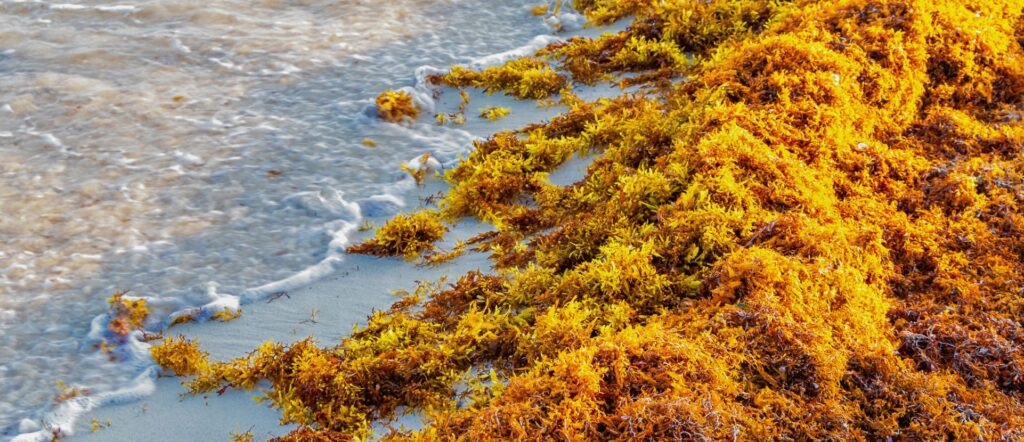
When the conditions are right, algae flourishes, creating an algal bloom. These blooms can be spectacular, leading to a blossoming of life and a sparkling Ocean, or they can cause serious problems for life in the Ocean and on land.
What do the white cliffs of Dover, the oil fields in the North Sea and Colorado oil shales and the clarifying agents used to make beer and wine have in common? They are all made of algae, a diverse group of incredible organisms which support most of the life in the Ocean.
But you can have too much of a good thing.Large amounts of algae can kill a lot of marine life and be toxic to humans. These events can have huge impacts, as we will see, from modern day Australia to the Bible.
What are algae?
This isnโt as simple an answer as it should be, so bear with us. Unlike mammals or birds or sharks (donโt get us started on โfishโ), โalgaeโ doesnโt refer to a single evolutionary group of species.
Instead, the things we call algae are a group of organisms that do the same kind of things, dotted around the tree of life. A group of roughly 50,000 species.
The name comes from the Latin for โseaweedโ. The study of algae is called phycology, and algal experts are phycologists, who are still figuring out exactly how they all fit together.
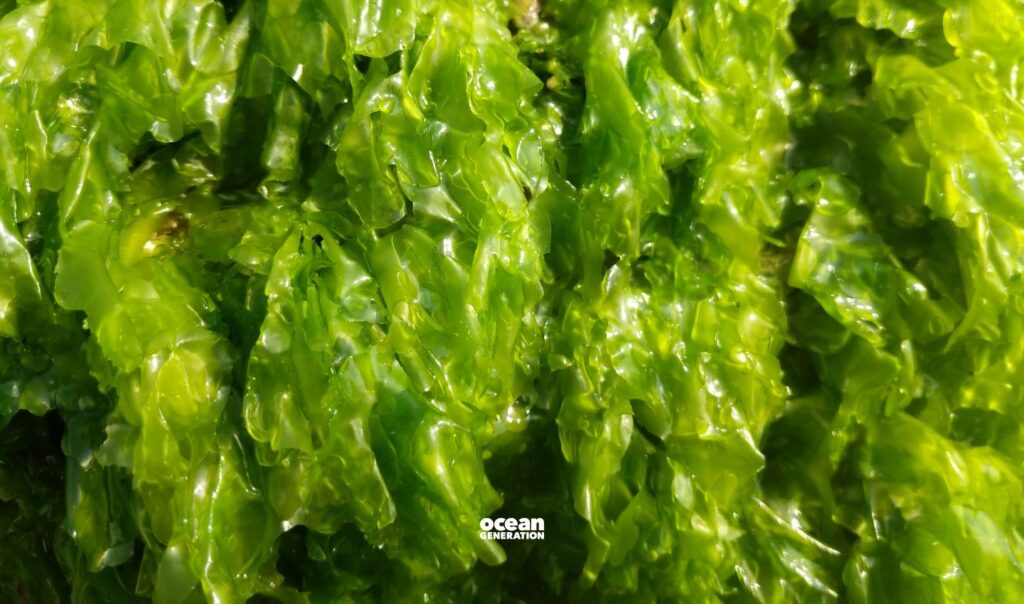
As a good rule of thumb โ if it photosynthesises, and it isnโt a land plant, it is algae (we will get to the differences between algae and plants in a minute).
Some of those 50,000 species are very basic organisms such as cyanobacteria, that lack a nucleus and the other advanced bits of cellular equipment that animals have.
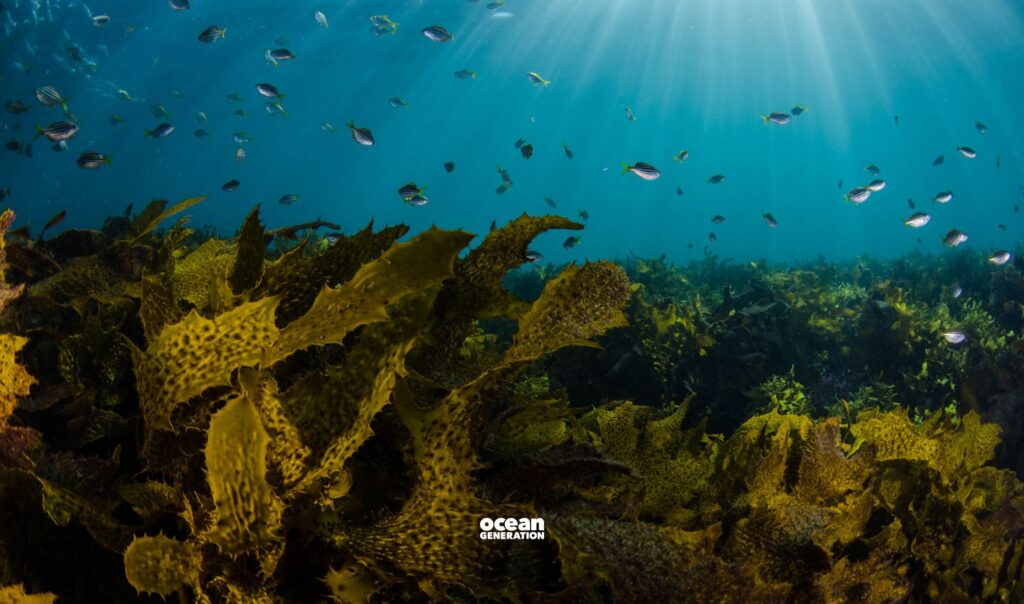
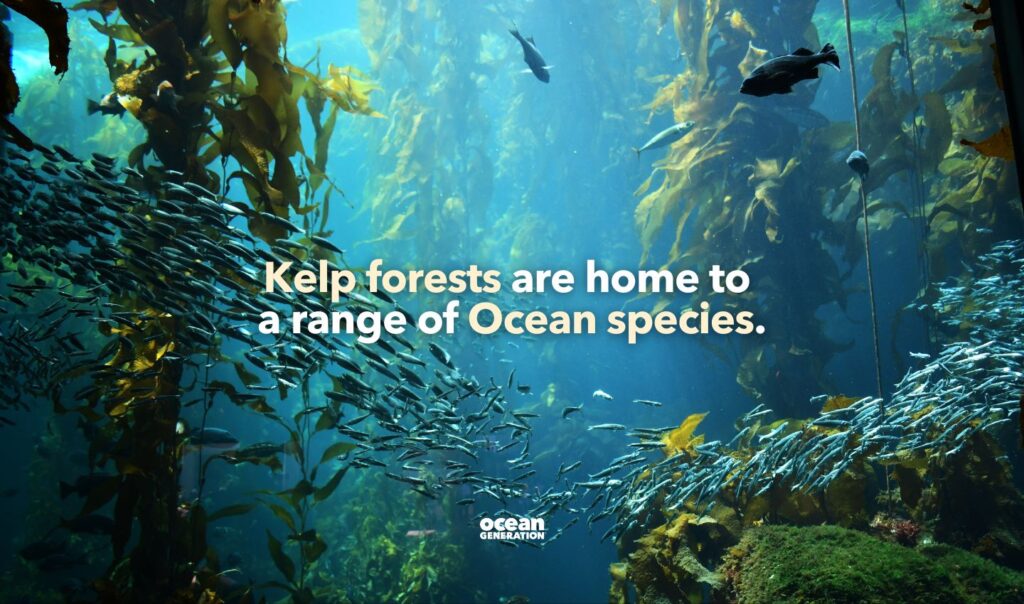
Other species are single-celled, floating around in the Ocean. Some are macroalgae like kelp, growing over 50m tall, creating vast forests filled with life and noise (ever wondered what the kelp forest sounds like?).
The magic of algae is something they share with plants. They produce oxygen and grow using sunlight โ photosynthesis.
This magic is what nearly all life on our planet is dependent on.
How are algae different from plants?
Fuelled by the sun’s energy, algae filled the Ocean and some conquered the land, becoming the plants that dominate our planet.
Plants evolved from ancient freshwater algae over 440 million years ago. Trees appeared around 400 million years ago. Psst…for context, sharks first appeared around 450 million years ago, so sharks have been around for longer than trees. 1-0 to the sharks.
Plants have developed into some beautiful, complex forms, conquering the land and making up around 82.5% of total biomass (the weight of living things) โ humans are only about 0.01%.
Meanwhile, algae have evolved to master the aquatic world.
Physical differences between algae and plants
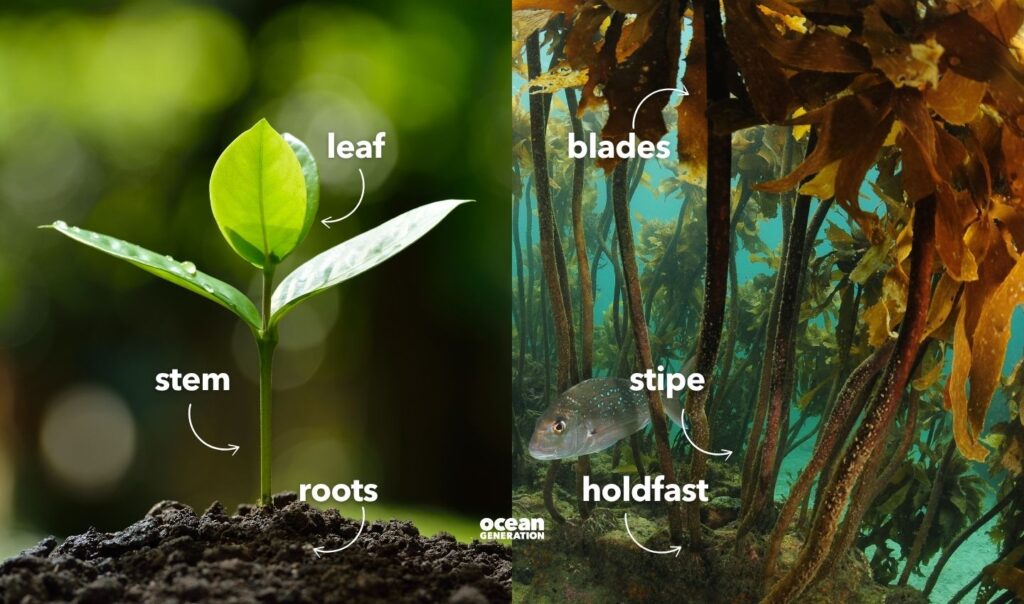
Plants developed a number of structures as they conquered the land, with roots to hold them in place and specialised structures for capturing sunlight โ leaves.
Looking at seaweed there are clear similarities. The โrootsโ of seaweed are holdfasts, the โstemโ is a stipe, and the โleavesโ are blades. They look similar, but these structures donโt transport nutrients or gases between each other as the plant equivalents do.
Microscopic algae lack these structures completely.
What are the biochemical differences between algae and plants?
We wonโt get too technical, but there are some big differences in the biochemistry of the two. Algae are much more varied in their structures, using a wider variety of building materials. Some use silica (glass) and some create chalk. Green algae use a compound called cellulose โ the sugar that makes up paper, cotton t-shirts and wood.
Plants, evolving from these algae, adapted cellulose into compounds such as lignin for structural support in their ongoing battle against gravity.
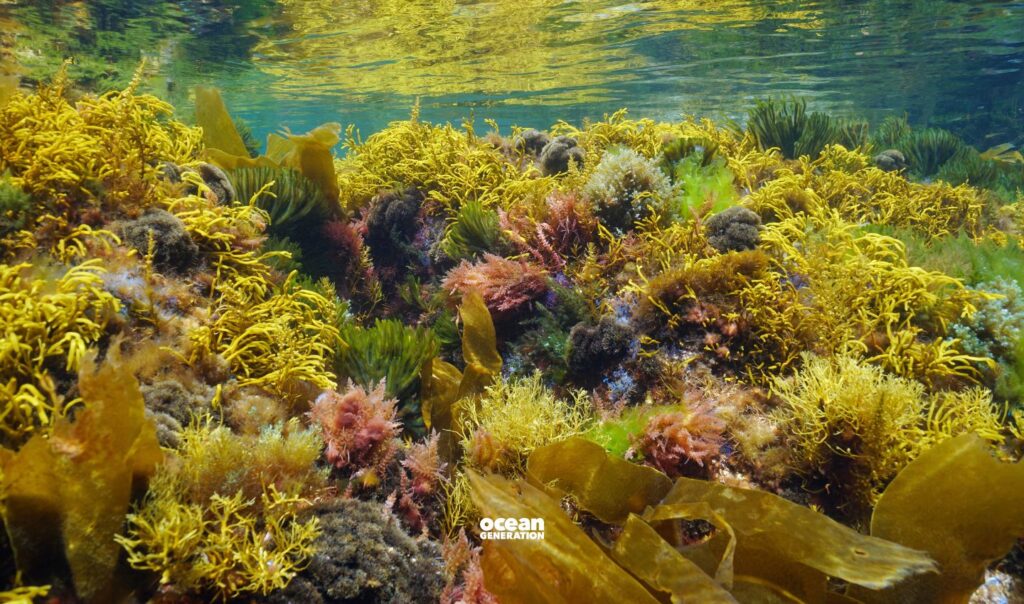
Many algae are named after their eclectic use of photosynthetic pigments.
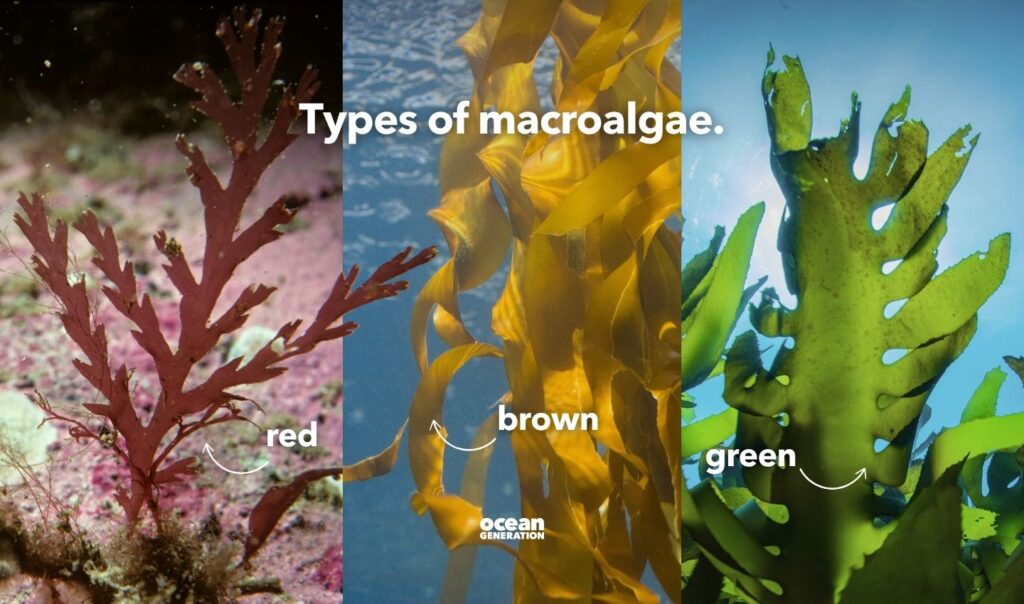
Red algae use phycoerythrin and phycocyanin (which appear red), brown algae use fucoxanthin giving them a golden-brown colour and green algae use the same chlorophyll a and b as their green, leafy land-based relatives.
The different pigments are utilised to ensure that the algae are most efficiently gathering the sunโs light, which is filtered by the water, modifying the wavelength (and therefore colour) of light that most gets through. More on that another time.
Where can you find algae?
You can find algae everywhere, and each habitat has its own name. They can be found in ice (cryophilic) and hot springs (thermophilic).
Algae are also in soil (edaphic) and in the Ocean (planktonic in the water column and neustonic on the surface). On rocks and in coral (epilithic and endolithic), on fungus and other plants (epiphytic), on turtles and sloths (epizoic) and even inside other organisms (endozoic endosymbiotic) – there is an alga for any location.
Someone should make a song about it.
Why do algae bloom?
When algae grow very fast into large numbers, itโs referred to as a bloom. This can happen at small scales in a pond or at huge scales visible from space. These blooms can be the start of a great flourishing of life, or a deadly threat.
To understand why algae might bloom we need to realise why it wouldnโt and identify what is limiting its growth. Both plants and algae growth are limited by several things: water, temperature, light and nutrients.
We are focusing in on the marine, where water is less of a concern, so short term variation is typically controlled by the rest (although how salty the water is does matter).
Different algal species will have different preferred conditions, but warming the Ocean, with more sunlight and more nutrients, would generally result in more algae.
To refine it further, algal blooms typically refer to large amounts of microscopic algae, kelp forest is technically an algal bloom too, but in headlines, โalgal bloomโ usually means the small stuff that can produce massive blooms.
Increasing light and temperature
Algal blooms are a normal part of the seasonal Ocean, as light and temperature increase in spring and summer, they allow algae to grow. This growth, like the arrival of spring on land, can be spectacular, as the sea sparkles with bioluminescent algae such as Noctiluca sp. which can give off a blue glow.
What happens in spring that might cause this? The days get longer and the temperature rises. More light and higher temperatures encourage algae to bloom, and they will until one of the other conditions becomes the limit.
Increased nutrients
When light and temperature are in plentiful supply in the summer months, the growth of marine algae is limited by nutrient levels, especially nitrogen (as opposed to freshwater, where it is phosphorus).
Human activities, primarily the use of fertiliser in agriculture, which is rich in nitrates, have altered the cycling of nitrogen. Some areas of Ocean receive much higher levels of nitrogen from water running off farms, giving the algae all the ingredients they need to thrive and bloom.
Lowered salinity
A lower level of salinity (saltiness in the water) means a higher concentration of water, enabling more growth. An increase in rainfall or ice melting could then lead to an algal bloom.
What makes an algae bloom harmful?
Broadly speaking there are two ways algal blooms can make life a bit rubbish for everything around it – by choking or poisoning them.
Choking blooms
When a large bloom of algae happens, it can disrupt the balance of the ecosystem.
But the real dangers come in the aftermath. As the bloom subsides, it is decomposed by bacteria and other organisms, which use oxygen. This can leave little or no oxygen in the water left for fish and other aquatic residents to breathe.
Which Bible story might have an algal bloom?
You may not think to go to the Bible for marine science but let us look at the story of Moses and the plagues of Egypt in Exodus 7: 20-21: โ…all the waters that were in the river were turned to blood. And the fish that were in the river died; and the river stank, and the Egyptians could not drink the water of the riverโ. If we assume the bit about blood is descriptive rather than literal, we have a good description of a bloom of red algae.
Following this, we can link some of the other plagues that befell Ancient Egypt. To recap, the ten plagues were: river of blood, frogs, mosquitoes, flies, death of livestock, boils, hail, locusts, darkness and the death of each firstborn son.
If there was an algal bloom that suffocated the Nile, killing many of the fish, then the things the fish ate would benefit, if they could survive low oxygen conditions. Something like a tadpole, which can respond physiologically to low oxygen conditions and thrive. With no fish, you could end up with a lot of tadpoles surviving, and… a plague of frogs.
Another winner would be mosquitos โ they lay their eggs on water surface, and the larvae feed on algae. With less predators (the fish are dead) to eat them and a banquet of food, you get a plague of mosquitos.
The death of much of the life of the river could poison the waters, resulting in the deaths of many of the livestock which depend on those waters to drink. The decay attracts flies, meaning one big algae bloom could be exactly the tool a deity would wield to cause five plagues.
Another algal alternative is that the red โbloodโ came as a result of heavy rainfall in the Ethiopian mountains that are the source of the Nile. The soil there is clay โ reddish in colour โ and could have suffocated the river by reducing how clear the water is (its turbidity), meaning the opposite of our theory โ there were very few algae to produce oxygen for the fish.
In either case, the algae hold the key to the ecosystem, and impacts to algae can have biblical effects.
Toxic blooms
There are three main types of phytoplankton that can make harmful toxic blooms: diatoms, dinoflagellates and cyanobacteria. These produce toxins themselves. When their abundances reach high enough levels, they become toxic to species in the water, and to humans โ directly and indirectly.
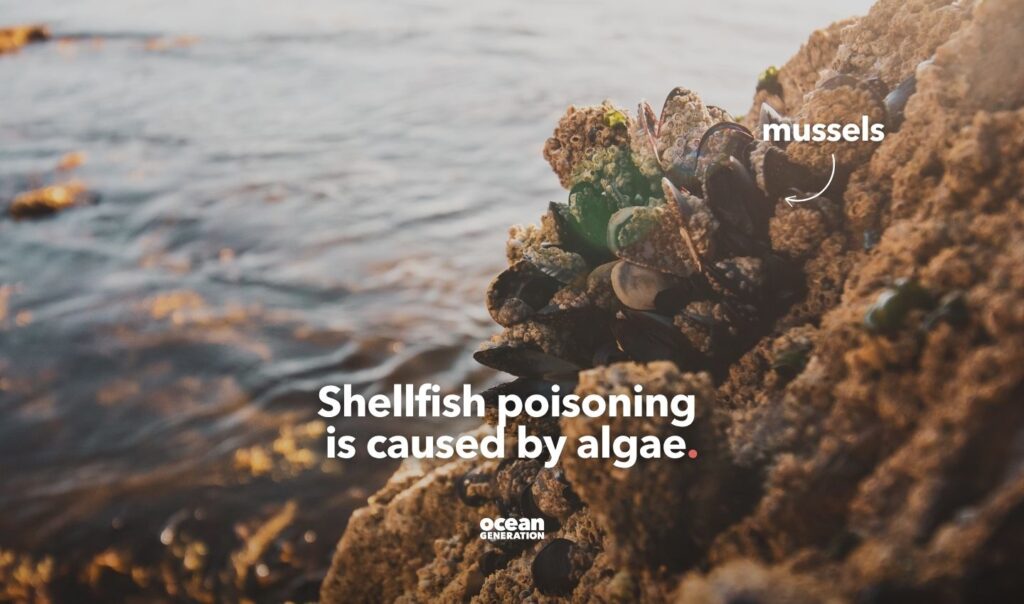
Shellfish poisoning in the US is caused by algae such as Alexandrium catenella or Karenia brevis (both dinoflagellates) which, when ingested by shellfish such as mussels, can make them deadly to humans.
More directly, blooms of toxic algae threaten life through the water column. K. brevis is amongst the best studied, as it occurs off the coast of the United States in โred tidesโ. Fish, marine mammals, elasmobranchs, turtles, birds and even coral suffer in waters stocked with high quantities of the toxic algae. K. brevis produces brevetoxin, potent neurotoxins which interfere with normal neural function. It essentially causes nerves to continuously fire, leading to behavioural change, muscular dysfunction and disorientation.
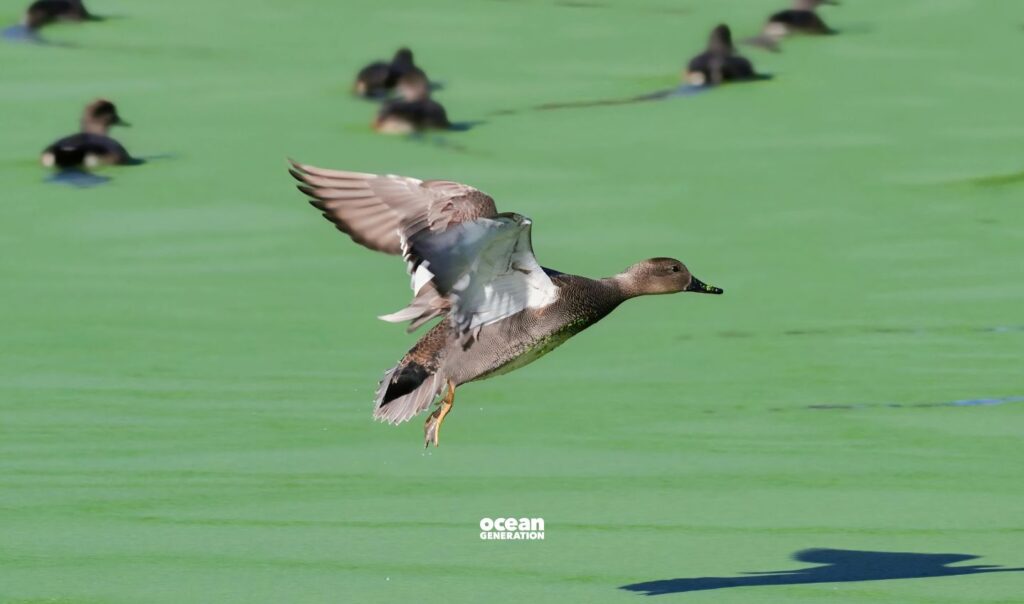
Blue-green algae are another commonly referred to algal bloom. It is named after the colour of the cyanobacteria that causes it, which can produce a wide array of toxins depending on species, none of which are good in high quantities.
Australia saw a harmful algal bloom start in March 2025
In March 2025, South Australia began to feel the effects of a huge algal bloom. As of February 2026, the bloom has impacted 20,000 square kilometres and roughly 30% of Australiaโs coastline. Over a million marine animals have died, from over 550 different species. Humans have suffered from eye and skin irritation, coughing and shortness of breath.
The finger was initially pointed at Karenia mikimotoi, a well-known species that often blooms around the world. But after brevetoxins were identified, which K. mikimotoi doesnโt make, researchers took another look using DNA sequencing. This identified K. cristata, which had only been previously found in Newfoundland, Canada in 2014 and in South Africa in 1988.
This is one of the largest and longest harmful blooms recorded, affecting a huge range of marine animals. Leafy sea dragons are one of the state symbols for Southern Australia, but the bloom has hit their populations hard enough that their populations are being reassessed for risk of extinction.
When does an algal bloom become deadly?
The simple answer is when there is too much.
Too much of any one species results in imbalance. Harmful algae blooms come when the balance is lost, for example with an excess of nutrients or an Ocean that is much warmer than usual. Pollution and climate change are increasing the frequency of harmful algal blooms. Not every algal bloom is caused by human activity, but more of them are, and they are more likely to be harmful. Tackling climate change and pollution protect animals like the leafy sea dragon.
Algae facilitated life on our planet, filling the atmosphere with oxygen. Still today, every second breath you take comes from the Ocean, specifically the little algal friends at work. They continue to be the foundation of marine food chains. Algae are amazing; you just donโt want too much.
The past year has seen some amazing developments in our understanding of and our relationship with the Ocean. Weโre unpacking: what Ocean discoveries have we made, what Ocean protection have we brought in and what Ocean recovery have we seen in 2025?
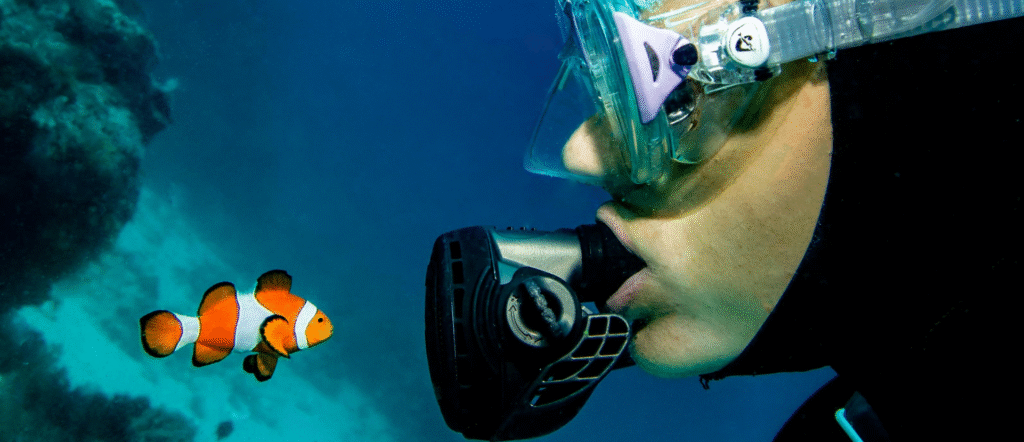
Over the course of 2025, there have been a series of discoveries centred around the clownfish, made famous by Nemo and Marlin in Finding Nemo (see our scientific analysis of the film here).
How does the clownfish avoid being stung by the anemone?
By having lower levels of sialic acid on their skin, clownfish avoid being stung by anemones. Sialic acid can be found on the outer surface of most animals โ it is important in cell-to cell communication and immune response. The nematocysts (stinging cells) of the anemone have a special trigger, to avoid the anemone constantly stinging itself. Researchers found the fish that can live in an anemone have low levels of sialic acid, to โhideโ from the anemone, and avoid triggering its stings.
We discovered that the relationship between clownfish and anemone isnโt as one-sided as it may seem.
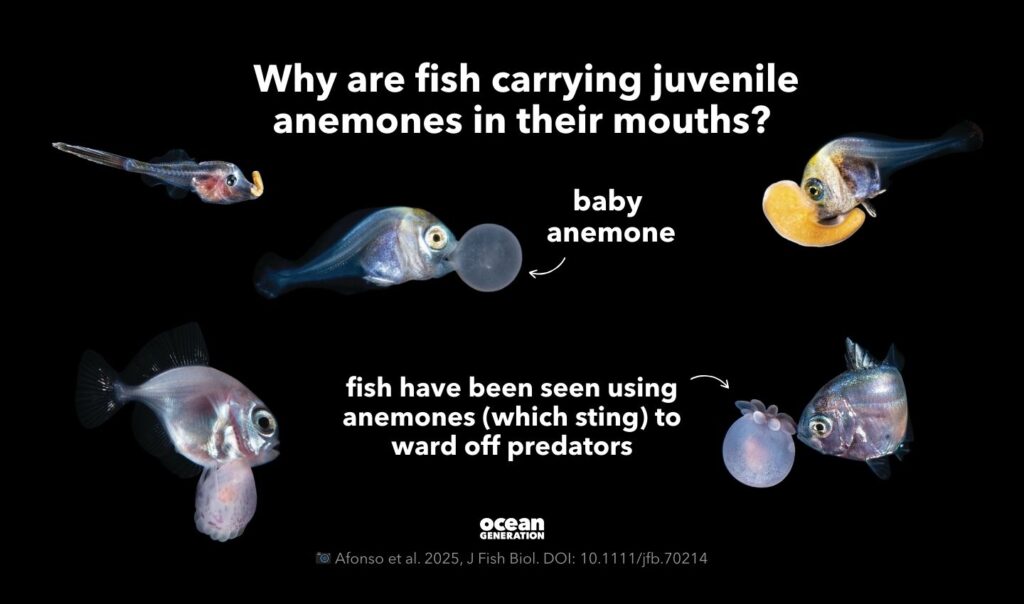
The assumption is that they are effectively arming themselves with marine (live) pepper spray. Predators can be warded off with a nasty sting. The anemones also benefit, as the young fish can swim and be swept much further than the anemone would normally reach.
The young fish have a predator deterrent, and the anemone gets a lift to a new neighbourhood.
Picture credit: Afonso et al. 2025, J Fish Biol. DOI: 10.1111/jfb.70214
What new Ocean species were discovered in 2025?
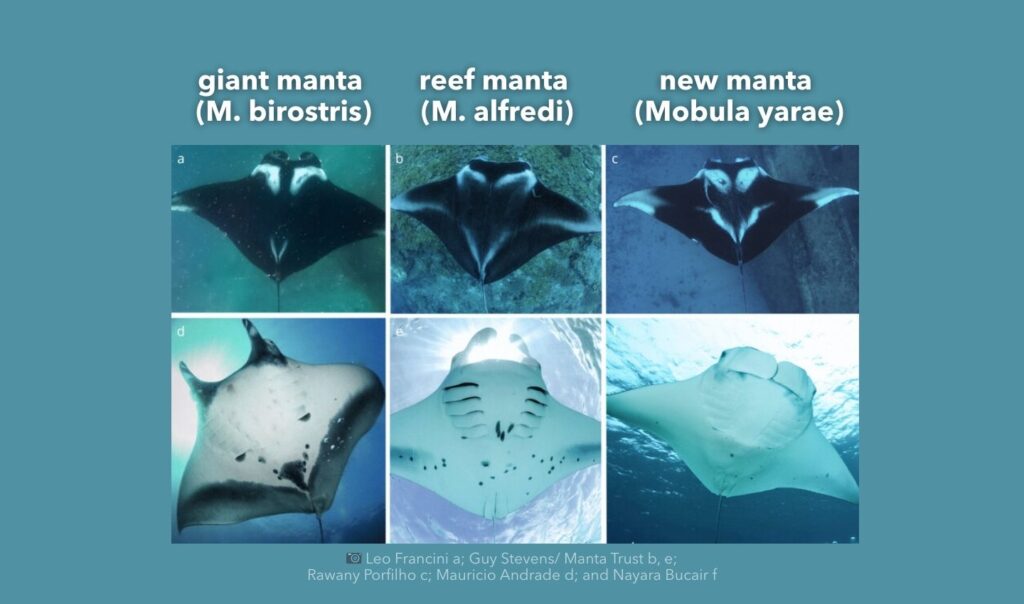
A new species of manta ray was distinguished in 2025, adding a third species to the manta ray family.
Until 2009, there was only one species of manta ray. In a study focussed on morphological characterisation, analysis of colour, teeth and other traits differentiated the reef and Oceanic manta rays.
Lead author of the study identifying the Oceanic and reef manta species, Dr. Andrea Marshall, had theorised a third species after diving in the Atlantic Ocean with manta rays she didnโt recognise. Years of study, including the description of a type specimen and genetic analysis, have confirmed her hypothesis: a third species of manta ray exists.
Picture credit: Leo Francini a; Guy Stevens/ Manta Trust b, e; Rawany Porfilho c; Mauricio Andrade d; and Nayara Bucair f
Facts about the newly discovered manta ray:
Mobula yarae, more commonly known as the Atlantic manta ray, are named after Yara, the โmother of watersโ from Indigenous Brazilian mythology.
Telling them apart from other manta rays starts with size: they reach an approximate size of 6m across, sitting between the Oceanic and reef manta in size. A โVโ shaped white shoulder patch, lighter colouration around the mouth and eyes and dark spots confined to the belly rather than between gill slits are the key identifying features.
The Ocean Census announced that it has facilitated the discovery of 909 new Ocean species.
The program, in its second year of running, hopes to fast-track Ocean discovery, and so far has increased the annual speed of species discovery by 38%.
A new kind of shark discovered
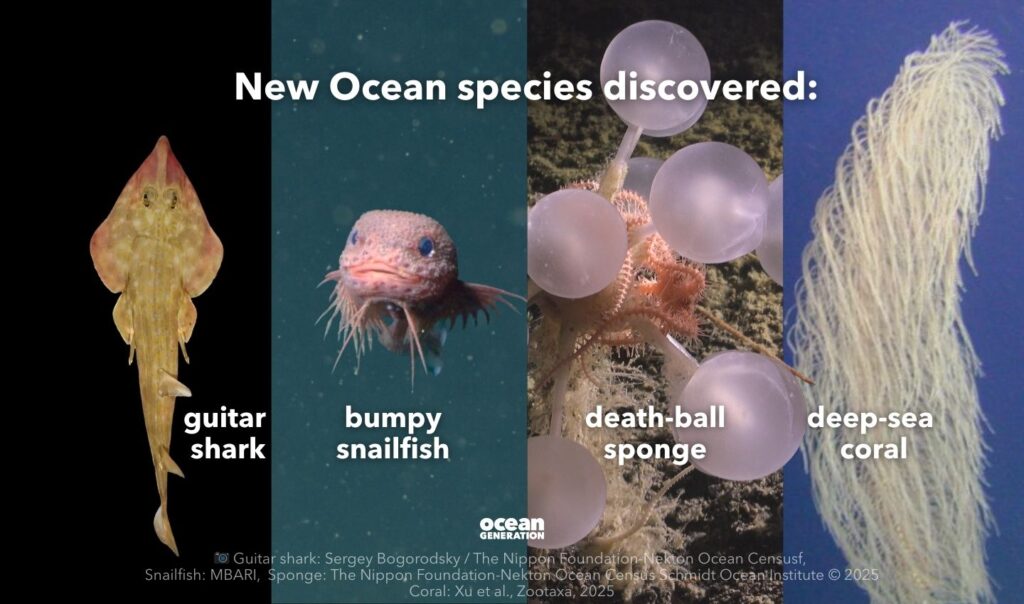
Sticking with our elasmobranchs (cartilaginous fish that include sharks, skates, and rays), a new kind of guitar shark was discovered off the coasts of Mozambique and Tanzania. It joins 37 other guitar sharks in one of the most threatened vertebrate families, with two thirds of them threatened.
New species of snailfish in the deep-sea
Looking deeper in the Ocean, a new species of snailfish was discovered 3,263m deep.
The suitably named โbumpy snailfishโ is only two to three inches long and was one of three new snailfish species found on the expedition led by the Monterey Bay Aquarium Research Institute.
There are over 400 species of snailfish, and the family holds the record for the deepest dwelling fish, with one found 8,338m deep.
Picture credit: Guitar shark: Sergey Bogorodsky / The Nippon Foundation-Nekton Ocean Census, Snailfish: MBARI, Sponge: The Nippon Foundation-Nekton Ocean Census Schmidt Ocean Institute ยฉ 2025
Coral: Xu et al., Zootaxa, 2025
Meet a newly discovered sea sponge: the Death-ball sponge
As one of the more notably named, the death-ball sponge (Chondrocladia sp. nov.) received a lot of press.
Where most sponges unobtrusively filter the water for food (ensuring highly efficient nutrient circulation where there isnโt much to go round), this new species has a number of โballsโ covered in tiny hooks to trap their prey.
New deep-sea discoveries with celebrity nicknames
There were a couple of famous characters whose semblances were discovered in the deep Ocean.
A deep-sea coral first spotted in 2006, but formally described this year, was given the name Iridogorgia chewbacca, due to its long hairy branches.
An iridescent scale worm found in the freezing waters of Antarctica was given the nickname โElvis-wormโ, its sparkling scales shimmering in the deep like the sequins of the King of Rock and Rollsโ jackets in Las Vegas
And a bonus one (not a new species): the colossal squid was caught on camera in its natural habitat for the very first time. This one wasnโt all that colossal: it was a juvenile just 30cm long.
What Ocean protection happened in 2025?
60 countries ratified The High Seas Treaty in 2025
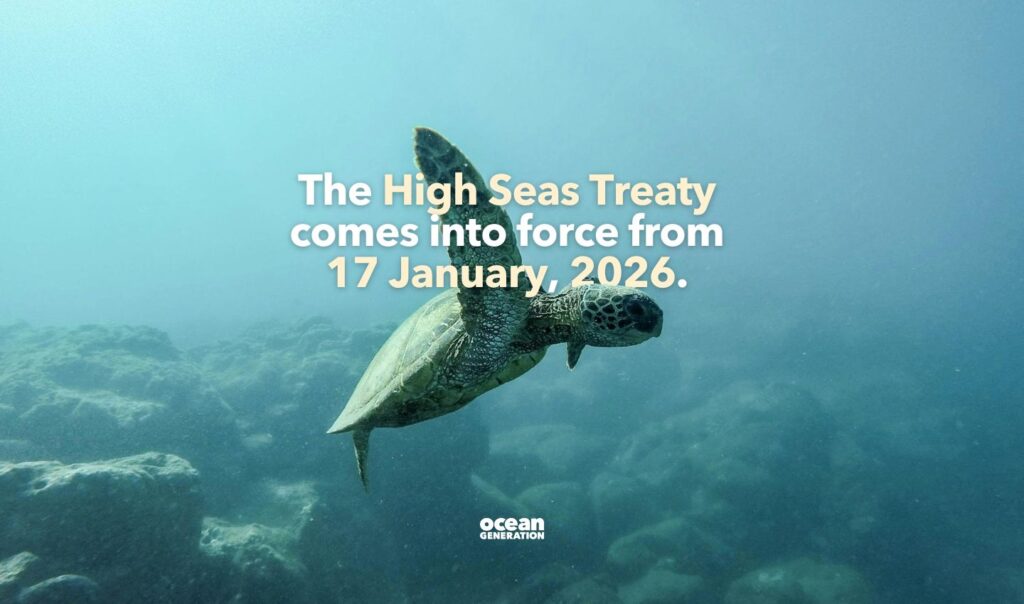
In September, the Agreement on the Conservation and Sustainable Use of Marine Biological Diversity of Areas beyond National Jurisdiction reached 60 ratifications, the milestone required to start the countdown to it becoming legally binding. From 17January 2026 the agreement, also known as the biodiversity beyond national jurisdiction (BBNJ) or High Seas Treaty, will enter force.
Many countries have been protecting the Ocean off their coastlines in 2025.
Countries havenโt been hanging about, waiting for the High Seas Treaty, they have been getting on with Ocean protection in their own patches.
Marine Protected Area, or MPA, is a general term for an area of Ocean in which human activities are managed or limited to protect the marine world. Depending on what they are aiming to protect, they can have different rules. Some will allow sustainable fishing and recreation; others may be no-take zones where no fishing is allowed.
What is the largest marine protected area in the world?
An exclusive economic zone is the area of Ocean extending up to 200 miles from the coast of each country, in which they have the rights to explore and utilise any marine resources.
A huge no-fishing zone has been expanded in the South Atlantic Ocean:
For Marine Protected Areas (MPAs) around South Georgia and the South Sandwich Islands (not where sandwiches were invented), the โno take zonesโ where no fishing can occur have been expanded to over 470,000km2, 38% of the MPA. This is to help protect the migration routes of humpback whales.
How whales are being protected in marine sanctuaries:
That isnโt the only help weโve given our whale friends. In October, a proposal for a huge marine sanctuary in the North Atlantic was approved. Macaronesia is an area including the Azores, Madeira, the Canary Islands and the Cabo Verde islands. Itโs rich in marine biodiversity, hosting 32 different species of cetacean. (Cetaceans include whales, dolphins and porpoises.)
The new marine sanctuary will hope to protect the Ocean from increasing pressures of boat traffic, underwater noise, industrial fishing and future threats such as deep-sea mining.
Do marine protected areas really help protect the Ocean?
There have been concerns that enforcement around MPAs isnโt feasible, any fishing vessels can just โgo darkโ – turn off their identification systems and continue poaching.
But analysis using artificial intelligence and satellite imagery has shown very little industrial fishing activity in highly protected MPAs. Conversely, there was substantial activity in MPAs with low protection.
Weโre protecting more of the Ocean, and it is working.
What is the EU Ocean Pact?
On money, the European Commission launched a unified framework for EU Ocean policy in 2025, backed by a โฌ1โฏbillion investment in the Ocean, with six priority areas including: habitat restoration, decarbonisation of maritime sectors, blue economy competitiveness, coastal/island community support, Ocean diplomacy and innovation.
Progress on cutting shipping emissions
Member States of the International Maritime Organisation agreed a global standard for decarbonising shipping: fuelโintensity reductions, global emissions pricing for ships, and a fund for low/zeroโemission marine fuels.
The agreement was agreed but not formally signed, as in a meeting in October 2025 delegations from Saudi Arabia and the United States lobbied for a delay.
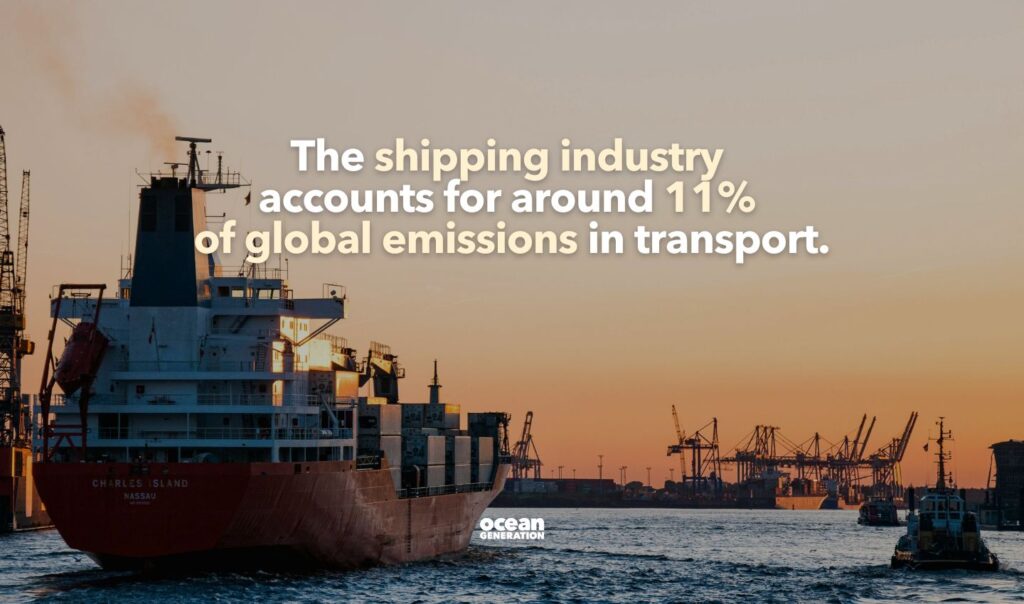
This is half a win this year and will hopefully be a full win for our Ocean in 2026, in a sector that accounts for around 11% of global emissions in transport.
What Ocean recovery have we seen in 2025?
Are whale populations bouncing back?
In a paper published towards the end of 2024 that examined historic databases on whales, it was suggested that we underestimate the longevity of whales by some distance.
How old do whales get?
Our estimates for the average age of whales were first shaken in 1979, when Japanese whalers found individual blue and fin whales that were 110 and 114 years old respectively. Prior to this, we understood these animals to live to 70 years.
This 2024 paper attributed the lower perceived longevity to our success in whaling. Whales werenโt living as long because we were hunting them.
But the world is changing. Whaling was made illegal in 1987, and populations have shown promising signs of recovery. Over the course of 2025 there were several markers of a better world for whales, and hints of the future we are creating for them.
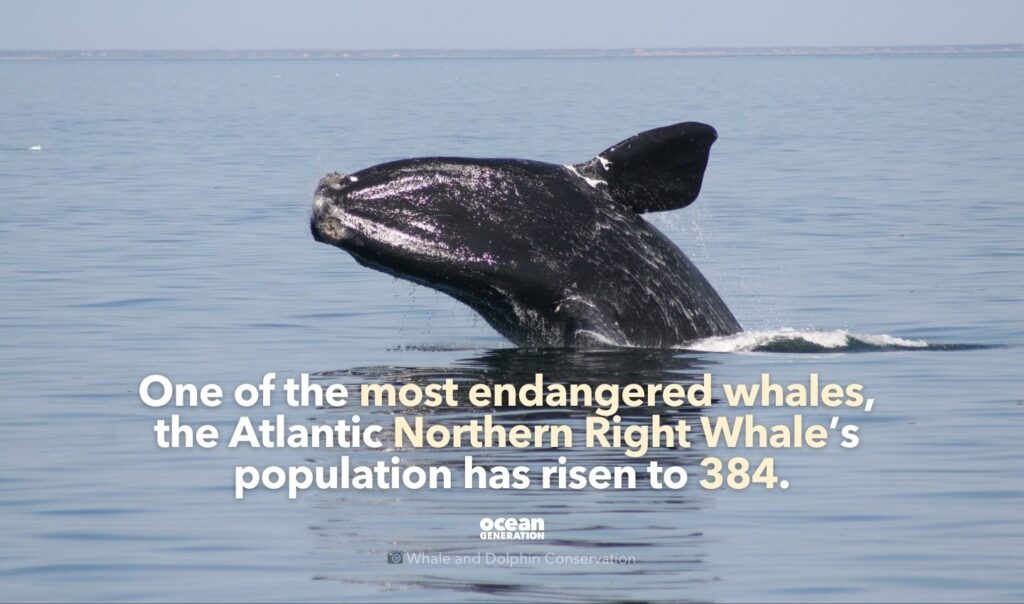
The Atlantic Northern Right Whale, one of the most endangered whales, has enjoyed an increase in population, up 8 individuals to 384 whales. This is off the back of a decade in which the population declined by 25% between 2010 and 2020 due to ship strikes and entanglement.
2025 saw the cancellation of the Icelandic fin whale season, meaning once again no fin whales were killed due to an unfavourable market, marked by diminishing demand for whale products and rising costs.
Picture credit: Whale and Dolphin Conservation
Who is โcrushโing it? Green turtles are no longer endangered.
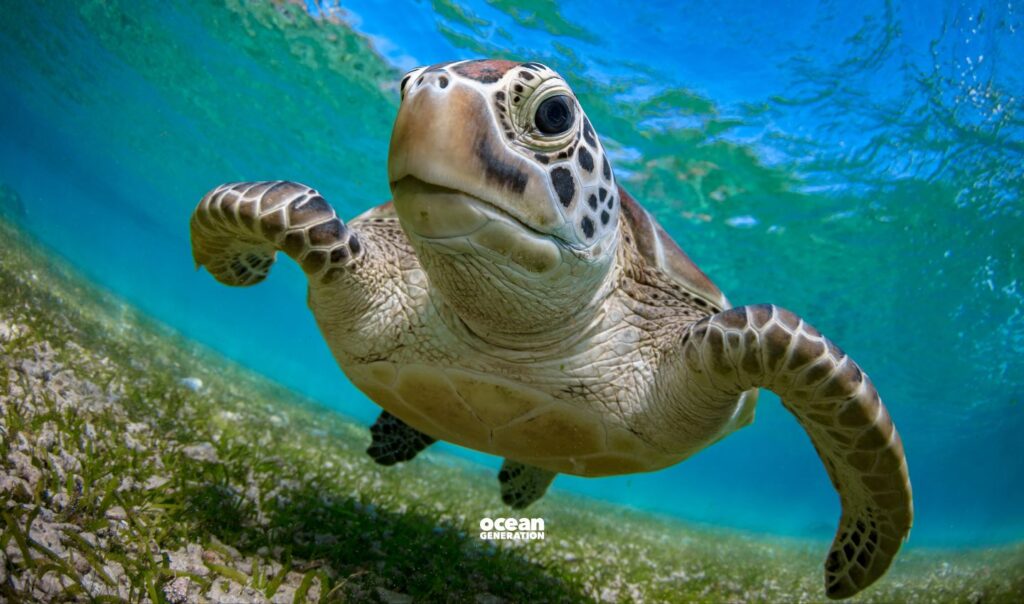
Itโs a good time to be a green turtle (Chelonia mydas). The species, made famous by Crush and Squirt in Finding Nemo, has been upgraded on the International Union for the Conservation of Nature (IUCN) Red List, from Endangered to Least Concern.
To best help them, we had to understand what was hurting them. Green turtles (and other sea turtle species) have long been hunted for their meat and their eggs, so legally protecting them was a good first step.
When did we start protecting sea turtles?
Legal protections started coming in in the second half of the 20th century, with bans such as that on Aldabra Atoll in 1968 safeguarding turtle mothers and their eggs. Since that ban, green turtle egg clutches have increased 410โ665%.
Even without the pressures of hunting, turtles still faced a struggle, becoming the poster of plastic pollution and entanglement in fishing gear, and facing the realities of a changing Ocean.
But conservation efforts have continued. Excluder devices (devices designed to prevent bycatch) have been implemented on fishing gear to avoid entanglement. Nesting beaches have been protected from light pollution that could lead hatchlings away from the Ocean, or plastic pollution that could tangle or choke them. Turtle hatchlings have been released at sea to give the population a boost.
Some sub-populations are still struggling and need help, but it shows us, again, that the Ocean has a great capacity to recover when we allow it.
โThe ongoing global recovery of the green turtle is a powerful example of what coordinated global conservation over decades can achieve to stabilise and even restore populations of long-lived marine species,โ – Roderic Mast, co-chair of IUCNโs Species Survival Commission Marine Turtle Specialist Group.
Dam Good News for salmon
In 1878, a lamp turned on. In itself, not a remarkable event, but this lamp was special. It was powered by water.
Cragside House in Northumberland, England, saw the birth of hydroelectric power. Within ten years, hundreds of hydropower stations were running around the world. It remains the third largest source of electricity globally, behind coal and gas. Until 2004, it represented over 90% of the worldโs electricity generated by renewables and is still over 50%.*
Benefits of hydropower
Our World in Data compiles the data to examine its benefits. Hydropower is incredibly safe, with the 1.3 deaths per terawatt hour of electricity produced far lower than coalโs 24.6, and almost all from a single event: the Banqiao Dam Failure in China in 1975, which killed 171,000.
Hydropower is very clean, producing an average of 24 tonnes of CO2 equivalent per gigawatt hour, compared to coal which produces 970 tonnes. A world without hydropower would likely be a world that had burned more fossil fuels.
Disadvantages of hydropower
However, hydropower isnโt all turbines and waterfalls – it comes with its limitations. Itโs expensive, especially in upfront cost. It also has an environmental impact beyond carbon emissions.
Huge dams create reservoirs, flooding land and cutting off rivers. Cutting off the rivers can lead to drought or famine downstream. Reservoirs can emit greenhouse gases by creating large areas of stagnant water full of decomposing material. As solar and wind have become far cheaper and more accessible, there is less need for the large projects.
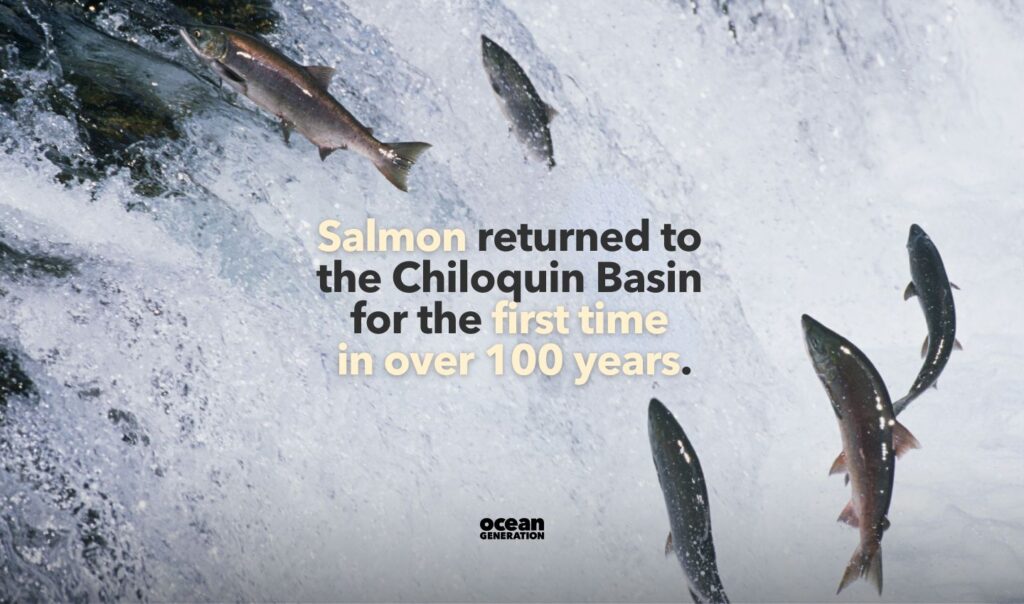
The project was initiated by local populations after 30-70,000 salmon died below the dams in 2002 due to low flow, the costs of maintenance and repair coupled with environmental costs and the reservoirโs proclivity to harmful algal blooms.
โA hundred and fifteen years that they havenโt been here, and they still have that GPS unit inside of them. Itโs truly an awesome feat if you think about the gauntlet they had to go through.โ said the visibly giddy Klamath Tribal Chair William Ray, Jr.
As we explored in some articles earlier in 2025, rivers and residents like salmon are vital in connecting different ecosystems.
Hydropower can prevent the salmon migrating and breeding in their ancestral waters and poison the rivers they grow up in. Losing that connection impacts the people and life all along the river.
We need energy to reinforce our high quality of life. That used to come at the cost of our natural environment. However, we are more aware of that impact, and we are getting far better at diminishing it. Stories like this are sprinkled with glimpses of a bright future, in which humans can flourish with nature.
This pattern – discovery igniting protection, protection enabling recovery – reflects how our relationship with nature has evolved over decades, not just this year.
The Ocean wins of 2025 demonstrate a shift in our relationship: we are learning to value and safeguard our seas, and in return, the Ocean is proving its remarkable capacity to heal.
In ten years, we hope stories of recovery and flourishing will dominate the narrative, as the need for more protection fades.
Discovery is good too; it will always be fun to hear about new death-ball sponges and bumpy snailfish.
*Energy Institute – Statistical Review of World Energy (2025)
The Ocean is surprisingly noisy. Sound is used to convey information over long distances, and to neighbours on the reef or in the grass. In water, sound travels farther than either light or chemical cues and moves almost five times as fast as it does in air.
Marine mammals like whales and dolphins are famously loud and use sound to communicate. Sperm whales can reach volumes louder than jet engines. But a shocking truth is that other marine animals contribute to the Ocean soundscape too! For example, did you know that some fish make hums and purrs?
Beyond marine animals, there are other sound sources in the Ocean. Geological sounds (earthquakes and landslides) and our own human activity (engines and drilling) have their own effects on the Ocean soundscape.
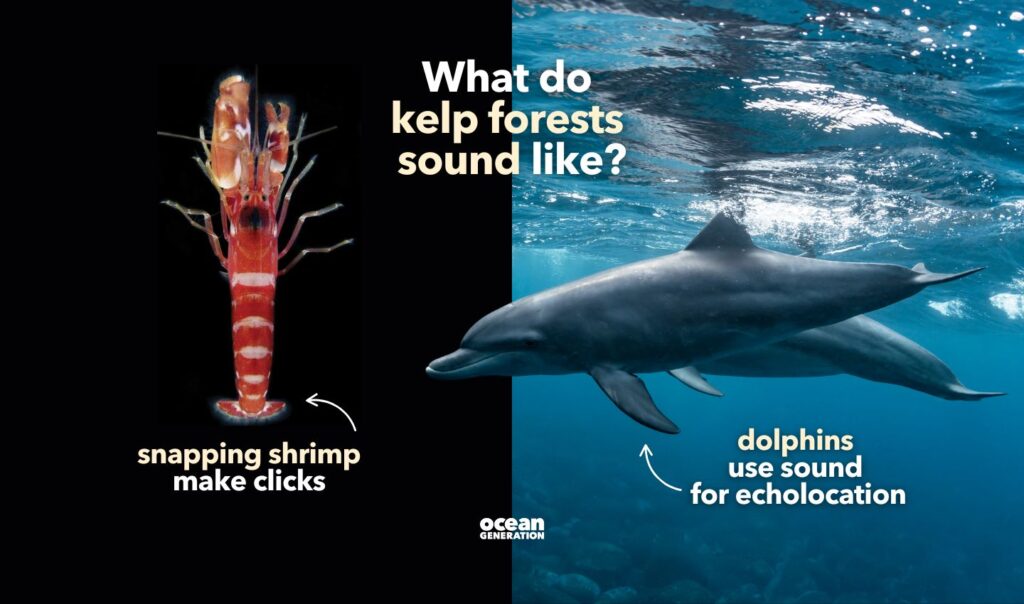
What do kelp forests sound like?
Kelp forests are an unfamiliar setting to most of us, so to assist on our adventure of the soundscape, weโll venture through the woods at the same time.
In the woods, we hear distinctive, familiar noises. The twitter of birds, the chattering of rabbits and the chirps of insects dominate the soundscape. In kelp forests, we can hear the different calls of fishes and the frequent snapping of shrimp.
The noises of kelp forest can be separated by their pitches. Generally, lower tones contain the noises of marine mammals and fish. The higher tones weโd hear contain the clicks of snapping shrimp and the sound of echolocating dolphins (although this is higher than the human ear can hear so it’s silent to us).
These soundscape features often change in both environments over time due to natural factors, like seasonal changes, or human activity.
As the night comes, the sounds of the daytime animals switch to the noise of nocturnal animals.
In the woods, hooting owls and squeaking bats take over the soundscape along with the occasional chirp from foxes. This daily change is seen in kelp forests too, where the activity of animals and therefore the volume of their sounds shifts over the course of the day.
For some species of fish, their noise peaks at sunset and dips at sunrise. As well as this, snapping shrimp are nocturnal, which shows in their activity, as they have peaks at sunset and sunrise but a decreased activity during the day.
Seasonal changes in the kelp forest soundscape
With the arrival of autumn and winter in the woods, some animals migrate or hibernate, removing their noises from the soundscape.
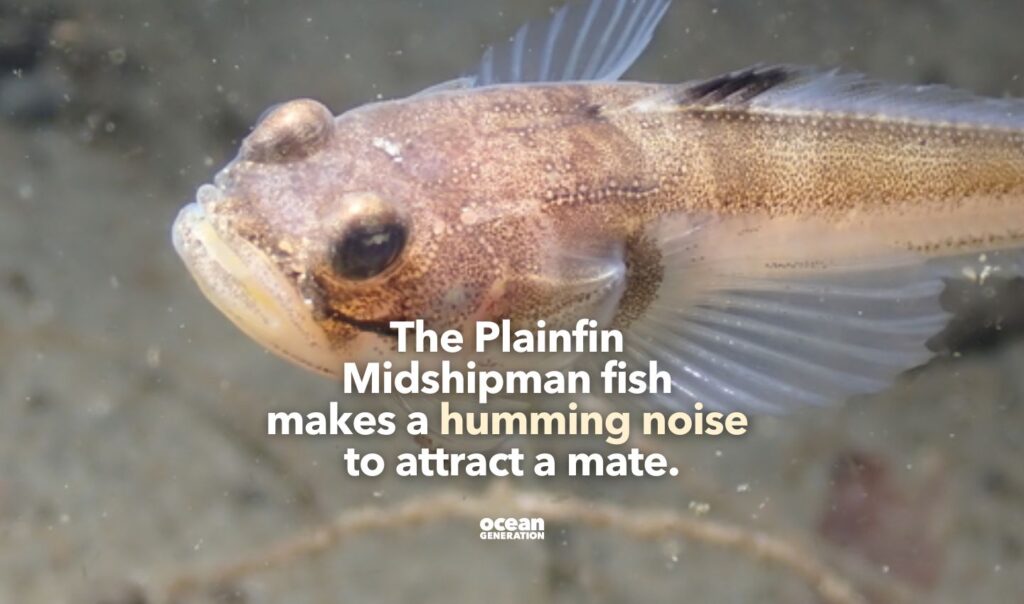
The Plainfin Midshipman fish makes nests near the coast and uses a humming noise to attract a mate. This humming is heard in the kelp forests during late spring and summer, consistent with their mating season. Contrasting this, the presence of snapping shrimps is maintained year-round.
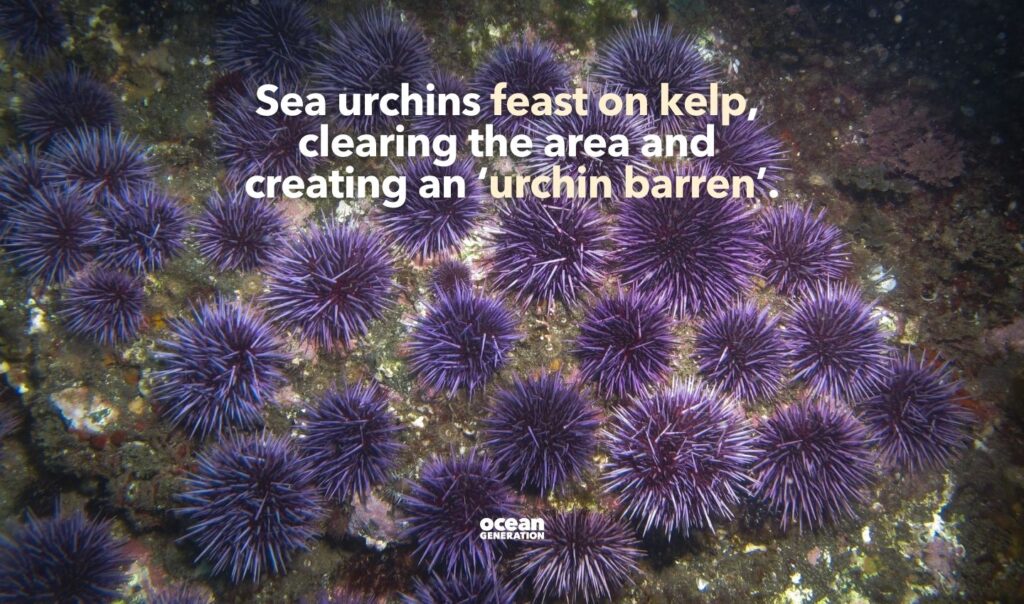
On our walk through the woods, we come across barren spots without trees, caused because of storms or fires. Similarly in the Ocean, an abundance of sea urchins and a lack of suitable food can cause them to feast on kelp clearing the area and leaving a space overrun with small, malnourished sea urchins, with the East Fish camp in California having an urchin density of 26.8 urchins per square metre.
Although urchin barrens may seem like a natural environment, they are created by human activity, just as extreme weather can become more prominent because of global warming.
Normally, sea otters and the occasional fish prey on urchins before the situation gets out of hand. But, due to hunting and overfishing, sea urchin predation is decreased, allowing their population to spike and kelp forests to be removed.
Sea urchin barrens influence the kelp forest soundscape as the region becomes less suitable for some species and more suitable for others. When hundreds of sea urchins move in, they change biodiversity.
A more direct human influence on woodland soundscapes is deforestation. The direct removal of trees by humans to clear space or for resources is easily a big issue, as it decreases habitat space, reducing biodiversity and harming ecosystems.
Listening in our woods, we don’t only hear animal noises but also human noises. Cars on roads which cut through the woods or heavy machinery operating can create loud persistent noises which can disturb the soundscape, affecting the distribution of the animals.
The same is true for animals in the Ocean. Loud noises like drilling and seismic surveys are loud and the noise can be emitted for tens of kilometres, causing confusion and hearing damage in marine mammals and fish.
Other sounds like engine noises from low flying planes and boats can act as background noises which decrease the distance that animals can hear and communicate.
Sound disturbances can normally be mitigated in kelp forests by kelpโs ability to attenuate (absorb and decrease) sound. However, because of the removal of kelp forests, this mitigation can quickly be removed.
The building of docks and other structures may seem like they could bring back attenuation, but they can also transfer noise from cars and docking boats into the Ocean, affecting microenvironments.
What can we do?
It may seem daunting that humans can cause all of this damage, but not all change is bad. Just as forests can be replanted and wildlife protected, as can kelp forests.
The growth of kelp can be stimulated, and areas can become marine protected areas, which can allow areas to be conserved. An example of this is in New Zealand, where an urchin barren has recovered back into a kelp forest within a marine protected area over the period of 20 years.
Looking at how we live our lives, like where our fish comes from or our usage of boats can make a difference in helping this delicate ecosystem.
What Happened to the Stellerโs Sea Cow? Explained.ย
Share this page
Copied
There are two theories about what happened to Stellerโs sea cow. Letโs unpack them.
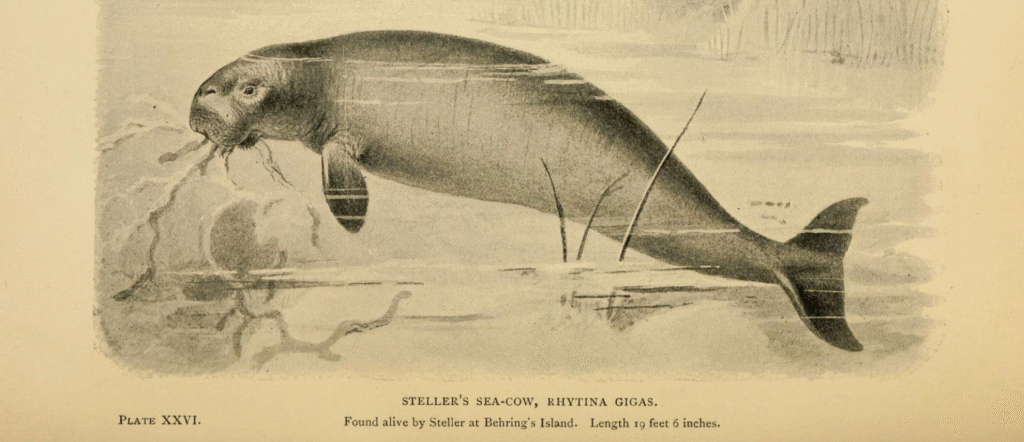
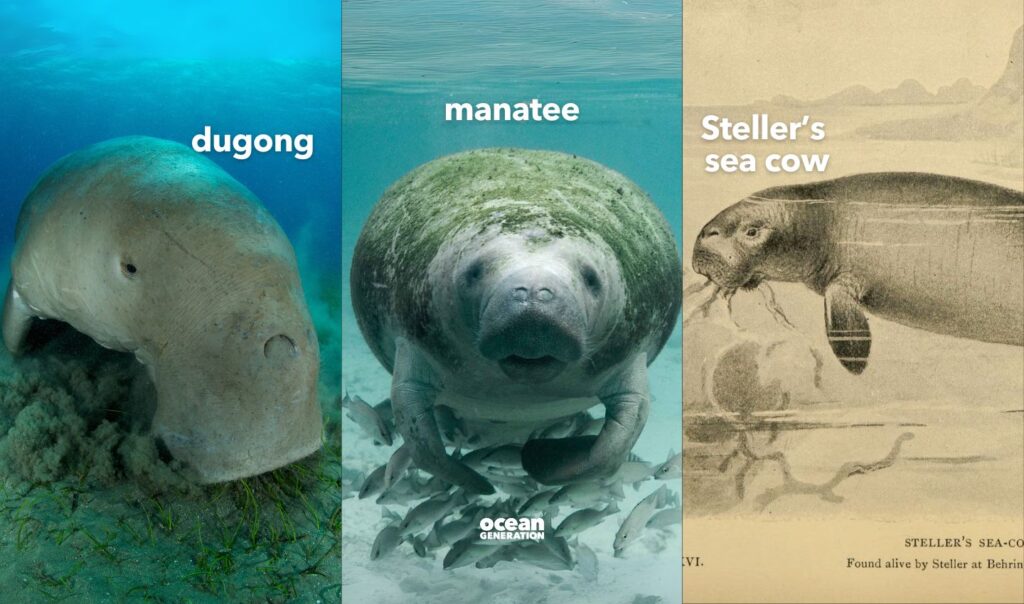
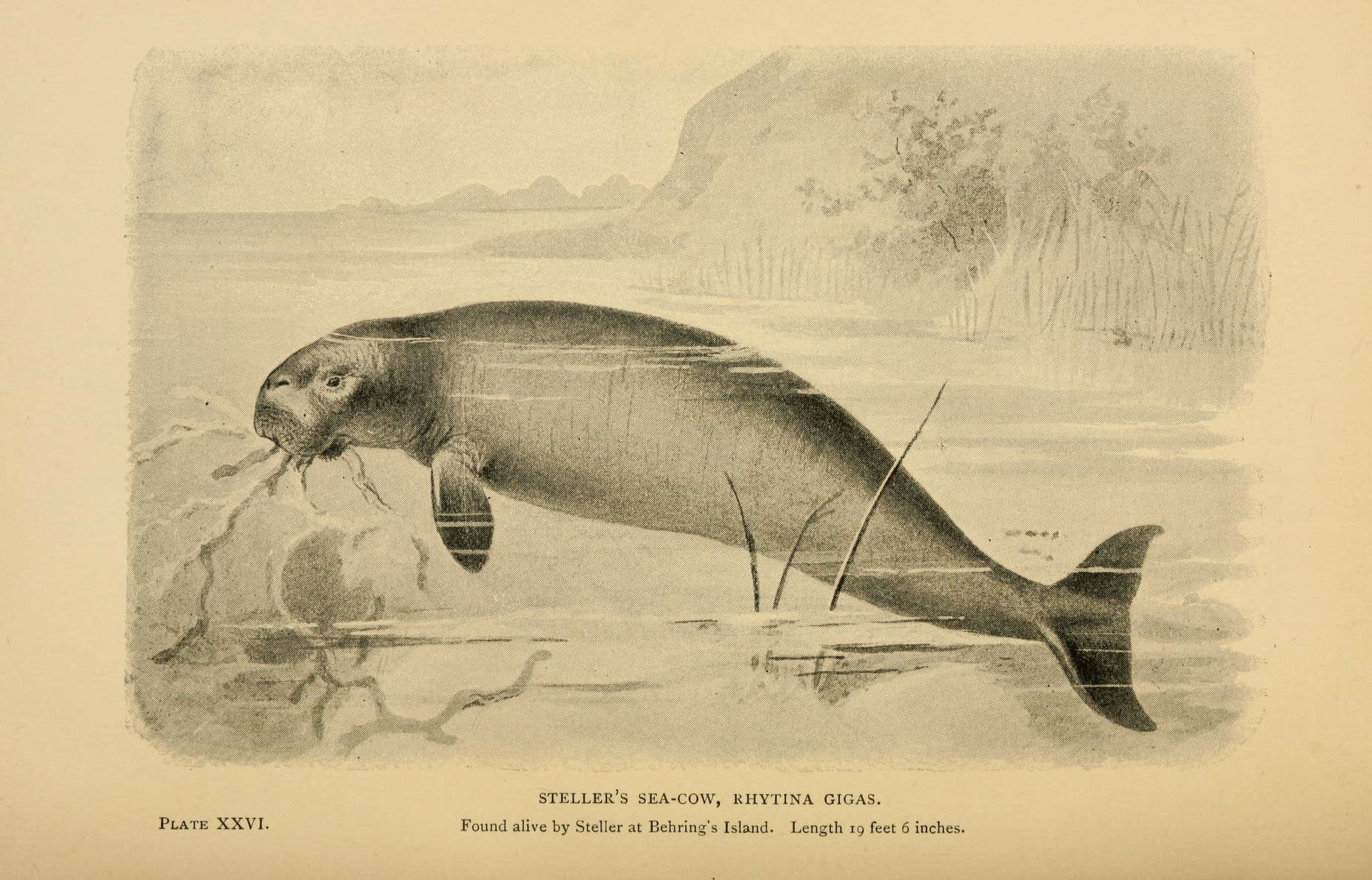
Steller’s sea cow was a 7-metre-long, 5-tonne cousin of the manatee; known to graze peacefully in kelp forests. But just 30 years after the sea cowโs discovery – it vanished from the Ocean forever.
In this article weโre going to explore two theories for why this marine species disappeared. Both involve hunting, but one requires an understanding of the habitat that Stellerโs sea cow called home: the kelp forest.
By looking at this complicated history, we can begin to understand the complex interactions going on under the Ocean surface, and learn lessons about how we can best preserve these incredible ecosystems in the present.
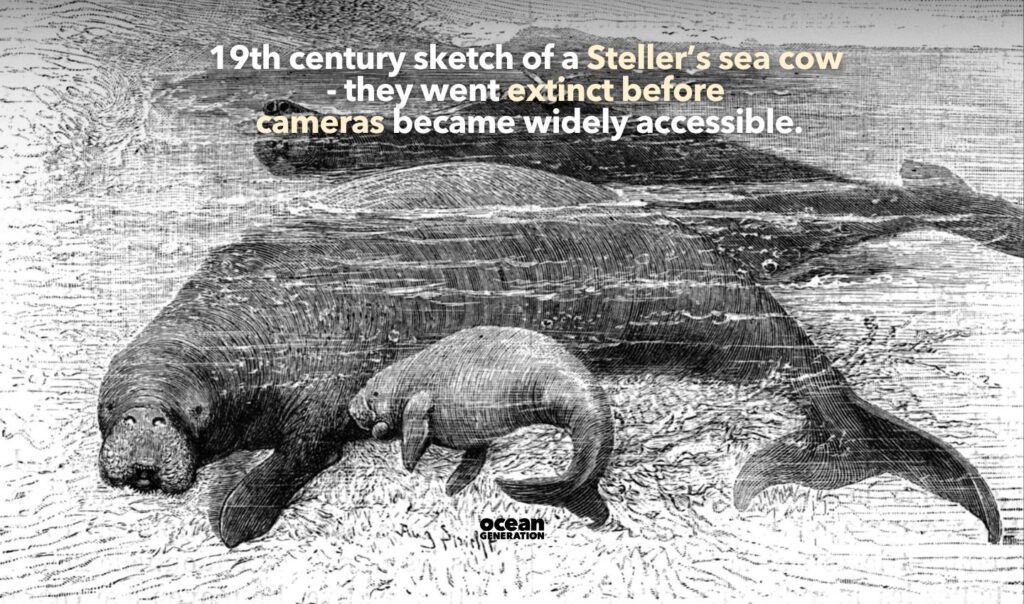
Steller’s sea cow sketch by Biodiversity Heritage Library
The story of Stellerโs sea cow starts with a shipwreck.
On the 6th November 1741, the Svyatoy Petr was shipwrecked on an isolated and uninhabited island, now known as a part of the Commander Islands chain. For several months, the crew of sailors, cartographers, geographers, and natural historians had been carrying out one of the first scientific explorations of the North Pacific.
Stranded for nearly a year, the remaining crew salvaged materials from the wreckage, and built a ship that could cross the Ocean back to Russia.
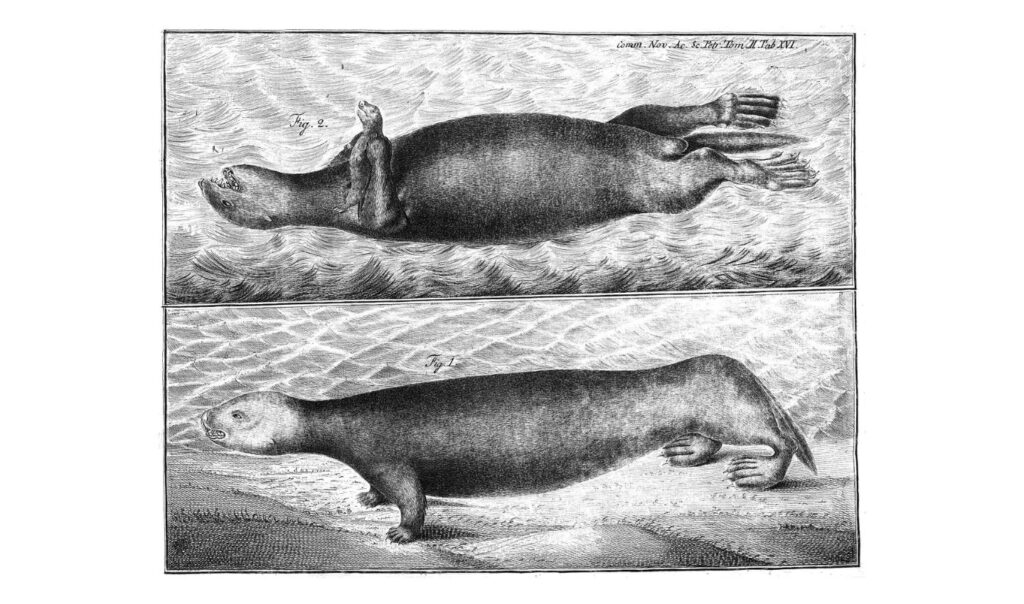
One of the most consequential outcomes of this failed expedition was the presence of a curious and observant naturalist, George Wilhelm Steller. For almost a year, he made meticulous observations, sketches, and notes on the unfamiliar and captivating wildlife that surrounded him, which have been left to us as an invaluable historical and ecological artefact.
From a massive population to extinct:
One creature left a particularly strong impression on George Steller. He wrote in his journal of โgigantic manatees grazing all about the islandโs lagoonsโ. These cousins of the manatee would often exceed 5,000kg in weight. He observed that they were very sociable creatures, sticking in large herds and eating kelp floating at the Ocean surface as though it were grass, โin the same way as horses and cattleโ.
Although Steller wrote that they were so numerous that โthat they would suffice to support all the inhabitants of Kamchatkaโ, a twist of fate left them extinct by the 1760s. To understand them, scientists have had to look at historical evidence and their closest living relatives, dugongs and manatees.
Story One: Hunting
Stellerโs crew hunted sea cows as a source of food whilst stranded on Bering Island. Steller recalled a story in his journal about the psychological stress this placed on them. Whilst hunting a female sea cow, a male aggressively followed and tried to ram their boat, following all the way to shore long after the female had died. They also hunted other creatures including otters and seals.ย
This is the most common theory for the extinction of the sea cow: they were exploited for their meat, fat, and hides, the latter of which would be used in the construction of boats. This theory suggests that the hunting was so widespread and unsustainable that the population was put under great stress and collapsed within 30 years.ย
Story Two: Loss of Keystone Species
In the past few decades, a group of scientists have put forward an alternative theory.
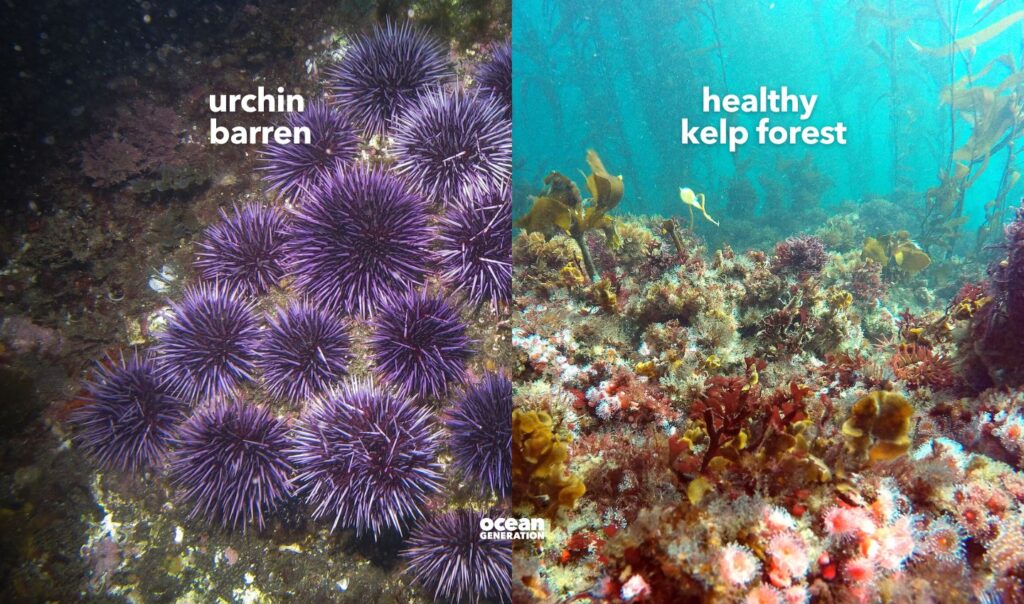
This theory pays attention to the complex dynamics of kelp forests, and the role that sea otters play as โkeystone speciesโ: species that play a disproportionate role in managing the ecosystems they call home. As we explained in a recent article, sea ottersโ appetite for sea urchins prevents overgrazed โurchin barrensโ emerging – desolate stretches of rock with little to no vegetation – in the place of lush and biodiverse kelp forest. Do read this article if you want to learn more!
Urchin barren photo by Ed Bierman, healthy seafloor photo by Zachary Randell
Whilst Stellerโs sea cows were hunted on these expeditions, sea otters were the main pursuit. When the first groups returned with the fur pelts of sea otters, traders were so astonished at their thickness and quality that they sold for nearly 100 rubles a pelt – 25 times more than the equivalent pelt from land animals. Itโs been said that they were, at some points, worth more than gold! In the wake of the euphoria that ensued, the sea otter population collapsed so quickly and dramatically that they were observed to be at the brink of extinction around the Commander Islands by 1753.
Kelp forests create a complex habitat for a diversity of species, with one study in Norway suggesting that the average piece of kelp in their study site supported 8,000 individual organisms. If sea otters are lost to hunting, the kelp forests can be transformed into urchin barrens, as there are no otters to control sea urchin populations. As kelp is lost, the Stellerโs sea cow loses their source of food, a change to their environment that might have ultimately resigned them to extinction.
Sketch of a sea otter by Steller
Which theory about the extinction of Stellerโs sea cow is it?
Both theories are reasonable. Ecosystems are complex and difficult to understand completely, and it is probably a bit of both. As I have been reminded by one of the scientists who proposed the second theory, โthe lack of good data from the extinction of sea cows means that we are unlikely to ever really know.โ
Sea cows may be extinct, but this story is not irrelevant, and shouldnโt be the cause of doom and gloom or eco-anxiety.
As scientists have better understood the role of sea otters as a โkeystone speciesโ that maintain kelp forests, we have become more capable of putting conservation programmes in place that work. The recovery of sea otter populations in the Pacific is arguably one of the greatest success stories of conservation, bringing back both populations of sea otters and the coastal ecosystems they engineer such as kelp forests. At the moment, we can look to innovative projects such as the Monterey Bay Aquariumโs surrogacy programme for hope, which raises orphaned pups so that they can be reintroduced back to the wild. (You can see them on the aquariumโs live stream here!)
We may have lost Stellerโs sea cow, but we can still restore kelp forests for the countless other species that call it home.
Steller had a sense for the value of sea otters, though he may have primarily seen them as creatures to hunt. He even wanted to bring some home as pets. โThe sea otter,โ he wrote, โdeserves the greatest respect from us allโ. Although he couldnโt have understood the complex work that they do as a โkeystone speciesโ as we do today, we can all wholeheartedly agree with him.
But more complicated things are going on below the surface.
As well as capturing our hearts, they are โkeystone speciesโ: species whose everyday eating, resting, and playing has a disproportionately large role in maintaining the entire ecosystem around them. This article will explore how otters make themselves a home in the kelp forest, and how they’re otterly (sorry!) essential to maintaining one of our Ocean’s most vibrant ecosystems.
Where do sea otters live?
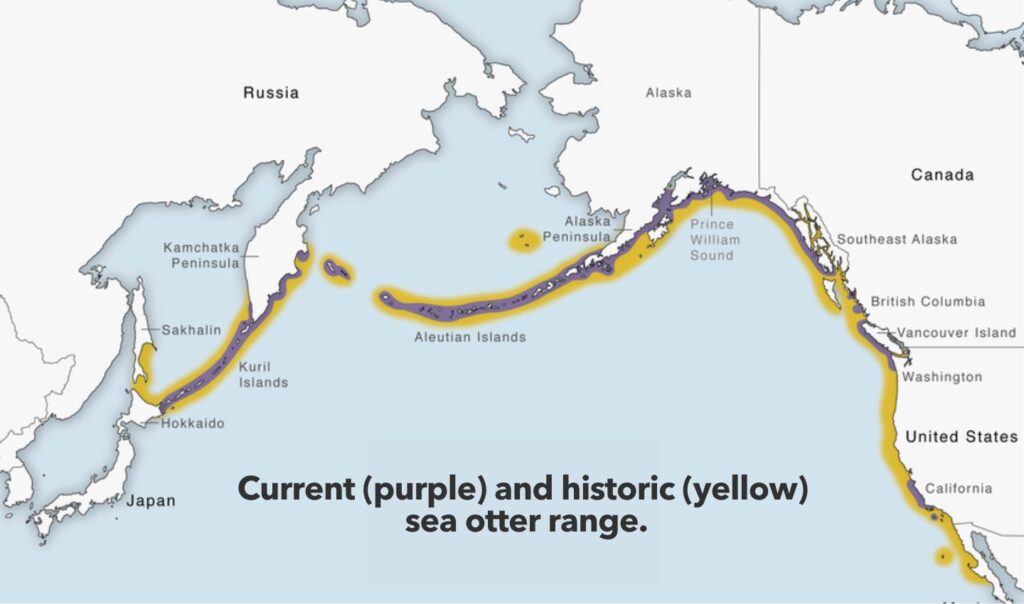
Sea otters (Enhydra lutris) have a range that covers the North Pacific, stretching around a coastline that extends between Japan, Russia, Alaska, and California.
Map: Future Directions in Sea Otter Research and Management
What connects all these places? Offshore โ out of sight and below the surface โ this whole stretch of coastline is a chain of โkelp forestsโ: magical ecosystems that are teeming with life. Whilst sea otters donโt only live in kelp forests, they are most at home in them as it provides them with food and shelter.
Kelps are a range of brown macroalgae (seaweed, to you and me) that grow up to 50m in length. The brown colour comes from a particular pigment that allows them to capture light below the Oceanโs surface. Like plants on land, they photosynthesise sunlight into organic material, which produces the energy for an entire complex food web around it.
This is the base for an incredibly rich and diverse habitat, and one study in Norway found that the average piece of kelp provides habitat for 8,000 individual organisms, with some even providing habitat for over 80,000!
What do sea otters eat?
If thereโs one thing sea otters can do, itโs eat. Studies have estimated that they need to eat between 19% and 39% of their body weight in food to meet their basic needs. To put this in perspective, this would be the equivalent of a person needing to eat about 20 pizzas every day!
As well as sea otters, kelp forests are home to a wide range of other species including fish, seals, and seabirds, and invertebrates such as molluscs, lobsters, and sea urchins. Many of these invertebrate species are found in sea otter diets, but at the top of the menu are sea urchins.
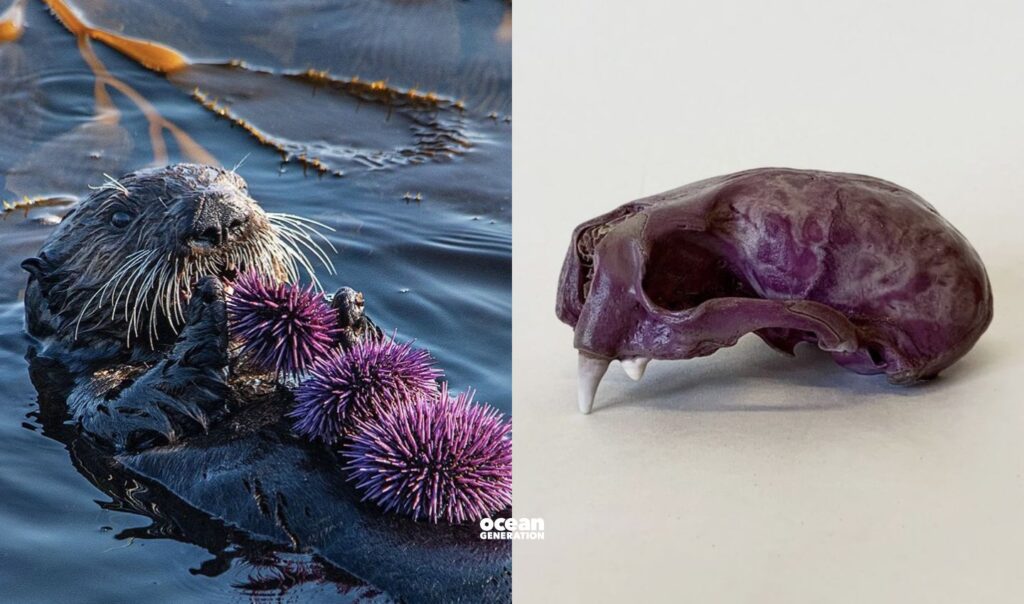
In fact, some sea otters crack open and eat so many purple sea urchins that their bones are dyed a pink to purple colour from the compounds they contain.
Sea otter skull image by Peter Monteforte
How are sea otters โkeystone speciesโ?
A โkeystone speciesโ is a species โwhose impact on its community or ecosystem is large, and disproportionately large relative to its abundanceโ. This means that if they are lost from an ecosystem, it can disrupt everything else within it. In the case of the sea otter, losing them can even indirectly lead to the loss of kelp. We have explored a historical case where this happened in an explainer article here.
But how does this happen?
The greatest threat to many kelp forests – especially, but not only, in temperate parts of the Ocean – is overgrazing from sea urchins. When their numbers are left unchecked, sea urchins sweep their way across the seabed, devour all the kelp they come across, and leave nothing but a desolate rocky seafloor known as an โurchin barrenโ.
The varied heights of kelp creates a habitat with different levels that can be compared to the differences between the canopy and floor of forests on land, meaning a diversity of species can call it home. Once an urchin barren forms and kelp is taken out of the ecosystem, the many other species that rely on it for food and shelter can also be lost.
Kelp is a complex habitat that supports a range of small species, which makes it a healthy breeding ground and nursery for fish. This attracts larger species such as seals and seabirds, who suffer knock on effects along with fish when kelp forest is lost.
Urchin barren photo by Ed Bierman, healthy seafloor photo by Zachary Randell
This is where our sea otterโs taste for urchins can come in handy. Sea otters can break through sea urchinsโ tough, prickly exterior for food, and do so in such large numbers that they play a crucial role in managing populations. Theyโre accidental conservationists!
How are sea otters part of conservation efforts?
Sea otter populations had declined very significantly by the 20th century. At the time when much of the initial research was being done on the relationships between sea otters, sea urchins, and kelp, one marine scientist publicly shared his worries that the kelp forests of the Pacific had gone through โirreversible degradationโ.
Sea otters have a long history of being at the heart of conservation efforts. Hunting them in parts of Alaska and Russia was banned in 1911 in the first ever piece of wildlife conservation policy, and banned throughout the United States in the 1970s.
More recently, sea otter โtranslocationsโ โ where populations are moved to parts of their former range so they can recolonise it โ have reintroduced sea otters to parts of the North Pacific such as Southeast Alaska, British Columbia, Washington, and San Nicolas Island in California. As the relationships between them and the kelp forests they live in has become better understood, reintroducing otters has become more than just about them, but the whole kelp forest ecosystem they can create too.
An exciting project has been taking place over the past few decades at the Monterey Bay Aquarium in California, where orphaned sea otter pups are rescued, rehabilitated, and released back into the wild. Between 2002 and 2016, they reared and reintroduced 37 individuals, with benefits not only for sea otter populations but the integrity of the ecosystem as a whole.
The North Pacific kelp forest: A place to call home
Marine scientists have carried out experiments where they observed the differences between how sea otters behave in parts of the Ocean which have kelp forest in comparison to those places without. As a result, itโs possible to see that the otters themselves benefit from their unwitting conservation work.
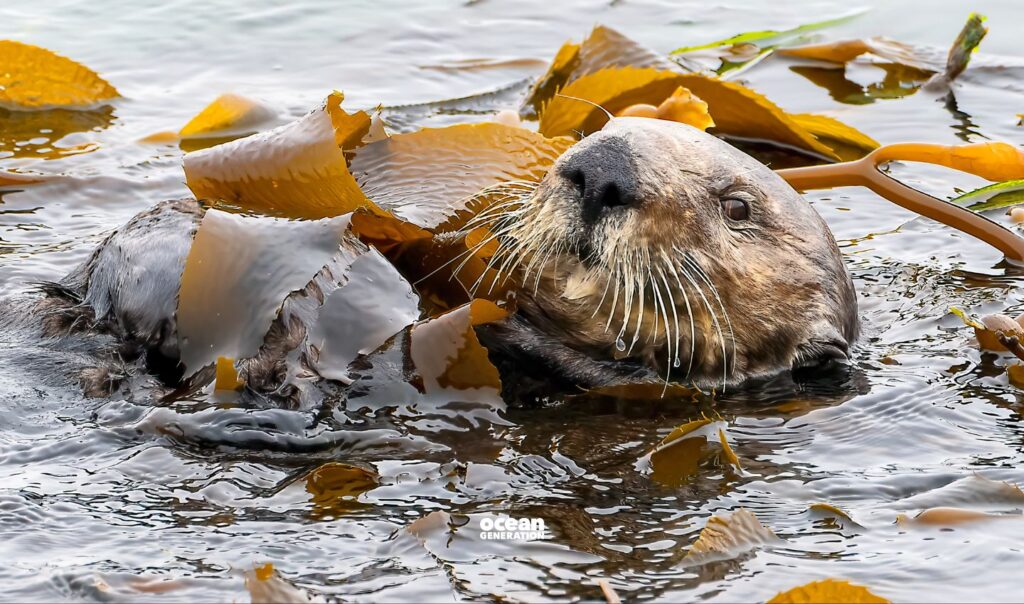
Firstly, sea otters love to be around kelp as it is a safe habitat for them. At low tide, kelp sits on the surface of the Ocean, and sea otters wrap up their pups in the strings of kelp so they donโt drift away while they nap or hunt. Their role in clearing the urchin barrens can be really kelpful โ restoring the very kelp in which they live!
Secondly, the sea urchins that sea otters catch from urchin barrens are not as nice as the ones in kelp forests. They are small, bad quality, and have poor nutrition. Scientists have estimated that due to the difference in quality, sea otters living outside of kelp forests in the Aleutian Islands in Alaska would need to eat about 1,085 urchins every day to meet their basic needs, compared to just 484 in areas with healthy kelp forests. This means that by restoring kelp ecosystems, sea otters save time and get an extra hour and a half every day to nap or frolic around on the Ocean surface.
Kelp forests can also sustain a more biodiverse and complex food web than urchin barrens. Those otters with a taste for fine foods arenโt stuck with urchins for dinner every day. If you had to eat sea urchins every day, youโd probably be bored and want a change too, right? Kelp forests offer sea otters a more varied diet, from a much larger range of sea creatures including crabs, clams, sea snails, scallops, and mussels.
Just an-otter brick in the wall?
So, how do otters make themselves at home in the kelp forest? The answer is simple: just by being their adorable and authentic selves. If there is one take away from this article, itโs that the health of sea otters are entangled in that of the kelp forest ecosystem they call home.
If you ever find yourself scrolling through cute videos of otters on the internet, just remember, they are not just cute and furry, but truly precious and wonderful engineers of the Oceanโs ecosystems.
How can we clean up plastic pollution in the Ocean?ย
Share this page
Copied
Why do beach cleans actually work: Explained.
An army of passionate people take to the beach, litter pickers in hand. Sea spray in their hair and sand under their nails, they comb the beach. Their bags fill with cigarette butts, plastic bottles and crisp wrappers. Spirits are high, notable pieces of rubbish are held up with announcement.
As the sun sets, the beach seems lighter, relieved of the weight of rubbish. The cleaners look over the coast with proud eyes at a job well done.
But as the night draws in, so does the tide. When the sun rises again, it unveils a plastic-laden beach once more. The Ocean has coughed up some of its burdens.
What is the point in beach cleans? Are we rearranging deck chairs on the Titanic or do they actually help combat Ocean pollution?
There arenโt great islands of plastic floating in the Ocean (even the Great Pacific Garbage Patch is a myth). But we are creating a plastic soup. Microplastics fill the Ocean, with some โcroutonsโ of bigger floating plastic.
This plastic can kill wildlife, carry toxins and enter the food chain โ all the way up to us.
Itโs obvious: we all want less plastic in the Ocean. The question is how to achieve that.
What impact do beach cleans actually have?ย ย
A beach clean is more than just a fun day out. They do a whole load of good.
Firstly, they are good for us. Beach cleans (and most coastal activities) have been associated with positive mood and improving our understanding of the Ocean. Combine a beach cleanup with some rock pooling and thatโs a brilliant afternoon. Imagine all the things you can find! We feel better cleaning our beaches.
Beach cleans are a chance for people to come together and make a tangible contribution. They act as displays, raising awareness for our pollution problem and encouraging more engagement. A snowball effect.
Beach cleans provide immediate benefit to the natural world too. Removing plastic from the beach takes away its threats straight away, and removes the future threats as well.
Plastic on the beach is exposed to the stresses and strains of the Ocean. Waves breaking, rubbing against the sand and rocks, the sun beating down. All these break up the plastic into smaller micro- and nano-plastics. Removing it before that stage is a lot easier.
Our understanding of the journey of plastic waste is evolving. Recent studies suggest that the vast majority (88% is the quoted figure) of plastic in the Ocean remains floating close to shore. This means our beaches take the brunt of the plastic problem. But that also means itโs accessible: We can remove the majority of the problem with ease and stop it getting worse.
Beach cleans treat the symptoms without addressing the illness.ย
Beach cleans are not the whole answer. You canโt keep bailing a sinking boat out and expect to float, until you bung the hole. A beach clean treats the symptoms without addressing the illness.
We need more than litter-pickers.
What are the other allies in the battle against Ocean plastic?ย
The closer to source of plastic pollution we can get, the better. Try filling a glass from someone pouring three stories above you โ a lot more water gets spilled compared to just filling from the tap.
Single use plastic bans have shown to be effective in reducing litter. Increasing the responsibility of plastic producers for the end of their products lives would motivate innovation and stop plastic becoming litter at all. A circular economy would prevent the demand for oil to produce more and reduce the amount of plastic that becomes rubbish.
As consumers, we also need to rethink how we use plastic.
How can we change our relationship with plastic? ย
Moving away from a single-use plastic world is, honestly, going to be tricky. We live in a world where convenience is king. Single-use plastic is very convenient. But there are solutions already working.
Deposit return schemes have proved to be highly effective in increasing the collection rates of plastic bottles. When you buy a drink in a plastic bottle, for example, a small extra fee is paid, which is returned when the bottle is returned. For one scheme, 94% of bottles were returned compared to 47% without a scheme.
Nearly every major manufacturer (98%) now has commitments to reduce plastic packaging. Whether this represents genuine change or sophisticated greenwashing remains to be seen, but consumer pressure and regulatory requirements are making plastic reduction a business imperative rather than a nice-to-have.
The challenge lies in balancing reduction with practicality. Sometimes plastic packaging actually reduces overall environmental impact compared to heavier alternatives – it’s the end-of-life management that needs sorting.
The uncomfortable reality of waste management
Here’s the uncomfortable truth: much of Ocean plastic pollution originates from countries with limited waste management systems. Sub-Saharan Africa, for example, averages 44% waste collection rates compared to 98% in high-income countries. It’s rather difficult to recycle rubbish that’s never collected in the first place.
We canโt simply take Western waste management systems and apply them exactly as they are in other countries. Locally managed, decentralised circular economy models – using local resources and creating local markets for recycled materials – show more promise than imposing one-size-fits-all solutions.
Is making plastic expensive a solution to pollution?ย
Governments wield powerful economic tools: taxes on single-use plastics, subsidies for recycling infrastructure, and extended producer responsibility schemes that make manufacturers pay for their products’ end-of-life management.
When virgin plastic (new plastic) becomes expensive and alternatives become cheap, behaviour changes remarkably quickly. But it has to be done without disadvantaging those that donโt have access to a cheap alternative.
So, back to the original question: Do beach cleans work?ย
Yes. But they wonโt stop the problem long term. Beach cleans deliver value beyond plastic removal. They’re powerful data collection exercises, providing crucial information about debris types and sources that inform policy decisions.
Beach cleanups are also remarkably effective educational tools – nothing quite drives home the scale of plastic pollution like spending a Saturday morning filling bin bags with bottle caps.
Perhaps most importantly, recent research from Norway found that removing larger plastic items from coastlines led to a 99.5% reduction in microplastics both on land and in water within a year. That’s a genuinely impressive result that suggests beach cleans have more direct environmental impact than critics assumed.
โRemoving plastic from the environment before it enters an active degradation phase, into microplastics, will reduce the formation of microplastics in the environment. The decrease of microplastic was over 99% in the water volumes we found on land. When we looked at seawater, the microplastics leaking into the sea was reduced by 99.9%,โ – Gunhild Bรธdtker, senior researcher at Norce
Whatโs the most effective strategy to deal with plastic pollution?ย
The most effective strategy combines both approaches: upstream prevention (stopping plastic from becoming waste) and downstream management (dealing with what’s already out there). Think of it as both turning off the tap and mopping up the flood.
Beach cleans work best when they inspire participants to tackle root causes – supporting deposit return schemes, choosing refillable alternatives, and pressuring companies to reduce packaging.
The real measure of a successful beach clean isn’t just the bags of rubbish collected, but the number of people who leave determined to prevent that rubbish from appearing in the first place.
What should you do next to help tackle plastic pollution?ย ย
So beach cleans wonโt solve the problem. The good news is that effective solutions exist. The challenge is implementation at the scale and speed the problem demands.
Join a beach clean, but don’t stop there. Support businesses with genuine circular economy commitments, lobby for deposit return schemes, and remember that every purchase is a vote for the kind of world you want to live in.
The Ocean doesn’t care about our good intentions. It needs systemic change, and that requires all of us to think beyond the beach. All our jobs can be beach.
Finding Nemo introduced millions to the technicolour world of coral reefs.
But beneath its heartwarming tale of family reunion lies a treasure trove of marine biology – some spot-on, some wildly imaginative. Let’s dive in and separate the science from the storytelling. How accurate is Finding Nemo?
Letโs start by identifying some of the main characters.
Who are the fish in Finding Nemo?
The clownfish
Nemo and Marlin are orange clownfish or clown anemonefish (Amphiprion percula), and their home-bound lifestyle is spot-on. Unlike their cartoon counterparts gallivanting across the Ocean, real clownfish are the ultimate homebodies. Adult clownfish rarely venture more than a few metres from their host anemone, making Marlin’s anxiety about Ocean exploration biologically justified rather than neurotic.
What type of fish is Dory?
Dory goes by a lot of names: regal tang, palette surgeonfish, blue tang, royal blue tang, flagtail surgeonfish, regal blue tang to name a few (Paracanthurus hepatus).
Regal tangs like Dory are common throughout the Indo-Pacific, so her presence on the Great Barrier Reef checks out perfectly. However, her famous memory problems contradict everything we know about fish cognition. Studies show that P. hepatus can remember spatial layouts for months and demonstrate complex social learning. More on fish brains later.
How accurate are the fish in Finding Nemo?
Mr Ray the spotted eagle ray (Aetobatus narinari) makes a charismatic teacher, though real eagle rays are typically solitary creatures who’d probably skip group activities in favour of a solo swim.
Gill the Moorish idol (Zanclus cornutus) represents one of the aquarium trade’s biggest challenges. These stunning fish are notoriously difficult to keep alive in captivity due to their specialised diet of sponges and tunicates (a group of marine invertebrates that include sea squirts which look, to non-divers like coloured blobs on the reef). This explains Gillโs dissatisfaction with captivity and desperate escape plans.
The film shows a fish dropping their kids off to Mr Rayโs class using their mouth, representing one of nature’s most devoted parenting strategies.
Cardinalfish (Apogon species) are the most common marine mouthbrooders, with males incubating eggs in their mouths for 8-10 days. This explains why they seem unable to speak clearly โ try having a conversation whilst holding 200 delicate eggs in your mouth without swallowing. The cartoon, however, doesnโt look much like a true cardinalfish.
Our current estimates are that green turtles live to approximately 80 years old, so the claim that Crush from Finding Nemo is 150 is a bit steep. Turtles arenโt known to travel in family groups, but Squirt does show the independence of a baby turtle. Right from the egg, turtles are fending for themselves, which Squirt shows they are more than capable of.
Do sea turtles really cruise the East Australian Current?
The East Australian Current (EAC) serves as nature’s highway in Finding Nemo, and this isn’t just Pixar imagination. The EAC is a genuine part of the Oceanic conveyor belt (global network of currents circulating water), flowing southward along Australia’s eastern coast at speeds up to 1.5 metres per second.
Crush’s “express lane” concept isn’t pure fantasy either. Ocean currents do have acceleration zones, particularly near topographical features like seamounts and continental shelf breaks. These current jets can provide genuine fast-track transport for marine life, making the turtle highway a plausible, if simplified, representation of oceanic dynamics.
Green turtles (Chelonia mydas) really do use these currents for epic migrations, though their navigation system is far more sophisticated than simple current-following. The sea turtles use magnetic field detection to create internal GPS systems, imprinting on magnetic signatures as hatchlings and using these for navigation throughout their lives.
Are the vegetarian sharks possible?
Bruce and his gang’s “fish are friends, not food” philosophy in Finding Nemo might seem biologically ridiculous, but nature occasionally surprises us.
Bonnethead sharks (Sphyrna tiburo) can derive up to 62% of their nutrition from seagrass, making them the Ocean’s most successful vegetarian predators. These remarkable sharks have evolved specialised digestive adaptations to break down plant cellulose โ essentially becoming underwater cows with teeth.
Whilst no shark is completely vegetarian (they still eat crabs, especially when they are older), the bonnethead’s plant-munching abilities suggest that Pixar’s gentle giants aren’t entirely impossible โ just highly evolved.
Bonnethead sharks photo by Robin Riggs
Other creature features in Finding Nemo
Pixar’s attention to detail shines with creatures like the Spanish dancer (Hexabranchus sanguineus) โ a spectacular sea slug that really does inhabit the Great Barrier Reef and can reach 40cm in length. These crimson beauties are nature’s underwater flamenco performers, funky reef rugs on a magic carpet ride over the reef.ย ย
However, some characters are biogeographical impossibilities. They wouldnโt be in the same scenes.
The anglerfish is most likely a black sea devil (Melanocetus johnsonii), the same species filmed swimming to the surface in early 2025. Whilst visually terrifying, the encounter represents a fundamental ecological error. These deep-sea specialists live 200-2,000 metres (656 โ 6561ft) down, where they’d never encounter shallow reef fish. Our clownfish friends donโt usually stray below 15m (49,2 ft). The poor blobfish is a good example of what happens when you take an animal out of the pressure range it’s adapted to.
Similarly, Nemoโs classmate Pearl is a flapjack octopus (Opisthoteuthis californiana). These are usually hanging out at depths of 200-1,500 metres (656 โ 4,921 ft). These adorable cephalopods (who had a new species found in 2025) are built for life under crushing pressure and would be about as comfortable in shallow reef waters as a penguin in the Sahara.
Letโs really get stuck in. Pearl talks about one of their arms (they say tentacles, but we know octopus have arms) being shorter than the rest. This means two things โ that Pearl is a male octopus, and that arm is their hectocotylus, or an arm shorter than the rest thatโs specialised to store and transfer sperm during mating.
Finding Nemo got it wrong? Letโs talk clownfish reproduction and genders.
Since we are ruining childhoods, letโs address the elephant seal in the room. Brace yourself for the biological bombshell that completely rewrites Nemo’s story.
Clownfish live together in anemones, with the largest individual as the matriarchal female. The largest male mates with her, with other smaller males helping with the chores and waiting their turn.
When Coral, Nemoโs mum, died in that barracuda attack, the real biological story would be different. Within 10-18 days, Marlin would undergo a complete sex change, transforming into Marlina โ the new dominant female clownfish of the anemone. This isn’t just changing wardrobes; it’s a full hormonal makeover involving suppressed testosterone and elevated oestrogen.
But would Marlina then mate with Nemo, as some marine biologists suggest? (Because Nemo was the only clownfish in the anemone.) Probably not. Studies show that clownfish larvae typically disperse 7-12 kilometres from their birth sites, and genetics prove most anemone families aren’t actually related. Marlina would more likely wait for a wandering young male to join the family and restart the dynasty properly. Thank goodness.
Does Mr Ray actually teach anything?
We love that Mr Ray’s impromptu biology lessons contain genuine scientific gems, though we do have notes. His Ocean zone definitions are accurate โ the mesopelagic (200-1,000m or 656 โ 3,280ft), bathypelagic (1,000-4,000m or 3,280 โ 13,123ft), and abyssopelagic (4000m+ or 13,123ft+) zones represent real oceanographic divisions with distinct communities.
His species song (itโs called โLetโs name the speciesโ, if you want to look it up) is catchy and gives a fun overview of the species you can find on a coral reef.
“Cnidaria” would be more accurate than “coelenteraโ. Coelentera is an old term grouping a lot of the animals he goes on to name: hydrozoa (hydriods like the Portuguese man-o’-war), scyphozoa (true jellyfish), anthozoa (coral and anemones) and ctenophora (comb jellies). Add in the porifera (sponges), byrozoa (colonies of moss animals), echinoderma (urchins and sea stars) and โsome fish like you and meโ and you have a pretty comprehensive overview of life of the reef.
Mr Rayโs excitement about โstromalitic cyanobacteriaโ is understandable and surprisingly sophisticated for a children’s film. These layered rock formations, created by ancient cyanobacteria, represent some of Earth’s earliest life. They were crucial in the Great Oxygenation Event 2.4 billion years ago. We can thank them for introducing oxygen to the atmosphere! Even now, the Ocean provides around half the oxygen we breathe.
Cleaner wrasses (Labroides dimidiatus) pass the mirror test โ a cognitive benchmark previously thought exclusive to mammals and birds. Meanwhile, archerfish demonstrate remarkable learning abilities, accurately spitting water at insects with ballistic precision that would make a sniper jealous.
(additional note โ read What A Fish Knows By Jonathan Balcombe for more)
Scientific pet peeves in Finding Nemo
The blue whale
The film shows Marlin and Dory falling to the back of the throat, to be blown out of the blowhole into Sydney harbour. But blue whales canโt blow something out of its blowhole from its mouth.
A whaleโs blowhole is linked to the lungs, nothing else. It isnโt spurting water out, itโs a mix of mucus and water on its skin (think blowing your nose when youโre wet). Scientists can actually find out a lot from a whale from its snot, and they use โSnotBotsโ – drones to collect whale blowhole bits.
The jellyfish
The jellyfish in Finding Nemo arenโt really any specific jellyfish, just mash of a few features to create a generic jelly. The closest real-life versions are the maeve stinger (Pelagia noctiluca) or the Amakusa Jelly (Sanderia malayensis), but neither are a perfect fit.
Despite the sound effects, they donโt electrocute their prey โ they have small cells firing tiny needles loaded with venom into anything that touches them.
Marlin claims โI am used to itโ. There isnโt much science to say that would help. Remember Nemo brushing in the anemone before school? That is science! Clownfish avoid being stung as they have a protective mucus layer similar to the anemone (it has to avoid stinging itself). They brush up against the anemone to coat themselves in the mucus, keeping them safe from stings. But this is specific to their home anemone and wouldnโt help much against a smack of generic jellyfish. Marlin isnโt any more jellyfish-proof than any other reef resident.
So, is Finding Nemo accurate?
Finding Nemo succeeds brilliantly in capturing the wonder of marine life whilst taking considerable liberties with biological reality. Its greatest accuracy lies in depicting clownfish territorial behaviour and anemone relationships, whilst its most glaring errors involve biogeographical impossibilities that would make any marine biologist wince.
We canโt not mention how clownfish would actually react in Marlinโs situation โ a biological reality that completely transforms the story’s foundation. It’s a perfect example of how nature’s truth can be stranger and more complex than fiction.
Perhaps the real magic lies not in perfect scientific accuracy, but in inspiring curiosity about the Ocean’s genuine wonders. After all, reality is often far more extraordinary than anything Pixar could animate.
Can we rebuild coral reefs? The promising (and weird) world of coral reef restorationย
Share this page
Copied
Hereโs what you need to know about coral reef restoration:
Corals are cool. But the reefs face danger. A warming Ocean causes corals to bleach more regularly. Some estimates say we have already lost 50% of the worldโs coral reefs.
While we work to reduce the emissions of greenhouse gases, to keep our world from warming, we can also look to support the recovery and rebuilding of impacted coral reef systems. So today we ask: how can we restore our coral reefs (and how is a coral reef like a struggling orchestra)?
Why should we care about coral reefs?
Anyone that has had the privilege of diving on a coral reef will tell you how special these places are.
Reefs cover less than 0.1% of our Ocean floor but support 20-30% of marine species. We have tried to estimate the economic value coral reefs bring, but itโs a difficult area, and economists canโt agree on the price tag.
The range of $30 billion to over $300 billion puts coral reef value somewhere between โtremendously valuableโ to โastronomically preciousโ. Include the goods and services provided by coral reefs and the estimated figure is $2.7 trillion. Trillion with a T.
Coral reefs are excellent shields โ healthy reefs can absorb 97% of wave energy. This protects our coasts, on which many of us live. Think of the most famous reef in the world โ the Great (what?) Reef for example.
So, we have to keep our corals around. The question is: how are we going to? Letโs take a look at the three most common coral reef restoration methods.
Image credits: Coral gardening photo by the BBC, Microfragmentation photo by Blue Corner Dive
Fragments of healthy coral are taken from an existing coral reef and placed in a nursery. This nursery is set up for the baby coral to thrive. When the corals reach a big enough size, they are โplantedโ back onto the reef.
This is a very accessible, increasingly cheap way of tackling coral decline. Costs are estimated to drop from $150-$400 per coral to <$10 per coral with improving techniques. It doesnโt require expensive equipment, and is a very visible, practical way to engage communities.
Does coral gardening work long-term?
Not sure. Short-term results? Pretty promising. Two large projects (Coral Reef Foundation in Florida and CARMABI in Curaรงao) claim over 80% survival after one and three years respectively.
However, it isnโt all sunshine and coral roses. These figures arenโt peer-reviewed (cross-examined by other scientists) and likely reflect best-case scenarios for certain coral species.
Gardening projects, however, tend to focus on fast-growing genus like Acropora, ignoring slower growing (but just as important) species. This results in โrestoredโ reefs that are low in biodiversity.
Itโs like trying to have an orchestra with only violins. It is technically music, and possible to even be good, but lacks the depth and the magic of the interplay between instruments that brings it to life.
(One of our marine scientists favourite orchestral pieces is the Planet Earth II Suite: the layering of the song as different instruments come in make your soul soar. What other piece can boast having sleigh bells?? Listen here.)
This coral restoration method is also limited in scalability โ can it be used to make a big difference?
Coral gardening is like trying to replant the Amazon by using window boxes. Itโs cost effective, and great for fast-growing corals. BUT it produces reefs with low genetic diversity (making them vulnerable to disease) and low species diversity.
Gardening alone isnโt going to save our coral reefs.
Can cutting corals into tiny bits help?
Microfragmentation is chopping up coral colonies into little pieces. The fragments are placed next to each other, and will grow out, to form larger colonies.
The key advantage here is in the species this method targets, such as star or brain coral.
Where, with coral gardening, we are predominantly working with fast-growing corals, this is for the slow-growing corals that are key to reef building, and for whom other methods wonโt be effective. These are the bass section in our orchestra: there are less of them, and they are slower, but still crucial to the symphony.
Studies have suggested that this method of coral restoration can accelerate the growth of massive colonies by 10-15%.
However, this is limited to massive species and carries the same dangers of limited genetic diversity as gardening, if few donor colonies are used.
As coral reproduction is strongly linked to size, smashing colonies into little bits certainly impacts their reproductive capacity in the short term. Currently, we donโt know how much or how long that effect lasts.
While this method is an excellent boost for the big boys on the reef, itโs not a reef-wide solution. If itโs used with more conventional gardening, you can help specific species of corals grow more successfully. But how can we support the entire reef system, in all its complexity and diversity?
How do corals reproduce?
Coral reproduction is weird. A few nights of the year, all the corals on the reef will release their eggs and sperm to mix in the Ocean currents. These are called coral spawning events.
The fertilised eggs will be Ocean floaters until they find a spot to settle. Most species settle within two weeks, but some can take as long as to 2 months.
Can we increase the amount of coral larvae settling?
Thereโs growing appreciation of the different ways coral larvae decides where to settle. We now know that the sounds produced by a healthy reef act as a draw for young corals (find out more about the sounds of a coral reef here). Similarly, we are now realising that young corals โsmellโ their way to their new home.
These solutions increase coral settlement, helping the reef rebuild itself. This is like advertising for more players in the orchestra, looking to bring in new talent. But what if we take that further?
So, how can we help the corals? By collecting the eggs and sperm during spawning events and taking them back to the lab. There, they have the best chance at fertilisation, and the larvae can be reared until they are ready to settle. Then, they can be released back to the reef.
We can protect the coral at their most vulnerable stage of life.
In the wild, less than 1% of coral larvae will make it to settlement. Of those that do, up to 90% wonโt survive the first few months. The proportion of larvae to survive to a juvenile coral is minute, somewhere between 0.001 – 0.1%.
Through assisted reproduction, the success rates are still low, but much higher than the wild. Some studies have shown survival rates to a year to be 0.1-1%. That might seem small, but itโs at least ten times better than the chances for a wild coral larvae. Others show an increase in coral cover after nearly three years. Even more promising? Drop the young corals in, rather than manually fixing them to the reef (a seeding approach), survival rates after a year can reach a whopping 9.6% while the costs remain low.
Here’s the real magic: these methods keep the gene pool diverse and interesting.
We’ve already discussed fragment-growing methods like coral gardening and micro-fragmentation. But unlike fragment growing (which is basically coral cloning), assisted reproduction gives us reefs with genetic variety – think coral cousins rather than identical twins. And that variety? It makes reefs more resilient long term.
This would be the equivalent of sponsoring a musical training programme, nurturing the next generation to guarantee the success of our orchestra.
Where’s the catch?
All the data here comes from projects with scientists doting on every need of the corals. Basically: If we were to strip back the money and the monitoring, the survival rates of corals will probably take a hit.
Assisted reproduction works with the natural reefs, which is its strength as it maintains diversity and avoids the risks of disrupting the ecosystem with new species. Itโs also a weakness, as some reefs have lost too many sexually mature corals to rebuild themselves.
While it may not be the most efficient way to resurrect a reef, assisted reproduction could make the difference on degraded reefs needing a boost.
Are artificial reefs the answer?
Like corals, people are great builders. Like us, corals need a good foundation to build on. Some of the most fun coral reef projects focus around providing those foundations, through concrete blocks and 3D printed units.
These foundations can encourage our polyp pals (AKA: coral babies) to settle down and make their home. We can build a new concert hall for our orchestra.
Plus, it works quickly and can be scaled up easily. Like coral gardening, artificial reef building is accessible enough for local communities to get their hands wet. And there’s nothing like a concrete reef structure to make conservation visible *literally* and raise the profile of reef protection efforts.
But we donโt have a silver bullet here. There is concern that they could act as an โecological trapโ. They are fish magnets, not factories โ they concentrate, not create.
Natural reefs and their residents settle and thrive not just because of a hard surface, but because there are good water conditions, plenty of food for their inhabitants and their populations are balanced.
A reef in a poor location could end up negatively impacting the local fish. Imagine a new housing estate, but with no water and no shops. And acid rain. And bears. This is not a good housing estate.
For artificial coral reefs to work they must be designed AND located with care and understanding. Donโt build a concert hall with terrible acoustics, no electricity and no public transport links. You need to know the area you are building in.
Can we make super corals to survive climate change?
None of the approaches so far tackle the root issue. The main threat to coral reefs is that the Ocean is changing faster than they can cope with.
Could the answer then lie in us accelerating their adaption, selecting the more heat-resistant corals as evolution does, but faster?
Our orchestra can experiment with new instruments and compositions to make a new sound.
What is a super coral?
Through selective breeding (choosing corals that can take the heat and breeding them) and microbial manipulation (like giving corals a probiotic yogurt, with beneficial bacteria and other tiny friends), we may be able to create โsuper coralsโ.
But temperature isnโt the only thing at work. These super corals have shown decreased resistance to Ocean acidification, the co-conspirator to Ocean warming. Think of a triathlete that can swim *like a fish* but also cycles like one. One-trick ponies arenโt what weโre going for when it comes to building healthy coral reefs.
Another simple hesitation is the amount we donโt know. How could the super corals fit in? Will they outcompete naturally evolving corals? Disrupt ecological balances we donโt yet understand? Will our new music find an audience?
Despite these challenges, assisted evolution remains a promising way for reef conservation in a rapidly warming world.
As one researcher memorably put it: “We’re not playing God with corals; we’re simply giving evolution a helping hand when we’ve rather inconsiderately moved the finish line.”
But if we are making new music, maybe we need a different orchestra set up.
Is coral reef restoration the way to go to save reefs?
New approaches and ways of thinking suggest that we should embrace our changing world.
We may not be able to โrestoreโ our reefs to the way they were, as our world is not the same as it was. Instead of spending time, money, and effort trying to build the reefs that used to exist, we could help build a reef that can thrive in the future conditions of the Ocean.
To play to the tune of the future, maybe we need more woodwind and brass. Think more jazz improvisation than classical recital.
This could offer a more pragmatic approach, acknowledging that full restoration is not feasible in the long term. It focuses on ecosystem function rather than maintaining the old reefs and could integrate the use of โsuper coralsโ.
But this comes with the issues of the unknown.
Ecosystems are notorious for their chain reactions. Tweak one thing, and something you thought completely unrelated is affected. Bring wolves back to Yellowstone? Suddenly the rivers change course. Remove tiger sharks from an area? Watch the dugongs reduce the seagrass to mud flats since they don’t have to watch their backs.
How would the new ecosystem function and effect the life around it? What if the new saxophonist doesnโt get on well with the trombone players? What if the audience donโt like it?
So how are we doing with coral reef restoration?
One estimate calculates that less than 0.1% of degraded reef area is under active restoration. Most projects are small-scale (100m2 or less) and short-term, with monitoring lasting less than 18 months.
But reef restoration is a stark reminder โ humanity can act.
Coral bleaching is among the most visual representations of our changing climate. But the time, effort and care that is devoted to restoring coral reefs around the world shows the desire to protect our natural world.
For us to have healthy coral reefs, to have our orchestra really sing, we need to combine approaches. We canโt focus only on strings or on bringing in the young talent. We need to support the whole orchestra so we can enjoy the music.
As corals have been a poster child for the degradation of our world, so too could they be the success story. Every young coral nurtured today could be the foundation of a healthy future reef, different to yesterday’s maybe, but no less important for our blue planet.
Why is the sound of coral reefs important? Explained.ย
Share this page
Copied
Take a deep breath. Immerse yourself. Imagine diving onto a coral reef. Multicoloured arms reach up from the seabed, fish fly by on their busy way, shrimps clean their clients, anemones wave in the water.
Energy and movement surround these bustling underwater cities. Let us explore the sounds of coral reefs (and letโs see how many synonyms for noise we can get in).
Had we asked you to put yourself in the jungle, or on a busy city street, you would have probably filled your ears with the calls of unseen birds and insects, or the honking of a taxi and chatter of fellow bipeds. The sounds of bustling coral reefs are just as diverse and entrancing.
What sounds can you hear on a coral reef?
Whistles, pops and hums. This background noise often stays as exactly that: background, largely unnoticed. Yet through advancements in bioacoustic research, we have begun to dissect the noises coral reefs make and realise their importance.
Video by Will Steen
If you take deliberate notice you will begin to hear the background crackle produced by the sharp pops of pistol shrimp. Pistol shrimp produce sounds exceeding 200 decibels at the source – a conversation is around 60 dB, city traffic 85dB and a jet engine 30m (100ft) away is approximately 150dB. Using their specially modified claws, they rip the water apart, creating cavitation bubbles that briefly reach temperatures comparable to the sun’s surface (up to 4,700ยฐC).
Then you hear the grunts of clownfish families talking to each other in their anemones. Gradually the other croaks, growls and even fish blowing raspberries come to your attention, and where there was only white noise is now a rich tapestry of sound. Coral reefs are bursting with sound and life. In fact, reefs support over a quarter of all marine life.
Pistol shrimp: Arthur Anker/Flickr
Why is sound so important for coral reefs?
The coral reef soundscape is crucial not only for the individuals communicating with each other, but for the survival of the reef itself.ย
Residents of coral reefs use sound in different ways. The Ambon damselfish can be heard singing to attract a mate; saddleback clownfish grunt to other members of their colony, warning of potential predators. And predators use sound to co-ordinate their hunts. ย
We now understand that young animals will listen out from the open sea and select their future home by listening to it. ย
This means that the health and resilience of coral reefs depends (at least in part) on their residentsโ din. Recently, even coral larvae have been shown to move towards the sounds of a healthy reef, called home by the hubbub. ย
There are some new faces on the coral reef: us. Say what you will about people, but we are rarely subtle.
Our visitations to the marine world bring our own katzenjammer. Motorboats busy themselves buzzing around, whilst seismic surveyors searching for oil and gas fill the water with explosions, and construction work hammers the seabed with steel piledrivers.
Most of the noise on coral reefs comes from our boats – engines chugging and rattling, propellers producing bubbles through cavitation just as the pistol shrimp do – these bubbles bursting with a screech. We create an โacoustic fogโ – as described by bioacoustic researcher, Steve Simpson.
We are realising with more clarity the effect of our racket. When motorboat noise is present, fish are more vulnerable to predation, perhaps due to warning calls being drowned out, or confusion slowing reaction times.
Fish show signs of stress and stop their usual activities, including parents fanning their eggs with oxygen-rich water. This can mean young fish donโt develop properly and less of them will survive.
As healthy reefs are noisy, the opposite is also true: damaged or dying reefs lose their song.
As our fog of noise descends and reefs quieten under the stresses created by us, young crabs, coral and fish listening as they drift in the Ocean canโt hear their homes call to them. Less offspring to fill these underwater cities puts their future in further doubt.ย
What can we do to protect coral reef soundscapes?
But hope isnโt lost! Whenever we give it a chance, nature exceeds our expectations to recover.
The growing research in bioacoustics is pushing our understanding of the noisy world under the waves. As we learn more about our Oceanโs audio, the desire and ability to protect it grows too.
โSound is a pollutant we have the most control over, and we can really fix thingsโ – Prof Steve Simpson
Ongoing research is decreasing the noise of our engines, and protection of our marine areas is growing. We now know minimising our audio footprint will improve feeding and mating behaviours of the animals on the reef, allow parents to feed and nurture their young better, and give fish a better chance to avoid predators.
We can now listen to a reef and learn how healthy it is. Phonic richness – the diversity of animal produced sounds – is greater on a healthy reef.
Early experiments with acoustic enrichment show promise. When speakers play healthy reef sounds, they attract significantly more juvenile fish and some invertebrates than areas where no sound was played.
While still experimental, this approach could potentially become one tool in the coral reef restoration toolkit. Read more about the other approaches to reef restoration here.
Our Ocean is resilient and, as we deepen our understanding of it, we can more effectively protect it.
Dunk your head again onto your imaginary coral reef, take a deep breath. Close your eyes. Just listen to the Ocean sing.
White branches reaching out, stark against the blue. Where there was colour, now only ghostly white. This haunting transformation isnโt just a visual tragedy โ it’s the silent SOS of some our Oceanโs most spectacular ecosystems. This is coral bleaching.
Coral reefs arenโt just beautiful โ theyโre nurseries for fish, protect coasts from storms, and feed millions of people. When coral reefs bleach, their whole ecosystem is at risk. But what is coral bleaching? What causes it, and why does it damage reefs?
Are corals animals, plants or rocks?
Corals are animals. Some may have stone skeletons and live with plants. But all corals are animals.
Corals are tiny animals called polyps. Each polyp has a soft body and a mouth surrounded by tentacles, like a little sea anemone or an upside-down jellyfish. All these animals are related โ they are cnidarians (silent c), named after their cnidocytes โ special cells that can sting.
Where does coralโs colour come from?
Corals are incredible animals. They build immense structures that provide homes for marine species, protect the coast and create oases in the โdesertโ of tropical seas (there are very few nutrients in the waters of the tropical Ocean).
To be able to do all this, they need some help. Corals have symbiotic algae called zooxanthellae living in their skin cells. Think of zooxanthellae as tiny solar-powered chefs living inside coral homes.
They catch sunlight, cook up energy, and share over 80% of the meal with their coral landlords. The coral provides protection and prime real estate with an Ocean view. Itโs a win-win (this is what symbiotic means) – until climate change cranks up the thermostat.
Itโs zooxanthellae that gives coral its colour. The magical, vivid world of coral reefs is painted by these little algae. Without them, corals are translucent, and the white of their calcium carbonate skeleton shines through.
Why do corals bleach?
The happy relationship between coral and zooxanthellae can be disrupted. When it is, this can lead to the expulsion of the algae from coral tissues, leaving the coral gleaming white (it is a spectrum, coral can partially bleach).
The most common cause of coral bleaching is thermal stress AKA temperature. If conditions arenโt right, the systems that make photosynthesis (plants turning sunlight into food) can break.
When these systems break, they can produce reactive oxygen species (ROS). ROS are produced in normal function, but too many ROS harm the coral. When the coral detects this build up, it acts in self-defence and throws the algae out.
Usually, this is from it being too hot, but the system can be broken when it is too cold, or in too much sunlight, or exposed to harmful pollutants.
Thatโs a bit abstract. Letโs make an analogy.
Imagine the coral as a battery, and the algae as a solar panel. Normally, the algae are providing energy to the battery from the sunlight. But if the solar panel gets too hot or is exposed to too much sunlight under a magnifying glass, it might start to malfunction. It starts to spark, so to protect itself the battery disconnects. Without its solar panels, our coral battery can only run on emergency power for so long before it’s completely drained.
History of coral bleaching โ how long has bleaching been about?
Places like the Maldives, Seychelles, and reefs in the Indian Ocean lost nearly half their coral cover. 2023 saw the start of the fourth global coral bleaching event, that over the next two years saw an estimated 84% of the worlds coral reef areas bleached.
Sounds bad, but this isnโt the end.
Image credit: Great Barrier Reef Foundation
Does bleaching mean coral is dead?
No. A bleached coral is still alive, it just doesnโt have its friend feeding it. This leaves the coral more vulnerable to disease, but also to starvation. Unless our battery reconnects to its solar panel, it will eventually run flat.
Having repeated bleaching events reduces coralsโ ability to recover. Itโs like punching them while they are down.
When the coral eventually dies, it loses its white look and will begin to get covered with other algae and seaweed.
However, corals have shown us again and again they have an amazing ability to recover when given the chance.
Different species of coral are more tolerant, and different species of zooxanthellae can take more heat too.
Some species of coral bounce back faster than others; the marine equivalent of those friends who somehow recover from a night out while you’re still nursing a headache. The massive boulder corals? They’re the slow-but-steady marathon runners. The branching corals? More like sprinters – quick to bleach, but sometimes quicker to recover.
There is a lot of work going into understanding corals, and reef restoration methods continue to be tested and implemented (read here for more.)
Corals are the poster child of Ocean health. They are impacted by all our Ocean threats, which means you can help wherever you are.
Every time you switch off an unnecessary light, choose a reef-safe sunscreen (free from oxybenzone, octocrylene or octinoxate), or select a sustainably caught fish dinner, you’re casting a vote for coral survival.
The future of coral reefs could be written in bleached white, or in vibrant technicolour. The pen, rather excitingly, is in your hands.
To provide the best user-experience for our website, we use cookies. Consenting to these allows us to process data such as browsing behaviour on our site.
Functional
Always active
Technical storage or access strictly necessary for the legitimate purpose of enabling the use of a specific service on our site.
Preferences
The technical storage or access is necessary for the legitimate purpose of storing preferences that are not requested by the subscriber or user.
Statistics
Technical storage or access that is used exclusively for statistical purposes.The technical storage or access that is used exclusively for anonymous statistical purposes. Without a subpoena, voluntary compliance on the part of your Internet Service Provider, or additional records from a third party, information stored or retrieved for this purpose alone cannot usually be used to identify you.
Marketing
Technical storage or access is required to create user profiles to track the user on a website or across several websites for similar marketing purposes.