Secret life of algae: From oxygen to algae blooms

Secret life of algae. Posted by Ocean Generation

Every second breath we take comes from the Ocean. More specifically, it comes from algae in the Ocean (thank you, algae).   

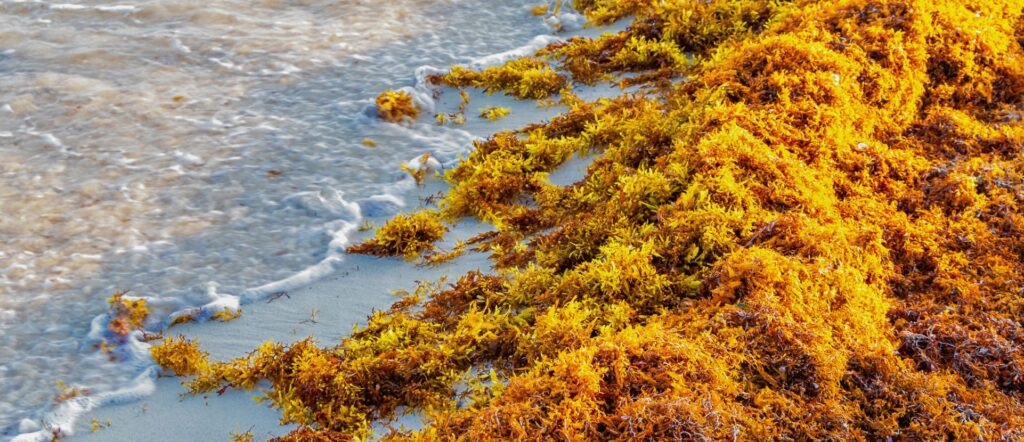
When the conditions are right, algae flourishes, creating an algal bloom. These blooms can be spectacular, leading to a blossoming of life and a sparkling Ocean, or they can cause serious problems for life in the Ocean and on land.

What do the white cliffs of Dover, the oil fields in the North Sea and Colorado oil shales and the clarifying agents used to make beer and wine have in common? They are all made of algae, a diverse group of incredible organisms which support most of the life in the Ocean.

But you can have too much of a good thing.Large amounts of algae can kill a lot of marine life and be toxic to humans. These events can have huge impacts, as we will see, from modern day Australia to the Bible.

What are algae

This isn’t as simple an answer as it should be, so bear with us. Unlike mammals or birds or sharks (don’t get us started on “fish”), “algae” doesn’t refer to a single evolutionary group of species.

Instead, the things we call algae are a group of organisms that do the same kind of things, dotted around the tree of life. A group of roughly 50,000 species.

The name comes from the Latin for “seaweed”. The study of algae is called phycology, and algal experts are phycologists, who are still figuring out exactly how they all fit together.

As a good rule of thumb – if it photosynthesises, and it isn’t a land plant, it is algae (we will get to the differences between algae and plants in a minute).

Some of those 50,000 species are very basic organisms such as cyanobacteria, that lack a nucleus and the other advanced bits of cellular equipment that animals have.

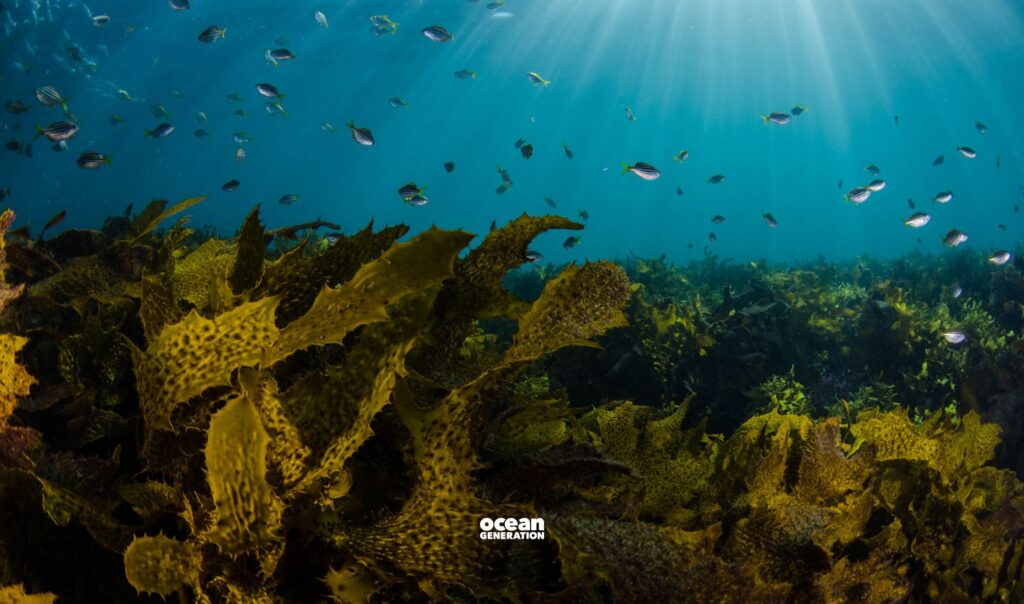
Other species are single-celled, floating around in the Ocean. Some are macroalgae like kelp, growing over 50m tall, creating vast forests filled with life and noise (ever wondered what the kelp forest sounds like?).

The magic of algae is something they share with plants. They produce oxygen and grow using sunlight – photosynthesis.

This magic is what nearly all life on our planet is dependent on.

How are algae different from plants

Fuelled by the sun’s energy, algae filled the Ocean and some conquered the land, becoming the plants that dominate our planet.

Plants evolved from ancient freshwater algae over 440 million years ago. Trees appeared around 400 million years ago. Psst…for context, sharks first appeared around 450 million years ago, so sharks have been around for longer than trees. 1-0 to the sharks.

Plants have developed into some beautiful, complex forms, conquering the land and making up around 82.5% of total biomass (the weight of living things) – humans are only about 0.01%.

Meanwhile, algae have evolved to master the aquatic world.

Physical differences between algae and plants 

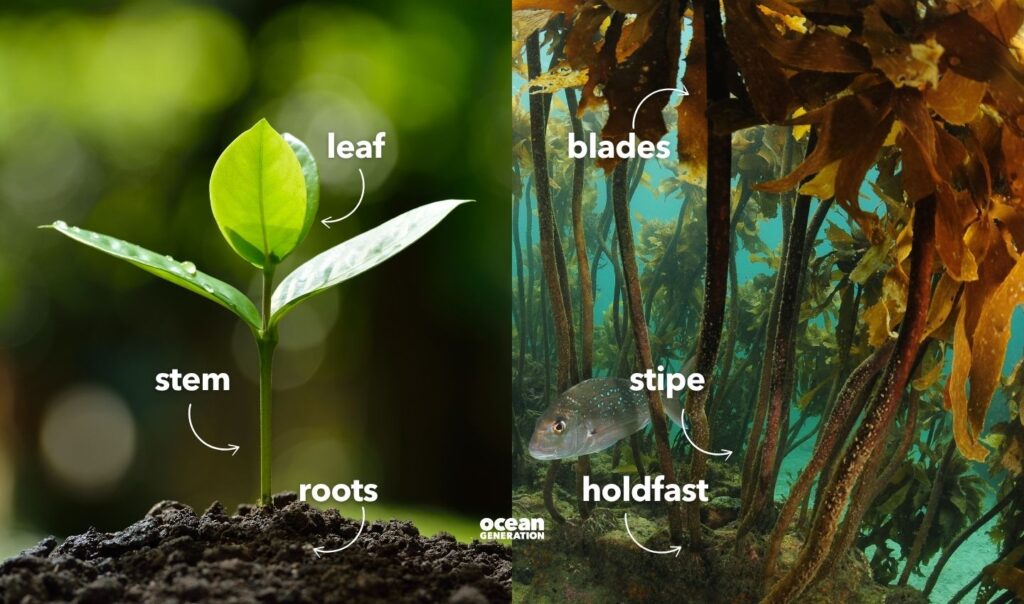
Plants developed a number of structures as they conquered the land, with roots to hold them in place and specialised structures for capturing sunlight – leaves.

Looking at seaweed there are clear similarities. The “roots” of seaweed are holdfasts, the “stem” is a stipe, and the “leaves” are blades. They look similar, but these structures don’t transport nutrients or gases between each other as the plant equivalents do.

Microscopic algae lack these structures completely.

Differences between plant and algae. Explained by Ocean Generation.

What are the biochemical differences between algae and plants? 

We won’t get too technical, but there are some big differences in the biochemistry of the two. Algae are much more varied in their structures, using a wider variety of building materials. Some use silica (glass) and some create chalk. Green algae use a compound called cellulose – the sugar that makes up paper, cotton t-shirts and wood.

Plants, evolving from these algae, adapted cellulose into compounds such as lignin for structural support in their ongoing battle against gravity.

Many algae are named after their eclectic use of photosynthetic pigments.

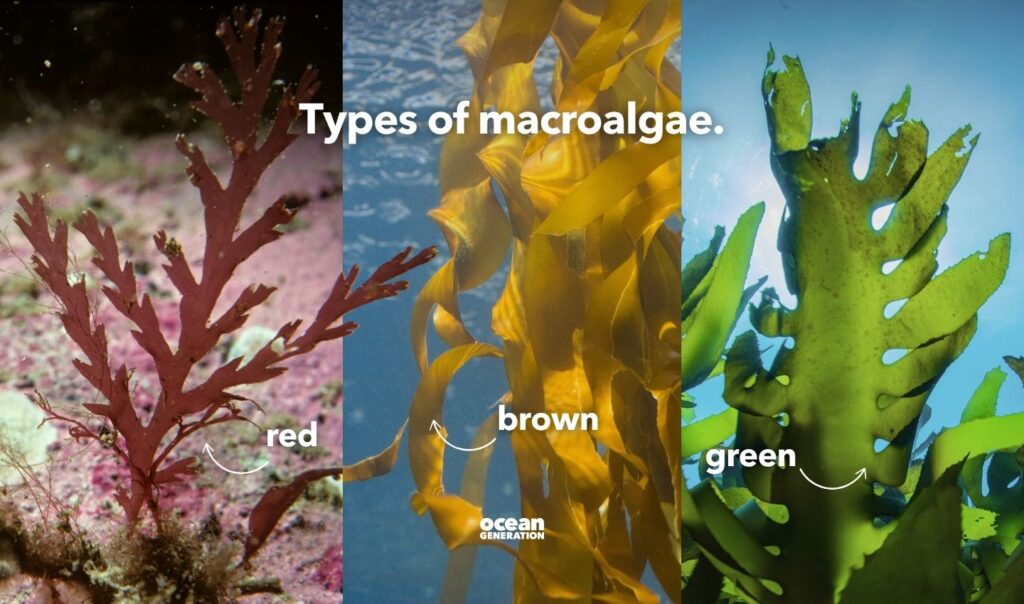
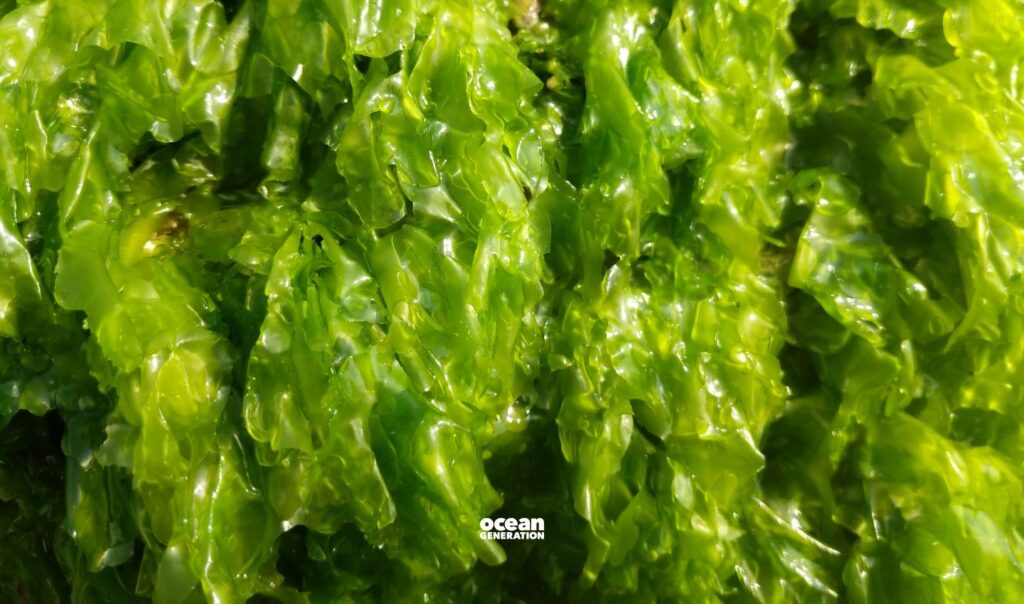
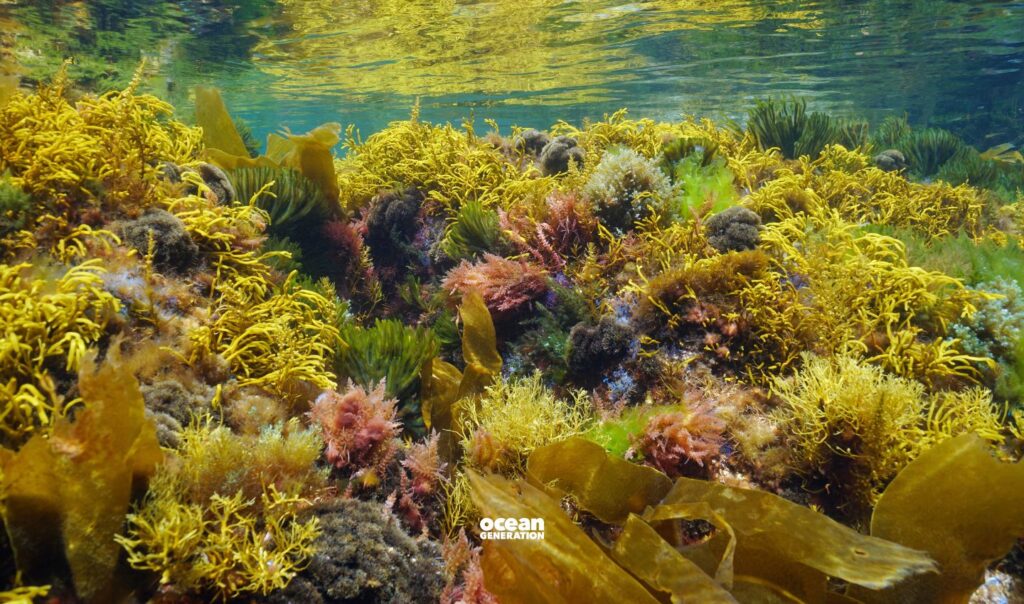
Red algae use phycoerythrin and phycocyanin (which appear red), brown algae use fucoxanthin giving them a golden-brown colour and green algae use the same chlorophyll a and b as their green, leafy land-based relatives.

The different pigments are utilised to ensure that the algae are most efficiently gathering the sun’s light, which is filtered by the water, modifying the wavelength (and therefore colour) of light that most gets through. More on that another time.

Types of macroalgae, explained by Ocean Generation.

Where can you find algae? 

You can find algae everywhere, and each habitat has its own name. They can be found in ice (cryophilic) and hot springs (thermophilic).

Algae are also in soil (edaphic) and in the Ocean (planktonic in the water column and neustonic on the surface). On rocks and in coral (epilithic and endolithic), on fungus and other plants (epiphytic), on turtles and sloths (epizoic) and even inside other organisms (endozoic endosymbiotic) – there is an alga for any location.

Someone should make a song about it.

Why do algae bloom?  

When algae grow very fast into large numbers, it’s referred to as a bloom. This can happen at small scales in a pond or at huge scales visible from space. These blooms can be the start of a great flourishing of life, or a deadly threat.

To understand why algae might bloom we need to realise why it wouldn’t and identify what is limiting its growth. Both plants and algae growth are limited by several things: water, temperature, light and nutrients.

We are focusing in on the marine, where water is less of a concern, so short term variation is typically controlled by the rest (although how salty the water is does matter).

Different algal species will have different preferred conditions, but warming the Ocean, with more sunlight and more nutrients, would generally result in more algae.

To refine it further, algal blooms typically refer to large amounts of microscopic algae, kelp forest is technically an algal bloom too, but in headlines, ‘algal bloom’ usually means the small stuff that can produce massive blooms.

Increasing light and temperature 

Algal blooms are a normal part of the seasonal Ocean, as light and temperature increase in spring and summer, they allow algae to grow. This growth, like the arrival of spring on land, can be spectacular, as the sea sparkles with bioluminescent algae such as Noctiluca sp. which can give off a blue glow.

What happens in spring that might cause this? The days get longer and the temperature rises. More light and higher temperatures encourage algae to bloom, and they will until one of the other conditions becomes the limit.

Why do algae bloom? Explained by Ocean Generation, leaders in Ocean education

Increased nutrients 

When light and temperature are in plentiful supply in the summer months, the growth of marine algae is limited by nutrient levels, especially nitrogen (as opposed to freshwater, where it is phosphorus).

Human activities, primarily the use of fertiliser in agriculture, which is rich in nitrates, have altered the cycling of nitrogen. Some areas of Ocean receive much higher levels of nitrogen from water running off farms, giving the algae all the ingredients they need to thrive and bloom.

Lowered salinity 

A lower level of salinity (saltiness in the water) means a higher concentration of water, enabling more growth. An increase in rainfall or ice melting could then lead to an algal bloom.

What makes an algae bloom harmful

Broadly speaking there are two ways algal blooms can make life a bit rubbish for everything around it – by choking or poisoning them.

Choking blooms 

When a large bloom of algae happens, it can disrupt the balance of the ecosystem.

But the real dangers come in the aftermath. As the bloom subsides, it is decomposed by bacteria and other organisms, which use oxygen. This can leave little or no oxygen in the water left for fish and other aquatic residents to breathe.

What makes algal blooms harmful? Posted by Ocean Generation.

Which Bible story might have an algal bloom?  

You may not think to go to the Bible for marine science but let us look at the story of Moses and the plagues of Egypt in Exodus 7: 20-21: “…all the waters that were in the river were turned to blood. And the fish that were in the river died; and the river stank, and the Egyptians could not drink the water of the river”. If we assume the bit about blood is descriptive rather than literal, we have a good description of a bloom of red algae.

Following this, we can link some of the other plagues that befell Ancient Egypt. To recap, the ten plagues were: river of blood, frogs, mosquitoes, flies, death of livestock, boils, hail, locusts, darkness and the death of each firstborn son.

If there was an algal bloom that suffocated the Nile, killing many of the fish, then the things the fish ate would benefit, if they could survive low oxygen conditions. Something like a tadpole, which can respond physiologically to low oxygen conditions and thrive. With no fish, you could end up with a lot of tadpoles surviving, and… a plague of frogs.

Another winner would be mosquitos – they lay their eggs on water surface, and the larvae feed on algae. With less predators (the fish are dead) to eat them and a banquet of food, you get a plague of mosquitos.

The death of much of the life of the river could poison the waters, resulting in the deaths of many of the livestock which depend on those waters to drink. The decay attracts flies, meaning one big algae bloom could be exactly the tool a deity would wield to cause five plagues.

Another algal alternative is that the red “blood” came as a result of heavy rainfall in the Ethiopian mountains that are the source of the Nile. The soil there is clay – reddish in colour – and could have suffocated the river by reducing how clear the water is (its turbidity), meaning the opposite of our theory – there were very few algae to produce oxygen for the fish.

In either case, the algae hold the key to the ecosystem, and impacts to algae can have biblical effects.

Toxic blooms 

There are three main types of phytoplankton that can make harmful toxic blooms: diatoms, dinoflagellates and cyanobacteria. These produce toxins themselves. When their abundances reach high enough levels, they become toxic to species in the water, and to humans – directly and indirectly.

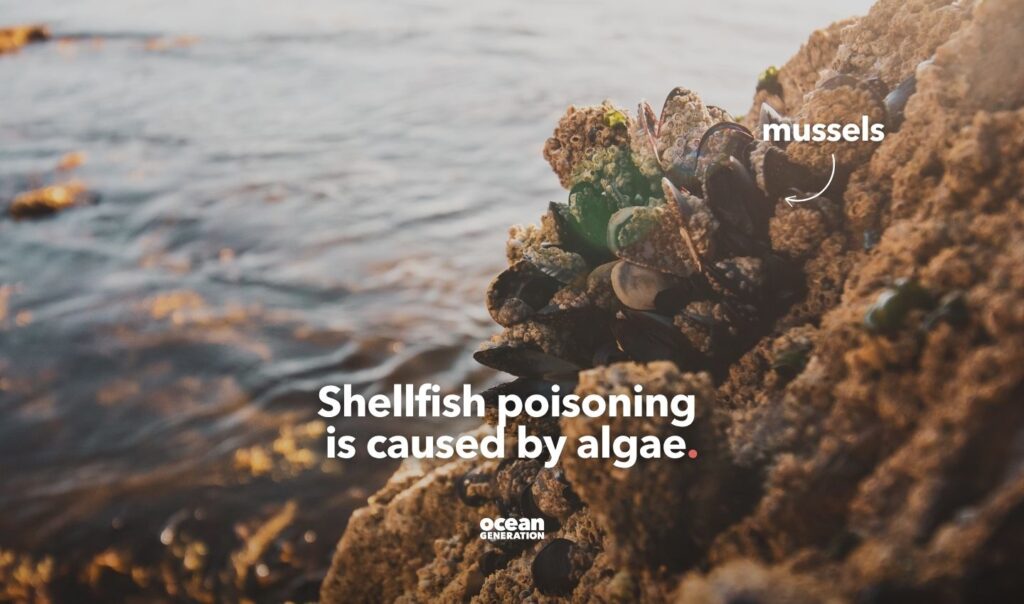
Shellfish poisoning in the US is caused by algae such as Alexandrium catenella or Karenia brevis (both dinoflagellates) which, when ingested by shellfish such as mussels, can make them deadly to humans.

Shellfish poisoning explained by Ocean Generation.

More directly, blooms of toxic algae threaten life through the water column. K. brevis is amongst the best studied, as it occurs off the coast of the United States in “red tides”. Fish, marine mammals, elasmobranchs, turtles, birds and even coral suffer in waters stocked with high quantities of the toxic algae. K. brevis produces brevetoxin, potent neurotoxins which interfere with normal neural function. It essentially causes nerves to continuously fire, leading to behavioural change, muscular dysfunction and disorientation.

Blue-green algae are another commonly referred to algal bloom. It is named after the colour of the cyanobacteria that causes it, which can produce a wide array of toxins depending on species, none of which are good in high quantities.

Australia saw a harmful algal bloom start in March 2025 

In March 2025, South Australia began to feel the effects of a huge algal bloom. As of February 2026, the bloom has impacted 20,000 square kilometres and roughly 30% of Australia’s coastline. Over a million marine animals have died, from over 550 different species. Humans have suffered from eye and skin irritation, coughing and shortness of breath.

The finger was initially pointed at Karenia mikimotoi, a well-known species that often blooms around the world. But after brevetoxins were identified, which K. mikimotoi doesn’t make, researchers took another look using DNA sequencing. This identified K. cristata, which had only been previously found in Newfoundland, Canada in 2014 and in South Africa in 1988.

This is one of the largest and longest harmful blooms recorded, affecting a huge range of marine animals. Leafy sea dragons are one of the state symbols for Southern Australia, but the bloom has hit their populations hard enough that their populations are being reassessed for risk of extinction.

When does an algal bloom become deadly

The simple answer is when there is too much.

Too much of any one species results in imbalance. Harmful algae blooms come when the balance is lost, for example with an excess of nutrients or an Ocean that is much warmer than usual. Pollution and climate change are increasing the frequency of harmful algal blooms. Not every algal bloom is caused by human activity, but more of them are, and they are more likely to be harmful. Tackling climate change and pollution protect animals like the leafy sea dragon.

Algae facilitated life on our planet, filling the atmosphere with oxygen. Still today, every second breath you take comes from the Ocean, specifically the little algal friends at work. They continue to be the foundation of marine food chains. Algae are amazing; you just don’t want too much.

When does an algal bloom become deadly? Explained by Ocean Generation.

Secret life of algae: From oxygen to algae blooms

Subscribe

Monthly: Impact in your inbox.

OceanGeneration-Join

What is the Global Plastics Treaty?

What is the Global Plastics Treaty? Explained by Ocean Generation.

The Global Plastics Treaty refers to the (currently undefined) international agreement by which the countries of the world hope to reduce plastic pollution. 

How far have we got? Progress in the Global Plastic Treaty talks

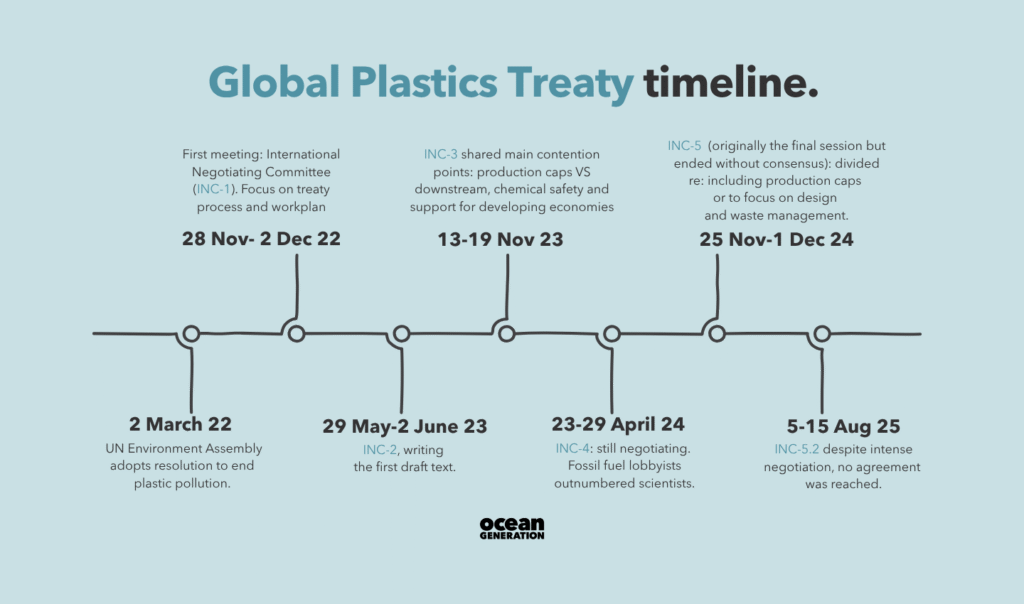
In 2022, 175 countries of the world signed an agreement that declared: plastic pollution needed to be addressed. Stronger than that, plastic pollution should be ended.  

To meet this goal, countries agreed on a series of meetings across the globe to discuss and negotiate how to end plastic pollution and write it into international law (a treaty). 

Five meetings were planned, with the treaty aimed to be finalised by the end of 2024.  

This agreement created the International Negotiating Committee (INC) which first met in Punta del Este in Uruguay. Subsequent meetings happened in Paris, France; Nairobi, Kenya; Ottawa, Canada; and Busan, Korea. 

By the end of the fifth meeting, no agreement had been reached for the Global Plastics Treaty, so another (INC5.2) was scheduled for August 2025 in Geneva. However, this meeting also ended with no treaty. 

Timeline of the Global Plastics Treaty. Posted by Ocean Generation.
Timeline by Will Steen

What is stopping a treaty being agreed? 

For the treaty to come to life, all countries must agree on the terms, so while some disagree there will be no treaty.  

The main point of disagreement is whether making new plastic (plastic production) should be limited within the treaty. Countries are split largely into two groups, the High Ambition Coalition and the Global Coalition for Plastics Sustainability. 

What is the High Ambition Coalition?  

There is a large group of countries (around 100) in a group, called the High Ambition Coalition (HAC).  

The HAC has been pushing for the plastics treaty to include plastic production limits – reducing the amount of new plastic made. Before INC5.2 the HAC published a “wake-up call” at the United Nations Ocean Conference at Nice in June 2025, outlining a ‘wishlist’ of five points: 

  • Limits on plastic production (to be regularly adjusted), and reporting on production, import and export of primary plastic polymers 
  • Phase out most harmful plastic products and chemicals of concern 
  • Improve the design of plastic products to minimise environmental and human impacts 
  • Financial support to support less developed countries in the transition 
  • A treaty responsive to changes in evidence and knowledge 

What is the Global Coalition for Plastics Sustainability

Another group of countries formed the Global Coalition for Plastics Sustainability (also known as the Like-Minded Group of Countries).  

A statement from a member country outlined the focus: 

“The [Global Plastics Treaty] should pave the way for improving the waste management systems in general, and to promote environmentally safe and sound management of hazardous plastic wastes, and to reduce uncontrolled hazardous plastic pollution.” 

They want a bottom-up approach, prioritising dealing with plastic waste.  

What's next for the Global Plastics Treaty? Explained by Ocean Generation.

What do major businesses think of the plastics treaty? 

Businesses that produce and use plastic are key to tackling the plastic pollution problem. 

The UK hosted a roundtable with major business in June 2025 and produced a statement. It called for the plastics treaty to address the whole lifecycle of plastics, amongst other things. 

As businesses and financial institutions, we stand ready to mobilise significant investments, and engage with the companies we invest in, towards achieving the objectives of the legally binding instrument, including towards innovation and infrastructure.” 

Other businesses, such as fossil fuel companies (99% plastics are made from fossil fuels) take a different view:  

While there have been calls for production caps or bans, it’s been reassuring to hear leaders share their belief that such measures could deprive the world – particularly the developing world – of the untold benefits plastics deliver in terms of health, food safety, the environment, the energy transition and more.” – Exxon Mobil President  

What’s next for the Global Plastics Treaty? 

The division has been entrenched from early in the process, with little movement on either side. It has led to questions about the process, and where to go next. Here are some options: 

  1. The process is changed to being decided by vote rather than by consensus, to make progress despite the disagreement of a small minority 
  2. The process continues via other means. For the Ottawa convention on landmines, a number of countries compiled texts outside of the process, that were then agreed upon. We could see this happening, for example, with the High Ambition Coalition.
  3. Another round: INC5.3 to try again! A (currently unnamed) country has offered to host, but has said they will not fund it. 

While the gears of global negotiation can feel like they turn slowly, they are turning. Read more about how international treaties work here. 

These countries have agreed that ending plastic pollution is an important issue. We want a world without the damage of plastic pollution.  

The Global Plastics Treaty is the representation of international intent. If it does produce legal guides to end plastic pollution, it will speed up progress. That it hasn’t yet is not going to stall momentum.  

Plastic pollution is an international target.  

The Global Plastics Treaty aims to end plastic pollution. Posted by Ocean Generation, leaders in Ocean education.

Secret life of algae: From oxygen to algae blooms

Subscribe

Monthly: Impact in your inbox.

OceanGeneration-Join

How do the Sounds of Kelp Forests Change?

How do the sounds of kelp forests change? Explained by Ocean Generation.

The age-old question goes “If kelp falls in a kelp forest and no one is around to hear it, does it make a sound?” … or something like that.

The study of kelp forest soundscapes is new, but it is essential to understanding the ecosystem. 

What are kelp forests

Kelp forests are incredibly diverse and important ecosystems of organisms living within dense areas of (surprise) kelp in coastal regions.  

Kelp forests, and more generally seaweed forests, act as major carbon storage for the planet and are, when compared to the woods, incredibly diverse, containing mammals, arthropods (shrimps), echinoids (sea urchins), brachiopods (a shelled animal that feeds via filter feeding) and much more.

What are kelp forests? Explained by Ocean Generation, leaders in Ocean education.

What does the Ocean sound like? 

The Ocean is surprisingly noisy. Sound is used to convey information over long distances, and to neighbours on the reef or in the grass. In water, sound travels farther than either light or chemical cues and moves almost five times as fast as it does in air.  

Marine mammals like whales and dolphins are famously loud and use sound to communicate.  Sperm whales can reach volumes louder than jet engines. But a shocking truth is that other marine animals contribute to the Ocean soundscape too! For example, did you know that some fish make hums and purrs?  

Beyond marine animals, there are other sound sources in the Ocean. Geological sounds (earthquakes and landslides) and our own human activity (engines and drilling) have their own effects on the Ocean soundscape. 

What do kelp forests sound like? 

Kelp forests are an unfamiliar setting to most of us, so to assist on our adventure of the soundscape, we’ll venture through the woods at the same time. 

In the woods, we hear distinctive, familiar noises. The twitter of birds, the chattering of rabbits and the chirps of insects dominate the soundscape. In kelp forests, we can hear the different calls of fishes and the frequent snapping of shrimp.  

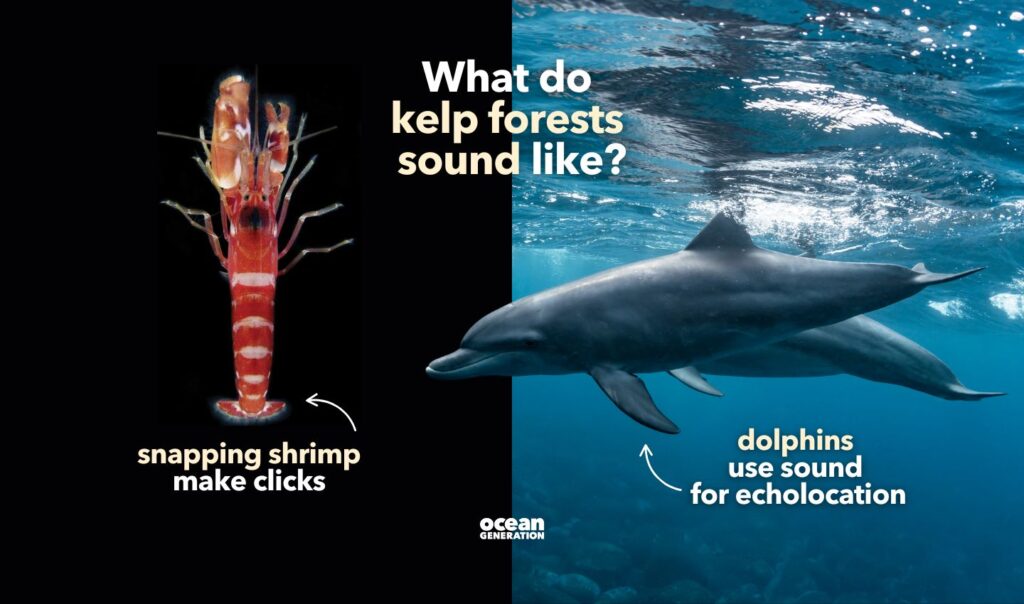
The noises of kelp forest can be separated by their pitches. Generally, lower tones contain the noises of marine mammals and fish. The higher tones we’d hear contain the clicks of snapping shrimp and the sound of echolocating dolphins (although this is higher than the human ear can hear so it’s silent to us). 

These soundscape features often change in both environments over time due to natural factors, like seasonal changes, or human activity. 

What do kelp forests sound like? Explained by Ocean Generation.
Snapping shrimp photo by Anker A Grave

Daily changes in the kelp forest soundscape 

As the night comes, the sounds of the daytime animals switch to the noise of nocturnal animals.  

In the woods, hooting owls and squeaking bats take over the soundscape along with the occasional chirp from foxes. This daily change is seen in kelp forests too, where the activity of animals and therefore the volume of their sounds shifts over the course of the day. 

For some species of fish, their noise peaks at sunset and dips at sunrise. As well as this, snapping shrimp are nocturnal, which shows in their activity, as they have peaks at sunset and sunrise but a decreased activity during the day. 

Seasonal changes in the kelp forest soundscape 

With the arrival of autumn and winter in the woods, some animals migrate or hibernate, removing their noises from the soundscape.  

A seasonal change also occurs in the kelp forest, where the time of year can affect the presence of animals.  

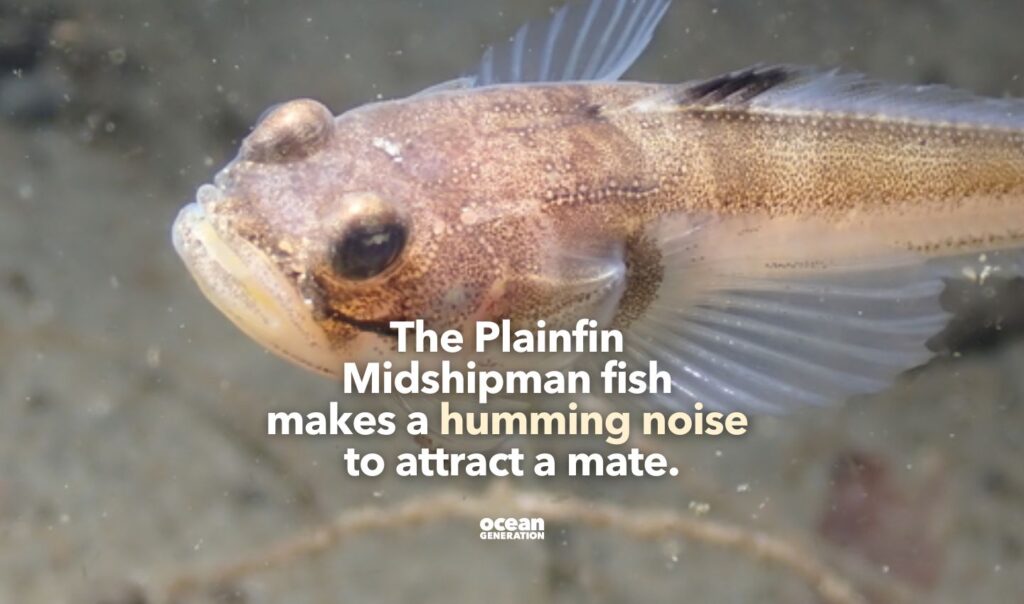
The Plainfin Midshipman fish makes nests near the coast and uses a humming noise to attract a mate. This humming is heard in the kelp forests during late spring and summer, consistent with their mating season. Contrasting this, the presence of snapping shrimps is maintained year-round. 

Plainfin Midshipman fish humm during spring and summer. Posted by Ocean Generation.
Photo by Sara Thiebaud

Human influence on kelp forest soundscapes 

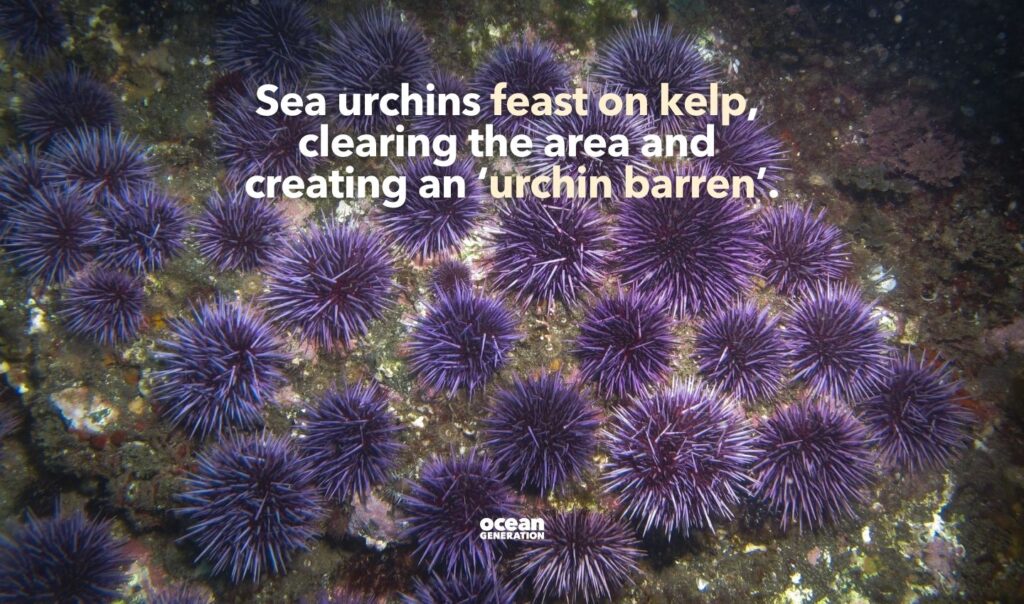
On our walk through the woods, we come across barren spots without trees, caused because of storms or fires. Similarly in the Ocean, an abundance of sea urchins and a lack of suitable food can cause them to feast on kelp clearing the area and leaving a space overrun with small, malnourished sea urchins, with the East Fish camp in California having an urchin density of 26.8 urchins per square metre

Although urchin barrens may seem like a natural environment, they are created by human activity, just as extreme weather can become more prominent because of global warming.  

Normally, sea otters and the occasional fish prey on urchins before the situation gets out of hand. But, due to hunting and overfishing, sea urchin predation is decreased, allowing their population to spike and kelp forests to be removed.  

Urchin barrens influence the kelp forest soundscape. Posted by Ocean Generation.
Photo by Ed Bierman

Sea urchin barrens influence the kelp forest soundscape as the region becomes less suitable for some species and more suitable for others. When hundreds of sea urchins move in, they change biodiversity.  

A more direct human influence on woodland soundscapes is deforestation. The direct removal of trees by humans to clear space or for resources is easily a big issue, as it decreases habitat space, reducing biodiversity and harming ecosystems.  

A similar situation happens with kelp as it can be harvested, as it has uses like in food and beauty products. As a consequence, the amount of kelp is decreased, showing little to no recovery after two years, and biodiversity can change to be unlike before harvesting. 

Does human noise affect kelp forests? 

Listening in our woods, we don’t only hear animal noises but also human noises. Cars on roads which cut through the woods or heavy machinery operating can create loud persistent noises which can disturb the soundscape, affecting the distribution of the animals

The same is true for animals in the Ocean. Loud noises like drilling and seismic surveys are loud and the noise can be emitted for tens of kilometres, causing confusion and hearing damage in marine mammals and fish. 

Other sounds like engine noises from low flying planes and boats can act as background noises which decrease the distance that animals can hear and communicate.  

Sound disturbances can normally be mitigated in kelp forests by kelp’s ability to attenuate (absorb and decrease) sound. However, because of the removal of kelp forests, this mitigation can quickly be removed.  

The building of docks and other structures may seem like they could bring back attenuation, but they can also transfer noise from cars and docking boats into the Ocean, affecting microenvironments. 

How does human noise affect kelp forests? Explained by Ocean Generation.

What can we do

It may seem daunting that humans can cause all of this damage, but not all change is bad. Just as forests can be replanted and wildlife protected, as can kelp forests.  

The growth of kelp can be stimulated, and areas can become marine protected areas, which can allow areas to be conserved. An example of this is in New Zealand, where an urchin barren has recovered back into a kelp forest within a marine protected area over the period of 20 years. 

Looking at how we live our lives, like where our fish comes from or our usage of boats can make a difference in helping this delicate ecosystem. 

Secret life of algae: From oxygen to algae blooms

Subscribe

Monthly: Impact in your inbox.

OceanGeneration-Join

Is Seaweed the Secret to Ditching Plastic? Explained.

Is seaweed the secret to ditching plastic? Explained by Ocean Generation, leaders in Ocean education.

Plastics play an essential role in modern human civilisation. They are incredibly versatile, providing function in almost all aspects of our lives. 

Why plastic is a problem for us and the Ocean

Fossil-based plastics are infamous for their long-lasting impact on the environment, taking up to hundreds or thousands of years to fully break up. Along the way, they harm wildlife and people both as large plastic items and microplastics. 

The impact of this is demonstrated perfectly in the Ocean, where wildlife can unknowingly eat or interact with plastics. It has been observed that every species of sea turtle has been affected by entanglement in plastic. 

Plastics have another big problem. They’re sourced from oil, which contributes to their damage to the environment. 3.4% of global emissions were contributed by the plastic lifecycle in 2019, with 90% of that being emissions from production and converting fossil fuels into plastic making materials. 

What's wrong with plastic - for us and the Ocean? Explained by Ocean Generation.

What are microplastics

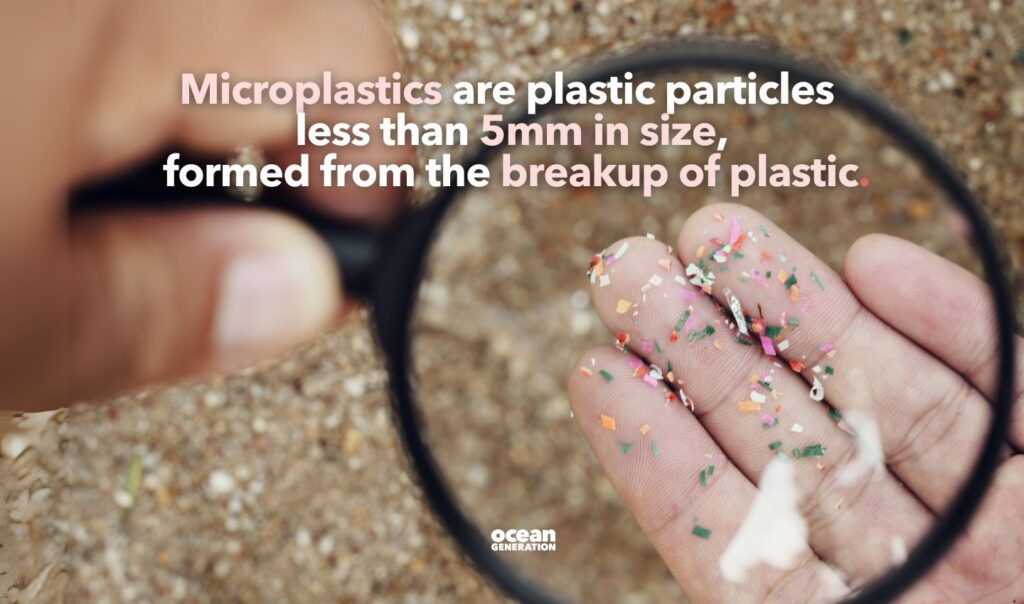
Microplastics are plastic particles less than 5mm in size formed from the breakup of plastic. They’re found across the planet, from deep in the Ocean to the snow high in the mountains. They’ve even been found in the human body.  We don’t fully know yet what that means for our health, but we do know they harm marine life and can travel up the food chain.  

Single use plastics, like plastic bags and straws, are big contributors to plastic waste, making up approximately half of all plastic waste.  We only use them once and then throw them out, which means more and more plastic needs to be made to maintain supply. 

What are microplastics?

What is the solution to our plastic usage problem? 

Recycling is one solution to this problem, but in 2019, the OECD estimated that only 9% of plastics are recycled.The rest is disposed of in landfill sites (50%), incinerated (19%), or goes unregulated into uncontrolled landfills, fires or the environment, including our Ocean (22%). On top of this, not all plastics are recyclable. Is there another solution? 

What are bioplastics

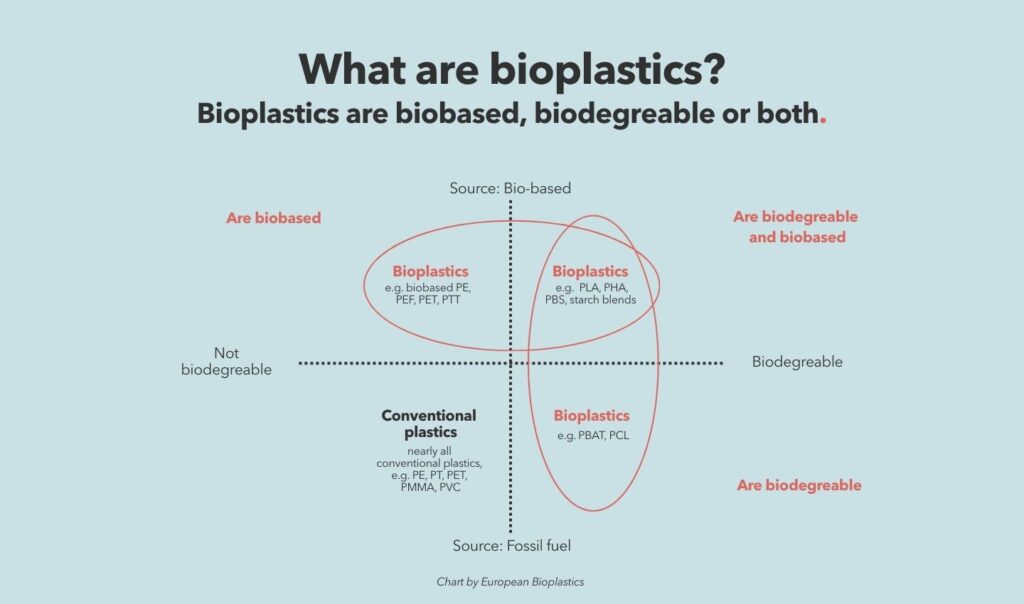
According to European Bioplastics,  “bioplastics”  are either bio-based, biodegradable, or both. Bio-based plastics are plastic alternatives which, rather than using fossil fuels to source the plastic, use biological feedstock (materials) like starch or cellulose.

Bio-based plastics are not necessarily biodegradable. Biodegradability has no clear definition or criteria, but in general, a product is biodegradable if a substance can be broken down into water, biomass and gasses. As a result of this definition, biodegradable fossil-based plastics can be considered as bioplastics.

What are the different types of bioplastics

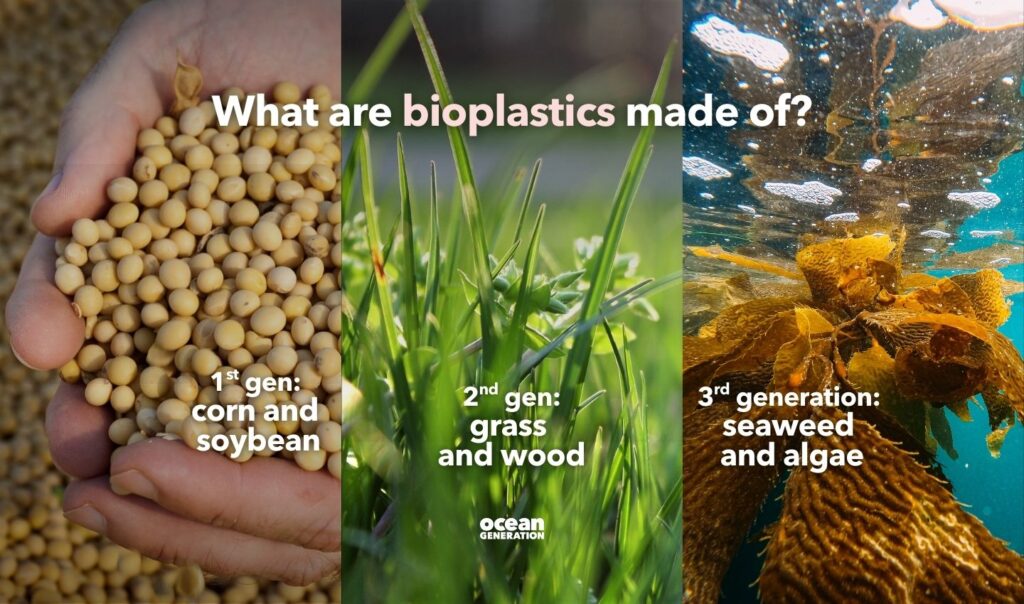
There are 3 distinct generations of bioplastics, all defined by what they’re made of:  

  • 1st generation bioplastics use food crops like corn or soybeans. 
  • 2nd generation bioplastics use non-food crops like grass and wood. 
  • 3rd generation bioplastics use seaweed and algae. 
What are bioplastics made of? Posted by ocean Generation.

What’s the major difference between using seaweed and crops

The major difference between crop-based and seaweed-based bioplastics is where they are planted. 

The first two generations of bioplastics use fertile land which could be used for growing other crops.  

Seaweed bioplastics are bio-based plastics and derived from seaweed. Seaweed bioplastics don’t have the same problems as the other generations as seaweed grows in the Ocean (which there is much more of than fertile land on Earth), and require only sunlight, atmospheric CO2 and the naturally nutritious waters of the Ocean.  

They are a relatively new discovery; the first seaweed bioplastics company was established in 2010. Lady Gaga’s music career began before bioplastics were commercial.  

How are seaweed bioplastics made? 

The first step is letting the seaweed spores grow before they are put into a seaweed farm. They are then harvested a few months later. 

The seaweed contains molecules that can be extracted via chemical processes. These have gelling and film-making (like plastic wrap, not movies) properties which make them useful in bioplastic production.

The extraction process leaves behind residuals. These leftovers can be turned into seaweed pellets which can feed back into the bioplastic making process, reducing waste. They can also be converted into methane which comes with the disadvantage of being a greenhouse gas. However, if captured and stored, it can be a carbon effective source of methane, which can be used in the chemical industry, or as a cleaner fuel than fossil fuels.  

Our molecules can be mixed with other substances like nanoclays or silver nanoparticles to improve strength or change properties like making them antimicrobial. 

Seaweed bioplastics are already used commercially in places like food packaging – that’s pretty kelp-ful! 

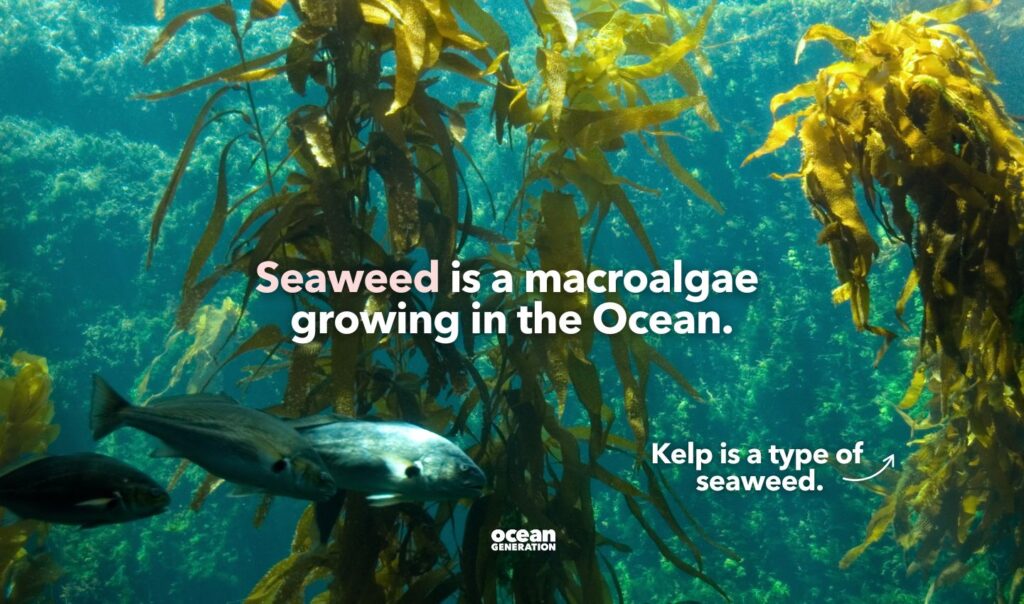
Seaweed is a macroalgae growing in the Ocean.

What is the environmental impact of seaweed bioplastics? 

The life cycle assessment of seaweed bioplastics looks at its carbon footprint from harvesting it from farms in the Ocean to its disposal in bins. Pilot scale assessments (these represent full production at a smaller scale) show that their production released more carbon than plastic, however, models show that scaling up production to full scale makes their carbon output less than plastics. 

What are the downsides of seaweed bioplastics? 

Making seaweed bioplastics relies heavily on farming and harvesting seaweed. This may present a problem when scaling up seaweed farms, especially to the size of being able to match plastic production, if this is even possible.  Seaweed farms take up space in the Ocean, and they affect organisms that are living in areas where farms are viable, like seagrasses and corals by blocking light or choking them. 

This problem can be mitigated by moving seaweed farms into the open Ocean and optimising growth by growing two different species in the same space. This can be done by growing buoyant kelp and non-buoyant seaweed next to each other to best use space. 

Seaweed can also wash onto the coast from farms and decay, releasing pollutants that were absorbed over the life of the seaweed, affecting the local environment and limiting biodiversity. 

There is also the problem that not all bioplastics are biodegradable. While it may be entirely possible that seaweed bioplastics specifically are biodegradable, there isn’t yet enough literature to suggest that this is the case. 

On top of this, the definition of biodegradability has no specific time frame in which a material should be broken down in, meaning this vagueness could be taken advantage of. 

This reintroduces a problem that we were trying to solve, simply sourcing the plastics from elsewhere.  

Which plastic or alternative is the bets to choose?

Which plastic (or alternative) is the best to choose? 

There are many factors that go into considering a product: the production, the functionality (how good it is at what it’s supposed to do) and the environmental cost.  

However, it can be difficult to remove bias. Take single use paper bags for example. At first glance, they seem much more environmental than single use plastic bags as they’re biodegradable, but when put into practice, they have a higher carbon footprint in production than plastic bags and aren’t as strong. So, it’s difficult to tell which of these is better. 

As more research goes into seaweed bioplastics, we may find solutions to the problems associated with them and have a more accurate understanding of their impact as they are produced on a larger scale. For now, it is better to avoid single use items altogether, and to use seaweed bioplastics where available.  

Secret life of algae: From oxygen to algae blooms

Subscribe

Monthly: Impact in your inbox.

OceanGeneration-Join

How can we clean up plastic pollution in the Ocean? 

How can we clean up plastic pollution in the Ocean? Posted by Ocean Generation.

Why do beach cleans actually work: Explained. 

An army of passionate people take to the beach, litter pickers in hand. Sea spray in their hair and sand under their nails, they comb the beach. Their bags fill with cigarette butts, plastic bottles and crisp wrappers. Spirits are high, notable pieces of rubbish are held up with announcement.  

As the sun sets, the beach seems lighter, relieved of the weight of rubbish. The cleaners look over the coast with proud eyes at a job well done.  

But as the night draws in, so does the tide. When the sun rises again, it unveils a plastic-laden beach once more. The Ocean has coughed up some of its burdens.  

What is the point in beach cleans? Are we rearranging deck chairs on the Titanic or do they actually help combat Ocean pollution? 

How bad is the Ocean plastic problem? 

Ocean plastic is increasing. Many scientists have done deep dives into the science of knowing how much. While it’s challenging to measure exactly how much plastic is in the Ocean, we know that as plastic production increases, so does plastic pollution in the Ocean.  

The Great Pacific Garbage Patch is a myth. Explained by Ocean Generation.

There aren’t great islands of plastic floating in the Ocean (even the Great Pacific Garbage Patch is a myth). But we are creating a plastic soup. Microplastics fill the Ocean, with some ‘croutons’ of bigger floating plastic.  

This plastic can kill wildlife, carry toxins and enter the food chain — all the way up to us. 

It’s obvious: we all want less plastic in the Ocean. The question is how to achieve that.  

What impact do beach cleans actually have?  

A beach clean is more than just a fun day out. They do a whole load of good. 

Firstly, they are good for us. Beach cleans (and most coastal activities) have been associated with positive mood and improving our understanding of the Ocean.  Combine a beach cleanup with some rock pooling and that’s a brilliant afternoon. Imagine all the things you can find! We feel better cleaning our beaches.  

Beach cleans are a chance for people to come together and make a tangible contribution. They act as displays, raising awareness for our pollution problem and encouraging more engagement. A snowball effect. 

Beach cleans provide immediate benefit to the natural world too. Removing plastic from the beach takes away its threats straight away, and removes the future threats as well.  

Plastic on the beach is exposed to the stresses and strains of the Ocean. Waves breaking, rubbing against the sand and rocks, the sun beating down. All these break up the plastic into smaller micro- and nano-plastics. Removing it before that stage is a lot easier. 

Our understanding of the journey of plastic waste is evolving. Recent studies suggest that the vast majority (88% is the quoted figure) of plastic in the Ocean remains floating close to shore. This means our beaches take the brunt of the plastic problem. But that also means it’s accessible: We can remove the majority of the problem with ease and stop it getting worse.  

Beach cleans have a great impact. Posted by Ocean Generation.

Beach cleans treat the symptoms without addressing the illness

Beach cleans are not the whole answer. You can’t keep bailing a sinking boat out and expect to float, until you bung the hole. A beach clean treats the symptoms without addressing the illness.  

We need more than litter-pickers.  

What are the other allies in the battle against Ocean plastic? 

The closer to source of plastic pollution we can get, the better. Try filling a glass from someone pouring three stories above you – a lot more water gets spilled compared to just filling from the tap.  

Single use plastic bans have shown to be effective in reducing litter. Increasing the responsibility of plastic producers for the end of their products lives would motivate innovation and stop plastic becoming litter at all. A circular economy would prevent the demand for oil to produce more and reduce the amount of plastic that becomes rubbish.  

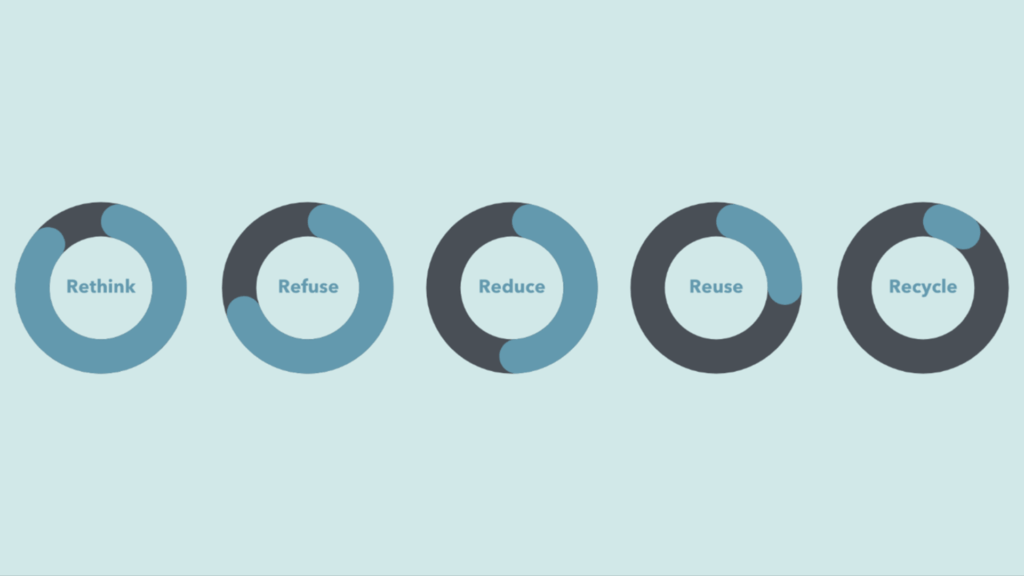
As consumers, we also need to rethink how we use plastic.  

How can we change our relationship with plastic?  

Moving away from a single-use plastic world is, honestly, going to be tricky. We live in a world where convenience is king. Single-use plastic is very convenient. But there are solutions already working. 

Deposit return schemes have proved to be highly effective in increasing the collection rates of plastic bottles. When you buy a drink in a plastic bottle, for example, a small extra fee is paid, which is returned when the bottle is returned. For one scheme, 94% of bottles were returned compared to 47% without a scheme.  

Moving away from single-use plastic is tricky. Posted by Ocean Generation, leaders in Ocean education.

Nearly every major manufacturer (98%) now has commitments to reduce plastic packaging. Whether this represents genuine change or sophisticated greenwashing remains to be seen, but consumer pressure and regulatory requirements are making plastic reduction a business imperative rather than a nice-to-have. 

The challenge lies in balancing reduction with practicality. Sometimes plastic packaging actually reduces overall environmental impact compared to heavier alternatives – it’s the end-of-life management that needs sorting. 

The uncomfortable reality of waste management

Here’s the uncomfortable truth: much of Ocean plastic pollution originates from countries with limited waste management systems. Sub-Saharan Africa, for example, averages 44% waste collection rates compared to 98% in high-income countries. It’s rather difficult to recycle rubbish that’s never collected in the first place. 

We can’t simply take Western waste management systems and apply them exactly as they are in other countries. Locally managed, decentralised circular economy models – using local resources and creating local markets for recycled materials – show more promise than imposing one-size-fits-all solutions. 

Is making plastic expensive a solution to pollution? 

Governments wield powerful economic tools: taxes on single-use plastics, subsidies for recycling infrastructure, and extended producer responsibility schemes that make manufacturers pay for their products’ end-of-life management.  

When virgin plastic (new plastic) becomes expensive and alternatives become cheap, behaviour changes remarkably quickly. But it has to be done without disadvantaging those that don’t have access to a cheap alternative.  

So, back to the original question: Do beach cleans work? 

Yes. But they won’t stop the problem long term. Beach cleans deliver value beyond plastic removal. They’re powerful data collection exercises, providing crucial information about debris types and sources that inform policy decisions.  

Beach cleanups are also remarkably effective educational tools – nothing quite drives home the scale of plastic pollution like spending a Saturday morning filling bin bags with bottle caps. 

Removing larger plastic items helps reduce microplastics. Posted by Ocean Generation.

Perhaps most importantly, recent research from Norway found that removing larger plastic items from coastlines led to a 99.5% reduction in microplastics both on land and in water within a year. That’s a genuinely impressive result that suggests beach cleans have more direct environmental impact than critics assumed. 

“Removing plastic from the environment before it enters an active degradation phase, into microplastics, will reduce the formation of microplastics in the environment. The decrease of microplastic was over 99% in the water volumes we found on land. When we looked at seawater, the microplastics leaking into the sea was reduced by 99.9%,” – Gunhild Bødtker, senior researcher at Norce 

What’s the most effective strategy to deal with plastic pollution? 

The most effective strategy combines both approaches: upstream prevention (stopping plastic from becoming waste) and downstream management (dealing with what’s already out there). Think of it as both turning off the tap and mopping up the flood. 

Beach cleans work best when they inspire participants to tackle root causes – supporting deposit return schemes, choosing refillable alternatives, and pressuring companies to reduce packaging.  

The real measure of a successful beach clean isn’t just the bags of rubbish collected, but the number of people who leave determined to prevent that rubbish from appearing in the first place. 

Do a beach clean, but don't just stop there. Posted by Ocean Generation.

What should you do next to help tackle plastic pollution 

So beach cleans won’t solve the problem. The good news is that effective solutions exist. The challenge is implementation at the scale and speed the problem demands. 

Join a beach clean, but don’t stop there. Support businesses with genuine circular economy commitments, lobby for deposit return schemes, and remember that every purchase is a vote for the kind of world you want to live in. 

The Ocean doesn’t care about our good intentions. It needs systemic change, and that requires all of us to think beyond the beach. All our jobs can be beach. 

Secret life of algae: From oxygen to algae blooms

Subscribe

Monthly: Impact in your inbox.

OceanGeneration-Join

Is plastic good or bad? What it means for you and the planet 

Is plastic good or bad? posted by Ocean Generation.

A great scholar once said – life in plastic, it’s fantastic. As one of the greatest revolutions in material engineering, plastic has undeniably changed the world.

But were we too successful? Did we end up with a committed friend who is always here for you – but really ALWAYS here, and we can’t get them to leave?  

Let’s look at our magic material, where plastic has done good and how we need to change our relationship with it.  

What is plastic 

Plastic can mean a lot of things.

We should be careful to define what we mean. Here, plastic is concerning synthetic or semi-synthetic materials composed primarily of polymers, that can mould, press or extrude into different forms. This feature, their plasticity, is key to their importance.  

Here’s a table summarising some of the most used plastics. Have a look around, I would guess, from wherever you are, you could see at least five of these. 

Polymer Abbreviation Examples of use 
Polypropylene PP Food packaging, automotive parts 
Low-density polyethylene LDPE Reusable bags, food packaging film 
High-density polyethylene HDPE Toys, shampoo bottles, pipes 
Polyvinylchloride PVC Window frames, floor covering, pipes, cable insulation 
Polystyrene PS Food packaging, insulation, electronic equipment 
Polyethylene terephthalate PET Beverage bottles 
Polyurethane PUR Insulation, mattresses 
ABS, elastomers, biobased plastics, PBT, PC, PMMA, PTFE, … Other Tyres, packaging, electronics, automotive, …
Fibres made of different polymers Fibres Textile applications but also in many other sectors 

Plastic is everywhere, from our food packaging to our computers, to our furniture. Our clothes, the paint on our walls, the tyres on our car; all have plastic in. So, let’s look at why plastic has become so engrained in our lives.  

How does plastic save lives? 

Plastic has pioneered a revolution in medicine. Through its versatility, sterility, durability and low cost, plastic has made modern medicine more safe, accessible and effective. Plastic IS fantastic.  

Plastic has pioneered a revolution in medicine

Disposable plastic items such as syringes, IV bags and gloves prevent cross-contamination. Plastic has enabled minimally invasive surgeries, reducing recovery time and infection risks.  

Plastic prosthetics and implants can be printed or moulded to individual needs. Medical packaging made from plastic keeps drugs and equipment sterile (more on packaging later).  

A surgeon or trainee doctor can examine a 3D-printed organ to better understand the patient. Complex procedures can now be done through a single incision using flexible plastic implements. Medical imagery has advanced as machines made from plastic don’t have the interference of metal. Due to the low price of plastic, everyone can benefit from better healthcare.  

It’s impossible to know how many lives have been saved by plastic.  

How has plastic helped our food systems? 

Food waste is a big environmental problem. 19% of food available to consumers is wasted, added to the 13% lost in supply chain.  

By the last attempt to calculate it, food waste made up 8-10% of annual global greenhouse gas emissions. In 2017, greenhouse gas emissions from food waste were estimated to be roughly the same as the emissions from the US and Europe combined

The UK and Japan are among the only countries to collect consistent food waste data. They have shown reductions of 18% and 31% respectively. Awareness, for consumers, is a powerful driver of behaviour change.  

Plastic can reduce food waste. Explained by Ocean Generation.

Plastic is a key ally in reducing food waste. 

Packaging reduces food waste and increases the shelf life of our food. Plastic packaging does this by stopping the aeration of food and providing thermal insulation. 

Of course, making plastic packaging produces emissions, but the food inside has a much bigger carbon footprint.  

Think of it this way: if plastic packaging stops your tomatoes going mouldy, you’ve saved all the emissions from growing, transporting, and processing those tomatoes – plus you’ve avoided the methane released when the tomato rots in landfill. The plastic wrapper can be the environmental hero, not the villain. 

One study found packaging innovations increased shelf life by 50% and cut food waste by 40%. Whilst they weren’t testing plastic specifically, it shows how crucial good packaging is. 

Take pork as an example. Yes, plastic foam trays create more emissions than butcher paper when they’re made. But only 5% of plastic-wrapped pork goes off, compared to 7-10% wrapped in paper. That means 35% less climate impact overall – the packaging emissions are nothing compared to a whole pig going to waste. 

This food preservation revolution has shrunk our world. A mango can now travel from Peru to Manchester and still be perfectly ripe when you bite into it. More food, travelling further, feeding more people – all thanks to a bit of clever plastic.  

The flipside of this is – do we need food travelling further? While food miles are a small part of food-related emissions, eating local is an easy way to reduce environmental impact.  

Plastic saves marine life. Posted by Ocean Generation, leaders in Ocean education

How is lightweight plastic doing its bit environmentally?  

Plastic is light, and strong. It has taken on roles previously performed by much heavier metals.  

A car fuel tank, for example, used to be made from steel, much heavier than plastics. A 10% reduction in vehicle weight can result in a 6-8% improvement in fuel economy. Plastics reduce the weight of a vehicle by up to 50%. This results in approximately 14 times lower greenhouse gas emissions than using a steel tank.  

In construction, the durability of plastic can be utilised. Due to the lighter weight, PVC pipes have much lower climate impact than concrete (45% less) and ductile iron (35% less). Every truck carrying plastic to the building site uses less fuel carrying PVC pipes. In water pipes, copper is recyclable but loses more heat than a cross-linked polyethylene (PEX) pipe. 

How is plastic saving marine life? 

There are many examples of plastic replacing consumer demand for natural products; saving marine life.

Tortoiseshell glasses are now made out of plastic, saving the hawksbill turtles who were harvested for their beautiful shells. How many trees are still standing because we have plastic furniture?  

Why do we call sponges sponges? Because they were originally the sea sponge, Spongia officialis, that we collected and used as a bath sponge. Replacing the sponges of the sea with plastic ones has alleviated another stress on our Ocean.

 Ivory’s another classic case. Before plastic, piano keys, billiard balls, and ornamental trinkets meant elephant tusks. Now, we get the same aesthetic from synthetic alternatives – and elephants get to keep their tusks. 

Plastic can replace natural products. Posted by Ocean Generation

What are the problems with plastic? 

Before we get too carried away with plastic’s positive impact on our planet, let’s address the elephant (with tusks) in the room – or rather, the gaps in our argument. 

Did plastic actually save those lives?  

Medicine improved dramatically alongside plastic adoption, but so did antibiotics, surgical techniques, and our understanding of infection control. We simply don’t know how many lives plastic specifically saved versus other medical advances happening simultaneously.  

We’ve built our entire food system around plastic packaging, then use that system to prove plastic’s necessity. It’s flawed logic. Considering the carbon emissions alone is one dimensional – what if we’d spent 70 years perfecting non-plastic preservation methods instead? We’ll never know – but it would be foolish to think plastic is the only solution.  

We’ve wrapped modern life around plastic like cling film around a sandwich – so tightly that peeling it away seems impossible. 

There are two key problems with plastic: 

Plastic has two big issues – its fossil fuel foundations and its longevity. The two mean that plastic can have a two-pronged impact environmentally.  

The perks of plastic haven’t been lost on us, as a society. We can’t get enough. We’ve gone from making 2 million tonnes of plastic in 1950 to over 400 million tonnes annually.  

Steel and cement are the only materials we produce more than plastic. Between 1950 and 2017, we are estimated to have produced over 9 billion tonnes of plastic. Half of that total was produced after 2004.

Here’s one of the issues – all the plastic we’ve produced is still around in some form or another. Approximately 7 billion tonnes of it is waste. 

Medical masks were a signature of the COVID-19 pandemic. They blocked the spread of the virus, saved lives and helped get us back to normality. But, once used we threw them ‘away’. A back-of-the-napkin calculation estimates that in 2020, 1.56 billion face masks would enter the Ocean. That isn’t a trade-off we (or our friendly neighbourhood Ocean creatures) should have to make.  

The vast majority of plastic is made from oil. It has a large carbon footprint, representing around 3.4% of global emissions through their lifecycle. A fossil fuel-free future isn’t plastic wrapped.  

There are two key problems with plastic. Posted by Ocean Generation.

Are plastic alternatives the answer? 

It isn’t that simple. Some alternatives are more emissions-intensive to produce, so if we maintain a single-use approach there will be greater environmental impact.    

The classic example is plastic bags to paper bags. Paper bags are approximately six times heavier than HDPE (plastic) bags, so have three times higher production emissions. Paper requires deforestation and lots of water use. Glass is energy intensive and heavy. There are no easy answers.  

Solutions, and their effectiveness, varies by region – in the US, PET bottles have the lowest impact by way of emissions, but in Europe it is aluminium, due to cleaner energy used to produce it and higher recycling rates. This also means the impact of a material can be lessened through wider changes (cleaner energy and higher recycling rates).  

Food packaging is an area of growing competition for plastic. Glass, metals and paper are long-standing packaging materials. Natural fibres and biopolymers are other possibilities, but they can be more energy intensive, more expensive and don’t provide the same level of protection for the food. 

In medicine, alternatives require more time and energy to achieve the same levels of sterility, and often lack the advantages offered by the lightweight, malleable, cheap plastic.  

This material saves marine life. Posted by Ocean Generation, leaders in Ocean education

What is the answer: is plastic good or bad? 

Plastic is brilliant and has advanced modern society in a multitude of ways. Unfortunately, there were more skeletons in the closet than we realised. We have more information now than ever before, and more advanced technology is allowing us to come up with solutions to address plastic problems.  

There are no silver bullets here. But we need to change our relationship with plastic. One key attitude shift that should definitely change: single-use doesn’t work at large scale. Regardless of material.  

Have a look at our article on how we can tackle the issue of plastic pollution and assess the effectiveness of beach cleanups.  

Ask yourself – if we started from scratch, with the knowledge we have now – how would we use plastic?  

Secret life of algae: From oxygen to algae blooms

Subscribe

Monthly: Impact in your inbox.

OceanGeneration-Join

How much plastic is in the Ocean? Depends who you ask. 

Plastic is at the heart of Ocean Generation; it is OG’s OG.

Our founder Jo Ruxton MBE produced the award-winning documentary, A Plastic Ocean, and put plastic in the spotlight like never before. But it wasn’t just showing people that plastic was an issue, it was showing that we didn’t really understand the issue. 

Nine years on, we’re taking a look at what we know (or don’t) about plastic now.

How much plastic is in the Ocean? 

Somewhere between 0.13 million and 23 million tonnes of plastic enters our Ocean each year.  

That’s quite a big range. Imagine your satnav saying your journey will take between 12 minutes and 2 weeks. Technically true, but not very helpful.  

So, why is this question so complex to answer? 

What are the estimates of plastic entering the Ocean? 

Here’s what the scientific heavy hitters reckon: 

*riverine emissions only 
† all aquatic environments 

And then there’s OECD (2022): they predict that by 2060, 44 million tonnes of plastic will enter the Ocean each year. 

That’s a 30-fold difference between lowest and highest estimates.  

How much plastic is entering the Ocean? Explained by Ocean Generation.

Why are the plastic in the Ocean numbers so different? 

Let’s visualise this better. Instead of trying to calculate the amount of plastic entering the Ocean, imagine that we’re trying to calculate the amount of popcorn falling on cinema floors. 

Picture scientists trying to measure how much popcorn hits cinema floors for each film watched. Sounds simple? How would you tackle that? 

To compare this with our plastics range, our estimates could be 50kg to 1,500kg of popcorn annually.

Here’s how different research teams tackle the popcorn problem: 

The Jambeck Method: Cinema-Goer Profiling  
Jambeck starts with the approximate number of people that go to the cinema. Then, she would factor in roughly how much popcorn each person would have and the “messy eater” rates, to get an estimate for how much popcorn ends up on the floor.  

The Lebreton/Meijer Method: Aisle Monitoring  
These researchers use data from observation. Actually going to cinema aisles and collecting the popcorn.

They look at how much popcorn a group of people drop during a movie. Then, they predict how much would be dropped by all moviegoers. Meijer took the method further by visiting more cinemas.  

The Borrelle Method: Cinema Stocktake  
This method looks at the number of kernels purchased by cinemas. Using this as a base, they can predict how much gets sold to customers and predict how much will be spilled or dropped during handling and eating.  

This gives the amount present in cup holders, the floor of the lobby and hallway, as well as the cinema screen floor, so the numbers will be a bit higher.

The Zhang Method: Simulated Screenings  
Create a computer model predicting how much popcorn is dropped throughout the cinema. Go and check down the back of specific seats and compare the amount of popcorn found with the amount the model predicted would be there. Adjust and validate the model in line with the findings.

The OECD Method: Future Spill Forecaster  
It predicts how messy cinemas will be in 2060 based on rising ticket sales and supersized buckets. 

Why is it so challenging to estimate the amount of plastic in the Ocean?

What do the studies about assessing how much plastic is in the Ocean do differently? 

Each method tackles different bits of the popcorn (plastic) pipeline (the stages where popcorn (plastic) might be spilled on the floor). No wonder their estimates vary wildly. 

Bottom-up studies (like Jambeck and Borrelle) start with waste on land and model Ocean inputs. Top-down studies (like Lebreton, Meijer, or Zhang) start with plastic actually observed in seawater and work backwards to estimate how much is entering the Ocean. Like comparing cinema managers’ spillage predictions with cleaners’ floor surveys.

Interestingly, the bottom-up studies predict consistently higher plastic in the Ocean than studies using observed data. To use our analogy again: these studies might be overestimating how messy cinema goers are and so end up predicting too much popcorn on the floor. 

Plus, these studies use different years for their data. Jambeck is using data from 2010, while Borelle is using 2016 data. The data at the basis of their work is quite different.  

Are we counting all plastic that enters the Ocean?  

To show how much we don’t know, a new study (July 2025) has highlighted nano-plastics. Nano-plastics are smaller than 1 µm, which is tiny. It is 1/75th of the width of your hair. Or – if you scaled a metre up to the size of a football pitch, a micrometre would be the width of your hair. Their size means they are very difficult to study.  

There has been debate that they can even exist, as it requires a lot of energy to break plastics up to that extent.  

This new paper from ten Hietbrink et al (2025) found nano-plastics from PET, PS and PVC (look at this table for the plastic acronyms) everywhere they studied across the north Atlantic.

The amount of nano-plastics they found are comparable to macro and micro-plastic, meaning we are missing a big piece of the plastic puzzle. If this study is accurate, it suggests nano-plastics make up 90% of the plastics in the Ocean by weight, compared to macro- and microplastic estimates. Turns out, our popcorn is shedding a lot of salt on the floor that we haven’t been thinking about. 

Interestingly, the paper also highlighted the lack of nano-plastics from PE or PP sources. This could suggest a removal pathway or breakdown process we aren’t aware of yet (which is really interesting). It serves as a reminder that we don’t have the whole picture here. Who knows, maybe there are some ants eating some of the popcorn crumbs? 

How much plastic is produces each year? Posted by Ocean generation, leaders in Ocean education.

How much plastic is produced each year? 

For context, let’s look at the changes in plastic production over this time:  

Year Estimated Production Source & Notes 
2010~270 million tonnes PlasticsEurope (2011 report); includes thermoplastics, polyurethanes, thermosets, adhesives, coatings, sealants, and PP-fibres
2016~335 million tonnes PlasticsEurope (2017); reflects continued growth in Asia, especially China. 
2024~460 million tonnes  Based on extrapolation from OECD and UNEP trends; global plastic production is increasing at ~4% annually.  

Plastic production has increased by approximately 200 million tonnes over the past 15 years. This we can say with more confidence – we know how much we produce.  

What do we know about the amount of plastic in the Ocean?  

The Knowns:  

  • Plastic is accumulating in the Ocean  
  • The problem is growing – plastic production has doubled since 2000  
  • Rivers are major transport pathways of plastic 
  • Areas with poor waste management and high consumption of single use plastic have higher leakage to the environment
  • Fishing gear (as pollution) dominates remote Ocean areas, much land-based plastic remains close to shore 
  • Most plastic never reaches the Ocean  
  • We want to avoid more plastic entering the Ocean 

The Unknowns:  

  • Exactly how much plastic enters the Ocean 
  • Exact source breakdowns by region  
  • How much plastic is already out there in the natural environment 

Do the unknowns stop the need for action? 

Changes in plastic production. Posted by Ocean Generation.

What can we do about plastic pollution?  

Recent studies are showing that plastic pollution tends to stay in our coastal areas. Currents, winds and tides push plastic back against the coast. Why is this good? Because it makes it easy to clear up! It means that beach cleans are in fact a really useful tool to fight plastic pollution.  

Going back to our analogy: When the popcorn stays close to our seat, it’s easy to get it off the floor again. And if everyone picks some up before it gets stamped into popcorn dust, it is much easier. 

We don’t know exactly how much plastic is in the Ocean. However… 

Science isn’t about having all answers immediately – it’s about getting better answers over time. Does it really matter if 0.13 million or 12 million tonnes of plastic enter the Ocean annually?  

The scale of the problem might be debated, but the need to act isn’t. Plastic in any amount is detrimental to the world we inhabit.  

While scientists debate over the amount of zeros, solutions remain largely the same: better waste management, smarter materials, improved recycling, reduced single-use plastics, and better fishing gear recovery.  

The uncertainty isn’t paralysing – it’s liberating. We don’t need perfect numbers to start fixing the problem. We just need to start. 

Each of us can reduce the amount of popcorn on the floor. By consciously buying less plastic you not only reduce plastic waste production but also signal to companies that less plastic is a customer preference.  

Picking up plastic from the beach will stop it being broken up by the waves, producing microplastics and nano-plastics, making the problem harder to solve.  

The little things matter. The big numbers don’t change the picture.  

We don't know exactly how much plastic is in the Ocean. Explained by Ocean Generation.

Secret life of algae: From oxygen to algae blooms

Subscribe

Monthly: Impact in your inbox.

OceanGeneration-Join

What is coral bleaching?

What is coral bleaching?

What you need to know about coral bleaching:

White branches reaching out, stark against the blue. Where there was colour, now only ghostly white. This haunting transformation isn’t just a visual tragedy – it’s the silent SOS of some our Ocean’s most spectacular ecosystems. This is coral bleaching.

Coral reefs aren’t just beautiful — they’re nurseries for fish, protect coasts from storms, and feed millions of people. When coral reefs bleach, their whole ecosystem is at risk. But what is coral bleaching? What causes it, and why does it damage reefs? 

Are corals animals, plants or rocks?  

Corals are animals. Some may have stone skeletons and live with plants. But all corals are animals.

Corals are tiny animals called polyps. Each polyp has a soft body and a mouth surrounded by tentacles, like a little sea anemone or an upside-down jellyfish. All these animals are related – they are cnidarians (silent c), named after their cnidocytes – special cells that can sting.  

Where does coral’s colour come from? 

Corals are incredible animals. They build immense structures that provide homes for marine species, protect the coast and create oases in the ‘desert’ of tropical seas (there are very few nutrients in the waters of the tropical Ocean).  

To be able to do all this, they need some help. Corals have symbiotic algae called zooxanthellae living in their skin cells. Think of zooxanthellae as tiny solar-powered chefs living inside coral homes. 

Where does coral's colour come from? Explained by Ocean Generation.

They catch sunlight, cook up energy, and share over 80% of the meal with their coral landlords. The coral provides protection and prime real estate with an Ocean view. It’s a win-win (this is what symbiotic means) – until climate change cranks up the thermostat.  

It’s zooxanthellae that gives coral its colour. The magical, vivid world of coral reefs is painted by these little algae. Without them, corals are translucent, and the white of their calcium carbonate skeleton shines through.  

Why do corals bleach?  

The happy relationship between coral and zooxanthellae can be disrupted. When it is, this can lead to the expulsion of the algae from coral tissues, leaving the coral gleaming white (it is a spectrum, coral can partially bleach).  

The most common cause of coral bleaching is thermal stress AKA temperature. If conditions aren’t right, the systems that make photosynthesis (plants turning sunlight into food) can break.  

When these systems break, they can produce reactive oxygen species (ROS). ROS are produced in normal function, but too many ROS harm the coral. When the coral detects this build up, it acts in self-defence and throws the algae out

Usually, this is from it being too hot, but the system can be broken when it is too cold, or in too much sunlight, or exposed to harmful pollutants.

That’s a bit abstract. Let’s make an analogy.  

Imagine the coral as a battery, and the algae as a solar panel. Normally, the algae are providing energy to the battery from the sunlight. But if the solar panel gets too hot or is exposed to too much sunlight under a magnifying glass, it might start to malfunction. It starts to spark, so to protect itself the battery disconnects. Without its solar panels, our coral battery can only run on emergency power for so long before it’s completely drained. 

Why does coral bleaching happen? Explained by Ocean Generation.

History of coral bleaching – how long has bleaching been about? 

We’ve known about coral bleaching for nearly a century. In 1929, scientists first described it during extreme low tides. But it wasn’t until 1984 that a mass bleaching was documented, linked to unusually warm waters.  

Then came 1998 — the first global mass bleaching event, when around 16% of the world’s coral reefs were lost.  

Places like the Maldives, Seychelles, and reefs in the Indian Ocean lost nearly half their coral cover. 2023 saw the start of the fourth global coral bleaching event, that over the next two years saw an estimated 84% of the worlds coral reef areas bleached. 

Sounds bad, but this isn’t the end. 

Why do corals bleach?
Image credit: Great Barrier Reef Foundation

Does bleaching mean coral is dead? 

No. A bleached coral is still alive, it just doesn’t have its friend feeding it. This leaves the coral more vulnerable to disease, but also to starvation. Unless our battery reconnects to its solar panel, it will eventually run flat.  

Having repeated bleaching events reduces corals’ ability to recover. It’s like punching them while they are down.

When the coral eventually dies, it loses its white look and will begin to get covered with other algae and seaweed.

However, corals have shown us again and again they have an amazing ability to recover when given the chance.  

Different species of coral are more tolerant, and different species of zooxanthellae can take more heat too.  

Some species of coral bounce back faster than others; the marine equivalent of those friends who somehow recover from a night out while you’re still nursing a headache. The massive boulder corals? They’re the slow-but-steady marathon runners. The branching corals? More like sprinters – quick to bleach, but sometimes quicker to recover. 

After bleaching, it is possible that coral acquire more heat-tolerant photosynthesising friends, chefs that can take the heat in the kitchen. Corals aren’t going down without a fight.  

How can we help prevent coral bleaching? Explained by Ocean Generation, leaders of Ocean education.

How can we help the corals? 

There is a lot of work going into understanding corals, and reef restoration methods continue to be tested and implemented (read here for more.)

Corals are the poster child of Ocean health. They are impacted by all our Ocean threats, which means you can help wherever you are.

Every time you switch off an unnecessary light, choose a reef-safe sunscreen (free from oxybenzone, octocrylene or octinoxate), or select a sustainably caught fish dinner, you’re casting a vote for coral survival.

The future of coral reefs could be written in bleached white, or in vibrant technicolour. The pen, rather excitingly, is in your hands.  

Secret life of algae: From oxygen to algae blooms

Subscribe

Monthly: Impact in your inbox.

OceanGeneration-Join

Why are rivers important?

Why are rivers important? Posted by Ocean Generation.

From the creek whispering through a forest, to the confusion of huge currents twisting against each other in the channel. These flowing waters connect ecosystems, cultures, and continents — and ultimately, they connect us to the sea. Join us to explore why rivers are important.  

Read about the wider water cycle and how rivers fit into it here

Why are rivers amazing? What is an estuary? And what are the threats to these wet wonders? 

What are rivers 

Let’s start with a quick definition. Rivers are large, natural flowing streams of water. They have banks on either side, they have a source and a mouth. They meander through every continent, from a few kilometres to thousands long.  

Which is the biggest river?  

What does ‘biggest’ mean? Let us start with length, and to answer that, let us start with another question: where do rivers start? Finding where a river begins is notoriously difficult.  

It’s tricky to work out where that first drop comes from. Some rivers begin from a lake or a melting glacier. Others, like the Danube in Europe, start from a spring (water bubbling out of the ground). 

River origin leads to debates over which the longest river is – the Nile or the Amazon 

The Guinness Book of World Records gives the award to the Nile but does concede “which is longer is more a matter of definition than simple measurement”.  

The Nile, in Africa, has been estimated as great as 7,088 km (4,404 miles) in length, and the same paper puts the Amazon, in South America, at 6,575km (4,085 miles). 

However, a quick search will reveal some debate. 6,650 km (4,132 miles) is more commonly quoted for the Nile, and 6,400 km (3,976 miles) for the Amazon. 

Explorers are always trying to prove otherwise, measuring in a different way, from a different point, to a different point. 
We are #TeamNile.

Next, there is the deepest river in the world: the river Congo.  

It reaches depths of 220m. That is about as deep as the world record for SCUBA diving. By that depth there is little light, and the pressure from the water above is equivalent to having three adult orcas lying on top of you.  

The Amazon stands alone in the amount of water it gathers.  

Once rivers start their journey, they gather in momentum on their mission back to the Ocean. More precipitation and groundwater help fuel their flow, and other streams, known as tributaries, join it along the way.   

Approximately 209,000m^3/s of water enters the Atlantic from the Amazon. Imagine 75 hot air balloons filled with water, every second. This is equivalent to almost 20% of the total global river discharge, the total volume of water rivers release into the Ocean.  

The Amazon is more than the Nile, the Mississippi, in the USA, and the Chang Jiang (Yangtze), in Asia, combined. The brown waters can be seen as far as 100km (62 miles) out to sea, which provided an important navigation tool for sailors hundreds of years ago.  

The biggest rivers on Earth, posted by Ocean Generation.

Where are estuaries? 

Where the river reaches the Ocean, the interface is an estuary. They usually have a mix of fresh and salty water, known as brackish (there are some examples of freshwater estuaries in the Great Lakes of North America). 

Estuaries are highly productive, unique ecosystems. For many different animals they provide food, places to breed, nursery grounds and hosting migratory species.  

But why do rivers matter? 

Rivers are important, as fresh water is key to all life. Rivers have influenced our world historically, geologically and culturally. They support life where it would otherwise be unviable, on land and in the Ocean. They are the ultimate connector. 

Approximately 40 trillion cubic metres of water enters the Ocean from rivers every year. But it doesn’t come alone.  

As water moves over the land, it picks up hitchhikers (such as ions, making the sea salty – see more here). Material dissolves into the river, or the water pulls it along. These can lend colour to the river waters (and often their names). 

There is the Rio Negro in Brazil, named due to the humic acid from decomposing vegetation colouring the water black. The Red Rivers in Peru and North America, from the small pieces of rock containing iron oxides. The Drina in central Europe is green due to the limestone it flows over and the Hwang Ho (Yellow River) in China is named so because of the loess (a type of soil or sediment) it carries. 

They do more than just look good; these multicoloured masses are changing the world. 

Freshwater is key to all life on Earth. Posted by Ocean Generation.

How do rivers change the world? 

Flowing over rocks, mud and sand, each particle that the waters pick up change the course of the river and the shape of the land. Look around where you live, you can usually find the fingerprints of water at work.  

Rivers can cut away land and form new land, depositing the sediment it has picked up on the bank or in deltas where they meet the Ocean.  

The Colorado River, in North America, has produced the most remarkable example, carving away the landscape to produce the Grand Canyon, while the Nile Delta shows us how rivers build land too.  

The waters are full of nutrients, iron, nitrates and other essential building blocks for life. When these enter the Ocean, life flourishes.  

How are rivers and estuaries important for us? 

Rivers are incredibly important for one species in particular: us.  

The first great civilisations all rose up on rivers. The Nile, the Indus, the Tigris and Euphrates and the Huang all supported some of the earliest great cities in human history. Think of a big city – if it isn’t on the coast, we bet it is on a river. 

Rivers provide food: the last two very long uninterrupted rivers in Southeast Asia, the Irrawaddy and Salween, provide 1.2 million tonnes of catch annually and support agriculture of over 30 million people. In the US, approximately 68% of the commercial fish caught were caught in estuaries. 

The water rivers carry is crucial for drinking, domestic use and agriculture. More recently, we use it for power and industry, and transport.  

Rivers have held a central place in culture as well, connecting us and our world metaphysically.  

The Whanganui river in New Zealand has been regarded as an ancestor by the Māori people for centuries, and the Ganges is upheld as a place of healing and purity, personified by the goddess Ganga. In Japan, Shinto beliefs hold that each river has its own divine guardian, the Kawa-no-Kami.  

Across many different cultures, rivers have been celebrated and protected.  

Why do rivers matter? Posted by Ocean Generation, leaders in Ocean education.

What are the threats to the rivers? 

As much as rivers have impacted human civilisation, we have had our impact on them.  

Changes to our water cycle due to climate change have reduced the resilience of our rivers as they experience larger variations in flow. Add that to pollution, developing on their banks, extracting their flora and fauna and even stopping their flow – rivers have had it tough. 

In order to harness the power of our rivers, we have been interrupting their flow. Just 23% of rivers over 1000km long flow uninterrupted into the Ocean, broken up by an estimated 2.8 million dams. 

The water rivers carry is crucial

How does pollution affect rivers? 

It is important to realise there are lots of different types of pollution. The first and most obvious is big pollution – plastic, waste, shopping trolleys – that kind of thing. This rubbish can damage the life in the river itself, spoil the water for use and clog and disrupt the water flow.

The other kind of pollution is the small stuff – chemicals, microplastics and pharmaceuticals. These can disrupt aquatic wildlife, make the water unsafe to drink and accumulate through the food chain.  

The Ganges, in India, is now a stark example of river pollution. In Hinduism, the river is personified as the goddess Ganga, the goddess of purity.   

Just 37% of sewage is treated before entering the river. The banks are lined with tanneries, slaughterhouses, textile mills, chemical plants and hospitals. The waste that fills the river has an estimated 66% occurrence of waterborne disease and contains super-bacteria resistant to antibiotics.  

How are estuaries under threat? 

Estuaries face many of the same threats as rivers. An estimated 55% of global wetland areas has been lost since 1900, due to developing coastal areas. These wetlands provide unique habitats for their inhabitants, who often are not suited to either the freshwater or marine environments.  

We also benefit from the carbon dioxide absorption, offsetting our emissions, and the reduction in the risks of flooding and coastal erosion. 

But we are poisoning them too. Chemicals – pesticides and fertilisers – used in agriculture, are washed into rivers and accumulate in estuaries. This leads to nutrient overloading, or eutrophication, with harmful algal blooms appearing. When these die, the decomposition uses up the oxygen in the water – impacting the animals living there.

Estuaries absorb carbon dioxide. Posted by Ocean Generation

How can we look after our rivers? 

Everything is connected, which means you can make a difference from anywhere. Simply being aware of the connection you have with the Ocean is an important step. You can look after it, wherever you are.

Rivers connect us directly to the Ocean. A hot take? All life is essentially marine – everything is connected to and dependent on the Ocean. 

Along with estuaries, they provide important habitats, give us the water we need to survive and bring us closer together through transport and culture. But they are threatened in our new world. As ever, being aware is such a crucial first step to solving any issue.  

Educate others:  

  • Share information about river conservation and encourage others to take action. 
  • Engage in local initiatives that promote sustainable water management practices. 

Join community and advocacy events:

  • Participate in local river clean-up events to help maintain waterways and raise awareness 

Advocate for sustainable practices:

  • Support policies that protect rivers from pollution and over-abstraction 
  • Promote low-impact renewable energy to preserve free-flowing rivers 
  • Be aware of what you use. Harsh chemicals for cleaning and gardening will eventually enter our Ocean. Check your shampoo for harmful chemicals and microplastics. 

Next time you are by a river, take a moment. That is a direct line to the Ocean. See if you can understand the connection humans have felt with rivers throughout our history. Wonder at the power and beauty. Appreciate the importance of our rivers.  

You can make a difference from anywhere.

Secret life of algae: From oxygen to algae blooms

Subscribe

Monthly: Impact in your inbox.

OceanGeneration-Join

How to Be a More Conscious Consumer 

Asian woman surrounded by neutral coloured clothing, emphasising our overconsumption mentality. Ocean Generation is sharing 5 strategies to become a more conscious consumer in this article.

5 Tips to become a more conscious consumer.

Overconsumption is one of the hallmarks of modern societies. We are quite literally sold the idea that consumption will boost our happiness. Clever marketing campaigns and the media champion this ‘more is better’ lifestyle.  

It can be easy to be caught up in this world of overconsumption. It’s easy to forget the impacts that our consumption habits have on both people and the planet.

We’re sharing a brief overview of these impacts below. Take a deeper dive into the impact of both appliances and textiles as part of our “What we Purchase” series. 

Man in a simple t-shirt and jeans handing off a bag to an extended hand while reaching for a new bag that looks exactly the same. The image symbolises how we over-consume fast fashion. To protect the planet, we need to address our more is best mindset. Ocean Generation is sharing tips to be a more conscious consumer.

The products that we consume impact the environment throughout their lifespans. From the sheer volume of water used in textile production to the generation of vast amounts of e-waste.

Waste from discarded products not only contaminates the environment, but also puts human health at risk. 

Globally, there is uneven distribution of these environmental and societal impacts of product consumption. Most impacts are felt in developing countries which receive exports of discarded products. This is despite developed countries being the primary product consumers.  

We need to start taking responsibility for our overconsumption.   

What we purchase directly impacts the use of natural resources, production practices, and the quantity of waste accumulated.

So, making more sustainable decisions about what we purchase has the power to reduce not only greenhouse gas emissions, but also wider environmental impacts.    

How to be a more environmentally conscious consumer:    

We’re all taught in school to reuse, reduce and recycle but there’s much more we can do to tackle overconsumption.

Our Plastic Intelligence Framework – which breaks down a hierarchy of actions; The 5 R’s: rethink, refuse, reduce, reuse, and recycle – can be used to guide consumer decision making around plastics

Ocean Generation has developed a Plastic Intelligence Framework that outlines the most impactful ways individuals can make a positive impact and curb their waste generation. The 5 most impactful ways we can address plastic pollution in order of positive impact are: Rethink, refuse, reduce, reuse and recycle.

The order of these actions is deliberate, with the most impactful change being to rethink, followed by refuse, reduce, reuse, and finally recycle.  

Utilising the 5R framework, we can also address broader sustainable consumption. How? What do these steps actually involve? Let’s start from the top.  

How to be a more environmentally conscious consumer:    

1. Rethink your relationship with products 

To do this, we need to remember that our ‘needs’ may differ from our ‘wants’. Have a think about what items you consider to be essential for your well-being and happiness.  

Advertising and media influence the perception what we ‘need’. It is our responsibility to acknowledge this and form our own opinions about what items are necessary in our lives.  

If you decide that you do really need an item, then that’s okay! The focus of rethinking is to slow down consumption. This is achieved by taking a moment to consider our relationship with items. 

2. Refuse to purchase unnecessary items.  

Female hand trying to force and over-full closet closed. The image symbolises our overconsumption habits when it comes to fashion and shopping.

Is an item of clothing part of a fast fashion trend, destined to be worn once then live at the back of your wardrobe until it is discarded?  

Do you really need multiple devices, or will one do the job? 

Refusing to purchase unnecessary items minimises waste produced.  

3. Reduce your overall consumption. 

If you find yourself needing to buy something, then where possible, opt for quality over quantity.  

If a product is low-quality, it is likely to be less durable and have a shorter useful lifespan. Question if you need the low-quality item. Can you wait until you have the resources to buy a better-quality product; built to last longer?

The result? Less waste. 

4. Reuse products to extend their lifespan.  

Reuse can take many forms.  

In the world of textiles, renting, remaking, repairing, and reselling are all part of the transition to ‘slow’ fashion. Online resale and rental platforms are becoming increasingly popular, along with second-hand shops and upcycled items.  

Explore repairing your damaged items before discarding them. It is never too late to learn how to sew a button. For more complex repairs, such as of household appliances, try checking out a local repair workshop.  

Before buying new appliances, consider refurbished items (products that are repaired/restored to working condition) or remanufactured items (used products that get dismantled, their worn parts replaced, and reassembled to like-new condition).  

Ultimately, reusing items decreases demand for resource extraction and minimises waste. 

We can't recycle our way out of our waste problems. Reducing waste - at its source - is key. To achieve that, we need to rethink our consumer behaviour.

5. Recycle at designated points.  

Remember that while the rethinking, refusing, reducing, and reusing are more impactful, recycling is still a valuable process. This is because again it reduces the amount of waste generated.  

If an item is truly at the end of its lifespan, recycle it at a designated recycling point.  

We don’t have to be perfectly zero-waste or plastic-free consumers to make a positive difference   

However, what we all must do is start making changes. Here are 20 ways to address your daily plastic waste on a daily basis to get you started.


Secret life of algae: From oxygen to algae blooms

Subscribe

Monthly: Impact in your inbox.

OceanGeneration-Join

The History of Fast Fashion

Green leaf poking out of a jean pocket, representing sustainable fashion. Shared by Ocean Generation.

A brief history of fast fashion and its impact on the planet. 

100 billion items of clothing are produced every year. That’s a 50% growth in just 15 years and the main culprit for this growth – fast fashion – shows little sign of slowing down. 

We’ve stitched together a brief history of fast fashion; from when fashion become fast, the impact it’s had on our blue planet, and what we can do to become sustainable fashion devotees.  

First: What is fast fashion?

Fast fashion can be defined as low-cost, trendy clothing rapidly produced by mass-market retailers in response to the latest trends.  

The focus of fast fashion is affordability and convenience – largely at the cost of people and the planet.  

Fast fashion plays into the idea that outfit repeating is a fashion faux pas. If you want to stay relevant, it’s believed you should be sporting the latest looks while they’re happening.  

Overproduction and overconsumption has resulted in the fashion industry being one of the world’s largest polluters. Jump here to read about the environmental impact of fast fashion.  

But how did we get here?  

Definition of fast fashion: Fast fashion is low-cost, trendy clothing rapidly produced by mass-market retailers in response to the latest trends. Fast fashion has a massive impact on our planet. Ocean Generation is sharing a brief history of fast fashion.

Once upon a time, in a slow fashion world

More than 20,000 years ago, people began hand sewing; using animal bones and horns as needles.  

Up until the early 1800’s, most people raised sheep or saved up to purchase wool to spin yarn to weave cloth and hand sew… You get the idea. 

Adding garments to your closet was a slow, infrequent process, driven by seasonal changes and growing pains. 

When was the first sewing machine invented?

It was only in 1830 – during the Industrial Revolution – that the fast fashion story really starts with the invention of the sewing machine. 

Barthelemy Thimonnier, a French tailor, invented a sewing machine that used a hooked needle and one thread to create a chain stitch (which is still commonly used in denim jeans). 

The first sewing machine was invented in 1830 by
Barthelemy Thimonnier. It had a hooked needle and created a chain stitch, which is still used on jeans today. Shared by Ocean Generation in the history of the fashion industry article.

With the advent of the sewing machine, clothes became easier, quicker, and cheaper to make. Clothing began to be made in bulk, in various sizes, rather than just being made to order. 

Dressmaking shops emerged to cater to the middle classes and – for the first time – people started wearing clothing for style, not just practical reasons.  

The fashion industry used to be slow. Sweatshops were the beginning of the end of that.

Shared by Ocean Generation this is a sweatshop of Mr. Goldstein, 30 Suffolk Street, New York City, photograph by Lewis Wickes Hine, February, 1908

What is a sweatshop?

Sweatshops are factories or workshops, especially in the clothing industry, where manual workers are employed at low wages for long hours and poor (or downright illegal) working conditions. 

To cater to the demand for clothing, sweatshops emerged in the 1800’s (and don’t be fooled: They still exist today.) 

“Fast fashion isn’t free. 
Someone, somewhere,  is paying.” 
Quote by Lucy Siegle regarding the fashion industry. In the image, an asian woman wears pink gloves poised under her chin.

Clothing becomes a form of personal expression: 1960s

By the 1960s and 1970s, young people were creating new trends and using clothing as a form of personal expression. 

There was increasing demand for affordable clothing. Textile mills opened across the developing world, and low-quality, mass-produced clothing took over.  

Shopping for new clothes became a hobby and a means of social status.  

When was the term fast fashion coined? 

In 1990, the New York Times published an article using the term ‘fast fashion’ for the first time. The piece was about a new fashion retailer with a mission to transform a garment – from an idea in the designer’s brain to being sold on racks in store – in only 15 days.  

This was the first article ever published using the term fast fashion. In 1990, the New York Times published an article about Zara stores coming to New York. Ocean Generation is sharing the impact of fast fashion on the planet.

It’s safe to say fast fashion had arrived.  

By the mid-1990s, online shopping took off – accelerating what was already a dizzying rate of textile consumption.  

No matter where you are in the world, chances are: If you see an outfit you like, online, you can buy it and have it on your doorstep in days. But at what cost?  

Two sets of socked feet are up in the air. One pair of feet is wearing green socks and the other is wearing mustard yellow socks. They are both wearing white strappy high heels and blue jeans.

Being fashionable shouldn’t cost the earth.  

All areas of fast fashion – super speedy production, use of synthetic fibres and dangerous chemicals, and competitive pricing – have massive negative impacts on our blue planet and the people involved in garment manufacturing.  

What’s more: Rapidly changing trends and clothing available at shockingly cheap prices instils a throw-away culture; as though clothing isn’t meant to be long-lasting or worn more than a few times.  

5 fast facts about fashion’s environmental impact.

And that’s the tip of the iceberg.

We’ve hardly touched on overconsumption, water usage, waste and haven’t even mentioned microplastics yet.  Read more about the impact of textiles on people and the planet.

Woman breaking through a piece of clear plastic with her hands. Learn about plastic pollution with Ocean Generation.

How does fast fashion impact the Ocean?  

Textiles in the fashion industry generally fit into two categories: Natural and synthetic.  

Natural materials (like wool and cotton) are made from plant and animal sources. They tend to be more expensive and last longer.  

Fast fashion relies on the cheaper (less, environmentally friendly) option: Synthetic materials. You’ll recognise these plastic-based materials in your clothing: Polyester, acrylic, and nylon. 

Synthetic fibres make up almost 60% of annual fibre consumption. Said differently: Our clothes are around 60% plastic. 

More than ever, our clothes are made of plastic. Just washing them can pollute the Ocean.  

Rainbow over the Ocean. It's like the Ocean is a pot of gold and really: it is. Our Ocean provides us with many resources and produces half the oxygen on Earth. Learn about the Oceans with Ocean Generation.

These synthetic fibres produce non-biodegradable waste that pollute the Ocean. How? A single 6kg laundry load releases up to 700,000 synthetic microfibres which pass through our drains and into our Ocean. 

Once in the Ocean, microfibres are ingested by Ocean life and end up making their way back up the food chain, to us, and pose numerous health risks.  

We can put fast fashion out of style.  

More and more, consumers are demanding sustainable clothing and calling out the true cost of the fashion industry. As a result, we’re starting to see some changes in the fashion industry, but there’s a long way to go.  

As recently as 2018, the fashion industry produced ~2.1 billion tonnes of greenhouse gas (GHG) emissions globally. Luckily for us, we can all directly influence the fashion industry and the impact it has.

As individuals, the first thing we need to tackle is our relationship with consumerism. 

Asian woman surrounded by a pile of clothing. Just her face showing amongst all the clothing and textiles. This photo represents the overconsumption in the fashion industry.

“What can I do to tackle fast fashion?” 

  • Continue to learn about how to spot fast fashion brands (then steer clear of them). 
  • Embrace buying less fast fashion items. (In a week or two, that item will be out of fashion anyway, right?) 
  • When you do shop for clothing, ensure you’re purchasing with long-term wear in mind. 
  • Support responsible, ethical clothing brands.  
  • Buy second hand. 
  • Only wash your clothes when they’re actually dirty.  
  • Be an outfit repeater (re-wear your clothing until it really is end-of-life). 
  • Repurpose clothing when they’re end-of-life. 
  • Remember that the most sustainable piece of clothing you have is the one already in your closet
  • Join the Wavemaker Programme for tools to accelerate your social actions. 
  • Subscribe to our newsletter for Ocean news, stories, and science.  

Secret life of algae: From oxygen to algae blooms

Subscribe

Monthly: Impact in your inbox.

OceanGeneration-Join

The impact of fashion on people and planet: What we purchase

What's the impact of fast fashion on the environment? Ocean Generation is diving into fast fashion, textile production, where clothing actually goes when we recycle it and how we can all be sustainable fashion lovers. Image is of three ethnically diverse and fashionable women, looking off into the distance. They're each wearing a power suit.

What you need to know about the environmental impact of the textiles in fashion.

Textiles – including clothing and footwear – are an everyday essential across the world. Our clothes can not only keep us warm in the cold, dry in the rain, and protect us from the sun, but they can also be an invaluable way to express ourselves through fashion. 

Despite their prevalence in our lives, it can be easy to overlook where our textiles come from, and the impact that fashion items have on both people and the planet.  

In this article Ocean Generation is sharing the impact of fashion on the environment. In this image a woman in a bright, flowing yellow dress is at a skatepark. You cannot see her face but you can see her black sneaker resting on the skateboard.

Let’s look deeper into the textile industry by discussing the following key areas:  

  • Overconsumption 
  • Environmental Impacts of Textiles 
  • Societal Impacts of Textiles 

What are the origins of the textiles that we know and love? 

It is important to consider the behind-the-scenes processes involved in textile production and distribution. These are illustrated below. 

Infographic describing the behind-the-scenes processes in textile production: fron fibre production, spinning, knitting to wet processes, assembly and distribution. This article looks at the impact of fashion and textiles on the planet.

What’s the impact of overconsumption in fashion? 

With the rise of fast fashion and increasing connectivity in this digital world, getting swept up in fashion trends has never been easier.  

But let’s slow down for a minute to think about our changing consumption habits. Between 2000 and 2015, clothing production doubled from ~50 billion units to over 100 billion units. This trend is driven by an increasing middle-class population globally and rising per capita sales in mature economies.  

Why are sales rising? Fast fashion is the prime culprit here.  

The fast fashion phenomenon began in the 1990s, with low-priced and short-lived items being generated by cheap manufacturing. Today, influencers on various digital platforms often promote rapidly changing trends, driving frequent consumption.  

On top of this, we wear clothes significantly less during their lifespans. This is not without considerable economic loss, with US$ 460 billion of value lost globally each year from people throwing away clothes they could still wear.  

Hands working with a sewing machine. A piece of navy fabric is being transformed into a piece of sustainable fashion. Shared by Ocean Generation - experts in Ocean health since 2009.

How do textiles and the fashion industry impact the environment?  

It isn’t just the economic loss that is a problem, however, as textile production, use, and disposal have significant environmental impacts which we’ll explore next.  

In 2018, the fashion industry produced ~2.1 billion tonnes of greenhouse gas (GHG) emissions globally. This weight is equivalent to that of 350 million adult male African Savanna elephants. GHG emissions are important to consider as they contribute to climate change.  

The textile value chain (the whole product lifecycle) is notoriously water intensive, consuming 215 trillion litres of water annually. This is equivalent to 86 million Olympic-size swimming pools.  

The fashion industry produced 2.1 billion tonnes of GHG in 2018; equivalent to the weight of 350 million adult male African elephants.

Overexploitation of our finite water sources can lead to major environmental disasters. An example of this is the Aral Sea Crisis, where water extraction for cotton irrigation desiccated what used to be the fourth largest lake in the world. 

Chemical contamination of textile wastewater is an environmental concern. The textile industry uses over 15,000 chemicals, many of which are harmful to the planet. Toxic substances such as reactive dyes and heavy metals often pollute local aquatic ecosystems.  

Did you know that washing textiles releases microfibres into the environment?   

All textiles are culprits, whether natural (such as cotton), semi-synthetic (including viscose) or synthetic (for example polyester).  

It was found that an average 6kg wash load of synthetic acrylic fabric releases over 700,000 fibres. These microfibres have been found in a range of environments, from the deep sea to Mount Everest, and can be ingested by aquatic organisms including sea cucumbers and hermit crabs.  

So far, we have investigated the impact of textile production and use on the environment.

What is the fate of discarded textiles?

In 2015, just 13% of total material input was recycled following clothing use. Most post-consumer waste is instead incinerated, landfilled, or exported to developing countries to be sold in second-hand markets.

Infographic from Ocean Generation sharing the fate of discarded clothing. Only 13% of clothing is actually recycled - the majority is exported to developing countries, incinerated or landfilled.

This is not to mention the pre-consumer waste comprised of new, unworn, or returned clothes that fail to be worn by consumers. The result? The accumulation of enormous quantities of textile waste.  

What are the societal impacts of textiles?  

While textiles are undeniably harmful to the planet, their production, use and disposal can have negative impacts on people too.  

The untreated textile wastewater that pollutes aquatic ecosystems also harms the communities using contaminated water systems for fishing, washing, and drinking.  

Breaking news: Plastic has been found in our lungs, blood, and even breast milk. Ocean Generation - experts in plastic pollution - share facts about plastic and the harms of plastic on human health.

Microfibres released into our waterways infiltrate human diets via tap water, beer, sea salt, and seafood, and have even been detected in human lungs.  

Textile waste exported to developing countries is sorted for sale in second-hand markets by low paid workers in unsafe conditions.  

The impacts of the textile industry are unevenly distributed, with the brunt being taken by developing countries where textile and garment manufacturing occurs. This is despite consumption primarily occurring in developed countries.  

Sounding familiar? The fate of textile waste mirrors that of both plastic and electronic waste.  

Global clothing production doubled from 50 billion units to over 100 billion units between 2000 and 2015. Fast fashion facts shared by Ocean Generation.

So, what is being done to repair the environmental impacts of the textile industry?  

There has been progress at reducing the environmental impact of the textile industry at various stages, from treating textile wastewater using plants to the degradation of textile waste by enzymes produced by bacteria and fungi.  

While these innovations are exciting, further development is needed before wider use.   

In the meantime, increasing awareness of the negative environmental and societal impacts of the textile industry has resulted in rising interest of new business models. Reselling, renting, repairing, and remaking increase product lifetimes, and this is a vital step in the move towards ‘slow’ fashion.

What is my role in the future of sustainable fashion – specifically, textiles?

You, as a textiles consumer, can drive change.

Here’s what action you can take:

  • Try to rethink your relationship with clothes. Some helpful tips on how to become a slower, more mindful consumer can be found here: How to take the fast out of fast fashion
  • Have a think about whether you need and will value that garment before making a purchase.  
  • Browse a second-hand shop before buying new.
       
  • Refuse to purchase unnecessary or low-quality, less durable clothes where possible.  
  • Think before putting your clothes in the wash. If possible, air out clothes or hand wash to remove specific stains. Try to avoid tumble drying too.  
  • Look into washing machine filters or washing bags designed to catch microfibres. 
  • Explore renting, leasing, updating, repairing, or reselling textiles to extend their lifespan. 
  • Try your hand at simple textile repairs, such as sewing buttons or patching up a hole, either by teaching yourself or attending a local repair workshop. 
  • If your garment is truly at the end of its lifespan, recycle it at a designated recycling point. 


Secret life of algae: From oxygen to algae blooms

Subscribe

Monthly: Impact in your inbox.

OceanGeneration-Join