The Global Plastics Treaty refers to the (currently undefined) international agreement by which the countries of the world hope to reduce plastic pollution.
How far have we got? Progress in the Global Plastic Treaty talks.
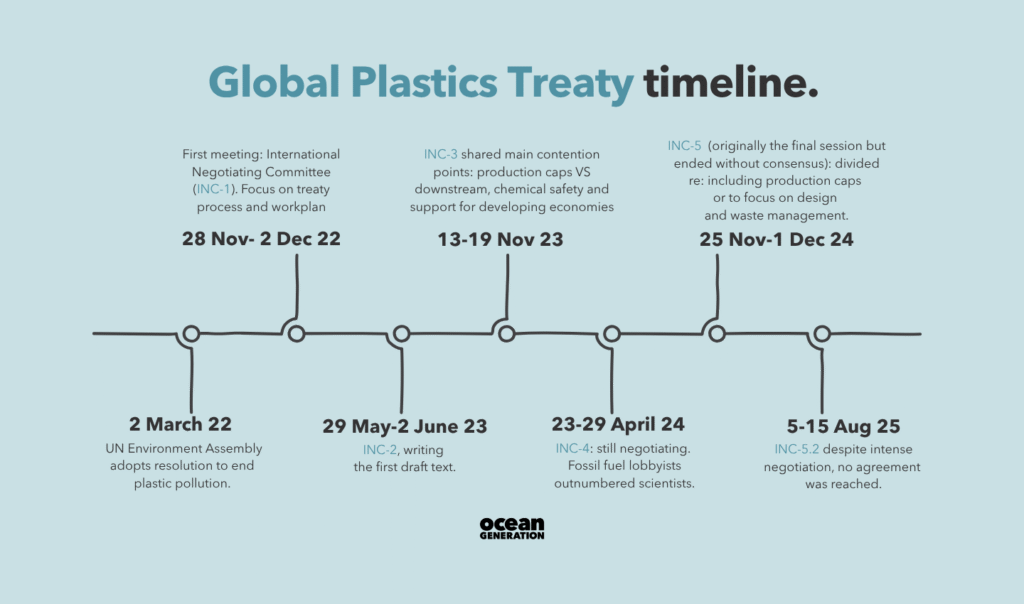
In 2022, 175 countries of the world signed an agreement that declared: plastic pollution needed to be addressed. Stronger than that, plastic pollution should be ended.
To meet this goal, countries agreed on a series of meetings across the globe to discuss and negotiate how to end plastic pollution and write it into international law (a treaty).
Five meetings were planned, with the treaty aimed to be finalised by the end of 2024.
This agreement created the International Negotiating Committee (INC) which first met in Punta del Este in Uruguay. Subsequent meetings happened in Paris, France; Nairobi, Kenya; Ottawa, Canada; and Busan, Korea.
By the end of the fifth meeting, no agreement had been reached for the Global Plastics Treaty, so another (INC5.2) was scheduled for August 2025 in Geneva. However, this meeting also ended with no treaty.
Timeline by Will Steen
What is stopping a treaty being agreed?
For the treaty to come to life, all countries must agree on the terms, so while some disagree there will be no treaty.
The main point of disagreement is whether making new plastic (plastic production) should be limited within the treaty. Countries are split largely into two groups, the High Ambition Coalition and the Global Coalition for Plastics Sustainability.
What is the High Ambition Coalition?
There is a large group of countries (around 100) in a group, called the High Ambition Coalition (HAC).
The HAC has been pushing for the plastics treaty to include plastic production limits – reducing the amount of new plastic made. Before INC5.2 the HAC published a “wake-up call” at the United Nations Ocean Conference at Nice in June 2025, outlining a ‘wishlist’ of five points:
Limits on plastic production (to be regularly adjusted), and reporting on production, import and export of primary plastic polymers
Phase out most harmful plastic products and chemicals of concern
Improve the design of plastic products to minimise environmental and human impacts
Financial support to support less developed countries in the transition
A treaty responsive to changes in evidence and knowledge
What is the Global Coalition for Plastics Sustainability?
Another group of countries formed the Global Coalition for Plastics Sustainability (also known as the Like-Minded Group of Countries).
A statement from a member country outlined the focus:
“The [Global Plastics Treaty] should pave the way for improving the waste management systems in general, and to promote environmentally safe and sound management of hazardous plastic wastes, and to reduce uncontrolled hazardous plastic pollution.”
They want a bottom-up approach, prioritising dealing with plastic waste.
What do major businesses think of the plastics treaty?
Businesses that produce and use plastic are key to tackling the plastic pollution problem.
The UK hosted a roundtable with major business in June 2025 and produced a statement. It called for the plastics treaty to address the whole lifecycle of plastics, amongst other things.
The division has been entrenched from early in the process, with little movement on either side. It has led to questions about the process, and where to go next. Here are some options:
The process is changed to being decided by vote rather than by consensus, to make progress despite the disagreement of a small minority
The process continues via other means. For the Ottawa convention on landmines, a number of countries compiled texts outside of the process, that were then agreed upon. We could see this happening, for example, with the High Ambition Coalition.
Another round: INC5.3 to try again! A (currently unnamed) country has offered to host, but has said they will not fund it.
While the gears of global negotiation can feel like they turn slowly, they are turning. Read more about how international treaties work here.
These countries have agreed that ending plastic pollution is an important issue. We want a world without the damage of plastic pollution.
The Global Plastics Treaty is the representation of international intent. If it does produce legal guides to end plastic pollution, it will speed up progress. That it hasn’t yet is not going to stall momentum.
Everything you need to know about the High Seas Treaty
Officially, it is the Agreement on the Conservation and Sustainable Use of Marine Biological Diversity of Areas beyond National Jurisdiction. It is known colloquially as the High Seas Treaty. Or, BBNJ (biodiversity beyond national jurisdiction) Agreement.
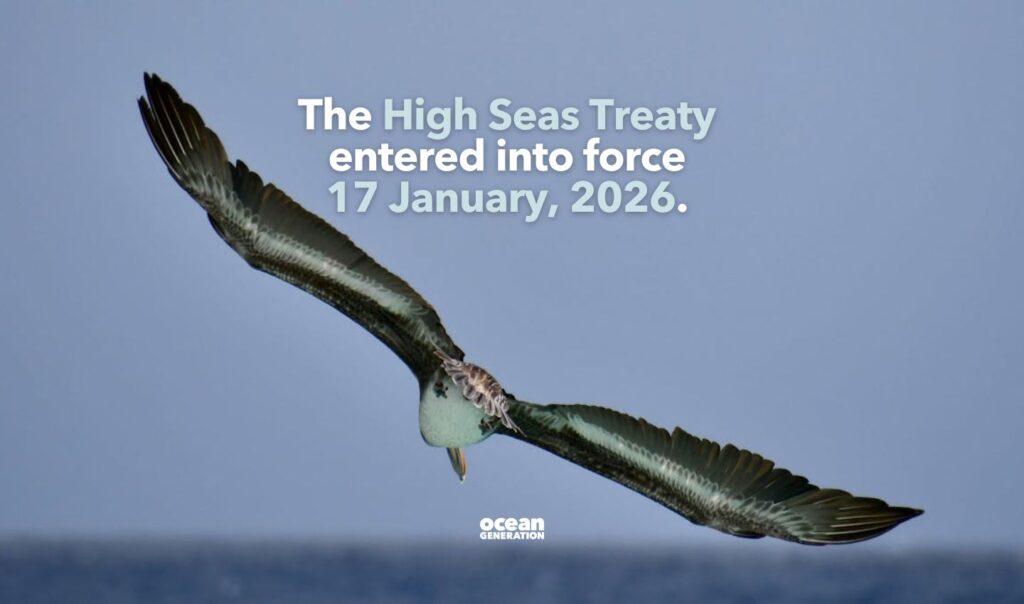
It entered force on 17 January 2026, 120 days after receiving the necessary 60 ratifications on the 19 September 2025.
What are the high seas?
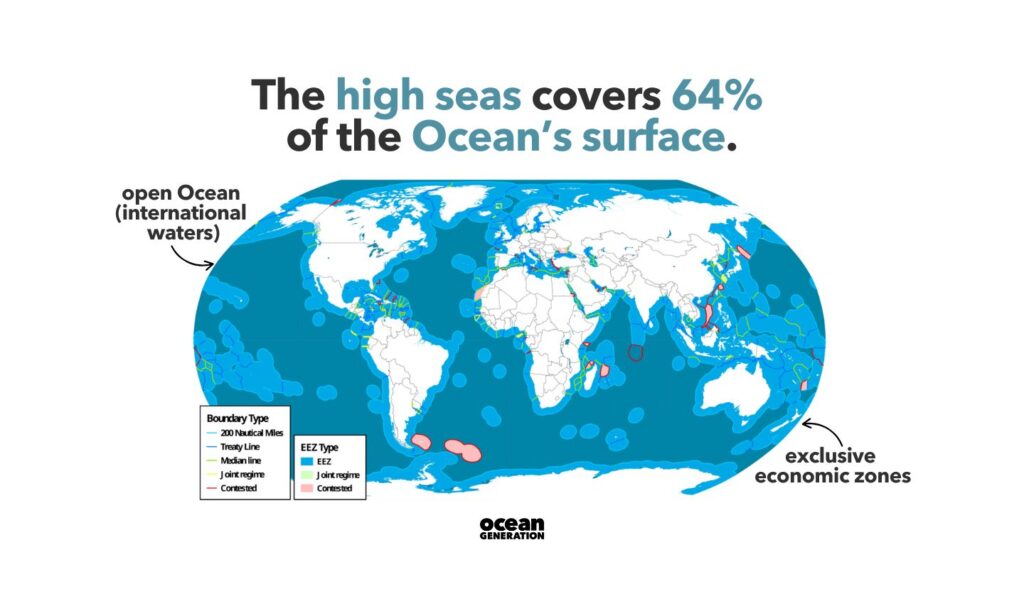
The high seas refer to around 64% of our Ocean’s surface.
In 1958, 63 countries signed the Convention on the High Seas, defining the “high seas” as the Ocean not within territorial waters.
In 1982, the United Nations Convention on the Law of the Sea (UNCLOS) was signed, establishing exclusive economic zones (EEZs) reaching 200 miles out to sea– each country has sovereign rights (‘ownership’) to the Ocean and seabed within 200 miles of its coast.
The rest of the Ocean, including the water column and “the Area” (the seabed outside these EEZs), are the high seas.
Share marine technologies between Parties, including funding mechanisms. This is aimed to enable developing nations to contribute to and benefit from Ocean conservation.
What is the process?
The agreement can be traced back to December 2017, when the United Nations General Assembly voted to start creating the High Seas Treaty.
The agreed-upon five meetings (with a gap due to COVID-19) failed to produce an agreement.
In March 2023, at the sixth meeting, the text of the agreement was finalised. The treaty was open for signatures for two years, from 20th September 2023, until 20th September 2025.
Palau was the first country to ratify, in January 2024.
At the United Nations Ocean Conference in June 2025, there were 20 signatories and 19 countries ratified, bringing the total number to 51.
What’s the difference between signing and ratifying?
Signing the agreement and ratifying are not the same. Signing is announcing the attention to ratify. Ratifying the agreement means committing to the agreement officially.
There is no deadline on ratification after signing; Parties can ratify at any point. Only Parties that have ratified the treaty are legally bound by it, and able to enjoy the benefits.
When did the High Seas Treaty come into force?
On 19 September 2025, Morocco became the 60th country to ratify. This initiated a 120 day countdown, which ended on January 17th 2026. From then, it is legally binding (for those who have ratified).
A year on, the first Conference of the Parties (COP) will meet to discuss high seas conservation, such as identifying the areas to protect. Belgium and Chile have submitted bids to host the Secretariat, and Chile has included a suggestion for the first high seas MPA.
Why protecting the high seas is so important
The high seas used to be out of our reach. Untouchable and unaffected by human activities. But in just the last sixty years or so, our technology has improved, this vast wilderness has become far less wild.
This has enabled us to benefit from the Ocean beyond our national borders. Fishing flotillas can travel the world and cargo ships cris-cross the Ocean. This global reach – impossible to our grandparents – has changed our relationship with the Ocean.
Without responsibility or ownership over the high seas, everyone has an incentive to extract as much as they can before anyone else. In just six decades, this free-for-all has led fishing stocks being depleted, marine animals being exposed to large amounts of noise from marine traffic and pollution accumulating out at sea.
The High Seas Treaty aims to solve this and enables the protection of important marine areas that don’t belong to any single nation. It enables the world to take responsibility for the wild Ocean.
A common misconception is that the end goal of conservationists and the marine industry (such as fishing and tourism) are incompatible. But healthy fish stocks are all a fisherman asks for, flourishing ecosystems pull in tourists and rich biodiversity offers untold discoveries and advances in pharmaceuticals and engineering to name but two.
Protecting the Ocean means letting it thrive, and we all enjoy the boon of a thriving Ocean.
The High Seas Treaty creates an opportunity. An opportunity to nurture our Ocean and share the benefits from it.
Ocean Generation’s Statement on the High Seas Treaty:
“We are delighted to hear that the UN High Seas Treaty has finally become a reality.
A healthy Ocean is vital for the survival of all living things, and this is the message we continue to deliver through our work at Ocean Generation. Protecting 30% by 2030 must, however, be seen as a minimum requirement.
We view this agreement as a starting point. The Ocean is our ally in the fight against climate change and we must stop underestimating its role in our survival.”
COP29 finished on the 24th November 2024, after two weeks of tough, technical negotiations.
It was full of colouring books, expensive sandwiches and drama! Let’s break down the COP29 outcomes: the wins and disappointments – and have a look across to COP16 (the biodiversity one) too.
COP29 was held in Baku, Azerbaijan and was painted as the ‘finance COP’ with the hopes of a climate finance deal being agreed.
Hold up – what is climate finance? Broadly speaking, climate finance refers to any money “that seeks to support mitigation or adaption actions that will address climate change” – UNFCCC (remember what it stands for? Spoiler: United Nations Framework Convention on Climate Change)
Richer countries – often referred to as the Global North (that also includes Australia, Israel and New Zealand) – have emitted the vast majority of the CO2 that is responsible for climate change. As of 2019, the Global North have emitted 2.5 times their fair share of the emissions allowed for 1.5 degrees of warming.
Countries in the Global North industrialised much earlier than the Global South, making a lot of money at the cost of carbon dioxide emissions. It has been called for, and agreed, that the richer countries should provide money to the developing countries, to allow them to develop without emitting so much CO2.
Furthermore, there’s a loss and damage fund to help countries most affected by climate change. Many of the countries most vulnerable to the effects of climate change (sea level rise, droughts, heatwaves, floods, intense storms etc.) are poorer countries.
What were the themes of COP29?
So, what actually happened this year? Let’s explore a few of the themes that came from the COP29 summit this year.
Presents and petrol stations.
Countries have their own stands – as an opportunity for cultural sharing and integration. Many gave out gifts: Georgia handed out some wine tasters, the UK provided coffee.
Go to the Russian stand and you could pick up an ecological colouring book, full of tips for environmental sustainability. Some were slightly cynical, as it was produced by a major fossil fuel company.
Fossil fuels were present throughout COP29. Azerbaijan, the host country, is a country with 90% of its exports comprised of fossil fuels. The capital, Baku (save that for the pub quiz) houses the very first industrial oil well and was the world’s first oil town (dating back to the 1840s).
For the second year running, COP was attended by more fossil fuel lobbyists than the ten most climate change vulnerable countries‘ delegations combined. The host nation Azerbaijan, next year’s host Brazil and one of the countries competing for COP31 presidency, Turkey, were the only countries with more attending.
Although the 1,773 attendees from fossil fuel companies made up only 1.5% – there were only three countries with more.
Should discussions around climate change happen in the house of the industry most responsible for the damage?
Or does it represent an opportunity to engage and include those most capable of changing our world?
Al Gore said, “It’s unfortunate that the fossil fuel industry and the petrostates have seized control of the COP process to an unhealthy degree.”
Or, as Oil Change International member David Tong said: “It’s like tobacco lobbyists at a conference on lung cancer.”
The president of Azerbaijan made headlines this year describing oil and gas as “a gift from God”. This was denounced by a multitude of faith groups. And the Brazilian environment minister Marina Silva said: “We should take care in moderation of the gifts we are given – if we eat too much sugar, we get diabetes.”
A report published during COP highlighted that eight fossil fuel companies had paid at least $17.6 million to Meta (which owns Facebook and Instagram) alone for pushing their posts – 700 million impressions, all within the last year.
Activism has always been a big part of COP.
It presents an opportunity to make voices heard by the decisionmakers and gives a platform to send big messages.
Attendees of the COP29 summit were welcomed by a realistic, full-sized model of a dead sperm whale on the waterside in Baku. Created by Belgian art collective Captain Boomer, the piece hopes to highlight “the disruption of our ecological system”.
In the run-up to COP29, the cop29.com website was acquired by Global Witness, which called for fossil fuel CEOs to pay for the damage they have done to the climate.
There was a protest outside BP headquarters in London, and a number of demonstrations in Baku, including a large snake, with the message “weed out the snakes” – aimed at the fossil fuel attendees.
COP29: Agreements and outcomes.
After two weeks, and running over by 34 hours, COP29 closed with a number of agreements. What did all the sleepless nights in smelly conference halls produce? (at one point the plumbing failed, filling the corridors with the smell of you-know-what).
There were finally some numbers for climate finance – $1.3 trillion per year, needed by 2035. This number is based in the recommendations of the Independent Expert Group on Climate Finance (IHLEG). “At least” $300 billion of this is to come from developed countries. The rest could come from a range of sources including private finance and taxes on cryptocurrency, airplane tickets and the super-rich – known as solidarity levies.
There was no agreement reached on how to take the Global Stocktake from COP28 forward, so it was pushed back to COP30 next year.
Article 6 of the Paris Agreement, describing ‘carbon markets’, was finalised, marking the last element of the Paris Agreement to be completed, although it was not agreed on. This just means that the text has been written, but countries have not yet signed on the dotted line.
The reaction to COP29 has been, optimistically, mixed.
The focus, following on from the expectations coming into COP29 (finance COP), has been on climate finance. The amount pledged by the Global North has come under fire: “A paltry sum” and “a joke” by delegates from India and Nigeria respectively.
However, some took a more positive view. Marshall Islands climate envoy Tina Stege said, “it isn’t nearly enough, but it is a start”. An observer was quoted by the Carbon Brief as saying, “momentum was neither lost nor gained, just maintained” so overall, it achieves “a passing grade”.
UNFCCC (remember what that stands for?) Executive Secretary Simon Steill said:
“This new finance goal is an insurance policy for humanity, amid worsening climate impacts hitting every country. But like any insurance policy – it only works – if premiums are paid in full, and on time. Promises must be kept, to protect billions of lives.”
$300 billion per year, it has been widely agreed, is not enough. But the creation of a deal is a good step and could be enough to spur on the further investment required from private finance and new sources, such as carbon markets and new taxes.
Outside the negotiating rooms.
Beyond the walls of formal negotiations, there were some big developments.
Indonesia, the 8th biggest emitter of CO2, unexpectedly pledged a complete phase out.
Mexico was the last G20 country to not commit to net zero, but did during COP29.
UK and the EU joined 30 nations in an agreement to slash emissions further, specifically targeting methane emissions.
China’s influence grew in the absence of strong US leadership. It announced the opening of the largest wind farm in the world.
Some NDCs (Nationally Determined Contributions) announced: UK pledged a reduction of 81% against 1990 levels by 2035. Brazil announced a 59-67% reduction against 2005 levels.
At COP29, over 70 events were hosted in the dedicated Ocean Pavilion over the two weeks.
What happened at COP16 (the biodiversity summit)?
Just 10 days before the first delegates landed in Baku, COP16 wrapped up in Cali, Columbia. This followed very similar themes. It was focused on money. Specifically, where to find the money required to tackle biodiversity loss and restoration.
The Cali Fund was established and though limited in being entirely voluntary with debated scope, can be a positive step.
Another main objective for COP16 was the updating National Biodiversity Strategies and Action Plans, and unfortunately only 44 countries out of 196 had done so by the end of the conference.
119 countries submitted national biodiversity targets, building on the work of the Global Biodiversity Framework agreed on at COP15.
COP16 formally recognised the importance of indigenous peoples and local communities (IPLCs) to conservation efforts, creating a body to amplify their voices in the CBD.
At COP16, the Ocean was prominent in a way not previously seen.
The Small Island Developing States (SIDS) pushed for progress. The Maldives announced14% protection of their coral reefs with more protection pencilled in. The Azores announced the largest MPA network in the North Atlantic, protecting 30% of its waters.
Parties approved a new process to identify ecologically or biologically significant marine areas (EBSAs) (bet you thought we were done with new acronyms).
This doesn’t guarantee protection but can guide the creation of marine protected areas (MPAs) in areas that will be most effective, including the high seas.
Generally, the progress made for the Ocean was received very positively.
COP29 and COP16: the transition from negotiation to actions.
Awareness, knowledge and respect for the natural world is growing. Frustration at pace of progress is evident throughout the process, from those in the room to those hearing the news. We need to appreciate how far we have come, while also maintaining the push onwards.
What was top of the COPs?
Tops
Nots
Agreement to triple climate finance to $300 billion
Amount falls far short of that hoped by developing countries
Carbon markets approved after a decade of trying
Fears of carbon markets being misused in bad offsetting and fraud
Cali Fund established
No mandatory contributions – entirely voluntary, no guarantees
Loss and Damage Fund should be operational in 2025, and has $730 million pledged
No further progress on last year’s Global Stocktake – phasing out fossil fuels
Mexico and Indonesia surprise with net zero and emission cutting announcements
Some countries and parties obstructing progress
China announces more voluntary contributions to climate finance
Brazil has made it clear it intends to make COP30 a “Nature COP”. If it can maintain momentum, COP29 has given foundation for the transition into tangible action.
These big global treaties can feel very far away, and it can seem that there is nothing you or I could do. But we are the key parts of this puzzle. Appreciate every small action you take.
Turn down your heating by one degree this winter – barely enough to notice but saving a lot of emissions.
Be conscious of what you eat – choosing local, seasonal food can be your difference.
Get talking. You are already doing something important – staying informed. Having conversations with other people, making people more aware, is a crucial part of the process. Engage with us! We love to hear the actions you are taking, and we will answer every question sent our way.
COP28 Outcomes: The beginning of the end of fossil fuels
Share this page
Copied
Everything you need to know about COP28 outcomes.
After a gruelling set of negotiations which dragged on well into the night, a new deal has finally been agreed at the UN climate summit COP28, in Dubai, UAE.
COP28 outcomes: ‘Fossil fuels’ finally make the cut.
In the face of colossal opposition from the world’s oil producing countries, and despite the highest number of fossil fuel lobbyists at COP than ever before, a global consensus has been reached. The world has finally agreed to transition away from fossil fuels.
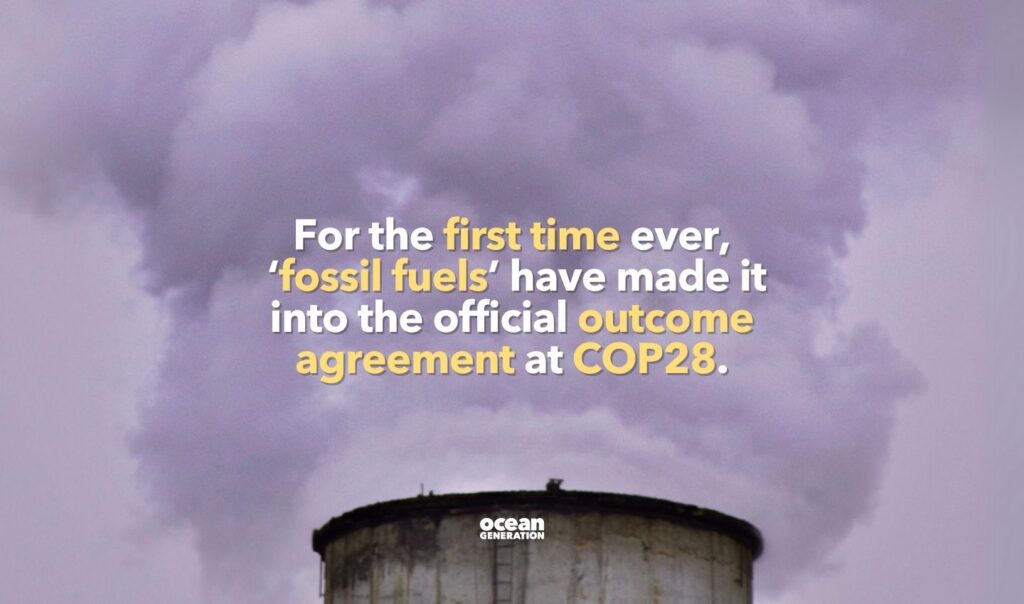
For the first time ever, the elephant in the room has been addressed. ‘Fossil fuels’ have made it into the official outcome agreement at COP28.
This is the biggest step forward for climate since the adoption of the Paris Agreement in 2015. And the COP28 agreement signals the beginning of the end of the fossil fuel era.
The agreement follows the widespread fury sparked by an earlier draft, which was deemed a “death sentence” by representatives from Pacific Island nations. The new document calls on countries to “contribute to global efforts to transition away from fossil fuels in energy systems in a just, orderly and equitable manner.”
The deal also calls for a tripling of global renewable energy capacity and doubling of energy efficiency by 2030.
Does the COP28 Agreement go far enough?
Despite the standing ovations as the new COP28 agreement was passed, many nations have criticised the final decision. And there are concerns that it hasn’t gone far enough.
With just six years left until 1.5 degrees becomes inevitable, it’s not the “phase-out” that we had all hoped for.
Put simply, the language of the text was weaker than many countries wanted.
There was no mention of coal or methane (the most potent greenhouse gas). A finance path to aid the transition for developing countries was also missing. There was also no request for developed countries to take the lead on the transition away from fossil fuels. This raised further criticisms over the fairness of the deal.
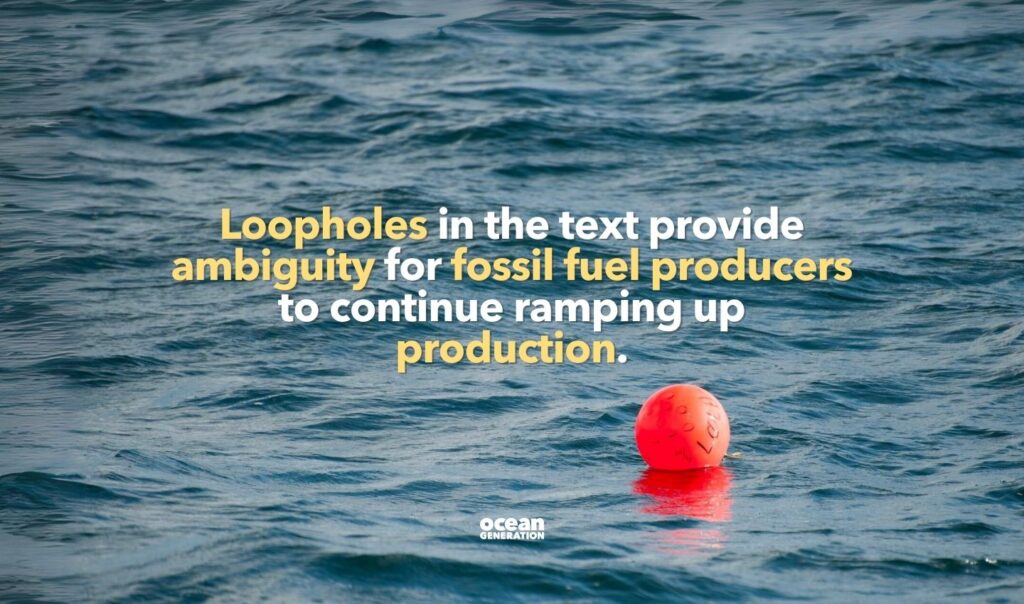
A ‘litany of loopholes’ scattered within the text provides enough ambiguity for fossil fuel producers to continue ramping up production. Examples include ‘abatement’ (A.K.A CO2 removal); ‘transition fuels’ (A.K.A gas), and ‘fossil fuel subsidies’ to name a few.
This will have devastating consequences. Particularly, for the most vulnerable communities who are already bearing the brunt of the worsening impacts of climate change.
Opposition to the new deal was voiced by a representative of Small Island Developing States (SIDS). The SIDS said: ‘You agreed the deal when we weren’t in the room’. This was meant literally (delegates from SIDS were still discussing their response to the text when it was agreed further down the hall). However, it also reflects that these nations feel overlooked, despite being the hardest hit by climate change.
Does the COP28 Agreement go far enough?
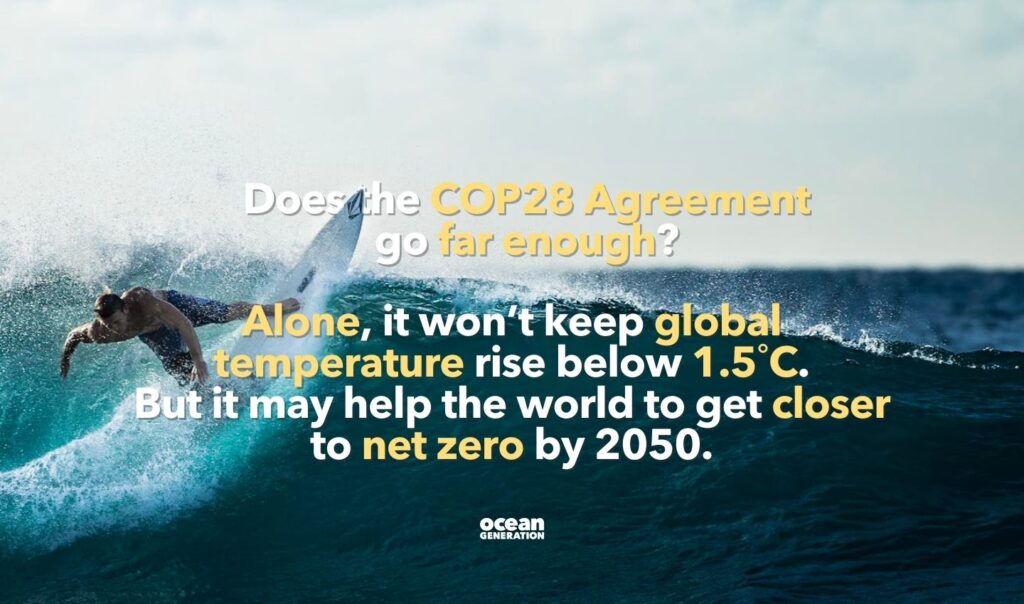
The agreement alone will not be enough to keep global temperature rise below 1.5˚C. But it may help the world to get closer to net zero by 2050. That’s if individual countries put a rapid transition to green energy at the heart of their new NDCs.
Here are some reactions from top climate scientists:
“At my lowest points as a climate scientist I did not think I would see a COP agreement that includes wording on the start of transitioning away from fossil fuels in my lifetime.” – Prof Mary Gagen, Climate scientist, Swansea University
“The agreement, though inadequate, is an essential and sustained baby step towards the goal of limiting human caused climate change.” – Prof Richard Allan, Climate scientist, University of Reading
How does the Ocean fit into COP28 outcomes?
Multilateralism (alliance between countries to achieve a common goal) connects us all, and so does the Ocean.
This was recognised during the Nature, Land Use and Ocean’s Day. Countries, non-state actors and other stakeholders came together in support of nature-based Ocean and climate action.
Here are our top three Ocean-wins from COP28:
The importance of maintaining the health of our Ocean is getting recognised.
During the Nature, Land Use and Ocean’s Day, 18 countries pledged to implement Sustainable Ocean Plans.These plans are supported by the official launch of Ocean Breakthroughs.
These will provide a roadmap for change and aim to catalyse momentum across five key areas. Namely, marine conservation, shipping, aquatic food, coastal tourism, and marine renewables. These contributing countries represent 50% of the world’s coastlines and close to 50% of global Exclusive Economic Zones (EEZ’s).
There’s an increased appreciation that the Ocean can provide solutions for mitigation and adaptation.
$186 million of new funding was pledged towards investment in nature-based solutions and Ocean-action. The Mangrove breakthrough was also formally endorsed by 21 countries. Its global goal is to protect 15 million hectares of mangroves.
And a growing acknowledgement of the need for synergy between climate and biodiversity targets.
The joint statement on climate, nature and people was signed by 20 countries. It seeks to align action on climate change, biodiversity loss and sustainable development. It recognises that a healthy Ocean will provide benefits across all three avenues.
What happens next?
For world leaders: While the COP28 decisions are not legally binding, Parties (countries) are obliged to act in accordance with the outcomes of this process. It’s time for world leaders to head home and begin delivering on the promises made. Individual countries are required to submit stronger action plans in their next round of Nationally Determined Contributions (NDCs) in 2025.
For COP: Fossil fuels have officially entered the global conversation. The work now begins to tighten this language and ensure a fair, equitable and just transition at COP29 in Azerbaijan, and beyond. To ensure a liveable planet and a healthy Ocean, we need a full ‘phase-out’ of fossil fuels before it’s too late.
For us: Together, we must ride this growing wave of hope and momentum, to continue advocating for stronger Ocean-action.
Stay up to date with all things Ocean:
We’re known for translating Ocean science into engaging content. See what we’re all about on your favourite social platform or make a donation to support our charity:
Extreme weather events and temperature records have made headlines more frequently in 2023 than ever.
The transition into an El Niño climate pattern (explained here) compounded by worsening impacts of climate change have resulted in an unstable year of weather patterns.
This is a trend which is set to intensify in the coming years.
The more often these events happen, the less headline-worthy they are and instead they simply become part of the norm. As the world turns its attention to climate change at COP28, we must recognise weather events as part of the larger-scale changes that are happening all around us, right now.
It’s also important to celebrate the key breakthroughs for Ocean-action in 2023 and use these as a foundation to expand our future ambition at COP28 and beyond.
Timeline of extreme weather events and Ocean wins that have made headlines in 2023:
Our Ocean regulates global climate and is inextricably linked to these extreme weather events.
How the Ocean is linked to temperature records broken:
Over the course of 2023, we saw the warmest Northern Hemisphere summer on record and the hottest September ever recorded (average global temperature reached +0.66°C and +0.93°C warmer than the 1991-2020 baseline respectively).
Unsurprisingly, since the Ocean absorbs 90% of the excess heat associated with climate change, these broken temperature records were not limited to land.
The highest ever Ocean surface temperature was recorded in August 2023, as widespread marine heatwaves spread across the North Atlantic, Mediterranean, and Gulf of Mexico.
This unprecedented heat stress caused a severe coral bleaching event in the Caribbean, during which the highest warning level alerted to significant coral mortality
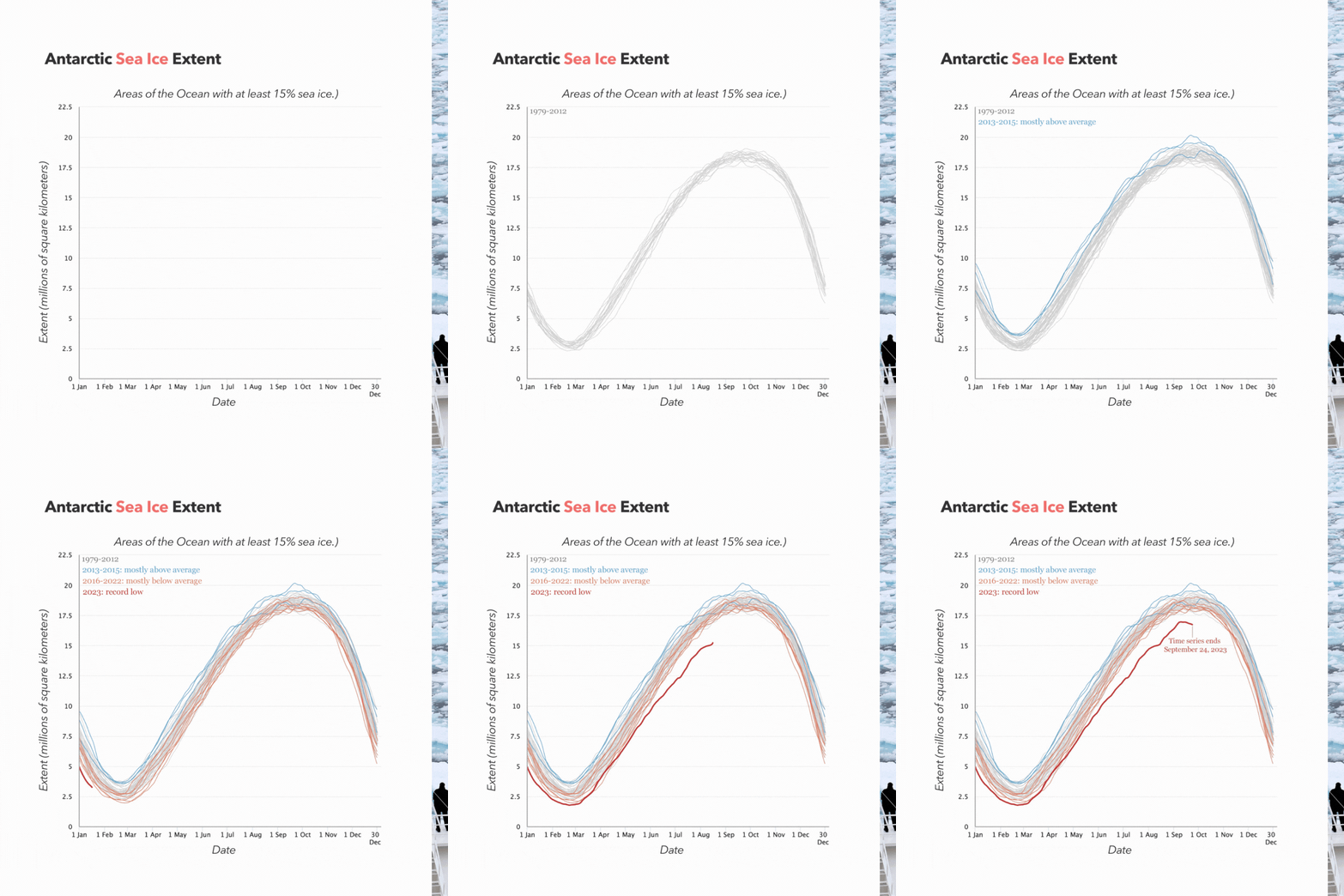
September 2023 also saw the lowest mean winter sea ice extent ever observed in the Antarctic, with maximum coverage a shocking 1.03 million km2 below the previous record low.
Scientists fear that this could mark the beginning of a long-term declining trend.
As greenhouse gases continue to accumulate in the atmosphere, our Ocean continues to warm.
Warmer water absorbs less carbon dioxide, and the Ocean’s ability to act as a buffer and protect us against rapid temperature change slows.
How the Ocean links to storms and flooding events:
Weather systems are supercharged by our warming Ocean, as warmer water supplies more moisture and thermal energy to the atmosphere.
This process drives intensified rainfall and more powerful storm and flooding events.
For instance, Cyclone Freddy made landfall multiple times across Malawi, Mozambique, and Madagascar in February 2023, killing more than 1,000 people and displacing millions.
This was the longest-lasting tropical cyclone ever recorded (34 days long), and also broke the record for the most accumulated energy based on wind strength measurements.
You’ve probably also heard of a phenomenon called ‘El Niño’ which has been linked to many extreme weather events this year.
What is the El Niño phenomenon?
El Niño occurs due to the periodical weakening of trade winds in the Pacific Ocean. This pushes warm surface water towards the west coast of the Americas and drives changes in wind and weather patterns across the globe.
The surprising impact of wildfires on our Ocean:
Wildfire events are growing in frequency and intensity across the globe, partly driven by rising temperatures, strong winds and drier conditions.
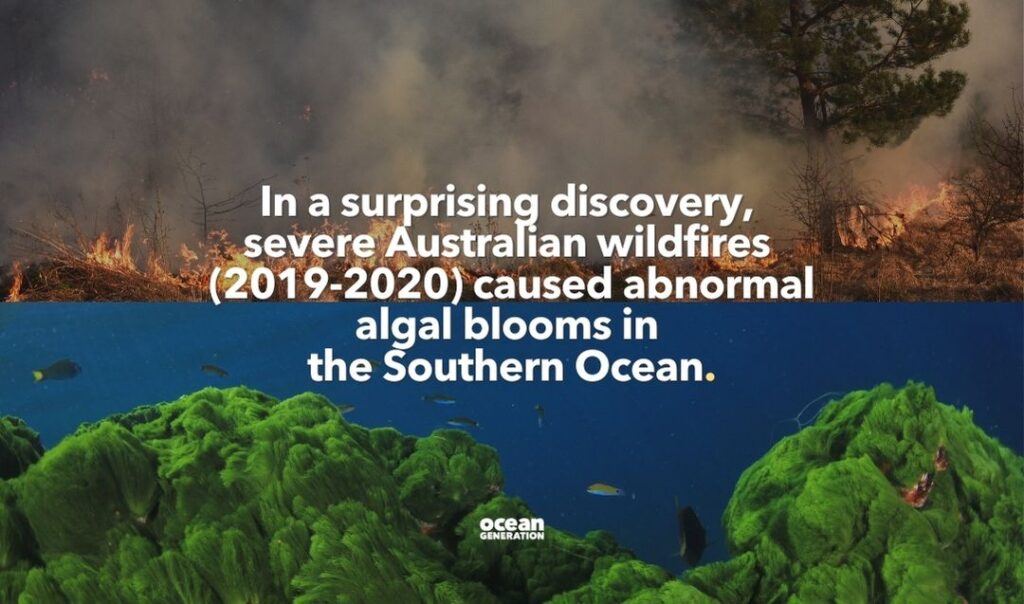
In a surprising discovery, severe Australian wildfires in 2019-2020 were found to cause abnormal algal blooms in the Southern Ocean, thousands of miles downwind of the flames.
It is believed that aerosols from the fire, which contain high levels of iron, phosphorous and other minerals, were transported downwind into the Southern Ocean. These minerals, which are usually in low supply in this region, acted as a fertiliser and caused abnormal algal bloom events.
Artificial fertilisation events can disrupt natural nutrient cycling and marine photosynthesis patterns in the Ocean.
Further clues of these widespread impacts were seen in 2023. Huge wildfires in Canada burned all summer long, releasing persistent aerosol pollution over the Atlantic Ocean. Evidence of this was seen in the skies over parts of the UK in September, where incoming smoke diluted the sunshine, causing the sun to appear lilac in colour.
Only time will tell the impacts of this year’s events, but it’s clear that wildfires can have far-reaching consequences on underwater ecosystems.
Ocean wins giving us hope for the future.
2023 has been a monumental year for Ocean wins.
This year, we celebrated the agreement of the landmark High Seas Treaty, improved single-use plastic regulations, and the decision to pause deep sea mining among others. This is a sign of the ever-growing Ocean-recognition in local, regional, and global decision making.
Each Ocean win moves us one step closer to effective Ocean-action, and it does not stop here. At COP28, we need to see continued momentum to protect and safeguard our Ocean into 2024 and beyond.
Stay up to date with COP28:
We’re sharing bite-sized COP updates, commitments, and Ocean wins on your favourite social platform.
COP27 was the third longest COP in history – but what Ocean and planet wins did the global climate summit deliver?
One things was strikingly clear throughout COP27: Climate change has become mainstream.
Global coverage of the biggest climate summit made headlines through the weeks, providing hope or despair, depending on where you looked.
What was the biggest win at COP27?
The push for stronger climate financing measures resulted in the historic outcome of establishing a ‘loss and damage fund’. Although the finer details hadn’t been drafted at the end of the climate conference, this was still the prominent highlight of COP27.
This fund will only be available for developing countries that are particularly vulnerable to climate-related disasters. This is a crucial win for small island nations.
What is loss and damage, in the context of climate conversations?
In a COP27 interview, Dr. Kees van der Geest, Senior Migration Expert, United Nations University, Institute for Environment and Human Security (UNU-EHS), explained what loss and damage means in a nutshell:
“I’ve been working on it [loss and damage] for 10 years. ‘Loss and damage’ is really about situations; where people live in places where the impacts of climate change are so severe that adaptation is no longer possible or feasible. It is not necessarily a future scenario because that is the lived reality for some people now.”
With global warming at 1.1C, COP27 proved that the scientific consensus of limiting warming to 1.5C was not being taken seriously enough. The final decision made no mention of phasing down fossil fuels, except for coal, with the power of fossil fuel delegates tremoring through this decision.
The IPCC (a kind of survival guide for humanity) stresses that global emissions must decline 45% by 2030. If we want to keep this limit alive, we need to peak global emissions by 2025.
This does not mean that we should just wait until COP28 in hopes of sweeping action.
In every corner of the world, people are rallying together to implement ambitious initiatives and COP27 has also shed light on many positive developments.
1. Young people are part of the decision-making progress.
COP27 hosted a Youth and Children Pavilion, marking the first official space for young people at a COP.
Another milestone came from YOUNGO, the official children and youth constituency of the UNFCCC, being recognised as stakeholders in designing and implementing climate policies.
2. Enthusiasm for the energy transition.
Despite the disappointment with curbing fossil fuels, the enthusiasm for a just energy transition is undeniable. Renewable energies are here to stay.
Some of the renewable energy transition commitments include:
Tanzania updated their NDC to achieve 80% adoption of renewable energies by 2025 (from 60% in 2015).
The Just Energy Transition Partnership for Indonesia which launched at the G20 summit, in parallel to COP 27, will secure $20 billion from wealthy economies to scale up renewables like solar, wind, hydro, and geothermal.
3. The Global Methane Pledge gains momentum.
In the first week of COP27, we shared that 130 countries has joined the Global Methane Pledge. By the end of COP27, that number grew to 150 countries.
4. Decarbonising the shipping industry is a serious priority.
There has been massive mobilisation to curb shipping emissions.
Some of the measures include:
More countries, ports and companies stated their plans to support the Green Shipping Challenge. Here’s a list of the various announcements made.
The EU’s “Fit for 55” package proposal includes the first ever carbon market for shipping and adoption of cleaner fuels.
Noteworthy policy recommendation: No one countryis responsible for a majority of shipping emissions but a study conducted by Transport & Environment showed that a zero-emission mandate in EU, China, and US could decarbonise 84% of global shipping.
5. The Ocean is part of the final COP27 cover decision.
In 2022, the Ocean had a seat at climate conversations at COP27.
The importance of Ocean-based climate action was highlighted and the COP27 cover decision emphasised this need and encouraged nations to “blue” their NDC’s.
6. Funds will be made available for early-warning systems.
Vulnerable nations need early-warning systems for adaptation and building resilience. UN Secretary-General António Guterres announced a $3.1 billion plan to support the development of these systems to protect people within the next five years.
7. Spotlight on nature-based Ocean solutions.
We cannot address climate change without considering the Ocean.
As more people realise this, we’re seeing great initiatives that support protecting the Ocean and ensuring its health:
The Great Blue Wall Initiative aims to protect marine areas to counteract the effects of climate change and global warming.
Hope for Coral Reefs – Egypt announced protection for the entire Great Fringing Reef in the Red Sea, creating a 2000km marine protected area (MPA).
The Mangrove Breakthrough Alliance aims to secure the future of 15 million hectares of mangroves globally, by 2030, through collective action.
The Convex Seascape Survey is a research programme aiming to provide critical data and insights on the connections between carbon and the Ocean.
“The Ocean and nature are our greatest allies to mitigate and adapt to climate change, as conservation efforts have a “triple bottom line” in that they address economies, communities, and nature.”
Razan Al Mubarak, President, International Union for Conservation of Nature (IUCN)
Ocean Generation’s comment on COP27:
Like any other COP, there is always going to be tension between progress and potential setbacks.
While there will always be room for doing more and better, COP is the only summit where world leaders and multiple stakeholders come together to discuss our environmental impacts and implement solutions. And without it, the conversations would be more diluted, disjointed, and slow to progress.
The progress made year on year at COP should translate into hope for all.
The decisions we make in this decade will have long-lasting impacts and we hope the Ocean continues to receive exponentially more importance in COP28’s agenda in 2023.
In the midst of increasing climate-related disasters perpetuated by other crises, hope can be instilled through action. We need the Ocean more than it needs us. So, let’s act now – in whatever position, wherever we are. However big, however small.
The Ocean is turning green because of climate change
Share this page
Copied
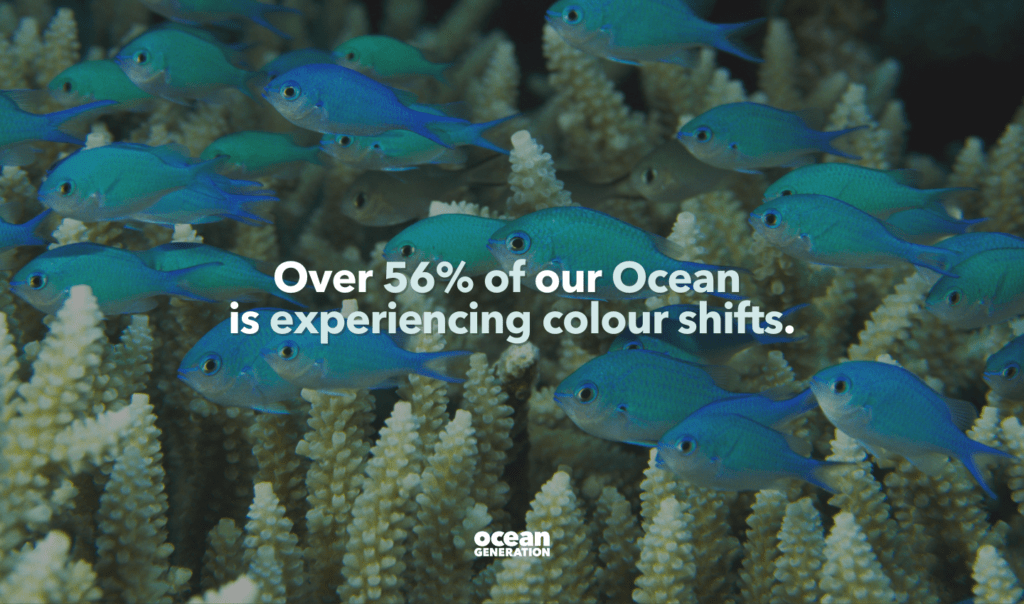
Over 56% of the Ocean is turning green.
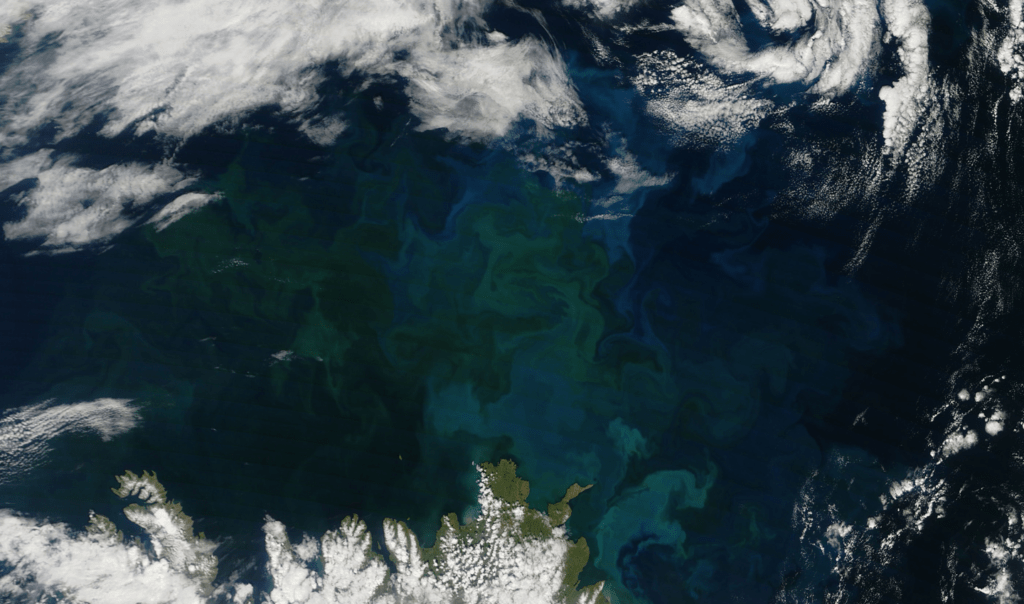
More than half of our Ocean has changed colour in the last 20 years, turning more green than blue. (That’s more than Earth’s total land area.) The culprit? Climate change.
Nature published a study in July ’23 that analysed two decades of research which we’ve translated into a 5 minute read about why the Ocean is changing colour and why we should care.
Why is the Ocean turning green?
Colour shifts in the Ocean happen for many reasons, like when light bounces off of particles (like plastic) and sediments in the water.
Phytoplankton (micro-algae) is the main reason the Ocean has a naturally green hue because it contains chlorophyll, like all terrestrial plants.
But phytoplankton is more than a just splash of colour. It’s the base of most Oceanic food chains, the main producer of our oxygen, and stores the bulk of our carbon.
So, shifts in Ocean colour aren’t really about the colour. We care about the colour shifts because they’re indicative of changes happening in important surface-level ecosystems.
How is the Ocean’s colour shift linked to climate change?
Good question. Tracking how changes in climate impact our Ocean can be challenging because of the sheer scale of our Ocean. So, often, time-series data is used to measure trends over long periods.
For this study, 20 years of observations from June 2002 to June 2022 by Nasa’s Modis-Aqua satellite were used.
By studying wavelengths of sunlight reflected off our Ocean’s surface, the scientists tracked the fluctuations in greenness (basically: How much phytoplankton is living near the Ocean’s surface, based on estimates of how much chlorophyll there is).
Of course, phytoplankton populations have natural fluctuations. To assess the connection to climate change, researchers created a computer model.
The model measured how phytoplankton populations may respond to increases in greenhouse gases (without the natural variations).
The results (between reality and the only-climate-driven-changes model) matched almost exactly, prooving:
Oceanic plant populations (measured by the green they’re adding to the Oceans colour palette) can indicate climate health.
What’s the impact of a greener Ocean?
It all comes back to the phytoplankton.
If the health of phytoplankton is impacted, there are implications relating to:
What is the UN High Seas Treaty and why does it matter?
Share this page
Copied
After two decades, the open Ocean or ‘high seas’ are on its way to being protected.
On 20th February 2023, the fifth session of the Intergovernmental Conference (IGC) on Conservation and Sustainable Use of Marine Biodiversity of Areas Beyond National Jurisdiction (BBNJ) resumed negotiations in attempt to agree on a treaty to protect the high seas.
The last negotiations were held in August 2022 and ended without agreement.
“Our Ocean has been under pressure for decades and we cannot ignore the Ocean emergency,” said António Guterres, UN Secretary-General in a statement, reiterating the need for a treaty that paves the way for a sustainable Ocean.
What are the “high seas”?
High seas refer to the vast majority of the Ocean that lies beyond national jurisdictions. This open water is not governed by any one country and covers 64% of the Ocean’s surface.
Global map showing the extent of exclusive economic zones (EEZ’s) and the high seas. [Extracted from Sumaila et al.]
What does the High Seas Treaty mean for our Ocean?
After an extra day of intense negotiations, IGC president, Rena Lee, Singapore, announced that the United Nations (UN) High Seas Treaty had been agreed.
This was a monumental milestone twenty years in the making.
“The ship has reached the shore!”
IGC President, Rena Lee, Singapore.
5 main takeaways from the High Seas Treaty:
Strengthening 30 x 30 –
This agreement seeks to protect 30% of the Ocean by 2030. This was an outcome from COP 15 (the global biodiversity conference held in Dec, 2022) that will be strengthened with the help of this treaty.
Marine Protected Areas (MPA’s) –
This treaty will provide the legal framework necessary to set up MPA’s as no such framework currently exists.
Conference of the Parties (COP) –
Establish a COP to ensure accountability on issues like biodiversity and governance.
Marine Genetic Resources (MGR’s) –
Highlighting the need for processes to share genetic resources like plants and animals for pharmaceuticals, food, cosmetics, etc.
Environmental Impact Assessments (EIA’s) –
Greater obligations to conduct EIA’s on activities relating to pollution or any potential effects on the marine environment that is unknown or not yet fully understood.
Ocean Generation’s Statement on the High Seas Treaty:
“We are delighted to hear that the UN High Seas Treaty has finally become a reality.
A healthy Ocean is vital for the survival of all living things, and this is the message we continue to deliver through our work at Ocean Generation. Protecting 30% by 2030 must, however, be seen as a minimum requirement.
We view this agreement as a starting point. The Ocean is our ally in the fight against climate change and we must stop underestimating its role in our survival. The sooner this treaty is ratified by all countries, the better chance we have of a safe and healthy future for the generations that will follow us.”
Jo Ruxton MBE Founder of Ocean Generation
We intend to update this article once the final text of the treaty has been published.
Ocean Generation: Endorsed as a UN Ocean Decade Project
Share this page
Copied
In 2017, the United Nations General Assembly declared 2021 – 2030 as ‘the Ocean Decade’ (officially: the UN Decade of Ocean Science for Sustainable Development).
What is the goal of the UN’s Ocean Decade?
The Ocean Decade is a global effort to provide “transformative Ocean science solutions for sustainable development, connecting people and our Ocean” endorsed by the Intergovernmental Oceanographic Commission (IOC) of UNESCO; scientists, resource providers, governments, business and industry, and other stakeholders joining forces to drive solutions.
Their vision? To provide the science we need for the Ocean we want, with the aim of supporting a well-functioning, productive, resilient and sustainable Ocean.
Ocean Generation’s “Ocean Intelligence” approach has been endorsed by UNESCO; the UN Ocean Decade.
What is Ocean Intelligence?
“We are delighted that our unique Ocean Intelligence approach has been endorsed by the Intergovernmental Oceanographic Commission of UNESCO (IOC). Our ‘Ocean Intelligence’ approach uses the power of storytelling to translate complex Ocean science into engaging programmes and practical actions. Through Ocean Intelligence we play a central role in bringing to life the vision of the Ocean Decade by connecting everyone, everywhere to the Ocean and communicating the science we need for the Ocean we want. We are particularly happy to continue our long relationship with the IOC who were early supporters and patrons of our original, award-winning documentary film, ‘A Plastic Ocean’.“
Richard Hill, CEO at Ocean Generation.
Ocean science can be complicated. We make it simple.
Ocean Generation uses the power of storytelling to translate environmental science into understandable, engaging content, impactful programmes and practical actions that people, globally, can take to restore a healthy relationship with the Ocean and live more sustainable lifestyles.
Our Ocean Intelligence approach is grounded in four science-based pillars:
Our Ocean: Engaging people in the wonder of our Ocean.
Ocean not Oceans: Sharing the Science behind one interconnected Ocean that humans rely on.
Our Impact: Exploring the 5 human actions that threaten our Ocean.
Our Future: Discovering how we can all take Ocean Action.
These 4 pillars underpin our Comms work, to a growing audience of +100,000, and all our Youth Engagement programmes for 3 – 25-year-olds.
How we bring the Ocean to young people
From a toe in the water to a full immersive experience
In partnership with Earth Cubs, we’ve launched a play-based game for 3 – 7-year-olds that aims to engage children on the importance of our Ocean, the harm of plastic pollution, and how they can contribute to creating a healthier planet.
Ocean Academy exists to bring the Ocean to the classroom. It’s an open-source digital education hub designed for 5 – 16-year-olds, providing them with access to the best Ocean education – in easy to understand and engage with formats.
The Wavemaker Programme empowers young adults – 16 – 25 – to make a positive change by providing them with tools and resources. Through our workshops, masterclasses, and personal development programmes, Wavemakers accelerates social action and incubates innovation.
We see a world where the Ocean is freed from human threats.
To provide the best user-experience for our website, we use cookies. Consenting to these allows us to process data such as browsing behaviour on our site.
Functional
Always active
Technical storage or access strictly necessary for the legitimate purpose of enabling the use of a specific service on our site.
Preferences
The technical storage or access is necessary for the legitimate purpose of storing preferences that are not requested by the subscriber or user.
Statistics
Technical storage or access that is used exclusively for statistical purposes.The technical storage or access that is used exclusively for anonymous statistical purposes. Without a subpoena, voluntary compliance on the part of your Internet Service Provider, or additional records from a third party, information stored or retrieved for this purpose alone cannot usually be used to identify you.
Marketing
Technical storage or access is required to create user profiles to track the user on a website or across several websites for similar marketing purposes.