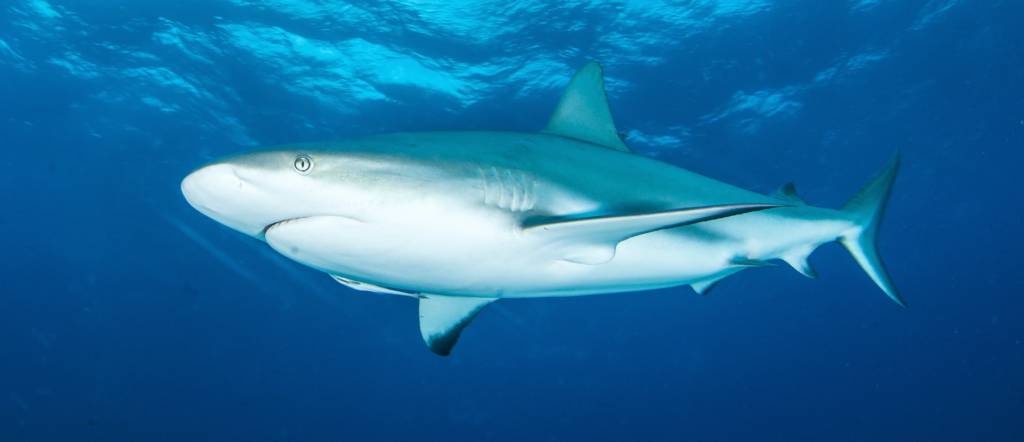
There are over 500 species of sharks. Some live over 300 years old, some glow in the dark. All of them have different vibes, so we’re asking – which kind of shark are you?
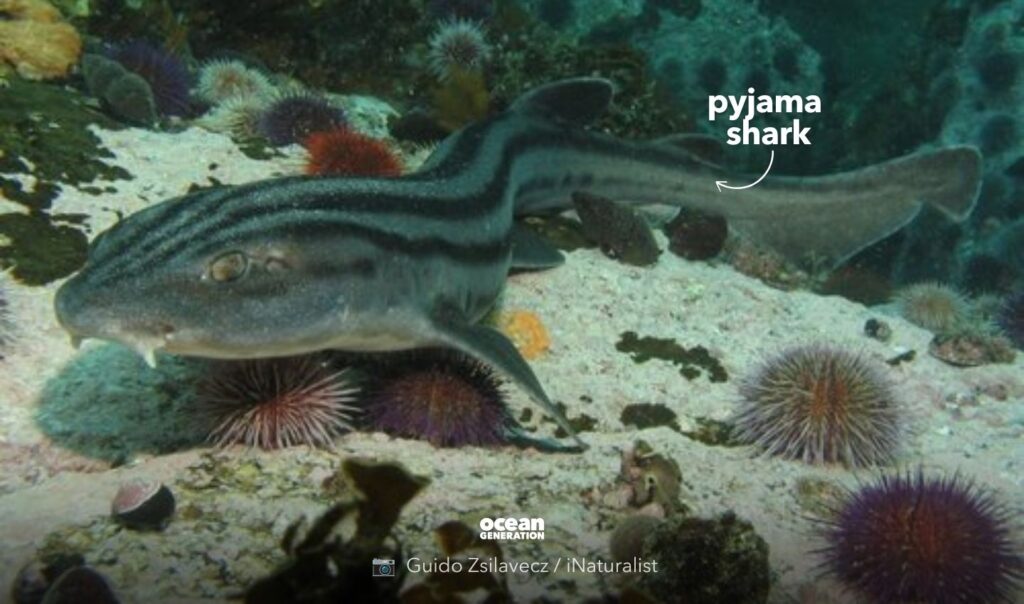
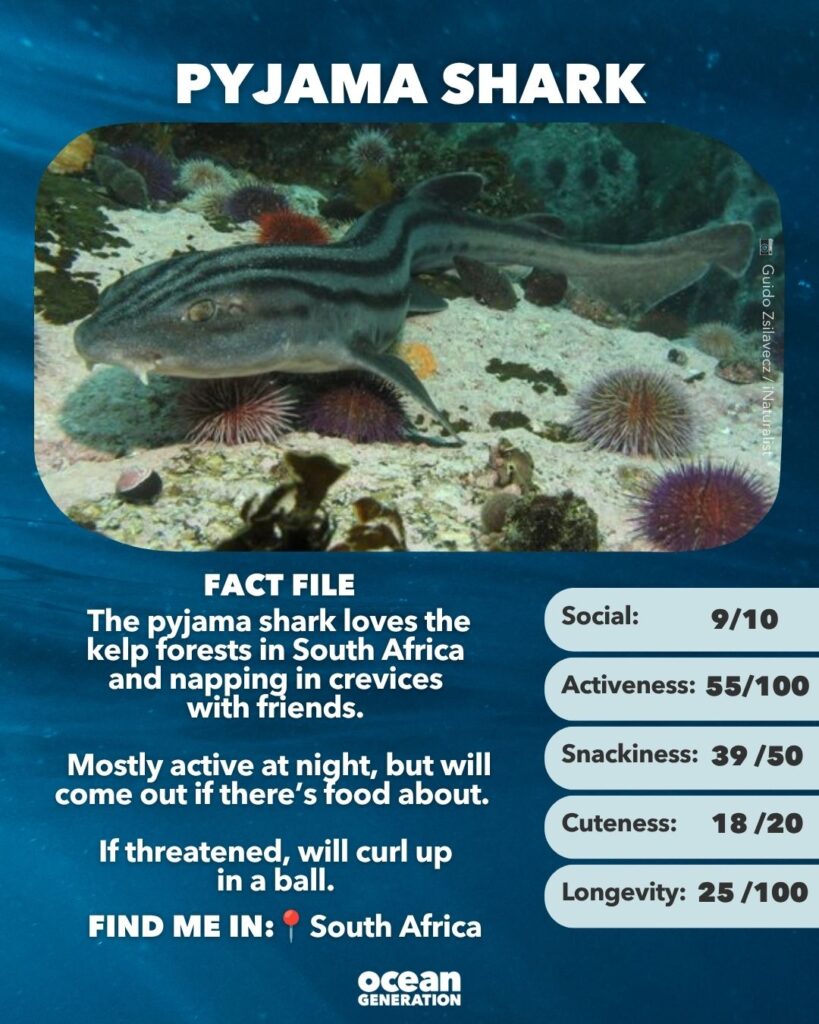
Pyjama Shark
In the temperate waters around South Africa, there is a small, stripey shark. The pyjama sharks live in the kelp forests, their small, slender bodies perfect for squeezing through the stipes and fronds in search of crustaceans, fish and other shark eggs.
Pyjama sharks are mostly active at night, but can come out in the day, especially if there is a lot of food, especially their favourite – squid. Usually, you can find them napping in crevices and caves with friends. If threatened, they will curl up in a ball to protect their eyes and heads. Relatable?
This is: the comfort-first homebody, whose ideal day is spent watching movies with friends and loads of snacks and maybe a nap or two on the way. They look great in stripes and hate horror films.
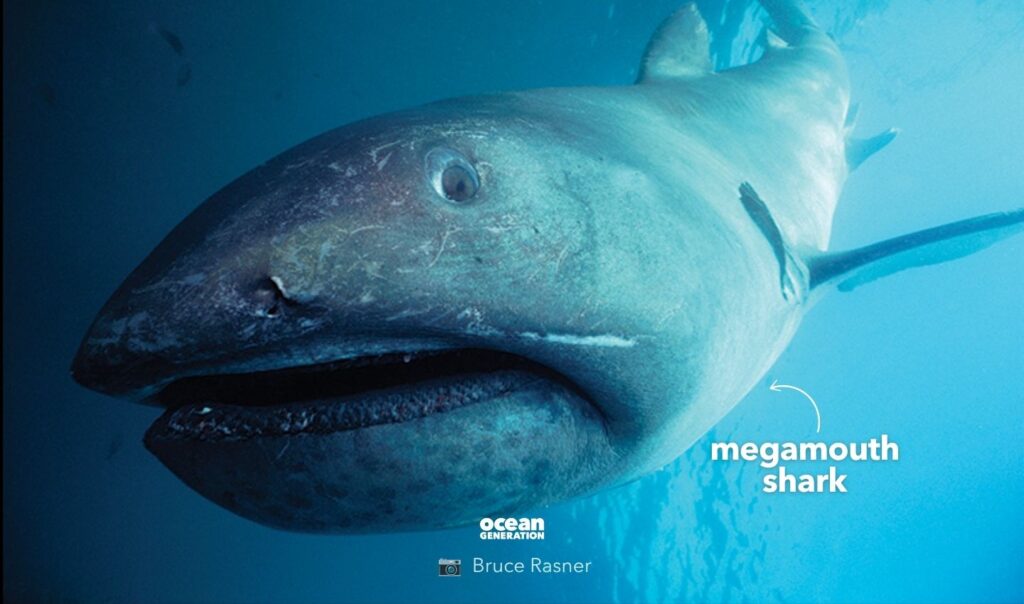
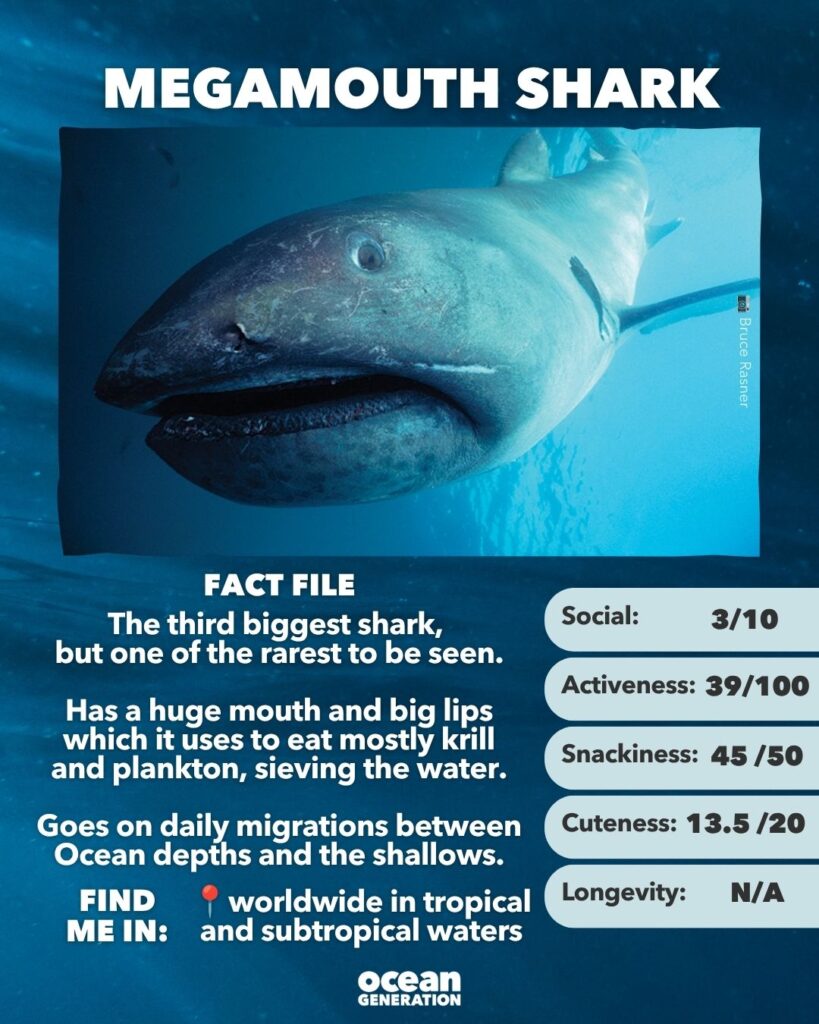
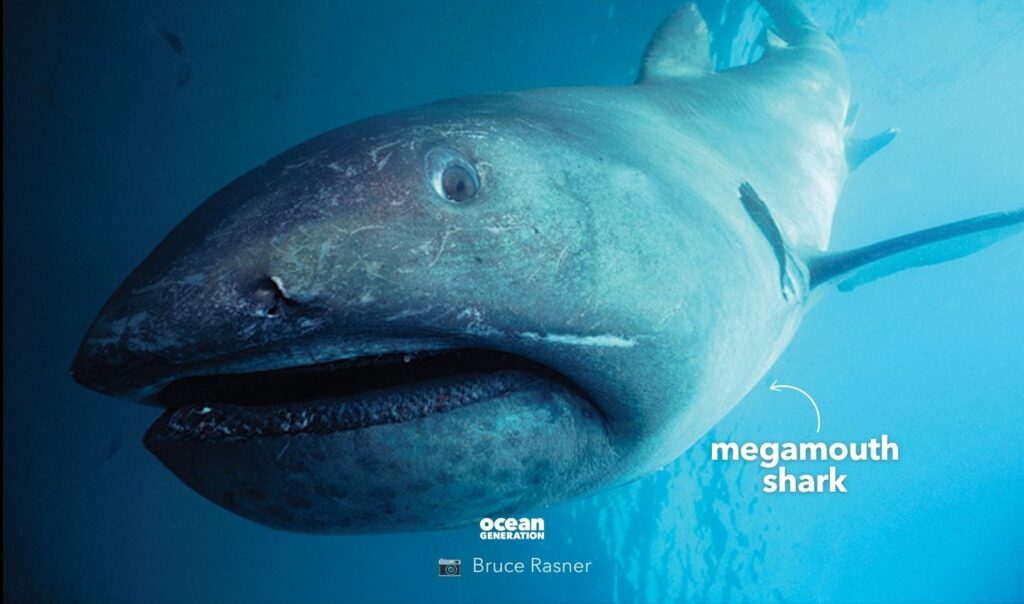
The third biggest shark, but one of the rarest to be seen. Only a few hundred have ever been seen since its discovery in 1976, and we still have a lot to learn. Read more about the discovery of the megamouth and how we learn about these sharks here.
The megamouth shark has a huge mouth and big lips which it uses to eat mostly krill and plankton, sieving the water in a way more like a whale than a shark. They go on daily migrations between the darker Ocean depths and the shallows at night, following their prey. Only a few times have they been seen with another megamouth and tagging surveys suggest that males and females remain largely separate.
Given how few we have seen, the precise limits of their range aren’t known, but they have been found in waters near the equator all around the world, from California to Japan, South Africa to Australia.
This is: the gentle giant who looks quite intimidating but is actually just here for the snacks. Works the night shift, is the one that people have heard about but never see. Has a quiet dating life, but a great kisser (apparently).
Photo by Bruce Rasner
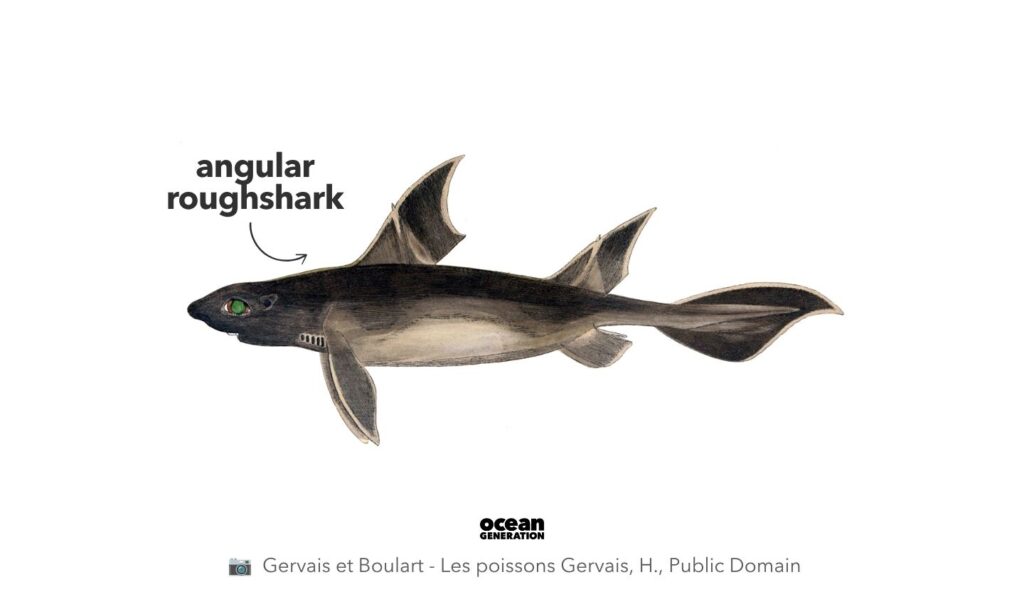
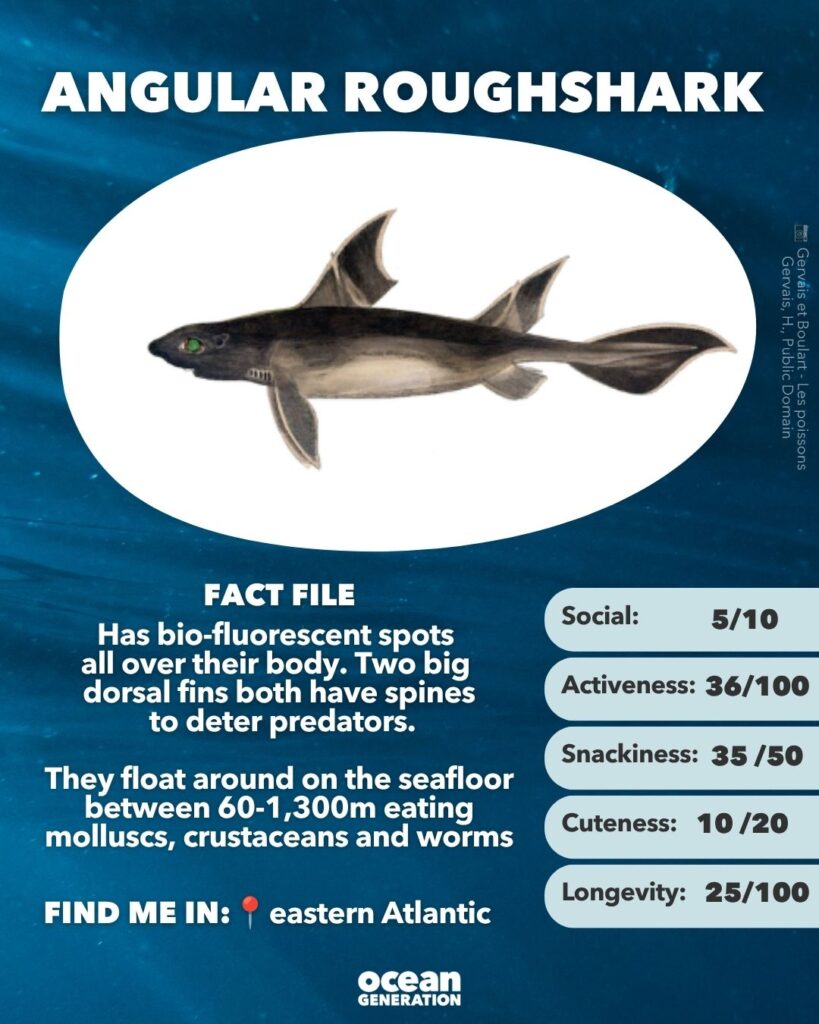
Angular Roughshark
The angular roughshark doesn’t care much for your views of what a shark should be. It is bold and it is sharp.
Angular roughsharks have a luminous organ, maybe to help with camouflage, or maybe just because it can. Two big dorsal fins both have spines to deter predators, such as larger sharks or nay-saying energy drains.
They float around on the seafloor from 60m to over 1300m eating molluscs, crustaceans and worms. Look at the angular roughshark face head-on and you are looking at a triangle with a pig-like face and an attitude.
Angular roughsharks are found all the way up the eastern Atlantic, from South Africa to Norway, including in the Mediterranean. You know they would rock a fez.
This is: the one with thick skin, prickly and a bit intimidating when you first meet them, but it is just a real trail-blazing style. Trend-setter, not follower. Thinks running is weird, loves a seafood linguine.
Illustration by Gervais et Boulart – Les poissons Gervais, H., Public Domain
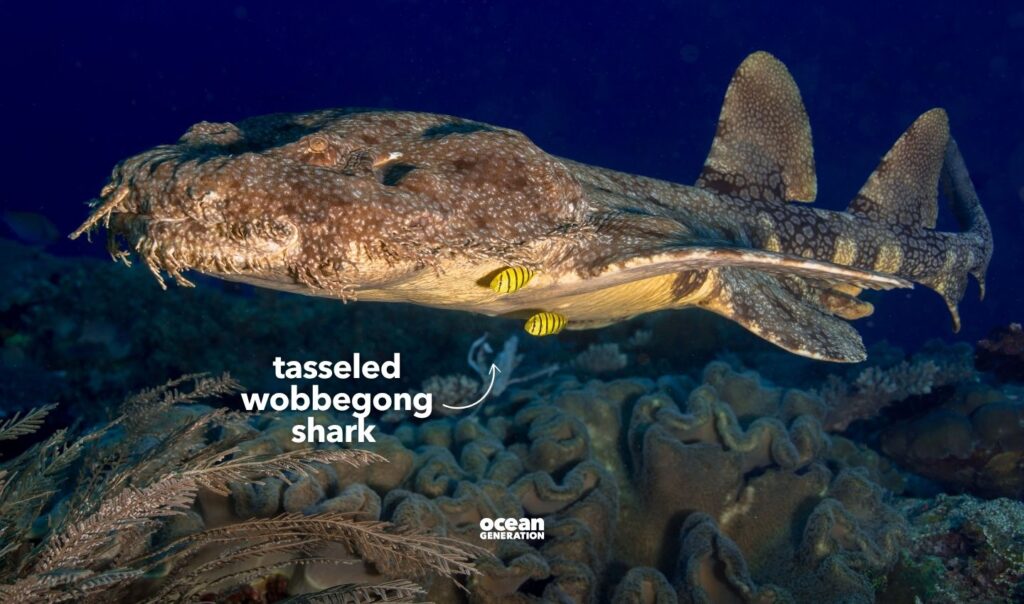
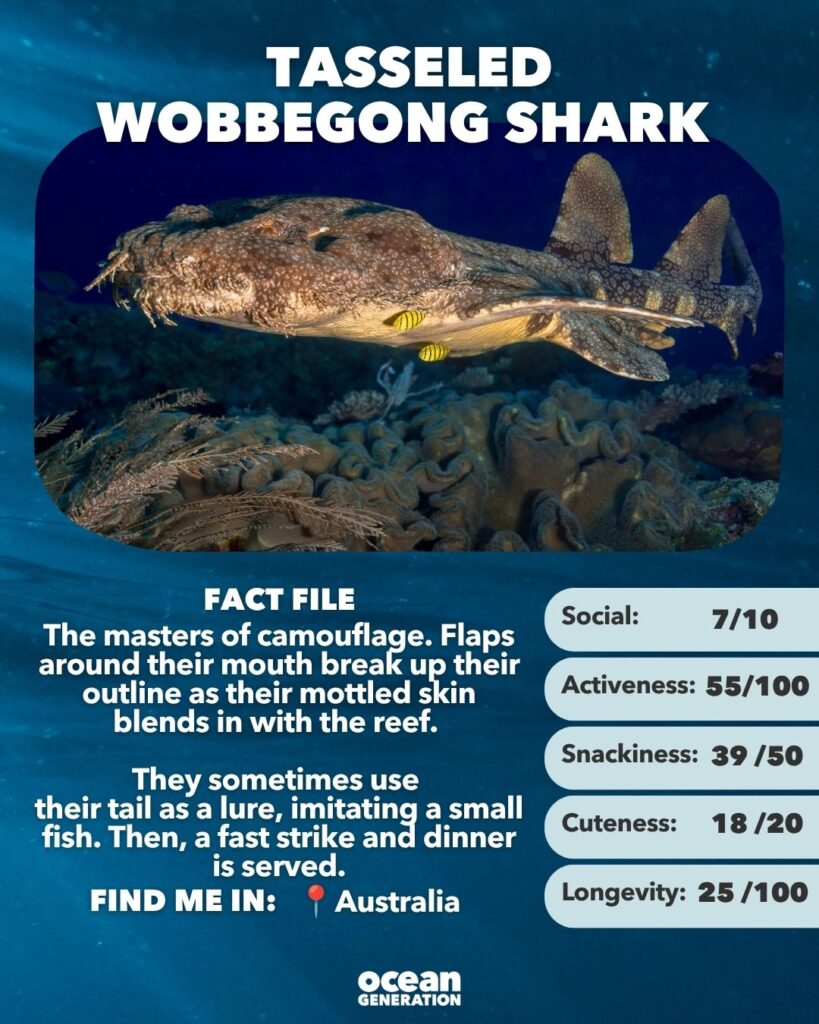
Tasselled Wobbegong Shark
Living on reefs around Australia, the name of the tasselled wobbegong shark comes from the Aboriginal meaning “shaggy beard” referring to the skin flaps around their mouth. These are part of their incredible camouflage, breaking up their outline so they can lie in wait, sometimes using their tail as a lure, enticing an unsuspecting fish to get close enough.
This is: the funny one, rocking a funky, colourful shirt. Isn’t loud but will come through with a knee-slapper of a joke when you least expect it. Likes a laid-back lifestyle, believes good things in life will come to you. Fantastic facial furniture optional, but encouraged.
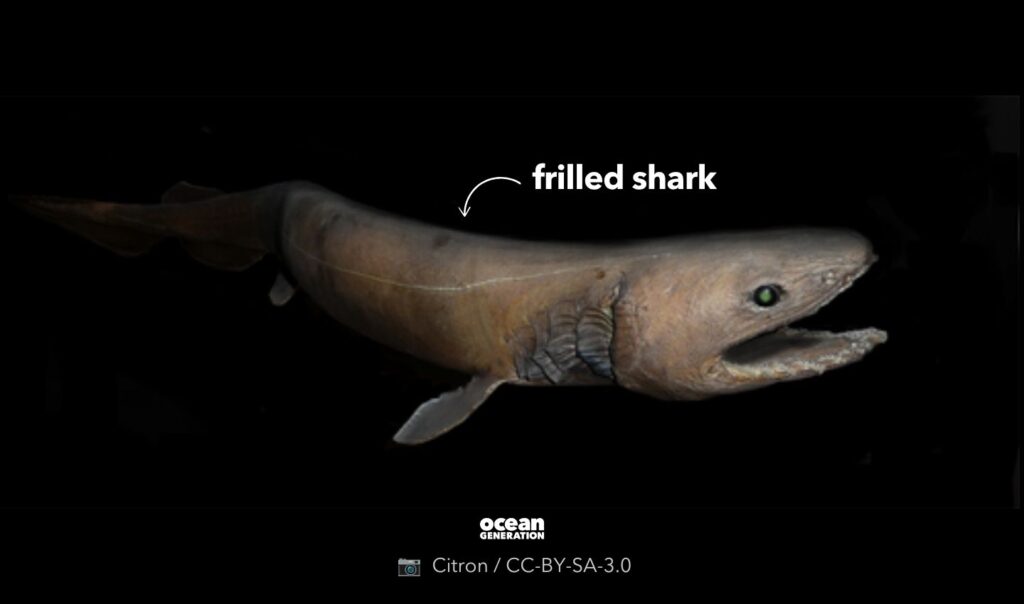
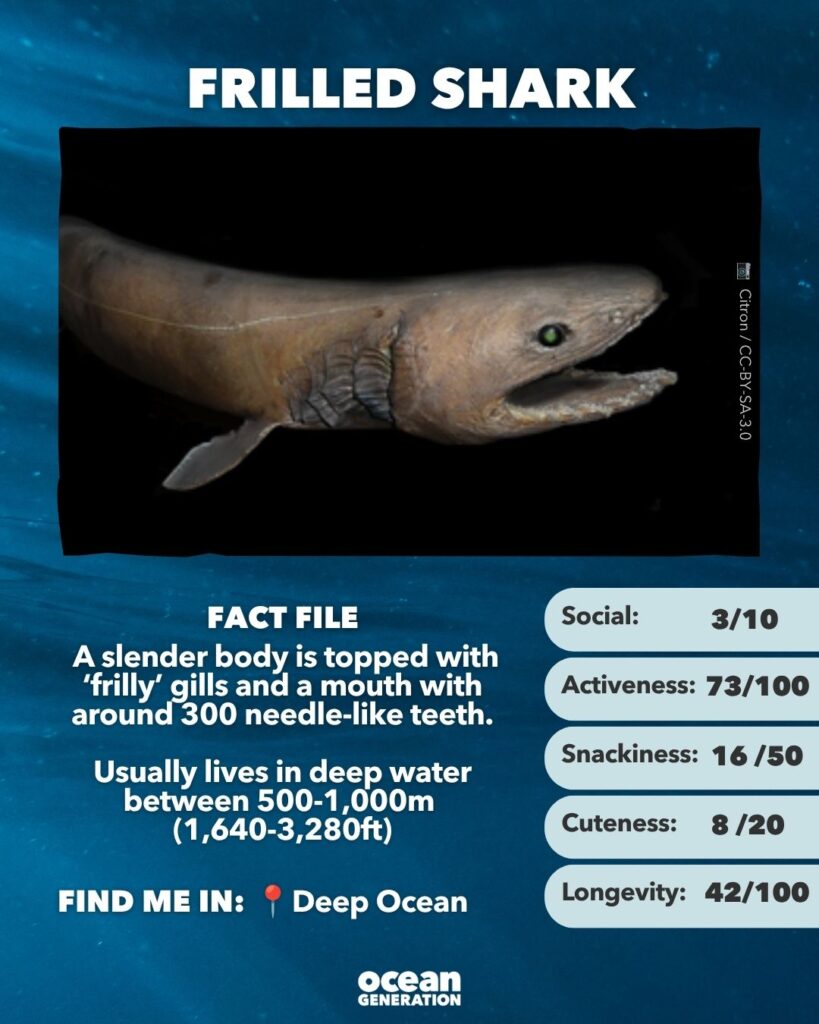
Frilled Shark
The frilled shark is an echo of the ancient Ocean. A slender, eel-like body is topped with ‘frilly’ gills and a mouth with around 300 needle-like teeth. These point back to trap soft-bodied prey like squid. Frilled sharks are another that’s rarely seen, as they usually live in deep water between 500 and 1000m (1640-3280ft). They are thought to ‘strike’ like a snake – lunging forward to grab prey.
Frilled sharks are found in depths around the world, preferring areas of the Ocean that are more biologically active with upwelling currents, such as seamounts.
This is: the old-soul, down to earth but not a big socialiser. When they do commit to something they are all in, no half measures. The one people describe as “an acquired taste”. Surprisingly athletic.
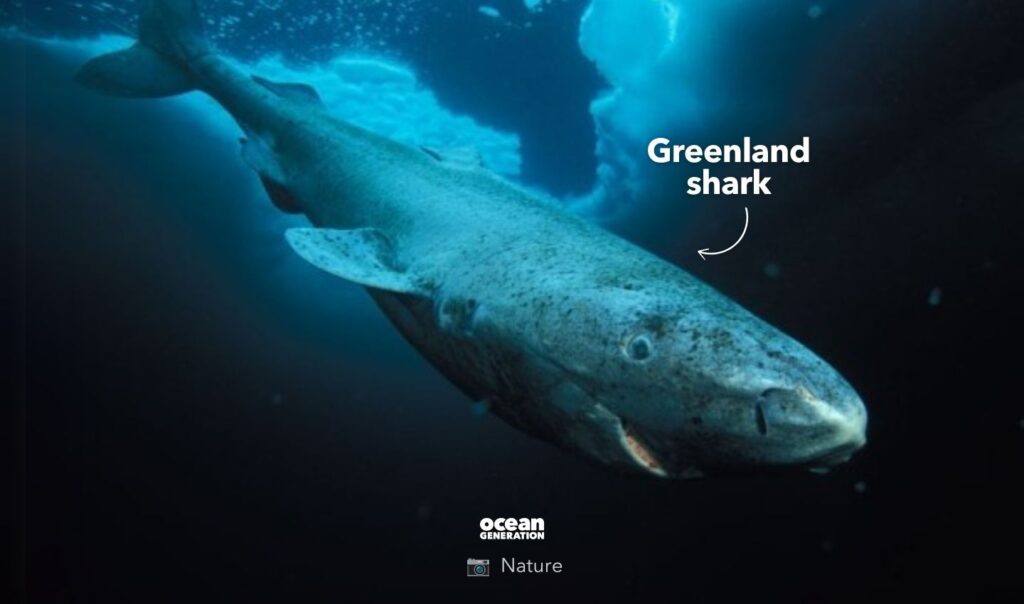
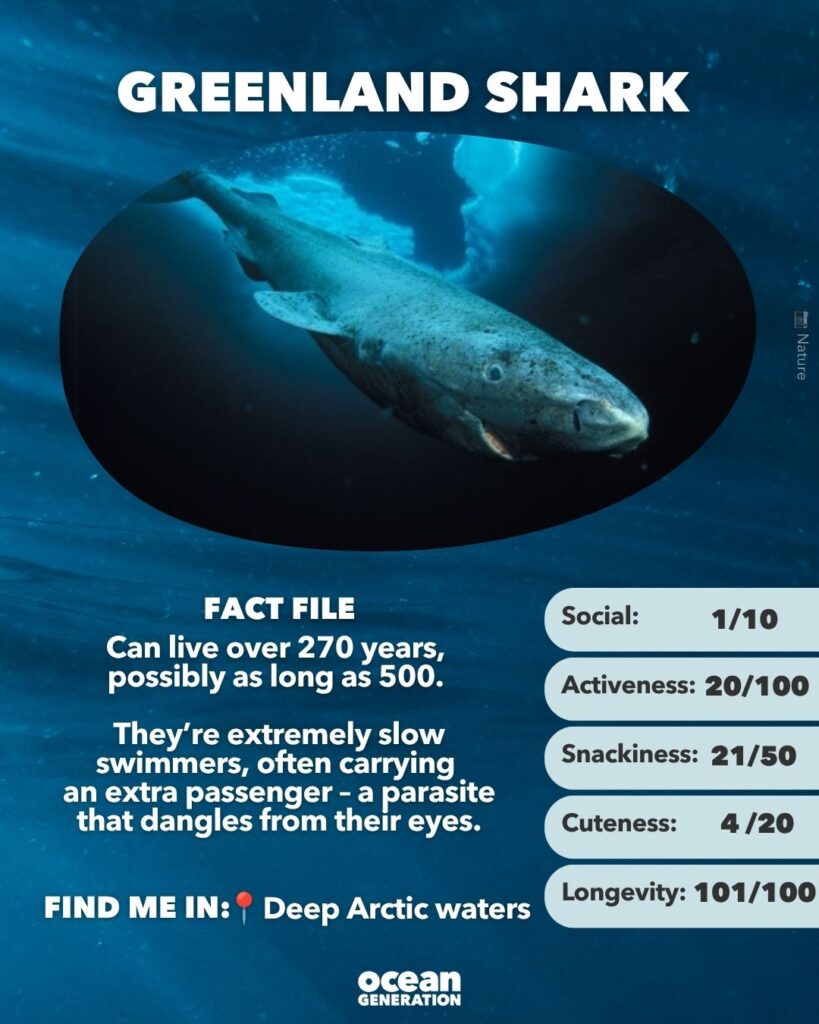
The Greenland shark is the longest-lived vertebrate on the planet. They can live over 270 years, possibly as long as 500 and don’t reach sexual maturity until approximately 150 years old. They are extremely slow swimmers, who cruise the cold, deep waters of the Arctic. The flesh of Greenland sharks is toxic to humans when raw due to high levels of urea and trimethylamine oxide, the compound that helps them live so deep.
They often carry an extra passenger – a parasite that dangles from their eyes. This may glow, attracting prey, but definitely does not help the Greenland shark’s eyesight. You win some, you lose some. Eyesight is overrated in the deep anyway.
This is: the patient one. No rush to do anything, is often late to things (we have all the time in the world!). Can be toxic if you don’t treat them right.
Photo via Nature
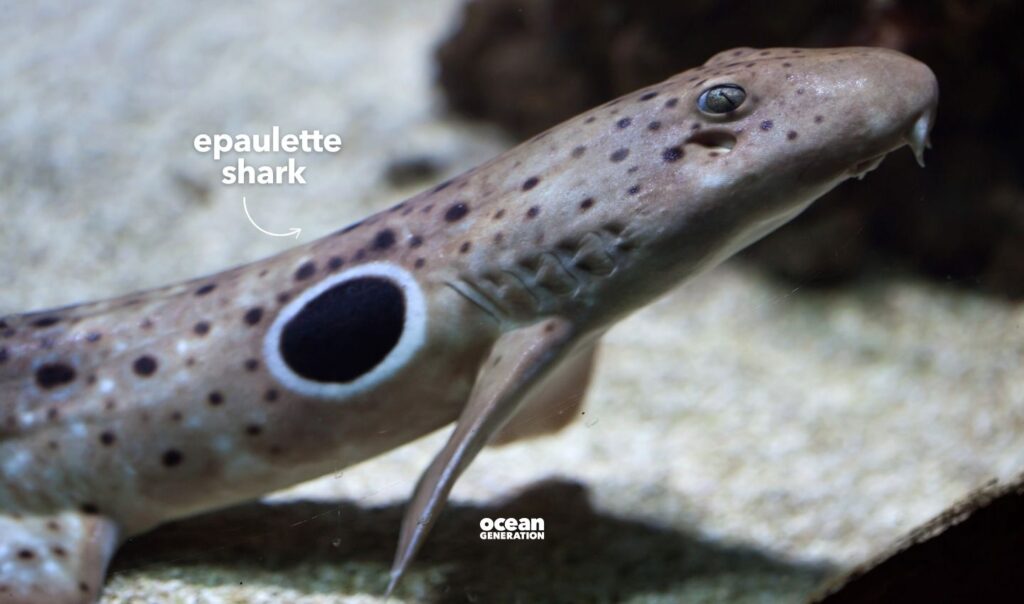
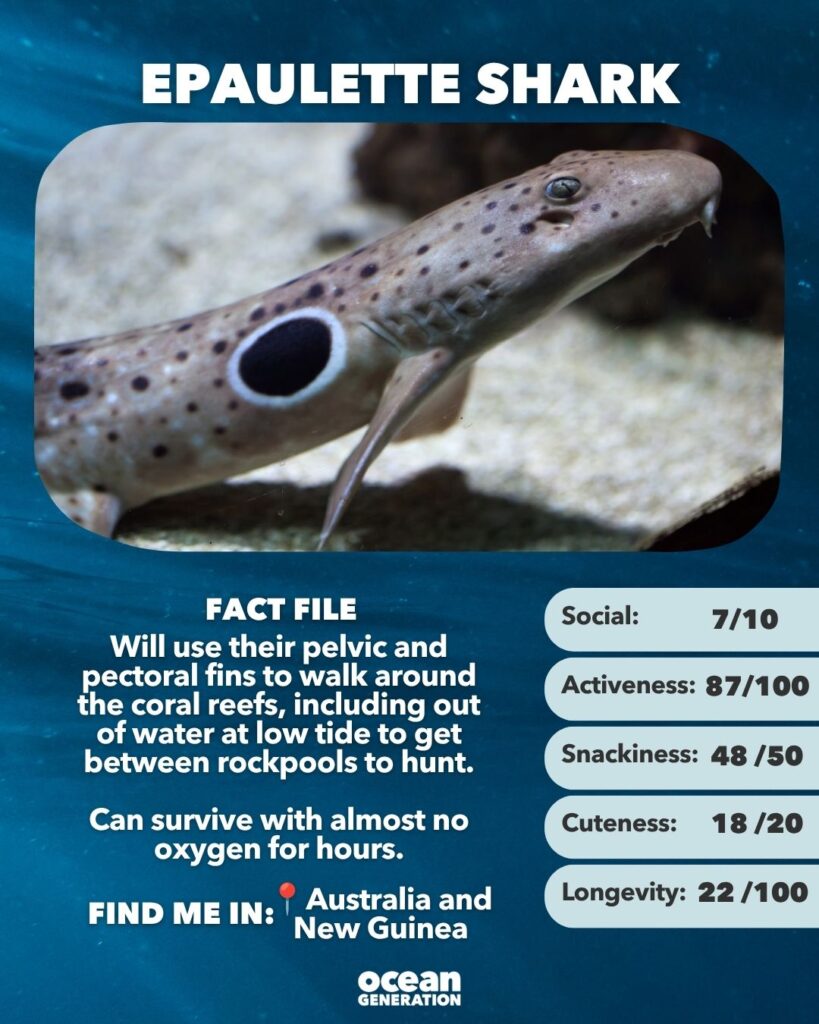
Epaulette Shark
Famous as the ‘walking shark’, epaulette sharks will use their pelvic and pectoral fins to walk around the coral reefs, including out of water at low tide to get between rockpools. The rockpools that were sanctuaries for small fish, crabs and worms are now hunting grounds, trapping them in when the tide gets low. Epaulette sharks can survive with almost no oxygen for hours by shutting down non-essential brain function.
This is: the one that can survive (and thrive) on shockingly little sleep/coffee. They are adaptable, can and will get where they want to using any means necessary. Often turns up unexpectedly, usually looking for food.
Still not sure which you identify most with?
Maybe our cards will help you decide – do you agree with our scores?
Does the Meg exist? Here’s what scientists actually found.
Share this page
Copied
Yes, the Meg exists. No, it isn’t the one you are thinking of.
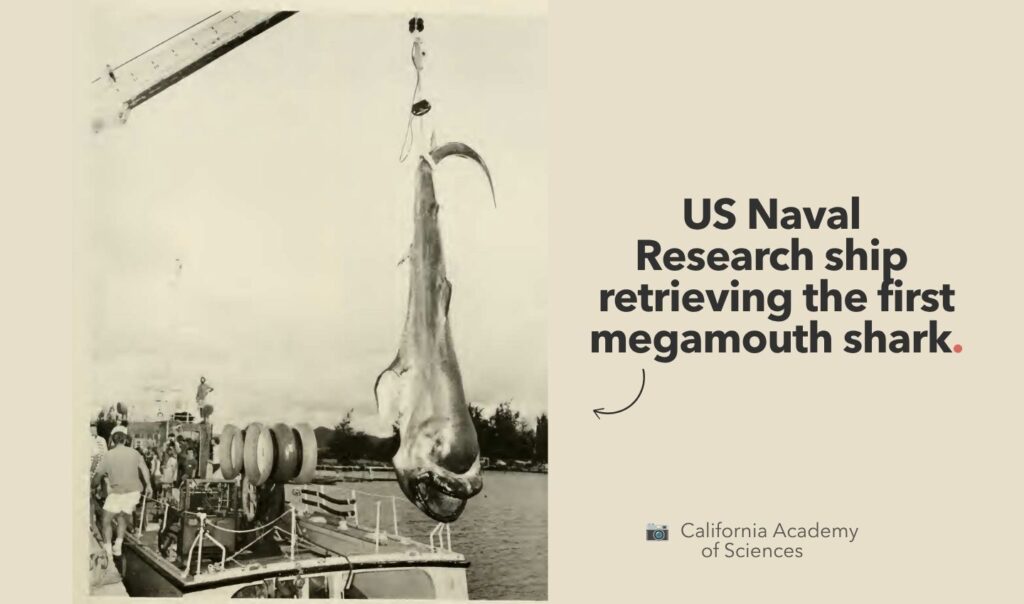
On the 15th November 1976, the US Naval Research ship with the catchy name AFB-14 was on a mission 42 km (26 miles) off the coast of Oahu, Hawaii. Suddenly, the sea anchor, a parachute-like tool for stabilising a ship at sea, caught and pulled. The crew hauled it up to find 4.5m (14.7 ft) of fish.
The crew brought the 750kg (1,653.5 lbs) shark on board with “much difficulty” and brought it back to Kaneohe Bay, tying it alongside the dock overnight.
The shark was so heavy it needed a Navy crane to lift it. During the operation the caudal fin (tail) broke off, dropping the shark into the water where it needed recovery by divers. Finally, though, it could be examined by the experts.
Amongst the first on the scene was the director of Waikiki aquarium, Leighton Taylor. Along with other marine biologists, they recognised a species that was entirely new to science.
Leighton Taylor had the honour of naming the species, and settled on Megachasma pelagios – from the Greek meaning “the large yawning hole of the open Ocean”. It is known more commonly as the megamouth shark – the largest shark you’ve probably never heard of.
50 years on, what do we know about this elusive shark? And after discovering this, does that mean there could be other huge shadows lurking in the depths?
Photo via California Academy of Sciences
What does the megamouth shark look like?
As the name suggests, the main feature of the megamouth is its vast mouth, which is housed in a huge bulbous head. This mouth is full of tiny teeth, not big white sharp things like its cousins, leaving the megamouth with a gummy grin. The tail also deserves a mention – similar to the thresher shark, the megamouth has a large upper lobe of its tail, which can be as big as a person.
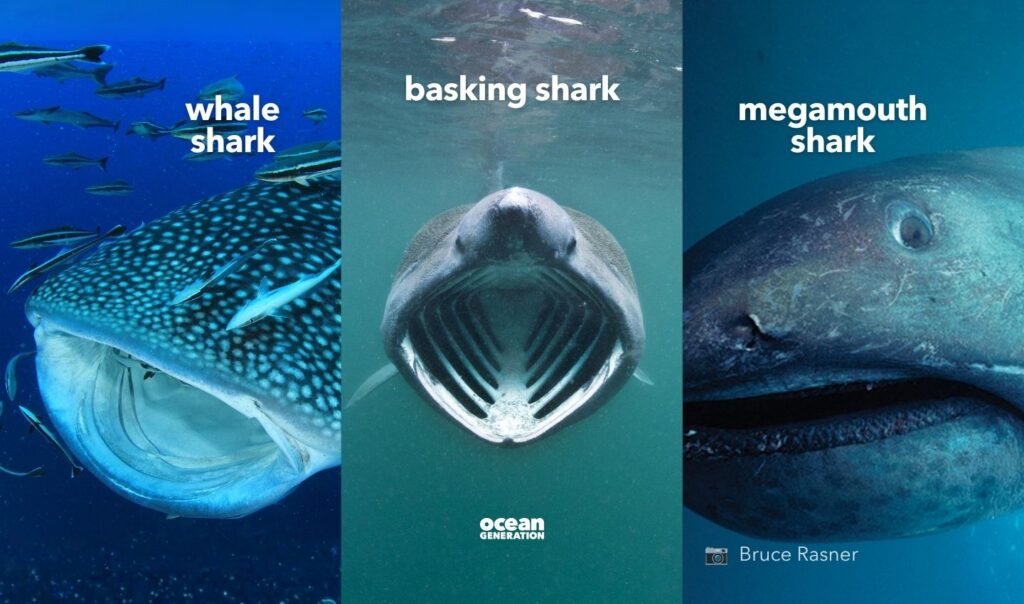
The megamouth is the third biggest species of shark behind the two other filter feeding sharks – the whale shark (Rhincodon typus) and the basking shark (Cetorhinus maximus).
Megamouth sharks can reach sizes of up to 8.2m long, maybe up to 9m, with females reaching larger sizes.
Photo by Bruce Rasner
What is filter feeding? Filter feeding is utilised by animals of all different shapes and sizes in the Ocean. The premise is to filter out the tiny algae and animals floating in the water. Whales do this using their baleen, flamingos with their special beaks, and most forage fish have gill rakers, catching anything in the water moving over their gills.
Megamouth shark photo by Bruce Rasner
On the 14 November 2023, a stranding gave us amazing insight into the reproduction of the large-lipped fish. A female megamouth was washed ashore while giving birth. 1 pup was found next to her, with 6 more in her belly. They measured 1.65m to 1.83 m (5.41-6 ft) long. That is approximately one Ocean Generation Marine Science Officer (not a scientifically accepted measurement) long.
The first descriptions of megamouths are less than kind. A “soft, flabby body and fins, low-flow branchial filter apparatus and small gill openings”. Taylor suggested that this pointed to an animal far less active than the other filter feeding sharks.
To confirm this, we had to find a live one.
When was the first live megamouth shark found?
On October 21, 1990, the sixth megamouth shark ever was found, caught up in a drift gill net off California. The big difference with megamouth number 6? He was still alive. We shall name him Luis, after the Luiseno people indigenous to the Californian coast he was caught off.
When the fisherman, Otto Elliot of the vessel Moonshiner, pulled up Luis, he recognised that this was a rare find. He managed to get a rope around the peduncle of the shark (the base of the tail) and towed it for five and half hours back to harbour.
Otto was asked by scientists to keep the shark alive until measurements had been taken, and so Luis was left tied by a short tail rope in the harbour. Quite remarkably, Luis survived.
The researchers formulated a release plan, and towed Luis back out to open water. Here, he become the first live megamouth shark to be filmed, and was released with a tag, giving us nearly 51 hours of insight into the lives of these mysterious sharks.
What did we learn from tagging megamouth number 6?
The research vessel R/V Discovery was assigned to tracking Luis, ensuring it was collecting data from his tag. It wasn’t difficult to keep up – Luis cruised at around 1.15 kilometre (0.73 miles per hour), although a current going against him led scientists to estimate his true speed: 1.5-2.1 km/h (0.73-1.3 miles). As predicted by the initial discovery, Luis was no speedster.
Luis showed us that megamouth sharks follow a crepuscular vertical migration: crepuscular meaning at dawn and dusk, vertical migration meaning moving up and down. He spent his days in the depths around 150m (492 ft), returning to shallow waters of around 20m (65.6 ft) during the nighttime. Luis used the light (or more accurately the dark) to guide his movements: a sharky anti-moth.
Why was he making this migration every day? Could he be chasing food?
What do megamouth sharks eat?
Researchers can use the chemical properties of tissue from an animal to work out where it has been eating, and what it has been eating.
A large study compared the diet and location of 91 megamouth sharks and 90 whale sharks.
Whale sharks tended to eat up the food chain as they got bigger (and older): they moved from phytoplankton to fish to bigger fish and so on. They had a far more varied diet than our mega-mouthed friends.
The very first megamouth was found with a stomach full of krill, and this was no coincidence. Megamouths love krill and jellyfish and that is kind of it. No matter how big they get, they don’t grow out of their krill phase. Imagine being stuck with that food you were obsessed with when you were young, for life.
The researchers also found that male and female megamouths were quite distinctly separated – they were eating in different places.
Why? We aren’t entirely sure yet, the researchers suggested that males may roam further to find mates while females stay in the productive, safer waters near birthing grounds. There is still plenty to find out about these secretive sharks, but why are they so good at remaining hidden?
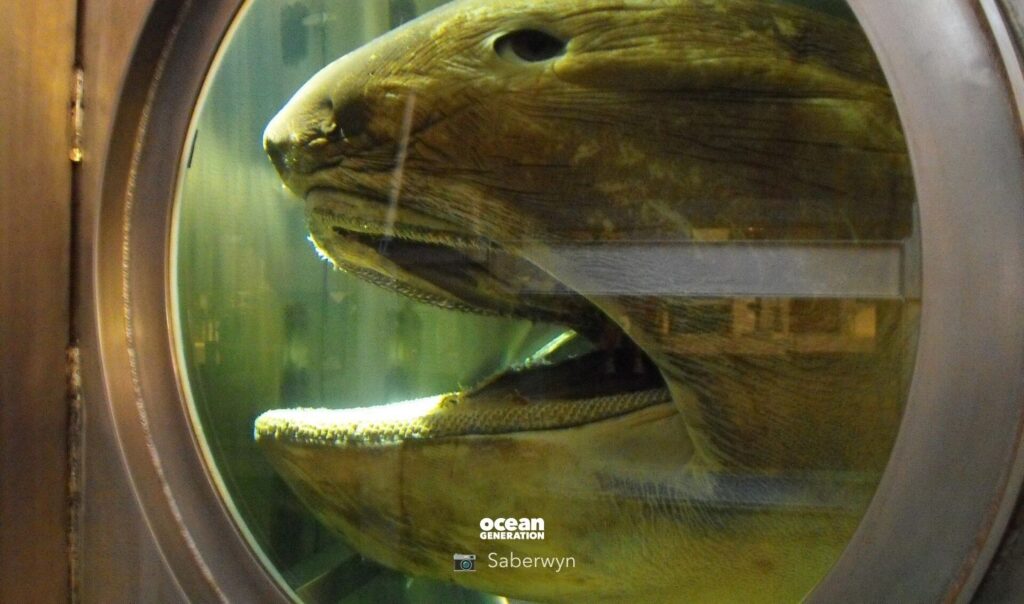
Image by Saberwyn via Wikimedia Commons
Why do we not see many megamouth sharks?
The Ocean is huge. Think of an Ocean creature – starfish, seahorse, the famous clownfish (find out how scientifically accurate Finding Nemo actually is here). Chances are, you are thinking of a coastal animal, that we land-dwellers cross paths with regularly.
The megamouth is from a different world, that we are not regular visitors to. During the day, they cruise through the darkness of the twilight zone, and only at night do they come more shallow. There are only nine sightings of megamouths in natural conditions – humans and megamouths don’t overlap.
230 of the 301 sightings (as of June 2026) come from megamouths caught up in fishing gear. And we are seeing more. 170 of the 301 megamouths ever found came in the last ten years, 131 coming in the 40 years before that. Why are we seeing more now?
Given the large portion that are found due to fishing, the increase is likely to be related to fishing. Maybe an increase in fishing activity is seeing more caught, or new equipment at different is catching more megamouths. Or maybe these fisheries have always caught megamouths, but the reporting of the catches has got a lot better. Being aware of our impact on the Ocean is the first step to controlling it.
Anyway, now we know there is a massive, nearly 10m (32.8 ft) shark swimming around out there that we only discovered 50 years ago: there is only one question to follow that.
Is the megalodon still alive and hiding in the deep?
No. There are two main reasons for this.
1. Amount of food – can’t hide the evidence.
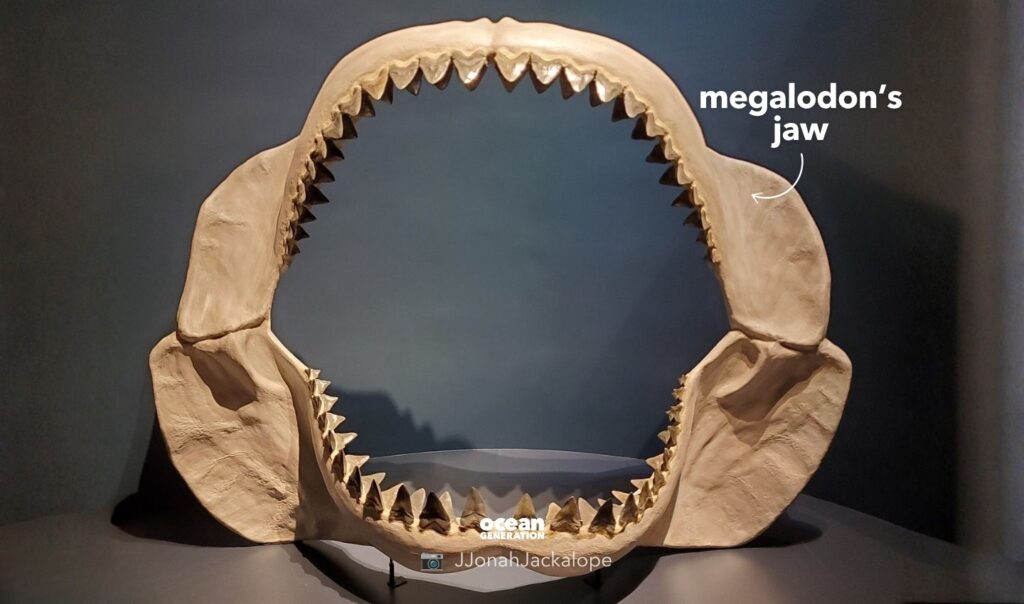
An active hunter that is estimated to have been over 24m (78.7 ft) long, the megalodon had huge teeth which it would have used to eat other sharks, fish and whales. Prey species like whales are mostly found in the surface Ocean, increasing the likelihood of even the stealthiest hunter being seen.
If not seen directly, the effects of having a huge hunter would be visible. Bite marks and teeth would be regularly spotted, and they aren’t. We haven’t found a megalodon tooth younger than 3.5 million years old, which is when we think megalodon went extinct.
2. Location – megalodon isn’t hiding in the depths.
We know megalodon was a tropical and subtropical dweller, that thrived in the warm waters. Suggestions that they could be hiding in the cold, dark depths of the Ocean are impossible. Especially when we consider the compound that protects sharks’ cells from the crushing pressures of the deep Ocean stops being effective around 3,000m (1.81 miles), suggesting that sharks absolutely can’t go below 4,000m (2.5 miles) deep.
The megamouth is a big shark, but smaller than megalodon, and eats tiny prey that lives in the pelagic depths (deep, open water). That is why it wasn’t discovered for so long.
Photo by JJonahJackalope via Wikimedia Commons
Could there be another huge species of shark still undiscovered?
We can’t rule it out completely (the Ocean is on average 3,682m (2.28 miles) deep – plenty of space for something to hide), but it is unlikely. We understand our Ocean more than ever, and large species would have been found if not by scientists, by the commercial fishing fleets that drag nets through most layers of the Ocean.
The most likely shark hiding out there would be a sleeper shark, similar to the Greenland shark. As the name suggests, these fish like life in the slow lane, cruising the Ocean depths for food. Their un-rushed lifestyle means low demand for food, and they can survive on less food, such as occasional whale falls (read more about how a dead whale means new life in the deep here).
What do we still not know about megamouth sharks?
There is plenty we still have to discover about megamouth sharks. Why are they usually separated like a school disco, the boys and girls staying far apart from each other? Do individuals migrate like whale sharks, or have their favourite spots they stay in? Do they have glowing mouths to attract prey?
How do they hunt? Is it like basking sharks, swimming with mouths agape? Or whale sharks, opening mouths quickly to create suction, drawing prey in? Or something else, more like a whale drawing its large mouth over prey?
The megamouth story is full of mystery and excitement. It also shows us our increasing presence in the Ocean. It does not mean the megalodon is still alive. That mystery has been solved. Trust us.
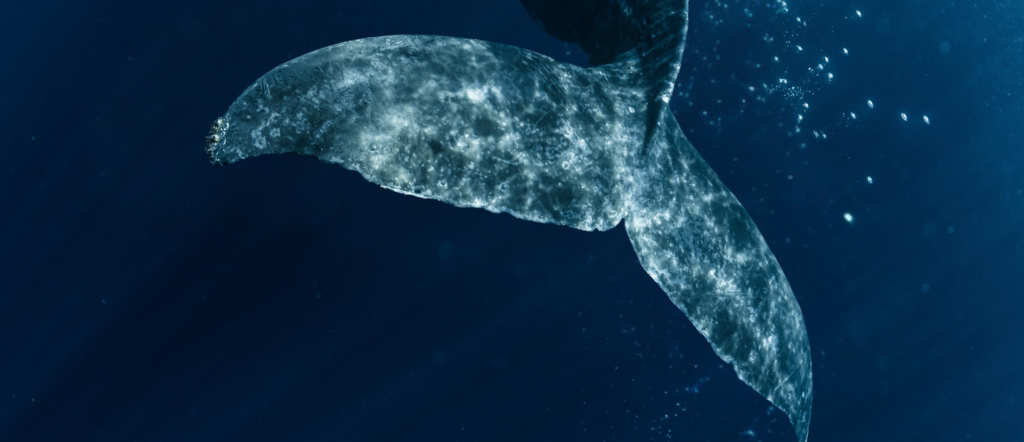
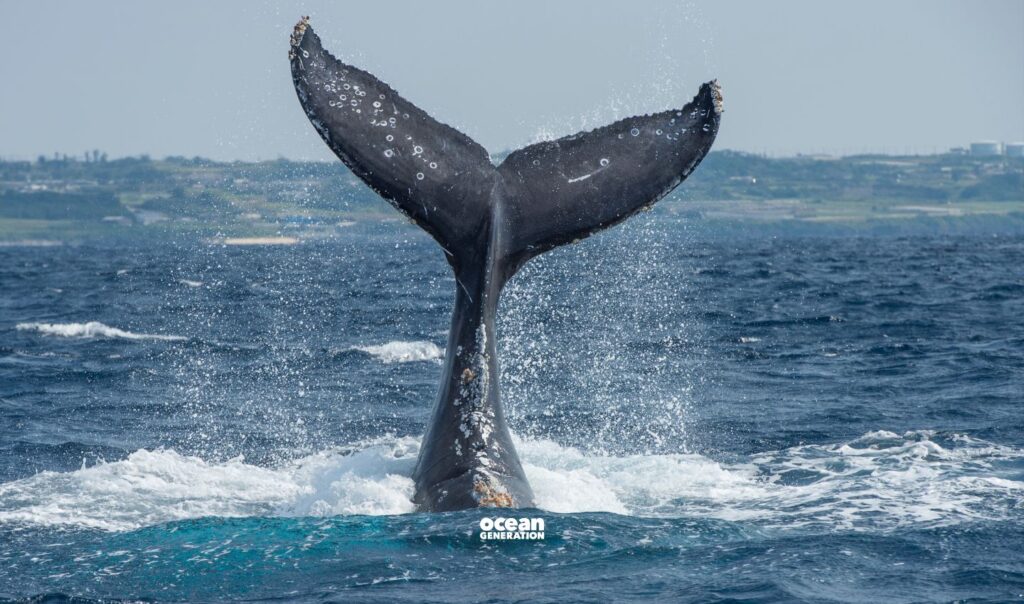
There is a unique whale song echoing through the Ocean, sung by the loneliest whale in the world. What kind of whale is it, and is he actually lonely?
The Ocean used to be thought of as noiseless. Legendary Ocean explorer Jacques Cousteau’s first book was named The Silent World. Swimming comes with ears full of water, muffling the familiar noises of the airy world above.
Only recently, and mostly by accident, have we begun to realise that the Ocean is far from silent. Noisy coral reefs call in larvae to settle, fish grunt and whistle at each other, and snapping shrimp fill the water with a white noise any focus app would be envious of.
The most famous of the Ocean songs is that of the whales.
How we discovered sounds in the Ocean
In the second half of the 20th century, the Ocean became the frontline of the Cold War. Submarines glided through the depths, carrying enormous destructive power but hidden from sight. In the Ocean, sound matters more than sight.
We began listening to the sounds of our Ocean, to keep track of those sneaky submarines, and discovered a new world we didn’t understand.
In March 1949, R/V Atlantis from Woods Hole Oceanographic Institution picked up some strange noises off the coast of Bermuda that couldn’t be identified. A haunting, eerie noise that could be mistaken for a wolf’s howl over the mountains. The noise was archived, unidentified.
1949 also saw bio acousticians William Schevill and Barbara Lawrence record beluga whales in Saguenay River, Canada. This was the first time that cetacean (whales and dolphin) noise had been identified.
“Bill helped defuse a tense moment between the USA and Soviet Union during the Cold War. The US military suspected that low frequency blips were being used by the Soviets to locate American submarines, whereas Bill showed these were produced by fin whales (Balaenoptera physalus) hunting prey.”
He wasn’t the only one battling misunderstood Ocean sounds. You can read about how herring farts nearly ended the world here.
In a naval listening station from the late 1950s into the early 1960s, engineer Frank Watlington was listening out for the sounds of submarines in the Atlantic. He would regularly hear rich and emotive melodies echoing around the Bermudian waters. He recognised the sounds as biological and recorded them, hoping to one day identify the singers responsible. He didn’t have to wait long.
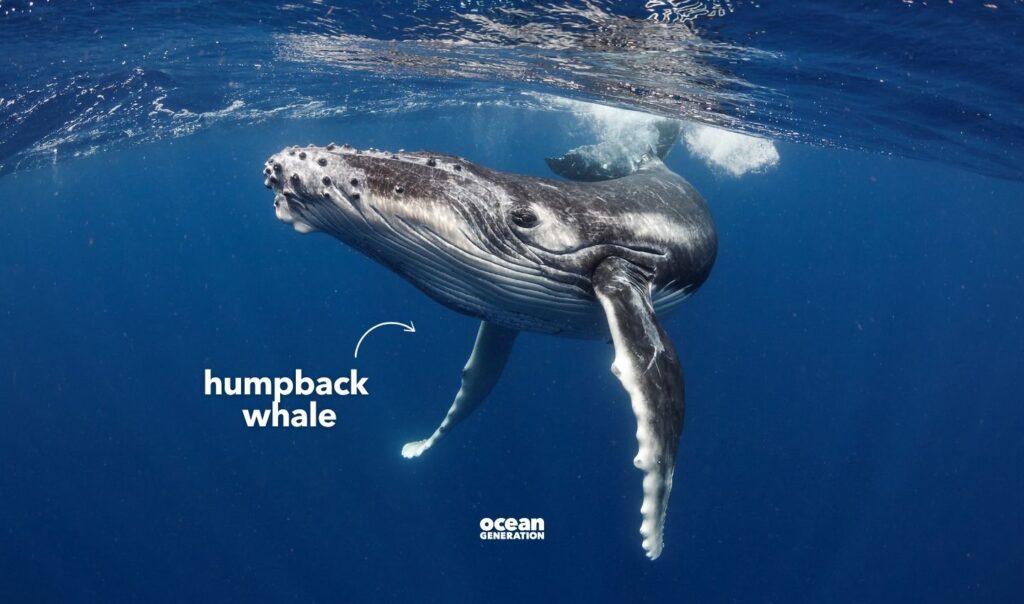
Who identified humpback whale song?
In the mid-1960s, a biologist who had focused on echolocation in bats and the hearing of owls turned his attention to Frank’s recordings. His name was Roger Payne, and he was the man who would take the songs of the sea to ears around the world.
Payne analysed the recordings and identified the singers: humpback whales. He published a scientific description of the songs Frank had recorded in 1971, revealing their complex structure and rhythm. But a peer-reviewed scientific paper wasn’t going to make big enough waves (pun intended).
In August 1970, before that paper had been published, Roger Payne released the Songs of the Humpback Whales, a vinyl record just under 35 minutes long of simple, unaltered whale song. The sound took the world by storm.
But even this record paled in comparison to a further honour, bestowed two years earlier in 1977. The Voyager spacecraft left the Earth’s atmosphere with a golden record – a phonograph filled with details about humanity and life on Earth, should the spacecraft ever reach distant life. Track 3 on the record was: “United Nations Greetings/Whale Songs (Various Artists)”.
The songs of the humpbacks were part of the exclusive package: the first man-made materials to leave the solar system, which it managed in 2012. Cetacean song was cemented as a defining element of our planet.
When was the 52 Hz whale first heard?
The wonder of the whale song increased as we listened and learned more – they evolve and spread culturally between and across populations.
Looking through a human lens, we can see similar cultural transmission. Gangnam Style had people trying to sing Korean around the world in 2012, and schools across the Western world are currently shouting “six-sevvvan”. Orcas? They have fashion cycles of wearing salmon as hats.
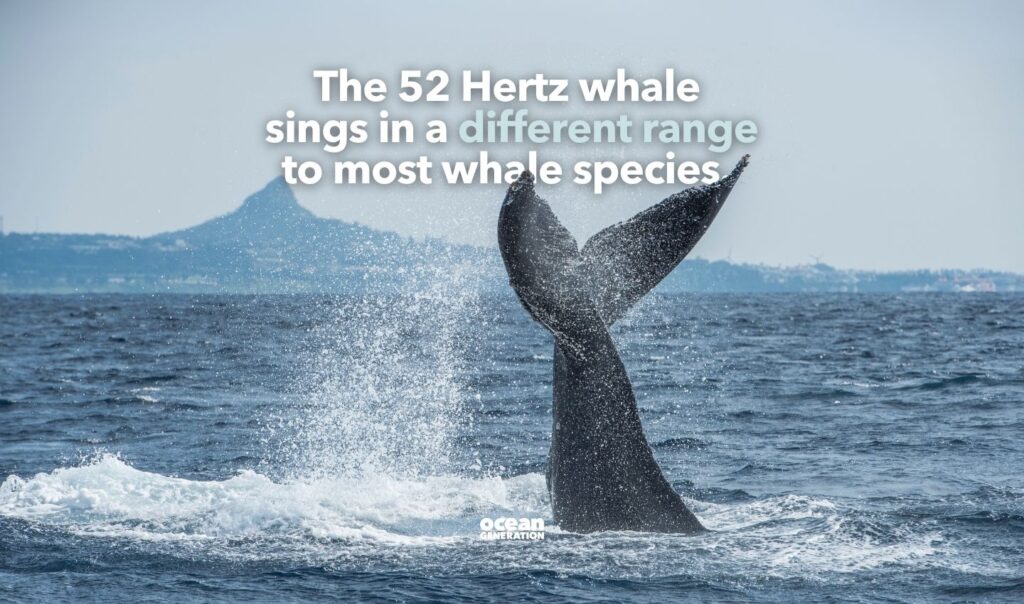
In 1989, a song was recorded that piqued the curiosity of biologist William (Bill) Watkins. The singer became known as the 52 Hertz whale, or as we will use, 52.
To understand why it stood out, we need to first explore sound.
What is sound? What can humans hear?
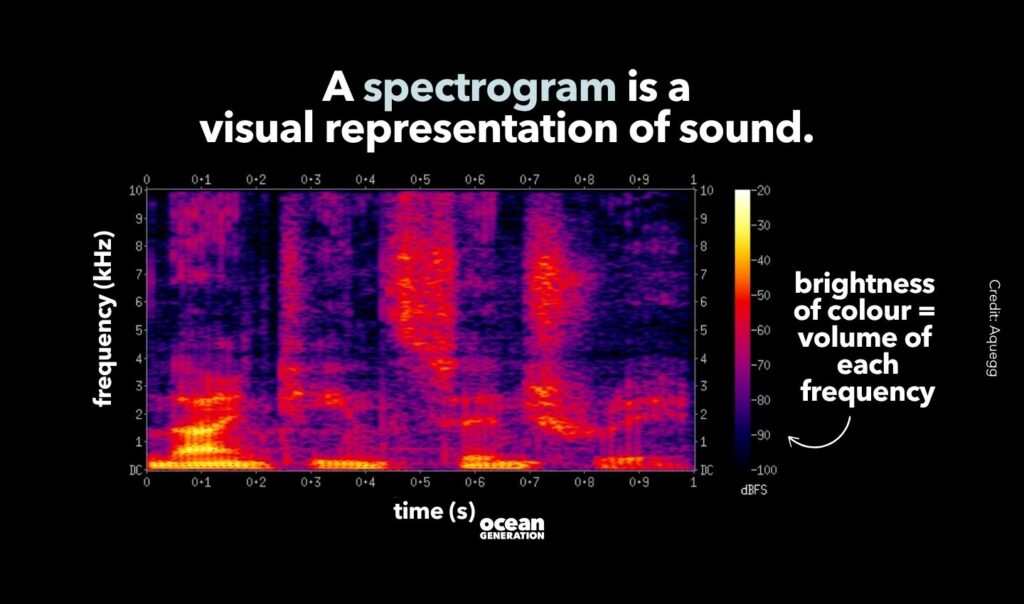
Sound has two basic properties: frequency and volume. Frequency translates as the pitch we hear – higher pitched sounds have higher frequencies. Frequency is measured in hertz (Hz).
Different animals have different ranges of hearing – some can hear higher frequencies, some lower. Humans are credited with a hearing range of 20Hz-20,000Hz, most sensitive from 2-5,000 Hz. Human speech is approximately 90-135Hz for an adult male and 160-240Hz for an adult female.
You can test your hearing range by listening to this video going through different frequencies – see how high you get.
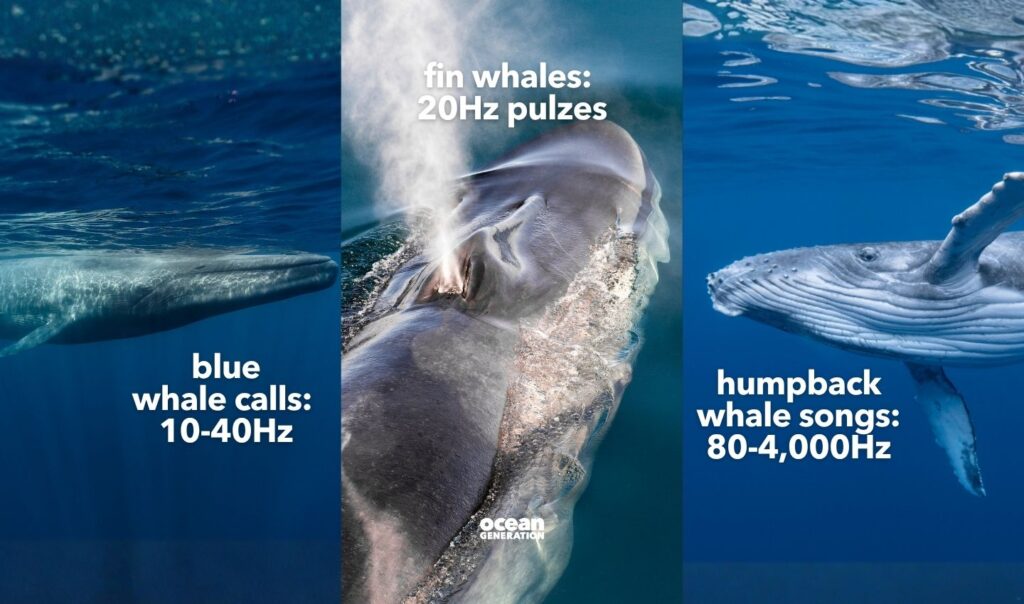
The humpback whales typically sing in the range of 80-4,000Hz, perfectly within our auditory range. Different animals use different frequencies to communicate: there is a whole world of noise that exists outside of our range of hearing.
Blue and fin whales produce songs of much lower frequency, slipping below our range of hearing (known as infrasound). Others, such as sperm whales and bottlenose dolphins, will use higher frequency clicks in echolocation that we can’t hear (known as ultrasound).
Why is the 52 hertz song so special?
The song we played earlier has been sped up by 10 times so we can properly appreciate it in our range of hearing. It would ordinarily be at the very bottom end of our hearing.
Blue whales will typically call between 10 and 40 Hz, soulful moans that would vibrate your entire body. Fin whale vocalisation is focused around 20Hz pulses, low chirps echoing through the blue.
So when the hydrophones picked up a call focused around 51.75Hz, it didn’t fit. Too high for blue and fin whales, but too low to be a humpback. This whale was singing its own tune.
Listen to the 52 Hz whale recording
Audio courtesy of NOAA PMEL.
For 12 years, Bill Watkins tracked the whale he had dubbed the 52Hz whale, or 52.
Daily travel distance: 52 was a mover. Across the 12 years of seasonal tracking, the whale averaged 47 kilometres every day, and up to 69 km per day.
Seasonal travel distance: A real mover. In the 1992/93 season, 52 travelled just 708km. But across all the tracked seasons, the average distance travelled was 5,518km. In 2002/03, 52 travelled 11,602km. If you ran a marathon every day, it would take you 275 days to cover that distance.
Time spent with other whales: 52, whether intentionally or not, is a solo rider most of the time. The calls were separate from other closely monitored whale species – blue, fin and humpback.
Time spent in one place: 52 is a true nomad. In Bill’s words: “There were no apparent repeated patterns to the whale’s travel”.
Deepening singing: As is normal with whales (and humans) the distinctive voice of 52 deepened by about 2Hz over the study period.
Daily singing time: On some days, 52 sang for over 20 hours.
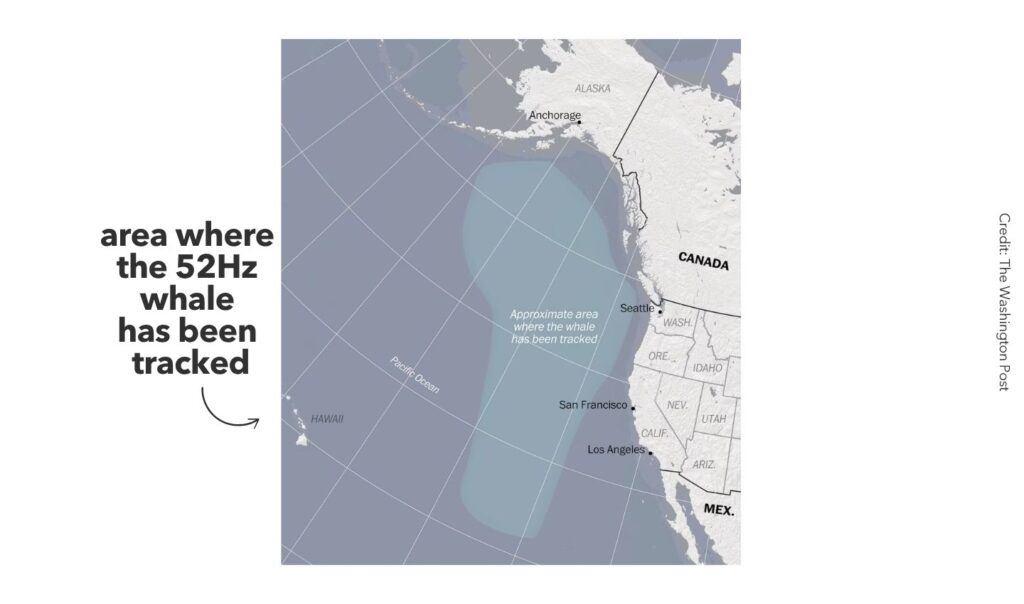
Credit: The Washington Post
The Symbol: The story of 52 captured the imagination far beyond the scientific community.
The paper caught the eye of a young science journalist, Jon Copley, who covered it in the New Scientist magazine, with the title “Lonely whale’s song remains a mystery”.
A New York Times article by Andrew Revkin built on this theme, painting the picture of a whale roaming the Ocean, calling out in a voice none could recognise, its song going unanswered.
To add melancholia of the whale’s song, Bill Watkins, the great listener and tracker of 52, died in 2004, a month before his paper was published. He would never see the impact his work had.
And it certainly had impact. The idea of a lonely, misunderstood whale resonated (sound joke) with the wider public.
A quick search of lonely whale will uncover endless articles, Facebook groups, TikToks, Reels, and videos exploring the legend of 52 (not all accurately). So, what do we know about this whale?
The Symphony: Is the 52 Hertz whale actually lonely?
Is 52 Hertz lonely? The short answer: we don’t know, but probably not.
The tracking study from Bill Watkins suggests 52 didn’t tend to hang out with other whales, preferring to meander and migrate on their own. But we don’t know how unusual that behaviour is. 52’s unique calls have allowed one of, if not the most detailed long-term tracking studies of any single great whale. It might not be unusual for a whale to spend a lot of time alone.
To clear things up – the other whales can still hear 52. They might just sound a bit strange, like a human talking after inhaling some helium at a birthday party.
One of the lead theories behind the 52 hertz whale is a hybrid between a fin and blue whale. These hybrids have been documented, and fin and blue whales are known to aggregate together on the west coast of North America.
The documentary The Loneliest Whale: Search For 52 set out to find the maverick cetacean singer. The team didn’t prove that 52 was a hybrid but did document a hybrid whale in amongst other blue and fin whales.
This hybrid was documented 20 times over a 16-year period, and at times with over 30 blue whales.IFthis is our whale, they have plenty of friends.
Another twist – in 2010, two separate listening stations picked up calls in the 52 hertz range. Could there be another whale hitting the same notes out there? We don’t yet know for sure, but we like to think so.
What’s next for the whales?
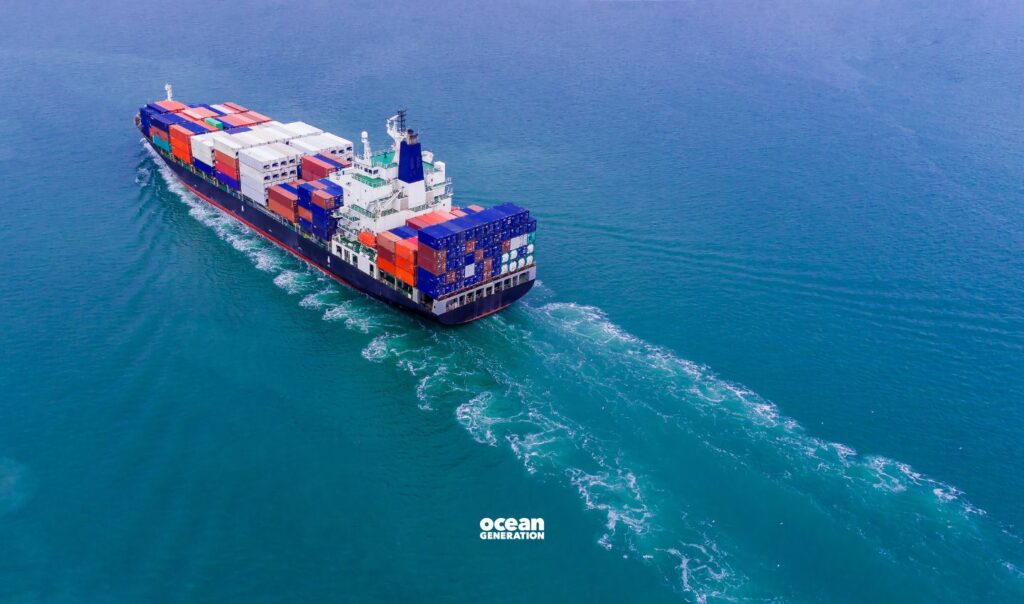
52 is certainly not alone in his sound-based struggles. The Ocean is a much noisier place than it used to be. Ships criss-cross the Ocean carrying food and goods between countries, and they are not subtle. Huge air guns fire, sounding out the seabed to find reserves of oil and gas. Piledrivers pound foundations for offshore constructions such as wind turbines.
The noise they produce creates an acoustic fog, making it harder for whales to communicate. One study estimated that North Atlantic Right Whales have lost over 60% of their communication space. Another shows that they have to ‘shout’ over the noise of propellers churning the whale’s waters. In the aftermath of 9/11, there was a significant drop in ship traffic and thus the noise they produce. Researchers examined whale poo and found less stress-related hormones in the excrement during this time: less noise = less stress.
Our noisiness is making all whales a bit lonelier (and a bit more stressed).
Fortunately, noise is one of the easiest pollutants to fix. Engines and propellers are getting quieter, and shipping slowdown areas where there are whales have reduced the acoustic intensity by 70%. We could see an Ocean far less impacted by our noise in the near future.
How has whale song connected us to the Ocean?
The discovery of whale song connected us to these Ocean giants like never before. The Songs of the Humpback Whale helped launch the Save the Whales campaign, ending industrial whaling.
52 has prompted songs, such as 52 Whalien by K-pop band BTS, tattoos, sculptures and stories. Wherever the story goes, there is an outpouring of sympathy and empathy. So many have found empathy, understanding and connection with 52.
The more we have listened to our Ocean, the more we have discovered, and the deeper our connection has grown. 52 has been a focal point for the misunderstood and unheard. But, as his popularity has shown, we aren’t as lonely or misunderstood as we may believe – and maybe 52 isn’t either.
Quick questions.
What kind of whale is 52 Hertz?
We don’t know for sure. Scientists have suggested a hybrid of a blue and fin whale, or one of those species with a slightly different morphology.
Where does the 52 Hertz whale live?
The calls of the 52 Hertz whale have been recorded off the west coast of North America, from Alaska to California and further south to Mexico.
How can we clean up plastic pollution in the Ocean?
Share this page
Copied
Why do beach cleans actually work: Explained.
An army of passionate people take to the beach, litter pickers in hand. Sea spray in their hair and sand under their nails, they comb the beach. Their bags fill with cigarette butts, plastic bottles and crisp wrappers. Spirits are high, notable pieces of rubbish are held up with announcement.
As the sun sets, the beach seems lighter, relieved of the weight of rubbish. The cleaners look over the coast with proud eyes at a job well done.
But as the night draws in, so does the tide. When the sun rises again, it unveils a plastic-laden beach once more. The Ocean has coughed up some of its burdens.
What is the point in beach cleans? Are we rearranging deck chairs on the Titanic or do they actually help combat Ocean pollution?
There aren’t great islands of plastic floating in the Ocean (even the Great Pacific Garbage Patch is a myth). But we are creating a plastic soup. Microplastics fill the Ocean, with some ‘croutons’ of bigger floating plastic.
This plastic can kill wildlife, carry toxins and enter the food chain — all the way up to us.
It’s obvious: we all want less plastic in the Ocean. The question is how to achieve that.
What impact do beach cleans actually have?
A beach clean is more than just a fun day out. They do a whole load of good.
Firstly, they are good for us. Beach cleans (and most coastal activities) have been associated with positive mood and improving our understanding of the Ocean. Combine a beach cleanup with some rock pooling and that’s a brilliant afternoon. Imagine all the things you can find! We feel better cleaning our beaches.
Beach cleans are a chance for people to come together and make a tangible contribution. They act as displays, raising awareness for our pollution problem and encouraging more engagement. A snowball effect.
Beach cleans provide immediate benefit to the natural world too. Removing plastic from the beach takes away its threats straight away, and removes the future threats as well.
Plastic on the beach is exposed to the stresses and strains of the Ocean. Waves breaking, rubbing against the sand and rocks, the sun beating down. All these break up the plastic into smaller micro- and nano-plastics. Removing it before that stage is a lot easier.
Our understanding of the journey of plastic waste is evolving. Recent studies suggest that the vast majority (88% is the quoted figure) of plastic in the Ocean remains floating close to shore. This means our beaches take the brunt of the plastic problem. But that also means it’s accessible: We can remove the majority of the problem with ease and stop it getting worse.
Beach cleans treat the symptoms without addressing the illness.
Beach cleans are not the whole answer. You can’t keep bailing a sinking boat out and expect to float, until you bung the hole. A beach clean treats the symptoms without addressing the illness.
We need more than litter-pickers.
What are the other allies in the battle against Ocean plastic?
The closer to source of plastic pollution we can get, the better. Try filling a glass from someone pouring three stories above you – a lot more water gets spilled compared to just filling from the tap.
Single use plastic bans have shown to be effective in reducing litter. Increasing the responsibility of plastic producers for the end of their products lives would motivate innovation and stop plastic becoming litter at all. A circular economy would prevent the demand for oil to produce more and reduce the amount of plastic that becomes rubbish.
As consumers, we also need to rethink how we use plastic.
How can we change our relationship with plastic?
Moving away from a single-use plastic world is, honestly, going to be tricky. We live in a world where convenience is king. Single-use plastic is very convenient. But there are solutions already working.
Deposit return schemes have proved to be highly effective in increasing the collection rates of plastic bottles. When you buy a drink in a plastic bottle, for example, a small extra fee is paid, which is returned when the bottle is returned. For one scheme, 94% of bottles were returned compared to 47% without a scheme.
Nearly every major manufacturer (98%) now has commitments to reduce plastic packaging. Whether this represents genuine change or sophisticated greenwashing remains to be seen, but consumer pressure and regulatory requirements are making plastic reduction a business imperative rather than a nice-to-have.
The challenge lies in balancing reduction with practicality. Sometimes plastic packaging actually reduces overall environmental impact compared to heavier alternatives – it’s the end-of-life management that needs sorting.
The uncomfortable reality of waste management
Here’s the uncomfortable truth: much of Ocean plastic pollution originates from countries with limited waste management systems. Sub-Saharan Africa, for example, averages 44% waste collection rates compared to 98% in high-income countries. It’s rather difficult to recycle rubbish that’s never collected in the first place.
We can’t simply take Western waste management systems and apply them exactly as they are in other countries. Locally managed, decentralised circular economy models – using local resources and creating local markets for recycled materials – show more promise than imposing one-size-fits-all solutions.
Is making plastic expensive a solution to pollution?
Governments wield powerful economic tools: taxes on single-use plastics, subsidies for recycling infrastructure, and extended producer responsibility schemes that make manufacturers pay for their products’ end-of-life management.
When virgin plastic (new plastic) becomes expensive and alternatives become cheap, behaviour changes remarkably quickly. But it has to be done without disadvantaging those that don’t have access to a cheap alternative.
So, back to the original question: Do beach cleans work?
Yes. But they won’t stop the problem long term. Beach cleans deliver value beyond plastic removal. They’re powerful data collection exercises, providing crucial information about debris types and sources that inform policy decisions.
Beach cleanups are also remarkably effective educational tools – nothing quite drives home the scale of plastic pollution like spending a Saturday morning filling bin bags with bottle caps.
Perhaps most importantly, recent research from Norway found that removing larger plastic items from coastlines led to a 99.5% reduction in microplastics both on land and in water within a year. That’s a genuinely impressive result that suggests beach cleans have more direct environmental impact than critics assumed.
“Removing plastic from the environment before it enters an active degradation phase, into microplastics, will reduce the formation of microplastics in the environment. The decrease of microplastic was over 99% in the water volumes we found on land. When we looked at seawater, the microplastics leaking into the sea was reduced by 99.9%,” – Gunhild Bødtker, senior researcher at Norce
What’s the most effective strategy to deal with plastic pollution?
The most effective strategy combines both approaches: upstream prevention (stopping plastic from becoming waste) and downstream management (dealing with what’s already out there). Think of it as both turning off the tap and mopping up the flood.
Beach cleans work best when they inspire participants to tackle root causes – supporting deposit return schemes, choosing refillable alternatives, and pressuring companies to reduce packaging.
The real measure of a successful beach clean isn’t just the bags of rubbish collected, but the number of people who leave determined to prevent that rubbish from appearing in the first place.
What should you do next to help tackle plastic pollution?
So beach cleans won’t solve the problem. The good news is that effective solutions exist. The challenge is implementation at the scale and speed the problem demands.
Join a beach clean, but don’t stop there. Support businesses with genuine circular economy commitments, lobby for deposit return schemes, and remember that every purchase is a vote for the kind of world you want to live in.
The Ocean doesn’t care about our good intentions. It needs systemic change, and that requires all of us to think beyond the beach. All our jobs can be beach.
The impact of overfishing and what you can do about it
Share this page
Copied
Fish is one of the most important food sources on the planet with more than 3.3 billion people relying on it as an important part of their diet.
Fishing is an ancient practice first thought to emerge 40,000 years ago, and for many people, it is central to their culture and way of life.
However, with our population on the rise and the demand constantly increasing, pressure from commercial fleets is causing fishing to become a problem.
Fisheries ideally harvest the Maximum Sustainable Yield (MSY), which is the most that can be continually extracted from a population without causing it to decline.
However, more and more of our wild fish stocks are being harvested at a rate faster than the fish populations can naturally regenerate. This is known as overfishing. Advancements in modern technology have exacerbated this by allowing modern fleets to track, target and process huge amounts of seafood.
According to the 2024 FAO report, 37.7% of global fish stocks are fished at unsustainable levels.
However, a recent study of 230 fisheries has revealed that the computer models used to set catch limits often overestimate the size of fish populations. This new research suggests that 85% more fish populations have collapsed than is recognised by the FAO estimate.
This high level of uncertainty when counting fish stocks poses a greater risk of overfishing and highlights the need for extra precautions to be taken.
Fishing in the open Ocean
Countries are allowed to exploit Ocean regions within 200 nautical miles of their coast, called the Economic Exclusion Zone (EEZ). Beyond these areas is what’s known as the high seas: 60% of our Ocean which lies beyond national jurisdiction.
The risk of overfishing is high here, as there’s great difficulty regulating such a huge expanse of Ocean that belongs to no one.
One of the principles of the high seas is the freedom for any state to have passage and engage in fishing.
However, it’s companies that rule these regions, not countries.
The combined impact of illegal fishing, and legal fishing that fails to follow scientific advice has led to 65% of straddling (fish that migrate between the high seas and EEZs) and high seas fish stocks to become overfished and for species richness to decline.
The challenges of regulating the Ocean and fisheries lead to the damage of one of our most important resources.
Threats such as over-exploitation, destructive fishing methods, and bycatch endanger the health of our Ocean and Ocean biodiversity. Therefore, there’s an immense need for change.
How can we make the fishing industry more sustainable?
Improving the sustainability of fisheries can be done in many ways. Just to name a few: increased regulation on catches and fishing gear, more legislative protection on different areas or cooperation between nations.
One important way is toinfluence the market and demand sustainability, which can be achieved through consumer action.
When you step into your local market, opting for sustainable seafood helps to place pressure on suppliers and drives the industry to improve – as it all comes down to consumer demand.
So, what can I do as a consumer?
1. Check the certification.
The Marine Stewardship Council (MSC) completes an assessment of a fishing operator. They look at the sustainability of their fishing, minimisation of environmental impact and how effective their management is.
Sustainable fisheries will be awarded an MSC blue badge, which appears on the packaging of their fish in store. It’s an easy way to identify sustainably caught fish while shopping. The MSC blue label is found on more than 25,000 seafood products all over the world.
However, it’s worth noting that while the MSC blue badge is the world’s most widely used certification programme for wild fisheries, it’s not without its limitations.
An independent review by ‘On the Hook’ in 2023 argued that the certification process is insufficient as an indicator of sustainable fishing and doesn’t meet consumer and market expectations.
Nevertheless, if consumers favour MSC approved seafood whenever possible, this will encourage fisheries to improve their sustainability and meet standards – as it’s currently the best sustainability certification we have.
2. Educate yourself on your options.
Another way to direct your decision to the most Ocean-friendly option is through education.
The Marine Conservation Society has a Good Fish Guide, designed to have a traffic light system to represent the environmental impact of your food. It uses scientific advice on the species and how and where it was caught to help inform the consumer on the best possible choice. The guide can be downloaded onto a phone and therefore accessed at any time!
Similar resources such as Seafood Watch and GoodFish assess Canadian and U.S markets and Australian markets respectively, who will also help you navigate the most sustainable choices.
3. Choose your supplier.
Rather than asking consumers to make the effort, some retailers will make the choice for them, and only stock sustainably produced goods.
For example, in the UK, M&S has worked with the WWF since 2010, focusing on their supply chains and ensuring traceability and sustainability in their seafood products. Sainsbury’s won both the MSC and ASC (Aquaculture Sustainability Council) awards in 2023, celebrating their achievements in sustainable fishing and responsible aquaculture.
So, if possible, try to consider buying seafood from retailers such as these, as more hassle-free way of making more fish friendly decisions.
The management of our Ocean resources is vital in allowing them to provide for us in the future. For those who choose to, fish is a favourite, but it will taste much better for having made it to your plate in the most sustainable way, minimising the harm to our Ocean.
Why do marine animals migrate: Everything you need to know
Share this page
Copied
Migration across the Ocean is such an extraordinary phenomenon that scientists today are still trying to discover how and why it’s done.
How does a turtle find the same exact beach where it hatched after an epic journey across the Ocean?
How do gray and humpback whales navigate record-breaking migrations: 14,000 miles of deep blue sea over 172 days?
Why do sardines, whales, turtles, hammerheads, great whites, manta rays and all manner of smaller creatures undertake these incredible journeys across our seas?
Why do marine animals migrate across the open Ocean?
Crossing an entire Ocean is extremely tiring. You could get lost or caught in a storm and you’re exposed to various risks along the way, so why do it?
Migration comes down to a need for a resource that an animal doesn’t have in its current environment. They’re often seasonal, long-distance movements in search of food, mates, habitat or to escape predation.
Food: One of the biggest reasons for migration.
Baleen whales, like humpbacks and gray whales, will migrate to northern latitudes during the spring and summer to feed in cold arctic waters, rich in krill and shrimp like crustacea. The long, tiresome journey from the south is made worthwhile for the feast of food that awaits them there.
Turtles also make their way north, with species like leatherbacks spotted in the waters off Canada, Alaska or Nova Scotia. Leatherbacks are some of the most highly migratory animals on Earth, the longest recorded journey being 12,744 miles from Indonesia to Oregon, USA.
Here during the summer months, there is an increasing abundance of a turtle’s favourite food: jellyfish.
But of course, the food can move too.
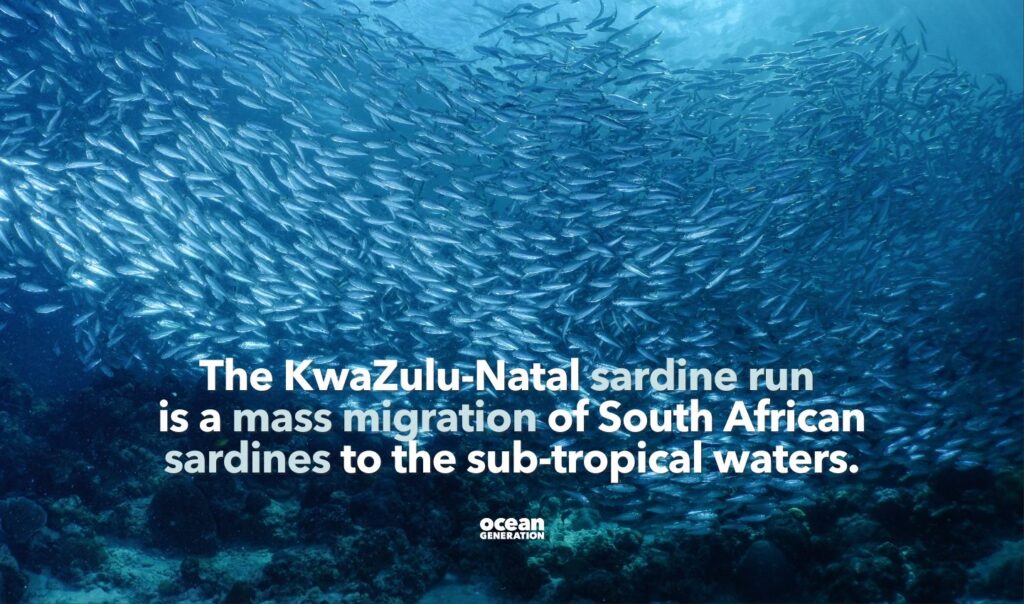
Fish are one of the most important sources of food on Earth, preyed upon by numerous different animals, including humans. The KwaZulu-Natal sardine run, also known as the “greatest shoal on Earth,” is a mass migration of South African sardines to the sub-tropical waters of the Indian Ocean.
Estimated to rival Africa’s wildebeest migration as being the largest biomass migration on Earth, this shoal becomes a ‘moveable feast’ for opportunistic predators like sharks, dolphins, gannets, seals and whales.
Whales also migrate to find a mate.
Whales, like humpback and gray whales, feed in cold arctic and sub-arctic waters but that’s not a suitable place to find a mate and give birth to their offspring. They could breed here but there are serious risks to the mothers and their calves with the cold water and predation by animals like orcas.
Instead they move from north to south during the winter months, giving birth to their young in shallow, warm waters such as lagoons. Popular destinations include Baja California, Mexico, Hawaii and Japan.
Frodo the humpback whale, named after the Lord of the Rings character, underwent his record-breaking adventure to find a mate from the Mariana islands to Mexico covering around 7,000 miles. Check out his journey on Happywhale.
Humpbacks will often migrate the same routes they were guided on by their mothers. Frodo’s unusually long journey may be relic behaviour of the whaling industry, where depleted numbers require males to travel further in search of a mate.
Turtles will return to the exact same beach where they hatched to lay their eggs, known as natal homing. Most turtle species spend most of their time in the open Ocean, widely dispersed across the globe.
But how do they know where they are and where they’re going?
Turtles show remarkable navigation skills with pinpoint accuracy using a combination of external cues to calculate their position and route. When they are near the site of their hatching, turtles may use visual cues such as the incline of the beach or the smell of the water or air.
However, in deeper water turtles must resort to other methods to find their way home. Loggerhead, green and leatherback turtles have all demonstrated the use of a ‘magnetic map sense’ like other long-distance migrants such as bird and butterflies.
Along a coastline, the inclination and intensity of the magnetic field will vary, giving rise to a unique magnetic signature at a precise location. Scientists suggest that hatchlings imprint on this unique magnetic signature and use it to navigate back across the entire Ocean years later.
Long journeys come with obstacles that Ocean migrants must face.
Our Ocean is becoming an increasingly treacherous place for its inhabitants, with threats from entanglement, ship strike, lack of jurisdictional protection and climate change.
As these migrants make their way along vast journeys, they tend to cross paths with one of the most dominant and widely distributed animals on Earth: people.
Many important migratory routes for whales and other surface-dwelling animals like turtles and sharks, converge with areas of heavy maritime traffic. This cross over can lead to ship strike, which is harmful if not fatal to an animal.
Species like the endangered North Atlantic Wright whale are particularly vulnerable as their habitat and migration routes are close to major ports and shipping lanes. There were 37 whales were reported injured in this region between 2010 and 2014 and that is likely to be an underestimate.
Furthermore, about 640,000 tonnes of discarded fishing gear, known as ‘ghost gear’, enters our Oceans every year, posing the major threat of entanglement.
The animals who travel the most are at higher risk of such encounters. For instance, an estimated 30,000 whales and dolphins die from entanglement each year.
Rising sea surface temperatures due to climate change may also alter where migratory species find food and push them past their heat tolerance. This could disrupt the longstanding migration patterns between feeding and breeding grounds.
Nevertheless, there’s a push for the conservation of these migratory species and a desire to make the Ocean a safer place.
We’re constantly developing new technologies to help prevent animals from becoming entrapped in fishing gear. For example, Galvanic Timed Releases (GTRs) involve materials that disintegrate over time, opening doors or panels on the gear or allowing lines to break away.
Restrictions such as vessel speed limits and altered ship routes help avoid collisions with endangered species such as North Atlantic wright whales, as well as establishing temporary precautionary zones around recently sighted whale groups.
The migration of these marine travellers across the Ocean highway are some of the most extraordinary and treacherous journeys in the world.
Continuing to learn and understand these journeys is essential for protecting Ocean life and reducing the threat that is posed by humans.
With torpedo-shaped bodies, forked tails, and dorsal fins, sharks belong to a group known as cartilaginous fishes (meaning their skeleton is made from cartilage, not bone).
As one of the oldest evolutionary groups, the earliest fossil evidence for sharks or their ancestors’ dates to 400 – 450 million years ago.
This means that the earliest sharks may have been around before trees even existed (trees evolved around 360 million years ago).
What makes sharks unique?
Sharks are one of the most diverse groups of predators in the animal kingdom. They come in all shapes and sizes. Sharks can have huge, gaping mouths (like the basking shark), long whip-like tails (like the thresher shark) or flattened, club-like heads (like the hammerhead shark).
The largest species is the whale shark, reaching lengths of 20m. The smallest is the dwarf lanternshark which grows to just 20cm long.
It’s this diversity in shape, size, feeding mechanism and habitat that has enabled sharks to persist throughout all parts of the Ocean over millions of years. They even live in some freshwater environments.
Why are sharks important?
Sharks can play many roles in ecosystem functioning: from predators to prey, competitors, and nutrient transporters.
Some species of shark are apex predators, meaning that they’re at the top of their food chain and exert a top-down control on food webs. Others can sit further down the food chain, yet still play an important role as food for other predators and transporting energy through ecosystems.
Large scale movements and migrations of sharks also connect even the most widely spaced food webs, transporting nutrients across the open Ocean system.
Unfortunately, sharks are heavily misunderstood.
Media and popular culture often demonise sharks, portraying them as senseless killers through sensationalistic headlines and striking imagery. This is designed to incite fear, leading us to believe that the threat posed by sharks is greater than it really is.
Did you know? Our fear of sharks originates from the ‘Jaws Effect’. It’s the powerful influence of the famous 1975 Hollywood thriller on our human perception of risk from sharks.
Put simply: Few animals are feared more than the shark.
But in reality, sharks have much more to fear from us than we do them.
The probability of a shark biting a human is very low compared to many other risks that people face in their everyday lives. According to the International Shark Attack File, there were 69 unprovoked shark bites, including 10 unprovoked shark-related deaths globally in 2023.
To put this into perspective, on average, 500 people are killed by elephants each year.
Sharks don’t actively hunt humans. The most common shark incident is known as a ‘test bite’. It means sharks swim away after a single bite once they realise it’s not their preferred prey. Surfers and other board sports make up 42% of reported incidents, as the shape of their boards can bear a resemblance to seals and other prey from below.
When we do encounter sharks, it’s often because their natural behaviour clashes with our activities, from fishing to recreation.
In contrast, the global population of sharks and rays have plummeted by over 70% over the past 50 years.
The pressure on shark populations continues to rise. At least 80 million sharks are killed each year and over 1/3 of all shark and ray species now threatened with extinction.
To put that into perspective, there are only 19 countries in the world whose population is greater than 80 million. As of 2024, the number of sharks killed each year exceeds the total population of Thailand (71.8 million), the UK (68.3 million), and France (68.1 million).
Sharks are particularly vulnerable to overexploitation.
They grow slowly and take a long time to reach sexual maturity.
Shark mothers put a significant amount of energy and time into the development and care of their offspring. They also take extensive rest periods between pregnancies.
This makes sharks far less resilient and slower to recover from disturbance and overexploitation than other fish species.
Overfishing is the greatest threat to shark populations worldwide.
The 70% decline in shark and ray populations is largely attributed to an 18-fold increase in fishing pressure over the past 50 years.
A key incentive for shark fishing is the Shark Fin Trade. This is the practice of removing the fins from a captured shark and discarding the rest back into the Ocean. Shark fins have become one of the most valuable seafood products worldwide, and this globalised market exists largely to meet the demand for the traditional dish: shark fin soup.
However, despite widespread legislation designed to prevent shark finning in recent years, fishing pressure and shark mortality continues to rise.
Restrictions surrounding the practice of shark finning has driven up the appetite for shark meat. It’s because it’s often only illegal to land fins with the shark removed, not the whole animal. As a result, largely unregulated fisheries in the high seas continue to put pressure on global shark species.
These markets are muddied by misidentification (often of protected or endangered species). For example, in Brazil, the meat is labelled “cação”: an umbrella term under which both shark and ray meat are sold.
This lack of transparency leads to consumers being poorly informed, and they often aren’t aware that the animals on their dinner plate are at risk of extinction.
Scientists used satellite tracking to discover that about 24% of the area sharks use each month overlap with large-scale industrial fishing zones. This means that many shark species in the open Ocean spend almost ¼ of their time under the looming shadow of large-scale fishing fleets.
Climate change compounds these threats.
The Ocean’s oxygen minimum zones (naturally occurring areas of open Ocean low in oxygen) have expanded horizontally and vertically. This is due to higher temperatures and changing circulation patterns associated with climate change.
The expansion of these oxygen minimum zones has caused the habitat of oceanic sharks to be compressed towards the surface, since they can’t survive in low oxygen conditions.
Species like the blue shark are being pushed closer towards intense surface fisheries as a result, making them more vulnerable to being caught as bycatch.
Despite the alarming statistics, it’s not all bad news for sharks.
In the northwest Atlantic, the white shark appears to be recovering after a 70% decline over the past 50 years, and hammerhead shark populations are also rebuilding here. This success is owed to strictly enforced fishing bans and quotas throughout their range.
This gives us hope that the successful implementation and enforcement of science-backed management across a species range can reverse shark population declines.
To protect sharks, we need to change the way we think about them.
Our irrational fear of sharks is limiting support for their conservation.
When we portray sharks in a negative light, our sense of risk becomes heightened. This leads people to believe that extreme mitigation measures such as culling are not only appropriate, but necessary.
This fear also diverts our attention away from the species which are at the highest risk of extinction and ignores the ongoing threats to sharks and their habitats.
Sharks have survived all five previous mass extinction events. For them to survive the sixth, we must re-evaluate our perceptions of them and show our support for the conservation of these magnificent creatures.
The motion of the Ocean explained: Waves and tides
Share this page
Copied
The Ocean spends its life in perpetual motion.
From the smallest ripple to the largest storm wave, energy from the Ocean is one of the most powerful forces on our planet. They have carved the shape of our coastlines over thousands of years.
Many of us observe the constant motion of waves and tides, but few of us ever stop to consider how these not-so-simple certainties actually work.
What are Ocean waves, and where do they come from?
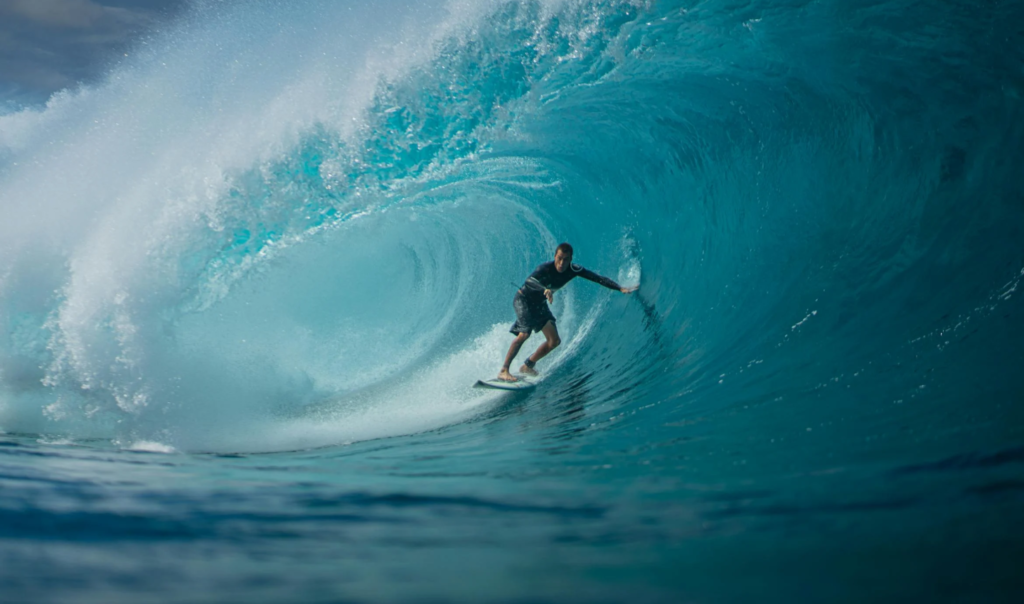
First things first, Ocean waves are the transfer of energy across a body of water, not the movement of water itself.
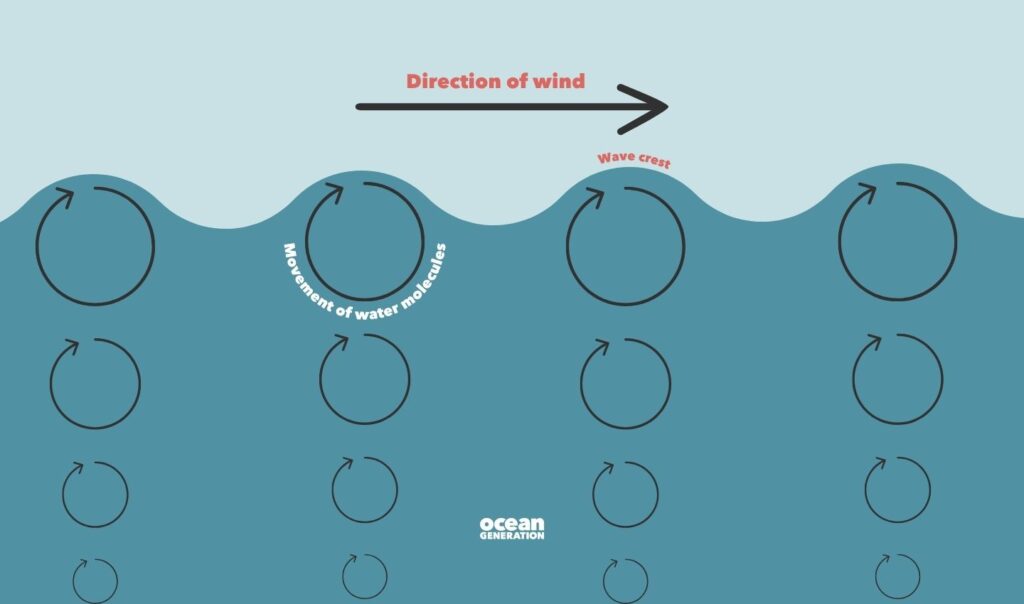
Surface waves are caused by wind out at sea. As the wind blows across the Ocean, particles near the surface are disturbed. Friction and pressure generate ripples, and this wave induced pressure causes each individual water particle to push and pull on its neighbour.
The water molecules begin to move up and down in a circular orbit, creating a wave crest. This motion propagates energy through the water in the direction of the wind.
Once they have enough energy from the wind, these wave crests spread out and begin their journey across the open Ocean as “swells”. These swells can travel uninterrupted for thousands of miles, until they reach the shore and meet their dramatic end.
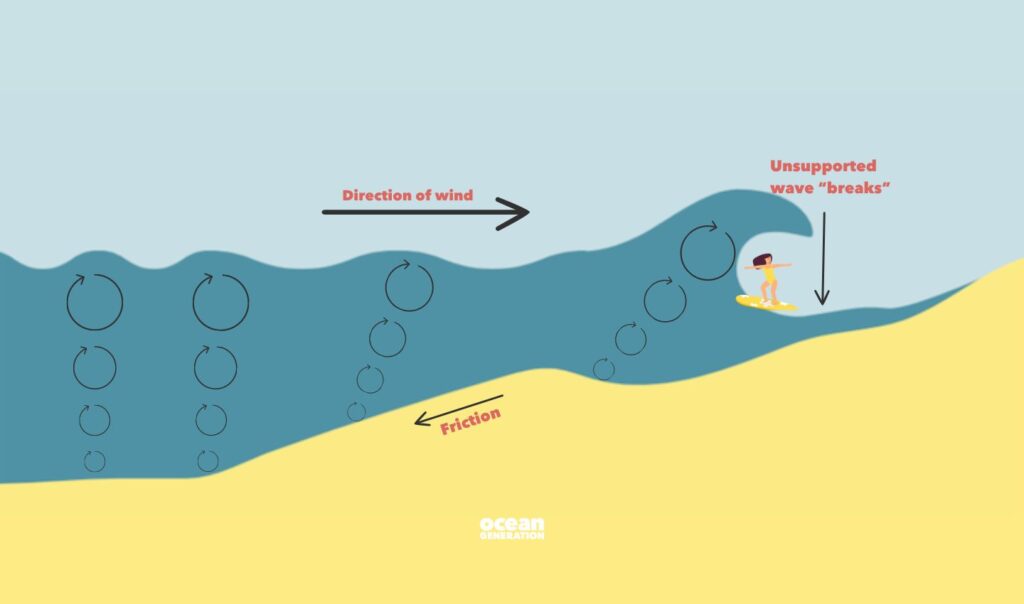
As the wave approaches shallower water, the circular orbits of the water molecules in the lower part of the water column are disrupted by the seafloor and get slowed down by friction.
The water molecules closer to the surface are less effected by friction, so the energy continues to move through them at its original speed.
The wave grows in height but is left unsupported as the lower part is dragged along the seafloor. Eventually, the wave finds itself with nothing underneath it, and collapses in a dramatic fashion, known as the wave “break”.
Another form of Ocean waves that move across our planet are tides.
The predictable rise and fall of the Ocean along our shores is as certain as the sun rising in the East and the stars coming out at night.
For centuries, humans have learned to predict the tides for navigation, fishing and other recreational activities.
But to fully understand how tides work, we must look up to space.
The moon and Earth both exert a gravitational force and are constantly accelerating towards each other in orbit.
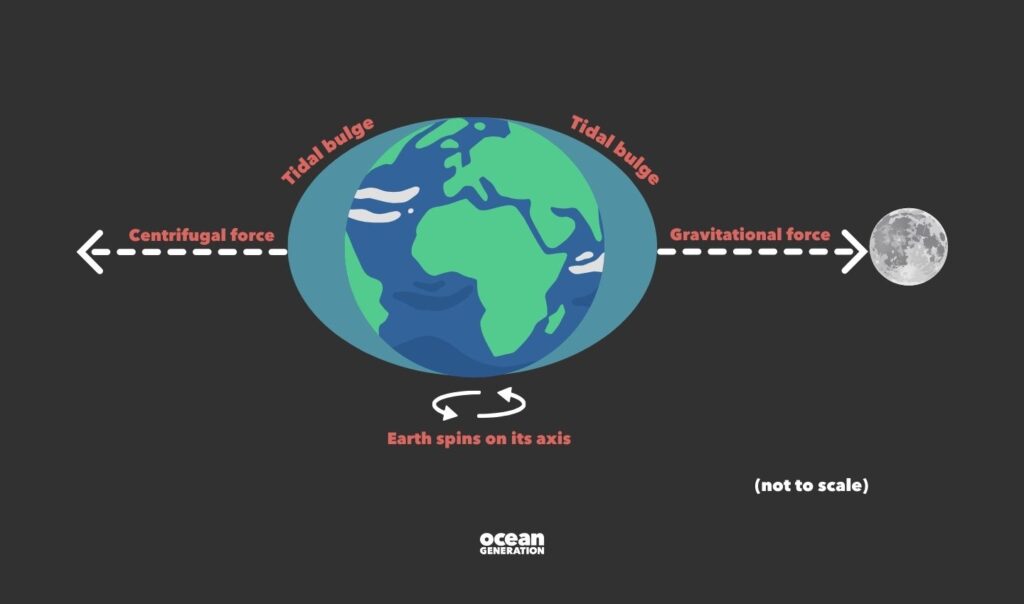
As our planet accelerates towards the moon, the water on the side closest to the moon accelerates faster than the solid rock in the middle and accumulates to form a slight bulge.
This is known as tidal bulge.
As the Earth rotates, this watery swell stays in the same position relative to the moon. The land rotates into this bulge at high tide, and out of it at low tide.
So, when we stand on the beach and watch the tide going out, what we’re actually observing is the Earth rotating away from the Ocean.
But wait a second, why are there two high tides per day?
This is where things get a bit more complicated. Put your scientist hats on, and imagine the following:
While the water on the near side bulges towards the moon, the water on the far side bulges away from the moon.
Remember that the moon and Earth are constantly accelerating towards each other in orbit.
A centrifugal force (a force which acts on an object that’s rotating) acts as a result of this spinning.
On Earth, this centrifugal force is strongest at locations facing away from the moon, causing the water to bulge away from the moon at the far side.
Earth therefore rotates into two tidal swells each lunar day of 24 hours 50 mins.
What is a lunar day?
A lunar day is the time it takes for a specific point on Earth to rotate from an exact point under the moon to return to the same point under the moon.
This explains why there are two high and two low tides per day, and each high tide occurs 12 hours and 25 minutes apart.
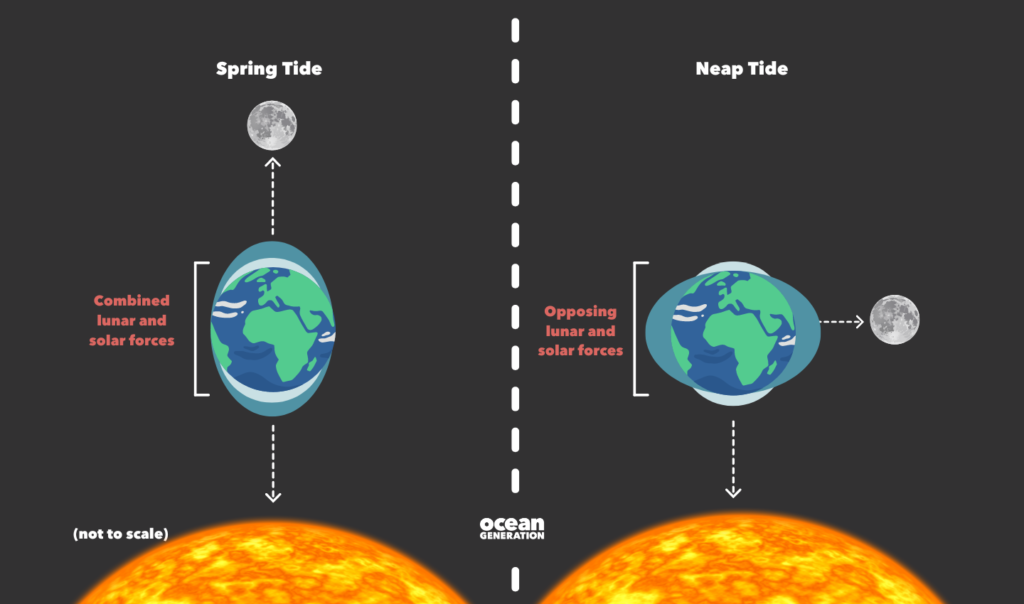
The sun also has a gravitational tidal force on our Ocean: It’s called a solar tide.
However, it’s much smaller since the sun is much further away.
When the sun and the moon are aligned, their lunar and solar forces combine to create a larger tide, known as spring tide.
In contrast, when the sun and moon are at a right angle, their opposing tidal forces partially cancel each other out, creating a smaller tide. This is known as neap tide.
Back on Earth, the shape of the coastline can have a dramatic influence on tidal magnitude.
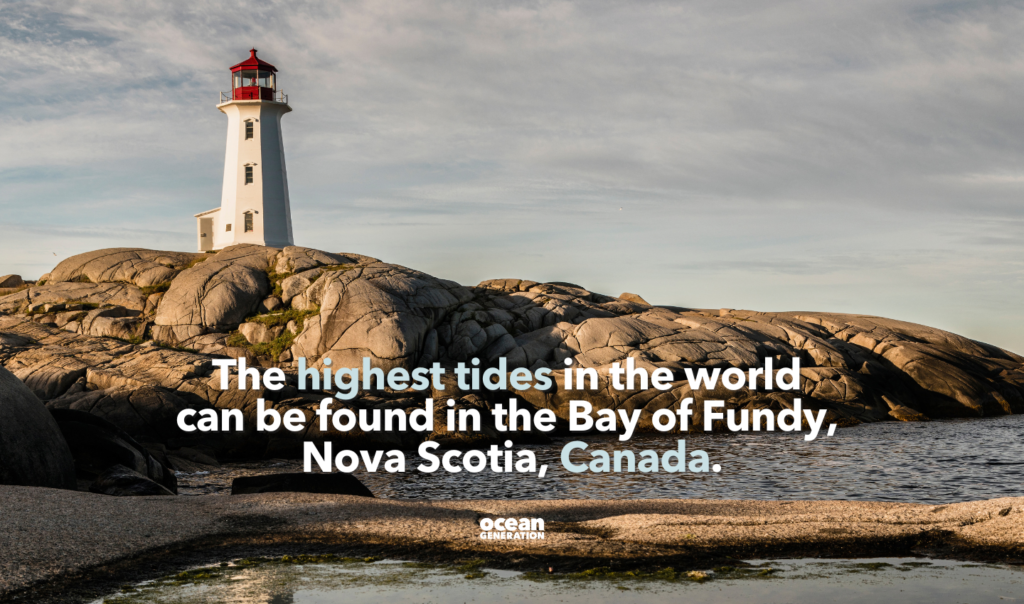
For example, the highest tides in the world can be found in the Bay of Fundy, Nova Scotia, Canada. The size, depth and unique funnel-shape of this coastline causes a natural oscillation (a back-and-forth movement in regular rhythm) of the water in near-perfect sync with the tide, which has an amplification effect.
So next time you’re taking a stroll along the coast and listening to waves crashing against the shore, take a moment to consider the forces in play to make it all possible.
Waves and tides are all part of the continuous movement of energy that has formed and shaped our universe since the beginning of time.
What is the UN High Seas Treaty and why does it matter?
Share this page
Copied
After two decades, the open Ocean or ‘high seas’ are on its way to being protected.
On 20th February 2023, the fifth session of the Intergovernmental Conference (IGC) on Conservation and Sustainable Use of Marine Biodiversity of Areas Beyond National Jurisdiction (BBNJ) resumed negotiations in attempt to agree on a treaty to protect the high seas.
The last negotiations were held in August 2022 and ended without agreement.
“Our Ocean has been under pressure for decades and we cannot ignore the Ocean emergency,” said António Guterres, UN Secretary-General in a statement, reiterating the need for a treaty that paves the way for a sustainable Ocean.
What are the “high seas”?
High seas refer to the vast majority of the Ocean that lies beyond national jurisdictions. This open water is not governed by any one country and covers 64% of the Ocean’s surface.
Global map showing the extent of exclusive economic zones (EEZ’s) and the high seas. [Extracted from Sumaila et al.]
What does the High Seas Treaty mean for our Ocean?
After an extra day of intense negotiations, IGC president, Rena Lee, Singapore, announced that the United Nations (UN) High Seas Treaty had been agreed.
This was a monumental milestone twenty years in the making.
“The ship has reached the shore!”
IGC President, Rena Lee, Singapore.
5 main takeaways from the High Seas Treaty:
Strengthening 30 x 30 –
This agreement seeks to protect 30% of the Ocean by 2030. This was an outcome from COP 15 (the global biodiversity conference held in Dec, 2022) that will be strengthened with the help of this treaty.
Marine Protected Areas (MPA’s) –
This treaty will provide the legal framework necessary to set up MPA’s as no such framework currently exists.
Conference of the Parties (COP) –
Establish a COP to ensure accountability on issues like biodiversity and governance.
Marine Genetic Resources (MGR’s) –
Highlighting the need for processes to share genetic resources like plants and animals for pharmaceuticals, food, cosmetics, etc.
Environmental Impact Assessments (EIA’s) –
Greater obligations to conduct EIA’s on activities relating to pollution or any potential effects on the marine environment that is unknown or not yet fully understood.
Ocean Generation’s Statement on the High Seas Treaty:
“We are delighted to hear that the UN High Seas Treaty has finally become a reality.
A healthy Ocean is vital for the survival of all living things, and this is the message we continue to deliver through our work at Ocean Generation. Protecting 30% by 2030 must, however, be seen as a minimum requirement.
We view this agreement as a starting point. The Ocean is our ally in the fight against climate change and we must stop underestimating its role in our survival. The sooner this treaty is ratified by all countries, the better chance we have of a safe and healthy future for the generations that will follow us.”
Jo Ruxton MBE Founder of Ocean Generation
We intend to update this article once the final text of the treaty has been published.
To provide the best user-experience for our website, we use cookies. Consenting to these allows us to process data such as browsing behaviour on our site.
Functional
Always active
Technical storage or access strictly necessary for the legitimate purpose of enabling the use of a specific service on our site.
Preferences
The technical storage or access is necessary for the legitimate purpose of storing preferences that are not requested by the subscriber or user.
Statistics
Technical storage or access that is used exclusively for statistical purposes.The technical storage or access that is used exclusively for anonymous statistical purposes. Without a subpoena, voluntary compliance on the part of your Internet Service Provider, or additional records from a third party, information stored or retrieved for this purpose alone cannot usually be used to identify you.
Marketing
Technical storage or access is required to create user profiles to track the user on a website or across several websites for similar marketing purposes.