From classroom to COP30: Questions from children to climate leaders about Ocean protection
From classroom to COP30: Questions from children to climate leaders about Ocean protection

If a group of 7–11-year-olds could interview delegates at COP30, what would they ask? 

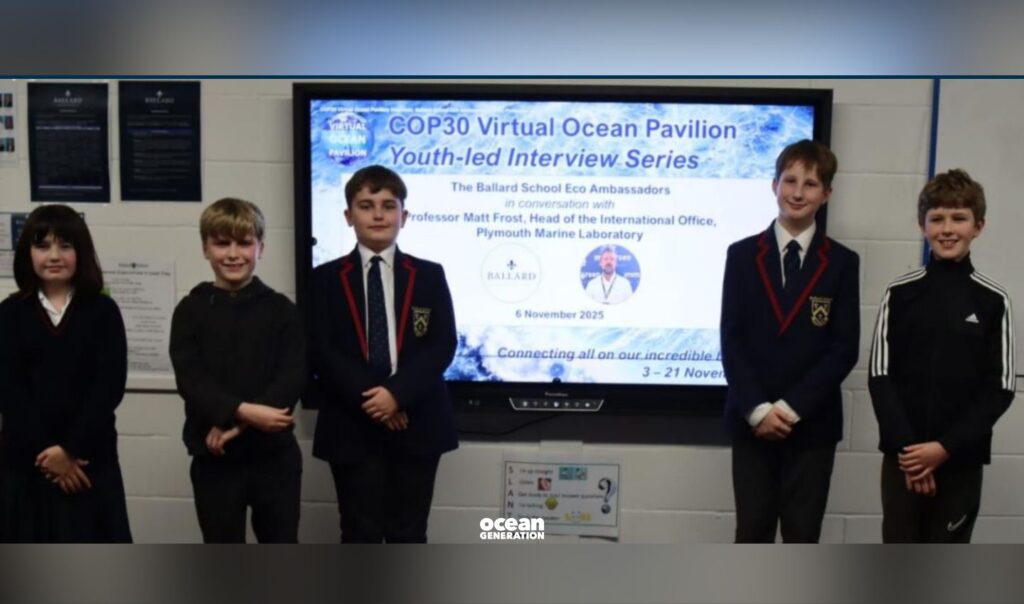
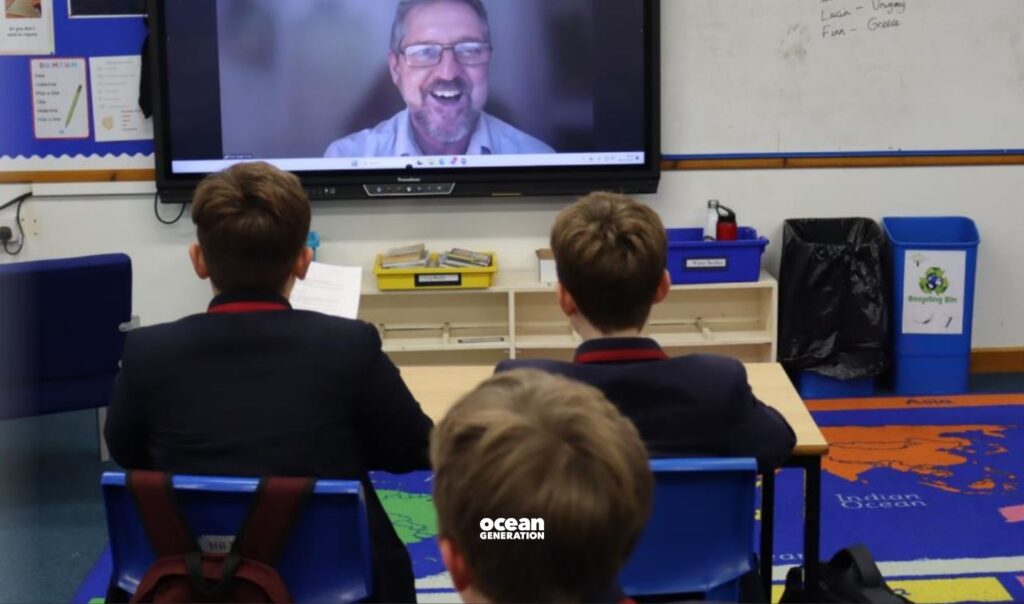
Well in November 2025, Ocean Generation made this happen. We worked with 5 young Eco Ambassadors at Ballard School in New Milton, UK as they interviewed Professor Matt Frost, Head of International Office at Plymouth Marine Laboratory as part of the COP30’s Virtual Ocean Pavilion’s series of youth-led interviews.  

What is COP?
COP (Conference of the Parties) is the UN’s annual climate summit. During the conference, parties negotiate climate action and review progress. COP is also a platform for scientific studies and activism. Read more about COP here. 

Ocean Generation’s Youth Engagement Lead, Dr Gemma Connell, mentored the young people through the process and was so proud when they wrote their own (very difficult!) questions for Matt, giving him a bit of a grilling!  

It was heartwarming to witness Matt’s honesty in his responses to the young people. He discussed where the problems are in the COP space, and most importantly – what we can all do to protect our Ocean.  

Join the Eco-Ambassadors as they ask Professor Matt Frost the important questions around COP30, the importance of the Ocean and what his favourite sea creature is.  

YouTube player

So, you wake up at COP30, what are you doing? What does you day look like? (Freddie’s question) 

Matt’s answer: 

Wake up, check the times on everything. You don’t want the changing time zones to lead to you missing events and meetings.  

Planning where to be that day, making a list of places and times I need to be somewhere.  

The first day and the start of every day includes a lot of security. Making sure everyone has identification and the right badges to get through the security measures that are in place protecting some of the world’s most important people. 

COP can involve hundreds of thousands of people, so just working out where everything and everyone is, is a challenge. Got to make sure you know where the good coffee shops are.  

“The fun bit is that you walk around, and you meet all sorts of people.”  

Not just meetings or speaking events, but you might find yourself doing some media as well. 

“Recently I was at a COP when I bumped into Tom Heap, who is one of the presenters on Countryfile. He said, ‘do you mind doing an interview while you’re here that we can put on Sky News?’” 

Every evening there will be a reception, meeting all sorts of people from government ministers to scientists.
What are your expectations coming to the COP30 and what would you consider a successful result for the Ocean? (Toby’s question) 

Matt’s answer: 

“For many years, when people came to these meetings, they were all worried about what was going on on the land.” Matt noted how the conversations would focus more on forests, trees and farming, “but nobody really thought about the Ocean.” 

“So, over the years, we’ve had to explain to people that our planet – and I’m sure you know this, being Eco Champions – is mostly water. The Ocean is most of our planet. So, one of the main things that is a success every time we go to these meetings is to make sure that everybody is talking about the Ocean.”

Every leader talking about the Ocean is a success. The next step is encouraging action.

The people at these meetings don’t have the power, they can go back to their governments to convince them to act. 

For example, the UK government going home and taking direct action to address the issues in the Ocean through laws and funding would be a real success from COP30.   
The Ocean has gradually grown in prominence on the global stage.

The Ocean has gradually grown in prominence on the global stage.  

Ocean Generation’s note:

Six years ago, COP25 recognised the connection between Ocean and climate, COP26 called for Ocean action to be integrated in work programs and COP27 encouraged countries to include the Ocean in their national climate goals.  

At COP30, the Ocean was formally included in the COP30 Action Agenda. It was the first time a COP decision included a specific Ocean angle, with goals and commitments. This included investing in marine conservation and renewable energy, reducing the environmental and ecological impacts of shipping, supporting aquatic food solutions and reducing the impact of coastal tourism.  

Practical tools were launched at COP30 to help achieve the goals. An Ocean Breakthrough Implementation Dashboard was launched to monitor country progress across those five areas (nature conservation, renewable energy, shipping, marine food and tourism). The Marine Biodiversity and Ocean Health Breakthrough and Roadmap gives the standards and methods to tackle Ocean assessment and actions.  

While COP30 included the Ocean more deeply than previous COPs, there was a lack of financing and binding agreements to ensure countries take action. It is now over to them to build on the outcomes of COP30 and take Ocean action.  

How can governments encourage private companies to not use single use plastic? (Leo’s question) 

Matt’s answer: 

If I could get a brilliant answer to that it would solve one of the world’s biggest problems. So, I will do my best and honestly, Leo, if you and your friends have got ideas… we need some help with this.” 

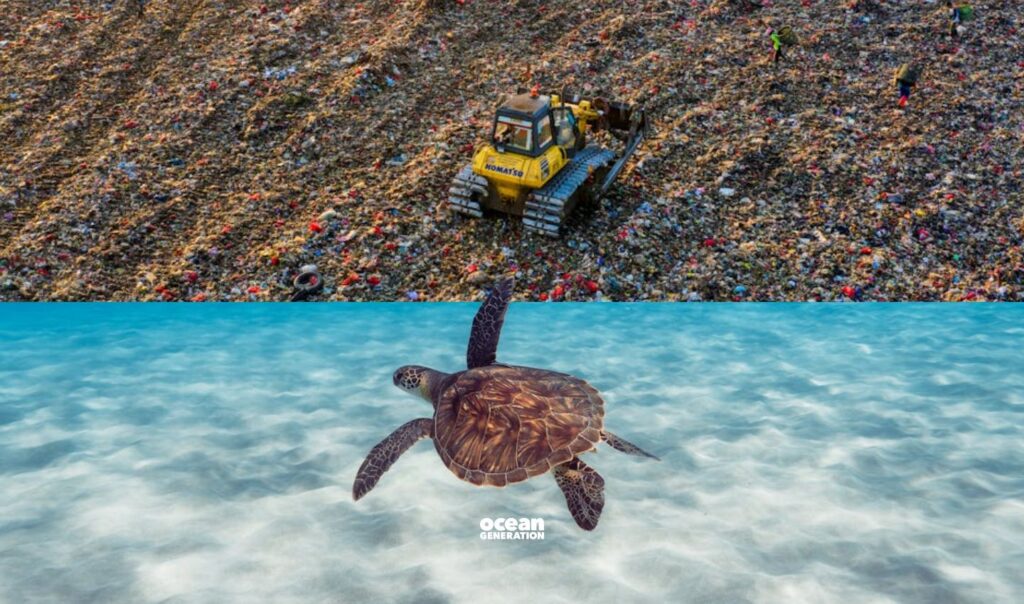
As well as a pollution problem, plastic is also a climate problem, as 99% of plastics are made from fossil fuels. 

Governments like the UK have been banning things like plastic straws, microbeads in cosmetics and charging for plastic bags. 

Should we ban everything? “I don’t think that will help ultimately…”. It is a global problem and needs to be addressed globally. The Global Plastics Treaty is an opportunity for governments to make a real difference. Read more about the treaty here.  

Companies are willing to cut down on plastic but need incentives to do so. Encourage is a great word in the question. 

“They [world leaders] can make it difficult by putting taxes [on plastic] and making it more expensive to use single use plastic. But ultimately… governments will only do so much.”  

Government action can be encouraged by what we buy and say.  
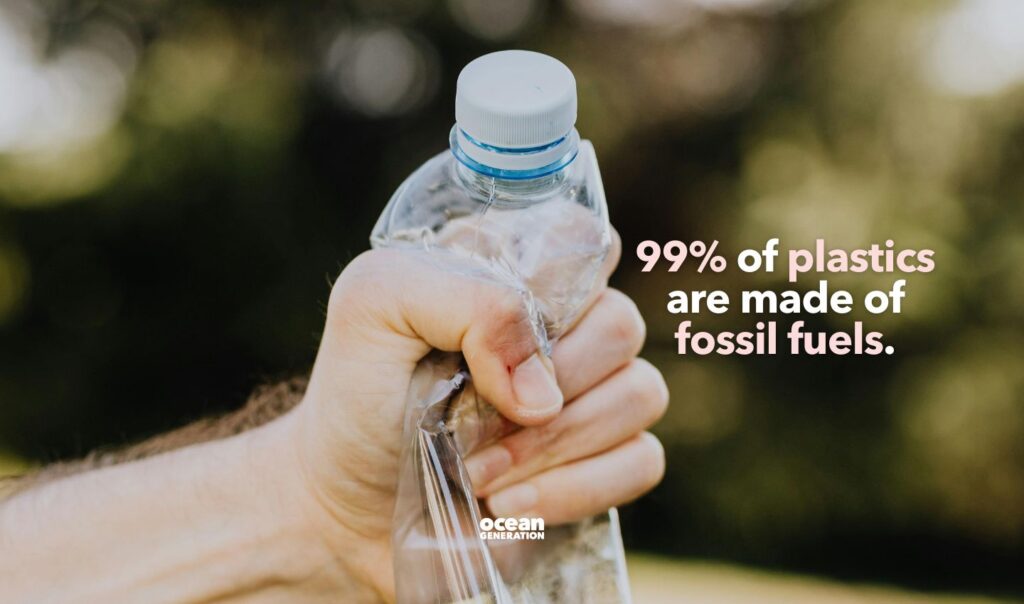
99% of plastics  are made of  fossil fuels. Posted by Ocean Generation, leaders in Ocean education.

Ocean Generation’s note:

The difficulty in banning all plastics, is where we haven’t yet found an affordable alternative which does the same thing as plastic but doesn’t have the impact on the environment.  

This is particularly difficult in industries such as healthcare, where single use plastic is often used to keep patients, doctors and nurses safe. We can’t ban all plastics without looking at the other consequences that might have – context is very important! Read more about if plastic is good or bad here

Are there plans to introduce whale friendly cruise routes to reduce noise pollution in the seas? (Lily’s question)  

Matt’s answer: 

Yes there are plans for whale friendly shipping, but we really need the shipping companies to start doing this now.” 

Ships are big contributors to climate change, producing air pollution as they burn fossil fuels to power their engines.  

There are much more ships on the Ocean at any one point – over 70,000. There are two main ways they cause issues for marine life such as whales – noise pollution and ship strikes. 

Whale friendly cruise routes hope to minimise the impact of both of those things. The International Maritime Organisation and the International Whaling Commission are trying to implement rules on shipping. These include go slow zones where whales are known to feed and live, and special routes that avoid whale “hotspots”.  

It is down to the individual ships, shipping companies and cruise companies to act on the advice of the IWC and IMO.  
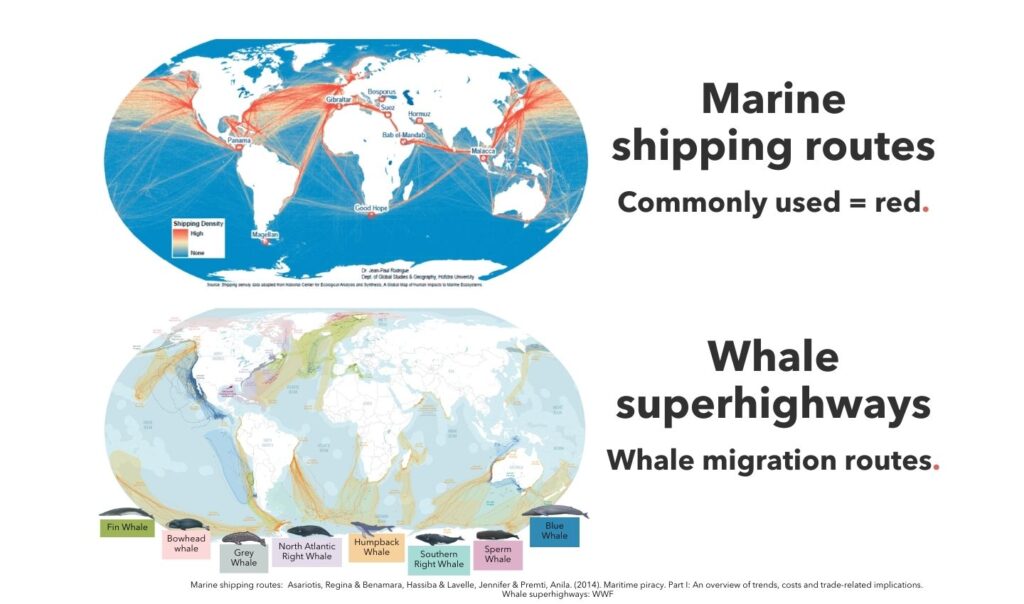
How marine shipping routes and whale's migration routes overlap. Explained by Ocean Generation.

Ocean Generation’s note:

Exact numbers of whales killed by ship strike are difficult to quantify, as data suffers from underreporting.  But recent work has shown that global shipping traffic overlaps with about 92% of whale species’ ranges. Of that, only 7% of the areas that are high-risk for whale-ship collisions have any protective measures. Protecting just 2.6% more of the Ocean would eliminate many high-risk areas with minimal impact to shipping times.  

As Matt says, there are two main solutions. Slower ships give all marine life more time to dive or swim away, avoiding collision. Slowing ships to 10 knots can reduce the the number of whale deaths by 30%.  

The other approach is by re-routing ships from collision hotspots. In the Mediterranean, rerouting ships away from the Hellenic Trench has reduced the risk of collision by an estimated 27%.  

95% of hotspots fall within the exclusive economic zones of a country, so, each country can implement protective measures in coordination with the IMO recommendations. Whale safe routes are in reach.  

Does creating the infrastructure in order to host COP30 and transporting leaders there outweigh the positive outcomes of the conference?  Do you assess the carbon footprint and is there a plan to offset this? (Sean’s question) 

Matt’s answer: 

The concern is that we might not have these conversations if we weren’t all in the same room. Yes, we carbon offset but there is going to be some environmental impact. We think the positives outweigh the negatives.  

“At the moment we feel that if we didn’t go, who’s going to be there to speak up for good science, to speak up for the Ocean, to speak up to actually look after things? And the danger is that, if all the people who feel very strongly about carbon decide not to go to the COP for the reasons you’ve said, then it could be left with the people that don’t really care much about it.”  

Ocean Generation’s note:

One of the intentions of hosts Brazil was to deliver a carbon-neutral COP30. They delivered this by offsetting their calculated emissions. They calculated that COP30 produced 130,000 tonnes of carbon dioxide or equivalent greenhouse gases. To counter this, they purchased 130,000 UN-certified carbon credits. The money for these credits goes towards carbon-negative projects, so COP30 is carbon-neutral in principle.  

However, this calculation only considers the emissions generated by hosting. The bulk of emissions are likely generated by the travel of attendees. There is no comprehensive calculation of these emissions. A large part of that relies on the attendees doing what they can to reduce environmental impact.  

“You can ask me again next year and maybe I’ll answer differently, but this year the positives outweigh the negatives.”  

Was COP30 carbon neutral? Explained by Ocean Generation.
Photo by Fernando Llano/AP

Is COP30 going to be used for fossil fuel deals like the last one? (Sean’s question) 

Matt’s answer: 

“I can’t promise that that will never happen at any COP.”   

Some people will want to see things stay as they are, but there are enough people with good intentions there to know that good things will come out of it. Multilateralism (global cooperation), connecting climate change messages to individuals and accelerating implementation are all main aims of this COP.  

I’m hoping the good things will outweigh the others.  

Ocean Generation’s note:

At COP29, there was backlash against the hosts, Azerbaijan, as one of their senior officials was found to be conducting meetings to coordinate fossil fuel deals. Find out more of what happened at COP29 in our article here.  

What is the extent of the impact of pumping carbon back into the Ocean underneath the seabed? (Lily’s question) 

Matt’s answer: 

It’s possibly helpful, capturing carbon dioxide from the atmosphere and tapping it. However, there are risks – if it leaks it can cause harm to marine life and return the carbon to the atmosphere. 

We’re asking that we [humans] don’t do it until we know more about the effects of it.  

“If you went to the doctor and said, ‘I feel really poorly,” and the doctor said ‘well, I’ve got some medicine for you… I don’t know if it works very well, and it might make you really ill, but I don’t actually know that we haven’t tried it.’ Would you take that medicine?  
Impact of pumping carbon back into the Ocean: explained by Ocean Generation.

What key messages would you like us to share with our school community in order to look after the Ocean better? (Freddy’s question) 

Matt’s answer: 

There is an ongoing problem that people don’t really understand the Ocean. They don’t know what is in it, they don’t really understand it, and they don’t know that we rely on it.  

We need to remind people that most of our planet is Ocean. When the Ocean is healthy, we are healthy.  

We rely on the Ocean for our food, our breathing air and our mental health.  

If we look after the Ocean, it will look after us.  

Read more about how the Ocean keeps us alive here

Toby’s surprise question: What is your favourite marine animal

Matt’s answer: 

Matt’s answer: the leafy sea dragon!  

Ocean Generation’s note:

The leafy sea dragon is a fish closely related to seahorses and pipefish. The name of its genus, Phycodurus, comes from the Greek words for seaweed (phûkos) and skin (derma), encapsulating its amazing camouflage. It can change the colour of its skin to match the seaweed around it and moves through the water like a drifting frond. 

Leafy seadragons typically swim solo, but will court each other through dance, mirroring each other’s movements. Males carry the eggs for 6-8 weeks on a specialised patch under their tail, before ‘giving birth’ to 100-250 20mm baby leafy sea dragons (about the size of a peanut).  
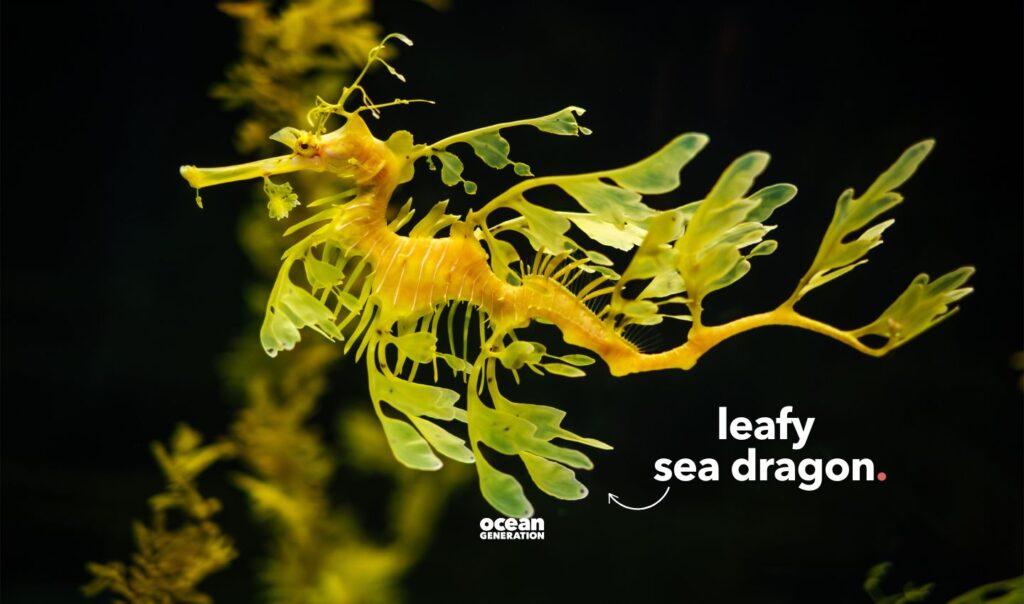
The leafy sea dragon is a fish closely related to seahorses. Posted by Ocean Generation.

Matt asked the students: what would the Eco Ambassadors’ message be for him to take to COP30?  

Toby answered, “Plant more trees!”  

A week later, the Eco Ambassadors planted 30 saplings after school, doing their bit to live up to Toby’s “plant more trees!” answer.  

Alex Bellars, teacher at Ballard School said: 

“Our Eco-Ambassadors absolutely loved taking part in the Virtual Ocean Pavilion interview with Professor Matt Frost on 6th November, 2025. It was inspiring to know that their voices and ideas formed even a tiny part of the global conversation at COP30!  

It was especially cool to know that our pupils were the youngest participants in the Virtual Ocean Pavilion – and therefore possibly at the whole of COP30 itself. And it was wonderful to see Toby grab the chance to put Matt on the spot with an unplanned bonus question!”  

From classroom to COP30: Questions from children to climate leaders about Ocean protection

Subscribe

Monthly: Impact in your inbox.

OceanGeneration-Join

What is the Global Plastics Treaty?

What is the Global Plastics Treaty? Explained by Ocean Generation.

The Global Plastics Treaty refers to the (currently undefined) international agreement by which the countries of the world hope to reduce plastic pollution. 

How far have we got? Progress in the Global Plastic Treaty talks

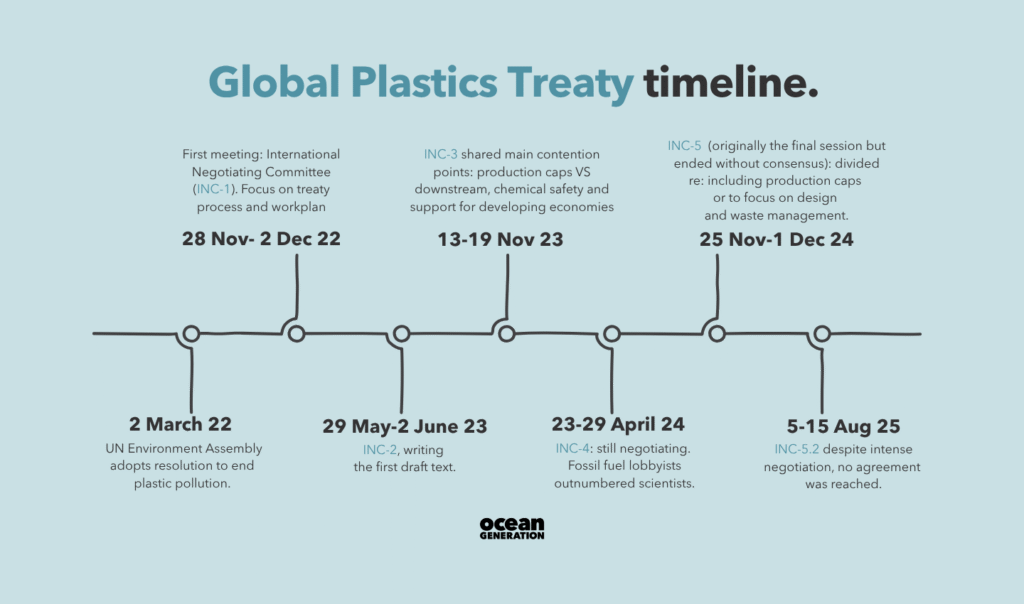
In 2022, 175 countries of the world signed an agreement that declared: plastic pollution needed to be addressed. Stronger than that, plastic pollution should be ended.  

To meet this goal, countries agreed on a series of meetings across the globe to discuss and negotiate how to end plastic pollution and write it into international law (a treaty). 

Five meetings were planned, with the treaty aimed to be finalised by the end of 2024.  

This agreement created the International Negotiating Committee (INC) which first met in Punta del Este in Uruguay. Subsequent meetings happened in Paris, France; Nairobi, Kenya; Ottawa, Canada; and Busan, Korea. 

By the end of the fifth meeting, no agreement had been reached for the Global Plastics Treaty, so another (INC5.2) was scheduled for August 2025 in Geneva. However, this meeting also ended with no treaty. 

Timeline of the Global Plastics Treaty. Posted by Ocean Generation.
Timeline by Will Steen

What is stopping a treaty being agreed? 

For the treaty to come to life, all countries must agree on the terms, so while some disagree there will be no treaty.  

The main point of disagreement is whether making new plastic (plastic production) should be limited within the treaty. Countries are split largely into two groups, the High Ambition Coalition and the Global Coalition for Plastics Sustainability. 

What is the High Ambition Coalition?  

There is a large group of countries (around 100) in a group, called the High Ambition Coalition (HAC).  

The HAC has been pushing for the plastics treaty to include plastic production limits – reducing the amount of new plastic made. Before INC5.2 the HAC published a “wake-up call” at the United Nations Ocean Conference at Nice in June 2025, outlining a ‘wishlist’ of five points: 

  • Limits on plastic production (to be regularly adjusted), and reporting on production, import and export of primary plastic polymers 
  • Phase out most harmful plastic products and chemicals of concern 
  • Improve the design of plastic products to minimise environmental and human impacts 
  • Financial support to support less developed countries in the transition 
  • A treaty responsive to changes in evidence and knowledge 

What is the Global Coalition for Plastics Sustainability

Another group of countries formed the Global Coalition for Plastics Sustainability (also known as the Like-Minded Group of Countries).  

A statement from a member country outlined the focus: 

“The [Global Plastics Treaty] should pave the way for improving the waste management systems in general, and to promote environmentally safe and sound management of hazardous plastic wastes, and to reduce uncontrolled hazardous plastic pollution.” 

They want a bottom-up approach, prioritising dealing with plastic waste.  

What's next for the Global Plastics Treaty? Explained by Ocean Generation.

What do major businesses think of the plastics treaty? 

Businesses that produce and use plastic are key to tackling the plastic pollution problem. 

The UK hosted a roundtable with major business in June 2025 and produced a statement. It called for the plastics treaty to address the whole lifecycle of plastics, amongst other things. 

As businesses and financial institutions, we stand ready to mobilise significant investments, and engage with the companies we invest in, towards achieving the objectives of the legally binding instrument, including towards innovation and infrastructure.” 

Other businesses, such as fossil fuel companies (99% plastics are made from fossil fuels) take a different view:  

While there have been calls for production caps or bans, it’s been reassuring to hear leaders share their belief that such measures could deprive the world – particularly the developing world – of the untold benefits plastics deliver in terms of health, food safety, the environment, the energy transition and more.” – Exxon Mobil President  

What’s next for the Global Plastics Treaty? 

The division has been entrenched from early in the process, with little movement on either side. It has led to questions about the process, and where to go next. Here are some options: 

  1. The process is changed to being decided by vote rather than by consensus, to make progress despite the disagreement of a small minority 
  2. The process continues via other means. For the Ottawa convention on landmines, a number of countries compiled texts outside of the process, that were then agreed upon. We could see this happening, for example, with the High Ambition Coalition.
  3. Another round: INC5.3 to try again! A (currently unnamed) country has offered to host, but has said they will not fund it. 

While the gears of global negotiation can feel like they turn slowly, they are turning. Read more about how international treaties work here. 

These countries have agreed that ending plastic pollution is an important issue. We want a world without the damage of plastic pollution.  

The Global Plastics Treaty is the representation of international intent. If it does produce legal guides to end plastic pollution, it will speed up progress. That it hasn’t yet is not going to stall momentum.  

Plastic pollution is an international target.  

The Global Plastics Treaty aims to end plastic pollution. Posted by Ocean Generation, leaders in Ocean education.

From classroom to COP30: Questions from children to climate leaders about Ocean protection

Subscribe

Monthly: Impact in your inbox.

OceanGeneration-Join

How can we clean up plastic pollution in the Ocean? 

How can we clean up plastic pollution in the Ocean? Posted by Ocean Generation.

Why do beach cleans actually work: Explained. 

An army of passionate people take to the beach, litter pickers in hand. Sea spray in their hair and sand under their nails, they comb the beach. Their bags fill with cigarette butts, plastic bottles and crisp wrappers. Spirits are high, notable pieces of rubbish are held up with announcement.  

As the sun sets, the beach seems lighter, relieved of the weight of rubbish. The cleaners look over the coast with proud eyes at a job well done.  

But as the night draws in, so does the tide. When the sun rises again, it unveils a plastic-laden beach once more. The Ocean has coughed up some of its burdens.  

What is the point in beach cleans? Are we rearranging deck chairs on the Titanic or do they actually help combat Ocean pollution? 

How bad is the Ocean plastic problem? 

Ocean plastic is increasing. Many scientists have done deep dives into the science of knowing how much. While it’s challenging to measure exactly how much plastic is in the Ocean, we know that as plastic production increases, so does plastic pollution in the Ocean.  

The Great Pacific Garbage Patch is a myth. Explained by Ocean Generation.

There aren’t great islands of plastic floating in the Ocean (even the Great Pacific Garbage Patch is a myth). But we are creating a plastic soup. Microplastics fill the Ocean, with some ‘croutons’ of bigger floating plastic.  

This plastic can kill wildlife, carry toxins and enter the food chain — all the way up to us. 

It’s obvious: we all want less plastic in the Ocean. The question is how to achieve that.  

What impact do beach cleans actually have?  

A beach clean is more than just a fun day out. They do a whole load of good. 

Firstly, they are good for us. Beach cleans (and most coastal activities) have been associated with positive mood and improving our understanding of the Ocean.  Combine a beach cleanup with some rock pooling and that’s a brilliant afternoon. Imagine all the things you can find! We feel better cleaning our beaches.  

Beach cleans are a chance for people to come together and make a tangible contribution. They act as displays, raising awareness for our pollution problem and encouraging more engagement. A snowball effect. 

Beach cleans provide immediate benefit to the natural world too. Removing plastic from the beach takes away its threats straight away, and removes the future threats as well.  

Plastic on the beach is exposed to the stresses and strains of the Ocean. Waves breaking, rubbing against the sand and rocks, the sun beating down. All these break up the plastic into smaller micro- and nano-plastics. Removing it before that stage is a lot easier. 

Our understanding of the journey of plastic waste is evolving. Recent studies suggest that the vast majority (88% is the quoted figure) of plastic in the Ocean remains floating close to shore. This means our beaches take the brunt of the plastic problem. But that also means it’s accessible: We can remove the majority of the problem with ease and stop it getting worse.  

Beach cleans have a great impact. Posted by Ocean Generation.

Beach cleans treat the symptoms without addressing the illness

Beach cleans are not the whole answer. You can’t keep bailing a sinking boat out and expect to float, until you bung the hole. A beach clean treats the symptoms without addressing the illness.  

We need more than litter-pickers.  

What are the other allies in the battle against Ocean plastic? 

The closer to source of plastic pollution we can get, the better. Try filling a glass from someone pouring three stories above you – a lot more water gets spilled compared to just filling from the tap.  

Single use plastic bans have shown to be effective in reducing litter. Increasing the responsibility of plastic producers for the end of their products lives would motivate innovation and stop plastic becoming litter at all. A circular economy would prevent the demand for oil to produce more and reduce the amount of plastic that becomes rubbish.  

As consumers, we also need to rethink how we use plastic.  

How can we change our relationship with plastic?  

Moving away from a single-use plastic world is, honestly, going to be tricky. We live in a world where convenience is king. Single-use plastic is very convenient. But there are solutions already working. 

Deposit return schemes have proved to be highly effective in increasing the collection rates of plastic bottles. When you buy a drink in a plastic bottle, for example, a small extra fee is paid, which is returned when the bottle is returned. For one scheme, 94% of bottles were returned compared to 47% without a scheme.  

Moving away from single-use plastic is tricky. Posted by Ocean Generation, leaders in Ocean education.

Nearly every major manufacturer (98%) now has commitments to reduce plastic packaging. Whether this represents genuine change or sophisticated greenwashing remains to be seen, but consumer pressure and regulatory requirements are making plastic reduction a business imperative rather than a nice-to-have. 

The challenge lies in balancing reduction with practicality. Sometimes plastic packaging actually reduces overall environmental impact compared to heavier alternatives – it’s the end-of-life management that needs sorting. 

The uncomfortable reality of waste management

Here’s the uncomfortable truth: much of Ocean plastic pollution originates from countries with limited waste management systems. Sub-Saharan Africa, for example, averages 44% waste collection rates compared to 98% in high-income countries. It’s rather difficult to recycle rubbish that’s never collected in the first place. 

We can’t simply take Western waste management systems and apply them exactly as they are in other countries. Locally managed, decentralised circular economy models – using local resources and creating local markets for recycled materials – show more promise than imposing one-size-fits-all solutions. 

Is making plastic expensive a solution to pollution? 

Governments wield powerful economic tools: taxes on single-use plastics, subsidies for recycling infrastructure, and extended producer responsibility schemes that make manufacturers pay for their products’ end-of-life management.  

When virgin plastic (new plastic) becomes expensive and alternatives become cheap, behaviour changes remarkably quickly. But it has to be done without disadvantaging those that don’t have access to a cheap alternative.  

So, back to the original question: Do beach cleans work? 

Yes. But they won’t stop the problem long term. Beach cleans deliver value beyond plastic removal. They’re powerful data collection exercises, providing crucial information about debris types and sources that inform policy decisions.  

Beach cleanups are also remarkably effective educational tools – nothing quite drives home the scale of plastic pollution like spending a Saturday morning filling bin bags with bottle caps. 

Removing larger plastic items helps reduce microplastics. Posted by Ocean Generation.

Perhaps most importantly, recent research from Norway found that removing larger plastic items from coastlines led to a 99.5% reduction in microplastics both on land and in water within a year. That’s a genuinely impressive result that suggests beach cleans have more direct environmental impact than critics assumed. 

“Removing plastic from the environment before it enters an active degradation phase, into microplastics, will reduce the formation of microplastics in the environment. The decrease of microplastic was over 99% in the water volumes we found on land. When we looked at seawater, the microplastics leaking into the sea was reduced by 99.9%,” – Gunhild Bødtker, senior researcher at Norce 

What’s the most effective strategy to deal with plastic pollution? 

The most effective strategy combines both approaches: upstream prevention (stopping plastic from becoming waste) and downstream management (dealing with what’s already out there). Think of it as both turning off the tap and mopping up the flood. 

Beach cleans work best when they inspire participants to tackle root causes – supporting deposit return schemes, choosing refillable alternatives, and pressuring companies to reduce packaging.  

The real measure of a successful beach clean isn’t just the bags of rubbish collected, but the number of people who leave determined to prevent that rubbish from appearing in the first place. 

Do a beach clean, but don't just stop there. Posted by Ocean Generation.

What should you do next to help tackle plastic pollution 

So beach cleans won’t solve the problem. The good news is that effective solutions exist. The challenge is implementation at the scale and speed the problem demands. 

Join a beach clean, but don’t stop there. Support businesses with genuine circular economy commitments, lobby for deposit return schemes, and remember that every purchase is a vote for the kind of world you want to live in. 

The Ocean doesn’t care about our good intentions. It needs systemic change, and that requires all of us to think beyond the beach. All our jobs can be beach. 

From classroom to COP30: Questions from children to climate leaders about Ocean protection

Subscribe

Monthly: Impact in your inbox.

OceanGeneration-Join

Is plastic good or bad? What it means for you and the planet 

Is plastic good or bad? posted by Ocean Generation.

A great scholar once said – life in plastic, it’s fantastic. As one of the greatest revolutions in material engineering, plastic has undeniably changed the world.

But were we too successful? Did we end up with a committed friend who is always here for you – but really ALWAYS here, and we can’t get them to leave?  

Let’s look at our magic material, where plastic has done good and how we need to change our relationship with it.  

What is plastic 

Plastic can mean a lot of things.

We should be careful to define what we mean. Here, plastic is concerning synthetic or semi-synthetic materials composed primarily of polymers, that can mould, press or extrude into different forms. This feature, their plasticity, is key to their importance.  

Here’s a table summarising some of the most used plastics. Have a look around, I would guess, from wherever you are, you could see at least five of these. 

Polymer Abbreviation Examples of use 
Polypropylene PP Food packaging, automotive parts 
Low-density polyethylene LDPE Reusable bags, food packaging film 
High-density polyethylene HDPE Toys, shampoo bottles, pipes 
Polyvinylchloride PVC Window frames, floor covering, pipes, cable insulation 
Polystyrene PS Food packaging, insulation, electronic equipment 
Polyethylene terephthalate PET Beverage bottles 
Polyurethane PUR Insulation, mattresses 
ABS, elastomers, biobased plastics, PBT, PC, PMMA, PTFE, … Other Tyres, packaging, electronics, automotive, …
Fibres made of different polymers Fibres Textile applications but also in many other sectors 

Plastic is everywhere, from our food packaging to our computers, to our furniture. Our clothes, the paint on our walls, the tyres on our car; all have plastic in. So, let’s look at why plastic has become so engrained in our lives.  

How does plastic save lives? 

Plastic has pioneered a revolution in medicine. Through its versatility, sterility, durability and low cost, plastic has made modern medicine more safe, accessible and effective. Plastic IS fantastic.  

Plastic has pioneered a revolution in medicine

Disposable plastic items such as syringes, IV bags and gloves prevent cross-contamination. Plastic has enabled minimally invasive surgeries, reducing recovery time and infection risks.  

Plastic prosthetics and implants can be printed or moulded to individual needs. Medical packaging made from plastic keeps drugs and equipment sterile (more on packaging later).  

A surgeon or trainee doctor can examine a 3D-printed organ to better understand the patient. Complex procedures can now be done through a single incision using flexible plastic implements. Medical imagery has advanced as machines made from plastic don’t have the interference of metal. Due to the low price of plastic, everyone can benefit from better healthcare.  

It’s impossible to know how many lives have been saved by plastic.  

How has plastic helped our food systems? 

Food waste is a big environmental problem. 19% of food available to consumers is wasted, added to the 13% lost in supply chain.  

By the last attempt to calculate it, food waste made up 8-10% of annual global greenhouse gas emissions. In 2017, greenhouse gas emissions from food waste were estimated to be roughly the same as the emissions from the US and Europe combined

The UK and Japan are among the only countries to collect consistent food waste data. They have shown reductions of 18% and 31% respectively. Awareness, for consumers, is a powerful driver of behaviour change.  

Plastic can reduce food waste. Explained by Ocean Generation.

Plastic is a key ally in reducing food waste. 

Packaging reduces food waste and increases the shelf life of our food. Plastic packaging does this by stopping the aeration of food and providing thermal insulation. 

Of course, making plastic packaging produces emissions, but the food inside has a much bigger carbon footprint.  

Think of it this way: if plastic packaging stops your tomatoes going mouldy, you’ve saved all the emissions from growing, transporting, and processing those tomatoes – plus you’ve avoided the methane released when the tomato rots in landfill. The plastic wrapper can be the environmental hero, not the villain. 

One study found packaging innovations increased shelf life by 50% and cut food waste by 40%. Whilst they weren’t testing plastic specifically, it shows how crucial good packaging is. 

Take pork as an example. Yes, plastic foam trays create more emissions than butcher paper when they’re made. But only 5% of plastic-wrapped pork goes off, compared to 7-10% wrapped in paper. That means 35% less climate impact overall – the packaging emissions are nothing compared to a whole pig going to waste. 

This food preservation revolution has shrunk our world. A mango can now travel from Peru to Manchester and still be perfectly ripe when you bite into it. More food, travelling further, feeding more people – all thanks to a bit of clever plastic.  

The flipside of this is – do we need food travelling further? While food miles are a small part of food-related emissions, eating local is an easy way to reduce environmental impact.  

Plastic saves marine life. Posted by Ocean Generation, leaders in Ocean education

How is lightweight plastic doing its bit environmentally?  

Plastic is light, and strong. It has taken on roles previously performed by much heavier metals.  

A car fuel tank, for example, used to be made from steel, much heavier than plastics. A 10% reduction in vehicle weight can result in a 6-8% improvement in fuel economy. Plastics reduce the weight of a vehicle by up to 50%. This results in approximately 14 times lower greenhouse gas emissions than using a steel tank.  

In construction, the durability of plastic can be utilised. Due to the lighter weight, PVC pipes have much lower climate impact than concrete (45% less) and ductile iron (35% less). Every truck carrying plastic to the building site uses less fuel carrying PVC pipes. In water pipes, copper is recyclable but loses more heat than a cross-linked polyethylene (PEX) pipe. 

How is plastic saving marine life? 

There are many examples of plastic replacing consumer demand for natural products; saving marine life.

Tortoiseshell glasses are now made out of plastic, saving the hawksbill turtles who were harvested for their beautiful shells. How many trees are still standing because we have plastic furniture?  

Why do we call sponges sponges? Because they were originally the sea sponge, Spongia officialis, that we collected and used as a bath sponge. Replacing the sponges of the sea with plastic ones has alleviated another stress on our Ocean.

 Ivory’s another classic case. Before plastic, piano keys, billiard balls, and ornamental trinkets meant elephant tusks. Now, we get the same aesthetic from synthetic alternatives – and elephants get to keep their tusks. 

Plastic can replace natural products. Posted by Ocean Generation

What are the problems with plastic? 

Before we get too carried away with plastic’s positive impact on our planet, let’s address the elephant (with tusks) in the room – or rather, the gaps in our argument. 

Did plastic actually save those lives?  

Medicine improved dramatically alongside plastic adoption, but so did antibiotics, surgical techniques, and our understanding of infection control. We simply don’t know how many lives plastic specifically saved versus other medical advances happening simultaneously.  

We’ve built our entire food system around plastic packaging, then use that system to prove plastic’s necessity. It’s flawed logic. Considering the carbon emissions alone is one dimensional – what if we’d spent 70 years perfecting non-plastic preservation methods instead? We’ll never know – but it would be foolish to think plastic is the only solution.  

We’ve wrapped modern life around plastic like cling film around a sandwich – so tightly that peeling it away seems impossible. 

There are two key problems with plastic: 

Plastic has two big issues – its fossil fuel foundations and its longevity. The two mean that plastic can have a two-pronged impact environmentally.  

The perks of plastic haven’t been lost on us, as a society. We can’t get enough. We’ve gone from making 2 million tonnes of plastic in 1950 to over 400 million tonnes annually.  

Steel and cement are the only materials we produce more than plastic. Between 1950 and 2017, we are estimated to have produced over 9 billion tonnes of plastic. Half of that total was produced after 2004.

Here’s one of the issues – all the plastic we’ve produced is still around in some form or another. Approximately 7 billion tonnes of it is waste. 

Medical masks were a signature of the COVID-19 pandemic. They blocked the spread of the virus, saved lives and helped get us back to normality. But, once used we threw them ‘away’. A back-of-the-napkin calculation estimates that in 2020, 1.56 billion face masks would enter the Ocean. That isn’t a trade-off we (or our friendly neighbourhood Ocean creatures) should have to make.  

The vast majority of plastic is made from oil. It has a large carbon footprint, representing around 3.4% of global emissions through their lifecycle. A fossil fuel-free future isn’t plastic wrapped.  

There are two key problems with plastic. Posted by Ocean Generation.

Are plastic alternatives the answer? 

It isn’t that simple. Some alternatives are more emissions-intensive to produce, so if we maintain a single-use approach there will be greater environmental impact.    

The classic example is plastic bags to paper bags. Paper bags are approximately six times heavier than HDPE (plastic) bags, so have three times higher production emissions. Paper requires deforestation and lots of water use. Glass is energy intensive and heavy. There are no easy answers.  

Solutions, and their effectiveness, varies by region – in the US, PET bottles have the lowest impact by way of emissions, but in Europe it is aluminium, due to cleaner energy used to produce it and higher recycling rates. This also means the impact of a material can be lessened through wider changes (cleaner energy and higher recycling rates).  

Food packaging is an area of growing competition for plastic. Glass, metals and paper are long-standing packaging materials. Natural fibres and biopolymers are other possibilities, but they can be more energy intensive, more expensive and don’t provide the same level of protection for the food. 

In medicine, alternatives require more time and energy to achieve the same levels of sterility, and often lack the advantages offered by the lightweight, malleable, cheap plastic.  

This material saves marine life. Posted by Ocean Generation, leaders in Ocean education

What is the answer: is plastic good or bad? 

Plastic is brilliant and has advanced modern society in a multitude of ways. Unfortunately, there were more skeletons in the closet than we realised. We have more information now than ever before, and more advanced technology is allowing us to come up with solutions to address plastic problems.  

There are no silver bullets here. But we need to change our relationship with plastic. One key attitude shift that should definitely change: single-use doesn’t work at large scale. Regardless of material.  

Have a look at our article on how we can tackle the issue of plastic pollution and assess the effectiveness of beach cleanups.  

Ask yourself – if we started from scratch, with the knowledge we have now – how would we use plastic?  

From classroom to COP30: Questions from children to climate leaders about Ocean protection

Subscribe

Monthly: Impact in your inbox.

OceanGeneration-Join

How much plastic is in the Ocean? Depends who you ask. 

Plastic is at the heart of Ocean Generation; it is OG’s OG.

Our founder Jo Ruxton MBE produced the award-winning documentary, A Plastic Ocean, and put plastic in the spotlight like never before. But it wasn’t just showing people that plastic was an issue, it was showing that we didn’t really understand the issue. 

Nine years on, we’re taking a look at what we know (or don’t) about plastic now.

How much plastic is in the Ocean? 

Somewhere between 0.13 million and 23 million tonnes of plastic enters our Ocean each year.  

That’s quite a big range. Imagine your satnav saying your journey will take between 12 minutes and 2 weeks. Technically true, but not very helpful.  

So, why is this question so complex to answer? 

What are the estimates of plastic entering the Ocean? 

Here’s what the scientific heavy hitters reckon: 

*riverine emissions only 
† all aquatic environments 

And then there’s OECD (2022): they predict that by 2060, 44 million tonnes of plastic will enter the Ocean each year. 

That’s a 30-fold difference between lowest and highest estimates.  

How much plastic is entering the Ocean? Explained by Ocean Generation.

Why are the plastic in the Ocean numbers so different? 

Let’s visualise this better. Instead of trying to calculate the amount of plastic entering the Ocean, imagine that we’re trying to calculate the amount of popcorn falling on cinema floors. 

Picture scientists trying to measure how much popcorn hits cinema floors for each film watched. Sounds simple? How would you tackle that? 

To compare this with our plastics range, our estimates could be 50kg to 1,500kg of popcorn annually.

Here’s how different research teams tackle the popcorn problem: 

The Jambeck Method: Cinema-Goer Profiling  
Jambeck starts with the approximate number of people that go to the cinema. Then, she would factor in roughly how much popcorn each person would have and the “messy eater” rates, to get an estimate for how much popcorn ends up on the floor.  

The Lebreton/Meijer Method: Aisle Monitoring  
These researchers use data from observation. Actually going to cinema aisles and collecting the popcorn.

They look at how much popcorn a group of people drop during a movie. Then, they predict how much would be dropped by all moviegoers. Meijer took the method further by visiting more cinemas.  

The Borrelle Method: Cinema Stocktake  
This method looks at the number of kernels purchased by cinemas. Using this as a base, they can predict how much gets sold to customers and predict how much will be spilled or dropped during handling and eating.  

This gives the amount present in cup holders, the floor of the lobby and hallway, as well as the cinema screen floor, so the numbers will be a bit higher.

The Zhang Method: Simulated Screenings  
Create a computer model predicting how much popcorn is dropped throughout the cinema. Go and check down the back of specific seats and compare the amount of popcorn found with the amount the model predicted would be there. Adjust and validate the model in line with the findings.

The OECD Method: Future Spill Forecaster  
It predicts how messy cinemas will be in 2060 based on rising ticket sales and supersized buckets. 

Why is it so challenging to estimate the amount of plastic in the Ocean?

What do the studies about assessing how much plastic is in the Ocean do differently? 

Each method tackles different bits of the popcorn (plastic) pipeline (the stages where popcorn (plastic) might be spilled on the floor). No wonder their estimates vary wildly. 

Bottom-up studies (like Jambeck and Borrelle) start with waste on land and model Ocean inputs. Top-down studies (like Lebreton, Meijer, or Zhang) start with plastic actually observed in seawater and work backwards to estimate how much is entering the Ocean. Like comparing cinema managers’ spillage predictions with cleaners’ floor surveys.

Interestingly, the bottom-up studies predict consistently higher plastic in the Ocean than studies using observed data. To use our analogy again: these studies might be overestimating how messy cinema goers are and so end up predicting too much popcorn on the floor. 

Plus, these studies use different years for their data. Jambeck is using data from 2010, while Borelle is using 2016 data. The data at the basis of their work is quite different.  

Are we counting all plastic that enters the Ocean?  

To show how much we don’t know, a new study (July 2025) has highlighted nano-plastics. Nano-plastics are smaller than 1 µm, which is tiny. It is 1/75th of the width of your hair. Or – if you scaled a metre up to the size of a football pitch, a micrometre would be the width of your hair. Their size means they are very difficult to study.  

There has been debate that they can even exist, as it requires a lot of energy to break plastics up to that extent.  

This new paper from ten Hietbrink et al (2025) found nano-plastics from PET, PS and PVC (look at this table for the plastic acronyms) everywhere they studied across the north Atlantic.

The amount of nano-plastics they found are comparable to macro and micro-plastic, meaning we are missing a big piece of the plastic puzzle. If this study is accurate, it suggests nano-plastics make up 90% of the plastics in the Ocean by weight, compared to macro- and microplastic estimates. Turns out, our popcorn is shedding a lot of salt on the floor that we haven’t been thinking about. 

Interestingly, the paper also highlighted the lack of nano-plastics from PE or PP sources. This could suggest a removal pathway or breakdown process we aren’t aware of yet (which is really interesting). It serves as a reminder that we don’t have the whole picture here. Who knows, maybe there are some ants eating some of the popcorn crumbs? 

How much plastic is produces each year? Posted by Ocean generation, leaders in Ocean education.

How much plastic is produced each year? 

For context, let’s look at the changes in plastic production over this time:  

Year Estimated Production Source & Notes 
2010~270 million tonnes PlasticsEurope (2011 report); includes thermoplastics, polyurethanes, thermosets, adhesives, coatings, sealants, and PP-fibres
2016~335 million tonnes PlasticsEurope (2017); reflects continued growth in Asia, especially China. 
2024~460 million tonnes  Based on extrapolation from OECD and UNEP trends; global plastic production is increasing at ~4% annually.  

Plastic production has increased by approximately 200 million tonnes over the past 15 years. This we can say with more confidence – we know how much we produce.  

What do we know about the amount of plastic in the Ocean?  

The Knowns:  

  • Plastic is accumulating in the Ocean  
  • The problem is growing – plastic production has doubled since 2000  
  • Rivers are major transport pathways of plastic 
  • Areas with poor waste management and high consumption of single use plastic have higher leakage to the environment
  • Fishing gear (as pollution) dominates remote Ocean areas, much land-based plastic remains close to shore 
  • Most plastic never reaches the Ocean  
  • We want to avoid more plastic entering the Ocean 

The Unknowns:  

  • Exactly how much plastic enters the Ocean 
  • Exact source breakdowns by region  
  • How much plastic is already out there in the natural environment 

Do the unknowns stop the need for action? 

Changes in plastic production. Posted by Ocean Generation.

What can we do about plastic pollution?  

Recent studies are showing that plastic pollution tends to stay in our coastal areas. Currents, winds and tides push plastic back against the coast. Why is this good? Because it makes it easy to clear up! It means that beach cleans are in fact a really useful tool to fight plastic pollution.  

Going back to our analogy: When the popcorn stays close to our seat, it’s easy to get it off the floor again. And if everyone picks some up before it gets stamped into popcorn dust, it is much easier. 

We don’t know exactly how much plastic is in the Ocean. However… 

Science isn’t about having all answers immediately – it’s about getting better answers over time. Does it really matter if 0.13 million or 12 million tonnes of plastic enter the Ocean annually?  

The scale of the problem might be debated, but the need to act isn’t. Plastic in any amount is detrimental to the world we inhabit.  

While scientists debate over the amount of zeros, solutions remain largely the same: better waste management, smarter materials, improved recycling, reduced single-use plastics, and better fishing gear recovery.  

The uncertainty isn’t paralysing – it’s liberating. We don’t need perfect numbers to start fixing the problem. We just need to start. 

Each of us can reduce the amount of popcorn on the floor. By consciously buying less plastic you not only reduce plastic waste production but also signal to companies that less plastic is a customer preference.  

Picking up plastic from the beach will stop it being broken up by the waves, producing microplastics and nano-plastics, making the problem harder to solve.  

The little things matter. The big numbers don’t change the picture.  

We don't know exactly how much plastic is in the Ocean. Explained by Ocean Generation.

From classroom to COP30: Questions from children to climate leaders about Ocean protection

Subscribe

Monthly: Impact in your inbox.

OceanGeneration-Join

11 of the best Ocean books

Man reading a book on a rocky coast with waves crashing nearby.

The best Ocean books: recommended by the Ocean Generation team

The Ocean is simply magnificent. In celebration of its importance and the wonder the sea invokes, we’re sharing 10 of our favourite Ocean books. 

Our Ocean has been inspiring authors for centuries. Whether you’re an avid bookworm, just want to learn more about the Ocean or dipping your toes into Ocean literacy, these reads are sure to educate, empower and connect you more deeply to the Ocean.

1) How to Read Water by Tristan Gooley

Suggested by: Lucy, Fundraising and Partnerships team 

About the book

An accessible guide that teaches you to decode the signs of rivers, lakes, puddles, and the Ocean (from ripple patterns to the colour of water).  

In Lucy’s words: “I enjoy this book because anyone can read it. Tristan Gooley encourages his readers to get to know your local landscapes better by reading its signs and patterns. He’s an advocate for connecting with nature from a deeper perspective – in ways our ancestors did.” 

Cover of "How to Read Water" by Tristan Gooley – a guide to reading water signs in nature.

Why Lucy chose it: 

“It gives you the power to be more present when in nature.”

2) Blue Mind by Wallace J. Nichols

Suggested by: Nadia (Fundraising and Partnerships) and Gemma (Youth Engagement) and…pretty much everyone else. We love this book! 

About the book

Blue Mind explores the science behind how being near, in, on, or under water can improve our mood, performance, and overall wellbeing. This Ocean book is a powerful blend of neuroscience, psychology, and personal stories.

Cover of "Blue Mind" by Wallace J. Nichols – a book about the mental health benefits of being near water.

Why Nadia chose it: 

“I read it when I first joined Ocean Generation. It’s a compelling exploration of our mental health and how it is impacted by our connection to the water and nature.” 

Why Gemma chose it: 

“It really shows just how important water and the Ocean are to all of us, particularly to our mental health.”

3) What A Fish Knows by Jonathan Balcombe

Suggested by: Will, Science team 

About the book

This Ocean book challenges what we think we know about fish. Balcombe uses scientific research to prove that fish are not just swimming creatures – they feel pain, communicate, play, and have personalities. This is a must-read for anyone who wants to dive deeper into marine life. 

Cover of "What A Fish Knows" – a science book revealing surprising facts about fish behaviour. Shared by Ocean Generation in an article of Ocean books.

Why Will chose it: 

“Consistently one of my favourite fishy books!”

4) The Sea Around Us by Rachel Carson

Suggested by: Jo Ruxton, founder 

About the book

Written in the 1950s, this award-winning book is lyrical and scientific. It paints a picture of the Ocean before plastic pollution and climate breakdown. It offers a historical baseline to help us understand how much has changed — and how much we still have to protect.  

Cover of "The Sea Around Us" – Rachel Carson’s classic Ocean science book.

Why Jo chose it: 

“This book is a snapshot of how the Ocean used to be, all in balance, before human destruction.”

5) The Brilliant Abyss by Helen Scales

Suggested by: Storm, Comms team 

About the book

In this book, Helen Scales dives into the darkest parts of the Ocean to show how life thrives in extremes. And how these little-known deep-sea regions are vital to the health of our entire planet.

Cover of "The Brilliant Abyss" by Helen Scales – a book about the deep Ocean's mysteries.

Why Storm chose it: 

“I love this book because it lifts the veil on the deep sea, a place most of us will never visit. The deep Ocean holds some of the greatest mysteries of our planet and I find it fascinating! This book balances scientific discovery with Ocean wonder really well, too.”  

6) The Salt Path by Raynor Winn

Suggested by: Kavina, Youth Engagement team 

About the book

A memoir of loss, resilience, and wild places. The Salt Path follows a couple who trek 1013km/ 630 miles along the Ocean-swept South West Coast Path of England. It’s about their journey and the healing power of nature (particularly the Ocean).  

Cover of "The Salt Path" – a coastal memoir about healing and walking the South West Coast.

Why Kavina chose it: 

“It weaves together the incredibly challenging and healing relationship we have with water as a couple take on the South West Coast Path whilst coming to terms with loss.”

7) White Caps by Jacques Cousteau

Suggested by: Victoria, CEO of Ocean Generation 

About the book

White Caps is a classic! It was written by legendary explorer, Jacques Cousteau. Readers get a first-hand view of the Ocean’s mystery and magnificence, from his perspective. It’s part adventure, part love letter to our Ocean, and full of curiosity. 

Cover of "White Caps" by Jacques Cousteau – a legendary Ocean explorer’s memoir.

Why Victoria chose it: 

“It was the first book I was given about the Ocean. I wanted to be him when I grew up. It’s taken me 50 years since then to finally reach the Ocean in my career, so I guess the moral of that story is ‘Never Give Up!’”

8) What The Wild Sea Can Be by Helen Scales

Suggested by: Will, Science team 

About the book

Marine biologist, Helen Scales, takes us on a journey across marine ecosystems: seagrass meadows, deep-sea trenches, and coral reefs. The book shares stories of resilience, adaptation, and hope. It’s a beautifully written call to action, urging us to protect the wild heart of our blue planet.   

Cover of "What The Wild Sea Can Be" – Helen Scales’ book about Ocean resilience.

Why Will chose it: 

“It is an honest representation of the state of our Ocean, with an Ocean Generation flavour of optimism looking forward.”

9) The Blue Machine: How the Ocean Works by Helen Czerski

Suggested by: Storm, Comms team 

About the book

Oceanpgrapher and physicist, Helen Czerski, connects the Ocean’s complex systems to climate and biodiversity impacts. This book makes Oceanography accessible and highlights the Ocean’s role in Earth’s climate and ecosystems. 

Cover of "The Blue Machine" by Helen Czerski – explaining how the Ocean system works.

Why Storm chose it: 

“The Ocean is more than a body of water. This book shows us just that: how the Ocean is a powerful, living system that shapes our whole planet. It’s a beautiful example of science meets rich, textured storytelling.” 

10) Whale Fall by Elizabeth O’Connor

Suggested by: Agnes, Comms team 

About the book

Set in a remote coastal village, in the UK, this novel follows a woman grappling with her past while surrounded by the wild, untamed Ocean. It’s atmospheric, almost poetic, and perfect for readers who love storytelling where the natural world is deeply felt.

Cover of "Whale Fall" by Elizabeth O’Connor – a literary novel set in a coastal Ocean village.

Why Agnes chose it: 

“I enjoyed the book because it shows the connection between the Ocean and the inhabitants of a remote island, but without romanticising it. This sort of lifestyle rarely exists today so it was really interesting to learn about it through the story of a young Welsh woman, a whale, and some English researchers.”

11) Life of Pi by Yann Martel

About the book

While this isn’t a science book, we’ve added it to the list for our fiction lovers. Life of Pi is an award-winning novel about survival at sea. It explores faith and the majesty (and brutality) of the Ocean.  

Pi’s deep respect for the Ocean and its creatures makes this quite a philosophical read for Ocean lovers. 

Cover of "Life of Pi" – a fiction novel about survival at sea and Ocean reverence.

What are your favourite Ocean books?

When we understand the Ocean, we care for it. And when we care, we take action. 

In their own ways, each of these books reminds us why take action to protect the Ocean.  

If we’ve missed one of your favourites, share it with us on social media. We’re @OceanGeneration everywhere.  

From classroom to COP30: Questions from children to climate leaders about Ocean protection

Subscribe

Monthly: Impact in your inbox.

OceanGeneration-Join

How to Be a More Conscious Consumer 

Asian woman surrounded by neutral coloured clothing, emphasising our overconsumption mentality. Ocean Generation is sharing 5 strategies to become a more conscious consumer in this article.

5 Tips to become a more conscious consumer.

Overconsumption is one of the hallmarks of modern societies. We are quite literally sold the idea that consumption will boost our happiness. Clever marketing campaigns and the media champion this ‘more is better’ lifestyle.  

It can be easy to be caught up in this world of overconsumption. It’s easy to forget the impacts that our consumption habits have on both people and the planet.

We’re sharing a brief overview of these impacts below. Take a deeper dive into the impact of both appliances and textiles as part of our “What we Purchase” series. 

Man in a simple t-shirt and jeans handing off a bag to an extended hand while reaching for a new bag that looks exactly the same. The image symbolises how we over-consume fast fashion. To protect the planet, we need to address our more is best mindset. Ocean Generation is sharing tips to be a more conscious consumer.

The products that we consume impact the environment throughout their lifespans. From the sheer volume of water used in textile production to the generation of vast amounts of e-waste.

Waste from discarded products not only contaminates the environment, but also puts human health at risk. 

Globally, there is uneven distribution of these environmental and societal impacts of product consumption. Most impacts are felt in developing countries which receive exports of discarded products. This is despite developed countries being the primary product consumers.  

We need to start taking responsibility for our overconsumption.   

What we purchase directly impacts the use of natural resources, production practices, and the quantity of waste accumulated.

So, making more sustainable decisions about what we purchase has the power to reduce not only greenhouse gas emissions, but also wider environmental impacts.    

How to be a more environmentally conscious consumer:    

We’re all taught in school to reuse, reduce and recycle but there’s much more we can do to tackle overconsumption.

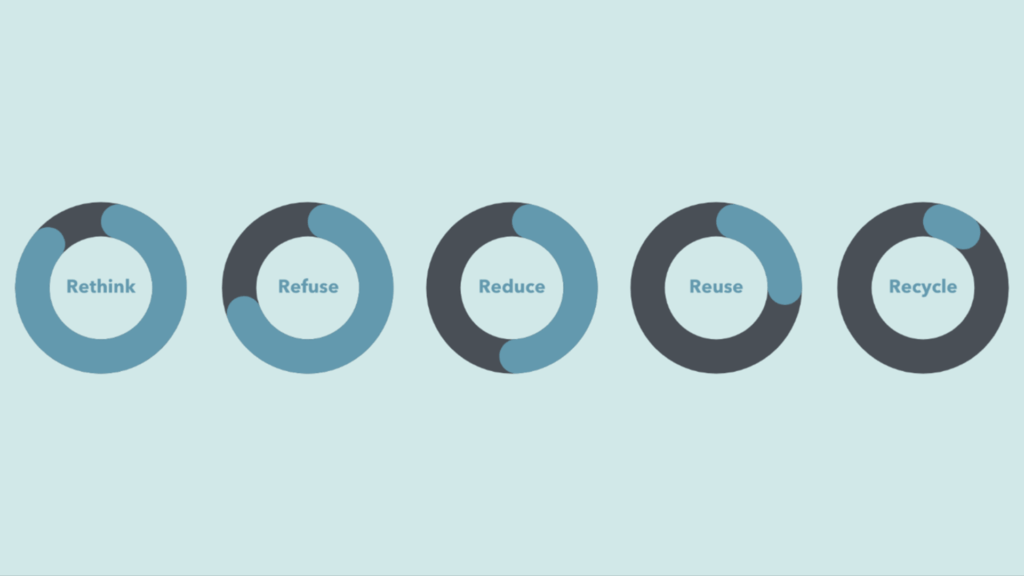
Our Plastic Intelligence Framework – which breaks down a hierarchy of actions; The 5 R’s: rethink, refuse, reduce, reuse, and recycle – can be used to guide consumer decision making around plastics

Ocean Generation has developed a Plastic Intelligence Framework that outlines the most impactful ways individuals can make a positive impact and curb their waste generation. The 5 most impactful ways we can address plastic pollution in order of positive impact are: Rethink, refuse, reduce, reuse and recycle.

The order of these actions is deliberate, with the most impactful change being to rethink, followed by refuse, reduce, reuse, and finally recycle.  

Utilising the 5R framework, we can also address broader sustainable consumption. How? What do these steps actually involve? Let’s start from the top.  

How to be a more environmentally conscious consumer:    

1. Rethink your relationship with products 

To do this, we need to remember that our ‘needs’ may differ from our ‘wants’. Have a think about what items you consider to be essential for your well-being and happiness.  

Advertising and media influence the perception what we ‘need’. It is our responsibility to acknowledge this and form our own opinions about what items are necessary in our lives.  

If you decide that you do really need an item, then that’s okay! The focus of rethinking is to slow down consumption. This is achieved by taking a moment to consider our relationship with items. 

2. Refuse to purchase unnecessary items.  

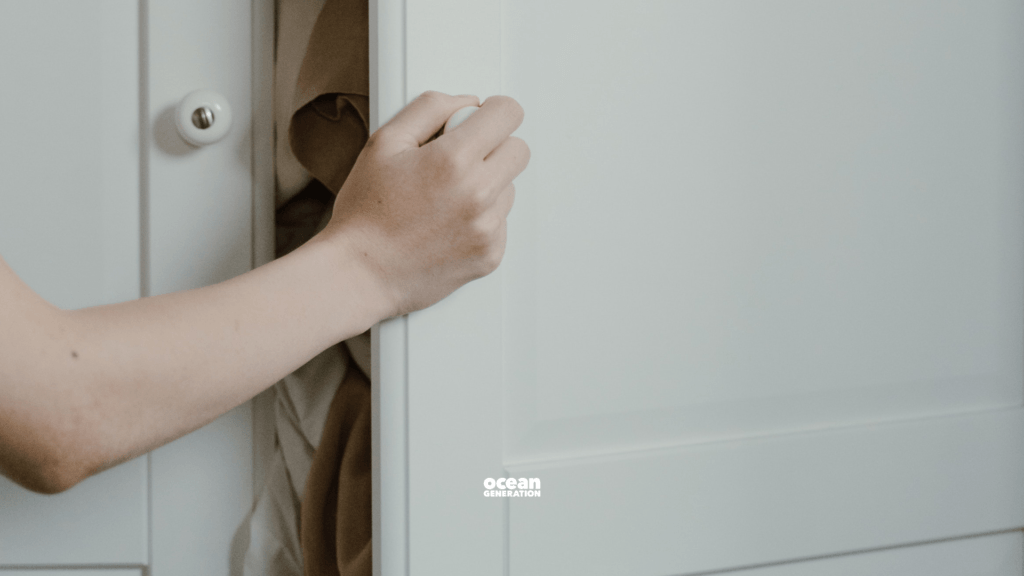
Female hand trying to force and over-full closet closed. The image symbolises our overconsumption habits when it comes to fashion and shopping.

Is an item of clothing part of a fast fashion trend, destined to be worn once then live at the back of your wardrobe until it is discarded?  

Do you really need multiple devices, or will one do the job? 

Refusing to purchase unnecessary items minimises waste produced.  

3. Reduce your overall consumption. 

If you find yourself needing to buy something, then where possible, opt for quality over quantity.  

If a product is low-quality, it is likely to be less durable and have a shorter useful lifespan. Question if you need the low-quality item. Can you wait until you have the resources to buy a better-quality product; built to last longer?

The result? Less waste. 

4. Reuse products to extend their lifespan.  

Reuse can take many forms.  

In the world of textiles, renting, remaking, repairing, and reselling are all part of the transition to ‘slow’ fashion. Online resale and rental platforms are becoming increasingly popular, along with second-hand shops and upcycled items.  

Explore repairing your damaged items before discarding them. It is never too late to learn how to sew a button. For more complex repairs, such as of household appliances, try checking out a local repair workshop.  

Before buying new appliances, consider refurbished items (products that are repaired/restored to working condition) or remanufactured items (used products that get dismantled, their worn parts replaced, and reassembled to like-new condition).  

Ultimately, reusing items decreases demand for resource extraction and minimises waste. 

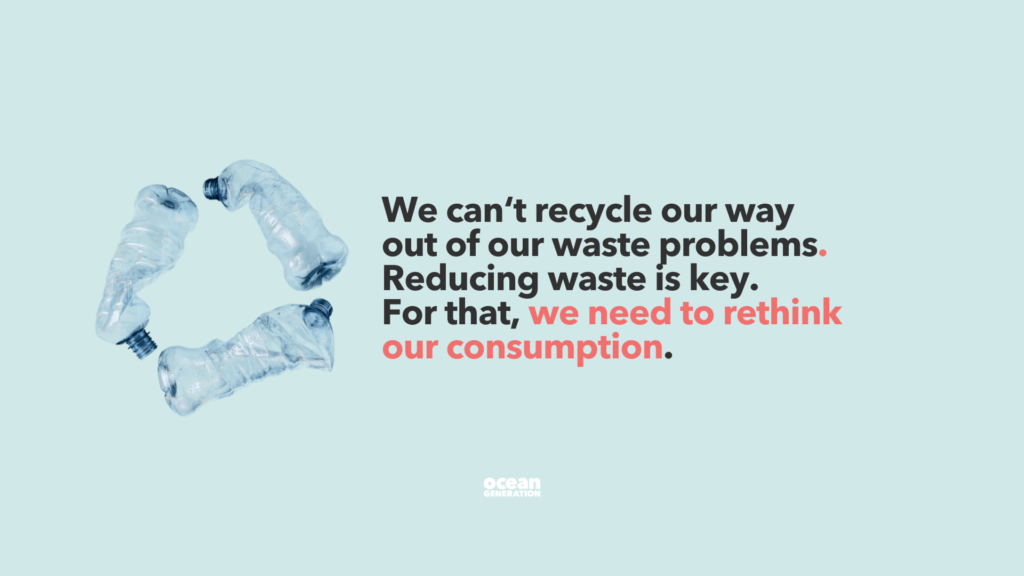
We can't recycle our way out of our waste problems. Reducing waste - at its source - is key. To achieve that, we need to rethink our consumer behaviour.

5. Recycle at designated points.  

Remember that while the rethinking, refusing, reducing, and reusing are more impactful, recycling is still a valuable process. This is because again it reduces the amount of waste generated.  

If an item is truly at the end of its lifespan, recycle it at a designated recycling point.  

We don’t have to be perfectly zero-waste or plastic-free consumers to make a positive difference   

However, what we all must do is start making changes. Here are 20 ways to address your daily plastic waste on a daily basis to get you started.


From classroom to COP30: Questions from children to climate leaders about Ocean protection

Subscribe

Monthly: Impact in your inbox.

OceanGeneration-Join

The History of Fast Fashion

Green leaf poking out of a jean pocket, representing sustainable fashion. Shared by Ocean Generation.

A brief history of fast fashion and its impact on the planet. 

100 billion items of clothing are produced every year. That’s a 50% growth in just 15 years and the main culprit for this growth – fast fashion – shows little sign of slowing down. 

We’ve stitched together a brief history of fast fashion; from when fashion become fast, the impact it’s had on our blue planet, and what we can do to become sustainable fashion devotees.  

First: What is fast fashion?

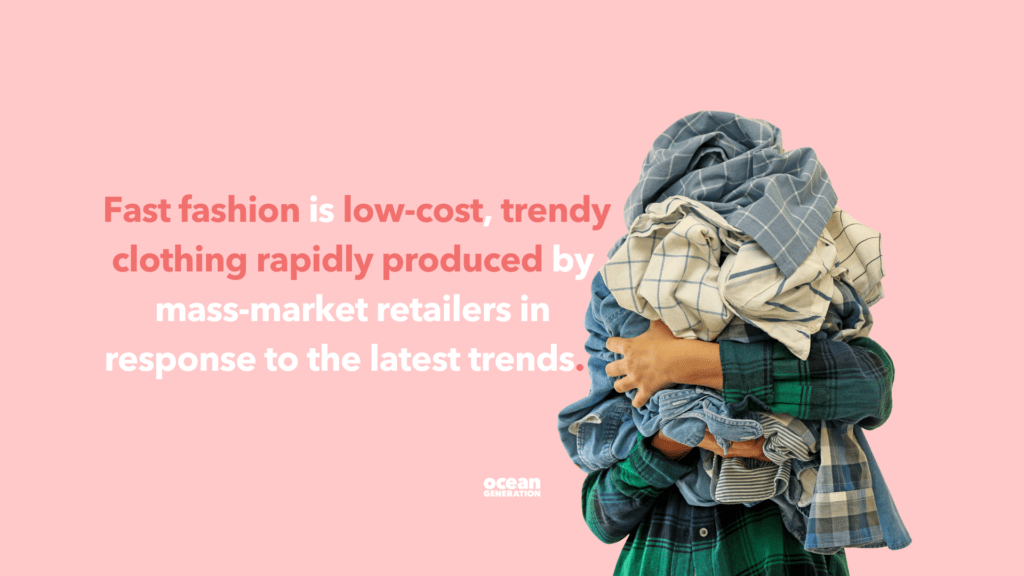
Fast fashion can be defined as low-cost, trendy clothing rapidly produced by mass-market retailers in response to the latest trends.  

The focus of fast fashion is affordability and convenience – largely at the cost of people and the planet.  

Fast fashion plays into the idea that outfit repeating is a fashion faux pas. If you want to stay relevant, it’s believed you should be sporting the latest looks while they’re happening.  

Overproduction and overconsumption has resulted in the fashion industry being one of the world’s largest polluters. Jump here to read about the environmental impact of fast fashion.  

But how did we get here?  

Definition of fast fashion: Fast fashion is low-cost, trendy clothing rapidly produced by mass-market retailers in response to the latest trends. Fast fashion has a massive impact on our planet. Ocean Generation is sharing a brief history of fast fashion.

Once upon a time, in a slow fashion world

More than 20,000 years ago, people began hand sewing; using animal bones and horns as needles.  

Up until the early 1800’s, most people raised sheep or saved up to purchase wool to spin yarn to weave cloth and hand sew… You get the idea. 

Adding garments to your closet was a slow, infrequent process, driven by seasonal changes and growing pains. 

When was the first sewing machine invented?

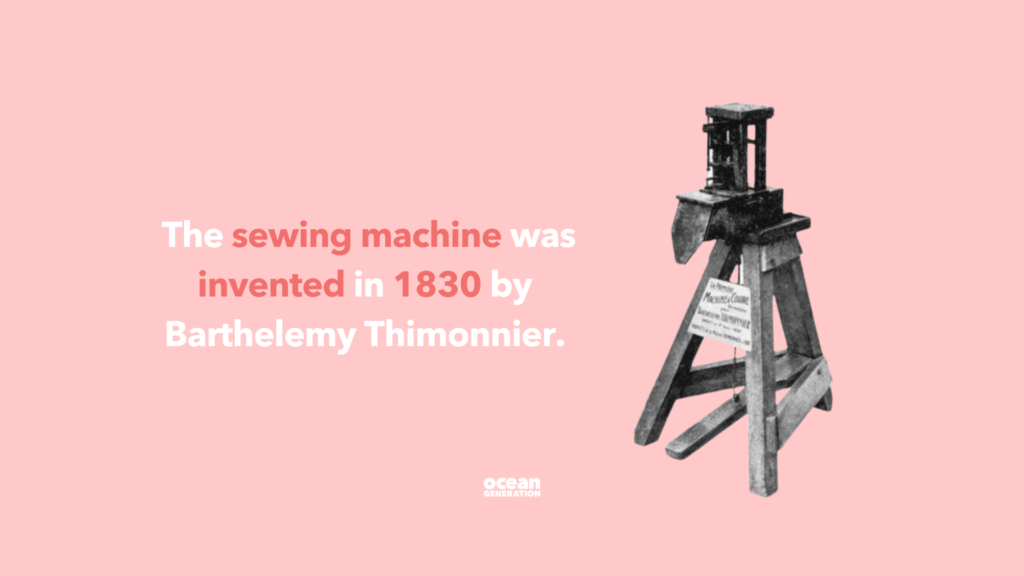
It was only in 1830 – during the Industrial Revolution – that the fast fashion story really starts with the invention of the sewing machine. 

Barthelemy Thimonnier, a French tailor, invented a sewing machine that used a hooked needle and one thread to create a chain stitch (which is still commonly used in denim jeans). 

The first sewing machine was invented in 1830 by
Barthelemy Thimonnier. It had a hooked needle and created a chain stitch, which is still used on jeans today. Shared by Ocean Generation in the history of the fashion industry article.

With the advent of the sewing machine, clothes became easier, quicker, and cheaper to make. Clothing began to be made in bulk, in various sizes, rather than just being made to order. 

Dressmaking shops emerged to cater to the middle classes and – for the first time – people started wearing clothing for style, not just practical reasons.  

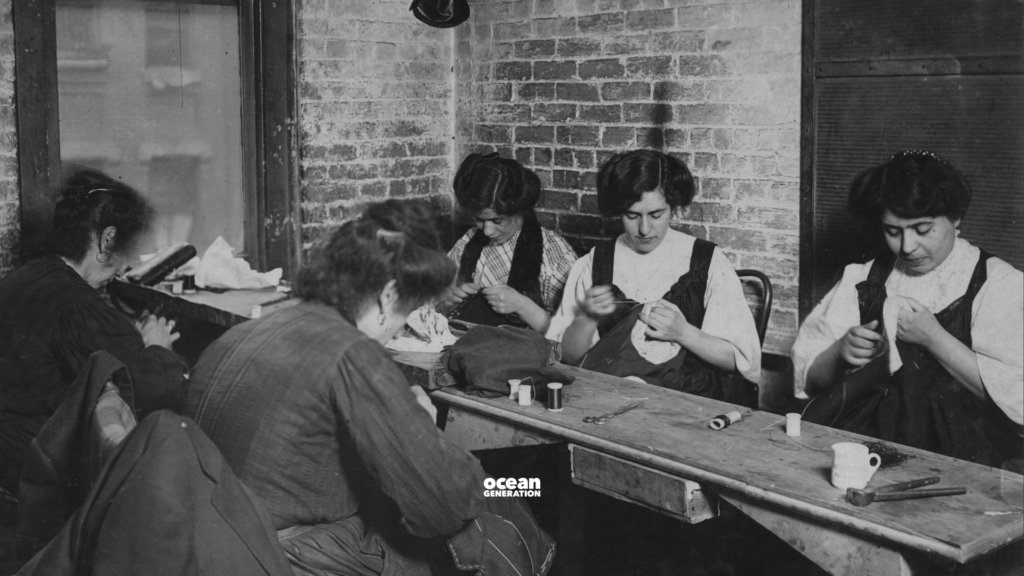
The fashion industry used to be slow. Sweatshops were the beginning of the end of that.

Shared by Ocean Generation this is a sweatshop of Mr. Goldstein, 30 Suffolk Street, New York City, photograph by Lewis Wickes Hine, February, 1908

What is a sweatshop?

Sweatshops are factories or workshops, especially in the clothing industry, where manual workers are employed at low wages for long hours and poor (or downright illegal) working conditions. 

To cater to the demand for clothing, sweatshops emerged in the 1800’s (and don’t be fooled: They still exist today.) 

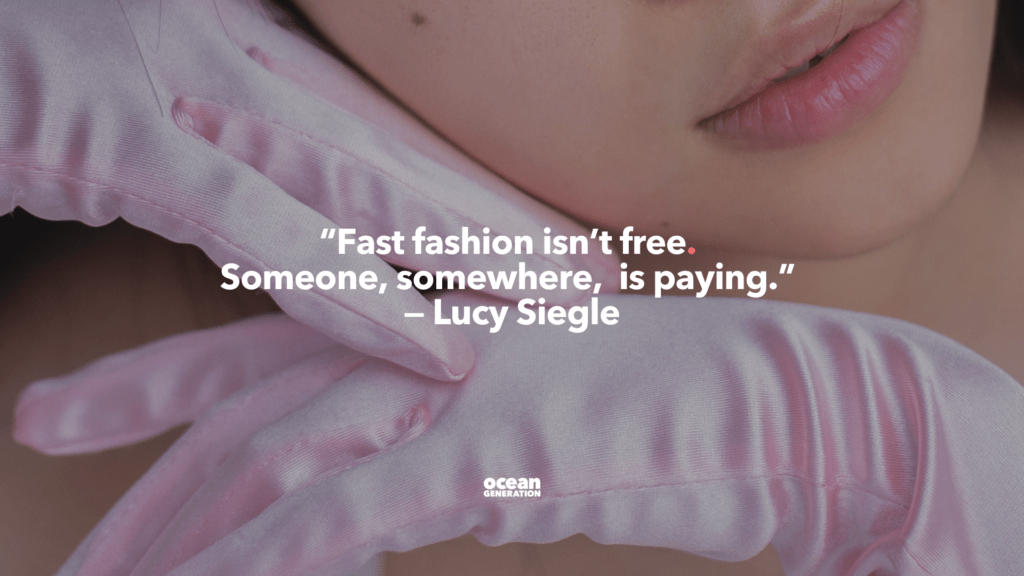
“Fast fashion isn’t free. 
Someone, somewhere,  is paying.” 
Quote by Lucy Siegle regarding the fashion industry. In the image, an asian woman wears pink gloves poised under her chin.

Clothing becomes a form of personal expression: 1960s

By the 1960s and 1970s, young people were creating new trends and using clothing as a form of personal expression. 

There was increasing demand for affordable clothing. Textile mills opened across the developing world, and low-quality, mass-produced clothing took over.  

Shopping for new clothes became a hobby and a means of social status.  

When was the term fast fashion coined? 

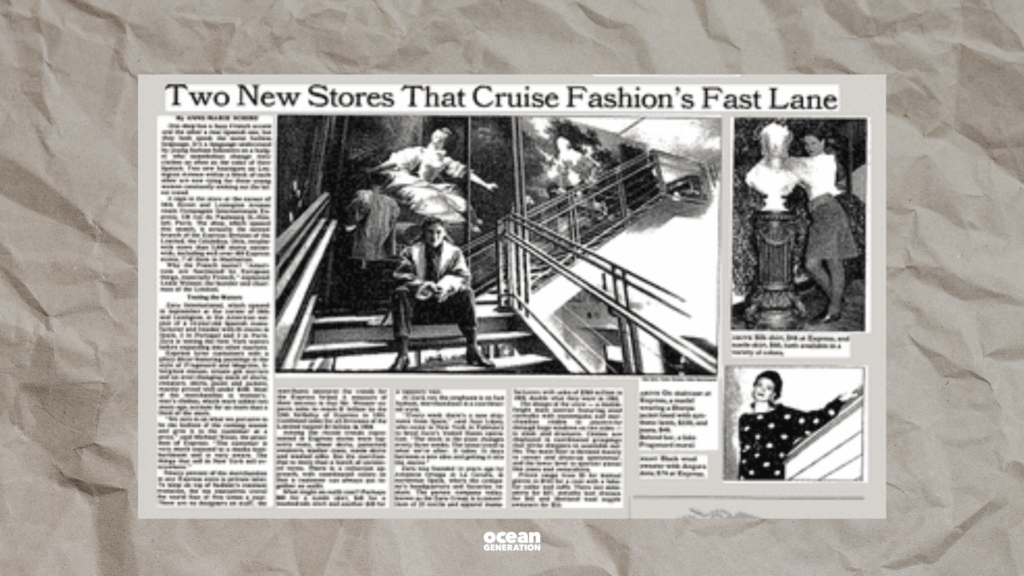
In 1990, the New York Times published an article using the term ‘fast fashion’ for the first time. The piece was about a new fashion retailer with a mission to transform a garment – from an idea in the designer’s brain to being sold on racks in store – in only 15 days.  

This was the first article ever published using the term fast fashion. In 1990, the New York Times published an article about Zara stores coming to New York. Ocean Generation is sharing the impact of fast fashion on the planet.

It’s safe to say fast fashion had arrived.  

By the mid-1990s, online shopping took off – accelerating what was already a dizzying rate of textile consumption.  

No matter where you are in the world, chances are: If you see an outfit you like, online, you can buy it and have it on your doorstep in days. But at what cost?  

Two sets of socked feet are up in the air. One pair of feet is wearing green socks and the other is wearing mustard yellow socks. They are both wearing white strappy high heels and blue jeans.

Being fashionable shouldn’t cost the earth.  

All areas of fast fashion – super speedy production, use of synthetic fibres and dangerous chemicals, and competitive pricing – have massive negative impacts on our blue planet and the people involved in garment manufacturing.  

What’s more: Rapidly changing trends and clothing available at shockingly cheap prices instils a throw-away culture; as though clothing isn’t meant to be long-lasting or worn more than a few times.  

5 fast facts about fashion’s environmental impact.

And that’s the tip of the iceberg.

We’ve hardly touched on overconsumption, water usage, waste and haven’t even mentioned microplastics yet.  Read more about the impact of textiles on people and the planet.

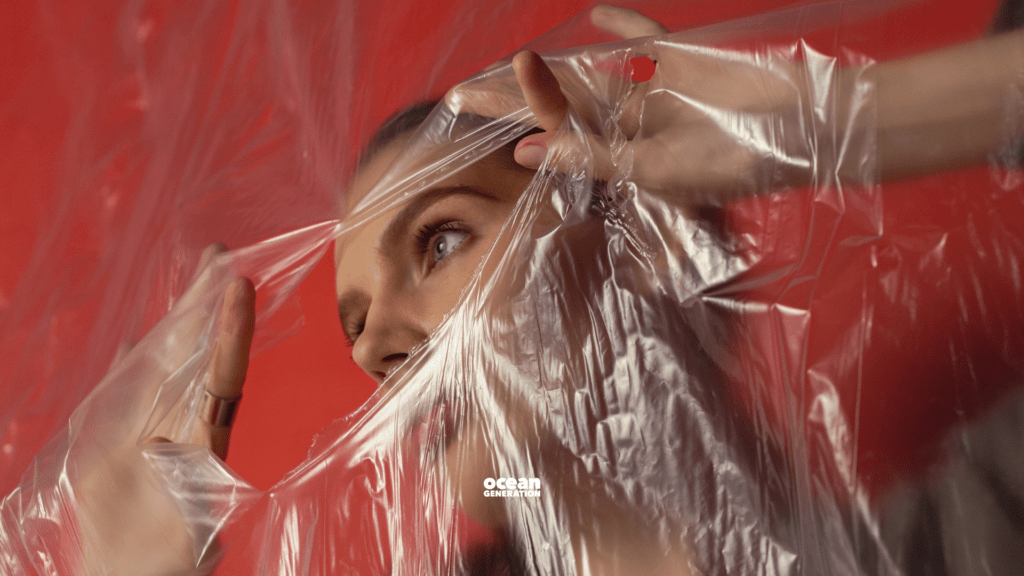
Woman breaking through a piece of clear plastic with her hands. Learn about plastic pollution with Ocean Generation.

How does fast fashion impact the Ocean?  

Textiles in the fashion industry generally fit into two categories: Natural and synthetic.  

Natural materials (like wool and cotton) are made from plant and animal sources. They tend to be more expensive and last longer.  

Fast fashion relies on the cheaper (less, environmentally friendly) option: Synthetic materials. You’ll recognise these plastic-based materials in your clothing: Polyester, acrylic, and nylon. 

Synthetic fibres make up almost 60% of annual fibre consumption. Said differently: Our clothes are around 60% plastic. 

More than ever, our clothes are made of plastic. Just washing them can pollute the Ocean.  

Rainbow over the Ocean. It's like the Ocean is a pot of gold and really: it is. Our Ocean provides us with many resources and produces half the oxygen on Earth. Learn about the Oceans with Ocean Generation.

These synthetic fibres produce non-biodegradable waste that pollute the Ocean. How? A single 6kg laundry load releases up to 700,000 synthetic microfibres which pass through our drains and into our Ocean. 

Once in the Ocean, microfibres are ingested by Ocean life and end up making their way back up the food chain, to us, and pose numerous health risks.  

We can put fast fashion out of style.  

More and more, consumers are demanding sustainable clothing and calling out the true cost of the fashion industry. As a result, we’re starting to see some changes in the fashion industry, but there’s a long way to go.  

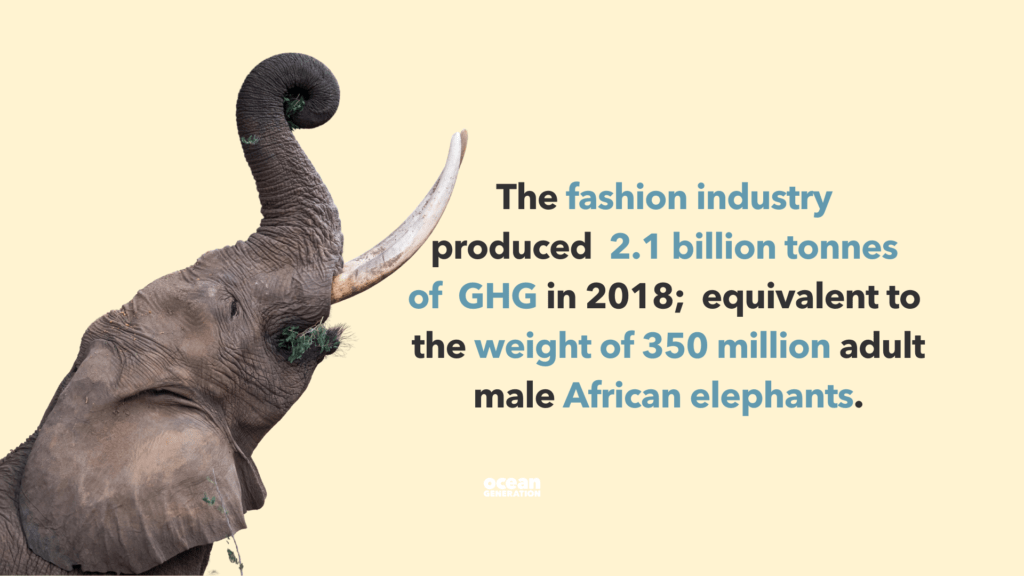
As recently as 2018, the fashion industry produced ~2.1 billion tonnes of greenhouse gas (GHG) emissions globally. Luckily for us, we can all directly influence the fashion industry and the impact it has.

As individuals, the first thing we need to tackle is our relationship with consumerism. 

Asian woman surrounded by a pile of clothing. Just her face showing amongst all the clothing and textiles. This photo represents the overconsumption in the fashion industry.

“What can I do to tackle fast fashion?” 

  • Continue to learn about how to spot fast fashion brands (then steer clear of them). 
  • Embrace buying less fast fashion items. (In a week or two, that item will be out of fashion anyway, right?) 
  • When you do shop for clothing, ensure you’re purchasing with long-term wear in mind. 
  • Support responsible, ethical clothing brands.  
  • Buy second hand. 
  • Only wash your clothes when they’re actually dirty.  
  • Be an outfit repeater (re-wear your clothing until it really is end-of-life). 
  • Repurpose clothing when they’re end-of-life. 
  • Remember that the most sustainable piece of clothing you have is the one already in your closet
  • Join the Wavemaker Programme for tools to accelerate your social actions. 
  • Subscribe to our newsletter for Ocean news, stories, and science.  

From classroom to COP30: Questions from children to climate leaders about Ocean protection

Subscribe

Monthly: Impact in your inbox.

OceanGeneration-Join

The impact of fashion on people and planet: What we purchase

What's the impact of fast fashion on the environment? Ocean Generation is diving into fast fashion, textile production, where clothing actually goes when we recycle it and how we can all be sustainable fashion lovers. Image is of three ethnically diverse and fashionable women, looking off into the distance. They're each wearing a power suit.

What you need to know about the environmental impact of the textiles in fashion.

Textiles – including clothing and footwear – are an everyday essential across the world. Our clothes can not only keep us warm in the cold, dry in the rain, and protect us from the sun, but they can also be an invaluable way to express ourselves through fashion. 

Despite their prevalence in our lives, it can be easy to overlook where our textiles come from, and the impact that fashion items have on both people and the planet.  

In this article Ocean Generation is sharing the impact of fashion on the environment. In this image a woman in a bright, flowing yellow dress is at a skatepark. You cannot see her face but you can see her black sneaker resting on the skateboard.

Let’s look deeper into the textile industry by discussing the following key areas:  

  • Overconsumption 
  • Environmental Impacts of Textiles 
  • Societal Impacts of Textiles 

What are the origins of the textiles that we know and love? 

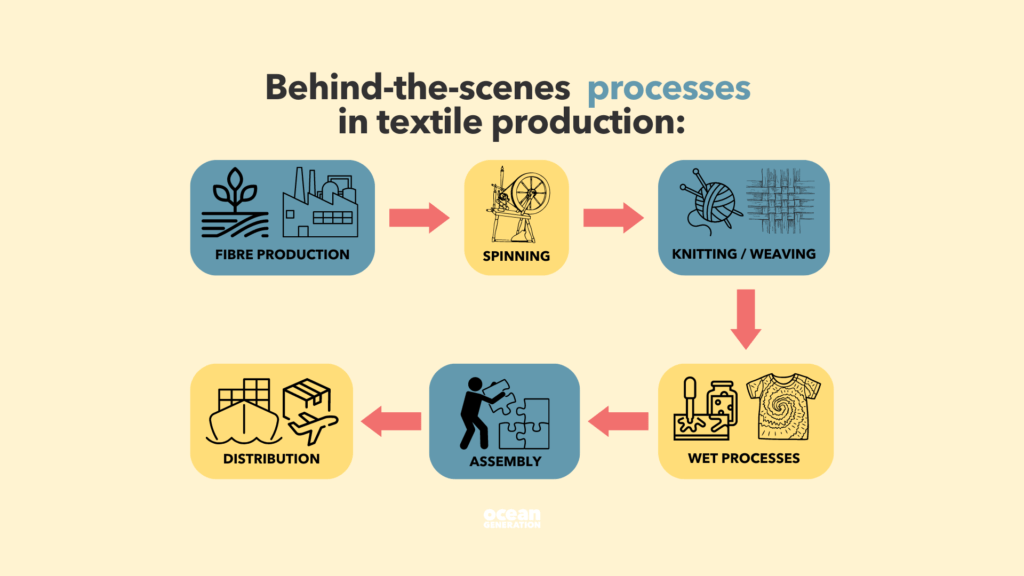
It is important to consider the behind-the-scenes processes involved in textile production and distribution. These are illustrated below. 

Infographic describing the behind-the-scenes processes in textile production: fron fibre production, spinning, knitting to wet processes, assembly and distribution. This article looks at the impact of fashion and textiles on the planet.

What’s the impact of overconsumption in fashion? 

With the rise of fast fashion and increasing connectivity in this digital world, getting swept up in fashion trends has never been easier.  

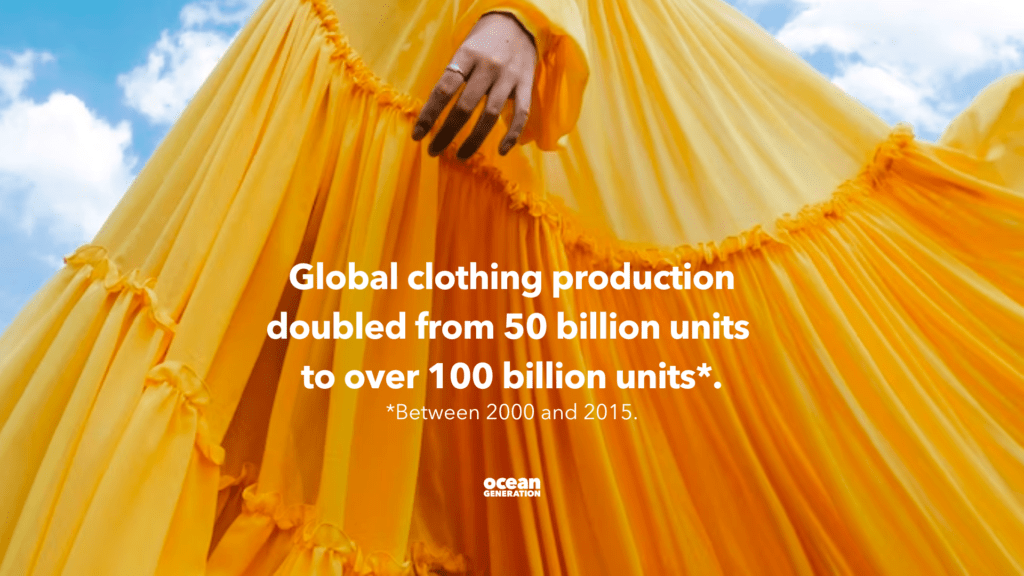
But let’s slow down for a minute to think about our changing consumption habits. Between 2000 and 2015, clothing production doubled from ~50 billion units to over 100 billion units. This trend is driven by an increasing middle-class population globally and rising per capita sales in mature economies.  

Why are sales rising? Fast fashion is the prime culprit here.  

The fast fashion phenomenon began in the 1990s, with low-priced and short-lived items being generated by cheap manufacturing. Today, influencers on various digital platforms often promote rapidly changing trends, driving frequent consumption.  

On top of this, we wear clothes significantly less during their lifespans. This is not without considerable economic loss, with US$ 460 billion of value lost globally each year from people throwing away clothes they could still wear.  

Hands working with a sewing machine. A piece of navy fabric is being transformed into a piece of sustainable fashion. Shared by Ocean Generation - experts in Ocean health since 2009.

How do textiles and the fashion industry impact the environment?  

It isn’t just the economic loss that is a problem, however, as textile production, use, and disposal have significant environmental impacts which we’ll explore next.  

In 2018, the fashion industry produced ~2.1 billion tonnes of greenhouse gas (GHG) emissions globally. This weight is equivalent to that of 350 million adult male African Savanna elephants. GHG emissions are important to consider as they contribute to climate change.  

The textile value chain (the whole product lifecycle) is notoriously water intensive, consuming 215 trillion litres of water annually. This is equivalent to 86 million Olympic-size swimming pools.  

The fashion industry produced 2.1 billion tonnes of GHG in 2018; equivalent to the weight of 350 million adult male African elephants.

Overexploitation of our finite water sources can lead to major environmental disasters. An example of this is the Aral Sea Crisis, where water extraction for cotton irrigation desiccated what used to be the fourth largest lake in the world. 

Chemical contamination of textile wastewater is an environmental concern. The textile industry uses over 15,000 chemicals, many of which are harmful to the planet. Toxic substances such as reactive dyes and heavy metals often pollute local aquatic ecosystems.  

Did you know that washing textiles releases microfibres into the environment?   

All textiles are culprits, whether natural (such as cotton), semi-synthetic (including viscose) or synthetic (for example polyester).  

It was found that an average 6kg wash load of synthetic acrylic fabric releases over 700,000 fibres. These microfibres have been found in a range of environments, from the deep sea to Mount Everest, and can be ingested by aquatic organisms including sea cucumbers and hermit crabs.  

So far, we have investigated the impact of textile production and use on the environment.

What is the fate of discarded textiles?

In 2015, just 13% of total material input was recycled following clothing use. Most post-consumer waste is instead incinerated, landfilled, or exported to developing countries to be sold in second-hand markets.

Infographic from Ocean Generation sharing the fate of discarded clothing. Only 13% of clothing is actually recycled - the majority is exported to developing countries, incinerated or landfilled.

This is not to mention the pre-consumer waste comprised of new, unworn, or returned clothes that fail to be worn by consumers. The result? The accumulation of enormous quantities of textile waste.  

What are the societal impacts of textiles?  

While textiles are undeniably harmful to the planet, their production, use and disposal can have negative impacts on people too.  

The untreated textile wastewater that pollutes aquatic ecosystems also harms the communities using contaminated water systems for fishing, washing, and drinking.  

Breaking news: Plastic has been found in our lungs, blood, and even breast milk. Ocean Generation - experts in plastic pollution - share facts about plastic and the harms of plastic on human health.

Microfibres released into our waterways infiltrate human diets via tap water, beer, sea salt, and seafood, and have even been detected in human lungs.  

Textile waste exported to developing countries is sorted for sale in second-hand markets by low paid workers in unsafe conditions.  

The impacts of the textile industry are unevenly distributed, with the brunt being taken by developing countries where textile and garment manufacturing occurs. This is despite consumption primarily occurring in developed countries.  

Sounding familiar? The fate of textile waste mirrors that of both plastic and electronic waste.  

Global clothing production doubled from 50 billion units to over 100 billion units between 2000 and 2015. Fast fashion facts shared by Ocean Generation.

So, what is being done to repair the environmental impacts of the textile industry?  

There has been progress at reducing the environmental impact of the textile industry at various stages, from treating textile wastewater using plants to the degradation of textile waste by enzymes produced by bacteria and fungi.  

While these innovations are exciting, further development is needed before wider use.   

In the meantime, increasing awareness of the negative environmental and societal impacts of the textile industry has resulted in rising interest of new business models. Reselling, renting, repairing, and remaking increase product lifetimes, and this is a vital step in the move towards ‘slow’ fashion.

What is my role in the future of sustainable fashion – specifically, textiles?

You, as a textiles consumer, can drive change.

Here’s what action you can take:

  • Try to rethink your relationship with clothes. Some helpful tips on how to become a slower, more mindful consumer can be found here: How to take the fast out of fast fashion
  • Have a think about whether you need and will value that garment before making a purchase.  
  • Browse a second-hand shop before buying new.
       
  • Refuse to purchase unnecessary or low-quality, less durable clothes where possible.  
  • Think before putting your clothes in the wash. If possible, air out clothes or hand wash to remove specific stains. Try to avoid tumble drying too.  
  • Look into washing machine filters or washing bags designed to catch microfibres. 
  • Explore renting, leasing, updating, repairing, or reselling textiles to extend their lifespan. 
  • Try your hand at simple textile repairs, such as sewing buttons or patching up a hole, either by teaching yourself or attending a local repair workshop. 
  • If your garment is truly at the end of its lifespan, recycle it at a designated recycling point. 


From classroom to COP30: Questions from children to climate leaders about Ocean protection

Subscribe

Monthly: Impact in your inbox.

OceanGeneration-Join

The rise of e-waste and what we can do about it: What we purchase.

Old TV set in a wheat-field. Ocean Generation is sharing facts about the rise of e-waste, the environmental impacts, and what we can do about it.

What you need to know about the environmental impact of e-waste.

Appliances are a marker of technological advancement and play a significant role in many of our lives. While they can be beneficial, it is important to consider the impact that these appliances, as e-waste, have on both people and the planet.  

Imagine your typical day, what appliances do you use? Do you work using a laptop or browse social media on a phone? Maybe you use a washing machine to do your laundry? Or perhaps you listen to music using headphones or use a refrigerator to keep your food fresh? 

Globally, the consumption of Electrical and Electronic Equipment (EEE) is rising by 2.5 million metric tons (Mt) each year (excluding solar electricity panels). This is due to higher disposable incomes, more people living in towns and cities, and further wide scale development of industries.  

In this article Ocean Generation is sharing facts about the rise of e-waste, the environmental impacts of e-waste, and what we can do about it.

What is e-waste

Despite increasing government influence over how discarded electronics (known as ‘e-waste’) is dealt with, and innovative e-waste recycling strategies, the sheer quantities and hazardous contents of e-waste remains a concern. 

We will discuss three main areas of interest when it comes to the impact of appliances:  

  • Use of Natural Resources 
  • Creation of E-waste  
  • Impact of E-waste 

What kind of materials can be found in appliances? 

Many materials are used to build the appliances that we know and love.  

From precious gold to hazardous mercury, up to 69 out of the 118 elements from the periodic table can be found in EEE.  

Depleting these limited natural resources is an issue in and of itself, not to mention the greenhouse gas emissions associated with resource extraction which contribute to climate change.  

The variety of materials in appliances also make it much more difficult to deal with e-waste, and we will return to this issue after discussing how e-waste is generated.  

How is e-waste created?

What happens when appliances are no longer used?  

Disposal of ‘obsolete’ appliances contribute to e-waste. This is one of the fastest growing solid waste streams in the world, with 53.6 Mt of e-waste generated globally in 2019 and expected growth to 74.7 Mt by 2030.  

To put this into perspective, the weight of e-waste that we produced in 2019 is equivalent to that of 53,600 blue whales, with an expected increase to the weight of 74,700 blue whales in 2030.  

Image of a blue whale in the the Ocean - Earth's biggest mammal. The text reads: The weight of e-waste produced in 2019 is equivalent to the weight of 53,600 blue whales. Facts shared by Ocean Generation.

What is causing growing quantities of e-waste?  

You may have heard of the term ‘planned obsolescence’.

This refers to goods being produced with intentionally short useful lifespans, encouraging consumers to buy a replacement sooner than they should have to.  

Planned obsolescence is one of the big contributors to the rise of e-waste, and examples can be found throughout the tech world, from the deliberate slowing down of smartphone processors to companies frequently creating new models to make old ones seem unfashionable.  

This new ‘normal’ perception of appliances having short lifespans fuels unnecessary consumption.  

What’s the environmental impact of e-waste? 

But why does it matter that e-waste is on the rise? In short, e-waste is problematic because of low recycling rates, export to developing countries, and the environmental and human health risks associated with improper e-waste management.  

Below is the fate of e-waste generation in numbers:  

Infographic from Ocean Generation. In 2019, 17.4% of e-waste generated was formally documented as collected and recycled. 82.6? of e-waste had an undocumented fate.

Many disposed appliances end up in landfill or incinerators in developed countries or are exported to developing countries.  

Ocean Generation shares an infographic asking what happens to the 82.6% of undocumented 
e-waste? In 2019, 8% was landfilled or incinerated and between 7-20% was exported to developing countries.

The lack of e-waste recycling means more raw materials are extracted to meet the growing demand for electronic products.  

Additionally, as seen with plastics and textiles, the export of e-waste to be dealt with by informal sectors (unregulated economic activities outside government control) in developing countries is a major issue. 

Out of sight, out of mind? No longer.  

Despite the efforts of the Basel Convention to restrict the transport of hazardous waste between countries, e-waste exporters often exploit loopholes, such as by labelling shipments as “charitable donations” or by claiming that the e-waste is “repairable”.  

The consequence?

Informal sectors in developing countries are dumped with large quantities of e-waste. Low paid workers in unsafe conditions process this e-waste using rudimentary techniques including manual disassembly, open incineration and acid dipping. Their aim is to tap into the literal gold mine of valuable resources hidden amongst this waste.  

Did you know: Up to 69 of the 118 elements in the periodic table can be found in electronic e-waste.
Infographic shared by Ocean Generation.

However, while there are valuable materials to be retrieved, e-waste also contains many hazardous substances which endanger the environment and humans alike.

Pollution of soil, air, and water with flame retardants and heavy metals (such as lead, copper, and cadmium) negatively impacts a variety of organisms, including reptiles, fish, crustaceans, and birds.  

Not only is wildlife impacted, but these dangerous substances also harm humans both through direct contact with workers and by making their way into the food and water that civilians consume.  

For example, the levels of lead and cadmium in polished rice from an e-waste recycling area in Southeast China were found to be 2-4 times higher than what is considered safe. Drinking water in this area was also contaminated, containing levels of lead up to 8 times higher than the local drinking water standard.  

So, what is being done to tackle the environmental impacts of e-waste?  

While 71% of the world’s population was guided by some form of national policy, legislation, or regulation to govern e-waste in 2019, this equates to less than half the countries in the world.  

This means that there is still much progress to be made until e-waste is sufficiently managed across the world.  

Interestingly, valuable materials can be extracted from e-waste using bacteria and fungi, but these recycling techniques still have some way to go before they can be scaled up.  

How can I become a conscious appliance consumer   

Having a responsible relationship with appliances is possible.  

  • Remember that a ‘want’ may differ from a ‘need’, so question whether you actually need that appliance before purchasing it.  
  • Refuse to purchase unnecessary or low-quality appliances where possible.  
  • When purchasing appliances, investigate refurbished items (products that are repaired/restored to working condition) or remanufactured items (used products that get dismantled, their worn parts replaced, and reassembled to like-new condition) before buying new.  
  • If your appliance breaks, consider repairing it yourself or booking a certified repair service.  
  • If your appliance is at the end of its lifespan, recycle it.


From classroom to COP30: Questions from children to climate leaders about Ocean protection

Subscribe

Monthly: Impact in your inbox.

OceanGeneration-Join

The History of Climate Change

A century of climate science history: Explained.

These days, you can’t go a week without the impacts of climate change making headlines – but that wasn’t always the case. When climate science first appeared in the media, it was batched with conspiracy theories and radical ideas.  

Now, we know better.

We’re hopping in a time machine to unpack the history of climate change, greenhouse gasses, global warming, and why climate skeptism existed for so long. 

When did climate science first make the news

Over a hundred years ago (hello, 1912), the Titanic set sail and sank, zippers were invented, Oreos were created. And Breaking News: Climate change entered the news for the first time.  

This caption appeared in the March 1912 publication of ‘Popular Mechanics’, directly linking burning coal and global temperature change: 

Snapshot of a caption that appeared in the March 1912 publication of ‘Popular Mechanics’, directly linking burning coal and global temperature change.

Several months later, on 14 August 1912, a paper in New Zealand re-shared the now-famous caption. They titled it: “Coal Consumption Affecting Climate.”

But before these publications, fundamental climate science was already understood.  

On 14 August 1912, a paper in New Zealand re-shared a now-famous caption titled: “Coal Consumption Affecting Climate.” 

Burning coal and climate change, for the first time, were linked in the media. Shared bY ocean Generation experts in Ocean health and inclusive environmental learning.

Scientists understood how greenhouse gasses contributed to rising temperatures in 1856.

What is the greenhouse gas effect and who discovered it? 

The greenhouse gas effect is how heat is trapped close to the Earth’s surface. Trapped by what? Greenhouse gas molecules like carbon dioxide, methane, and nitrous oxide.  

John Tyndall, an Irish physicist, is commonly miscredited with discovering the greenhouse effect.  

In 1856 (three years before Tyndall’s work was published), Eunice Foote, an American scientist, concluded certain gasses warm when exposed to sunlight. She concluded that rising carbon dioxide levels would lead to atmospheric changes, which could impact the climate.  

Human activity was suggested as the main driver of climate change in 1896.

Svante Arrhenius, a Swedish scientist, suggested that as humanity burned fossil fuels (non-renewable energy sources like coal, crude oil and petroleum), which added carbon dioxide to the atmosphere, we’d raise the planet’s average temperature. 

Over 100 years ago, the science was there. Why does it feel like we’re only waking up now? 

Climate science wasn’t accepted by the public.

We can point to these news articles and research pieces and say, “It’s been a century! Why was nothing done?” But climate change began on the fringe of society. The science – and these scientists – weren’t taken seriously.  

“Humans? Impacting the planet? No way!” – someone in 1912, probably.  

Turning our backs on fossil fuels, which were building the modern world, seemed outlandish. When the world went to war in 1914, the topic lost momentum and only picked up again in the 1930’s. 

Ocean Generation is sharing the history of climate change. In this image, which is horizontally split in two, two sets of hands hold symbols of the modern world: a light bulb and a globe of Earth. The bottom image is of smoke rising from a factory, symbolising the connection between burning fossil fuels and the modern world.

The origin of global warming.

In 1938, Guy Callendar caused a stir in the science world when he put together weather observations and concluded that global average temperatures had already increased. 

Callendar was the first person to clearly identify a warming trend and connect it to carbon dioxide in the atmosphere. He was shunned by the science community for his research which became known as “the Callendar Effect.”  

Today, we just call it global warming. 

How does climate change impact our Ocean? 

The Ocean absorbs much of the sun’s heat which helps regulate land temperature and drive global weather patterns. More than 90% of the heat from global warming is stored in our Ocean. That makes the Ocean one of the most important carbon sinks on Earth.  

But this continual heat absorption is changing the characteristics of the Ocean. (Spoiler: not in a good way). Those changes have massive impacts on all life on Earth. 

Scroll: The 7 climate change indicators we’re seeing in the Ocean. 

How does climate change impact the Ocean? Ocean Generation has the answers. In this horizontally split image half is made up by an orange sunset, in the bottom image a scene under the Ocean is captured: there are vibrant corals and clown fish.

Why was climate scepticism so strong for so long?  

Scientific coverage in the media that pointed to the reality we all know now – that human activity is a key driver of climate change – was often published alongside pieces that were sceptical of such facts. 

As recently as 2003, it was covered that global warming amplified death tolls in the 2003 European Heatwave. In the same year, at a speech given on the US Senate floor, a former Chair of the Environment and Public Works Committee called climate change, “The greatest hoax ever perpetrated on the American people.”  

With contradicting statements everywhere, people believed that the jury was out on climate change. We know better. 

The best time to take climate action was in 1912.

The second-best time is right now and every day from now. Because the history of climate change is just that: History.

Each decision we take, today, tomorrow, in three weeks or four years, sets up the future health of our blue planet.  

A hand reaching out above a body of water. The hand's reflection looms below. Shared by Ocean Generation.

Actions you can take to fight climate change.

From classroom to COP30: Questions from children to climate leaders about Ocean protection

Subscribe

Monthly: Impact in your inbox.

OceanGeneration-Join

The Ocean is turning green because of climate change

Breathtaking image of an Ocean wave breaking. The wave has a green hue. In this article, Ocean Generation explains why our Ocean is turning green because of climate change.

Over 56% of the Ocean is turning green.

More than half of our Ocean has changed colour in the last 20 years, turning more green than blue. (That’s more than Earth’s total land area.) The culprit? Climate change.

Nature published a study in July ’23 that analysed two decades of research which we’ve translated into a 5 minute read about why the Ocean is changing colour and why we should care.

More than half of the Ocean is turning green. It's changed colour in the last 20 years, becoming more green than blue. That's more than Earth's total land area. The culprit is climate change. Ocean Generation has translated the report into an easy read.

Why is the Ocean turning green?

Colour shifts in the Ocean happen for many reasons, like when light bounces off of particles (like plastic) and sediments in the water.

Phytoplankton (micro-algae) is the main reason the Ocean has a naturally green hue because it contains chlorophyll, like all terrestrial plants.

But phytoplankton is more than a just splash of colour. It’s the base of most Oceanic food chains, the main producer of our oxygen, and stores the bulk of our carbon.

So, shifts in Ocean colour aren’t really about the colour. We care about the colour shifts because they’re indicative of changes happening in important surface-level ecosystems.

How is the Ocean’s colour shift linked to climate change?

Good question. Tracking how changes in climate impact our Ocean can be challenging because of the sheer scale of our Ocean. So, often, time-series data is used to measure trends over long periods.

For this study, 20 years of observations from June 2002 to June 2022 by Nasa’s Modis-Aqua satellite were used.

By studying wavelengths of sunlight reflected off our Ocean’s surface, the scientists tracked the fluctuations in greenness (basically: How much phytoplankton is living near the Ocean’s surface, based on estimates of how much chlorophyll there is).

Satellite image of phytoplankton populations from space. Phytoplankton is a micro-algae but so important to all life on our planet. Ocean Generation shares the importance of this Ocean-surface ecosystem.

Of course, phytoplankton populations have natural fluctuations.
To assess the connection to climate change, researchers created a computer model.

The model measured how phytoplankton populations may respond to increases in greenhouse gases (without the natural variations).

The results (between reality and the only-climate-driven-changes model) matched almost exactly, prooving:

Oceanic plant populations (measured by the green they’re adding to the Oceans colour palette) can indicate climate health.

What’s the impact of a greener Ocean?

It all comes back to the phytoplankton.

If the health of phytoplankton is impacted, there are implications relating to:

  • Our Ocean ‘s ability to store carbon;
  • The entire Ocean food chain (and thus, ours);
  • Balance in the biogeochemical cycle (AKA: the water cycle, nitrogen cycle, etc).

We say it all the time. We mean it every time: A healthy Ocean is essential for all life on Earth.

Ocean Generation shares why a healthy Ocean is essential for all life on Earth. Image of a man floating on his back in the Ocean.

From classroom to COP30: Questions from children to climate leaders about Ocean protection

Subscribe

Monthly: Impact in your inbox.

OceanGeneration-Join