The Global Plastics Treaty refers to the (currently undefined) international agreement by which the countries of the world hope to reduce plastic pollution.
How far have we got? Progress in the Global Plastic Treaty talks.
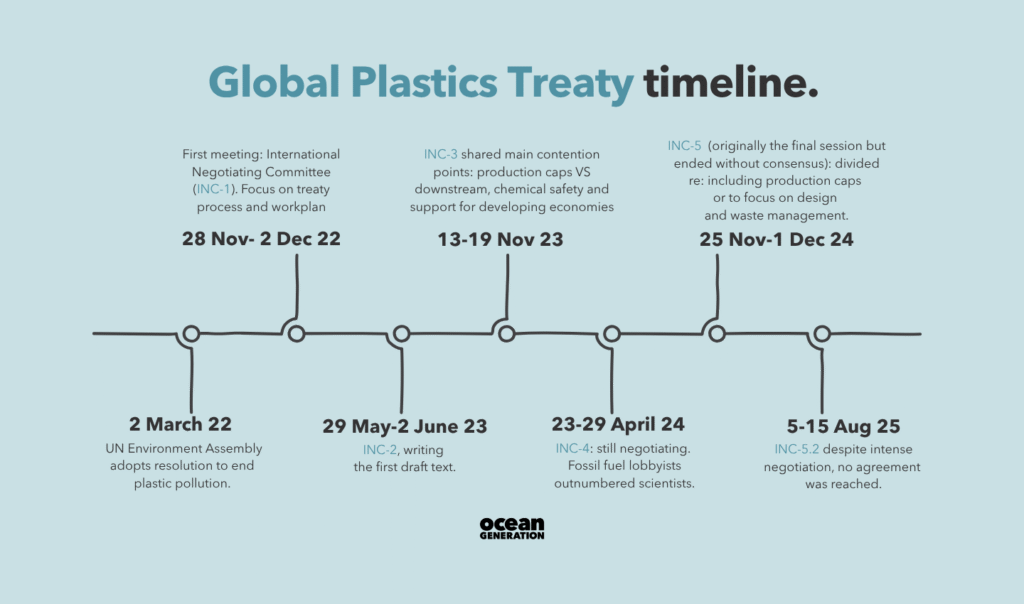
In 2022, 175 countries of the world signed an agreement that declared: plastic pollution needed to be addressed. Stronger than that, plastic pollution should be ended.
To meet this goal, countries agreed on a series of meetings across the globe to discuss and negotiate how to end plastic pollution and write it into international law (a treaty).
Five meetings were planned, with the treaty aimed to be finalised by the end of 2024.
This agreement created the International Negotiating Committee (INC) which first met in Punta del Este in Uruguay. Subsequent meetings happened in Paris, France; Nairobi, Kenya; Ottawa, Canada; and Busan, Korea.
By the end of the fifth meeting, no agreement had been reached for the Global Plastics Treaty, so another (INC5.2) was scheduled for August 2025 in Geneva. However, this meeting also ended with no treaty.
Timeline by Will Steen
What is stopping a treaty being agreed?
For the treaty to come to life, all countries must agree on the terms, so while some disagree there will be no treaty.
The main point of disagreement is whether making new plastic (plastic production) should be limited within the treaty. Countries are split largely into two groups, the High Ambition Coalition and the Global Coalition for Plastics Sustainability.
What is the High Ambition Coalition?
There is a large group of countries (around 100) in a group, called the High Ambition Coalition (HAC).
The HAC has been pushing for the plastics treaty to include plastic production limits – reducing the amount of new plastic made. Before INC5.2 the HAC published a “wake-up call” at the United Nations Ocean Conference at Nice in June 2025, outlining a ‘wishlist’ of five points:
Limits on plastic production (to be regularly adjusted), and reporting on production, import and export of primary plastic polymers
Phase out most harmful plastic products and chemicals of concern
Improve the design of plastic products to minimise environmental and human impacts
Financial support to support less developed countries in the transition
A treaty responsive to changes in evidence and knowledge
What is the Global Coalition for Plastics Sustainability?
Another group of countries formed the Global Coalition for Plastics Sustainability (also known as the Like-Minded Group of Countries).
A statement from a member country outlined the focus:
“The [Global Plastics Treaty] should pave the way for improving the waste management systems in general, and to promote environmentally safe and sound management of hazardous plastic wastes, and to reduce uncontrolled hazardous plastic pollution.”
They want a bottom-up approach, prioritising dealing with plastic waste.
What do major businesses think of the plastics treaty?
Businesses that produce and use plastic are key to tackling the plastic pollution problem.
The UK hosted a roundtable with major business in June 2025 and produced a statement. It called for the plastics treaty to address the whole lifecycle of plastics, amongst other things.
The division has been entrenched from early in the process, with little movement on either side. It has led to questions about the process, and where to go next. Here are some options:
The process is changed to being decided by vote rather than by consensus, to make progress despite the disagreement of a small minority
The process continues via other means. For the Ottawa convention on landmines, a number of countries compiled texts outside of the process, that were then agreed upon. We could see this happening, for example, with the High Ambition Coalition.
Another round: INC5.3 to try again! A (currently unnamed) country has offered to host, but has said they will not fund it.
While the gears of global negotiation can feel like they turn slowly, they are turning. Read more about how international treaties work here.
These countries have agreed that ending plastic pollution is an important issue. We want a world without the damage of plastic pollution.
The Global Plastics Treaty is the representation of international intent. If it does produce legal guides to end plastic pollution, it will speed up progress. That it hasn’t yet is not going to stall momentum.
The Ocean is surprisingly noisy. Sound is used to convey information over long distances, and to neighbours on the reef or in the grass. In water, sound travels farther than either light or chemical cues and moves almost five times as fast as it does in air.
Marine mammals like whales and dolphins are famously loud and use sound to communicate. Sperm whales can reach volumes louder than jet engines. But a shocking truth is that other marine animals contribute to the Ocean soundscape too! For example, did you know that some fish make hums and purrs?
Beyond marine animals, there are other sound sources in the Ocean. Geological sounds (earthquakes and landslides) and our own human activity (engines and drilling) have their own effects on the Ocean soundscape.
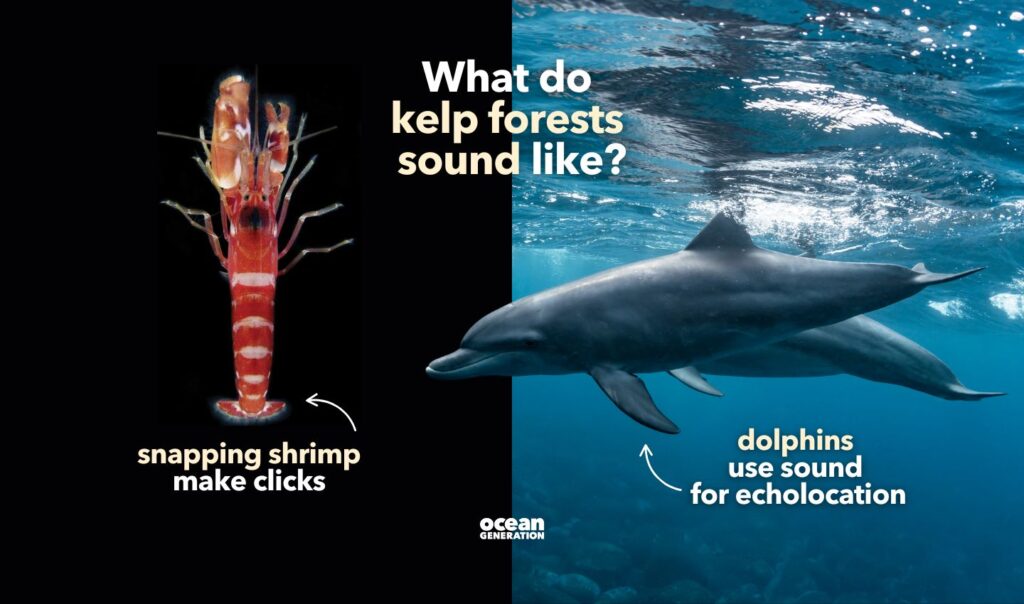
What do kelp forests sound like?
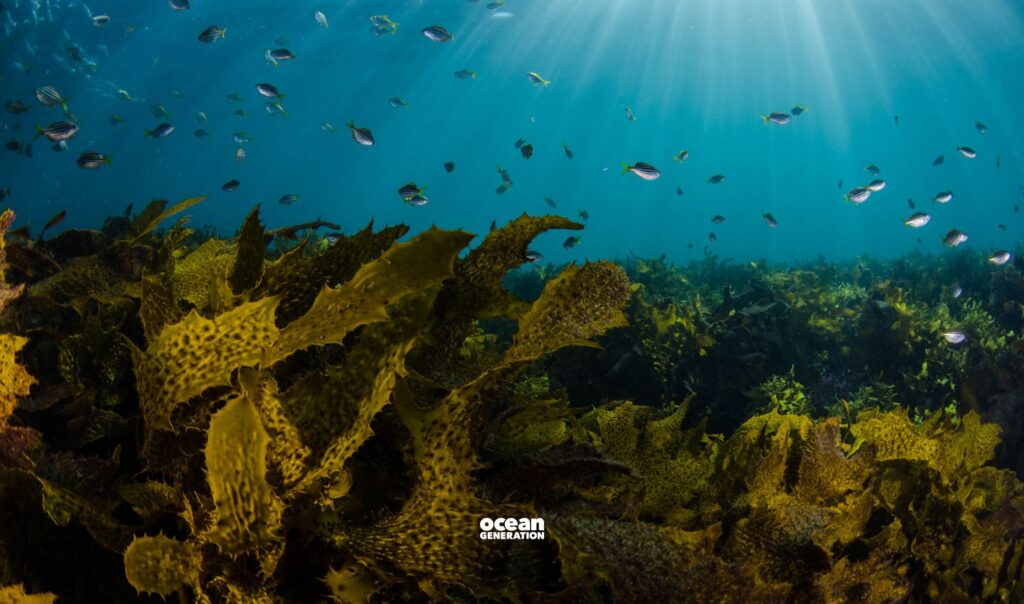
Kelp forests are an unfamiliar setting to most of us, so to assist on our adventure of the soundscape, we’ll venture through the woods at the same time.
In the woods, we hear distinctive, familiar noises. The twitter of birds, the chattering of rabbits and the chirps of insects dominate the soundscape. In kelp forests, we can hear the different calls of fishes and the frequent snapping of shrimp.
The noises of kelp forest can be separated by their pitches. Generally, lower tones contain the noises of marine mammals and fish. The higher tones we’d hear contain the clicks of snapping shrimp and the sound of echolocating dolphins (although this is higher than the human ear can hear so it’s silent to us).
These soundscape features often change in both environments over time due to natural factors, like seasonal changes, or human activity.
As the night comes, the sounds of the daytime animals switch to the noise of nocturnal animals.
In the woods, hooting owls and squeaking bats take over the soundscape along with the occasional chirp from foxes. This daily change is seen in kelp forests too, where the activity of animals and therefore the volume of their sounds shifts over the course of the day.
For some species of fish, their noise peaks at sunset and dips at sunrise. As well as this, snapping shrimp are nocturnal, which shows in their activity, as they have peaks at sunset and sunrise but a decreased activity during the day.
Seasonal changes in the kelp forest soundscape
With the arrival of autumn and winter in the woods, some animals migrate or hibernate, removing their noises from the soundscape.
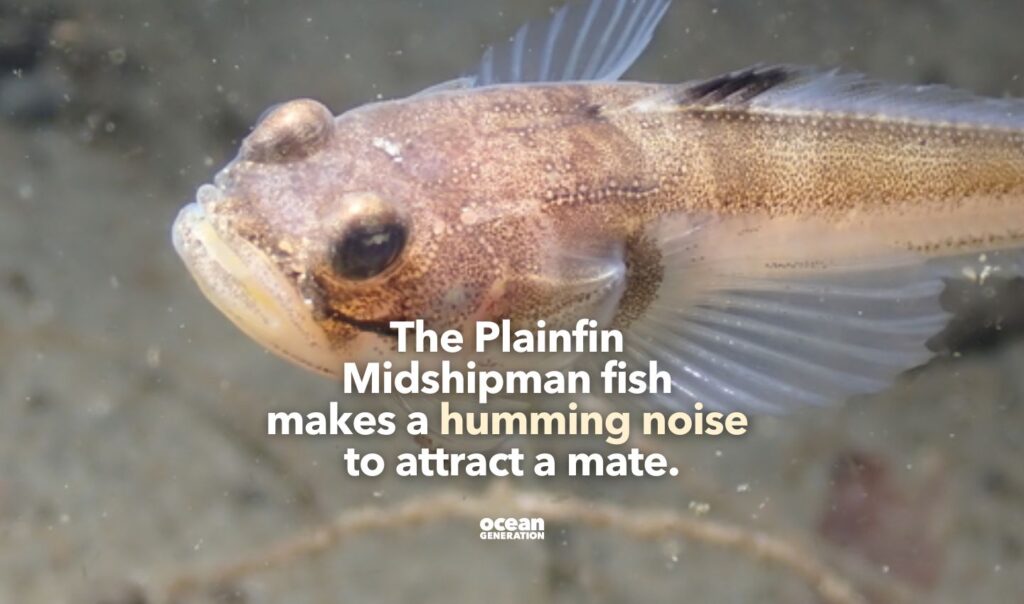
The Plainfin Midshipman fish makes nests near the coast and uses a humming noise to attract a mate. This humming is heard in the kelp forests during late spring and summer, consistent with their mating season. Contrasting this, the presence of snapping shrimps is maintained year-round.
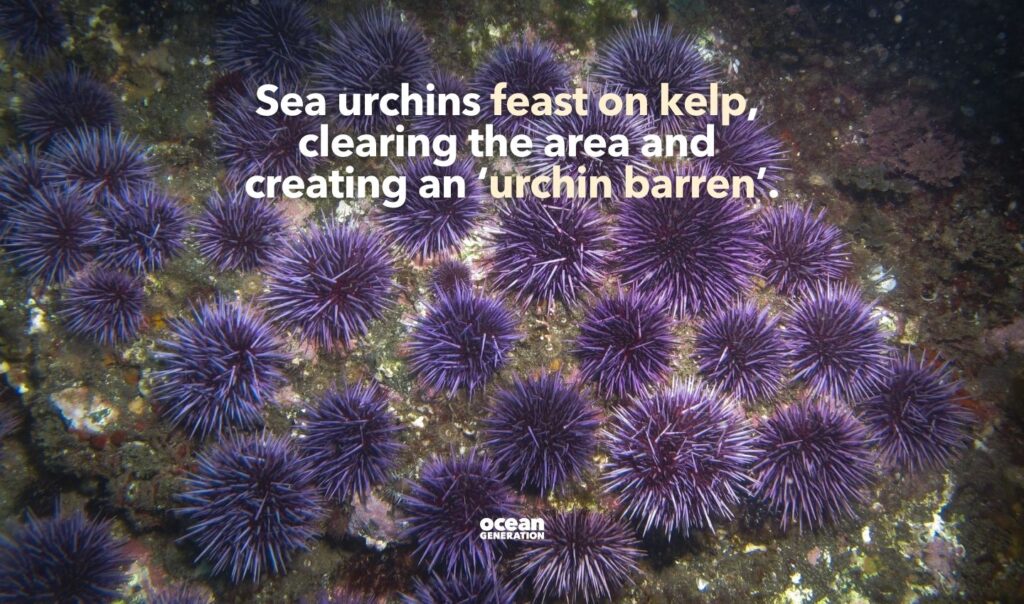
On our walk through the woods, we come across barren spots without trees, caused because of storms or fires. Similarly in the Ocean, an abundance of sea urchins and a lack of suitable food can cause them to feast on kelp clearing the area and leaving a space overrun with small, malnourished sea urchins, with the East Fish camp in California having an urchin density of 26.8 urchins per square metre.
Although urchin barrens may seem like a natural environment, they are created by human activity, just as extreme weather can become more prominent because of global warming.
Normally, sea otters and the occasional fish prey on urchins before the situation gets out of hand. But, due to hunting and overfishing, sea urchin predation is decreased, allowing their population to spike and kelp forests to be removed.
Sea urchin barrens influence the kelp forest soundscape as the region becomes less suitable for some species and more suitable for others. When hundreds of sea urchins move in, they change biodiversity.
A more direct human influence on woodland soundscapes is deforestation. The direct removal of trees by humans to clear space or for resources is easily a big issue, as it decreases habitat space, reducing biodiversity and harming ecosystems.
Listening in our woods, we don’t only hear animal noises but also human noises. Cars on roads which cut through the woods or heavy machinery operating can create loud persistent noises which can disturb the soundscape, affecting the distribution of the animals.
The same is true for animals in the Ocean. Loud noises like drilling and seismic surveys are loud and the noise can be emitted for tens of kilometres, causing confusion and hearing damage in marine mammals and fish.
Other sounds like engine noises from low flying planes and boats can act as background noises which decrease the distance that animals can hear and communicate.
Sound disturbances can normally be mitigated in kelp forests by kelp’s ability to attenuate (absorb and decrease) sound. However, because of the removal of kelp forests, this mitigation can quickly be removed.
The building of docks and other structures may seem like they could bring back attenuation, but they can also transfer noise from cars and docking boats into the Ocean, affecting microenvironments.
What can we do?
It may seem daunting that humans can cause all of this damage, but not all change is bad. Just as forests can be replanted and wildlife protected, as can kelp forests.
The growth of kelp can be stimulated, and areas can become marine protected areas, which can allow areas to be conserved. An example of this is in New Zealand, where an urchin barren has recovered back into a kelp forest within a marine protected area over the period of 20 years.
Looking at how we live our lives, like where our fish comes from or our usage of boats can make a difference in helping this delicate ecosystem.
How can we clean up plastic pollution in the Ocean?
Share this page
Copied
Why do beach cleans actually work: Explained.
An army of passionate people take to the beach, litter pickers in hand. Sea spray in their hair and sand under their nails, they comb the beach. Their bags fill with cigarette butts, plastic bottles and crisp wrappers. Spirits are high, notable pieces of rubbish are held up with announcement.
As the sun sets, the beach seems lighter, relieved of the weight of rubbish. The cleaners look over the coast with proud eyes at a job well done.
But as the night draws in, so does the tide. When the sun rises again, it unveils a plastic-laden beach once more. The Ocean has coughed up some of its burdens.
What is the point in beach cleans? Are we rearranging deck chairs on the Titanic or do they actually help combat Ocean pollution?
There aren’t great islands of plastic floating in the Ocean (even the Great Pacific Garbage Patch is a myth). But we are creating a plastic soup. Microplastics fill the Ocean, with some ‘croutons’ of bigger floating plastic.
This plastic can kill wildlife, carry toxins and enter the food chain — all the way up to us.
It’s obvious: we all want less plastic in the Ocean. The question is how to achieve that.
What impact do beach cleans actually have?
A beach clean is more than just a fun day out. They do a whole load of good.
Firstly, they are good for us. Beach cleans (and most coastal activities) have been associated with positive mood and improving our understanding of the Ocean. Combine a beach cleanup with some rock pooling and that’s a brilliant afternoon. Imagine all the things you can find! We feel better cleaning our beaches.
Beach cleans are a chance for people to come together and make a tangible contribution. They act as displays, raising awareness for our pollution problem and encouraging more engagement. A snowball effect.
Beach cleans provide immediate benefit to the natural world too. Removing plastic from the beach takes away its threats straight away, and removes the future threats as well.
Plastic on the beach is exposed to the stresses and strains of the Ocean. Waves breaking, rubbing against the sand and rocks, the sun beating down. All these break up the plastic into smaller micro- and nano-plastics. Removing it before that stage is a lot easier.
Our understanding of the journey of plastic waste is evolving. Recent studies suggest that the vast majority (88% is the quoted figure) of plastic in the Ocean remains floating close to shore. This means our beaches take the brunt of the plastic problem. But that also means it’s accessible: We can remove the majority of the problem with ease and stop it getting worse.
Beach cleans treat the symptoms without addressing the illness.
Beach cleans are not the whole answer. You can’t keep bailing a sinking boat out and expect to float, until you bung the hole. A beach clean treats the symptoms without addressing the illness.
We need more than litter-pickers.
What are the other allies in the battle against Ocean plastic?
The closer to source of plastic pollution we can get, the better. Try filling a glass from someone pouring three stories above you – a lot more water gets spilled compared to just filling from the tap.
Single use plastic bans have shown to be effective in reducing litter. Increasing the responsibility of plastic producers for the end of their products lives would motivate innovation and stop plastic becoming litter at all. A circular economy would prevent the demand for oil to produce more and reduce the amount of plastic that becomes rubbish.
As consumers, we also need to rethink how we use plastic.
How can we change our relationship with plastic?
Moving away from a single-use plastic world is, honestly, going to be tricky. We live in a world where convenience is king. Single-use plastic is very convenient. But there are solutions already working.
Deposit return schemes have proved to be highly effective in increasing the collection rates of plastic bottles. When you buy a drink in a plastic bottle, for example, a small extra fee is paid, which is returned when the bottle is returned. For one scheme, 94% of bottles were returned compared to 47% without a scheme.
Nearly every major manufacturer (98%) now has commitments to reduce plastic packaging. Whether this represents genuine change or sophisticated greenwashing remains to be seen, but consumer pressure and regulatory requirements are making plastic reduction a business imperative rather than a nice-to-have.
The challenge lies in balancing reduction with practicality. Sometimes plastic packaging actually reduces overall environmental impact compared to heavier alternatives – it’s the end-of-life management that needs sorting.
The uncomfortable reality of waste management
Here’s the uncomfortable truth: much of Ocean plastic pollution originates from countries with limited waste management systems. Sub-Saharan Africa, for example, averages 44% waste collection rates compared to 98% in high-income countries. It’s rather difficult to recycle rubbish that’s never collected in the first place.
We can’t simply take Western waste management systems and apply them exactly as they are in other countries. Locally managed, decentralised circular economy models – using local resources and creating local markets for recycled materials – show more promise than imposing one-size-fits-all solutions.
Is making plastic expensive a solution to pollution?
Governments wield powerful economic tools: taxes on single-use plastics, subsidies for recycling infrastructure, and extended producer responsibility schemes that make manufacturers pay for their products’ end-of-life management.
When virgin plastic (new plastic) becomes expensive and alternatives become cheap, behaviour changes remarkably quickly. But it has to be done without disadvantaging those that don’t have access to a cheap alternative.
So, back to the original question: Do beach cleans work?
Yes. But they won’t stop the problem long term. Beach cleans deliver value beyond plastic removal. They’re powerful data collection exercises, providing crucial information about debris types and sources that inform policy decisions.
Beach cleanups are also remarkably effective educational tools – nothing quite drives home the scale of plastic pollution like spending a Saturday morning filling bin bags with bottle caps.
Perhaps most importantly, recent research from Norway found that removing larger plastic items from coastlines led to a 99.5% reduction in microplastics both on land and in water within a year. That’s a genuinely impressive result that suggests beach cleans have more direct environmental impact than critics assumed.
“Removing plastic from the environment before it enters an active degradation phase, into microplastics, will reduce the formation of microplastics in the environment. The decrease of microplastic was over 99% in the water volumes we found on land. When we looked at seawater, the microplastics leaking into the sea was reduced by 99.9%,” – Gunhild Bødtker, senior researcher at Norce
What’s the most effective strategy to deal with plastic pollution?
The most effective strategy combines both approaches: upstream prevention (stopping plastic from becoming waste) and downstream management (dealing with what’s already out there). Think of it as both turning off the tap and mopping up the flood.
Beach cleans work best when they inspire participants to tackle root causes – supporting deposit return schemes, choosing refillable alternatives, and pressuring companies to reduce packaging.
The real measure of a successful beach clean isn’t just the bags of rubbish collected, but the number of people who leave determined to prevent that rubbish from appearing in the first place.
What should you do next to help tackle plastic pollution?
So beach cleans won’t solve the problem. The good news is that effective solutions exist. The challenge is implementation at the scale and speed the problem demands.
Join a beach clean, but don’t stop there. Support businesses with genuine circular economy commitments, lobby for deposit return schemes, and remember that every purchase is a vote for the kind of world you want to live in.
The Ocean doesn’t care about our good intentions. It needs systemic change, and that requires all of us to think beyond the beach. All our jobs can be beach.
Is plastic good or bad? What it means for you and the planet
Share this page
Copied
A great scholar once said – life in plastic, it’s fantastic. As one of the greatest revolutions in material engineering, plastic has undeniably changed the world.
But were we too successful? Did we end up with a committed friend who is always here for you – but really ALWAYS here, and we can’t get them to leave?
Let’s look at our magic material, where plastic has done good and how we need to change our relationship with it.
What is plastic?
Plastic can mean a lot of things.
We should be careful to define what we mean. Here, plastic is concerning synthetic or semi-synthetic materials composed primarily of polymers, that can mould, press or extrude into different forms. This feature, their plasticity, is key to their importance.
Here’s a table summarising some of the most used plastics. Have a look around, I would guess, from wherever you are, you could see at least five of these.
Textile applications but also in many other sectors
Plastic is everywhere, from our food packaging to our computers, to our furniture. Our clothes, the paint on our walls, the tyres on our car; all have plastic in. So, let’s look at why plastic has become so engrained in our lives.
How does plastic save lives?
Plastic has pioneered a revolution in medicine. Through its versatility, sterility, durability and low cost, plastic has made modern medicine more safe, accessible and effective. Plastic IS fantastic.
Disposable plastic items such as syringes, IV bags and gloves prevent cross-contamination. Plastic has enabled minimally invasive surgeries, reducing recovery time and infection risks.
Plastic prosthetics and implants can be printed or moulded to individual needs. Medical packaging made from plastic keeps drugs and equipment sterile (more on packaging later).
A surgeon or trainee doctor can examine a 3D-printed organ to better understand the patient. Complex procedures can now be done through a single incision using flexible plastic implements. Medical imagery has advanced as machines made from plastic don’t have the interference of metal. Due to the low price of plastic, everyone can benefit from better healthcare.
It’s impossible to know how many lives have been saved by plastic.
How has plastic helped our food systems?
Food waste is a big environmental problem. 19% of food available to consumers is wasted, added to the 13% lost in supply chain.
The UK and Japan are among the only countries to collect consistent food waste data. They have shown reductions of 18% and 31% respectively. Awareness, for consumers, is a powerful driver of behaviour change.
Plastic is a key ally in reducing food waste.
Packaging reduces food waste and increases the shelf life of our food. Plastic packaging does this by stopping the aeration of food and providing thermal insulation.
Think of it this way: if plastic packaging stops your tomatoes going mouldy, you’ve saved all the emissions from growing, transporting, and processing those tomatoes – plus you’ve avoided the methane released when the tomato rots in landfill. The plastic wrapper can be the environmental hero, not the villain.
Take pork as an example. Yes, plastic foam trays create more emissions than butcher paper when they’re made. But only 5% of plastic-wrapped pork goes off, compared to 7-10% wrapped in paper. That means 35% less climate impact overall – the packaging emissions are nothing compared to a whole pig going to waste.
This food preservation revolution has shrunk our world. A mango can now travel from Peru to Manchester and still be perfectly ripe when you bite into it. More food, travelling further, feeding more people – all thanks to a bit of clever plastic.
How is lightweight plastic doing its bit environmentally?
Plastic is light, and strong. It has taken on roles previously performed by much heavier metals.
A car fuel tank, for example, used to be made from steel, much heavier than plastics. A 10% reduction in vehicle weight can result in a 6-8% improvement in fuel economy. Plastics reduce the weight of a vehicle by up to 50%. This results in approximately 14 times lower greenhouse gas emissions than using a steel tank.
In construction, the durability of plastic can be utilised. Due to the lighter weight, PVC pipes have much lower climate impact than concrete (45% less) and ductile iron (35% less). Every truck carrying plastic to the building site uses less fuel carrying PVC pipes. In water pipes, copper is recyclable but loses more heat than a cross-linked polyethylene (PEX) pipe.
How is plastic saving marine life?
There are many examples of plastic replacing consumer demand for natural products; saving marine life.
Tortoiseshell glasses are now made out of plastic, saving the hawksbill turtles who were harvested for their beautiful shells. How many trees are still standing because we have plastic furniture?
Why do we call sponges sponges? Because they were originally the sea sponge, Spongia officialis, that we collected and used as a bath sponge. Replacing the sponges of the sea with plastic ones has alleviated another stress on our Ocean.
Ivory’s another classic case. Before plastic, piano keys, billiard balls, and ornamental trinkets meant elephant tusks. Now, we get the same aesthetic from synthetic alternatives – and elephants get to keep their tusks.
What are the problems with plastic?
Before we get too carried away with plastic’s positive impact on our planet, let’s address the elephant (with tusks) in the room – or rather, the gaps in our argument.
Did plastic actually save those lives?
Medicine improved dramatically alongside plastic adoption, but so did antibiotics, surgical techniques, and our understanding of infection control. We simply don’t know how many lives plastic specifically saved versus other medical advances happening simultaneously.
We’ve built our entire food system around plastic packaging, then use that system to prove plastic’s necessity. It’s flawed logic. Considering the carbon emissions alone is one dimensional – what if we’d spent 70 years perfecting non-plastic preservation methods instead? We’ll never know – but it would be foolish to think plastic is the only solution.
We’ve wrapped modern life around plastic like cling film around a sandwich – so tightly that peeling it away seems impossible.
There are two key problems with plastic:
Plastic has two big issues – its fossil fuel foundations and its longevity. The two mean that plastic can have a two-pronged impact environmentally.
Steel and cement are the only materials we produce more than plastic. Between 1950 and 2017, we are estimated to have produced over 9 billion tonnes of plastic. Half of that total was produced after 2004.
Here’s one of the issues – all the plastic we’ve produced is still around in some form or another. Approximately 7 billion tonnes of it is waste.
Medical masks were a signature of the COVID-19 pandemic. They blocked the spread of the virus, saved lives and helped get us back to normality. But, once used we threw them ‘away’. A back-of-the-napkin calculation estimates that in 2020, 1.56 billion face masks would enter the Ocean. That isn’t a trade-off we (or our friendly neighbourhood Ocean creatures) should have to make.
The vast majority of plastic is made from oil. It has a large carbon footprint, representing around 3.4% of global emissions through their lifecycle. A fossil fuel-free future isn’t plastic wrapped.
Are plastic alternatives the answer?
It isn’t that simple. Some alternatives are more emissions-intensive to produce, so if we maintain a single-use approach there will be greater environmental impact.
The classic example is plastic bags to paper bags. Paper bags are approximately six times heavier than HDPE (plastic) bags, so have three times higher production emissions. Paper requires deforestation and lots of water use. Glass is energy intensive and heavy. There are no easy answers.
Solutions, and their effectiveness, varies by region – in the US, PET bottles have the lowest impact by way of emissions, but in Europe it is aluminium, due to cleaner energy used to produce it and higher recycling rates. This also means the impact of a material can be lessened through wider changes (cleaner energy and higher recycling rates).
Food packaging is an area of growing competition for plastic. Glass, metals and paper are long-standing packaging materials. Natural fibres and biopolymers are other possibilities, but they can be more energy intensive, more expensive and don’t provide the same level of protection for the food.
In medicine, alternatives require more time and energy to achieve the same levels of sterility, and often lack the advantages offered by the lightweight, malleable, cheap plastic.
What is the answer: is plastic good or bad?
Plastic is brilliant and has advanced modern society in a multitude of ways. Unfortunately, there were more skeletons in the closet than we realised. We have more information now than ever before, and more advanced technology is allowing us to come up with solutions to address plastic problems.
There are no silver bullets here. But we need to change our relationship with plastic. One key attitude shift that should definitely change: single-use doesn’t work at large scale. Regardless of material.
How much plastic is in the Ocean? Depends who you ask.
Share this page
Copied
Plastic is at the heart of Ocean Generation; it is OG’s OG.
Our founder Jo Ruxton MBE produced the award-winning documentary, A Plastic Ocean, and put plastic in the spotlight like never before. But it wasn’t just showing people that plastic was an issue, it was showing that we didn’t really understand the issue.
Nine years on, we’re taking a look at what we know (or don’t) about plastic now.
How much plastic is in the Ocean?
Somewhere between 0.13 million and 23 million tonnes of plastic enters our Ocean each year.
That’s quite a big range. Imagine your satnav saying your journey will take between 12 minutes and 2 weeks. Technically true, but not very helpful.
So, why is this question so complex to answer?
What are the estimates of plastic entering the Ocean?
Zhang et al. (2023): 0.70 million tonnes (95% confidence: 0.13-3.8 million tonnes)
*riverine emissions only † all aquatic environments
And then there’s OECD (2022): they predict that by 2060, 44 million tonnes of plastic will enter the Ocean each year.
That’s a 30-fold difference between lowest and highest estimates.
Why are the plastic in the Ocean numbers so different?
Let’s visualise this better. Instead of trying to calculate the amount of plastic entering the Ocean, imagine that we’re trying to calculate the amount of popcorn falling on cinema floors.
Picture scientists trying to measure how much popcorn hits cinema floors for each film watched. Sounds simple? How would you tackle that?
To compare this with our plastics range, our estimates could be 50kg to 1,500kg of popcorn annually.
Here’s how different research teams tackle the popcorn problem:
The Jambeck Method: Cinema-Goer Profiling Jambeck starts with the approximate number of people that go to the cinema. Then, she would factor in roughly how much popcorn each person would have and the “messy eater” rates, to get an estimate for how much popcorn ends up on the floor.
The Lebreton/Meijer Method: Aisle Monitoring These researchers use data from observation. Actually going to cinema aisles and collecting the popcorn.
They look at how much popcorn a group of people drop during a movie. Then, they predict how much would be dropped by all moviegoers. Meijer took the method further by visiting more cinemas.
The Borrelle Method: Cinema Stocktake This method looks at the number of kernels purchased by cinemas. Using this as a base, they can predict how much gets sold to customers and predict how much will be spilled or dropped during handling and eating.
This gives the amount present in cup holders, the floor of the lobby and hallway, as well as the cinema screen floor, so the numbers will be a bit higher.
The Zhang Method: Simulated Screenings Create a computer model predicting how much popcorn is dropped throughout the cinema. Go and check down the back of specific seats and compare the amount of popcorn found with the amount the model predicted would be there. Adjust and validate the model in line with the findings.
The OECD Method: Future Spill Forecaster It predicts how messy cinemas will be in 2060 based on rising ticket sales and supersized buckets.
What do the studies about assessing how much plastic is in the Ocean do differently?
Each method tackles different bits of the popcorn (plastic) pipeline (the stages where popcorn (plastic) might be spilled on the floor). No wonder their estimates vary wildly.
Bottom-up studies (like Jambeck and Borrelle) start with waste on land and model Ocean inputs. Top-down studies (like Lebreton, Meijer, or Zhang) start with plastic actually observed in seawater and work backwards to estimate how much is entering the Ocean. Like comparing cinema managers’ spillage predictions with cleaners’ floor surveys.
Interestingly, the bottom-up studies predict consistently higher plastic in the Ocean than studies using observed data. To use our analogy again: these studies might be overestimating how messy cinema goers are and so end up predicting too much popcorn on the floor.
Plus, these studies use different years for their data. Jambeck is using data from 2010, while Borelle is using 2016 data. The data at the basis of their work is quite different.
Are we counting all plastic that enters the Ocean?
To show how much we don’t know, a new study (July 2025) has highlighted nano-plastics. Nano-plastics are smaller than 1 µm, which is tiny. It is 1/75th of the width of your hair. Or – if you scaled a metre up to the size of a football pitch, a micrometre would be the width of your hair. Their size means they are very difficult to study.
There has been debate that they can even exist, as it requires a lot of energy to break plastics up to that extent.
This new paper from ten Hietbrink et al (2025) found nano-plastics from PET, PS and PVC (look at this table for the plastic acronyms) everywhere they studied across the north Atlantic.
The amount of nano-plastics they found are comparable to macro and micro-plastic, meaning we are missing a big piece of the plastic puzzle. If this study is accurate, it suggests nano-plastics make up 90% of the plastics in the Ocean by weight, compared to macro- and microplastic estimates. Turns out, our popcorn is shedding a lot of salt on the floor that we haven’t been thinking about.
Interestingly, the paper also highlighted the lack of nano-plastics from PE or PP sources. This could suggest a removal pathway or breakdown process we aren’t aware of yet (which is really interesting). It serves as a reminder that we don’t have the whole picture here. Who knows, maybe there are some ants eating some of the popcorn crumbs?
How much plastic is produced each year?
For context, let’s look at the changes in plastic production over this time:
Year
Estimated Production
Source & Notes
2010
~270 million tonnes
PlasticsEurope (2011 report); includes thermoplastics, polyurethanes, thermosets, adhesives, coatings, sealants, and PP-fibres
2016
~335 million tonnes
PlasticsEurope (2017); reflects continued growth in Asia, especially China.
2024
~460 million tonnes
Based on extrapolation from OECD and UNEP trends; global plastic production is increasing at ~4% annually.
Plastic production has increased by approximately 200 million tonnes over the past 15 years. This we can say with more confidence – we know how much we produce.
What do we know about the amount of plastic in the Ocean?
The Knowns:
Plastic is accumulating in the Ocean
The problem is growing – plastic production has doubled since 2000
Rivers are major transport pathways of plastic
Areas with poor waste management and high consumption of single use plastic have higher leakage to the environment
Fishing gear (as pollution) dominates remote Ocean areas, much land-based plastic remains close to shore
Most plastic never reaches the Ocean
We want to avoid more plastic entering the Ocean
The Unknowns:
Exactly how much plastic enters the Ocean
Exact source breakdowns by region
How much plastic is already out there in the natural environment
Do the unknowns stop the need for action?
What can we do about plastic pollution?
Recent studies are showing that plastic pollution tends to stay in our coastal areas. Currents, winds and tides push plastic back against the coast. Why is this good? Because it makes it easy to clear up! It means that beach cleans are in fact a really useful tool to fight plastic pollution.
Going back to our analogy: When the popcorn stays close to our seat, it’s easy to get it off the floor again. And if everyone picks some up before it gets stamped into popcorn dust, it is much easier.
We don’t know exactly how much plastic is in the Ocean. However…
Science isn’t about having all answers immediately – it’s about getting better answers over time. Does it really matter if 0.13 million or 12 million tonnes of plastic enter the Ocean annually?
The scale of the problem might be debated, but the need to act isn’t. Plastic in any amount is detrimental to the world we inhabit.
While scientists debate over the amount of zeros, solutions remain largely the same: better waste management, smarter materials, improved recycling, reduced single-use plastics, and better fishing gear recovery.
The uncertainty isn’t paralysing – it’s liberating. We don’t need perfect numbers to start fixing the problem. We just need to start.
Each of us can reduce the amount of popcorn on the floor. By consciously buying less plastic you not only reduce plastic waste production but also signal to companies that less plastic is a customer preference.
Picking up plastic from the beach will stop it being broken up by the waves, producing microplastics and nano-plastics, making the problem harder to solve.
The little things matter. The big numbers don’t change the picture.
White branches reaching out, stark against the blue. Where there was colour, now only ghostly white. This haunting transformation isn’t just a visual tragedy – it’s the silent SOS of some our Ocean’s most spectacular ecosystems. This is coral bleaching.
Coral reefs aren’t just beautiful — they’re nurseries for fish, protect coasts from storms, and feed millions of people. When coral reefs bleach, their whole ecosystem is at risk. But what is coral bleaching? What causes it, and why does it damage reefs?
Are corals animals, plants or rocks?
Corals are animals. Some may have stone skeletons and live with plants. But all corals are animals.
Corals are tiny animals called polyps. Each polyp has a soft body and a mouth surrounded by tentacles, like a little sea anemone or an upside-down jellyfish. All these animals are related – they are cnidarians (silent c), named after their cnidocytes – special cells that can sting.
Where does coral’s colour come from?
Corals are incredible animals. They build immense structures that provide homes for marine species, protect the coast and create oases in the ‘desert’ of tropical seas (there are very few nutrients in the waters of the tropical Ocean).
To be able to do all this, they need some help. Corals have symbiotic algae called zooxanthellae living in their skin cells. Think of zooxanthellae as tiny solar-powered chefs living inside coral homes.
They catch sunlight, cook up energy, and share over 80% of the meal with their coral landlords. The coral provides protection and prime real estate with an Ocean view. It’s a win-win (this is what symbiotic means) – until climate change cranks up the thermostat.
It’s zooxanthellae that gives coral its colour. The magical, vivid world of coral reefs is painted by these little algae. Without them, corals are translucent, and the white of their calcium carbonate skeleton shines through.
Why do corals bleach?
The happy relationship between coral and zooxanthellae can be disrupted. When it is, this can lead to the expulsion of the algae from coral tissues, leaving the coral gleaming white (it is a spectrum, coral can partially bleach).
The most common cause of coral bleaching is thermal stress AKA temperature. If conditions aren’t right, the systems that make photosynthesis (plants turning sunlight into food) can break.
When these systems break, they can produce reactive oxygen species (ROS). ROS are produced in normal function, but too many ROS harm the coral. When the coral detects this build up, it acts in self-defence and throws the algae out.
Usually, this is from it being too hot, but the system can be broken when it is too cold, or in too much sunlight, or exposed to harmful pollutants.
That’s a bit abstract. Let’s make an analogy.
Imagine the coral as a battery, and the algae as a solar panel. Normally, the algae are providing energy to the battery from the sunlight. But if the solar panel gets too hot or is exposed to too much sunlight under a magnifying glass, it might start to malfunction. It starts to spark, so to protect itself the battery disconnects. Without its solar panels, our coral battery can only run on emergency power for so long before it’s completely drained.
History of coral bleaching – how long has bleaching been about?
Places like the Maldives, Seychelles, and reefs in the Indian Ocean lost nearly half their coral cover. 2023 saw the start of the fourth global coral bleaching event, that over the next two years saw an estimated 84% of the worlds coral reef areas bleached.
Sounds bad, but this isn’t the end.
Image credit: Great Barrier Reef Foundation
Does bleaching mean coral is dead?
No. A bleached coral is still alive, it just doesn’t have its friend feeding it. This leaves the coral more vulnerable to disease, but also to starvation. Unless our battery reconnects to its solar panel, it will eventually run flat.
Having repeated bleaching events reduces corals’ ability to recover. It’s like punching them while they are down.
When the coral eventually dies, it loses its white look and will begin to get covered with other algae and seaweed.
However, corals have shown us again and again they have an amazing ability to recover when given the chance.
Different species of coral are more tolerant, and different species of zooxanthellae can take more heat too.
Some species of coral bounce back faster than others; the marine equivalent of those friends who somehow recover from a night out while you’re still nursing a headache. The massive boulder corals? They’re the slow-but-steady marathon runners. The branching corals? More like sprinters – quick to bleach, but sometimes quicker to recover.
There is a lot of work going into understanding corals, and reef restoration methods continue to be tested and implemented (read here for more.)
Corals are the poster child of Ocean health. They are impacted by all our Ocean threats, which means you can help wherever you are.
Every time you switch off an unnecessary light, choose a reef-safe sunscreen (free from oxybenzone, octocrylene or octinoxate), or select a sustainably caught fish dinner, you’re casting a vote for coral survival.
The future of coral reefs could be written in bleached white, or in vibrant technicolour. The pen, rather excitingly, is in your hands.
Balancing conservation and community in polar wildlife conflicts
Share this page
Copied
Addressing human-wildlife conflict is essential for both wildlife conservation and human well-being.
As human populations expand into natural habitats, finding solutions that promote coexistence between people and wildlife becomes increasingly important. By fostering harmony, we can support thriving species, healthy ecosystems, and positive relationships between local communities and conservation efforts.
Reducing conflicts benefits wildlife and eases financial losses for local communities. It also aligns with the UN’s Sustainable Development Goals by enhancing livelihoods, building community resilience, and creating economic opportunities for local populations.
Mitigating human-wildlife conflict on land
Climate change intensifies human-wildlife conflict by changing the historical range and behaviour of wild species, increasing the frequency of interactions between humans and wildlife.
While addressing climate change is key to reducing these conflicts, communities can adopt strategies to minimise interactions with conflicting species. Some of these approaches are listed below:
Fencing key resources, such as livestock, and securing protected areas. Planting buffer crops could also reduce wildlife consuming important resources.
Implementing animal-safe food storage facilities and improving waste management systems can prevent wildlife from being attracted to human food sources.
Integrating guarding measures, such as specialised livestock-guarding dogs or patrol officers, into resource protection could provide early warning signs to alert residents to potential conflicting wildlife.
The use of non-lethal deterrents, such as visual, chemical, and acoustic repellents, can further discourage wildlife from approaching human settlements and resources.
Economic costs of conflicts could also be reduced through compensation schemes, alternative income generation, or increasing wildlife-related tourism.
A better understanding of animal movement can help predict high-risk areas and times, allowing for more targeted mitigation efforts. For example, researchers studying moose found that the risk of vehicle collisions increases in winter when snow depth is below 120 cm and nighttime traffic is higher due to longer nights.
This highlights the need for seasonally adaptive strategies to mitigate such risks.
Mitigating human-wildlife conflict in the Ocean
Fishers have several options to minimise encounters with marine mammals.
Mammals often collide with or become entangled in vertical lines attached to buoys, which mark where nets have been set. To prevent wildlife harm and gear damage, fishers could reduce the number of vertical lines in the water column or use ropes in colours more visible to mammals.
Common rope colors like yellow, green, or blue may be difficult for whales to detect. Switching to colours such as white, black, or striped patterns could make the ropes more visible to whales, potentially helping them avoid entanglement.
Another approach involves weakening lines so that entangled animals can break free more easily. However, this solution can result in financial losses due to reduced catch and replacing lost gear.
Technological innovations, such as acoustic buoy releases that surface only when triggered, could eliminate the need for vertical lines. Another potential solution is the use of pingers, which are devices placed on lines that emit noises at specific frequencies to warn whales and other marine mammals away from boats and fishing gear.
While these strategies could help reduce human-wildlife conflict in fisheries, more testing is needed to see how effective they are. Supportive initiatives, like financial compensation programs to cover losses from wildlife, can ease the economic strain on fishers and encourage the use of non-lethal deterrents.
Collaboration between scientists and communities is key to solving these challenges. For example, the Alaska Longline Fishermen’s Association partnered with biologists and bioacoustic experts in 2003 to study whale behaviour and minimise interactions with longline boats. This led to the creation of the Southeast Alaska Whale Avoidance Project (SEASWAP), a successful project improving our understanding of depredation.
Balancing conservation and community needs
The key to addressing human-wildlife conflict involves recognising and valuing the diverse attitudes towards conservation that influence both the conflict and resolution.
By appreciating the different perspectives of stakeholders, conservation plans can be designed to address the needs and interests of everyone involved. Engaging meaningfully with communities is key to developing policies that are not only effective but also widely supported.
Bearly coexisting: Human-wildlife conflict in the polar regions
Share this page
Copied
As human populations grow, we’re getting closer to natural habitats, leading to increased interactions with wildlife.
Conflict arises when wildlife presence poses real or perceived costs to human interests or needs, like loss of livestock, crop raiding or attacks on humans.
Human-wildlife conflict can have negative impacts on wildlife and can also affect community dynamics, commodity production, and sustainable development.
Conservation biologists are increasingly concerned about human-wildlife conflict in the polar regions – the Arctic in the Northern Hemisphere and Antarctic in the Southern Hemisphere.
Why is human-wildlife conflict increasing in the polar regions?
The polar regions are characterised by low temperatures, extreme seasonality, and the seasonal advance and retreat of sea ice. Both polar regions are home to numerous endemic species, but their survival is threatened by climate change, fishing, tourism, invasive species, and pollution.
These pressures often lead to more frequent encounters between people and wildlife, especially in the Arctic where around 4 million people live.
A recent study on protecting Antarctic biodiversity found that current conservation efforts are insufficient. It’s predicted that around 65% of land animals and land-associated seabirds could decline by 2100 if global greenhouse gas emissions continue on their >2°C trajectory. The study suggests several ways to boost conservation efforts, such as:
Improving the quality of land that has been polluted or negatively impacted by human use
Managing infrastructure
Protecting areas
Controlling non-native species and diseases
How does human-wildlife conflict appear in the polar regions?
Encounters between people and polar bears
Polar bears are an iconic Arctic species, distributed across 19 subpopulations within five countries: the United States, Canada, Greenland, Norway, and Russia. They rely on sea ice for hunting (primarily seals), breeding, and resting.
With climate change accelerating and sea ice diminishing, polar bears are forced to spend more time on land. Here finding natural food sources becomes challenging, so they often seek out human settlements for a predictable source of nutrition.
The town of Churchill, Manitoba, Canada, is famously known as the ‘polar bear capital of the world’ due to the Western Hudson Bay population that pass through the town each summer and autumn.
Between the 1940s and 1980s, these bears regularly visited a waste disposal site, feeding on scraps that caused property damage, human injuries, and malnutrition for the bears. The food waste was often insufficient in fat and contaminated with plastics, metals, and wood.
Efforts to manage the problem included better waste management, relocating bears, temporarily housing them at a holding facility until Hudson Bay froze, or, in some cases, lethal removal.
The Government of Manitoba has since closed the dump site and established the Polar Bear Alert Program to minimise the need for lethal measures and reduce conflicts with bears.
As polar bear encounters become more frequent, the significance of this program is expected to grow.
How orcas and Arctic foxes hunting impact communities
Sometimes predators feed on animals of economic and ecological importance to people. These are depredation events (events that cause damage or destruction).
Mammals in the Arctic Ocean are increasingly observed preying on fish caught by commercial and recreational fishing boats. Longline fishing, which involves the use of baited hooks on a long line, is currently the most severely affected by depredation across both hemispheres, primarily by toothed whales, such as orcas and sperm whales.
These depredation events can result in financial losses for fishers who face difficulties due to reduced catch and often face costs for repairing damaged fishing gear. These interactions can also harm wildlife through injuries or fatalities caused by entanglement with fishing gear and responses from fishers.
Orcas, otherwise known as killer whales, are frequently involved in depredation events in polar regions. It’s been suggested that their group hunting behaviour enables orcas to effectively remove fish from longlines.
These animals are highly social and live in tightly knit family groups, known as pods. Research suggests that pods which overlap geographically can communicate and share information. It’s thought that this cultural transmission is causing depredation behaviour to spread throughout western Alaska.
Depredation on land is also a concern, particularly with Arctic foxes preying on reindeer calves
In the Yamal Peninsula, traditional reindeer herding practices are central to the lives of the indigenous Nenet people of Arctic Russia. However, reindeer mortality has increased due to factors such as pasture icing (explained later), disease outbreaks, and predation by Arctic foxes.
The population growth of arctic foxes has been fueled by the collapse of the fur trade in the 1990s, which reduced hunting pressure. Industrial expansion also provided waste for foxes to feed on, further supporting their population increase.
Climate change worsens the issue by causing abnormal weather conditions, such as freezing rain and rapid temperature fluctuations, which lead to pasture icing. This occurs when a thick layer of ice forms over grazing land, trapping vegetation and making it inaccessible to livestock and wildlife. As a result, weakened reindeer become easier prey for foxes, while more carcasses are left for scavenging.
Finding solutions for people and wildlife
Human-wildlife conflict in the polar regions presents challenges, especially with the added pressures of climate change and other stressors.
However, finding solutions that harmonise conservation goals with community needs can lead to positive outcomes for both people and wildlife. Check out our article on Balancing Conservation and Community in Polar Wildlife Conflicts for strategies to effectively manage and resolve human-wildlife conflict.
The climate changed in a pattern for the past 800,000 years. Every 100,000 years, the Earth entered a warm period, called an “interglacial”, lasting 15,000-20,000 years. Between these periods, ice ages called “glacials” dominated.
Changes to the climate that caused these glacials and interglacials in the past can be explained by natural forcings. These are forces that act upon Earth’s climate, causing a change in how energy flows through it e.g., greenhouse gases.
What are some natural forcings?
1. Milankovitch Cycles
Milutin Milankovitch, a mathematician, discovered three “Milankovitch” cycles.
Over the past 800,000 years, these were the dominant causes of climate variability because they affect the amount of solar heat that can reach the Earth’s surface.
Eccentricity occurs every 100,000 years, corresponding with interglacials. Sometimes Earth’s elliptical orbit is more circular, which keeps the Earth at an equal distance from the Sun. When the orbit is more elliptical, Earth’s distance from the Sun changes. When Earth is closer, the climate is warmer.
Obliquity, Earth’s axial tilt, changes between 22.1° to 24.5° every 41,000 years. Larger angles cause warmer summers and colder winters.
Every 19,000 – 24,000 years, Precession impacts seasonal contrasts between the hemispheres and the timing of seasons. The Earth wobbles on its axis due to the gravitational pull of the Sun and moon, changing where the North Pole points.
Design by Grace Cardwell
2. Sunspots
Every 11 years, the Sun gets spots when its magnetic field increases. The temperature is lowered in this area, influencing the amount of solar radiation warming Earth.
3. Changes in Ocean currents
Ocean currents carry heat around the Earth. When the Ocean absorbs more heat from the atmosphere, sea surface temperatures increase, and Ocean circulation patterns change. Different areas become colder or warmer.
Because the Ocean stores a lot of heat, small changes can have massive effects on the global climate. A warmer Ocean can’t absorb as much carbon dioxide (CO2) and will evaporate more water vapour. Both contribute to the greenhouse effect and global warming.
4. Volcanic eruptions
Volcanoes spew out sulphur dioxide and ash, which blocks solar radiation and cools the atmosphere. CO2 released in the eruption eventually overpowers this to increase temperatures, but this is only equivalent to 1% of human emissions.
5. Meteorite and Asteroid impacts
66 million years ago, an asteroid hit the Earth on Mexico’s Yucatán Peninsula. Scientists call this the Chicxulub Impact, and it drove the extinction that killed 60% of all species, including all non-flying dinosaurs.
Lots of sulphur, soot and dust entered the atmosphere, blocking out the Sun. Temperatures plummeted 15°C, causing a 15-year winter.
Some climate change and emissions are unavoidable.
Butnatural forcings are too gradual or irregular to cause current climate change.
The Intergovernmental Panel on Climate Change (IPCC) states “the observed widespread warming of the atmosphere and Ocean, together with ice mass loss, support the conclusion that it is extremely unlikely that global climate change of the past fifty years can be explained without external forcing, and very likely that it is not due to known natural causes alone”.
Just right or too hot?
Greenhouse gases are natural, to an extent.
Some solar radiation passes through the atmosphere, hitting the Earth. Most of this is reflected into space, but some is absorbed by greenhouse gases and re-directed back to Earth.
This keeps Earth just right (Earth is called the “Goldilocks” planet!).
People are emitting too many greenhouse gases, too quickly. Therefore, more heat is trapped in the atmosphere, leading to global warming.
“External forcings” are things we’re doing that release extra greenhouse gases.
1. Power
We burn fossil fuels like coal, oil and gas to make electricity and heat. This releases carbon dioxide and nitrous oxide to the atmosphere. Half of this electricity powers our buildings.
Globally, only about ¼ of our electricity comes from wind, solar and other renewable sources.
Some people use more power than others: the richest 1% of the global population combined account for more greenhouse gases than the poorest 50%.
2. Food and Manufacturing
To make goods like steel and plastic, fossil fuels are burnt to power factory machines and many other processes. Manufacturing is one of the largest contributors to greenhouse gas emissions worldwide.
Food production emits greenhouse gases at various stages. Livestock and rice farming releases methane, fertilisers release nitrous oxides, and carbon dioxide is released to make packaging and transport the food.
3. Deforestation
In places like the Amazon Rainforest, trees are cut down to make space for farming and houses. From 2003 – 2023, 54.2 million hectares of rainforest was lost there.
When trees are cut down, they release locked up carbon. With fewer trees, less CO2 absorption can take place. Land use changes make up ¼ of greenhouse gas emissions.
4. Transport
Cars, ships and planes all burn fossil fuels such as petrol. This makes up ¼ of global energy-related CO2emissions. This graph shows our impact on the atmosphere:
Don’t put the blame on natural forcings.
Now we know current climate change is down to us; everyone has a responsibility to reduce their emissions. Have a look and see what you can do!
What can Antarctic ice cores tell us about the history of our climate?
Share this page
Copied
Ice cores are the key to the ancient climate and can help us unlock the mysteries of the future.
Scientists can drill into ice sheets to obtain a cylinder of ice, called an ice core.
Ice cores are “time capsules” of the climate. Over time, annual and seasonal snow with different chemical compositions, particulates (like dust), and bubbles of air are compressed into ice.
One of Antarctica’s ice cores, Dome Concordia, shows the climate record for the past 800,000 years through the Quaternary period (2.58 million years ago – present).
Annual temperatures are estimated using oxygen’s heavy (O18) and light (O16) varieties, called isotopes. When atmospheric temperatures increase, more energy is available to evaporate water containing more O18 from the Ocean. This water is precipitated in Antarctica and turns to ice. Scientists can relate the isotopic ratio in an ice layer to the temperature.
Trapped air is analysed for which/how much atmospheric greenhouse gases were present annually. Scientists can estimate carbon dioxide (CO2) and methane (CH4)to determine the degree of global warming.
Using this data and more, scientists can piece together past climates.
What’s the story, ice cores?
Ice cores tell us that the climate swings between stable bounds of warm interglacials happening every 100,000 years which last 15,000 – 20,000 years, and cold glacials (ice ages).
Ice cores show these key events:
1. 800,000 years ago in the Pleistocene, ice cores show an interglacial Earth. The glacial-interglacial pattern continued from here…
2. 430,000 years ago, the Mid-Brunhes Event marked the sudden increase in the temperature range of climate cycles.
3. The penultimate deglaciation event, seen in Antarctic ice cores extends from 132,000 -117,000 years ago.
4. From 24,000 – 17,000 years ago, the Earth was glacial, with temperatures 20°C below pre-industrial levels.
5. Deglaciation began 16,900 years ago, punctuated with tiny ice ages, called the “Bøllering-Allerød” and “Younger Dryas”, thanks to the “bi-polar seesaw” (the Northern Hemisphere cools whilst the Southern Hemisphere warms and vice versa).
6. 15,000 years ago, ice sheets began to shrink. This heating continued into the Holocene (the official period of geological time which we currently live in)
7. This interglacial’s temperature peaked between 14,500 and 14,000 years ago.
8. From 13,800 – 12,500 years ago, Antarctica experienced a Cold Reversal, where temperatures plummeted.
9. The Holocene interglacial began 11,000 years ago, with temperatures fluctuating between warm and cold again.
10. 1,000 years ago, the Medieval Warm Period allowed crops to flourish, cities to rise, and populations to more than double.
11. The Little Ice Age, from the 14th-19th centuries, caused Viking colonies in Greenland to fail.
12. 1750 – the Industrial Revolution began. Ignorant to environmental consequences, humans started emitting greenhouse gases.
13. Scientists mark 1800 as initiating the Anthropocene, an unofficial epoch where humans effect the climate more than natural forcings.
14. Humans have continued global warming at an unprecedented rate. Summer 2024 was the world’s warmest on record. August was the 13th in a 14-month period where global average temperatures exceeded 1.5°C above pre-industrial levels.
Levels of greenhouse gases are higher than in the past 800,000 years, with average CO2 at 419.3ppm as of 2023.
Paleoclimatology records like ice cores and marine sediments help scientists to understand past climates and estimate future climates. They can compare different emission scenarios with the past to see how future climates may respond.
The Intergovernmental Panel on Climate Change (IPCC) have estimated several trajectories.
The aggressive mitigation scenario expects CO2 concentrations to remain at Pliocene-like concentrations (>350ppm) until 2350. It will still take 100s -1000s of years for concentrations to return to pre-industrial levels.
Under a middle-of-the-road scenario, CO2 peaks at 550ppm, remaining above Pliocene levels for 30,000 years.
If CO2 reaches 1000ppm, the worst-case scenario suggests concentrations will remain at Mid-Cretaceous levels for 5000 years, Eocene levels for 10,000 years, and Pliocene levels for 300,000 years. It will take 40,000 human generations for CO2 to return to pre-industrial levels.
Scientists and governments can then prepare for the extreme consequences of climate change and make net-zero emission targets.
Although the Earth has recovered in the past, the future is uncertain. What will happen to our Ocean and our species? We all have opportunities to ensure a “best-case scenario”.
Antarctic ice cores unlock the past, our actions will unlock the future.
Why the Arctic is the fastest warming region on the planet
Share this page
Copied
A polar biome brimming with glaciers, permafrost, and sea ice. Home to countless species, but for how much longer?
The Arctic is extremely sensitive to environmental changes. The increase in global mean air temperature is linked to the excessive melting of Arctic sea ice: one of the most unambiguous indicators of climate change. Since 1978, the yearly minimum Arctic sea ice extent has decreased by ~40%.
Global warming is rapidly taking place due to our greenhouse gas (like carbon dioxide (CO2)) emissions. Our current emission rates of ~40 Gt CO2/year could leave the Arctic ice-free by 2050.
“The hotspot of global warming” – not the nickname you want!
Unfortunately, this is the nickname the Arctic’s Barents Sea is bestowed. Atlantification (the process by which the warming climate alters the marine ecosystem towards a more temperate (milder) state) is to blame.
Scientists (though they’re still not 100% sure of all processes involved) have noticed drastic changes in our Ocean where Arctic and Atlantic conditions collide.
Arctic water is colder and less salty than Atlantic water. Thawing ice releases freezing freshwater into the Ocean, keeping Arctic water buoyant. Atlantic water, being warmer and more saline, should sink beneath Arctic water, creating a salinity gradient called a halocline.
The halocline protects ice from thawing by blocking warm water from rising.
However, because atmospheric temperatures are increasing and melting the ice, and less ice is imported into the Barents Sea, freshwater supplies are dwindling. This disrupts the halocline. Surface winds stir up the Ocean, drawing Atlantic heat upwards to melt the ice.
Design by Grace Cardwell
Throughout the 2000s, the Barents Sea experienced a 1.5°C warming of the upper 60m of its water column, with sea ice thickness decreasing by 0.62m/decade.
Plenty of fish in the sea – but are they the right ones?
Birds are indicators of a changing marine ecosystem.
After hot winters in Kongfsjord (Norway), Black Legged Kittiwake diets shifted in 2007 from Arctic cod to Atlantic capelin and, as of 2013, herring as their main meal. Whilst Kittiwakes seem to have adapted to their new diet, some species aren’t so lucky…
The most abundant sea bird in the North Atlantic, the Little Auk, should eat Arctic zooplankton.
The Little Auks decreased in fitness (the ability to survive and reproduce in a competitive environment) due to Atlantic water inflow. Chick growth rate decreased from six to five grams per day when Atlantic water inflow increased between 5-25% in Horsund (Norway).
Atlantic zooplankton are a suboptimal food source for the Little Auk because they provide less energy than Arctic zooplankton. Because there is less Arctic prey, chick parents spend time and energy foraging for it and might favour their own maintenance over their chicks.
Scientists anticipate the Arctic will have the largest species turnover globally, predicting a northward marine fish species migration of 40km/decade. Atlantic species are already outcompeting Arctic species, which could lead to extinction and changes in the food web.
Could the killer whale overthrow the polar bear, which has reigned as the top Arctic predator for over 200,000 years?
Feedback. But not the helpful kind…
In 1896, scientist Svante Arrhenius noticed that Arctic temperature changes were higher relative to lower latitudes. This is known as Arctic Amplification and has occurred for over three million years.
The main driver of this is the albedo effect. This effect is a positive feedback mechanism, where the result of the mechanism causes the mechanism to repeat itself – in a loop.
Dark objects absorb 93% of the sun’s energy. When the Arctic receives solar radiation in the spring, melting ice, darker areas are exposed amongst the ice which absorb more solar radiation. This reveals the even darker Ocean, repeating the loop.
Melt seasons are becoming longer as a warming climate leads to an earlier spring melt and exposes darker areas for longer. The Barents Sea’s ice-free season increases by 40 days per decade.
Where ice has melted, vegetation replaces tundra. Plants are darker than ice, so this furthers the albedo effect. Permafrost also melts, releasing CO2 and methane (which has 84x the warming effect of CO2 in the first 20 years after its release), contributing to the greenhouse effect and exposing darker ground.
We are amplifying these positive feedbacks with greenhouse gas emissions. Since 1979, the Arctic has warmed nearly four times faster than the rest of the globe, with the most Arctic Amplification observed in autumn and winter.
Positive feedbacks are taking place very quickly, perhaps too quickly for negative feedbacks (like cloud cover) to balance them. Scientists are uncertain about future trajectories.
In the past, the Palaeocene-Eocene thermal maximum saw an ice-free Arctic. Is this a mirror of the future?
What can be done to slow down Arctic warming?
Local knowledge aids global governance and monitoring of organisms and landscapes.
Regional plans like Alaska’s 2017 “Climate Action for Alaska” set targets for reducing emissions.
Canada’s ArcticNet scheme distributes knowledge for policy development and adaptation strategies, helping Canadians face the challenges and opportunities of socio-economic and climate change.
The Arctic Council involves international cooperation towards marine and science research. Arctic and non-Arctic states, indigenous representatives and NGOs engage in binding agreements, for example: committing to enhance international Arctic scientific cooperation.
On a smaller scale, the Arctic Ice Project wants to spread silica beads across the ice to increase reflectivity.
But it’s clear: further global cooperation is needed. In 2015, The Paris Agreement stated that temperatures shouldn’t rise 2°C above pre-industrial levels, yet global warming is continuing.
What can we do?
Every tonne of CO2 we emit melts three m2 of Arctic sea ice in the summer.
To reduce emissions, hold yourself, your country, and the businesses who produce the goods you consume accountable. Walk instead of drive. Switch off lights. Support others fighting for the Arctic.
Don’t just leave it to the scientists. The Arctic isn’t a disappearing, far-away land. Your help, regardless of scale, is necessary for our Ocean to thrive.
Green tourism and Thailand’s unexpected wildlife revival
Share this page
Copied
Being well into summer, tourism in Thailand is at its very peak again.
It may not be obvious but the beaches that you see today have undergone a significant recovery during the pandemic. Many called it a miracle in disguise. It was a turning point that allowed for a more sustainable path forward to emerge.
To understand why, let’s go back in time.
During the pandemic, I took part in a beach clean-up as a high school community service project. When I arrived, I could see that all the beaches were empty, and it was unusual to see them without people as I have always linked the two together.
However, it was peaceful.
There was a lot less litter than I remember from my visit a few years ago, where there was trash every 5 meters along the coast and floating in the sea. I felt relieved for the Ocean and its community – this was probably the first break it had in a long time.
Photo by Ferra, a Wavemaker
In the south of Thailand, numerous sea creatures such as fish, sharks, turtles and dugongs made unexpected appearances.
There were multiple news reports of locals’ observations of sea life, indicating that there has been a promising recovery of the marine ecosystem. I even saw my first shark in the Ocean at Maya Bay in 2023, a clear and unforgettable sign I witnessed firsthand.
But it wasn’t always like this.
As often happens, many of the following problems occur because of us, and our impact.
Pollution can arise from littering, air emissions, noise, or oil and chemicals. The most prominent is litter, ingested by marine animals or accumulating in Ocean gyres. Microplastics are another significant threat which cause toxic chemicals and disrupt food chains.
In the Mediterranean Sea, marine litter accumulates 4.7 x faster during the high tourist season. This mostly happens due to too much waste, from lack of resources, food waste and unfamiliarity with waste systems.
Anchoring and other marine activities damage corals and other marine environments such as seagrass beds. Anchors can impact 7.11% of the coral at popular sites every year. This has severe repercussions as corals are one of the slowest growing creatures – massive ones grow merely 0.3 to 2 cm per year.
Photo by Ferra, a Wavemaker
How did this crisis turn into opportunity?
With the absence of tourists during the lockdown, conservationists seized the opportunity by repairing 30,000 fragments of coral in Maya Bay, Ko Phi Phi Lee; collecting rubbish and cleaning the beach.
Moving forward, there will be rules such as limiting the number of tourists per day at popular tourist sites such as Maya Bay, Similan islands and Koh Tachai. Additionally, closing off the island at certain points of the year and increasing the strictness of regulations to move towards a sustainable future.
Photo by Ferra, a Wavemaker
What is green tourism?
Green tourism is a more responsible way of travelling. It means being mindful of the destination’s natural resources and the local community to minimise our environmental impact.
Nowadays, hotels are being more sustainable by eliminating single use amenities and promoting the re-use of products. When travelling, it’s up to us, too, to make a positive impact.
Here are a few tips to be more sustainable when travelling:
Support local businesses & communities
Bring your own refillable water bottle (if there are no refillable stations, I often ask nearby stores/restaurants which may have large containers of water)
Consider traveling during off-peak season
Take public transport, walk or cycle
Stay on path and avoid interacting with wildlife
Avoid collecting seashells and sand
Do your own research on how you can minimise your impact at the destination you plan on visiting
After seeing the Ocean come back to life, I felt hopeful that we can indeed restore its health.
With green tourism, we can reduce our ecological footprint and make sure that the breathtaking destinations will be there for us and future generations to cherish. I believe that the Ocean and people can thrive together, but for that to last, we must appreciate and take care of it.
Cover photo by Prinn Vajrabhaya
Thank you for raising your voice for the Ocean, Ferra!
Ferra, from Thailand, is a certified island girl with a deep love for the beach. She believes in everyone's power to care for our planet and hopes to inspire action through her story.
To provide the best user-experience for our website, we use cookies. Consenting to these allows us to process data such as browsing behaviour on our site.
Functional
Always active
Technical storage or access strictly necessary for the legitimate purpose of enabling the use of a specific service on our site.
Preferences
The technical storage or access is necessary for the legitimate purpose of storing preferences that are not requested by the subscriber or user.
Statistics
Technical storage or access that is used exclusively for statistical purposes.The technical storage or access that is used exclusively for anonymous statistical purposes. Without a subpoena, voluntary compliance on the part of your Internet Service Provider, or additional records from a third party, information stored or retrieved for this purpose alone cannot usually be used to identify you.
Marketing
Technical storage or access is required to create user profiles to track the user on a website or across several websites for similar marketing purposes.