How do the Sounds of Kelp Forests Change?
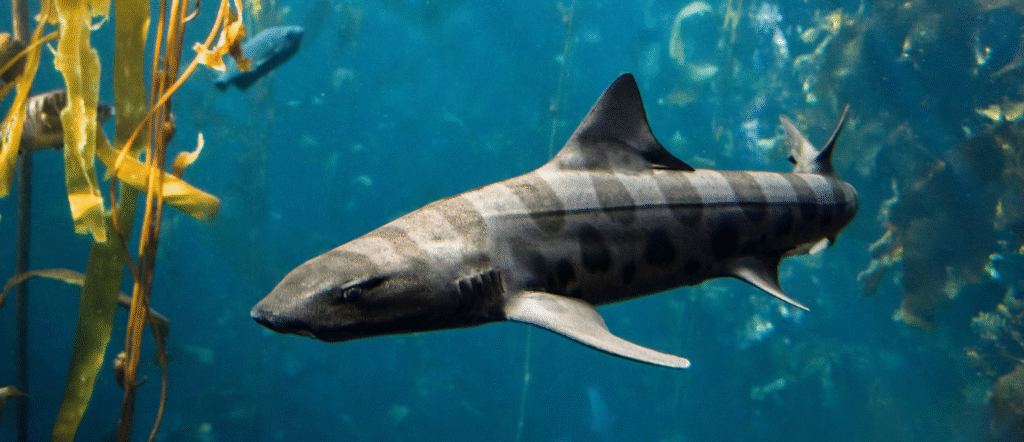
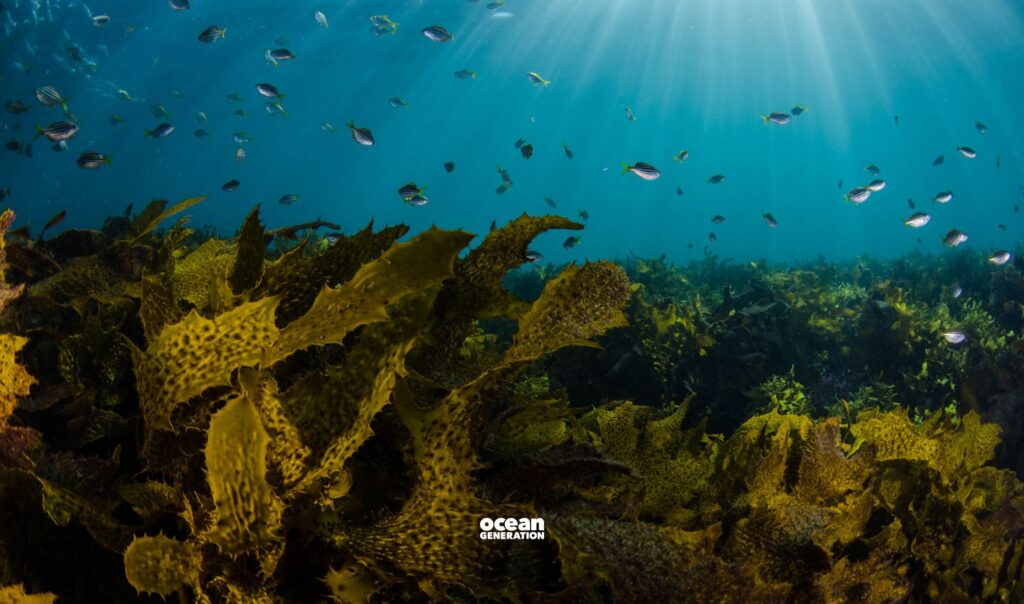
How do the sounds of kelp forests change? Explained by Ocean Generation.

The age-old question goes “If kelp falls in a kelp forest and no one is around to hear it, does it make a sound?” … or something like that.

The study of kelp forest soundscapes is new, but it is essential to understanding the ecosystem. 

What are kelp forests

Kelp forests are incredibly diverse and important ecosystems of organisms living within dense areas of (surprise) kelp in coastal regions.  

Kelp forests, and more generally seaweed forests, act as major carbon storage for the planet and are, when compared to the woods, incredibly diverse, containing mammals, arthropods (shrimps), echinoids (sea urchins), brachiopods (a shelled animal that feeds via filter feeding) and much more.
What are kelp forests? Explained by Ocean Generation, leaders in Ocean education.

What does the Ocean sound like? 

The Ocean is surprisingly noisy. Sound is used to convey information over long distances, and to neighbours on the reef or in the grass. In water, sound travels farther than either light or chemical cues and moves almost five times as fast as it does in air.  

Marine mammals like whales and dolphins are famously loud and use sound to communicate.  Sperm whales can reach volumes louder than jet engines. But a shocking truth is that other marine animals contribute to the Ocean soundscape too! For example, did you know that some fish make hums and purrs?  

Beyond marine animals, there are other sound sources in the Ocean. Geological sounds (earthquakes and landslides) and our own human activity (engines and drilling) have their own effects on the Ocean soundscape. 

What do kelp forests sound like? 

Kelp forests are an unfamiliar setting to most of us, so to assist on our adventure of the soundscape, we’ll venture through the woods at the same time. 

In the woods, we hear distinctive, familiar noises. The twitter of birds, the chattering of rabbits and the chirps of insects dominate the soundscape. In kelp forests, we can hear the different calls of fishes and the frequent snapping of shrimp.  

The noises of kelp forest can be separated by their pitches. Generally, lower tones contain the noises of marine mammals and fish. The higher tones we’d hear contain the clicks of snapping shrimp and the sound of echolocating dolphins (although this is higher than the human ear can hear so it’s silent to us). 

These soundscape features often change in both environments over time due to natural factors, like seasonal changes, or human activity. 
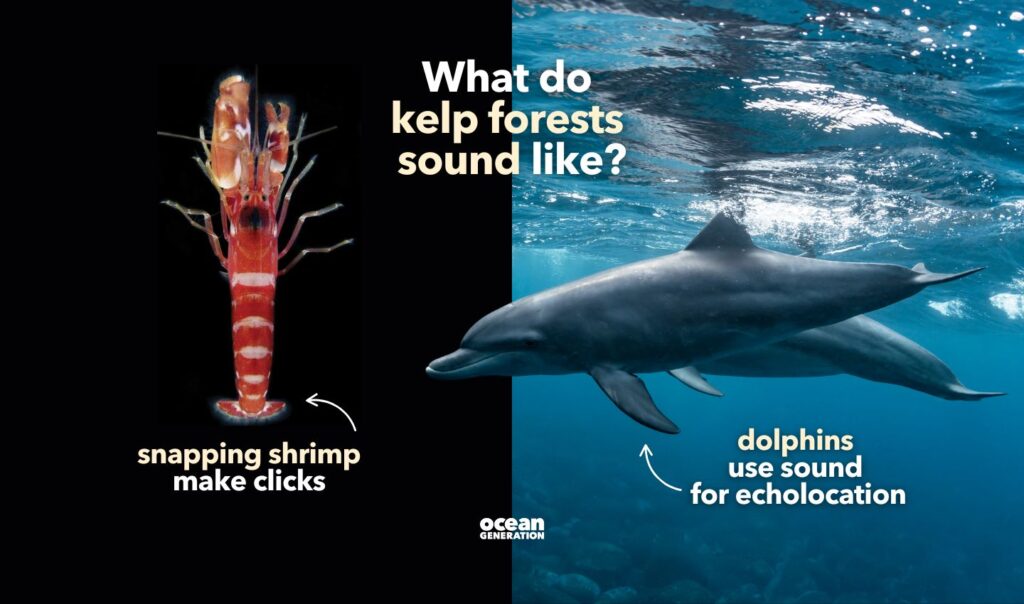
What do kelp forests sound like? Explained by Ocean Generation.
Snapping shrimp photo by Anker A Grave

Daily changes in the kelp forest soundscape 

As the night comes, the sounds of the daytime animals switch to the noise of nocturnal animals.  

In the woods, hooting owls and squeaking bats take over the soundscape along with the occasional chirp from foxes. This daily change is seen in kelp forests too, where the activity of animals and therefore the volume of their sounds shifts over the course of the day. 

For some species of fish, their noise peaks at sunset and dips at sunrise. As well as this, snapping shrimp are nocturnal, which shows in their activity, as they have peaks at sunset and sunrise but a decreased activity during the day. 

Seasonal changes in the kelp forest soundscape 

With the arrival of autumn and winter in the woods, some animals migrate or hibernate, removing their noises from the soundscape.  

A seasonal change also occurs in the kelp forest, where the time of year can affect the presence of animals.  

The Plainfin Midshipman fish makes nests near the coast and uses a humming noise to attract a mate. This humming is heard in the kelp forests during late spring and summer, consistent with their mating season. Contrasting this, the presence of snapping shrimps is maintained year-round. 
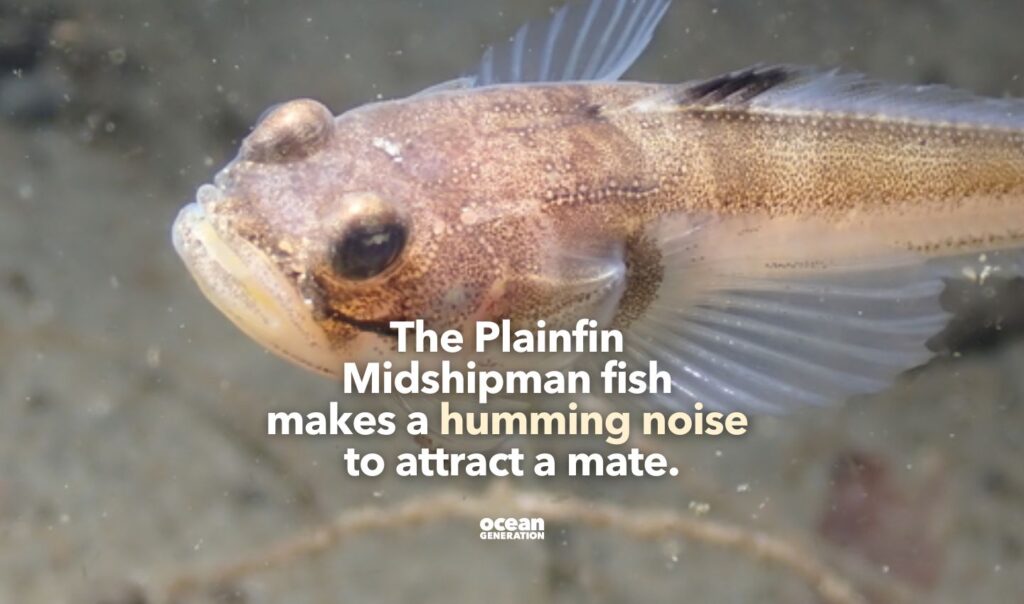
Plainfin Midshipman fish humm during spring and summer. Posted by Ocean Generation.
Photo by Sara Thiebaud

Human influence on kelp forest soundscapes 

On our walk through the woods, we come across barren spots without trees, caused because of storms or fires. Similarly in the Ocean, an abundance of sea urchins and a lack of suitable food can cause them to feast on kelp clearing the area and leaving a space overrun with small, malnourished sea urchins, with the East Fish camp in California having an urchin density of 26.8 urchins per square metre

Although urchin barrens may seem like a natural environment, they are created by human activity, just as extreme weather can become more prominent because of global warming.  

Normally, sea otters and the occasional fish prey on urchins before the situation gets out of hand. But, due to hunting and overfishing, sea urchin predation is decreased, allowing their population to spike and kelp forests to be removed.  
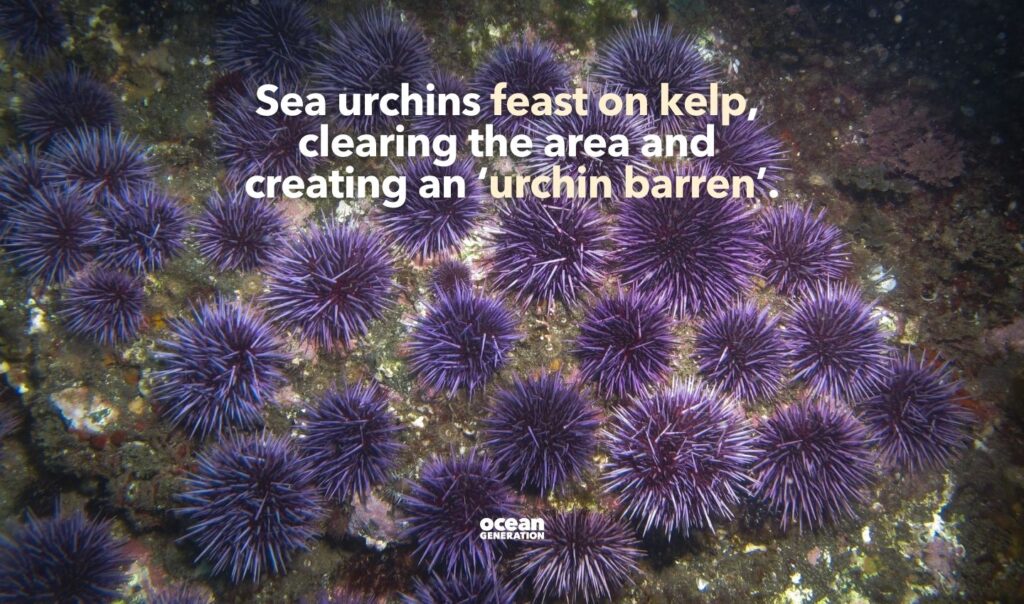
Urchin barrens influence the kelp forest soundscape. Posted by Ocean Generation.
Photo by Ed Bierman

Sea urchin barrens influence the kelp forest soundscape as the region becomes less suitable for some species and more suitable for others. When hundreds of sea urchins move in, they change biodiversity.  

A more direct human influence on woodland soundscapes is deforestation. The direct removal of trees by humans to clear space or for resources is easily a big issue, as it decreases habitat space, reducing biodiversity and harming ecosystems.  

A similar situation happens with kelp as it can be harvested, as it has uses like in food and beauty products. As a consequence, the amount of kelp is decreased, showing little to no recovery after two years, and biodiversity can change to be unlike before harvesting. 

Does human noise affect kelp forests? 

Listening in our woods, we don’t only hear animal noises but also human noises. Cars on roads which cut through the woods or heavy machinery operating can create loud persistent noises which can disturb the soundscape, affecting the distribution of the animals

The same is true for animals in the Ocean. Loud noises like drilling and seismic surveys are loud and the noise can be emitted for tens of kilometres, causing confusion and hearing damage in marine mammals and fish. 

Other sounds like engine noises from low flying planes and boats can act as background noises which decrease the distance that animals can hear and communicate.  

Sound disturbances can normally be mitigated in kelp forests by kelp’s ability to attenuate (absorb and decrease) sound. However, because of the removal of kelp forests, this mitigation can quickly be removed.  

The building of docks and other structures may seem like they could bring back attenuation, but they can also transfer noise from cars and docking boats into the Ocean, affecting microenvironments. 
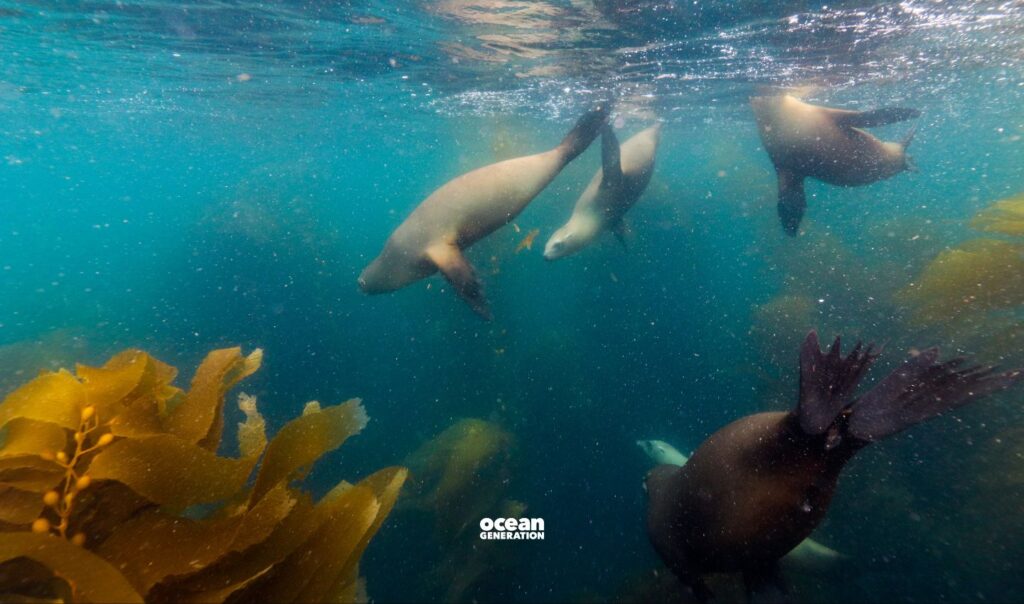
How does human noise affect kelp forests? Explained by Ocean Generation.

What can we do

It may seem daunting that humans can cause all of this damage, but not all change is bad. Just as forests can be replanted and wildlife protected, as can kelp forests.  

The growth of kelp can be stimulated, and areas can become marine protected areas, which can allow areas to be conserved. An example of this is in New Zealand, where an urchin barren has recovered back into a kelp forest within a marine protected area over the period of 20 years. 

Looking at how we live our lives, like where our fish comes from or our usage of boats can make a difference in helping this delicate ecosystem. 

Who are the orca outlaws sinking boats, and why are they?

Subscribe

Monthly: Impact in your inbox.

OceanGeneration-Join

Why are rivers important?

Why are rivers important? Posted by Ocean Generation.

From the creek whispering through a forest, to the confusion of huge currents twisting against each other in the channel. These flowing waters connect ecosystems, cultures, and continents — and ultimately, they connect us to the sea. Join us to explore why rivers are important.  

Read about the wider water cycle and how rivers fit into it here

Why are rivers amazing? What is an estuary? And what are the threats to these wet wonders? 

What are rivers 

Let’s start with a quick definition. Rivers are large, natural flowing streams of water. They have banks on either side, they have a source and a mouth. They meander through every continent, from a few kilometres to thousands long.  

Which is the biggest river?  

What does ‘biggest’ mean? Let us start with length, and to answer that, let us start with another question: where do rivers start? Finding where a river begins is notoriously difficult.  

It’s tricky to work out where that first drop comes from. Some rivers begin from a lake or a melting glacier. Others, like the Danube in Europe, start from a spring (water bubbling out of the ground). 

River origin leads to debates over which the longest river is – the Nile or the Amazon 

The Guinness Book of World Records gives the award to the Nile but does concede “which is longer is more a matter of definition than simple measurement”.  

The Nile, in Africa, has been estimated as great as 7,088 km (4,404 miles) in length, and the same paper puts the Amazon, in South America, at 6,575km (4,085 miles). 

However, a quick search will reveal some debate. 6,650 km (4,132 miles) is more commonly quoted for the Nile, and 6,400 km (3,976 miles) for the Amazon. 

Explorers are always trying to prove otherwise, measuring in a different way, from a different point, to a different point. 
We are #TeamNile.

Next, there is the deepest river in the world: the river Congo.  

It reaches depths of 220m. That is about as deep as the world record for SCUBA diving. By that depth there is little light, and the pressure from the water above is equivalent to having three adult orcas lying on top of you.  

The Amazon stands alone in the amount of water it gathers.  

Once rivers start their journey, they gather in momentum on their mission back to the Ocean. More precipitation and groundwater help fuel their flow, and other streams, known as tributaries, join it along the way.   

Approximately 209,000m^3/s of water enters the Atlantic from the Amazon. Imagine 75 hot air balloons filled with water, every second. This is equivalent to almost 20% of the total global river discharge, the total volume of water rivers release into the Ocean.  

The Amazon is more than the Nile, the Mississippi, in the USA, and the Chang Jiang (Yangtze), in Asia, combined. The brown waters can be seen as far as 100km (62 miles) out to sea, which provided an important navigation tool for sailors hundreds of years ago.  

The biggest rivers on Earth, posted by Ocean Generation.

Where are estuaries? 

Where the river reaches the Ocean, the interface is an estuary. They usually have a mix of fresh and salty water, known as brackish (there are some examples of freshwater estuaries in the Great Lakes of North America). 

Estuaries are highly productive, unique ecosystems. For many different animals they provide food, places to breed, nursery grounds and hosting migratory species.  

But why do rivers matter? 

Rivers are important, as fresh water is key to all life. Rivers have influenced our world historically, geologically and culturally. They support life where it would otherwise be unviable, on land and in the Ocean. They are the ultimate connector. 

Approximately 40 trillion cubic metres of water enters the Ocean from rivers every year. But it doesn’t come alone.  

As water moves over the land, it picks up hitchhikers (such as ions, making the sea salty – see more here). Material dissolves into the river, or the water pulls it along. These can lend colour to the river waters (and often their names). 

There is the Rio Negro in Brazil, named due to the humic acid from decomposing vegetation colouring the water black. The Red Rivers in Peru and North America, from the small pieces of rock containing iron oxides. The Drina in central Europe is green due to the limestone it flows over and the Hwang Ho (Yellow River) in China is named so because of the loess (a type of soil or sediment) it carries. 

They do more than just look good; these multicoloured masses are changing the world. 

Freshwater is key to all life on Earth. Posted by Ocean Generation.

How do rivers change the world? 

Flowing over rocks, mud and sand, each particle that the waters pick up change the course of the river and the shape of the land. Look around where you live, you can usually find the fingerprints of water at work.  

Rivers can cut away land and form new land, depositing the sediment it has picked up on the bank or in deltas where they meet the Ocean.  

The Colorado River, in North America, has produced the most remarkable example, carving away the landscape to produce the Grand Canyon, while the Nile Delta shows us how rivers build land too.  

The waters are full of nutrients, iron, nitrates and other essential building blocks for life. When these enter the Ocean, life flourishes.  

How are rivers and estuaries important for us? 

Rivers are incredibly important for one species in particular: us.  

The first great civilisations all rose up on rivers. The Nile, the Indus, the Tigris and Euphrates and the Huang all supported some of the earliest great cities in human history. Think of a big city – if it isn’t on the coast, we bet it is on a river. 

Rivers provide food: the last two very long uninterrupted rivers in Southeast Asia, the Irrawaddy and Salween, provide 1.2 million tonnes of catch annually and support agriculture of over 30 million people. In the US, approximately 68% of the commercial fish caught were caught in estuaries. 

The water rivers carry is crucial for drinking, domestic use and agriculture. More recently, we use it for power and industry, and transport.  

Rivers have held a central place in culture as well, connecting us and our world metaphysically.  

The Whanganui river in New Zealand has been regarded as an ancestor by the Māori people for centuries, and the Ganges is upheld as a place of healing and purity, personified by the goddess Ganga. In Japan, Shinto beliefs hold that each river has its own divine guardian, the Kawa-no-Kami.  

Across many different cultures, rivers have been celebrated and protected.  

Why do rivers matter? Posted by Ocean Generation, leaders in Ocean education.

What are the threats to the rivers? 

As much as rivers have impacted human civilisation, we have had our impact on them.  

Changes to our water cycle due to climate change have reduced the resilience of our rivers as they experience larger variations in flow. Add that to pollution, developing on their banks, extracting their flora and fauna and even stopping their flow – rivers have had it tough. 

In order to harness the power of our rivers, we have been interrupting their flow. Just 23% of rivers over 1000km long flow uninterrupted into the Ocean, broken up by an estimated 2.8 million dams. 

The water rivers carry is crucial

How does pollution affect rivers? 

It is important to realise there are lots of different types of pollution. The first and most obvious is big pollution – plastic, waste, shopping trolleys – that kind of thing. This rubbish can damage the life in the river itself, spoil the water for use and clog and disrupt the water flow.

The other kind of pollution is the small stuff – chemicals, microplastics and pharmaceuticals. These can disrupt aquatic wildlife, make the water unsafe to drink and accumulate through the food chain.  

The Ganges, in India, is now a stark example of river pollution. In Hinduism, the river is personified as the goddess Ganga, the goddess of purity.   

Just 37% of sewage is treated before entering the river. The banks are lined with tanneries, slaughterhouses, textile mills, chemical plants and hospitals. The waste that fills the river has an estimated 66% occurrence of waterborne disease and contains super-bacteria resistant to antibiotics.  

How are estuaries under threat? 

Estuaries face many of the same threats as rivers. An estimated 55% of global wetland areas has been lost since 1900, due to developing coastal areas. These wetlands provide unique habitats for their inhabitants, who often are not suited to either the freshwater or marine environments.  

We also benefit from the carbon dioxide absorption, offsetting our emissions, and the reduction in the risks of flooding and coastal erosion. 

But we are poisoning them too. Chemicals – pesticides and fertilisers – used in agriculture, are washed into rivers and accumulate in estuaries. This leads to nutrient overloading, or eutrophication, with harmful algal blooms appearing. When these die, the decomposition uses up the oxygen in the water – impacting the animals living there.

Estuaries absorb carbon dioxide. Posted by Ocean Generation

How can we look after our rivers? 

Everything is connected, which means you can make a difference from anywhere. Simply being aware of the connection you have with the Ocean is an important step. You can look after it, wherever you are.

Rivers connect us directly to the Ocean. A hot take? All life is essentially marine – everything is connected to and dependent on the Ocean. 

Along with estuaries, they provide important habitats, give us the water we need to survive and bring us closer together through transport and culture. But they are threatened in our new world. As ever, being aware is such a crucial first step to solving any issue.  

Educate others:  

  • Share information about river conservation and encourage others to take action. 
  • Engage in local initiatives that promote sustainable water management practices. 

Join community and advocacy events:

  • Participate in local river clean-up events to help maintain waterways and raise awareness 

Advocate for sustainable practices:

  • Support policies that protect rivers from pollution and over-abstraction 
  • Promote low-impact renewable energy to preserve free-flowing rivers 
  • Be aware of what you use. Harsh chemicals for cleaning and gardening will eventually enter our Ocean. Check your shampoo for harmful chemicals and microplastics. 

Next time you are by a river, take a moment. That is a direct line to the Ocean. See if you can understand the connection humans have felt with rivers throughout our history. Wonder at the power and beauty. Appreciate the importance of our rivers.  

You can make a difference from anywhere.

Who are the orca outlaws sinking boats, and why are they?

Subscribe

Monthly: Impact in your inbox.

OceanGeneration-Join

How can we protect and restore our coastlines?

Protecting and restoring coastlines starts with us.

Coastlines are the gateway to the Ocean.

Vital ecosystems like mangrove forests, seagrass meadows, coral reefs and tidal marshes exist almost exclusively in coastal regions.  

They support a high biodiversity of life and provide key nursery and breeding areas for migratory species.

They’re also essential to the livelihoods of coastal populations, and we all rely on the important services they provide, such as carbon sequestration and protecting the coast from erosion.

Our coastlines are under threat. 

If you’re wondering which of the five key Ocean threats impact our coastlines, the answer is all of them.

Because coastlines are the boundary between land and sea, our impacts are often amplified in coastal regions due to their proximity to the cause…us.  

With more than one third (2.75 billion) of the world’s population living within 100km of the coast, it’s no surprise that coastal regions are heavily concentrated.

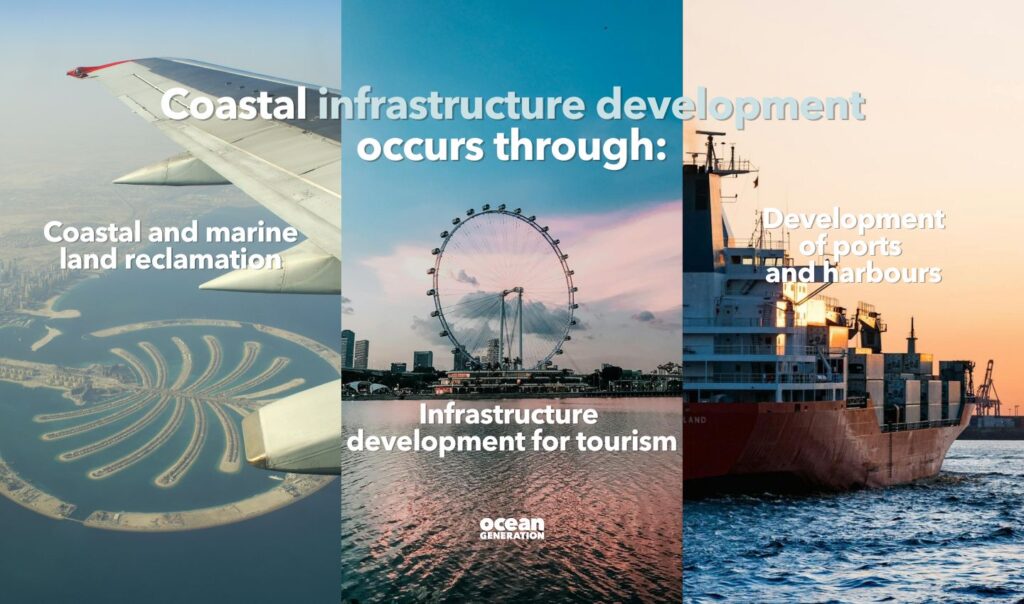
To supply the needs of this ever-growing population, coastal infrastructure development happens through:

  1. Coastal and marine land reclamation, the process by which parts of the Ocean are formed into land. 
  1. Infrastructure development for tourism, such as resorts and recreational facilities.  
  1. Development of ports, harbours, and their management.
Coastal infrastructure development, posted by Ocean Generation.

This is a key driver for habitat destruction (when a natural habitat can no longer support the species present) and biodiversity loss. It also increases the vulnerability of coastal communities to climate change impacts.

With higher frequencies of natural events like cyclones and hurricanes, risk of erosion, saltwater intrusion, flooding and other cascading climate change impacts, coastal regions have never been this vulnerable.

How can we protect and restore our coastlines? 

Enter: Nature Based Solutions (NBS). These are described by the IUCN as:

‘Actions to protect, sustainably use, manage and restore natural or modified ecosystems, which address societal challenges (such as climate change, food and water security) effectively and adaptively, while simultaneously providing human-wellbeing and biodiversity benefits.’ 

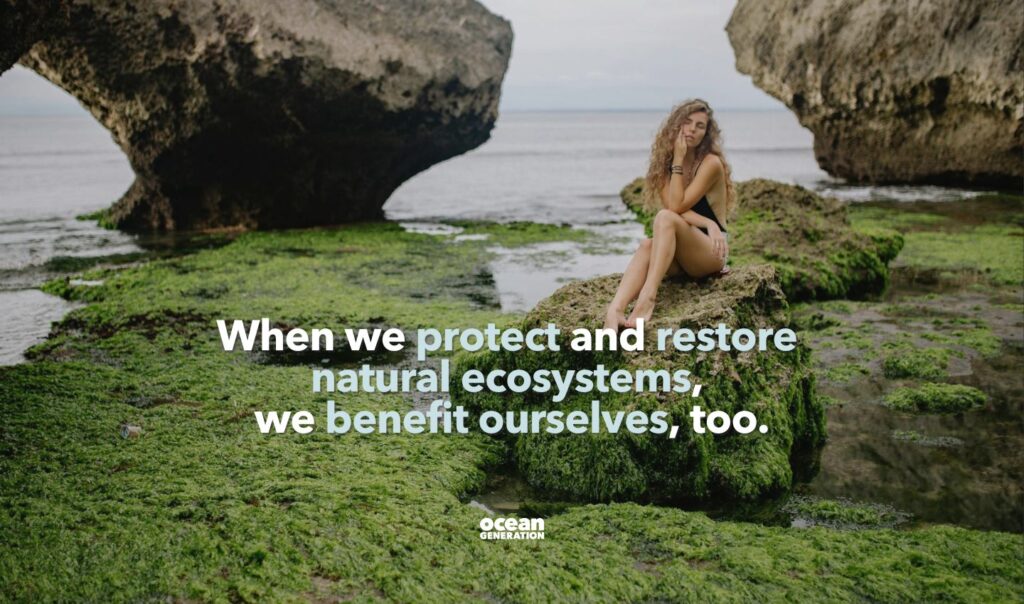
In other words, when we protect and restore natural ecosystems, we provide a whole host of benefits to ourselves, too.  

This can be done by restoring degraded ecosystems to their former glory and halting further loss of existing ecosystems.

When we restore natural habitats we protect ourselves too.

Ocean Solution: Habitat restoration.

Habitat restoration is the process of actively repairing and regenerating damaged ecosystems.

Restoring coastal ecosystems such as mangrove forests, coral reefs, oyster beds and seagrass meadows allow us to address environmental challenges (such as biodiversity loss). It reduces risks to vulnerable communities (like flooding, erosion, and freshwater supply). It also contributes to sustainable livelihoods by providing job opportunities.

That’s why at Ocean Generation, we support a mangrove restoration project in Madagascar, led by Eden Reforestation.

In 2022 alone, this project contributed to: 

  • Carbon sequestration and habitat restoration by planting over 4.3 million young mangrove trees.  
  • Creating sustainable livelihoods by employing around 70 people per month at the Maroalika site, with a total of 1,468 working days generated over the year.  

PSA: We plant a mangrove for every new follower on Instagram and newsletter subscriber. Sign up to our newsletter or follow us on our socials to be part of the change today. 

Interest in nature based solutions have surged lately. Posted by Ocean Generation, leaders in Ocean education.

Ocean solution: Marine Protected Areas. 

To halt ecosystem destruction and prevent further habitat loss, we must take measures to protect remaining coastal ecosystems.

One mechanism to achieve this is by implementing Marine Protected Areas (MPAs). These are designated areas of the Ocean established with strict regulations to protect habitats, species and essential processes within them.

If implemented and monitored effectively, Marine Protected Areas can provide a range of benefits across biodiversity conservation, food provisioning and carbon storage

What is the 30 by 30 target? 

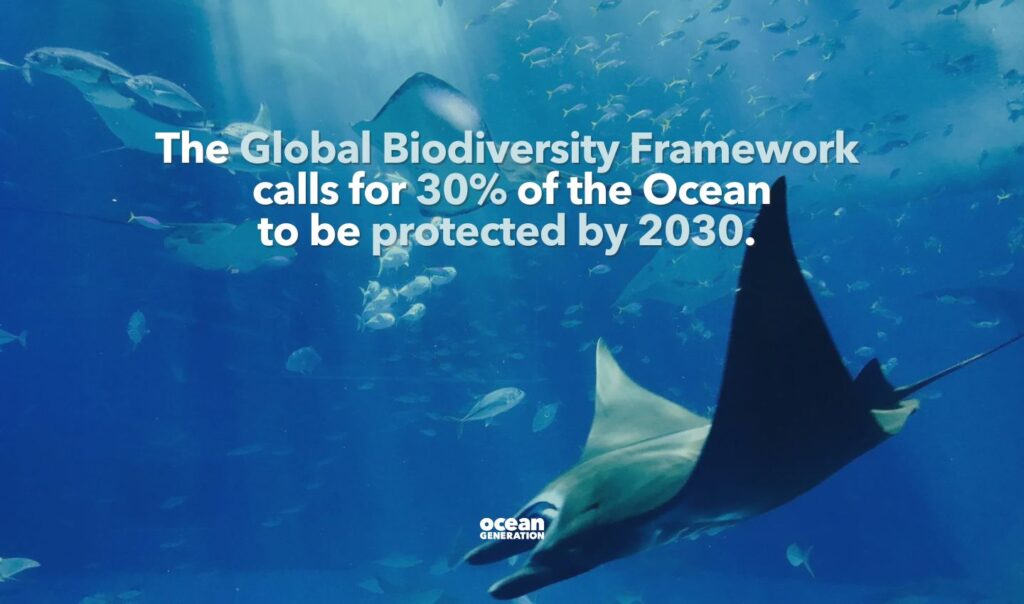
In recognition of the importance of healthy and thriving ecosystems, the Global Biodiversity Framework have established a “30×30” target. This calls for the conservation of 30% of the earth’s land and sea through the establishment of protected areas by 2030.

The Global Biodiversity Framework calls for 30 percent of the sea to be protected.

Spoiler alert: We’re not on track to meet this goal.

According to the Marine Protection Atlas (2024), only around 8% of the global Ocean area has been designated or proposed for MPAs, and only 2.9% of the Ocean is in fully or highly protected zones.  

Research also shows that 90% of the top 10% priority areas for biodiversity conservation are contained within coastal zones (within 200-miles of the shore). We must ramp up our efforts to preserve these vital coastal ecosystems and ensure that MPAs continue to benefit both people and planet.

What are the main challenges to implementation? 

Over the past 10 years, interest in the potential of Nature Based Solutions to help meet global climate change and biodiversity goals has surged, as we have begun to truly appreciate the importance of natural ecosystems.  

Despite this knowledge and an abundance of opportunities for implementation worldwide, marine and coastal regions still lack uptake.  

We must address the barriers to implementation to accelerate the rate of success of coastal protection worldwide, including (but not limited to):

  • Conflict of interest between stakeholders i.e. blocking of protective legislation by fishing and other extractive industries.  
  • Marine and coastal ecosystems are ‘out-of-sight, out-of-mind’. This results in a lack of public and policy awareness of their value. As a result, Nature Based Solutions are often overlooked in favour of grey infrastructure such as seawalls.  

Increasing our understanding of the vital services provided by coastal ecosystems is critical to overcoming these barriers. 

The more we appreciate what these incredible ecosystems do for us, the more likely we are to succeed in protecting and restoring our coastlines.  

Restoring coastal ecosystems help address environmental challenges

Who are the orca outlaws sinking boats, and why are they?

Subscribe

Monthly: Impact in your inbox.

OceanGeneration-Join

Our Impact: Understanding the 5 Ocean Threats

The Ocean is a flourishing ecosystem that can maintain itself.

But our actions have been negatively impacting the Ocean for decades, at a rate our Ocean cannot keep up with. 

There was a time when we thought the Ocean was endless. So, we treated it that way: Taking what we wanted, when we wanted, in whatever quantity we liked.  

It took us far too long to realise the many ways we threaten our Ocean. But now we know better.

Our Ocean is one of our planet’s most valuable ecosystems.

The Ocean provides over 50% of the world’s oxygen, captures 30% of human-made carbon emissions, and mitigates the climate crisis. The bottom line: We need a healthy Ocean for a healthy planet. 

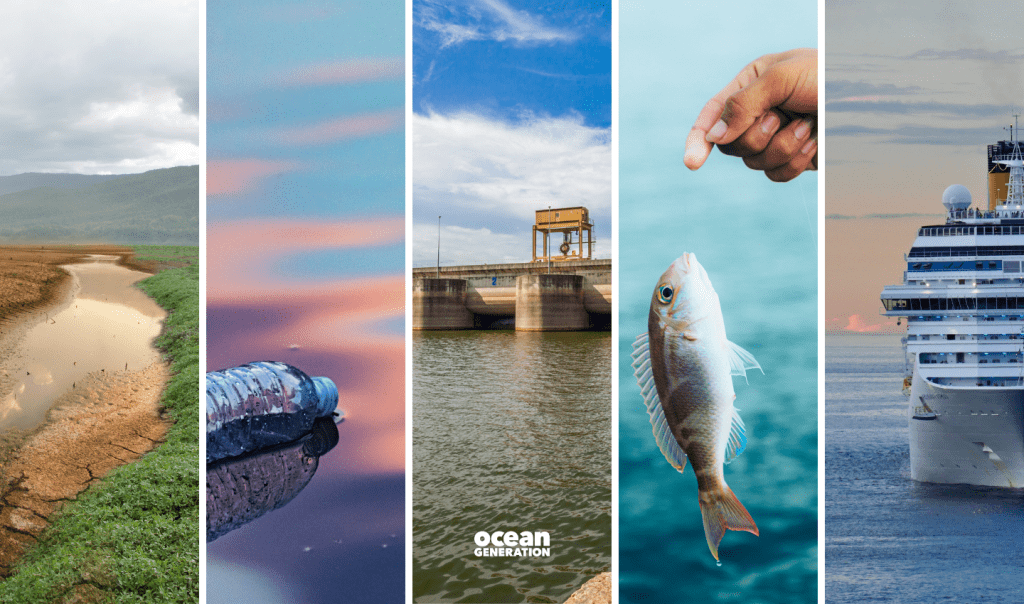
What are the 5 key ways human activity impacts the Ocean? Ocean Generation is sharing the human threats our Ocean faces. 5 images side by side represent the threats: a dry landscape for climate change; a plastic bottle in the Ocean for pollution; a dam wall for costal infrastructure; a caught fish for resource extraction; and a cruise ship for daily Ocean use.

How does human activity threaten the Ocean?

Our Impact work explores the 5 key ways human actions negatively impact the Ocean.

Many of the underlying actions causing these Ocean Threats have existed throughout the course of human history – but have become unsustainable more recently because of rapid population growth and the consequent scale of our impact on the marine environment.  

What human activity impacts the Ocean the worst?

There are no known, credible, scientific classification of the severity of these Ocean threats. What does that mean – simply? We can’t tell you which of the five threaten the Ocean the worst.

But there’s no doubt that all of these Ocean threats are inter-related and can combine to have vast negative impacts on Ocean health, marine habitats and marine life which, in turn, pose serious threats to human health.

What are the 5 human-made Ocean threats?

1. Climate change: We can’t talk about climate change without the Ocean

It’s widely accepted that human actions are the primary drivers of climate change. The biggest culprit? Burning fossil fuels (for example, coal, oil and gas) to produce energy is the main cause of climate change.

Signs of climate change are all around us – and impossible to ignore. But too few of us understand the important role our Ocean plays in mitigating the climate crisis.

How does the Ocean mitigate climate change?

Our Ocean plays a fundamental role in regulating global temperatures, storing massive amounts of carbon, and capturing heat from the atmosphere.

Although the Ocean drastically mitigates climate change, it’s also impacted by climate change. These changes (like increased Ocean heat), have negative consequences on Ocean health and thus, all of us.

2. Pollution: It’s not just plastic polluting our Ocean. 

Plastic is, by far, the most common and impacting pollutant in the Ocean.

80% of plastic in our Ocean comes from the land and most of that is made up of single-use plastic items; products we use once, then throw away. And that’s the biggest problem with plastic: there is no “away.”

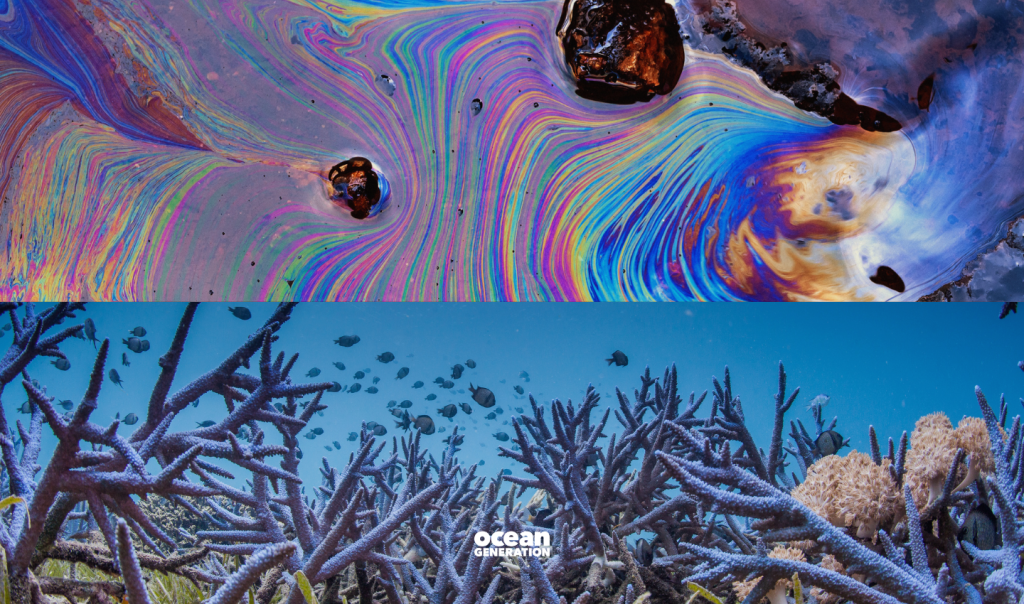
This Ocean Generation above and below image shows human impact on the Ocean in the top half of the image with an oil spill in the Ocean and in the bottom half, the flourishing Ocean. An array of fish are swimming among bright blue corals.

3. Coastal Infrastructure Development: Why do we need to protect our coastlines?


2.5 billion people live within 100km from our Ocean.

Coastal regions are densely populated areas with increasing rates of population growth (and who can blame them? Living near the Ocean has numerous benefits.)

But rapid urbanisation of our coastlines has negative impacts on the environment – many of which are linked to climate change.

With higher frequencies of natural weather events (like cyclones and hurricanes), erosion and land loss, and flooding, coastal regions have never been this vulnerable.

4. Resource Extraction: What resources do we extract from the Ocean? 

Around 3 billion people rely on the Ocean for their primary source of protein: Seafood.

Seafood is the most notable thing we extract from the Ocean but it’s not the only thing. We also extract minerals, fossil fuels, and plants from the Ocean.

Our Ocean – as incredible as it is – is not limitless.

We must recognise the limits of Ocean resources and control the quantity and frequency at which we extract resources from the Ocean; allowing it time to replenish and regenerate. Otherwise, we will reach a point of no return.

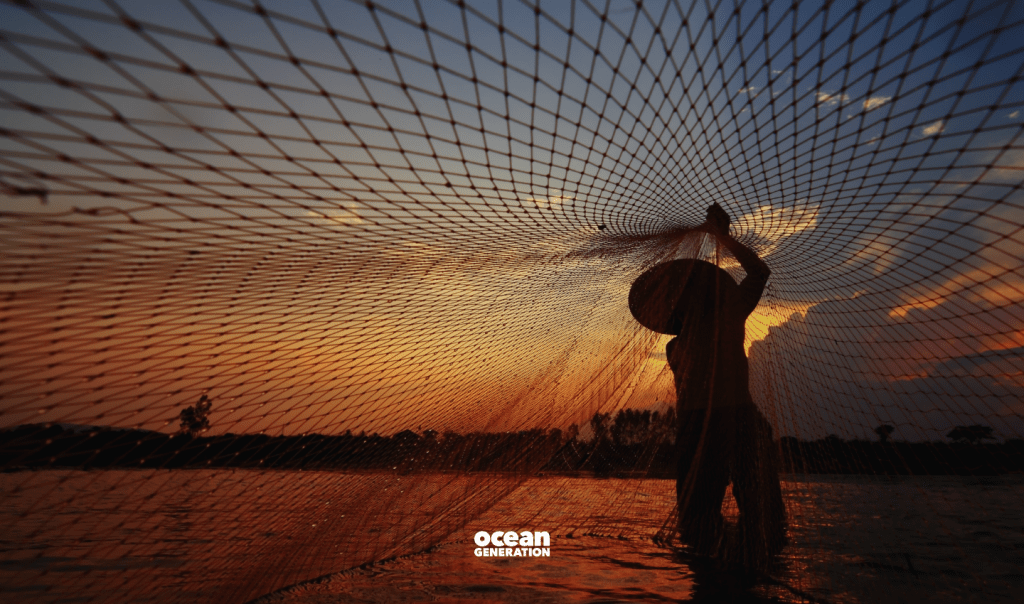
A fisherman, standing knee deep in the Ocean, is holding up a fishing net. It is sunset and only the outline of the fisherman and his hat can be seen against the yellow sky. In this blog, Ocean Generation is sharing the negative impact of resource extraction on the Ocean.

5. Daily Ocean Use: What’s the impact of daily human actions on the Ocean?

Humans work hard and always have something on the go. The Ocean is no different.

All around the world, our Ocean is in use every day. From cargo shipping for trade, passenger traffic for travel to commercial fishing and research – the Ocean is used widely. How we make use of the Ocean is what’s important.

We need to turn to using the Ocean sustainably to protect the awe-inspiring ecosystem that supports all life on Earth. 

What can I do to protect our blue planet?

Understanding the 5 main threats our Ocean faces is step one. Step two is doing something about them. Some of these Ocean Threats can feel overwhelming – but they don’t have to be.

Working together is humanity’s superpower. And it remains our best tool for solving the world’s biggest problems, and simultaneously, restoring our Ocean.

Three ways you can take environmental action – with a focus on the Ocean – right now:

  1. Subscribe to our newsletter to receive monthly impact in your inbox; explore our Science Hub; or visit our Instagram page for bite-size environmental education.

  2. Recognise that you don’t have to be perfect.

    Ask yourself: What can I do right now to decrease my carbon footprint? What can I do to be a voice for our Ocean and empower others to do the same?

  3. 20 actions to reduce and reuse plastic.

Subscribe for simple Ocean Science and pop-culture stories

* indicates required

View previous campaigns.

Ocean Generation will use the information provided here to be in touch with updates and marketing.

You can unsubscribe at any time.

Who are the orca outlaws sinking boats, and why are they?

Subscribe

Monthly: Impact in your inbox.

OceanGeneration-Join

Our Impact: Why is protecting our coastlines important?

This is part of our Four Pillars work that highlights the importance of the Ocean, the human-made threats it faces, and the solutions our Ocean provides.

Think of some of the most vibrant cities around the world: Mumbai, Istanbul, Dubai, Copenhagen, Tokyo. What do they all have in common?  

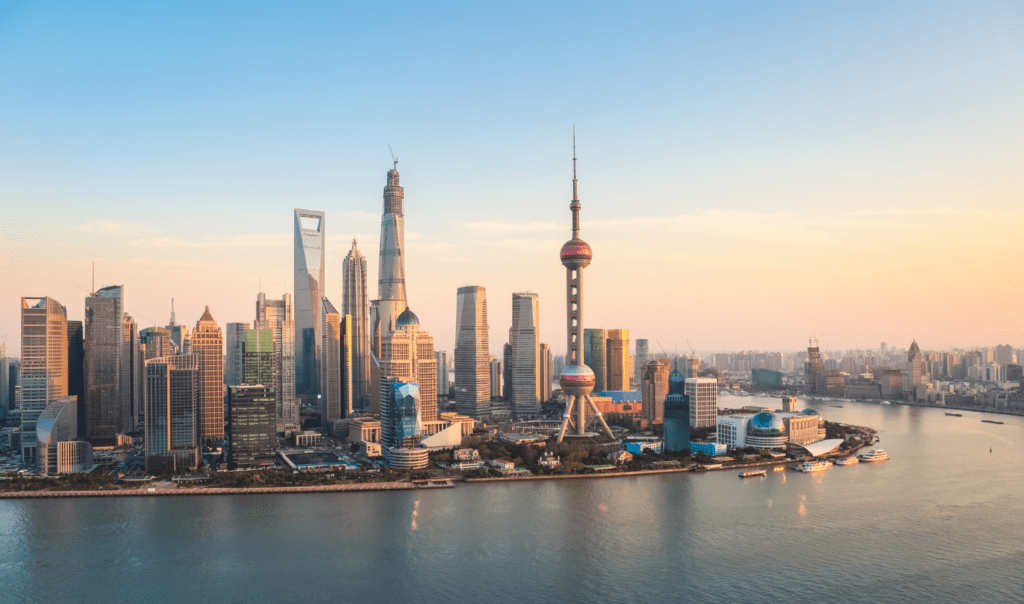
Shanghai coastal city at sunset. Ocean Generation is sharing the impact of coastal infrastructure development on the Ocean.

They are coastal cities. 

How does living on the coast impact human health?

Coastal regions can positively contribute to human health. Through the food we eat, the quality of air we breathe, and the water we drink, living by the Ocean can have a calming effect.

This is not to mention the wealth of economic and recreational opportunities that come with coastal areas.  

With 2.5 billion people within 100km of the coast living in 4% of land area within the same distance, it is no surprise that coastal regions are heavily concentrated. In fact, about 90% of population concentration is in coastal cities with populations of over one million.  

So what?  

What impact do coastal regions have on our blue planet?  

The coastal zone is the most urbanised region in the world, hosting 15 of the 20 megacities (cities with populations of over 10 million people).

This rapid urbanisation of coastal regions has cracks in planetary health that we notice more and more every day.  

The impacts of climate change on coastal communities are increasingly evident. With higher frequencies of natural events like cyclones and hurricanes, risk of erosion and land loss, salinisation, flooding and other cascading impacts, coastal regions have never been this vulnerable.  

Let’s investigate some ways coastal infrastructure impacts the Ocean and the organisms that call it home. 

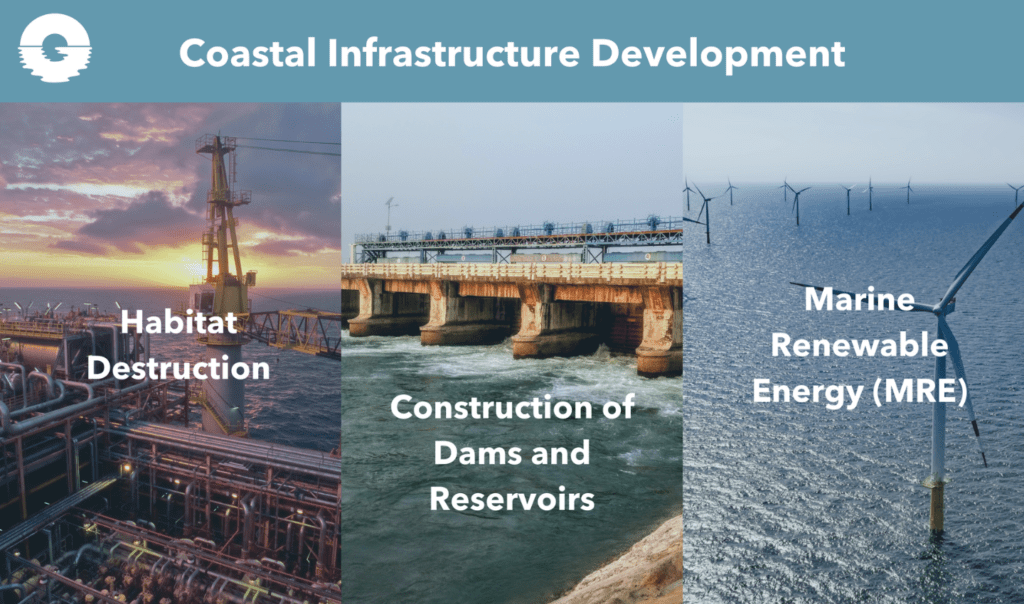
Impacts of coastal development on the Ocean and Ocean life. Ocean Generation is spotlighting the impact of habitat destruction, construction of dams and marine renewable energy.

Building along our coasts causes habitat destruction 

Human activities are a key driver for habitat destruction.

This can be observed through: 

– Coastal and marine land reclamation, the process by which parts of the Ocean are formed into land (by infilling or building dykes, for example) 

– Infrastructure development for tourism (for example, resorts and recreational facilities) 

– Development of ports, harbours, and their management (including dredging) 

Habitat destruction occurs when a natural habitat, like a wetland, can no longer support the species present. The species are often destroyed or displaced.  

Thus, habitat destruction is a leading cause of biodiversity loss. With changes in physical and chemical compositions, invasive species tend to thrive in these areas, further driving out native species.  

Destruction of China’s Coastline: A quick study 

The most significant recent development is coastal and marine land reclamation, especially in China, with 1249.8km2 of ‘new’ land developed since the mid 1980’s.  

This can have many unintended consequences. In one study, scientists observed 19,793.4 hectares of coastal wetlands changed to inland wetlands enclosed by a seawall and dike, between 1989 and 2013. This cuts off the exchange of sediments and the flow of water between the wetland and the Ocean.  

In this case, more than 80% of the natural wetlands had been used to develop urban, industrial, and agricultural land uses. This can be seen as an ecological trade off in favour of human activities.  

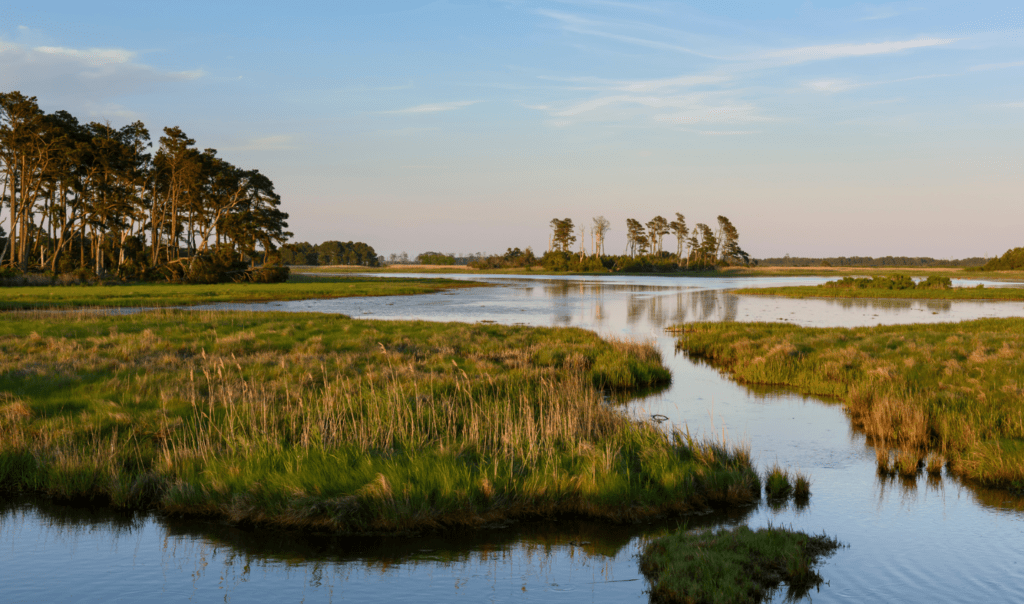
A coastal wetland shared by Ocean Generation.

Coastal wetlands are resilient natural habitats, important for flood protection, carbon sequestration, habitat for wildlife, etc.

Destroying these natural habitats impact the Ocean, aquatic life, and humans too.  

The impact of building dams and reservoirs 

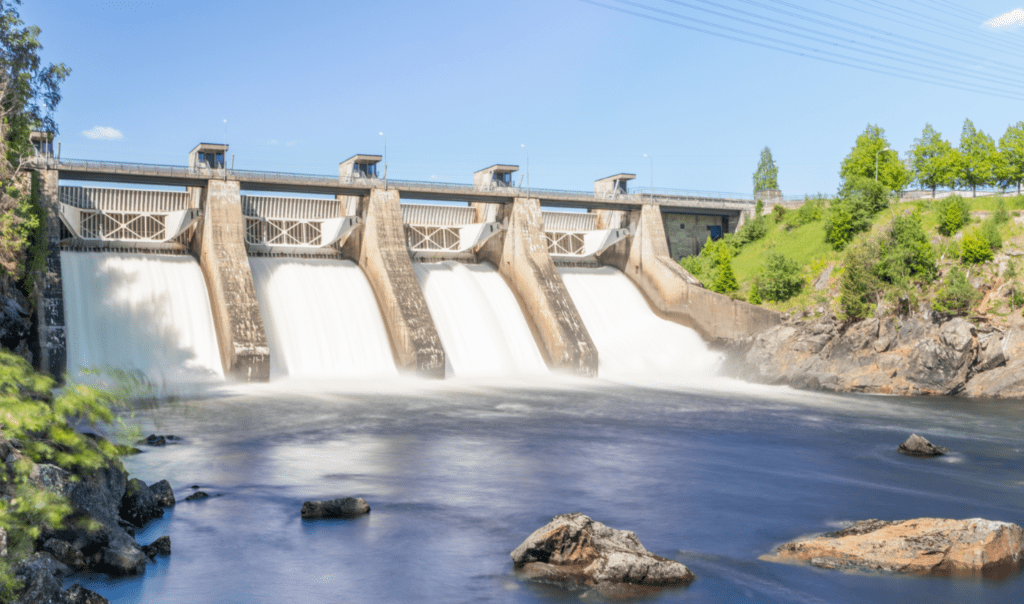
A dam is a barrier that holds back water whereas a reservoir is a human-made lake that stores water.

For thousands of years, dams and reservoirs have been built for irrigation, flood prevention, water diversion, and even warfare purposes. Nowadays, dams are also used to generate hydropower.  

Dam walls are often built for hydropower.

The construction of dams and reservoirs reduces sediment supply by varying degrees, sometimes by more than 50%, which leads to erosion. This can decay coastal ecosystems like mangroves and can even cause irreversible changes.  

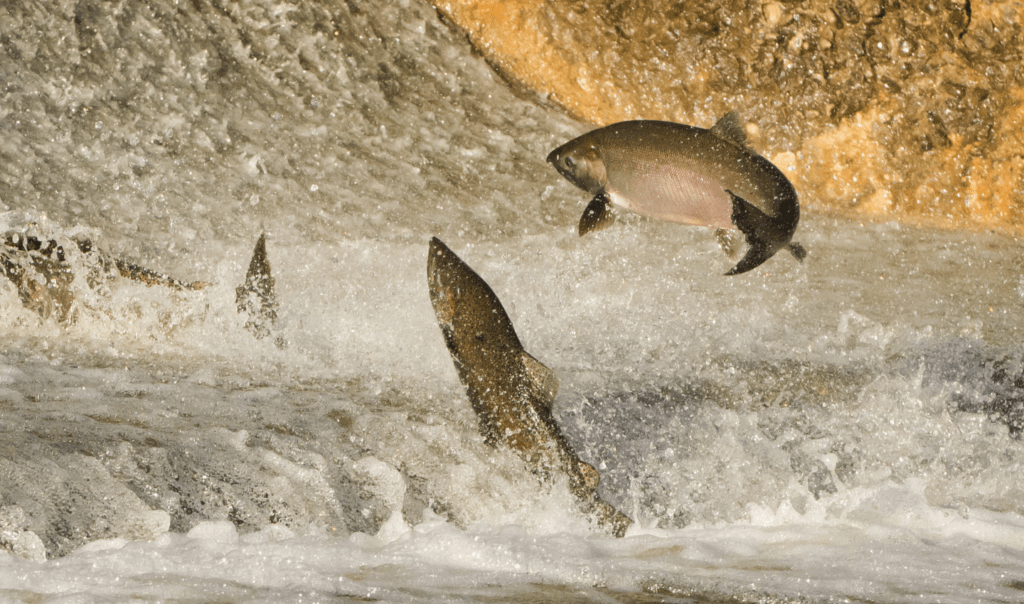
Another concerning effect of dams is that they restrict the migration of fish. Many freshwater species rely on free-flowing rivers to complete their life cycles.  

The harm of building too many dams and reservoirs: A quick study 

A good example to understand this effect is by observing salmon populations. In the USA, between 1933 and 1975, 211 dams were built during the construction of a hydropower system in Columbia Basin. This led to a massive loss in the wild salmon population.  

Although hatchery and commercial aquaculture operations were underway, the wild salmon population failed to bounce back. Authorities had set a target for salmon recovery of 5 million, but after 34 years and $17.9 billion, they failed to meet this modest target.  

Salmon leaping from the water.

The ecological reality of the effects of human activities needs to be acknowledged alongside economic viability.  

It is not too late to include these considerations in the budding marine renewable industry. 

Tread lightly: Our Ocean’s role in the energy transition 

The Ocean has the potential to be at the heart of the energy transition. As we steer away from fossil fuels, the Ocean is enabling a new industry: marine renewable energy (MRE). 

This includes offshore wind, floating solar, tidal, wave and Ocean current energies. At present, offshore wind technology is the most mature and commercially viable, whereas some other technologies are still in the development phase.  

There is no doubt that MRE is less disastrous than fossil fuel extraction. But we must be careful not to ignore the environmental impacts of MRE. This is not a truly well understood area which makes this even more important.  

Environmental impacts of Marine Renewable Energy installations 

The underwater infrastructures for MRE installation, like cables and anchors, can affect benthic habitats like reefs and seagrass meadows, i.e., the bottom of the Ocean. It can also affect the open waters by changing its function and characteristics.  

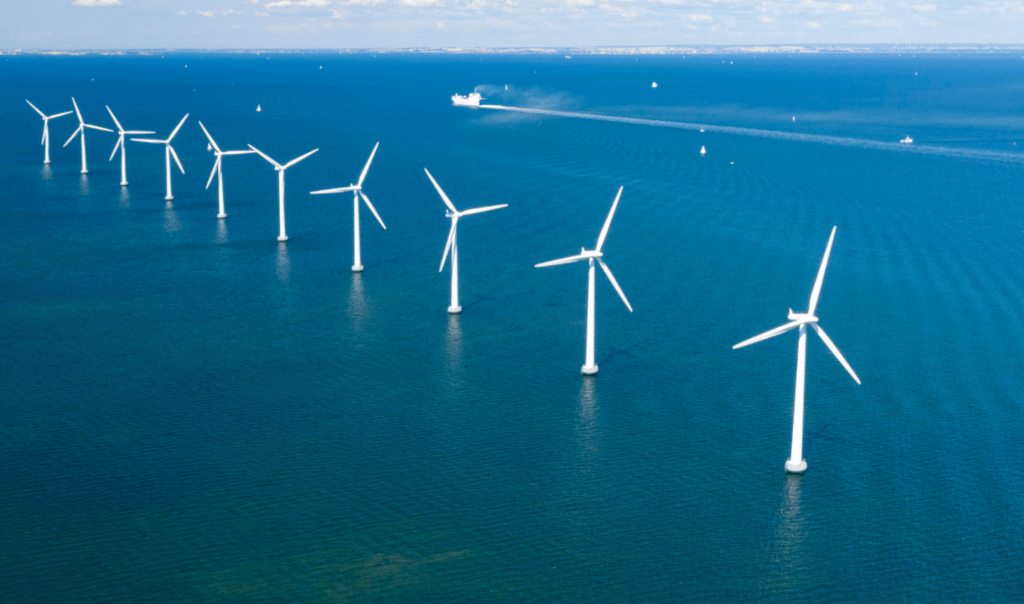
A row of bottom fixed wind farms in the Ocean.

The effects of MRE can be observed through the creation of artificial reefs, and biofouling (invasive species) in offshore wind farms.  

Furthermore, there is a lack of research in the following areas: 

– Collision risks for fish (with underwater MRE infrastructure) 
– Associated fish behaviour 
– Environmental interactions between commercial fishing and offshore wind farms 
– Direct interactions between tidal turbines and specific seabird populations 

Although underwater noise is not an issue for operational MRE, the construction phase can have major impacts.

For example, noise generated from construction of fixed-bottom wind farms can mask echolocation sounds used by marine life for hunting, navigation, and communication. It also has the potential to impair hearing. To mitigate these effects, floating wind farms are preferable, as they do not require piling. 

As we have seen, avoiding, and minimising these environmental impacts will enable successful deployment of MRE technologies at a competitive cost. However, this is not possible without further research and additional data to truly understand these impacts.   

How can we build better along our coastlines?  

We need to understand our environmental impacts 

Currently, there is little incentive to research the environmental impacts of MRE technologies. We need robust environmental impact assessments, as well as lifecycle assessments to be as resource efficient and considerate to the Ocean and marine life.  

Despite a few environmental concerns, MRE technologies are still so much better than relying on fossil fuels, greatly mitigating greenhouse gas emissions. We must choose renewable energy where possible and strive to understand the potential impacts so we can avoid and reduce them. 

We need to account for ecosystems as a whole 

Considering an ecosystem as a whole means that we focus on restoring our ecosystems and enhancing ecosystem services to protect us from the effects of climate change.  

These kinds of measures are multi-disciplinary, which paints a better picture of what we are dealing with than traditional technical measures. This is especially needed for successful implementation of solutions to mitigate the negative effects of dams and reservoirs.  

We need to invest in nature-based solutions: 

Nature-based solutions focus on the protection, restoration, and management of natural and semi-natural ecosystems, to benefit both human beings and biodiversity.

The difference between nature-based solutions and ecosystem-based approaches can be found here

Investment in nature-based solutions like coastal blue carbon ecosystems (mangroves, seagrass etc.) are important for continual coastal security and carbon sequestration.

These solutions, in addition to adaptation strategies, will be key in protecting coastal and island communities. 

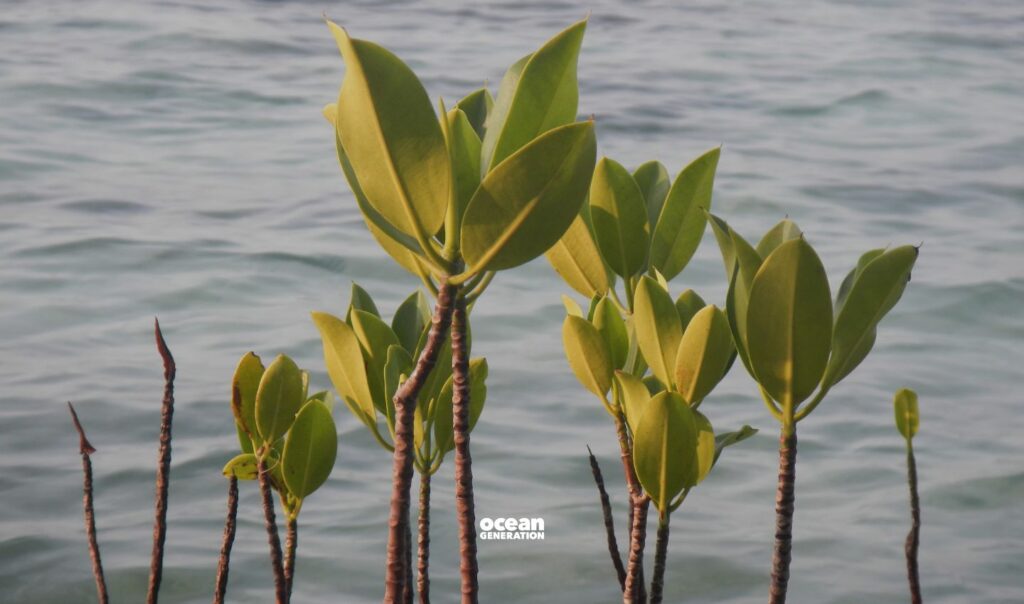
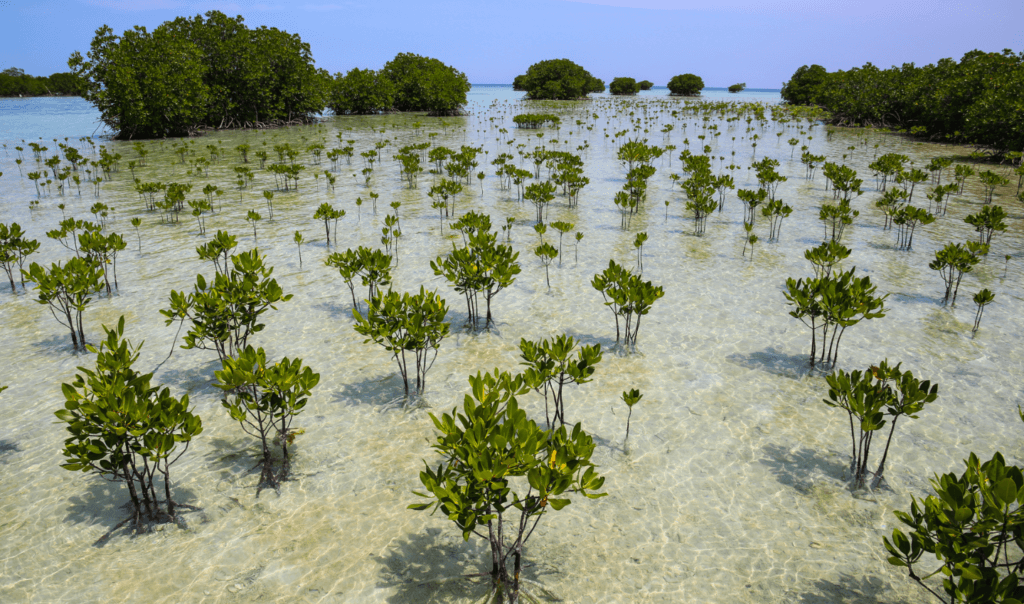
Growing mangrove trees. Mangroves are climate change heroes.

Support ongoing scientific consensus 

We continue to learn about the effects of our activities on the natural environment and subsequently, ourselves, as we unlearn that humans and nature are not separate entities.  

Following the latest evidence and implementing policies and practices to reflect those changes are key to limiting the damage we have done. We must not wait any longer as we have many reliable solutions already.  

Our hope to save and restore the Ocean starts on land.  

As with most climate initiatives affecting the Ocean, we must make sure our Ocean is part of the conversation. 
 

Who are the orca outlaws sinking boats, and why are they?

Subscribe

Monthly: Impact in your inbox.

OceanGeneration-Join