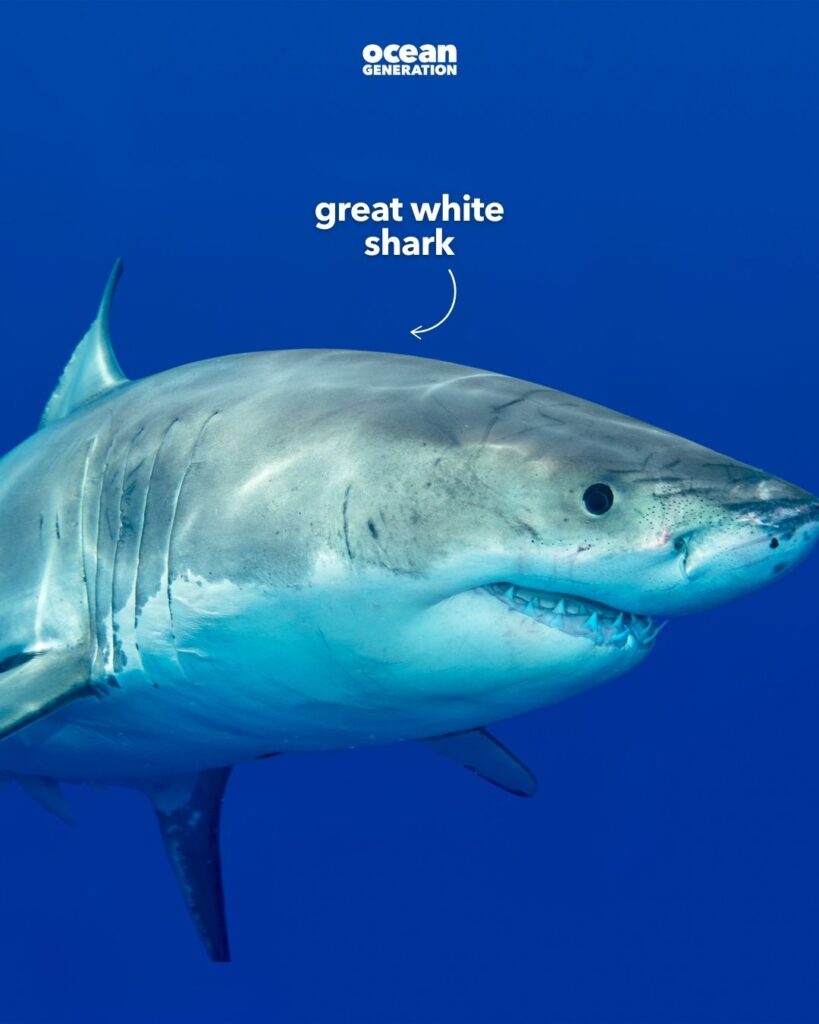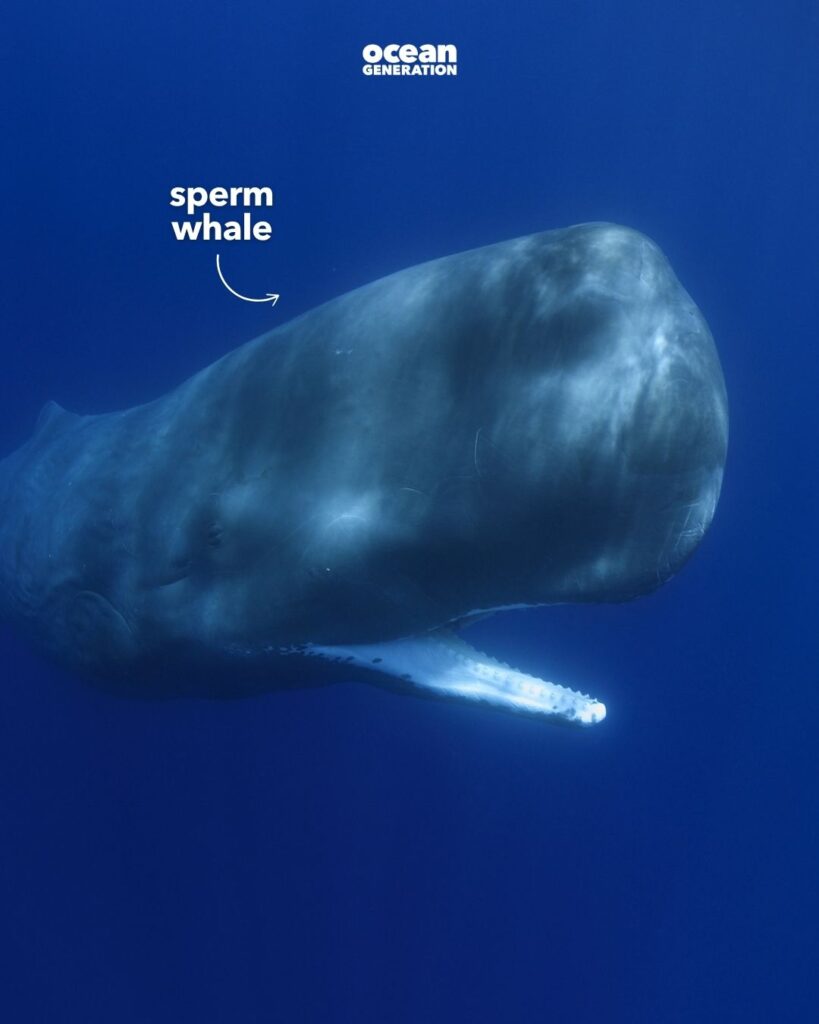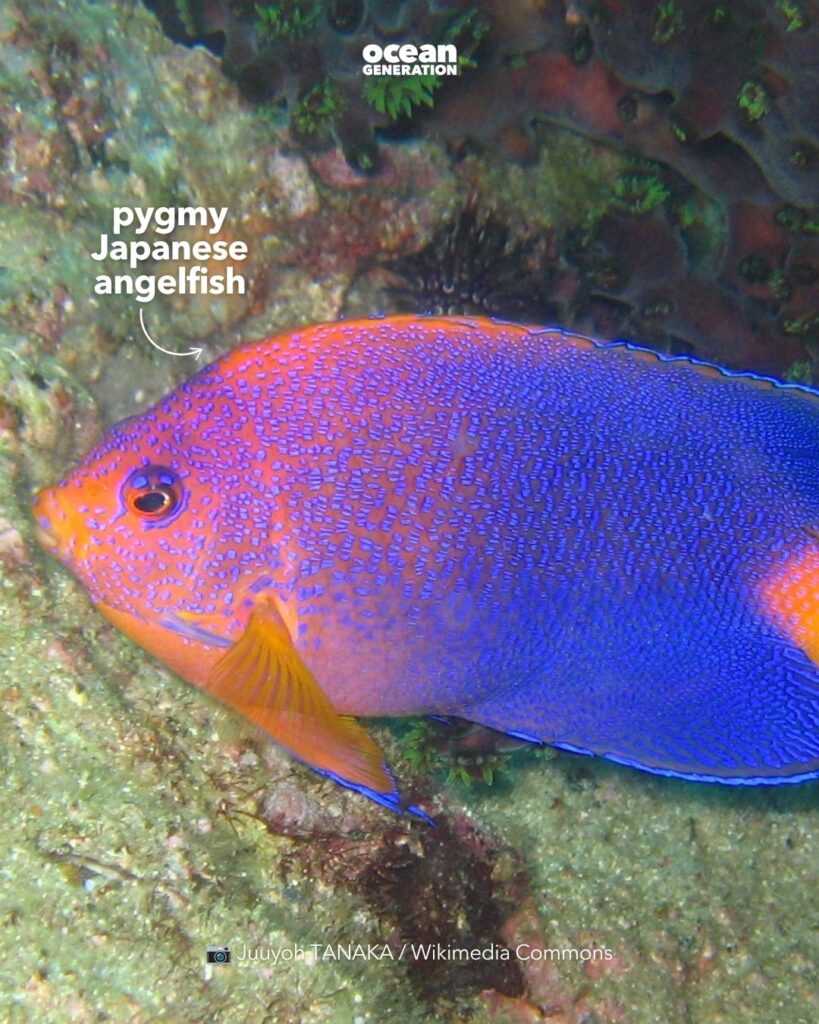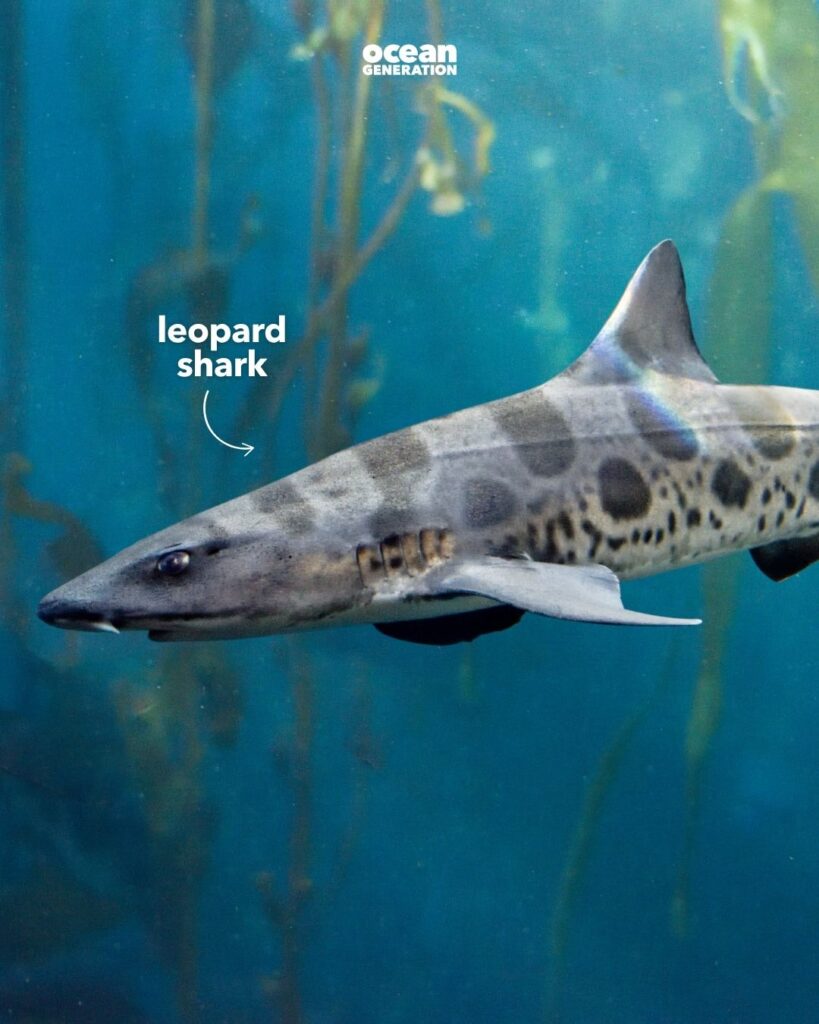
What deep-sea creature is the best Halloween costume?

Five deep sea creatures that make perfect Halloween costumes. Posted by Ocean Generation.

Trying to avoid spending money on a new Halloween costume youโ€™ll only wear once?

Trying to be environmentally friendly? Just got a last-minute invite to an Ocean-themed costume party? Just love the deep sea? We got you. These deep-sea creature costumes should help you bring the Ocean to the Halloween party. 

For the main event: dress up as an anglerfish 

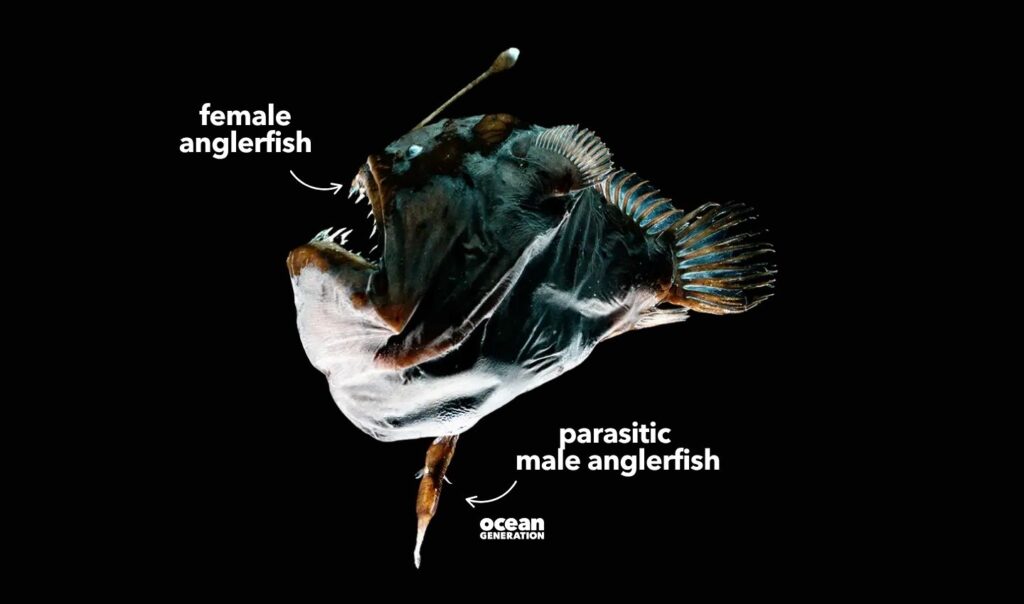
Anglerfish female and parasitic male. Posted by Ocean Generation.
Photo by Edith A. Widder

A classic. Anglerfish are the posterchild for the deep sea. Who hasnโ€™t dreamt of these creatures lurking in the depths, with huge teeth and a glowing orb of light to draw you in until it is too late to escape.  

Finding Nemo put this fish on the map for many of us (but it wasnโ€™t completely accurate โ€“ see here).  

We are using anglerfish liberally here:  there are many different animals that could be referred to as anglerfish, but we are talking about deep-sea species from the Ceratioidei family.

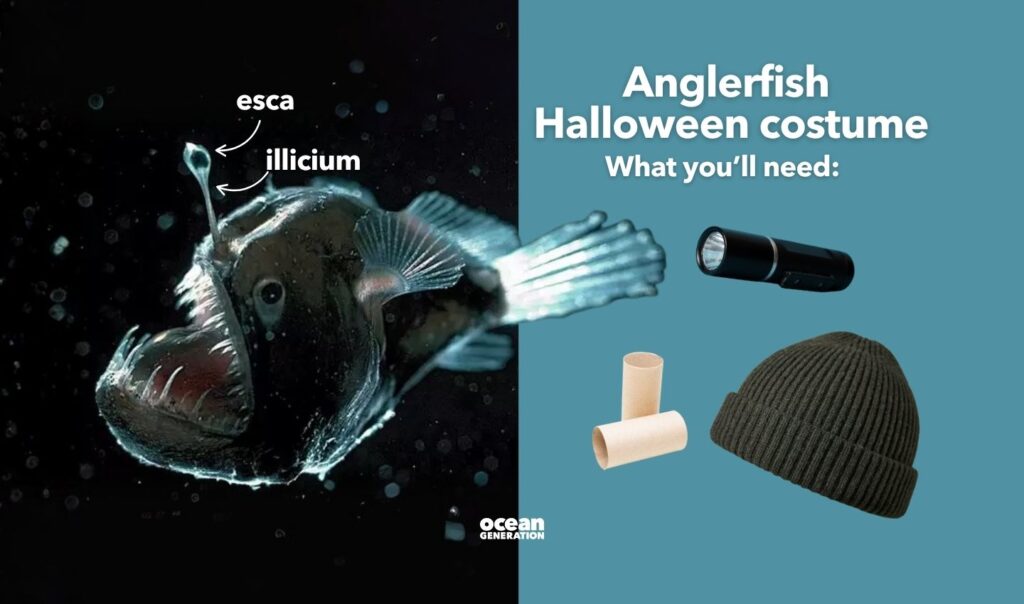
The name means horn bearers, referring to the modified dorsal spine that for many species has a lit up lure at the end.   Anglerfish host bacteria in their lure to generate light. This attracts fish, shrimp or squid close enough for the anglerfish to suck into its mouth, which is very big for their body.

Eyes too big for their stomach? Not likely for the anglerfish. They have extendable stomachs that can hold fish twice their size (useful if you arenโ€™t sure when your next meal will swim along).  

The main point to hit in your costume is the lure โ€“ the esca. Face paint for some big teeth would certainly add to the look.  

What you need for the anglerfish Halloween costume

  • Light source (headtorch, LED lights etc.) 
  • Something to hang it off 
  • Hat 
  • Black clothes 

I have done this outfit before on very little notice, using toilet rolls as the illicium (the modified dorsal spine tipped by the esca). Other good options are repurposed clothes hangers or just a good-sized stick from outside. Attach your esca to your illicium (some glue, blue tac or tape), attach your illicium to your hat and away you go!  

A battery pack on the back of the hat can act as a good counterweight to your lure.  

Now just watch your work entrance everyone around you, tempting them closer. Too close, and they risk your teeth.  

Optional extra: Add a parasitic male!  

We arenโ€™t telling you to invite your ex. But Anglerfish live in the deep Ocean, so when they get the chance for romance, they donโ€™t let it pass.  

The female anglerfish is far bigger than the male, who is little more than a sperm donor with a good sense of smell.  

This size difference is most on show in Kroyerโ€™s deep-sea anglerfish, Ceratias holboelli. Males can reach up to 1.3cm (while free-swimming), while the females are on average 77cm long.  

When he finds a female, he bites her and doesnโ€™t let go. Over time, he fuses with her, receiving nourishment in exchange for sperm. One female can have multiple males attached, and she can lay her eggs at her own leisure.  

To add your parasitic male, just stick an empty loo roll in a sock and staple/attach it to yourself. The more the merrier! 

For the witty one-liner: the cookiecutter shark 

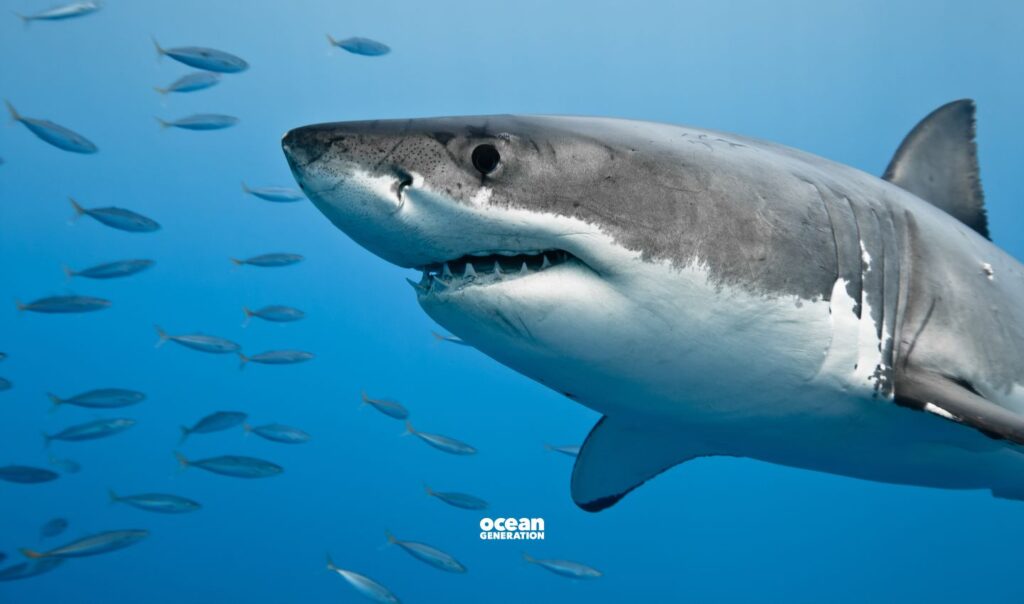
This is a true Halloween shark, with the old nickname โ€œdemon whale-biters”.  

These little sharks gouge a circle of flesh out of animals, leaving bite marks as if cut out by a cookie cutter.  

Whales and dolphins are often spotted with the strange circular wounds, multiple if they were unfortunate enough to come across a group of cookiecutters. One sei whale was found with 138 โ€œcookiesโ€ cut out. Fortunately, these bitey biscuit bois are only half a metre long, so the damage they cause is limited.  

The cookiecutter doesnโ€™t need the dentist โ€“ rather than brushing their teeth, they lose the entire bottom row and usually swallow it with whatever meal they are enjoying (recycle some of the calcium).  

What you need for the shark costume 

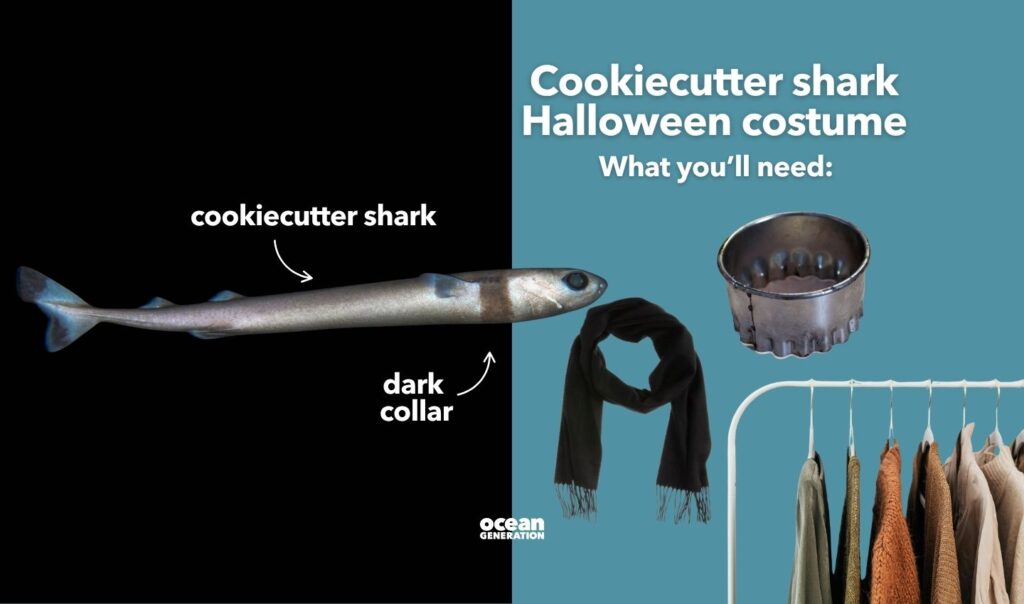
What you need for a cookiecutter shark Halloween costume. Posted by Ocean Generation.
Cookiecutter shark photo by Blue Planet Archive/Alamy
  • A cookie cutter 
  • Cardboard/card 
  • A black scarf 
  • Brown clothes 
  • Optional: Chef hat 

Sometimes simplicity is the way. Wear brown clothes, hang a cookiecutter around your neck and fashion a shark fin to attach somewhere, with the cardboard.  

Add the black scarf around the neck, for the cookiecutters dark collar (this is one of the reasons they are also known as โ€˜cigar sharksโ€™). If you want to make it a couple’s costume, dress your partner as a whale with some bloody circles on them!  

Optional extra: glowing belly

Cookie cutters have photophores on their belly, to camouflage them from predators and prey by matching the little light that penetrates the depths.  

Why not add some flair to the costume? Add some glitter to the belly, or even better some glow in the dark stickers/paint or some fairy lights.  

N.B. Cookie cutters do not have a classic shark’s dorsal fin, only a small one towards the tail. The recommendation is for costume purposes only. Also, donโ€™t take any flesh out of your partner for this costume.  

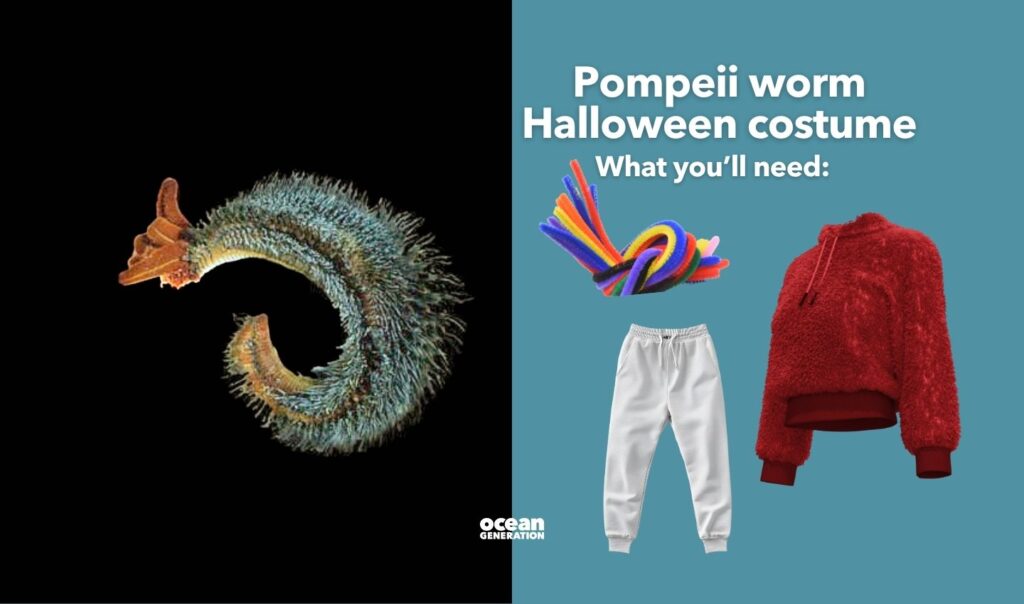
For the flamboyant and fiery: the Pompeii worm 

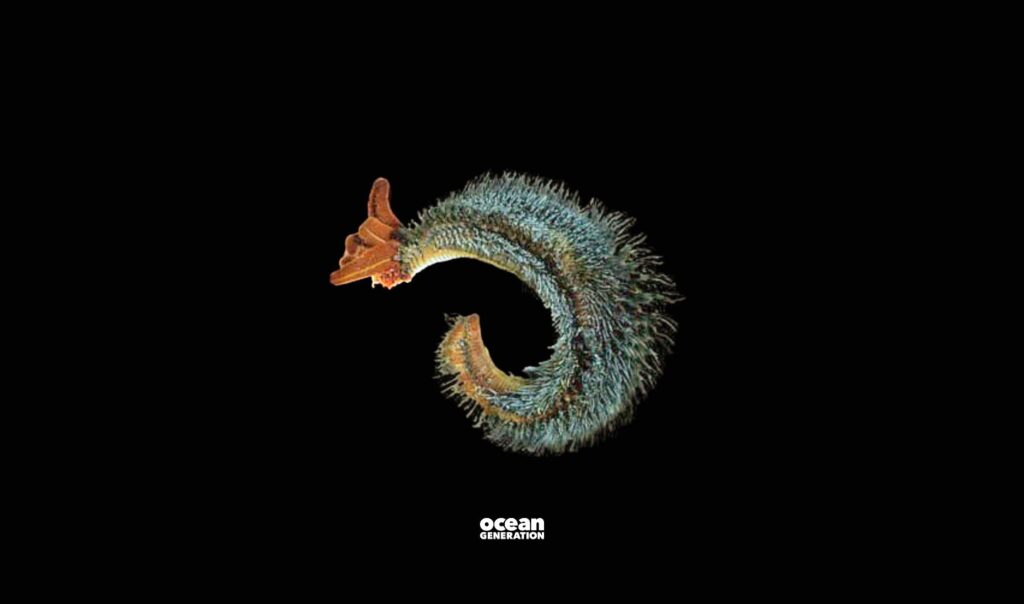
Pompei worms live around hydrothermal vents in the Ocean. Posted by Ocean Generation.
Photo by National Science Foundation (University of Delaware College of Marine Studies)

In the depths of the Ocean, there are huge chimneys belching out black and white smoke. Hydrothermal vents are where the Ocean meets the hot inside of our planet. Think of thermal spas with the heat turned way up. Combine the extreme heat with the crushing pressures and cold of the deep sea, it doesnโ€™t sound like an appealing neighbourhood.  

But they host rich ecosystems, full of incredible creatures adapted to these extremes. Hydrothermal vents may have been the origin of life on our planet

The Pompeii worm shows a flamboyant distain for the usual limitations for life. Bright red, building a tube for itself to live in, it dances in water that would kill most. It can take the heat up to 55 degrees Celsius (131 Fahrenheit). But a woolly jumper of bacteria helps it stay cool, despite living in waters that can be over 100 degrees C (212 F). This is no normal jacket, as the worm has to keep it well fed with mucus in a symbiotic relationship*.  

Four long, red-orange tentacles crown its head, used for breathing. Pompeii worms have the highest specific gill surface area of any marine worm and have acidic blood to encourage the oxygen to dissociate from their blood cells in their extreme environment. What other animal can work a feather boa with acid blood? 

What you need for the costume 

Pompeii worm Halloween costume, inspired by deep sea animals. Posted by Ocean Generation.
  • Grey/white/black trousers or skirt 
  • Red/white long sleeve top โ€“ preferably fuzzy 
  • Red/pink/orange pipe cleaners/paper/feather boa 

Be bold. Channel your inner Pompeii worm and dance in and out of your sulfur-and-protein based tube. A fluffy or fuzzy top will show off your bacterial biofilm and use some pipe cleaners or paper to make some tentacles around your head. Smaller feeding tentacles to add a bit extra. 

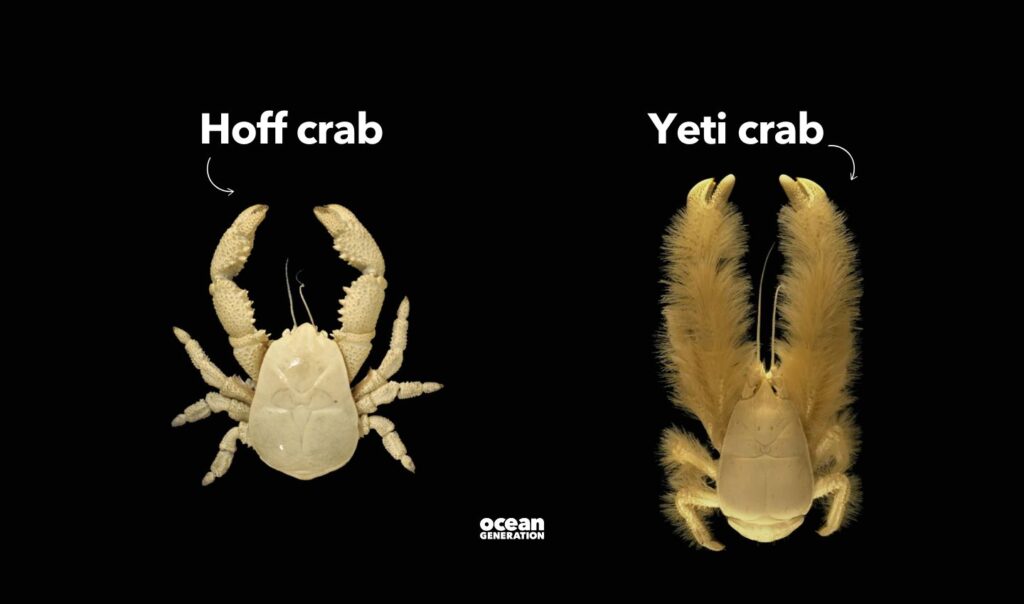
For the dancers: Hoff or yeti crab Halloween costume 

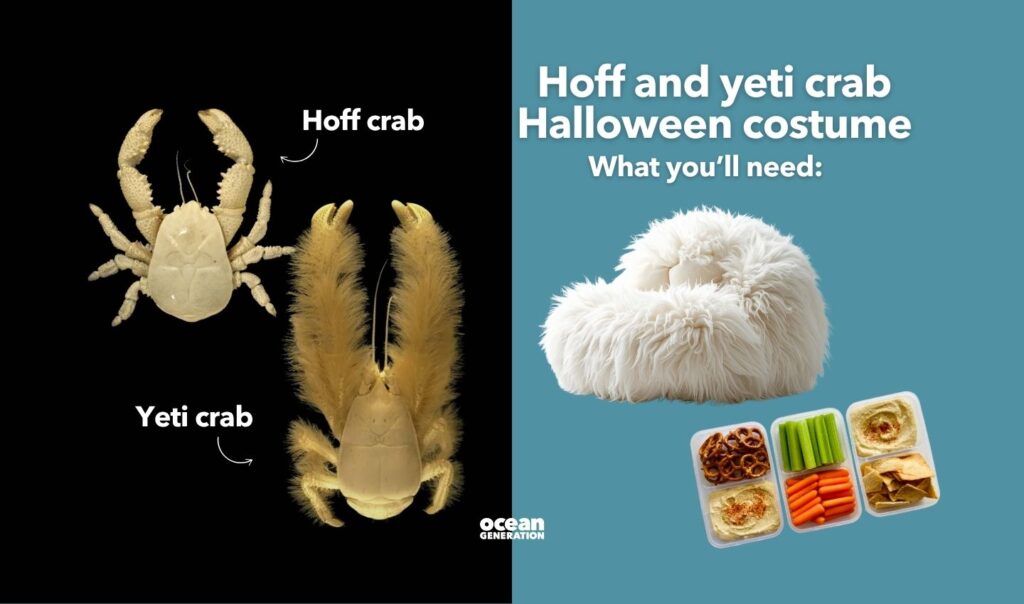
Hoff and yeti crabs grow their own food in the deep sea. Posted by Ocean Generation, leaders in Ocean education.
Hoff crab: University of Portsmouth / Yeti crab: A. Fifis, Ifremer/ChEss, Census of Marine Life

Another resident of the hydrothermal vents are crabs. There are two we want to spotlight. The Hoff and Yeti crabs.  

Both are named after their appearance. One has a hairy chest and so bears the name of Baywatch legend David Hasslehoff. The yeti crab is the more general term for the Kiwa genus, of which the Hoff crab is a member. 

These downy decapods are covered hairs. What is the other key to their success in the deep? Dancing. 

The crabs wiggle and wave, which moves water over the hairs, feeding the colonies of bacteria that live there. These crabs grow their own food in their fur, so the fuzzier the better.  

What you need for the crab costume 

Hoff and yeti crab
Halloween costume
  • Fuzz โ€“ for the Hoff, a hairy chest, and for a Yeti crab, get your arms fuzzy 
  • Creative claws  
  • Snacks in a pocket 

The key for the crabs is owning your hair and rewarding your dancing. Every wiggle is a snack earner. Get fuzzy, and for added authenticity get some snacks in the fuzz for easy snacking.  

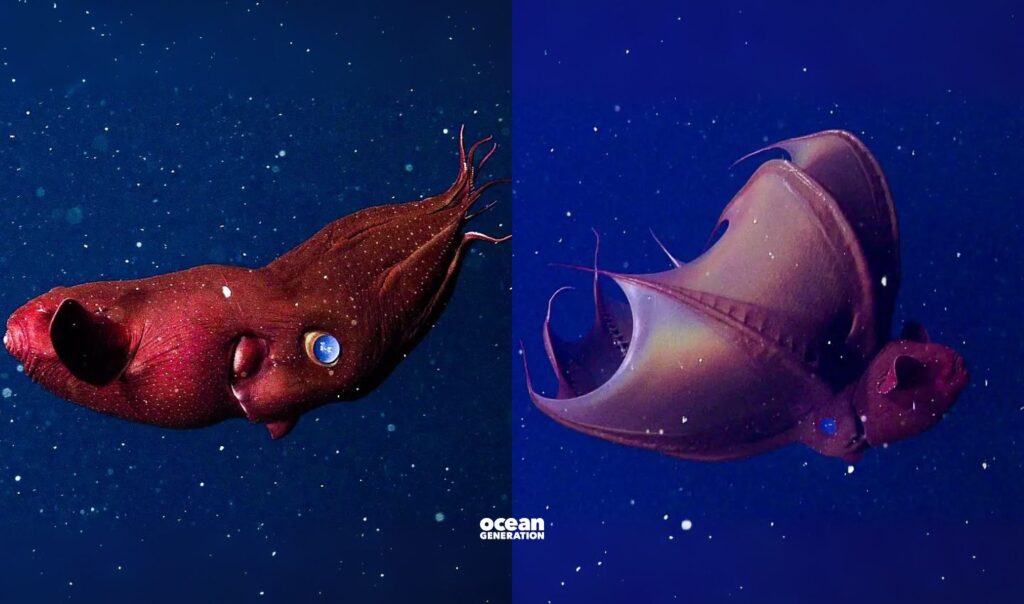
For the dramatic introvert: the vampire squid 

As another unfairly named creature, the Latin name of the vampire squid, Vampyroteuthis infernalis, literally means vampire squid from hell.  

Red eyes, black or red colouration, and spikes lining their arms (incorrectly known as tentacles), living in the abyssal depths of the Ocean. You can see what they were going for.  

Truly a survivor, these cephalopods live between 600m and 900m and can thrive where others canโ€™t – oxygen minimum zones. These parts of the Ocean donโ€™t have enough oxygen for most organisms to breathe. The vampire squid can survive where oxygen saturation is as low as 3% (the usual oxygen saturation in air is 21%).  

If something does dare to get in their personal space, the vampire squid has a lesson for all of us: when stressed, be a pineapple.  

The vampire squid will โ€˜invertโ€™ itself, pulling its arms over its head, covering its photophores and revealing the spiny projections (known as cirri) underneath.  

The glowing tips of its arms are held far above the head to draw attacks away from where they could do serious damage. The arm tips can grow back, so can be a handy (if youโ€™ll pardon the pun) distraction.  

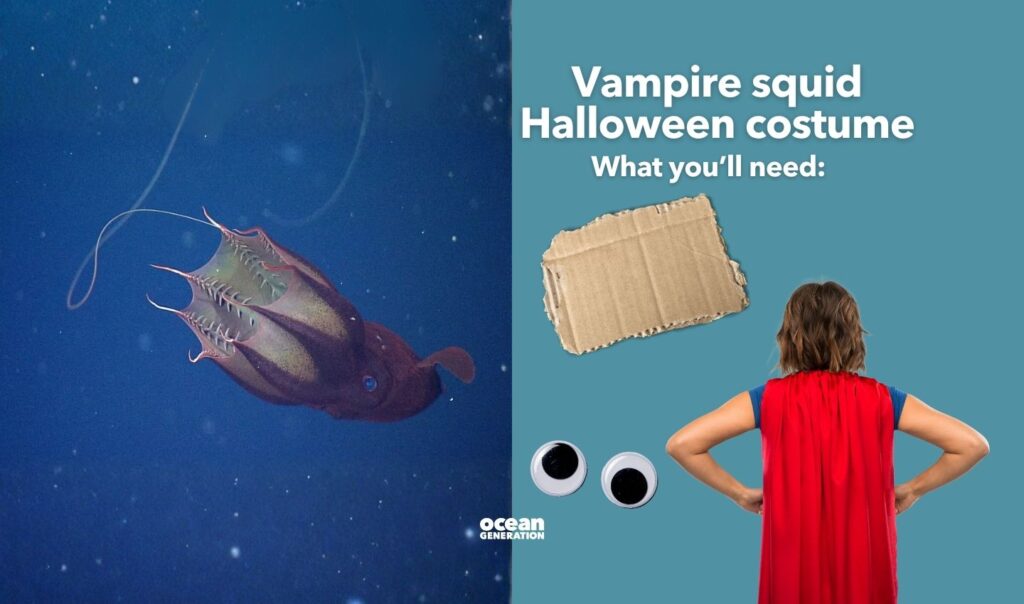
What you need for the squid costume 

What you need for the vampire squid Halloween costume. Posted by Ocean Generation.
Vampire squid photo by Monterey Bay Aquarium
  • Loose black or red clothing, ideally a cape 
  • Cardboard to make some spines 
  • Lights/sparkles 
  • Fins on the side of the head 
  • Red eyes 

To embody the vampire squid, you need your own space. Space to let your cloak free. Line the inside with your cirri (the spines), in case of encroachment by unwanted parties. Coloured contacts or red eye makeup to give that squid from hell look. 

Have fun with your lights on this one โ€“ vampire squid can control their own light show. Lights over the cloak and in your hands can make an entrancing look, ready to be muffled and switched to a spiny dark outer should the mood change.  

Optional extra: Glitter juice 

If the pineapple pose doesnโ€™t work, a vampire squid has a secret weapon. A sticky cloud of bioluminescent mucus, which they can squirt at offending parties. This glowing goo can dazzle while the vampire squid escapes or stick to the transgressor and light them up for up to 10 minutes. Ten minutes is a long time to wait to see what else can see you in the dark Ocean.  

A spray bottle, with some (eco-friendly) glitter mixed with water will give you your last line of defence.  

*Grime, J. P., & Pierce, S. (2012). The evolutionary strategies that shape ecosystems. Wiley-Blackwell.

Secret life of algae: From oxygen to algae blooms

Subscribe

Monthly: Impact in your inbox.

OceanGeneration-Join

How accurate is Finding Nemo?ย 

How accurate is Finding Nemo: Explained by Ocean Generation.

Finding Nemo introduced millions to the technicolour world of coral reefs.  

But beneath its heartwarming tale of family reunion lies a treasure trove of marine biology – some spot-on, some wildly imaginative. Let’s dive in and separate the science from the storytelling. How accurate is Finding Nemo?  

Letโ€™s start by identifying some of the main characters.  

Who are the fish in Finding Nemo?  

The clownfish 

Nemo and Marlin are orange clownfish or clown anemonefish (Amphiprion percula), and their home-bound lifestyle is spot-on. Unlike their cartoon counterparts gallivanting across the Ocean, real clownfish are the ultimate homebodies. Adult clownfish rarely venture more than a few metres from their host anemone, making Marlin’s anxiety about Ocean exploration biologically justified rather than neurotic. 

Finding Nemo: Nemo and Marlin are orange clownfish. Posted by Ocean Generation.

What type of fish is Dory? 

Dory goes by a lot of names: regal tang, palette surgeonfish, blue tang, royal blue tang, flagtail surgeonfish, regal blue tang to name a few (Paracanthurus hepatus).  

Regal tangs like Dory are common throughout the Indo-Pacific, so her presence on the Great Barrier Reef checks out perfectly. However, her famous memory problems contradict everything we know about fish cognition. Studies show that P. hepatus can remember spatial layouts for months and demonstrate complex social learning. More on fish brains later.  

Dory in Finding Nemo is a regal tang. Posted by Ocean Generation.

How accurate are the fish in Finding Nemo? 

Mr Ray the spotted eagle ray (Aetobatus narinari) makes a charismatic teacher, though real eagle rays are typically solitary creatures who’d probably skip group activities in favour of a solo swim.  

Gill the Moorish idol (Zanclus cornutus) represents one of the aquarium trade’s biggest challenges. These stunning fish are notoriously difficult to keep alive in captivity due to their specialised diet of sponges and tunicates (a group of marine invertebrates that include sea squirts which look, to non-divers like coloured blobs on the reef). This explains Gillโ€™s dissatisfaction with captivity and desperate escape plans.  

The film shows a fish dropping their kids off to Mr Rayโ€™s class using their mouth, representing one of nature’s most devoted parenting strategies.  

Cardinalfish (Apogon species) are the most common marine mouthbrooders, with males incubating eggs in their mouths for 8-10 days. This explains why they seem unable to speak clearly โ€“ try having a conversation whilst holding 200 delicate eggs in your mouth without swallowing. The cartoon, however, doesnโ€™t look much like a true cardinalfish. 

Supporting cast of Finding Nemo.

Crush and Squirt are green turtles (Chelonia mydas), shown as current riding nomads, which is entirely accurate. Green turtles have been tracked making migrations of almost 3000km (1,864mi)!  

Our current estimates are that green turtles live to approximately 80 years old, so the claim that Crush from Finding Nemo is 150 is a bit steep. Turtles arenโ€™t known to travel in family groups, but Squirt does show the independence of a baby turtle. Right from the egg, turtles are fending for themselves, which Squirt shows they are more than capable of.

Do sea turtles really cruise the East Australian Current

The East Australian Current (EAC) serves as nature’s highway in Finding Nemo, and this isn’t just Pixar imagination. The EAC is a genuine part of the Oceanic conveyor belt (global network of currents circulating water), flowing southward along Australia’s eastern coast at speeds up to 1.5 metres per second

Crush’s “express lane” concept isn’t pure fantasy either. Ocean currents do have acceleration zones, particularly near topographical features like seamounts and continental shelf breaks. These current jets can provide genuine fast-track transport for marine life, making the turtle highway a plausible, if simplified, representation of oceanic dynamics. 

Green turtles (Chelonia mydas) really do use these currents for epic migrations, though their navigation system is far more sophisticated than simple current-following. The sea turtles use magnetic field detection to create internal GPS systems, imprinting on magnetic signatures as hatchlings and using these for navigation throughout their lives

Green turtles use Ocean currents. Posted by Ocean Generation, leaders in Ocean education.

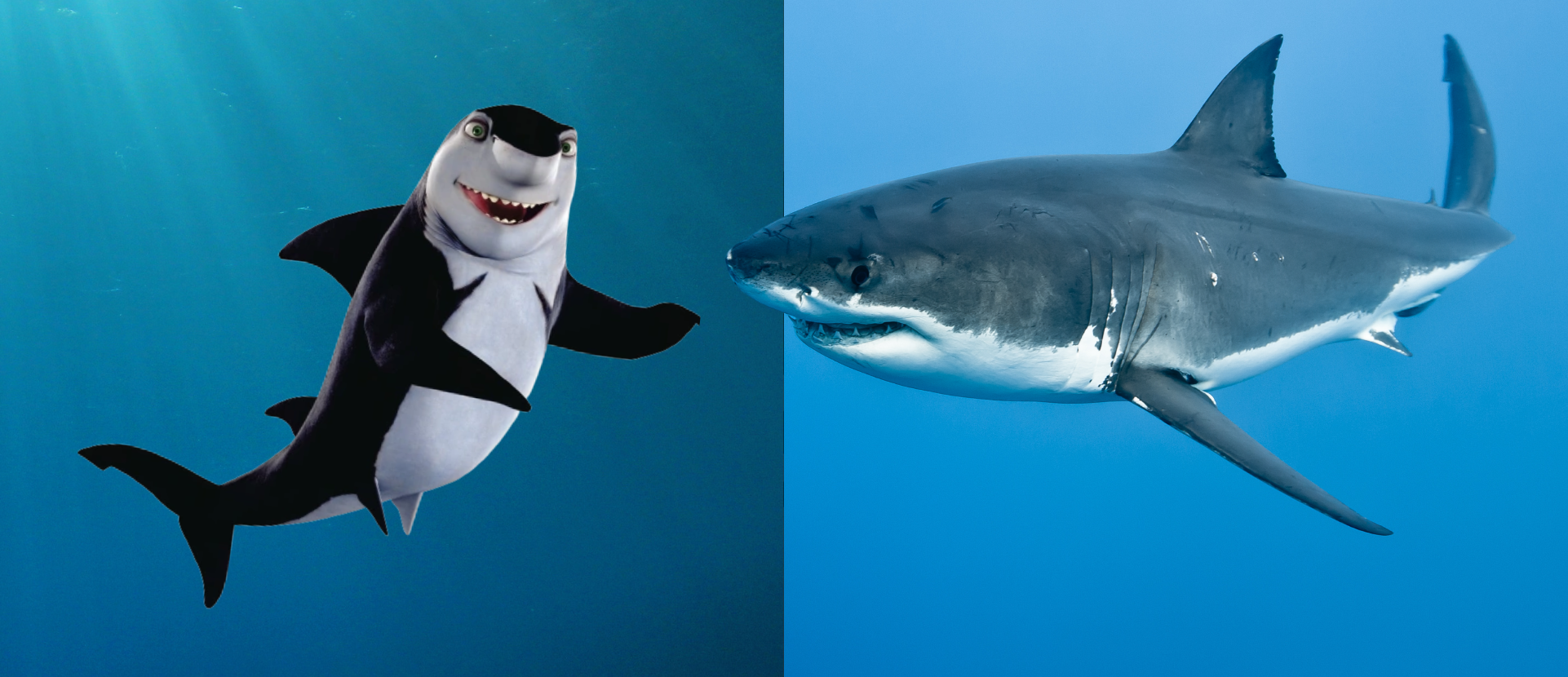
Are the vegetarian sharks possible? 

Bruce and his gang’s “fish are friends, not food” philosophy in Finding Nemo might seem biologically ridiculous, but nature occasionally surprises us.  

Bonnethead sharks (Sphyrna tiburo) can derive up to 62% of their nutrition from seagrass, making them the Ocean’s most successful vegetarian predators. These remarkable sharks have evolved specialised digestive adaptations to break down plant cellulose โ€“ essentially becoming underwater cows with teeth.

Whilst no shark is completely vegetarian (they still eat crabs, especially when they are older), the bonnethead’s plant-munching abilities suggest that Pixar’s gentle giants aren’t entirely impossible โ€“ just highly evolved.  

Bonnethead sharks are vegetarian. Posted by Ocean Generation.
Bonnethead sharks photo by Robin Riggs

Other creature features in Finding Nemo 

Pixar’s attention to detail shines with creatures like the Spanish dancer (Hexabranchus sanguineus) โ€“ a spectacular sea slug that really does inhabit the Great Barrier Reef and can reach 40cm in length. These crimson beauties are nature’s underwater flamenco performers, funky reef rugs on a magic carpet ride over the reef.ย ย 

However, some characters are biogeographical impossibilities. They wouldnโ€™t be in the same scenes.  

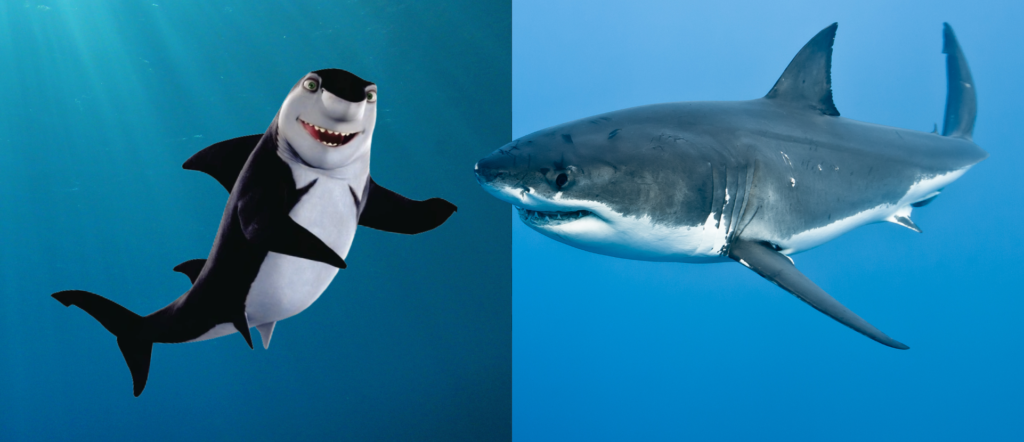
The anglerfish is most likely a black sea devil (Melanocetus johnsonii), the same species filmed swimming to the surface in early 2025. Whilst visually terrifying, the encounter represents a fundamental ecological error. These deep-sea specialists live 200-2,000 metres (656 โ€“ 6561ft) down, where they’d never encounter shallow reef fish. Our clownfish friends donโ€™t usually stray below 15m (49,2 ft). The poor blobfish is a good example of what happens when you take an animal out of the pressure range it’s adapted to.  

Similarly, Nemoโ€™s classmate Pearl is a flapjack octopus (Opisthoteuthis californiana). These are usually hanging out at depths of 200-1,500 metres (656 โ€“ 4,921 ft). These adorable cephalopods (who had a new species found in 2025) are built for life under crushing pressure and would be about as comfortable in shallow reef waters as a penguin in the Sahara.  

Letโ€™s really get stuck in. Pearl talks about one of their arms (they say tentacles, but we know octopus have arms) being shorter than the rest. This means two things โ€“ that Pearl is a male octopus, and that arm is their hectocotylus, or an arm shorter than the rest thatโ€™s specialised to store and transfer sperm during mating.  

Spanish dancer, anglerfish and flapjack octopus in Finding Nemo. Posted by Ocean Generation.
Anglerfish: @jara.natura & @laiavlr / Condrik, Flapjack octopus: Monterey Bay Aquarium

Finding Nemo got it wrong? Letโ€™s talk clownfish reproduction and genders

Since we are ruining childhoods, letโ€™s address the elephant seal in the room. Brace yourself for the biological bombshell that completely rewrites Nemo’s story. 

Clownfish live together in anemones, with the largest individual as the matriarchal female. The largest male mates with her, with other smaller males helping with the chores and waiting their turn.  

When Coral, Nemoโ€™s mum, died in that barracuda attack, the real biological story would be different. Within 10-18 days, Marlin would undergo a complete sex change, transforming into Marlina โ€“ the new dominant female clownfish of the anemone. This isn’t just changing wardrobes; it’s a full hormonal makeover involving suppressed testosterone and elevated oestrogen. 

But would Marlina then mate with Nemo, as some marine biologists suggest? (Because Nemo was the only clownfish in the anemone.) Probably not. Studies show that clownfish larvae typically disperse 7-12 kilometres from their birth sites, and genetics prove most anemone families aren’t actually related. Marlina would more likely wait for a wandering young male to join the family and restart the dynasty properly. Thank goodness.  

Does Mr Ray actually teach anything? 

We love that Mr Ray’s impromptu biology lessons contain genuine scientific gems, though we do have notes. His Ocean zone definitions are accurate โ€“ the mesopelagic (200-1,000m or 656 โ€“ 3,280ft), bathypelagic (1,000-4,000m or 3,280 โ€“ 13,123ft), and abyssopelagic (4000m+ or 13,123ft+) zones represent real oceanographic divisions with distinct communities. 

His species song (itโ€™s called โ€˜Letโ€™s name the speciesโ€™, if you want to look it up) is catchy and gives a fun overview of the species you can find on a coral reef.  

Ocean animals in Finding Nemo. Posted by Ocean Generation, leaders in Ocean education.

“Cnidaria” would be more accurate than “coelenteraโ€. Coelentera is an old term grouping a lot of the animals he goes on to name: hydrozoa (hydriods like the Portuguese man-o’-war), scyphozoa (true jellyfish), anthozoa (coral and anemones) and ctenophora (comb jellies). Add in the porifera (sponges), byrozoa (colonies of moss animals), echinoderma (urchins and sea stars) and โ€œsome fish like you and meโ€ and you have a pretty comprehensive overview of life of the reef.  

Mr Rayโ€™s excitement about โ€œstromalitic cyanobacteriaโ€ is understandable and surprisingly sophisticated for a children’s film. These layered rock formations, created by ancient cyanobacteria, represent some of Earth’s earliest life. They were crucial in the Great Oxygenation Event 2.4 billion years ago. We can thank them for introducing oxygen to the atmosphere! Even now, the Ocean provides around half the oxygen we breathe.  

Fish cognition: Smarter than we thought 

Dory’s memory issues might be Hollywood fiction, but fish intelligence is no joke. Recent research has revolutionised our understanding of piscine cognition. Fish can recognise individual faces, remember complex spatial maps, use tools, and even show signs of self-awareness

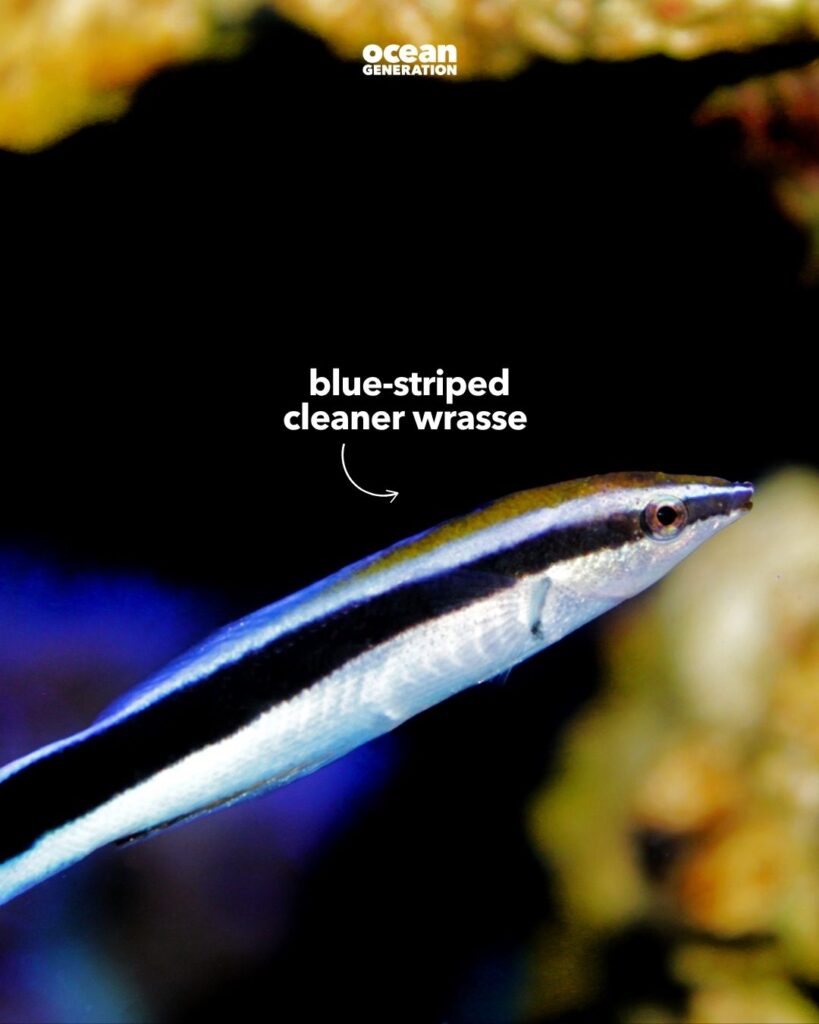
Cleaner wrasses (Labroides dimidiatus) pass the mirror test โ€“ a cognitive benchmark previously thought exclusive to mammals and birds. Meanwhile, archerfish demonstrate remarkable learning abilities, accurately spitting water at insects with ballistic precision that would make a sniper jealous. 

The idea that fish have three-second memories is complete codswallop. Goldfish can remember things for months, whilst cichlids can recognise their offspring years after separation. If Dory existed, she’d likely be suffering from a very specific neurological condition rather than general fish amnesia. 

(additional note โ€“ read What A Fish Knows By Jonathan Balcombe for more) 

Finding Nemo got it wrong? Posted by Ocean Generation.

Scientific pet peeves in Finding Nemo 

The blue whale 

The film shows Marlin and Dory falling to the back of the throat, to be blown out of the blowhole into Sydney harbour. But blue whales canโ€™t blow something out of its blowhole from its mouth.  

A whaleโ€™s blowhole is linked to the lungs, nothing else. It isnโ€™t spurting water out, itโ€™s a mix of mucus and water on its skin (think blowing your nose when youโ€™re wet). Scientists can actually find out a lot from a whale from its snot, and they use โ€˜SnotBotsโ€™ – drones to collect whale blowhole bits.  

The jellyfish 

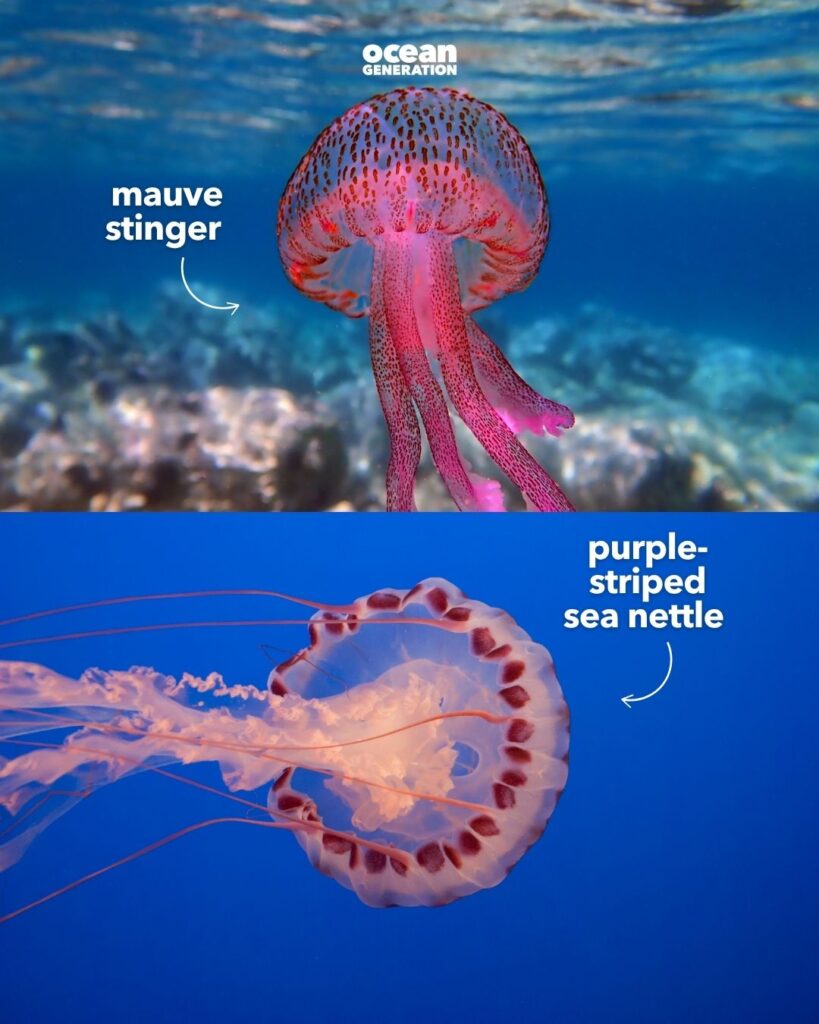
The jellyfish in Finding Nemo arenโ€™t really any specific jellyfish, just mash of a few features to create a generic jelly. The closest real-life versions are the maeve stinger (Pelagia noctiluca) or the Amakusa Jelly (Sanderia malayensis), but neither are a perfect fit.  

Despite the sound effects, they donโ€™t electrocute their prey โ€“ they have small cells firing tiny needles loaded with venom into anything that touches them.  

Marlin claims โ€œI am used to itโ€. There isnโ€™t much science to say that would help. Remember Nemo brushing in the anemone before school? That is science! Clownfish avoid being stung as they have a protective mucus layer similar to the anemone (it has to avoid stinging itself). They brush up against the anemone to coat themselves in the mucus, keeping them safe from stings. But this is specific to their home anemone and wouldnโ€™t help much against a smack of generic jellyfish. Marlin isnโ€™t any more jellyfish-proof than any other reef resident. 

A blue whale can't blow something out of its blowhole from its mouth.

So, is Finding Nemo accurate

Finding Nemo succeeds brilliantly in capturing the wonder of marine life whilst taking considerable liberties with biological reality. Its greatest accuracy lies in depicting clownfish territorial behaviour and anemone relationships, whilst its most glaring errors involve biogeographical impossibilities that would make any marine biologist wince.

We canโ€™t not mention how clownfish would actually react in Marlinโ€™s situation โ€“ a biological reality that completely transforms the story’s foundation. It’s a perfect example of how nature’s truth can be stranger and more complex than fiction. 

Perhaps the real magic lies not in perfect scientific accuracy, but in inspiring curiosity about the Ocean’s genuine wonders. After all, reality is often far more extraordinary than anything Pixar could animate. 

FIN. 

Secret life of algae: From oxygen to algae blooms

Subscribe

Monthly: Impact in your inbox.

OceanGeneration-Join

11 of the best Ocean books

Man reading a book on a rocky coast with waves crashing nearby.

The best Ocean books: recommended by the Ocean Generation team

The Ocean is simply magnificent. In celebration of its importance and the wonder the sea invokes, weโ€™re sharing 10 of our favourite Ocean books. 

Our Ocean has been inspiring authors for centuries. Whether youโ€™re an avid bookworm, just want to learn more about the Ocean or dipping your toes into Ocean literacy, these reads are sure to educate, empower and connect you more deeply to the Ocean.

1) How to Read Water by Tristan Gooley

Suggested by: Lucy, Fundraising and Partnerships team 

About the book:ย 

An accessible guide that teaches you to decode the signs of rivers, lakes, puddles, and the Ocean (from ripple patterns to the colour of water). ย 

In Lucyโ€™s words: โ€œI enjoy this book because anyone can read it. Tristan Gooley encourages his readers to get to know your local landscapes better by reading its signs and patterns. He’s an advocate for connecting with nature from a deeper perspective โ€“ in ways our ancestors did.โ€ย 

Cover of "How to Read Water" by Tristan Gooley โ€“ a guide to reading water signs in nature.

Why Lucy chose it:ย 

โ€œIt gives you the power to be more present when in nature.โ€

2) Blue Mind by Wallace J. Nichols

Suggested by: Nadia (Fundraising and Partnerships) and Gemma (Youth Engagement) and…pretty much everyone else. We love this book!ย 

About the book

Blue Mind explores the science behind how being near, in, on, or under water can improve our mood, performance, and overall wellbeing. This Ocean book is a powerful blend of neuroscience, psychology, and personal stories.

Cover of "Blue Mind" by Wallace J. Nichols โ€“ a book about the mental health benefits of being near water.

Why Nadia chose it:ย 

โ€œI read it when I first joined Ocean Generation. It’s a compelling exploration of our mental health and how it is impacted by our connection to the water and nature.โ€ย 

Why Gemma chose it:ย 

โ€œIt really shows just how important water and the Ocean are to all of us, particularly to our mental health.โ€

3) What A Fish Knows by Jonathan Balcombe

Suggested by: Will, Science teamย 

About the book

This Ocean book challenges what we think we know about fish. Balcombe uses scientific research to prove that fish are not just swimming creatures โ€“ they feel pain, communicate, play, and have personalities. This is a must-read for anyone who wants to dive deeper into marine life.ย 

Cover of "What A Fish Knows" โ€“ a science book revealing surprising facts about fish behaviour. Shared by Ocean Generation in an article of Ocean books.

Why Will chose it:ย 

โ€œConsistently one of my favourite fishy books!โ€

4) The Sea Around Us by Rachel Carson

Suggested by: Jo Ruxton, founderย 

About the book

Written in the 1950s, this award-winning book is lyrical and scientific. It paints a picture of the Ocean before plastic pollution and climate breakdown. It offers a historical baseline to help us understand how much has changed โ€” and how much we still have to protect. ย 

Cover of "The Sea Around Us" โ€“ Rachel Carsonโ€™s classic Ocean science book.

Why Jo chose it:ย 

โ€œThis book is a snapshot of how the Ocean used to be, all in balance, before human destruction.โ€

5) The Brilliant Abyss by Helen Scales

Suggested by: Storm, Comms teamย 

About the book

In this book, Helen Scales dives into the darkest parts of the Ocean to show how life thrives in extremes. And how these little-known deep-sea regions are vital to the health of our entire planet.

Cover of "The Brilliant Abyss" by Helen Scales โ€“ a book about the deep Ocean's mysteries.

Why Storm chose it:ย 

โ€œI love this book because it lifts the veil on the deep sea, a place most of us will never visit. The deep Ocean holds some of the greatest mysteries of our planet and I find it fascinating! This book balances scientific discovery with Ocean wonder really well, too.โ€  

6) The Salt Path by Raynor Winn

Suggested by: Kavina, Youth Engagement teamย 

About the book

A memoir of loss, resilience, and wild places. The Salt Path follows a couple who trek 1013km/ 630 miles along the Ocean-swept South West Coast Path of England. Itโ€™s about their journey and the healing power of nature (particularly the Ocean).ย ย 

Cover of "The Salt Path" โ€“ a coastal memoir about healing and walking the South West Coast.

Why Kavina chose it:ย 

โ€œIt weaves together the incredibly challenging and healing relationship we have with water as a couple take on the South West Coast Path whilst coming to terms with loss.โ€

7) White Caps by Jacques Cousteau

Suggested by: Victoria, CEO of Ocean Generationย 

About the book

White Caps is a classic! It was written by legendary explorer, Jacques Cousteau. Readers get a first-hand view of the Oceanโ€™s mystery and magnificence, from his perspective. Itโ€™s part adventure, part love letter to our Ocean, and full of curiosity.ย 

Cover of "White Caps" by Jacques Cousteau โ€“ a legendary Ocean explorerโ€™s memoir.

Why Victoria chose it:ย 

โ€œIt was the first book I was given about the Ocean. I wanted to be him when I grew up. It’s taken me 50 years since then to finally reach the Ocean in my career, so I guess the moral of that story is โ€˜Never Give Up!โ€™โ€

8) What The Wild Sea Can Be by Helen Scales

Suggested by: Will, Science teamย 

About the book

Marine biologist, Helen Scales, takes us on a journey across marine ecosystems: seagrass meadows, deep-sea trenches, and coral reefs. The book shares stories of resilience, adaptation, and hope. Itโ€™s a beautifully written call to action, urging us to protect the wild heart of our blue planet. ย ย 

Cover of "What The Wild Sea Can Be" โ€“ Helen Scalesโ€™ book about Ocean resilience.

Why Will chose it:ย 

โ€œIt is an honest representation of the state of our Ocean, with an Ocean Generation flavour of optimism looking forward.โ€

9) The Blue Machine: How the Ocean Works by Helen Czerski

Suggested by: Storm, Comms teamย 

About the book:ย 

Oceanpgrapher and physicist, Helen Czerski, connects the Ocean’s complex systems to climate and biodiversity impacts. This book makes Oceanography accessible and highlights the Ocean’s role in Earth’s climate and ecosystems. 

Cover of "The Blue Machine" by Helen Czerski โ€“ explaining how the Ocean system works.

Why Storm chose it:ย 

โ€œThe Ocean is more than a body of water. This book shows us just that: how the Ocean is a powerful, living system that shapes our whole planet. Itโ€™s a beautiful example of science meets rich, textured storytelling.โ€ 

10) Whale Fall by Elizabeth Oโ€™Connor

Suggested by: Agnes, Comms teamย 

About the book

Set in a remote coastal village, in the UK, this novel follows a woman grappling with her past while surrounded by the wild, untamed Ocean. Itโ€™s atmospheric, almost poetic, and perfect for readers who love storytelling where the natural world is deeply felt.

Cover of "Whale Fall" by Elizabeth Oโ€™Connor โ€“ a literary novel set in a coastal Ocean village.

Why Agnes chose it:ย 

โ€œI enjoyed the book because it shows the connection between the Ocean and the inhabitants of a remote island, but without romanticising it. This sort of lifestyle rarely exists today so it was really interesting to learn about it through the story of a young Welsh woman, a whale, and some English researchers.โ€

11) Life of Pi by Yann Martel

About the book

While this isnโ€™t a science book, weโ€™ve added it to the list for our fiction lovers. Life of Pi is an award-winning novel about survival at sea. It explores faith and the majesty (and brutality) of the Ocean. ย 

Piโ€™s deep respect for the Ocean and its creatures makes this quite a philosophical read for Ocean lovers.ย 

Cover of "Life of Pi" โ€“ a fiction novel about survival at sea and Ocean reverence.

What are your favourite Ocean books?

When we understand the Ocean, we care for it. And when we care, we take action. 

In their own ways, each of these books reminds us why take action to protect the Ocean.  

If weโ€™ve missed one of your favourites, share it with us on social media. Weโ€™re @OceanGeneration everywhere.  

Secret life of algae: From oxygen to algae blooms

Subscribe

Monthly: Impact in your inbox.

OceanGeneration-Join

Charles Darwinโ€™s Galรกpagos Voyage and Theory of Evolutionย 

Charles Darwinโ€™s Galapagos Voyage and Theory of Evolution. Posted by Ocean Generation.

A fresh breeze, the sounds of gulls calling, cold sea spray touching the cheeks, the slightest hint of rotten eggs in the air.

What was going through the mind of 26-year-old Charles Darwin on 15 September 1835, as he stood on the deck of HMS Beagle with the shapes of the Galรกpagos islands approaching? 

His letters home suggest two things. First, that he was homesick. Understandable after nearly four years away from England, which he had left at 22 years old โ€“ he truly was the pioneer of the gap year. He was also incredibly excited.

What Charles Darwin observed during his five week visit to the Galรกpagos would plant the seeds that would eventually grow into his Theory of Natural Selection 

In this article we will explore who Darwin was, how he came to be on the Galรกpagos, and the sparks of inspiration that he found there for his theory of evolution.  

Who was Charles Darwin? How did he end up on the Galรกpagos? 

Charles Darwin was nearly a little-known priest in Shropshire, in England. His father wanted Charles to get good employment, either following his footsteps to become a doctor or to become a man of the church. Aged 16, his father sent him to medical school in Edinburgh. His foray into the medical world was brief, however. After witnessing the brutality of surgery without anaesthetic (on a child), Charles knew he was not to be a doctor. He left the course after only two years.  

In those two years, Edinburgh did give him some important foundations; Darwin was taught geology, biological classification and taxidermy. He was also exposed to the radical ideas of the day. These denied the Divine design of humans and suggested that animals shared human mental abilities, like thinking, remembering or making decisions.  

Charles Darwin and the HMS Beagle, posted by Ocean Generation
HMS Beagle image from The Popular Science Monthly, Volume 57

On leaving Edinburgh he went to Christs College, Cambridge University, to complete a degree and take holy orders โ€“ ministry beckoned. He breezed through the degree and enjoyed his time at Cambridge. He would go out drinking, shooting and beetle collecting. College folklore claims the sounds of his shotgun would ring out as he fired blanks to extinguish candles in his rooms. 

It was at Christs that he met Professor John Stevens Henslow. Professor Henslow encouraged discussion around natural philosophy and introduced Darwin to some of the greatest minds of the era.  

It was Professor Henslow who got Charles Darwin on the voyage to the Galรกpagos. The Professor had been approached to be a naturalist and gentleman companion to accompany Captain Robert FitzRoy on a ship called HMS Beagle. His wife was… unwilling to let him go, so he instead recommended his protege, Charles Darwin.  

What was the mission of the HMS Beagle? 

The Beagle was sent on a two-year mission to map South America. It ended up being a five-year circumnavigation of the globe. Captain FitzRoy had completed a similar mission the year previous, and had thought a โ€˜naturalistโ€™ would benefit the scientific productivity of the voyage. Few could argue with the scientific output of the Beagle.  

It was the Ocean that really started Darwinโ€™s thinking about evolution.

While at Edinburgh Charles Darwin would collect sea slugs and sea pens, and was mentored by Robert Grant, an expert on sponges who encouraged him to study marine invertebrates. He began exploring classification and gave talks on his findings at the university.  

The Ocean got Darwin thinking, posted by Ocean Generation.
Sea pen image via Britannica

Onboard the Beagle, he made himself a plankton net with which he drew up trawls full of Ocean life. He wrote, โ€œMany of these creatures, so low in the scale of nature, are exquisite in their forms and rich colours. It creates a feeling of wonder that so much beauty should be apparently created for such little purposeโ€.  

If the accepted worldview of the time was correct, and God made everything for humankinds’ benefit, why do these tiny organisms exist out at sea where no one sees them? The Ocean was creating Darwinโ€™s first glimmers of insight.  

What are the Galรกpagos Islands? 

About 1,000km off the coast of Ecuador in the Pacific, are a group of islands called Islas Encantas, or Enchanted Isles. They are better known as the Galรกpagos.

The initial descriptions of the islands are at odds with the image of โ€œenchanted islandsโ€. The first man to discover the Galapagos, Fray Tomรกs de Berlanga, speaks of the inhospitality and lack of water on the islands.  

Captain Fitzroy, leader of the expedition Charles Darwin was part of, describes the first viewing of the Galapagos: โ€œBlack, dismal-looking heaps of broken lava, a shore fit for pandemoniumโ€. Darwin himself compares them to the iron-foundries of Staffordshire, or the furnaces of Wolverhampton. Hardly flattering for either party.

So, not a tropical paradise. 

The Galpagos Islands is a volcanic archipelago off the coast of Ecuador. Posted by Ocean Generation.

The word galรกpagos comes from the Spanish word for saddle, the shape of some of the shells of the most famous residents of the islands โ€“ tortoises.  

Darwin reported that locals could determine the island tortoise by the shape of its shell. The implications of this did not occur to Darwin until later.

Unfortunately for science, and the tortoises, they were an excellent food source for long voyages. The Beagle collected 50, none of which made it back to England.  Tortoises became extinct on the island of Floreana in the 1840s, just ten years after Charles Darwin’s visit. However, careful genetic analysis and targeted breeding has created the possibility of de-extinction (click here for more). 

The names of the islands and the tortoises immediately hint at the special nature of the Galรกpagos.

Galapagos means saddle in Spanish.

From their discovery, the Galรกpagos were renowned for their rich biodiversity. 

Whalers came to benefit off the many sperm whales that gathered there, and tales of the lizards that lived there reached across the globe. 

It is important to clarify that Darwin was not struck with a bolt of genius immediately on seeing the islands.  

He was inquisitive, curious and observant about the natural world. He saw many things in the Galรกpagos, and documented and collected evidence he would later use to build and justify his arguments for evolution. 

But what was Charles Darwinโ€™s theory of evolution? 

Darwinโ€™s thinking was radical at the time. He was opposing the accepted position that species were โ€˜fixedโ€™ – unchanging. This was tied into the strong Christian influence of the time โ€“ God had created all life, and it hadnโ€™t changed since โ€“ with humankind superior to all. 

His work was an attack on the accepted views of his time: that man was supreme by divine making, and the order of the world was fixed. 

Observing the animals of the Galรกpagos and beyond, Darwinโ€™s theory of natural selection proposed that the natural world was ever-changing, evolving.  

Within this, the idea that species change over time. Further, he suggested a world in which animals were not below humans, but simply different, surviving using different strategies.  

Darwin himself recognised that his theories opposed widely held beliefs. He likened publishing his work to confessing a murder. 

What did Charles Darwin find on the Galรกpagos? 

Darwin was in the archipelago (an area that contains a group of islands) for five weeks. During that time, he explored the islands, at one stage camping for nine days with only a few others, and collected specimens.  

Birds, reptiles, plants and plankton were all stashed in crates on board the Beagle. He was intrigued by what he found, writing in his journal, โ€œthe natural history of these islands is eminently curious, and well deserves attentionโ€.  

Whatโ€™s the deal with Darwin and finches? 

If you have heard of Darwin, you have probably heard something about finches. He collected loads of finches from the Galรกpagos, and they became an iconic example of his theory of natural selection.  

The birds would even come to be named after the naturalist โ€“ Darwin’s finches. 

Darwin's finches are an iconic example of his theory of natural selection. Posted by Ocean Generation.
Drawing of the finches by John Gould, from “Voyage of the Beagle” , 1845

Far from being an example of his genius, the finches are an example of Darwin being human.  

He misidentified many of the finches he collected as blackbirds, wrens and โ€œgross-billsโ€, and did not write down which bird came from which island. It was ornithologist John Gould of the Zoological Society of London who reported that this collection were all finches.  

After this realisation, Darwin looked again, and the differences in their beaks does lead him to comment โ€œone might really fancy… [that] one species had been taken and modified for different endsโ€. However, his poor documentation meant they could not be used as evidence in his work, and they do not appear in his book.  

Modern work has made the beaks of finches a poster child for natural selection. It was a clear visual example of the adaptions that can allow different animals to survive.  

On the Origin of Species: Darwinโ€™s work, published 

Darwin held the Galรกpagos dear for the rest of his life. On The Origin of Species, his seminal work on natural selection, was not published until 1859, 23 years after returning to England.

The first sentence of the book affirms the importance of the voyage in developing his theory of evolution:  

โ€œWhen on board H.M.S. โ€˜Beagle,โ€™ as naturalist, I was much struck with certain facts in the distribution of the inhabitants of South America, and in the geological relations of the present to the past inhabitants of that continent. These facts seemed to me to throw some light on the origin of speciesโ€”that mystery of mysteries, as it has been called by one of our greatest philosophers.โ€ 

In the interim, Darwin had been gathering evidence and forming arguments, bracing for the backlash and interrogation his theory would receive.  

On the Origin of Species, written by Charles Darwin is one of the most important scientific books.
Page from the 1859 Murray edition of the Origin of species by Charles Darwin.

How was Charles Darwin’s theory of evolution received?  

Darwin’s theories certainly made a splash.  

The book sold out the first edition before being released, and divided opinion.  

Predictably, the Church took a strong stance against it, along with some prominent scientists such as Darwinโ€™s former Cambridge peer, Adam Sedgewick. International press put out cartoons and insults, often focused on the idea that humans descended from apes.  

But many scientists, especially geologists, supported Darwinโ€™s work. Atheists were especially enthusiastic.  

Charles Darwin kept in close correspondence with supporters and opponents alike. Debate continued for decades after, until his theory was general accepted in the 1940s. 

The book went to six editions during Darwinโ€™s lifetime and is now seen as one of the most important scientific books ever written.  

It fundamentally changed how people viewed the natural world and the place of humans within it; a lifetimeโ€™s work, from a man that explored and observed, inspired by the Ocean and the Galรกpagos.  

Quotes from Charles Darwin: Even the best scientists have bad days  

We can all relate to Darwin, on a very personal level, after reading some of his journal inserts and letters. Here are a few quotes that remind us even the brightest minds have down days:  

โ€œBut I am very poorly today & very stupid & hate everybody & everything.โ€ – C. Darwin, letter to Charles Lyell 1861 

โ€œI am rather low today about all my experiments, – everything has been going wrongโ€ – Letter to W. D. Fox 1855 

โ€œI beg a million pardons. Abuse me to any degree but forgive me- it is all an illusion (but almost excusable) about the Bees. I do so hope that you have not wasted any time for my stupid blunder. – I hate myself I hate clover & I hate Bees-โ€ Letter to John Lubbock, 1862 

โ€œI am very tired, very stomachy & hate nearly the whole world. so good night, & take care of your digestion which means Brainโ€ – Letter to T. H. Huxley, 1860 


Thank you to Prof David Norman of Christโ€™s College for his time and writing. 

Secret life of algae: From oxygen to algae blooms

Subscribe

Monthly: Impact in your inbox.

OceanGeneration-Join

The history of Earth Day and practical actions you can takeย 

The history of Earth Day explained, with practical actions we can all take

Everything you need to know about the history of Earth Day

Earth Day is celebrated annually on 22 April. It sparks environmental action and reminds us there is no planet B โ€“ but how and when did Earth Day start? Weโ€™re hopping in a time machine to break it down. 

Can you imagine a time when factories polluting our waterways and spitting thick, toxic smoke into the atmosphere came with no consequences? Before 1970, that was the reality.  

53 years ago, there were no legal or regulatory mechanisms in existence to protect our environment โ€“ even though climate change had started making the news in 1912.  

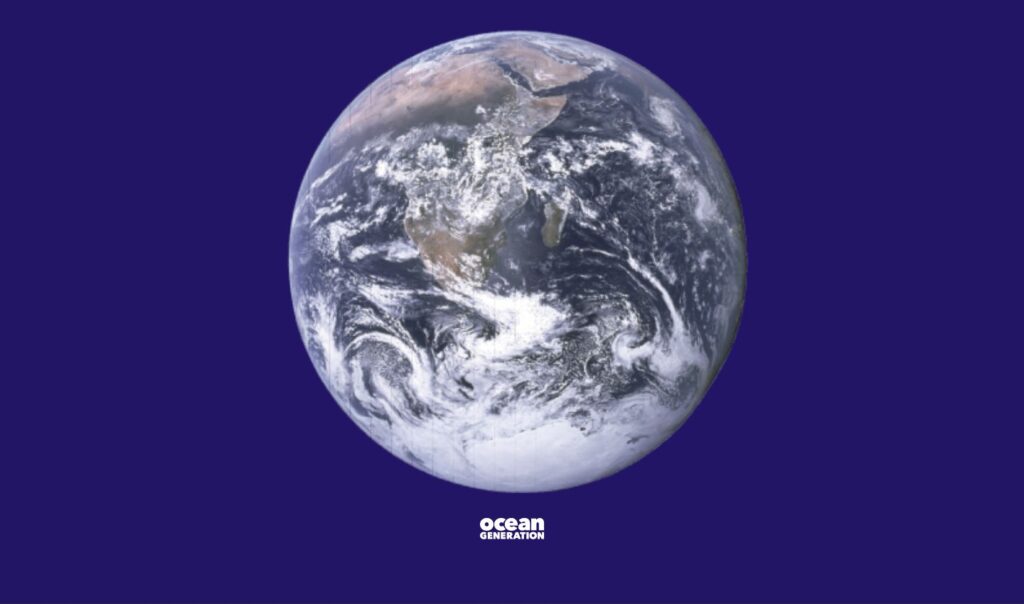
Unofficial Earth Flag created by John McConnell includes The Blue Marble photograph taken by the crew of Apollo 17.
Unofficial Earth Flag created by John McConnell includes The Blue Marble photograph taken by the crew of Apollo 17. Via Wikipedia.

A ripple in time: The birth of Earth Day 

In 1970, amidst a growing environmental movement in the United States, Earth Day was created by the junior senator from Wisconsin: Senator Gaylord Nelson.

Public concern about pollution, deforestation and the deterioration of natural habitats was growing but environmental action and protection wasnโ€™t yet on the US national agenda… 

To force the issue, the Senator, along with activist Denis Hayes, envisioned a day dedicated to raising awareness about environmental issues and mobilising communities to take environmental action.

Although originally called the โ€˜Environmental Teach-In’ and aimed university students, the duo quickly realised their concept could inspire a wider audience. They renamed it Earth Day and pencilled it in on the calendar. 

On 22 April 1970, the first Earth Day was celebrated. 

What did the first Earth Day look like?

Looking back at the History of Earth Day: An image of demonstrators in Philadelphia, 1970. It's believed 20 million Americans raised awareness about environmentalism on the first Earth Day. Image shared via Ocean Generation

Itโ€™s reported that 20 million Americans took part in the first Earth Day (around 10% of the total population of the United States at the time).  

They took to the streets, parks and auditoriums to demonstrate against the impacts of 150 years of industrial development.

From coast to coast, US citizens from all walks of life made it clear: They understood and were concerned about the impact we were having on the planet.  

Their voices were heard.  

In July of the same year, President Nixon called for establishment of the EPA: The Environmental Protection Agency. And in the 10 years that followed the first Earth Day, dozens of regulations to protect the environment were put in place in the US.  

President Richard Nixon and First Lady Pat Nixon plant a tree on the White House South Lawn to recognise the world's first Earth Day. Shared by ocean Generation.
President Richard Nixon and First Lady Pat Nixon plant a tree on the White House South Lawn to recognise the world’s first Earth Day.

The origin of Earth Day reminds us that we have immense power to influence political decision making.  

When we care, and make it known we want political action, we let the leaders of our countries know they better want it, too.   

Why Earth Day matters: A call to climate action

By 1990, Earth Day was celebrated by over 140 countries around the globe. Now, Earth Day is the largest civic observance in the world.  

No matter where we live or how old we are, thereโ€™s no denying that looking after our planet is in our best interest.  

The Ocean deserves a VIP invitation to Earth Day celebrations 

If we look down at Earth from space, most of what we see is blue. Over 70% of our planet is Ocean, but more than just big and blue, the Ocean is the beating heart and lungs of our planet.  

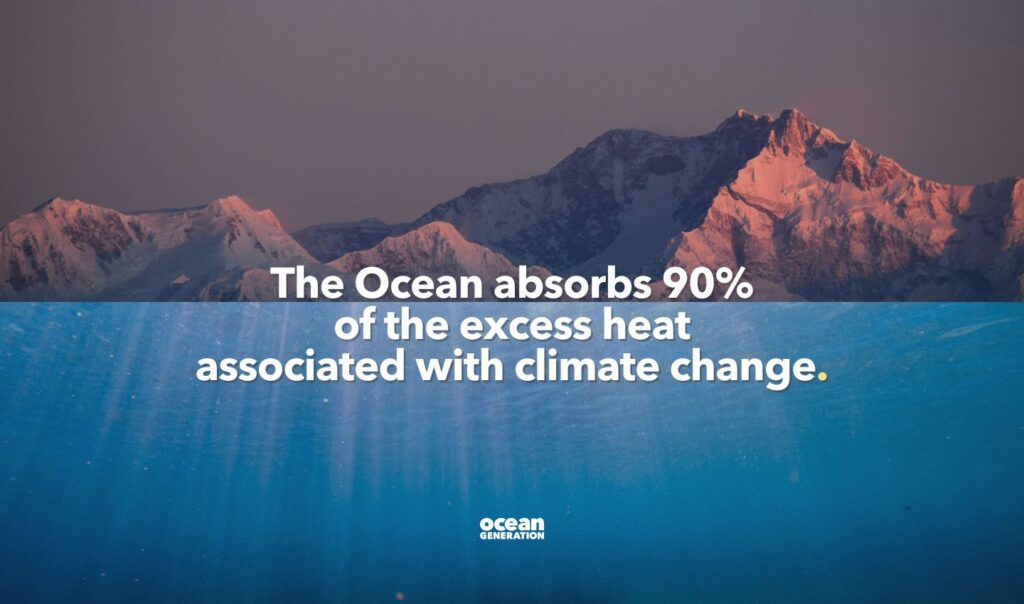
The Ocean absorbs 90%
of the excess heat 
associated with climate change.

5 reasons to look after the Ocean this Earth Day  

  • The Ocean is keeping us all alive. It provides over 50% of all oxygen on Earth. Simply put: If the Oceanโ€™s ability to produce oxygen was compromised, weโ€™d be in trouble. 
  • Around 30% of the CO2 we produce is absorbed by the Ocean. 
  • The Ocean helps regulate land temperature and drive global weather patterns. 
  • Coastal โ€œblue carbonโ€ ecosystems, like mangrove forests and seagrass meadows, can sequester (store) more carbon in their soils than terrestrial forests. 
  • The Ocean is the main protein source for over 3 billion people. 

We depend on a healthy Ocean for a healthy planet. In the words of Dr. Sylvia Earle, โ€œNo water, no life. No blue, no green.โ€ 

Whatโ€™s the theme for Earth Day 2024?  

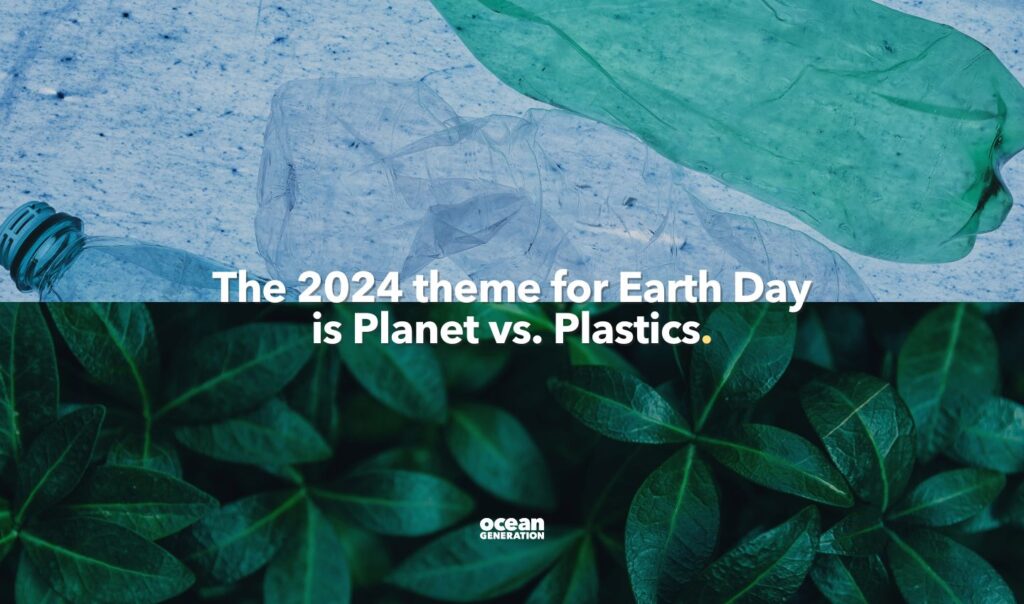
In 2024, the theme for Earth Day is Planet vs. Plastics. 422 million tonnes of plastic are produced annually โ€“ half of which is for single-use purposes.

Plastic is everywhere. It’s in what we wear, the items we use daily, and itโ€™s even in the food we eat. 

We know plastic was designed to be indestructible (so, itโ€™s not going anywhere, anytime soon). We know it has numerous negative impacts on human health. We know single-use plastics are the biggest contributors to marine litter. And we use it anyway.  

Itโ€™s safe to say: We have a problematic relationship with plastic. 

This Earth Day, rethink your relationship with plastic. 

The 2024 theme for Earth Day 
is Planet vs. Plastics.

What action can I take this Earth Day? 

Riding the Wave of Change 

As we commemorate Earth Day, itโ€™s important to reflect on how far weโ€™ve come and re-commit ourselves to leaving our blue planet better than we found it. 

We only have one planet and itโ€™s up to all of us to look after it.  

We only have one planet so we have to look after it.

Secret life of algae: From oxygen to algae blooms

Subscribe

Monthly: Impact in your inbox.

OceanGeneration-Join

The History of Fast Fashion

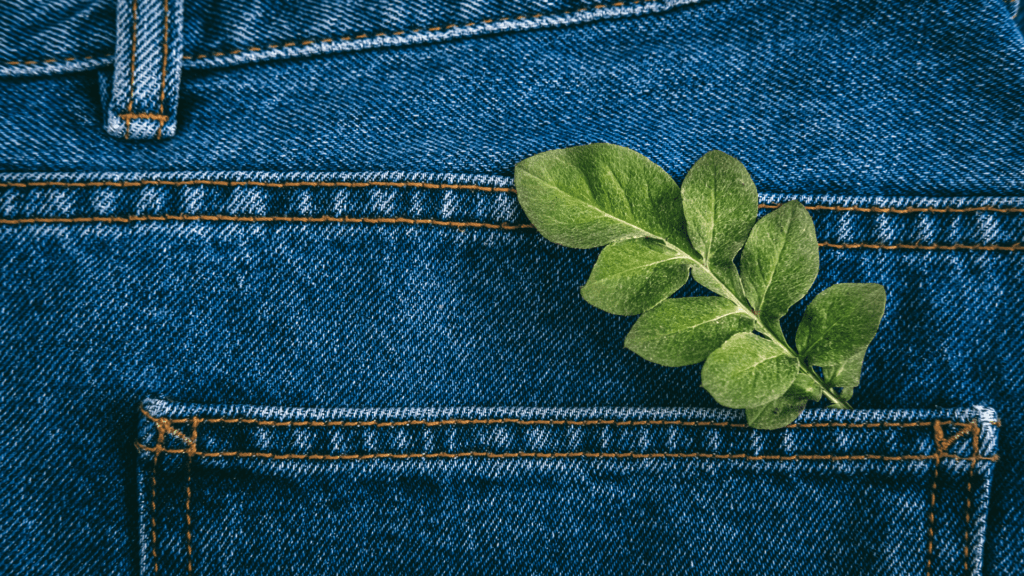
Green leaf poking out of a jean pocket, representing sustainable fashion. Shared by Ocean Generation.

A brief history of fast fashion and its impact on the planet. 

100 billion items of clothing are produced every year. Thatโ€™s a 50% growth in just 15 years and the main culprit for this growth โ€“ fast fashion โ€“ shows little sign of slowing down. 

Weโ€™ve stitched together a brief history of fast fashion; from when fashion become fast, the impact it’s had on our blue planet, and what we can do to become sustainable fashion devotees.  

First: What is fast fashion?

Fast fashion can be defined as low-cost, trendy clothing rapidly produced by mass-market retailers in response to the latest trends.  

The focus of fast fashion is affordability and convenience โ€“ largely at the cost of people and the planet.  

Fast fashion plays into the idea that outfit repeating is a fashion faux pas. If you want to stay relevant, itโ€™s believed you should be sporting the latest looks while theyโ€™re happening.  

Overproduction and overconsumption has resulted in the fashion industry being one of the worldโ€™s largest polluters. Jump here to read about the environmental impact of fast fashion.  

But how did we get here?  

Definition of fast fashion: Fast fashion is low-cost, trendy clothing rapidly produced by mass-market retailers in response to the latest trends. Fast fashion has a massive impact on our planet. Ocean Generation is sharing a brief history of fast fashion.

Once upon a time, in a slow fashion world

More than 20,000 years ago, people began hand sewing; using animal bones and horns as needles.  

Up until the early 1800โ€™s, most people raised sheep or saved up to purchase wool to spin yarn to weave cloth and hand sew… You get the idea. 

Adding garments to your closet was a slow, infrequent process, driven by seasonal changes and growing pains. 

When was the first sewing machine invented?

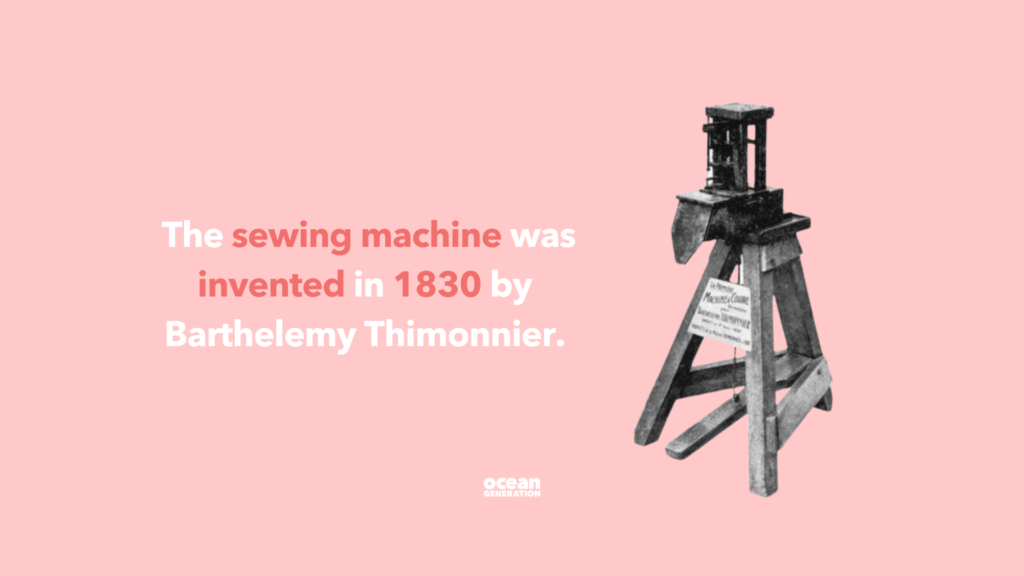
It was only in 1830 โ€“ during the Industrial Revolution โ€“ that the fast fashion story really starts with the invention of the sewing machine. 

Barthelemy Thimonnier, a French tailor, invented a sewing machine that used a hooked needle and one thread to create a chain stitch (which is still commonly used in denim jeans). 

The first sewing machine was invented in 1830 by
Barthelemy Thimonnier. It had a hooked needle and created a chain stitch, which is still used on jeans today. Shared by Ocean Generation in the history of the fashion industry article.

With the advent of the sewing machine, clothes became easier, quicker, and cheaper to make. Clothing began to be made in bulk, in various sizes, rather than just being made to order. 

Dressmaking shops emerged to cater to the middle classes and โ€“ for the first time – people started wearing clothing for style, not just practical reasons.  

The fashion industry used to be slow. Sweatshops were the beginning of the end of that.

Shared by Ocean Generation this is a sweatshop of Mr. Goldstein, 30 Suffolk Street, New York City, photograph by Lewis Wickes Hine, February, 1908

What is a sweatshop?

Sweatshops are factories or workshops, especially in the clothing industry, where manual workers are employed at low wages for long hours and poor (or downright illegal) working conditions.ย 

To cater to the demand for clothing, sweatshops emerged in the 1800โ€™s (and donโ€™t be fooled: They still exist today.)ย 

โ€œFast fashion isnโ€™t free. 
Someone, somewhere,  is paying.โ€ 
Quote by Lucy Siegle regarding the fashion industry. In the image, an asian woman wears pink gloves poised under her chin.

Clothing becomes a form of personal expression: 1960s

By the 1960s and 1970s, young people were creating new trends and using clothing as a form of personal expression.ย 

There was increasing demand for affordable clothing. Textile mills opened across the developing world, and low-quality, mass-produced clothing took over. ย 

Shopping for new clothes became a hobby and a means of social status.ย ย 

When was the term fast fashion coined?ย 

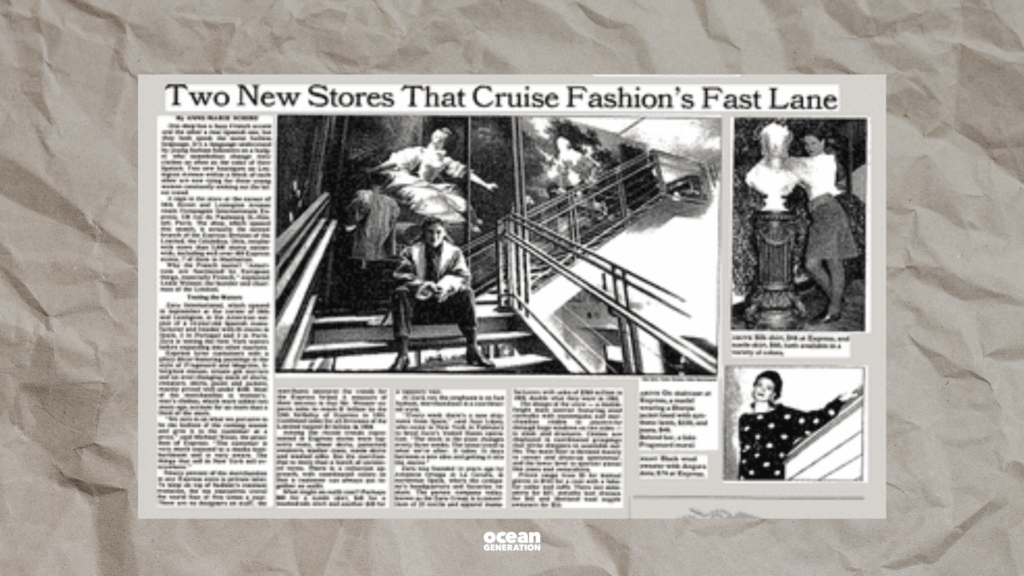
In 1990, the New York Times published an article using the term โ€˜fast fashionโ€™ for the first time. The piece was about a new fashion retailer with a mission to transform a garment โ€“ from an idea in the designerโ€™s brain to being sold on racks in store โ€“ in only 15 days.  

This was the first article ever published using the term fast fashion. In 1990, the New York Times published an article about Zara stores coming to New York. Ocean Generation is sharing the impact of fast fashion on the planet.

Itโ€™s safe to say fast fashion had arrived.ย ย 

By the mid-1990s, online shopping took off โ€“ accelerating what was already a dizzying rate of textile consumption.  

No matter where you are in the world, chances are: If you see an outfit you like, online, you can buy it and have it on your doorstep in days. But at what cost?  

Two sets of socked feet are up in the air. One pair of feet is wearing green socks and the other is wearing mustard yellow socks. They are both wearing white strappy high heels and blue jeans.

Being fashionable shouldn’t cost the earth.ย ย 

All areas of fast fashion โ€“ super speedy production, use of synthetic fibres and dangerous chemicals, and competitive pricing โ€“ have massive negative impacts on our blue planet and the people involved in garment manufacturing.ย ย 

Whatโ€™s more: Rapidly changing trends and clothing available at shockingly cheap prices instils a throw-away culture; as though clothing isnโ€™t meant to be long-lasting or worn more than a few times.ย ย 

5 fast facts about fashionโ€™s environmental impact.

And thatโ€™s the tip of the iceberg.

Weโ€™ve hardly touched on overconsumption, water usage, waste and havenโ€™t even mentioned microplastics yet.  Read more about the impact of textiles on people and the planet.

Woman breaking through a piece of clear plastic with her hands. Learn about plastic pollution with Ocean Generation.

How does fast fashion impact the Ocean?ย ย 

Textiles in the fashion industry generally fit into two categories: Natural and synthetic.  

Natural materials (like wool and cotton) are made from plant and animal sources. They tend to be more expensive and last longer.  

Fast fashion relies on the cheaper (less, environmentally friendly) option: Synthetic materials. Youโ€™ll recognise these plastic-based materials in your clothing: Polyester, acrylic, and nylon. 

Synthetic fibres make up almost 60% of annual fibre consumption. Said differently: Our clothes are around 60% plastic. 

More than ever, our clothes are made of plastic. Just washing them can pollute the Ocean.ย ย 

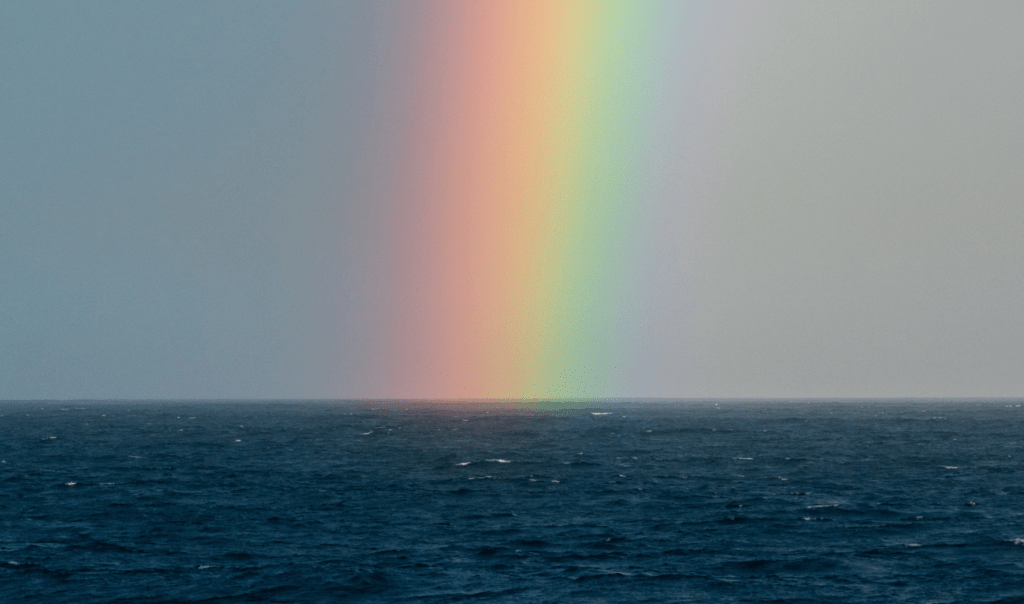
Rainbow over the Ocean. It's like the Ocean is a pot of gold and really: it is. Our Ocean provides us with many resources and produces half the oxygen on Earth. Learn about the Oceans with Ocean Generation.

These synthetic fibres produce non-biodegradable waste that pollute the Ocean. How? A single 6kg laundry load releases up to 700,000 synthetic microfibres which pass through our drains and into our Ocean. 

Once in the Ocean, microfibres are ingested by Ocean life and end up making their way back up the food chain, to us, and pose numerous health risks.  

We can put fast fashion out of style.ย ย 

More and more, consumers are demanding sustainable clothing and calling out the true cost of the fashion industry. As a result, weโ€™re starting to see some changes in the fashion industry, but thereโ€™s a long way to go.ย ย 

As recently as 2018, the fashion industry producedย ~2.1 billionย tonnes ofย greenhouse gas (GHG) emissionsย globally. Luckily for us, we can all directly influence the fashion industry and the impact it has.

As individuals, the first thing we need to tackle is our relationship with consumerism.ย 

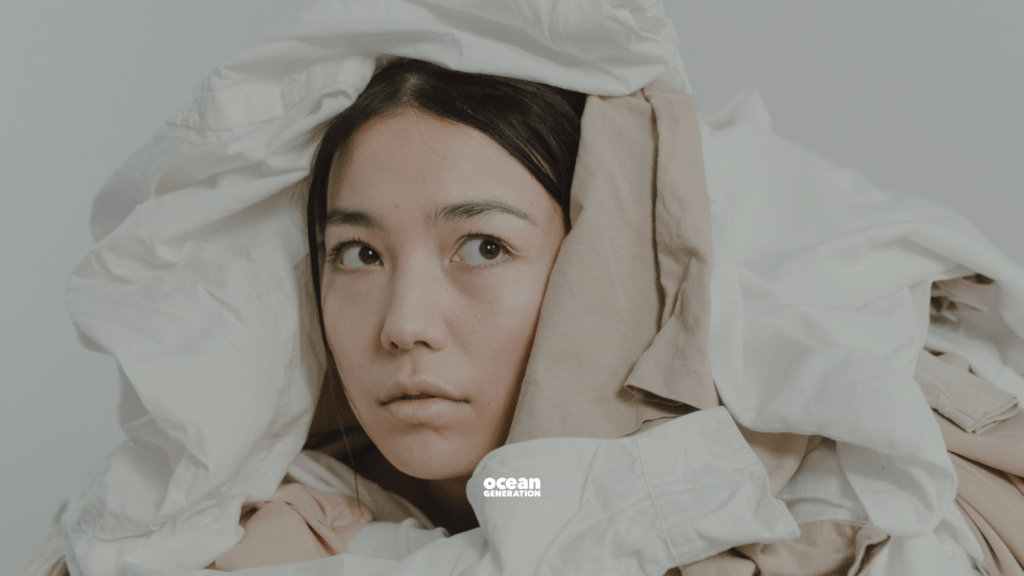
Asian woman surrounded by a pile of clothing. Just her face showing amongst all the clothing and textiles. This photo represents the overconsumption in the fashion industry.

โ€œWhat can I do to tackle fast fashion?โ€ย 

  • Continue to learn about how to spot fast fashion brands (then steer clear of them).ย 
  • Embrace buying less fast fashion items. (In a week or two, that item will be out of fashion anyway, right?)ย 
  • When you do shop for clothing, ensure youโ€™re purchasing with long-term wear in mind.ย 
  • Support responsible, ethical clothing brands.ย ย 
  • Buy second hand.ย 
  • Only wash your clothes when theyโ€™re actually dirty.ย ย 
  • Be an outfit repeater (re-wear your clothing until it really is end-of-life).ย 
  • Repurpose clothing when they’re end-of-life.ย 
  • Remember that the most sustainable piece of clothing you have is the one already in your closet
  • Join the Wavemaker Programme for tools to accelerate your social actions. 
  • Subscribe to our newsletter for Ocean news, stories, and science.  

Secret life of algae: From oxygen to algae blooms

Subscribe

Monthly: Impact in your inbox.

OceanGeneration-Join

The History of Climate Change

A century of climate science history: Explained.

These days, you canโ€™t go a week without the impacts of climate change making headlines โ€“ but that wasnโ€™t always the case. When climate science first appeared in the media, it was batched with conspiracy theories and radical ideas.  

Now, we know better.

Weโ€™re hopping in a time machine to unpack the history of climate change, greenhouse gasses, global warming, and why climate skeptism existed for so long. 

When did climate science first make the news

Over a hundred years ago (hello, 1912), the Titanic set sail and sank, zippers were invented, Oreos were created. And Breaking News: Climate change entered the news for the first time.  

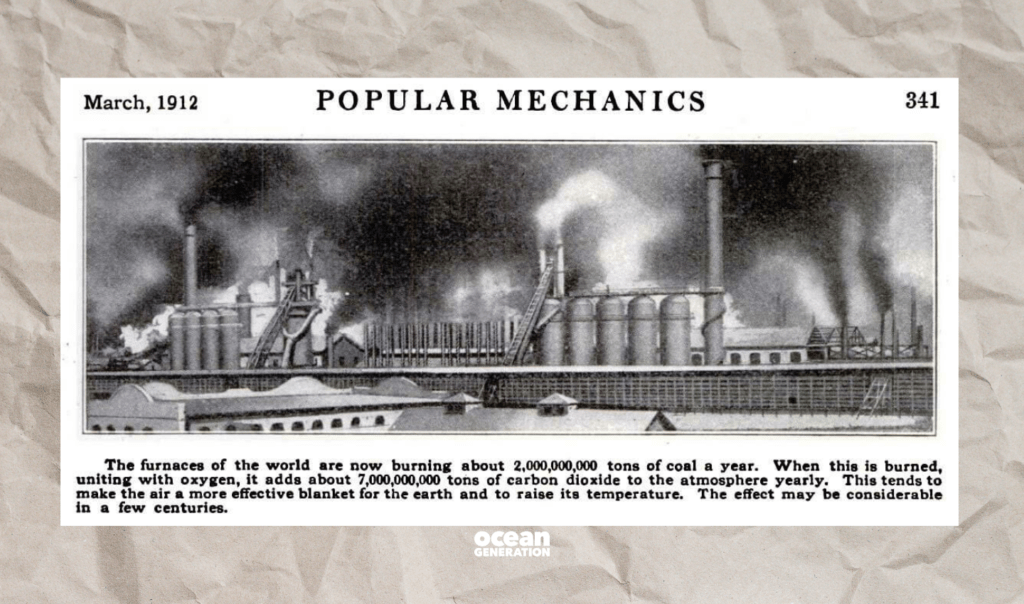
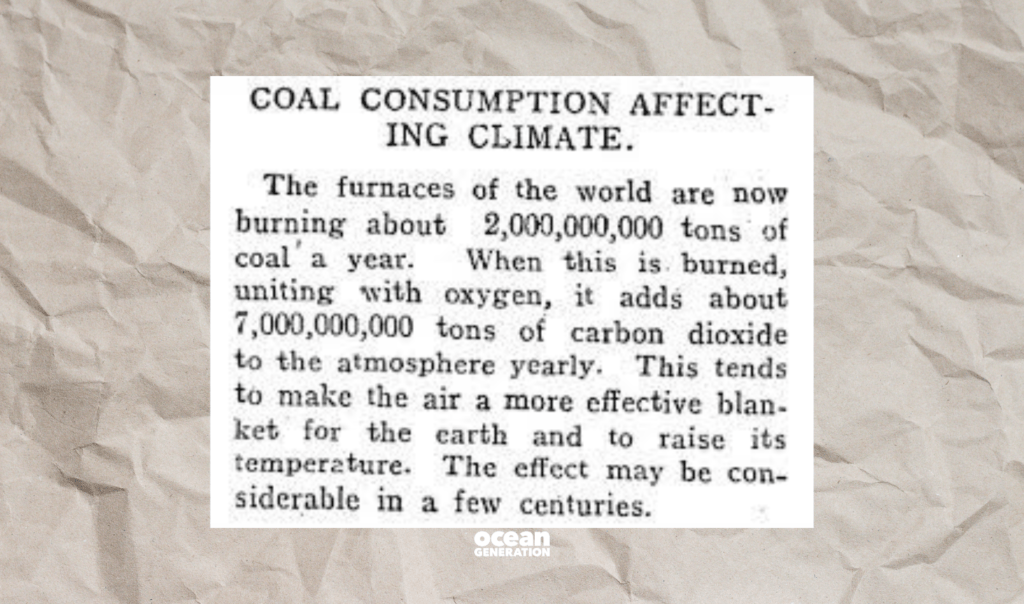
This caption appeared in the March 1912 publication of โ€˜Popular Mechanicsโ€™, directly linking burning coal and global temperature change: 

Snapshot of a caption that appeared in the March 1912 publication of โ€˜Popular Mechanicsโ€™, directly linking burning coal and global temperature change.

Several months later, on 14 August 1912, a paper in New Zealand re-shared the now-famous caption. They titled it: โ€œCoal Consumption Affecting Climate.โ€

But before these publications, fundamental climate science was already understood.  

On 14 August 1912, a paper in New Zealand re-shared a now-famous caption titled: โ€œCoal Consumption Affecting Climate.โ€ 

Burning coal and climate change, for the first time, were linked in the media. Shared bY ocean Generation experts in Ocean health and inclusive environmental learning.

Scientists understood how greenhouse gasses contributed to rising temperatures in 1856.

What is the greenhouse gas effect and who discovered it? 

The greenhouse gas effect is how heat is trapped close to the Earthโ€™s surface. Trapped by what? Greenhouse gas molecules like carbon dioxide, methane, and nitrous oxide.  

John Tyndall, an Irish physicist, is commonly miscredited with discovering the greenhouse effect.  

In 1856 (three years before Tyndall’s work was published), Eunice Foote, an American scientist, concluded certain gasses warm when exposed to sunlight. She concluded that rising carbon dioxide levels would lead to atmospheric changes, which could impact the climate.  

Human activity was suggested as the main driver of climate change in 1896.

Svante Arrhenius, a Swedish scientist, suggested that as humanity burned fossil fuels (non-renewable energy sources like coal, crude oil and petroleum), which added carbon dioxide to the atmosphere, weโ€™d raise the planetโ€™s average temperature. 

Over 100 years ago, the science was there. Why does it feel like weโ€™re only waking up now? 

Climate science wasnโ€™t accepted by the public.

We can point to these news articles and research pieces and say, โ€œItโ€™s been a century! Why was nothing done?โ€ But climate change began on the fringe of society. The science โ€“ and these scientists โ€“ weren’t taken seriously.  

โ€œHumans? Impacting the planet? No way!โ€ – someone in 1912, probably.  

Turning our backs on fossil fuels, which were building the modern world, seemed outlandish. When the world went to war in 1914, the topic lost momentum and only picked up again in the 1930โ€™s. 

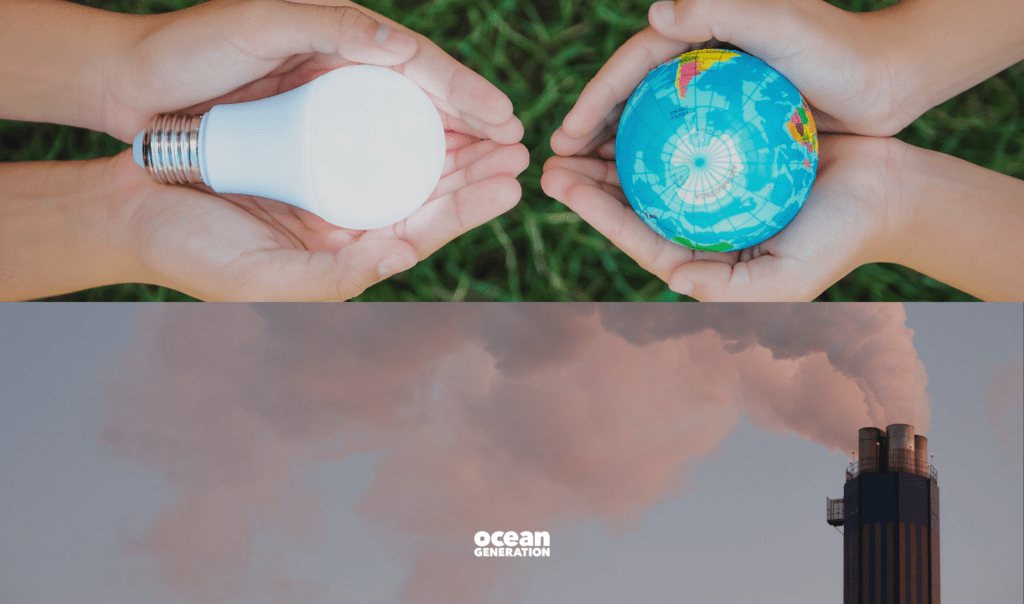
Ocean Generation is sharing the history of climate change. In this image, which is horizontally split in two, two sets of hands hold symbols of the modern world: a light bulb and a globe of Earth. The bottom image is of smoke rising from a factory, symbolising the connection between burning fossil fuels and the modern world.

The origin of global warming.

In 1938, Guy Callendar caused a stir in the science world when he put together weather observations and concluded that global average temperatures had already increased. 

Callendar was the first person to clearly identify a warming trend and connect it to carbon dioxide in the atmosphere. He was shunned by the science community for his research which became known as โ€œthe Callendar Effect.โ€  

Today, we just call it global warming. 

How does climate change impact our Ocean? 

The Ocean absorbs much of the sun’s heat which helps regulate land temperature and drive global weather patterns. More than 90% of the heat from global warming is stored in our Ocean. That makes the Ocean one of the most important carbon sinks on Earth.  

But this continual heat absorption is changing the characteristics of the Ocean. (Spoiler: not in a good way). Those changes have massive impacts on all life on Earth. 

Scroll: The 7 climate change indicators weโ€™re seeing in the Ocean. 

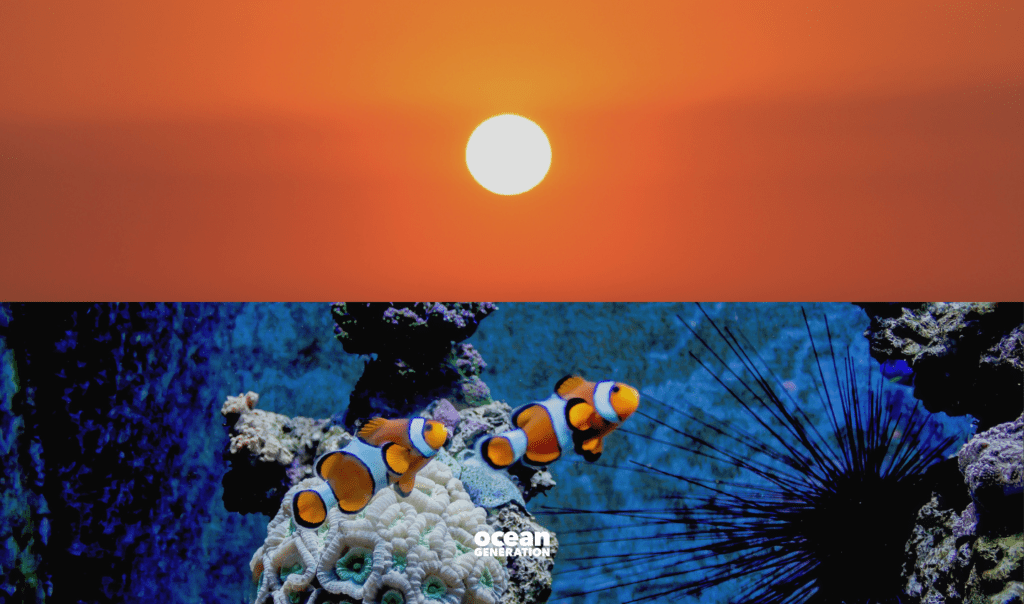
How does climate change impact the Ocean? Ocean Generation has the answers. In this horizontally split image half is made up by an orange sunset, in the bottom image a scene under the Ocean is captured: there are vibrant corals and clown fish.

Why was climate scepticism so strong for so long?  

Scientific coverage in the media that pointed to the reality we all know now โ€“ that human activity is a key driver of climate change – was often published alongside pieces that were sceptical of such facts. 

As recently as 2003, it was covered that global warming amplified death tolls in the 2003 European Heatwave. In the same year, at a speech given on the US Senate floor, a former Chair of the Environment and Public Works Committee called climate change, โ€œThe greatest hoax ever perpetrated on the American people.โ€  

With contradicting statements everywhere, people believed that the jury was out on climate change. We know better. 

The best time to take climate action was in 1912.

The second-best time is right now and every day from now. Because the history of climate change is just that: History.

Each decision we take, today, tomorrow, in three weeks or four years, sets up the future health of our blue planet.  

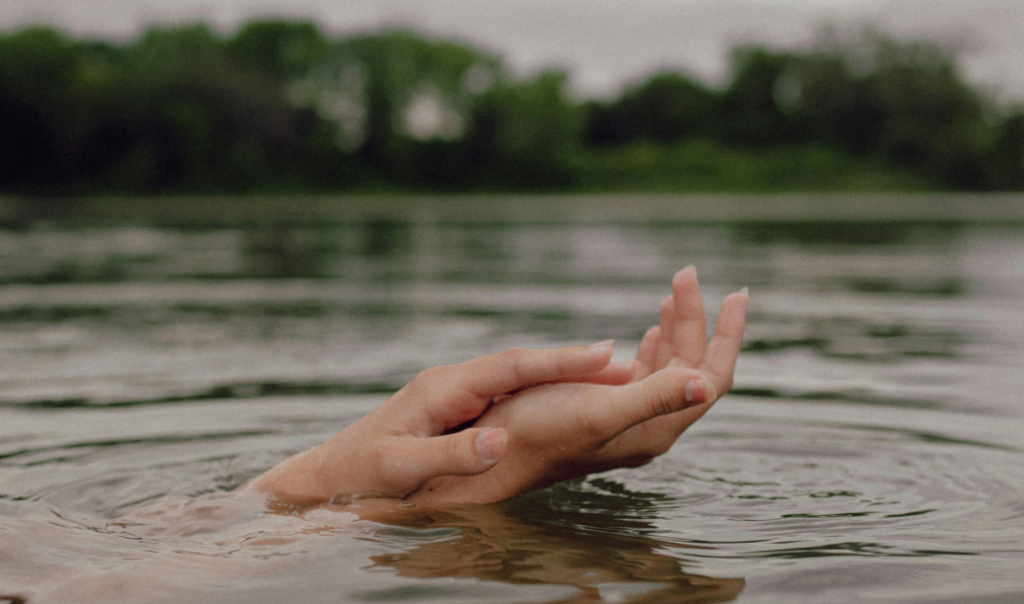
A hand reaching out above a body of water. The hand's reflection looms below. Shared by Ocean Generation.

Actions you can take to fight climate change.

Secret life of algae: From oxygen to algae blooms

Subscribe

Monthly: Impact in your inbox.

OceanGeneration-Join

The History of Plastic Pollution

Understanding the plastic problem

Worldwide, up to five trillion plastic bags are used every year and up to 422 million tonnes of plastic are being produced annually.

As if that isn’t bad enough, half of all plastic produced is for single-use purposes, meaning it’s used once and then thrown away. In reality, there is no ‘away’ for a material designed to be indestructible.

For decades, our Ocean has been a dumping ground for plastic, sewage, industrial and chemical waste. While the Ocean is vast, it’s not bottomless and it’s certainly not a landfill site.

Single-use plastics are the biggest contributors to marine litter and pose severe threats to marine life, human health, and the planet. But how did we get here? When was plastic created? What can we do to take action and reduce the plastic polluting our blue planet?

YouTube player

What is the history of Ocean pollution?

We’re used to having our rubbish collected, sorted, recycled or put into landfill – but for millennia, people didnโ€™t dispose of their waste as we would today.

Instead, waterways were used as a means of waste disposal or rubbish would be burned. As a result, pollution would end up in our Ocean or in the atmosphere.

Before the advent of plastics, and with a relatively small population, the amount of waste in the Ocean was rather small. 

The invention of plastic: The dawn of pollution

In 1862, Alexander Parkes developed the first man-made plastic. The product, called ‘Parkesine’, wasn’t a commercial success, but it was an important step in the development of man-made plastic.

A staggering number of plastic innovations emerged in the period surrounding World War II, from 1933 – 1945. Plastic technology came to the forefront because copper, aluminium, steel and zinc became highly sought-after metals used only for the war effort.

In the 1960s, it became clearerย how pollutedย our Ocean was getting.

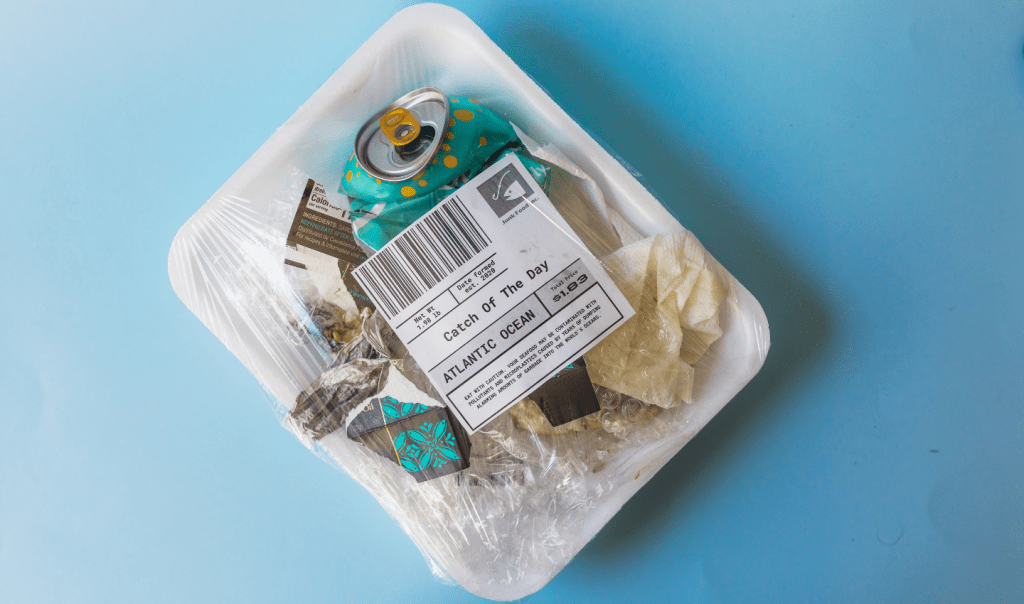
A styrofoam food pack from a grocery store, which usually contains meat or fish, is filled with plastic pollution found in the Ocean: a discarded can of soda snack wrappers, tissues, and plastic packaging. A label on the front reads: Catch of the Day. Atlantic Ocean. In this article, Ocean Generation shares the history of plastic pollution.

Hold on: What is marine pollution?

Marine pollution refers to waste ending up in the Ocean and causing adverse effects. Specifically, marine pollution is a result of human impacts. A combination of chemicals and trash – most of which comes from land – is tossed, washed, or blown into the Ocean.

When was Ocean pollution – specifically, Ocean dumping – first reported?

We can assume that Ocean dumping has been in practice before anyone investigated it, partly because scientists didnโ€™t attempt to research this issue before the 1960s. Many organisations used to dump their chemical by-products into waterways to remove their waste.ย 

In the 1960s, scientists from the National Academy of Sciences discovered some alarming news:ย More than 100 million tonnesย of waste had been dumped in our Ocean.

This report discounted plastic pollution, which we now know is one of the major pollutants in our Ocean, because it had just recently become a mainstream material. Instead, the Ocean pollution that these scientists reported largely relates to chemical, industrial and sewage waste.ย 

How have plastics developed into a major Ocean polluter?

Between the 1970’s and 1990’s,
plastic waste generation more than tripled.

Realisation hit in the 1970’s: Plastic doesnโ€™t โ€˜go away’ and it doesn’t break down; it breaks up into smaller and smaller pieces, called microplastics. 

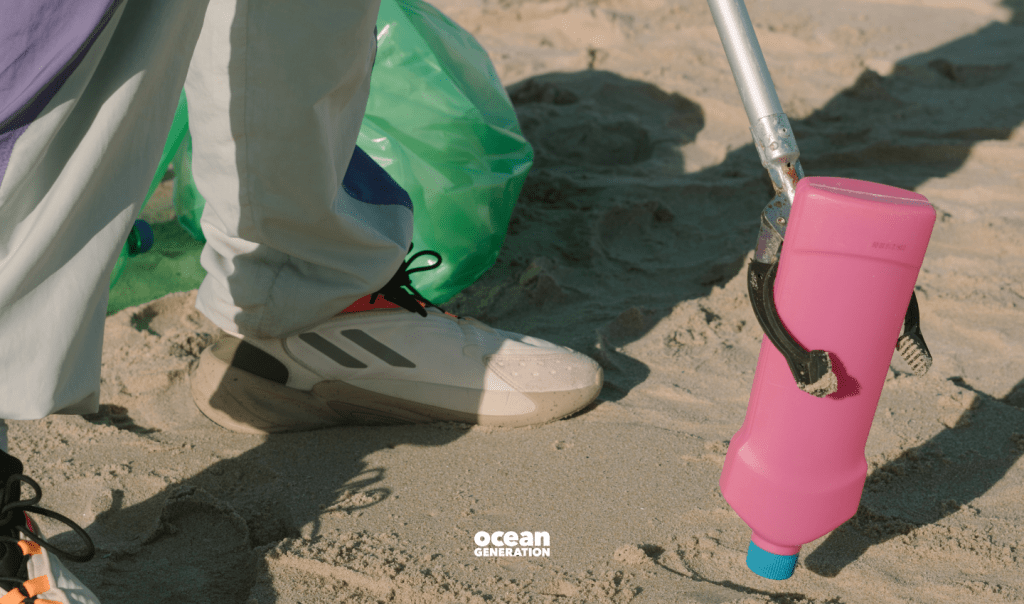
During this period, there was a significant rise in plastic production too, which resulted in more and more pollution. Scientists also discovered that seabirds were ingesting plastic materials and seals were getting trapped in plastic netting.

Scene from a beach clean. White tennis shoes of a litter picker are visible. The beach cleaner is picking up a pink plastic bottle off the beach. In the background, a plastic trash bag can be seen. Ocean Generation shares the history of plastic pollution in this blog.

How have we tried to de-pollute the Ocean?

There have been legislative attempts to de-pollute the Ocean and remove plastic from our waterways.ย 

Four years after the National Academy of Sciences scientists discovered how much waste had really been dumped into the Ocean, the U.S Congress passed the Marine Protection, Research and Sanctuaries act.

By the 1980s, the Society of the Plastics Industry developed theย plastic resin identification code, to make recycling and disposing of plastics easier. But our reliance on plastic had already taken hold.ย 

In the early 2000s, the amount of plastic waste we generated rose more in a single decade than it had in the previous 40 years.

Plastic pollution has negative consequences for all life on Earth.

Even though we know plastic pollution is bad for our blue planet, we continue toย produce millions of tonnes of plastic from plastic bottles and plastic forks to plastic shopper bags to giant plastic commercial containers.

A key reason plastic continues to contribute to marine pollution is lack of awareness.

From individuals to businesses to governments – if we don’t understand the problems associated with plastic pollution and the importance of having a healthy Ocean, we won’t do anything to change our ways.

As of 2022, there are 8 billion people on Earth. We need millions of those people understanding that a healthy Ocean is essential to a healthy future for all life.

Necessary legislation to reduce plastic production and pollution will only be implemented when the masses understand how necessary that legislation is.

Up to 422 million tonnes of plastic is being produced annually.

What does the future of our Ocean look like?

We make decisions about what to purchase and what to wear daily. Choices made about how we live right now will impact the Ocean for decades to come.

So, the future health of our Ocean isn’t set. We have the ability to decide the magnitude of the plastic pollution problem. We can start making choices today to turn the tide.

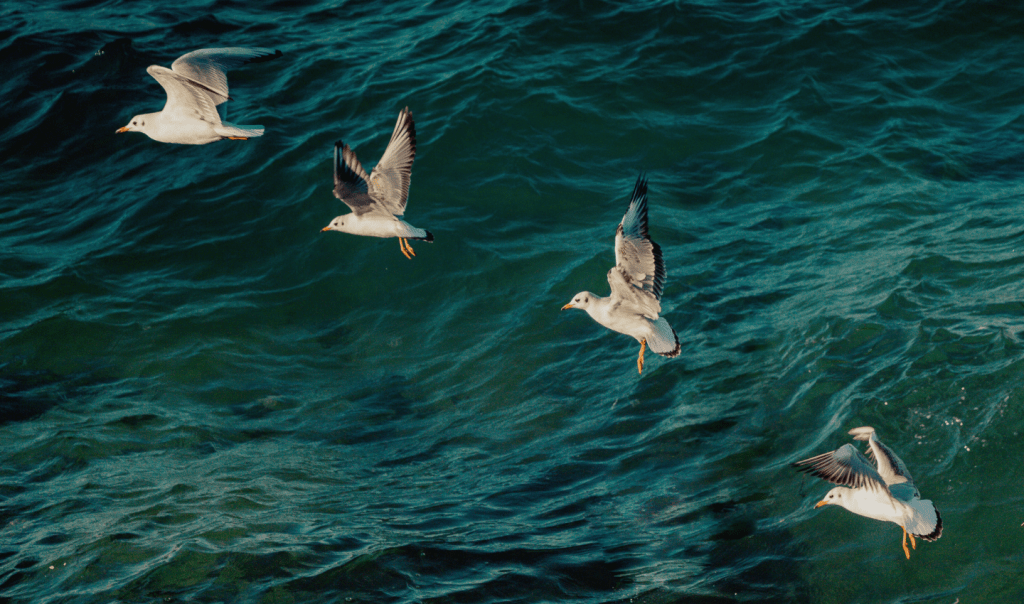
Seagulls in flight. With the Ocean int the background, four seagulls are in various stages of taking flight; their wings flapping as they set off. Ocean Generation - experts in Ocean health since 2009 - shares the history of plastic pollution in this article.


We can right the wrongs of our plastic pollution history, and embrace the Ocean as the life supporting ecosystem that it is, rather than use it as a dumping ground. 

We are the first generation to deeply understand Ocean issues, and the last generation who can stop them. We are all the Ocean Generation.

How can I start taking Ocean and climate action?

Get informed. Our monthly newsletter provides Ocean positive news, easy to understand Ocean science, and engaging pop-culture pieces to help you understand the human-made threats our Ocean faces and what you can do to make a difference. 

Secret life of algae: From oxygen to algae blooms

Subscribe

Monthly: Impact in your inbox.

OceanGeneration-Join