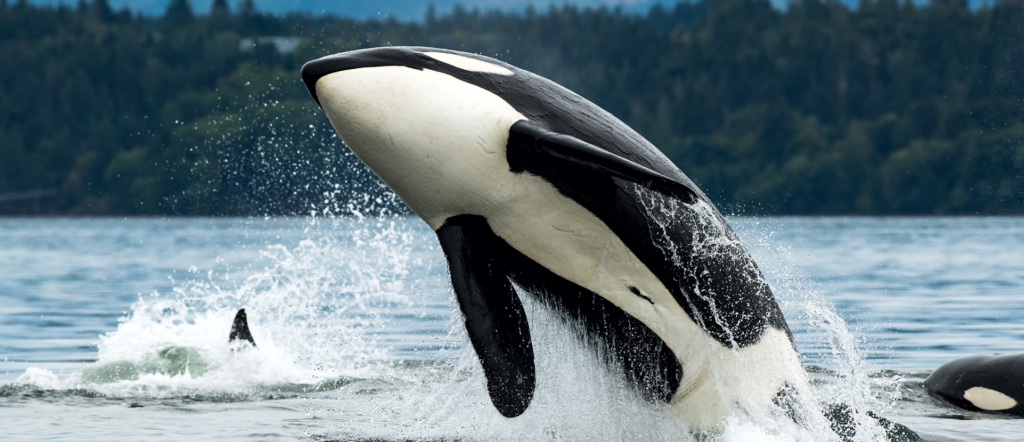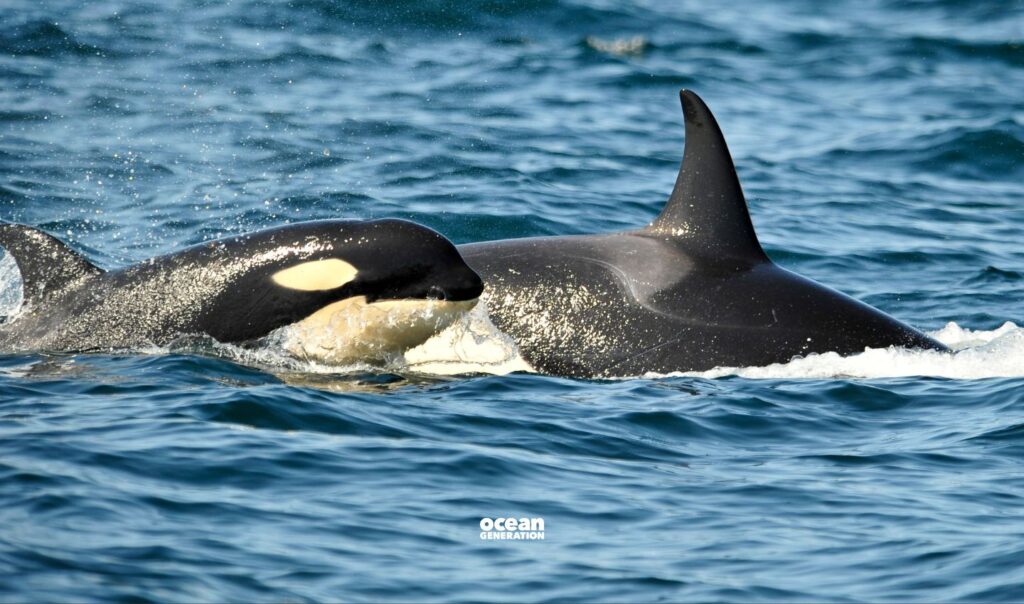
Orca (also known as killer whales) are famous residents of the Ocean. They are fast, fashionable and family-oriented. Frankly, they are fantastic.
What are orca?
Orca arenโt whales
The commonly used name, killer whales, can cause confusion. Early sailors became familiar with orca hunting the great whales, naming them โwhale killersโ. Somewhere in history, that got flipped to become โkiller whaleโ, even though orca are actually dolphins. They are the biggest of the dolphins.
Orca are whales
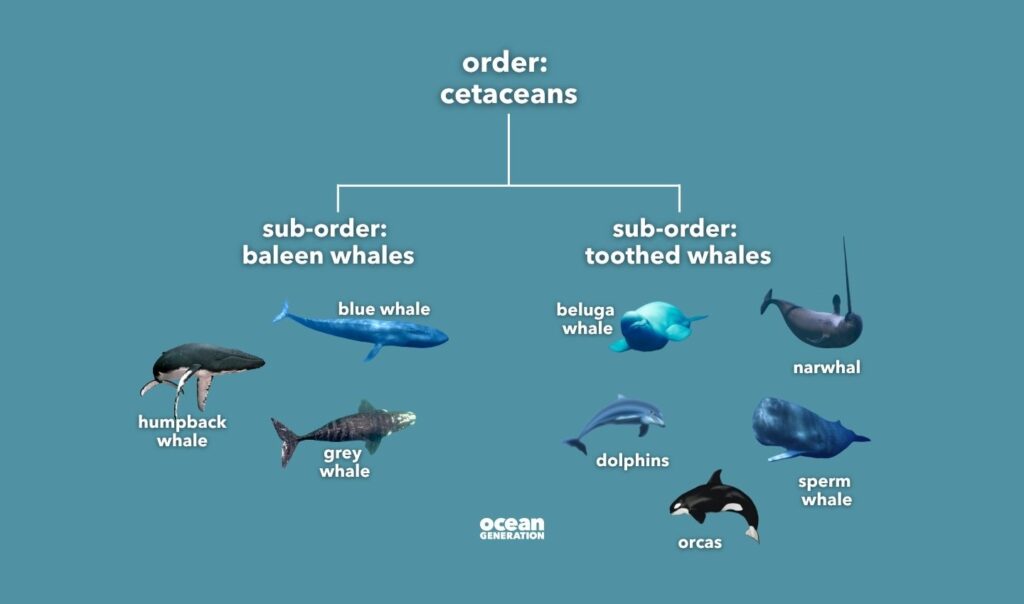
But the whole dolphin family, the Delphinoidea, belong to the toothed whales โ the Odontoceti. Along with the Mysticeti, the baleen whales, they make up the cetaceans. So, you could argue all dolphins (and therefore the orcas) are in fact whales.
Orcinus orca is currently a single species, although scientists have suggested dividing it into races, sub species or even different species.
Different groups of orcas are known as ecotypes which inhabit different parts of the Ocean and show physical and cultural differences. They speak different dialects, eat different food and grow to different sizes with different colouration. In many ways they are much like humans.
Where do orca live?
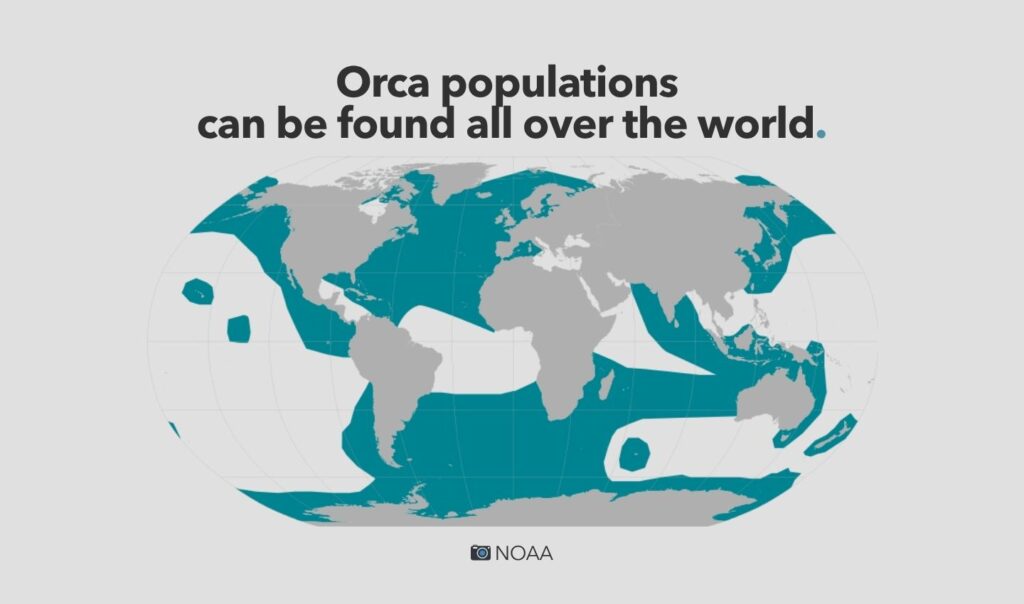
Populations can be found all over the world, typically preferring coastal seas to the open Ocean, and the higher latitudes closer to the poles. The main population centres for orca are in the Southern Ocean, the north-eastern Atlantic and in the northern Pacific, but orca can be found from Hawaii to the Arctic.
How many orcas are there?
There is an estimated global population of 50,000 orca, including 25,000 in the Southern Ocean, and 10,000 in the waters of Norway, Iceland and the Faroes.
The global population of orca has not been assessed by the International Union for Conservation of Nature (IUCN). We donโt know enough to say whether orca populations are increasing, decreasing or stable.
We do know about the different orca sub populations around the world. Some, such as the Iberian orca population which has been sinking boats, are critically endangered. The West Coast Community of the UK is thought to only have two members remaining: Aquarius and John Coe, who at over 60 years old may well be the oldest male killer whale in the world.
Other orca populations are doing better. Antarctic populations are hard to study, but thought to be stable. Northern Resident orca of the west coast of North America are listed as threatened, but their numbers are increasing by an average of 2% per year after protective measures were introduced for them and their main prey โ harbour seals.
All orca are carnivores but different populations of orca have different preferred diets. Norwegian orca have specialised in herring, northeast Pacific orca hunt salmon and New Zealand orca focus on elasmobranch species such as eagle rays, stingrays and shark species.
Two orca brothers in South African waters, Port and Starboard, are infamous for targeting great white sharks, flipping them onto their backs into a trance-like state known as tonic immobility and eating their livers. As a result, great whites leave the area when orcas are about. Other orcas have been recording other shark species such as whale sharks, seven gill sharks, mako sharks and white sharks.
Nothing is off the menu. Orca will hunt marine mammals, including walrus, dolphins, narwhals, beluga and whales. Orca have been recorded recently hunting the largest animal that has even lived: blue whales.
A population off the western coast of North America has revived a fashion fad last seen in the 1980s of swimming around with dead salmon on their heads. Fashion experts compare this to the revival of the bucket hat.
Orca are among the very few species to go through menopause in the wild. Beluga, narwhals, short-finned pilot whales and false killer whales join humans in this exclusive group. This allows orca grandmothers to act as vital sources of knowledge in food location and hunting techniques, while avoiding them competing reproductively with their daughters.
Orca are estimated to eat nearly 800kg a week (roughly 1600 loaves of bread or 8,000 apples).
Narwhals and Unicorns: How the magic of the Arctic has changed
Share this page
Copied
Are unicorns real? Look to the Arctic Ocean.
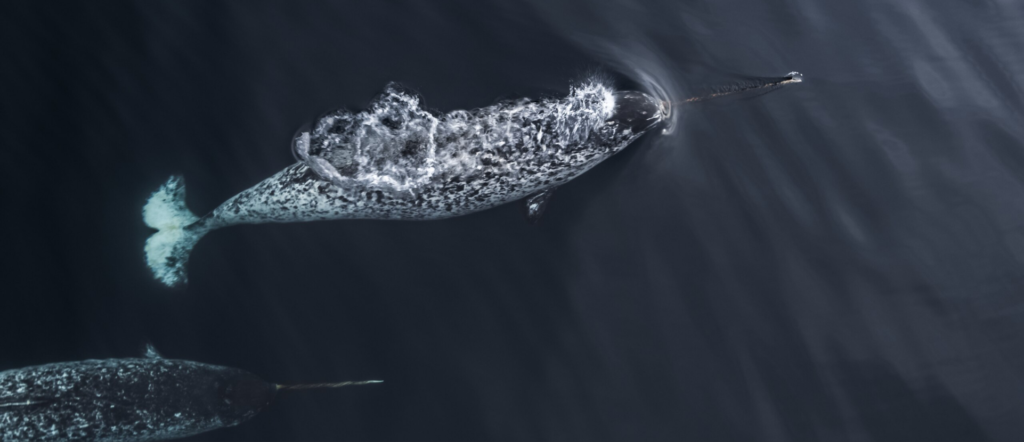
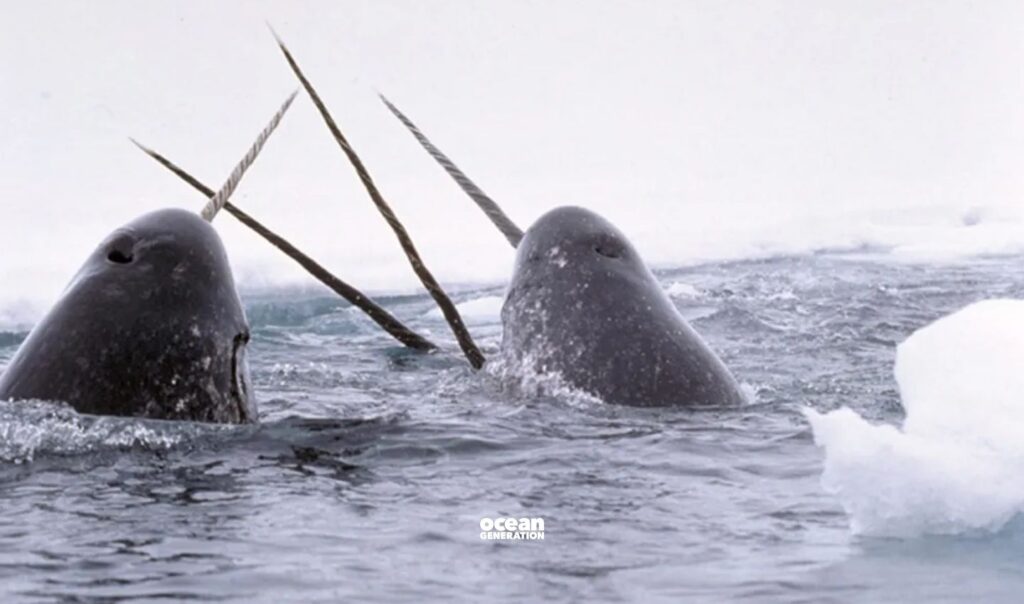
Under a clear blue sky, icebergs silently sparkle as they float in the Ocean, occasionally nudging each other. The water between them is a deep blue and still, undisturbed.Until a twisted ivory lance pierces the air, sliding out of the water inch by inch until two metres of tusk are followed by a mottled grey head. The head directs the tusk down again, exhales through the nostrils on top and takes a deep breath, slipping into the frigid waters.
Maybe not quite how you would picture seeing your first unicorn.
Except thereโs some bad news. Unicorns arenโt real. We are as disappointed as you are; the closest we can come to a unicorn is a whale that lives in the Ocean:narwhals.
But there was a time not so long ago that people believed the unicorn existed.
Why did people believe unicorns existed?
In the first half of fourth century BC the Greek physician Ctesias provided the first description of a unicorn.He outlined an Indian wild ass(a horse-like animal);with a crimson head and a tri-coloured horn about 28 inches long. He wrote that powdered unicorn horn acted as an antidote to deadly poisons.
Aelian, a Roman writer in 200AD fleshed out the description and noted that only noblemen could afford the horns, they were so expensive.
Early Christianity adopted the unicorn as a symbol of Christ, with the horn as a symbol of the cross of Christ.Through the belief in protection for the self and the soul, the unicorn horn โ known as alicorn – became a highly sought after asset.
Unicorn horns were symbols of wealth and power, often displayed in positions of prominence on banquet tables. It was thought that the horn would bubble if dipped in a poisoned chalice, saving the wielder – a popular tool in the medieval banquet hall.
At the peak of its popularity, a complete horn was worth 20 times its weight in gold*, and even powdered horn once cost ten times.
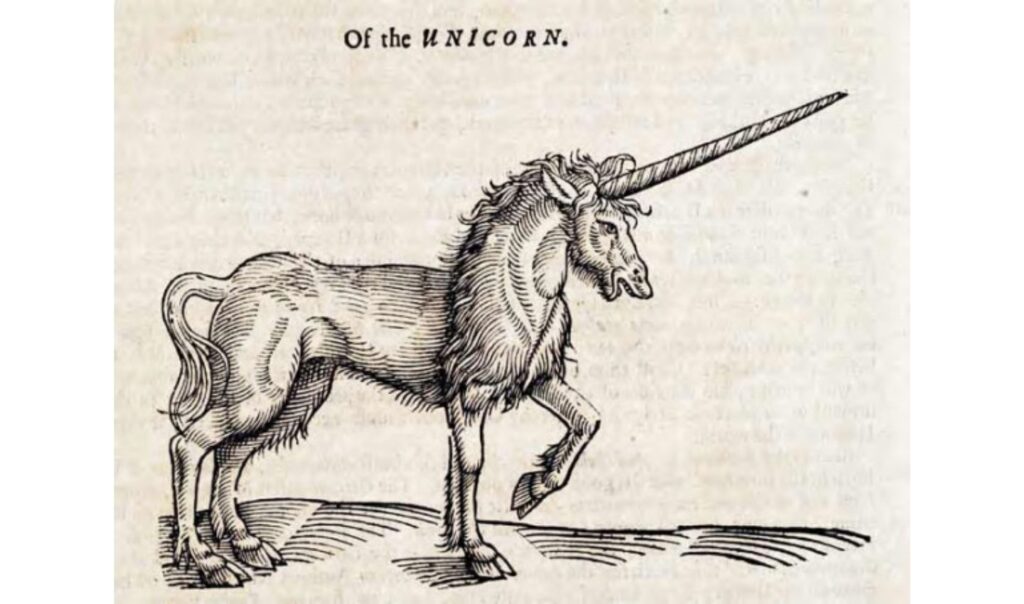
Illustration from the book The history of four-footed beasts and serpents by Edward Topsell.
Unicorn horns were sought after by nobles, kings and religious leaders in Europe:
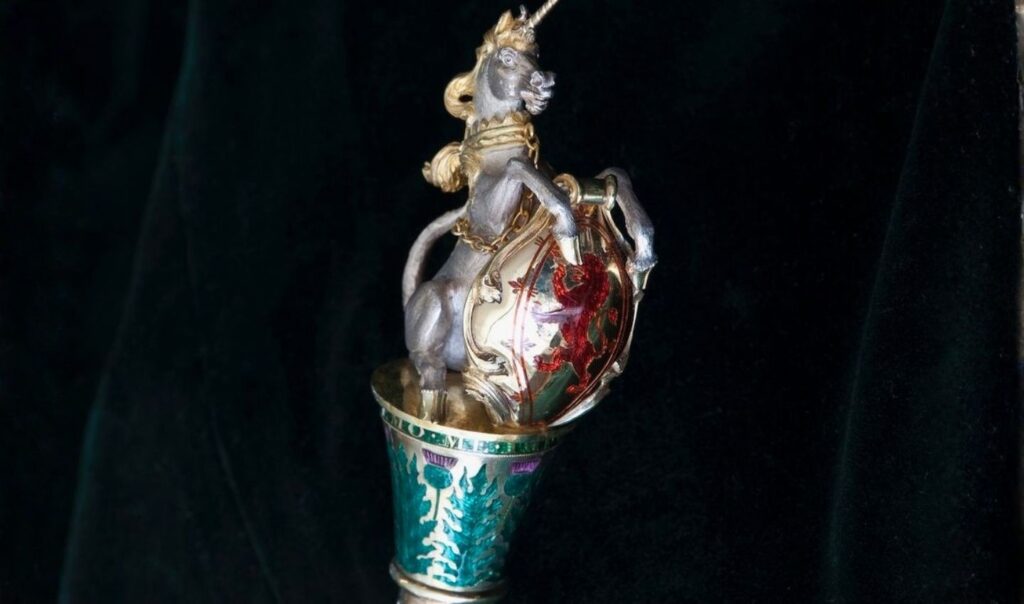
Such a powerful tool befits a queen, and on hearing that Mary Queen of Scots was using unicorn horn to test her food for poison, Elizabeth I offered a handsome reward for another.Privateer and Arctic explorerMartin Frobisher(or&Humphrey Gilbert, both were on the expedition, but different sources credit them) found a narwhal washed ashore in Canada and gifted it to the queen.She was enamoured with it and covered it in jewels. It was said to be valued at ยฃ10,000*, approximately ยฃ3 million in modern terms. She also handed a gilted and bejewelled unicorn horn drinking vessel down to James I.
In the 1660s, King Frederick III ordered the building of a coronation chair. This chair was made using several unicorn horns and served as the centrepiece of Danish coronations until 1840.
But as we know, unicorns arenโt real. Where are these horns coming from?
The Trustees and Factor and Commissioner of the Walker Trust / National Museums Scotland
Where did tales of unicorn horns come from?
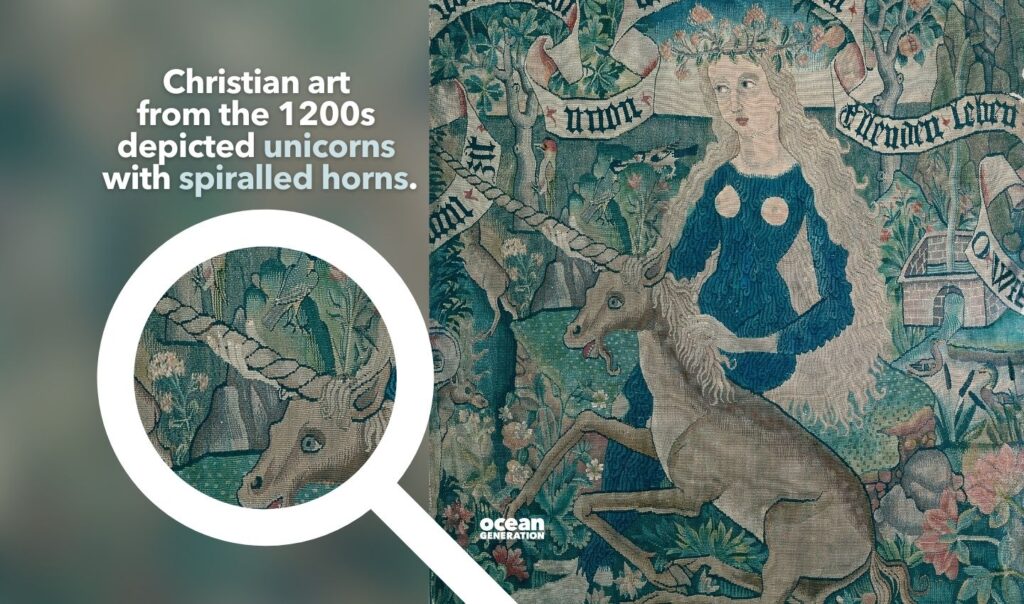
Most of the Roman and Greek accounts of unicorns were;likely based on stories from travellers coming across rhinoceros in India and Africa. But after these initial accounts describing the horn as straight, Christian art from about 1200 changed its view of the unicorn.
Unicorns now had spiralled horns. There is only one animal that possesses a straight, spiralling โhornโ โ the narwhal (Monodon monceros).And it isnโt a horn at all, but a tooth.
What you need to know about narwhals: unicorns of the sea
The name comes from the Old Norse nรกrhval, meaning corpse whale. Narwhals have mottled grey skin not dissimilar to rotting flesh and like to lounge at the surface โ behaviour known as logging. Combine the two and you can understand why the Viking explorers named them.
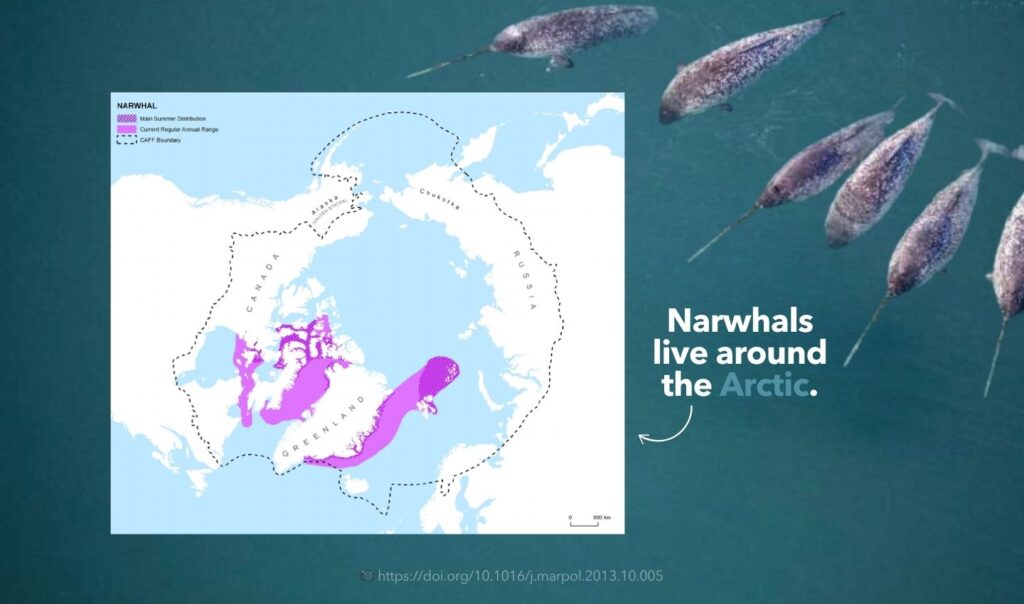
Narwhals are homebodies. They have โhigh site fidelityโ -meaning they stick to the places they like and will go back to their favourite spots. They can be found in the Canadian Arctic, through to East Greenland,Svalbard and the western Russian Arctic.
What is a narwhalโs โhornโ?
The โhornโ of a narwhal is one (or in rare cases two) of the incisors,so is a tusk rather than a horn at all. All narwhals have two tusks embedded in their top lip.
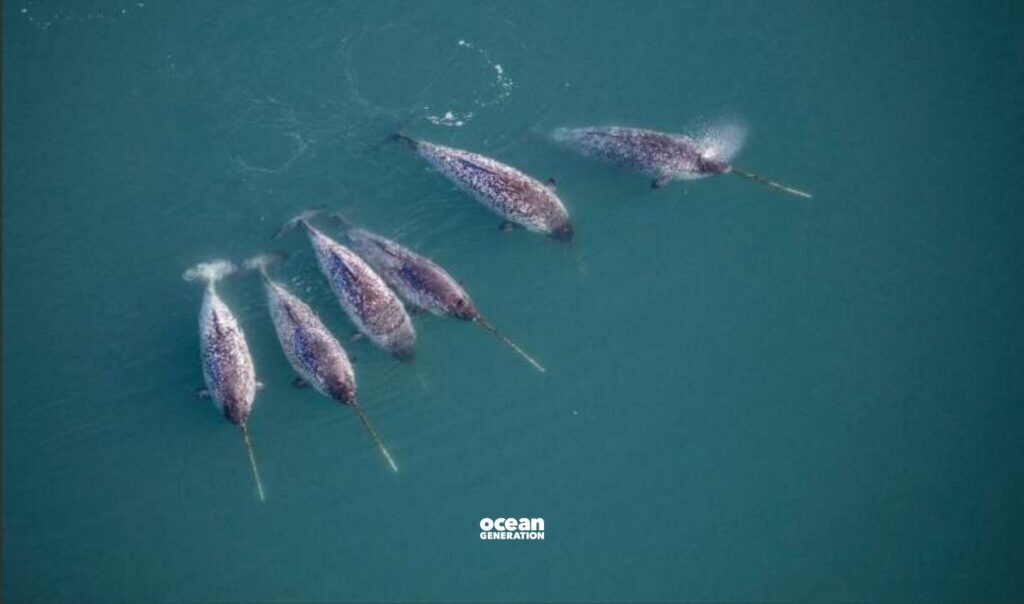
Most commonly, males in their 2nd or 3rd year will have the front left tusk erupt through their top lip, growing with age to reach 1.5-2.5m long. Around 3% of narwhals are anomalies, with some females growing tusks, some males growing two or none at all.Double tusks in narwhals are about as common as an extra finger in humans.
What do narwhals use their tusk for?
The use of the tusk is still under debate.
The first theories were that narwhal tusks were used for piercing prey or breaking up ice to make breathing holes. Observers supposed they could also function as a defensive mechanism or a cooling system. However, these theories are either discredited or unproven. The real uses are even more spectacular.
NIST/Glenn Williams
Dental Displays
Studies suggest that narwhal tusks are sexually selected. Male narwhals will use their tusk as a display feature in competition with each other, and bigger is better. The size of the tusk has been shown to positively correlate with teste size โ so could be an easy indicator for the females to see which males are most fertile. Sometimes, size does matter.
Where males with similar tusks meet, they may fight โmale narwhals show far more scarring on their heads than juvenile and female narwhals and 40-60% have broken tusks, but this hasnโt ever been observed.
What is sexual selection? Sexual selection is a special type of natural selection, where traits that increase reproduction will be passed on.
Fish Fencers
But it isnโt just for showing or skirmishing. Using drones to study the narwhalsโ behaviour, researchers saw the tusks in action. They could use the tusk to guide the fish, chasing it. They even saw the tusk being used, as a thresher shark uses its tail, to hit the fish, stunning it ready for eating. The scientists involved think there could even have been an element of play.
Temperature Taster
In 2014, we discovered that a narwhal tusk was full of holes and nerves. This could mean that it can operate as a water sensing tool for the narwhal, and they can โfeelโ changes in water saltiness (salinity) and temperature. They show elevated heart rate when the horn is exposed to very salty water and fresh water, suggesting they can detect it.
โFeelingโ your surroundings can be very useful for navigation, when diving deep and moving between their favourite spots. It could also save their lives. Seawater freezing depends on the temperature and salinity of the water โ saltier water needs to be colder before it freezes. By knowing the temperature and salinity of the water they are in, they are detecting when the water is likely to freeze, trapping them from the air to breathe.
This could also be used in hunting โ those narwhals weโve seen using their tusks to โchaseโ fish? They could be using their swirly sensor to detect the fishes’ movements through pressure changes in the water, even faster than they can see them
So, we have a tooth that helps guide them through the icy waters like Rudolph’s nose, zero in on prey like a laser guided missile and show off their suitability to be a parent.
A narwhal’s tusk could enable them to tell when ice is going to form and find prey hiding in the dark as they can dive over a kilometre (3,281 ft) down, where no light can reach.
Unicorns might not be real, but this all sounds like magic.
Does something lose its magic just because we understand how it works?Whether it is magic or incredible biology, the enchantment of the narwhal is threatened by a changing world.
How is the narwhalsโ world changing?
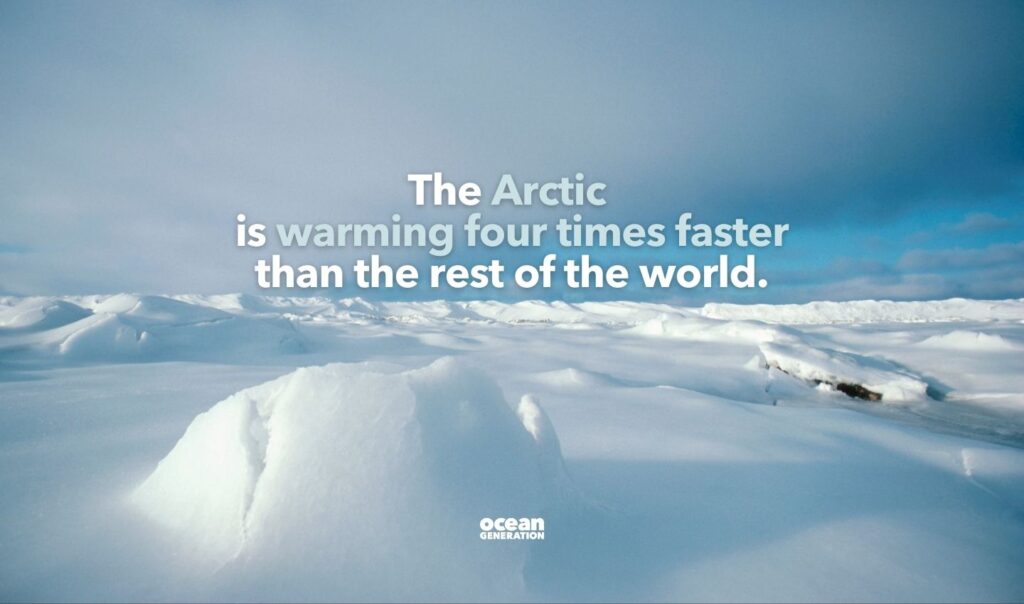
The opinions and doting of nobles across Europe and the world meant nothing to the narwhal.After years of hunting operations, narwhals are now enduring other changes, this time in their home. Climate change, caused primarily by the human burning of fossil fuels, is hitting the polar regions, where narwhals live, the hardest.
It could also be to do with their supreme adaptions for the coldest places on the planet โ they may overheat at higher temperatures. No one wants to be wearing a thick winter coat on a hot summer’s day.
Ice is an important part of the lives of every animal living in the polar seas.The loss of sea ice has been shown to change the diet of the narwhal as they canโt eat ice-based (known as sympagic) prey, so they eat more open-water (pelagic) species instead.
Through burning coal and mining for gold, humans have increased the amount of mercury in the environment.Less ice means there is more bioavailable mercury. The result: the narwhals are exposed to more mercury.Increased mercury levels can impact the reproduction and immune systems of narwhals. How do we know this? Through analysing narwhal tusks, which give us an insight into their life history. The magic tusks are whispering to us.
Narwhal hunting is monitored and almost every whale caught is for the subsidence of the indigenous Inuit people. The population is difficult to track, especially without a reliable baseline. However, the International Union for the Conservation of Nature assessed the population in 2017 and shifted the status from Near Threatened to Least Concern. The narwhal is doing well so far.
The isolation of the Arctic and the changing attitude towards cetaceans means the narwhal hasnโt had to deal with a multitude of human pressures. But more than ever, those pressures are finding them where they log.
Research will continue to develop quieter boats, and policy will increase protected areas. The narwhal is one example of a bit of remote magic we are trying to keep.
Climate change is being tackled head on, with an energy transition in full flow, electric vehicles going from strength to strength and global emission increases are slowing. We will be the generation to see the transition to human flourishing not coming at the cost of our natural world, for the first time.
But within this, driving this, is being able to see the magic of the unicorn, not as a made-up money-making monopoly manufacture, but in the reality of the narwhal and its beautiful, magical tooth. See the magic, spread the magic โ that is what will lead to us protecting the magic.
*Wexler, P. (2017). Toxicology in the Middle Ages and Renaissance. Academic Press. Cover image by ะัะพะตะบัะฝัะน ะพัะธั ะะฐัะฒะฐะป
Weโre exploring some of the many ways the Ocean keeps us all alive. It gives us the air we breathe, the rain that waters our food, climate stability and incredible biodiversity that keeps our planet thriving.
And yet, most of us donโt realise just how much we rely on the Ocean every single day.
Here are 17 science-backed ways the Ocean keeps us, and all life on Earth, alive.
1. The Ocean is an oxygen factory
Over 50% of the oxygen you breathe comes from marine plants (who rely on a healthy Ocean to survive. Big shout out to microscopic phytoplankton, doing the heavy lifting!).
Btw, that’s more than all the rainforests combined.
Ocean currents redistribute heat, making life liveable. Ocean currents make it cooler in summer and warmer in winter all across the world.
4. Carbon sink
The Ocean is one of the largest carbon sinks on Earth. Various marine ecosystems store carbon plus allllll the animals and plants = natural carbon capture technology.
When animals pass away and sink to the bottom of the Ocean, they lock carbon deep in the Ocean.
5. Key player in the water cycle
The amount of freshwater we have on Earth is fixed. And the Ocean? It powers the water cycle: evaporation, precipitation, and storm formation.

No Ocean = no rain = no drinking water = no crops = no people.
6. Food source
+3 billion people rely on fish as a key source of protein. Fisheries also support jobs, economies, and cultures.
And ecosystems like coral reefs and mangrove forests nurture little fish (like Ocean nurseries).
7. Ocean = weather controller
Ocean temperatures drive weather events like monsoons, hurricanes and El Niรฑo. So, a warm Ocean = stronger storms (bad). A cooler Ocean = more weather stability (good).
Until itโs too hot, our Ocean will keep regulating the worldโs weather patterns.
8. Biodiversity
Most biodiversity = within the Ocean.
Coral reefs, deep-sea ecosystems, the open Ocean: they all have unique ecosystems that are VITAL to the overall balance of our planet.
9. Blue carbon ecosystems = defence systems
Coral reefs, mangroves, and seagrasses protect our coastlines. They guard against erosion, flooding, tsunamis and other disasters.
Considering about a third of the global population (2.5 billion people) live within 100 km of the coasts, this is a very important way Ocean ecosystems support us. And these ecosystems will be CRUCIAL as sea level rises.
10. Dr Ocean, reporting for duty
There are MANY marine compounds (over 20) that are used/ studied for medicines. The Ocean, and its creatures, help us develop medicines for: cancer, Alzheimerโs, infections and general pain.
11. Ocean currents keep food webs healthy
Ocean currents move nutrients across the world. These nutrients fuel marine food webs. One example is marine snow (tiny bits of decaying matter from dead organisms that slowly drifts from the surface which becomes food for deep-sea animals.
12. Culture and economic impact
There are numerous Ocean-based industries that generate trillions. Think of shipping, tourism, fishing and marine renewable energy. These industries, which rely on the Ocean, support millions of jobs and centuries of cultural heritage.
13. The origin of ALL LIFE ON EARTH
Scientists predict that all life began in the Ocean (in hydrothermal vents in the deep-sea.)
Sea ice and the surface of our Ocean act as a reflector of solar radiation. Losing ice = more heat absorption = hotter planet = not good.
16. Ice cores hold the secrets of our climate
Ocean sediments and ice cores preserve millions of years of Earthโs climate and carbon dioxide history. This makes our Ocean a vital archive of climate science and information. We use these findings to model future predictions of our climate and weather patterns.
Image credit: NASA’s Goddard Space Flight Center/Ludovic Brucker
17. Speedy carbon storage
I already mentioned blue carbon ecosystems (like mangroves, salt marshes and seagrasses and how they protect our coastlines). But! These ecosystems store carbon up to 10x faster than land-based forests.
No matter where you live, the Ocean is keeping you alive.
Whether the Ocean is stabilising the climate, powering the water cycle, feeding billions, or buffering us from storms, itโs Earthโs life support system.
But hereโs the catch: our Ocean canโt keep protecting us if we donโt protect it.
As you scroll, sip, breathe and go about your day, remember a healthy Ocean is essential for a healthy future. For you. For me. For ducks. For everyone.
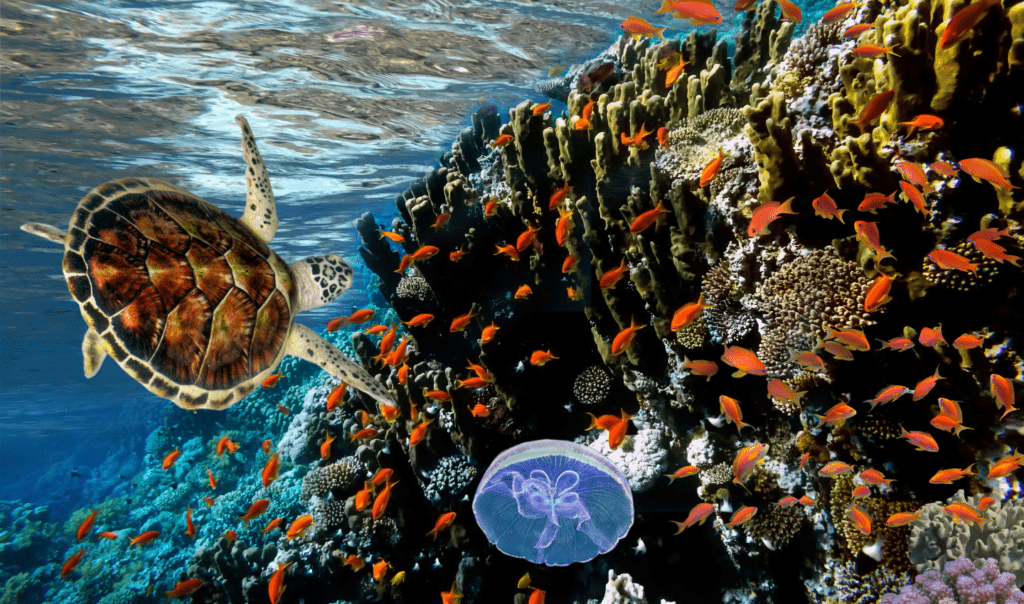
Coral reefs are one of the most important ecosystems on Earth.
What makes coral so brightly coloured? Why do they turn white when they’re unhealthy? We’ve got you covered. Below, we’re sharing 12+ fascinating facts about coral reefs: The most biologically diverse ecosystem on Earth.
Corals reefs are large skeletons (because theyโre made up of tiny animals a.k.a. โcoral polypsโ). They’re home to hundreds of plants and organisms, support fisheries and may host the answers needed to develop new cancer medication.
How many of these coral reef facts do you know?
1. Coral reefs occur in more than 100 countries and territories whilst covering only 0.2% of the seafloor. They reside in tropical and semi-tropical waters.
2. The single-celled algae, zooxanthellae, that live in the tissues of the coral polyps can fuel up to 90% of the reef-building coralโs energy requirements for growth and reproduction. Additionally, zooxanthellae are responsible for the vibrant colours of the corals!
3. In return, the corals provide them with a home to reside in and nutrients to aid photosynthesis. Thus, fulfilling a mutually beneficial (โsymbioticโ) relationship!
Coral reefs protect around $6 billion worth of built infrastructure from flooding around the world, from an economic perspective.
5. Large scale losses of coral reefs are due to a warming Ocean and climate change.
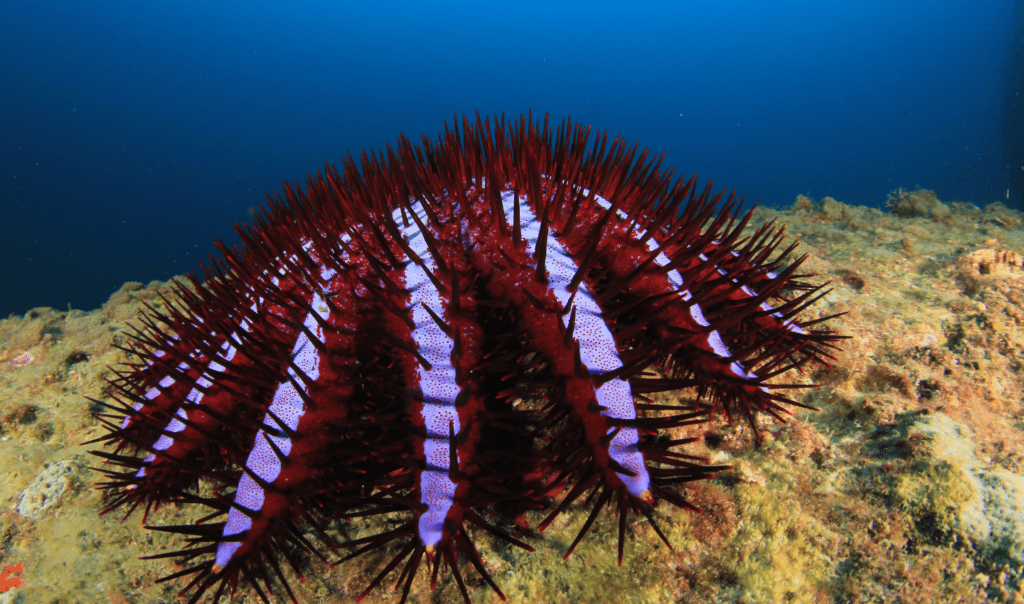
Land-based pollution of nutrients and sediments from agriculture, marine pollution, overfishing and destructive fishing practices, and outbreaks of coral diseases and crown-of-thorn starfish (see below image) are all causes of local coral losses.
6. Coral reefs support at least a quarter of all marine species. What’s more: Coral reefs are a home to an average of 830,000 species (550,000 โ 1,330,000). The range varies widely due to large populations of small cryptic species being difficult to sample.
7. Astonishingly, scientists estimate that roughly 74% of coral reef species remain undiscovered!
8. Ocean acidification is a major threat to coral reefs.
The decrease in pH (making water acidic) hinders corals and other organisms from forming their skeletons. This makes them especially vulnerable in juvenile stages.
The weakening of these skeletons also results in habitat loss, low reef biodiversity, coastline erosion etc.
9. Coral reefs subjected to higher temperature levels increase the likelihood of abrupt and irreversible changes. According to the IPCC, a record-shattering warming world of 1.5ยฐC would mean a 70-90% decline in coral reefs.
10. Coral reef associated fisheries provide 70% of protein in the diets of Pacific Islanders. These fisheries support around 6 million people and are worth $6.8 billion annually.
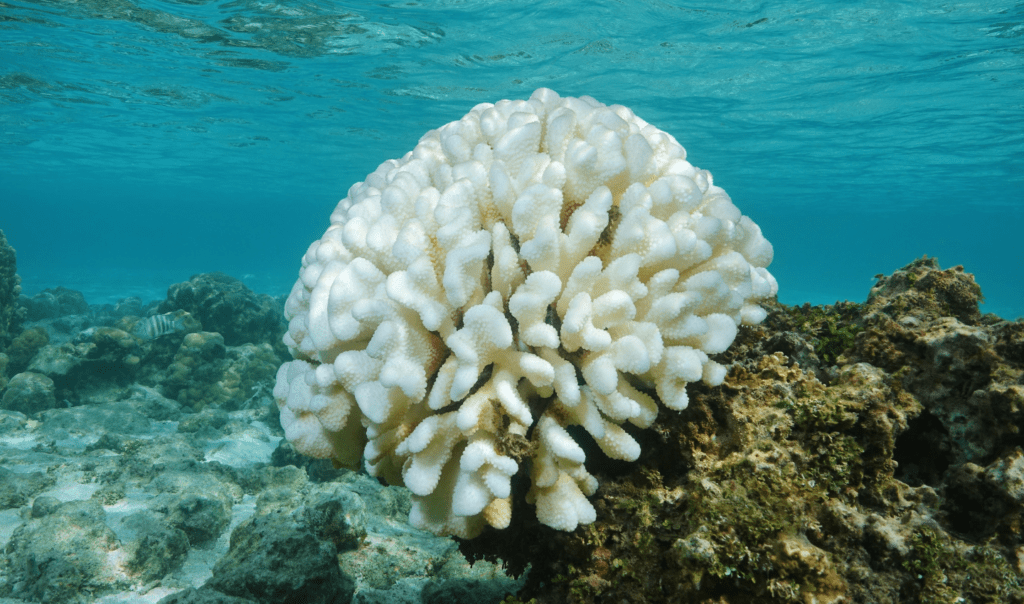
11. Corals can turn white due to coral bleaching. Climate change is a major driver of coral bleaching, and this process disrupts the symbiotic relationship with zooxanthellae.
As the algae is dispelled by the corals in an attempt to protect themselves, the corals vulnerability increases and they lose a major energy source. If the heat stress persists, corals are likely to die.
Over half of the our coral reefs are already lost.
12. Coral restoration is a relatively new nature-based solution. Nature-based solutions refers to an umbrella of methods for reviving ecosystems in the face of adversity.
A 2020 review stated that coral restoration projects report a survival rate between 60-70% with a report stating that 1.5C warming would render this solution to be ineffective.
The authors of the review noted that most projects are small-scale and that weโll still require large-scale climate action to tackle the root of this issue.
With over half of the worldโs coral reefs already lost, it is evident that coral reefs are declining due to a multitude of human pressures.
Some warm water corals have reached adaptation limits. Nevertheless, scientists and local communities are working extremely hard to continuously build on existing solutions and quickly adopt innovative approaches.
The existential threat of the rise in global temperatures means that climate change action is urgently needed to establish coral reef resilience.
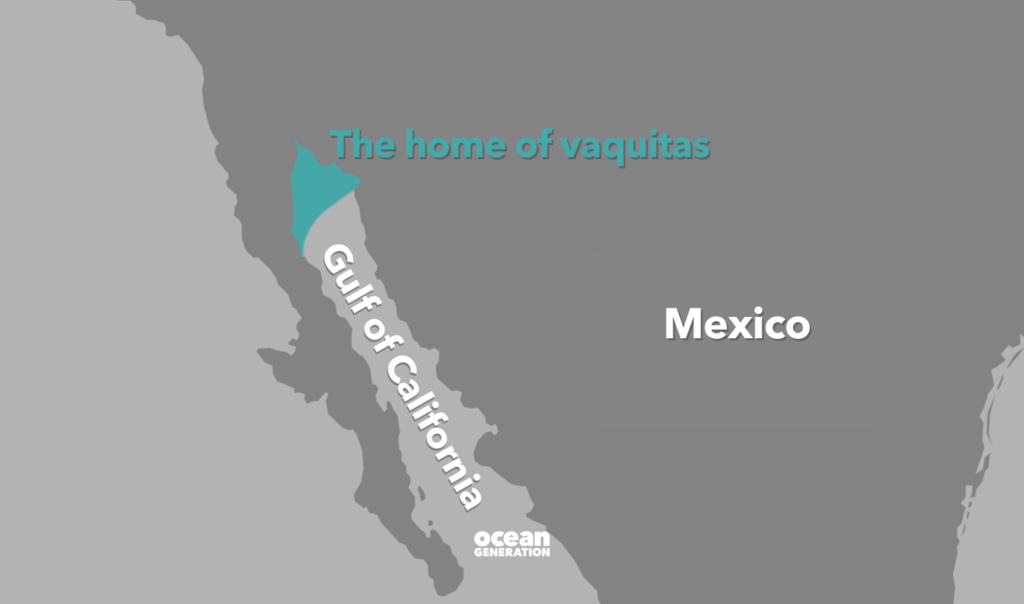
2. Vaquitas are endemic to the Gulf of California, Mexico.
Vaquitas display no migratory behaviour and have limited themselves to the Northern part of the Gulf of California, as depicted in the figure below.
3. How big do vaquitas get?
They grow up to 1.5m long (5 feet). Vaquitas live in relatively shallow waters (<50m) and have been observed individually, in pairs, and small groups of up to 8-10 individuals.
4. No one really knew what vaquitas looked like until the late 1980s.
Locals, along the Gulf of California, didn’t know much about vaquitas before they were described, based on their skulls in 1958, but anecdotal evidence from locals include references to โvaquitaโ(meaning little cow), โcochitoโ(meaning little pig) and โduendeโ(meaning ghost or spirit).
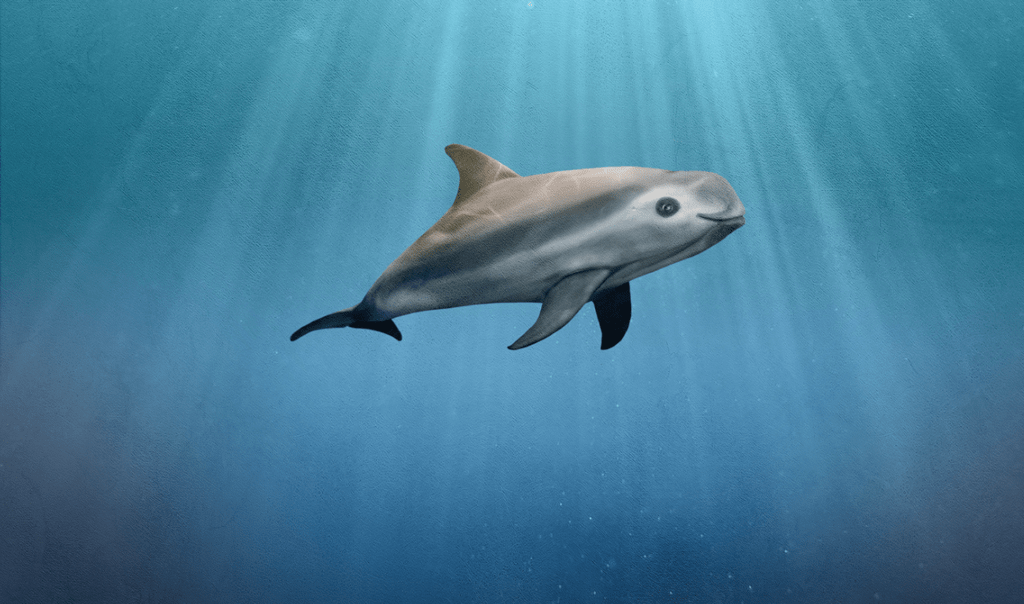
A dark ring around the eyes is the vaquitas most striking feature, along with a proportionally large dorsal fin. They’re unique among porpoises because they’re the only species of the porpoise family found in warm waters.
6. When did the vaquita become endangered?
In 1978, the IUCN red-listed the vaquita as โVulnerable.โ In 1990, vaquitas became โEndangeredโ and, in 1996, โCritically Endangered.โ
7. Why are vaquitas endangered?
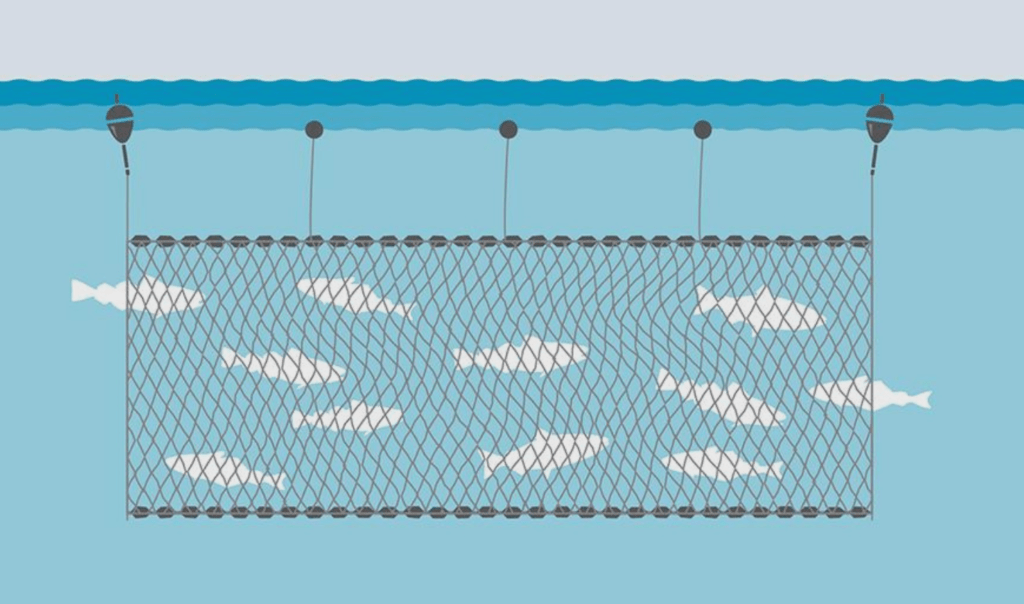
The main reason vaquitas are endangered is due to entanglement in gillnets with bycatch in legal and illegal fisheries for shrimp and finfish, and in the last decade, specifically for totoaba.
A gillnet is a wall or curtain of netting that hangs in the water. Image source.
8. How many vaquitas are left?
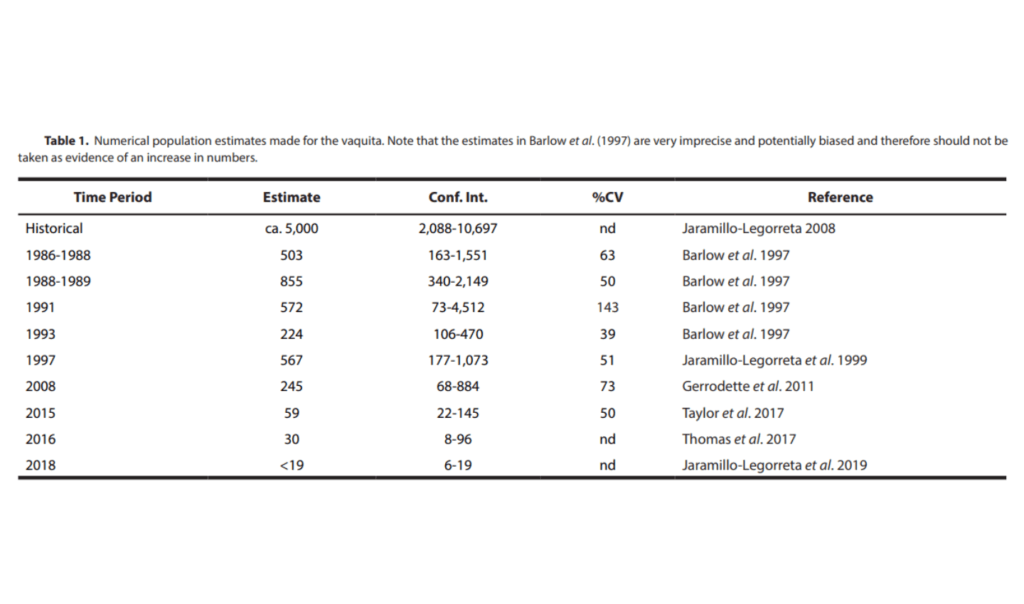
In 2007, there were an estimated 150 vaquitas in our Ocean but by 2018, that number had dropped to 19.
Gillnet fishing – has been banned – however, illegal fishing of totoaba (an endemic fish) continues. The totoaba is also critically endangered too so, the fate of the totoaba and vaquita are closely linked.
There is always hope.
Scientists suggested imminent vaquita extinction in the mid-2000โs but as of 2023, there are still between 6-19 vaquitas alive.
One study on genetics found that due to low population size and low genetic diversity, if gillnet fishing was 100% stopped, there is only a 6% chance of extinction of vaquitas.
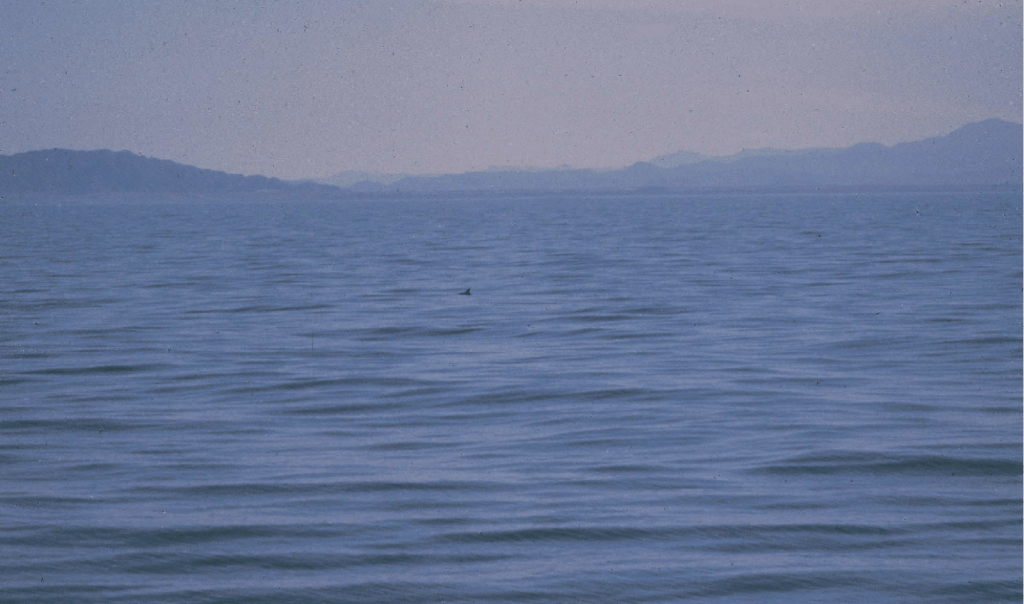
This is possibly the first photo published of a vaquita in nature, on a rather placid sea, taken on 10 March 1979. Photo by R.S. Wells.
10. The vaquita can give birth annually.
And multiple newborns were sighted in 2019.
A note from Ocean Generation: Your support may feel like a drop in the Ocean, but the Ocean would be less without that drop.
We’re known for translating complex Ocean science into engaging content and bringing the Ocean to young people across the world. As a charity, every donation is vital and will directly support our environmental youth programmes that drive social action to safeguard our Ocean.
7 Interesting travel facts, linked to the environmentย
Share this page
Copied
“How much do we need to reduce travel emissions to meet the targets set out in the Paris Agreement?”
Good question! Perhaps you’ve also wondered how much worse the private jets celebs catch are, compared to commercial planes, or how much more we drive than walk?
Here are 7 interesting travel facts linked to the environmental:
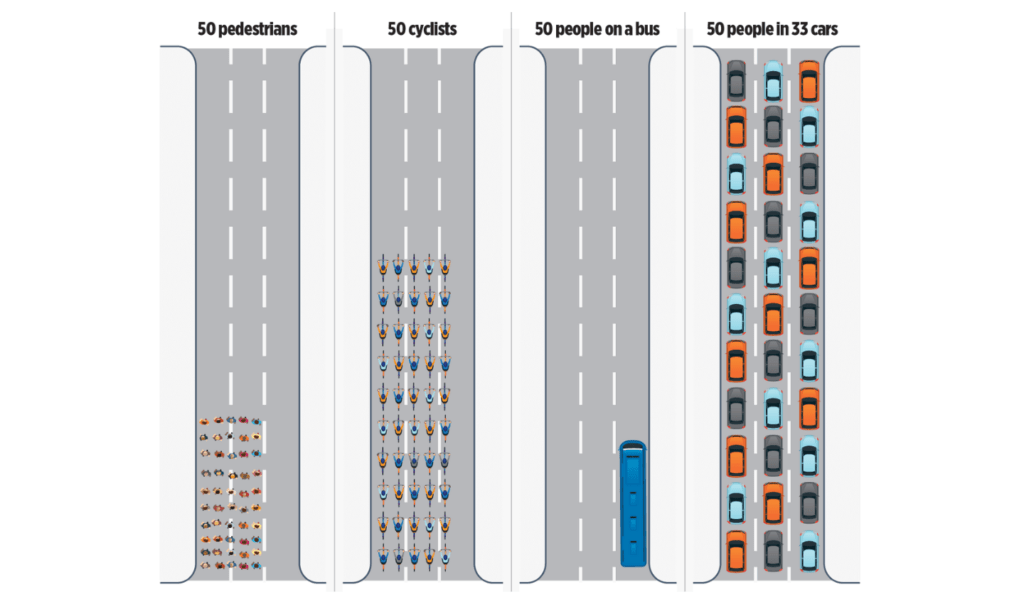
3. A double decker bus, a clever form of public transport, can replace up to 50 other motorised vehicles.
4. Making cities walkable, i.e., making it easy to travel around a neighbourhood on your own two feet, reduces greenhouse gas emissions by 4 tonnes a year when compared to automobile-dependent areas.
The avoided emissions are equivalent to 2-person round trip flying economy between Paris and New York. ย
6. In 2016 most passengers in the UK (72%) were flying for leisure. ย
7. Private jets are 5-14 times more polluting than commercial planes (per passenger) and about 50 times more polluting than trains.
The amount of space taken up on a road by 50 pedestrians vs. 50 cyclists vs. 50 people on a bus vs. 50 people in 33 cars. Source: Philadelphia Inquirer
Our planet doesnโt need a handful of perfect environmentalists. It needs millions of imperfect people doing what they can to make a difference, and always trying to do better. ย
We’ve become dependent on single-use plastic products.
And the reason why isn’t hard to find. Plastic is cheap, convenient and was made to last forever – but as plastic pollution has severe environmental and health consequences for our blue planet.
Understanding key facts about plastic pollution is the first step to rethinking our relationship with it, and ensuring a healthier, more sustainable future all life on Earth.
We’re breaking down 15 facts about plastic pollution – backed by science and our expertise as experts in Ocean health since 2009. Find out how plastic enters the environment, its impact on wildlife, what microplastics are, and how it effects our health below.
15 Plastic pollution factsย you need to know:
1. Up to 422 million tonnes of plastic are being produced each year.
The amount of plastic produced every year weighs more than all of humanity (estimated at 316 million tonnes in 2013).
2. Up to 12.7 million tonnes of plastic enter the Ocean every year.
If waste management practices don’t improve, scientists predict this amount could increase tenfold by 2025.
Single-use plastic items are the biggest contributors to marine litter (it is estimated that 1 – 5 trillion plastic bags are consumed worldwide each year).
3. Plastics make up to around 75% of marine litter, although this can be up to 100% at some sites.
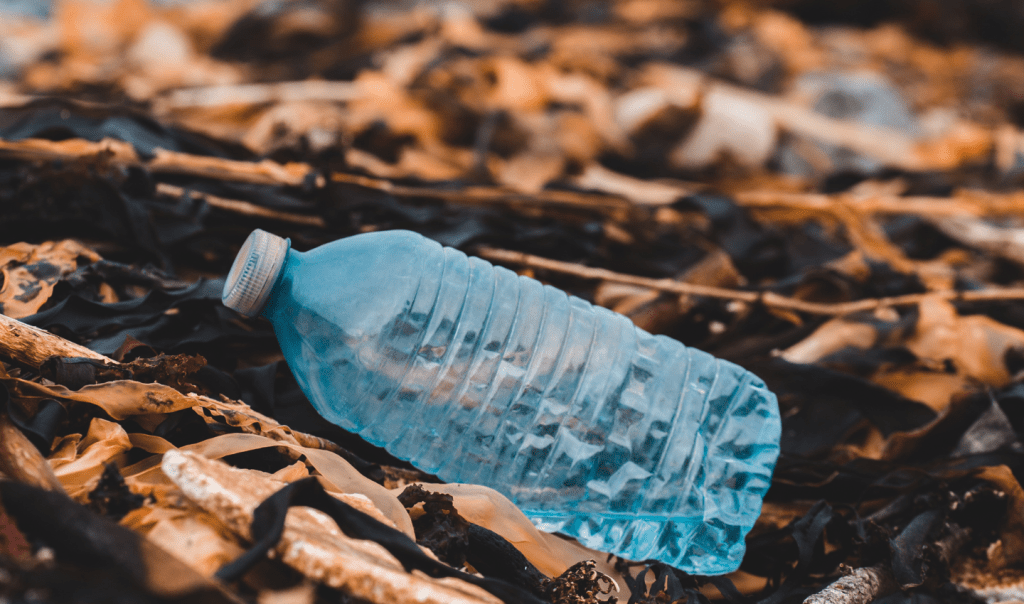
Plastic in the Ocean breaks up into smaller fragments called microplastics, which have been identified in commercial fish and thus, consumed by humans.
4. Plastic in the Ocean breaks up into smaller fragments called microplastics.
Plastic will never go away. These microplastics have been identified in commercial fish consumed by humans.
What are microplastics?
Microplastics are small plastic pieces measuring less than 5 millimetres.
While some microplastics are intentionally made small (like microbeads in facial scrubs and industrial abrasives used in sandbags), others have been formed by breaking away from larger plastic products.
Due to large amounts of plastic pollution, microplastics can now be found everywhere on Earth – from Mount Everest to the Mariana Trench; the deepest part of our Ocean.
Explained: What are microplastics, where do they come from and what can we do about them?
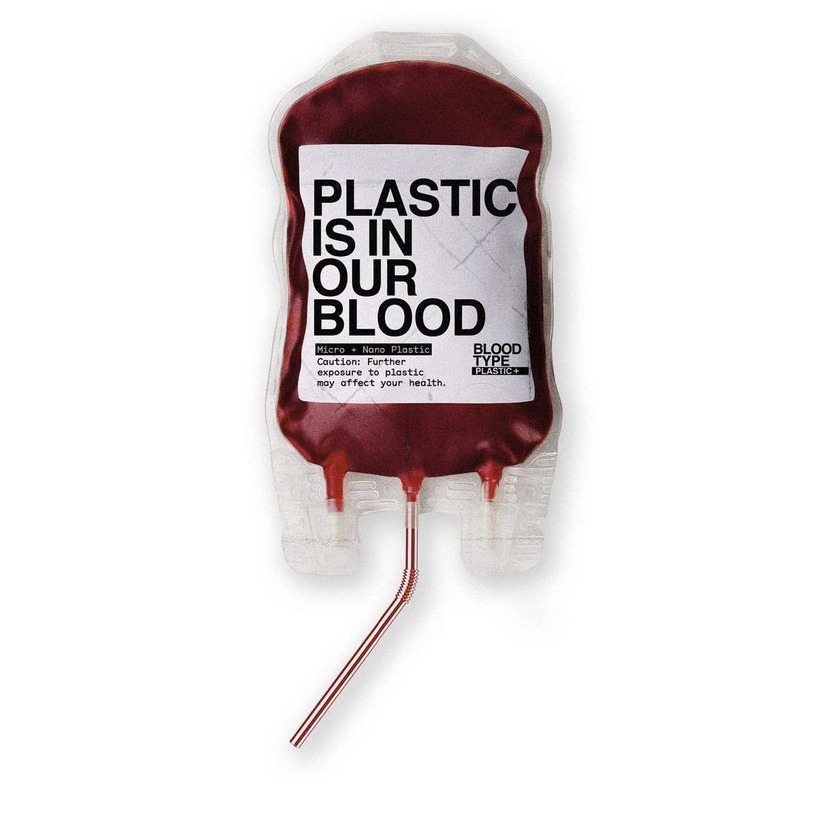
Read: For the first time, in March 2022, plastic was found in human blood.
5. Half of all plastics are single-use applications, meaning they’re used just once and disposed of.
We are all guilty of using single-use plastic items. From shampoo bottles to make-up products, plastic forks, and straws – single-use plastic is part of our daily lives.
Small behaviour changes can make a massive impact in reducing the flow of plastic pollution to the Ocean.
The next time you’re at the store, reaching for a single-use plastic item, stop and consider: Is there a more sustainable product I can use? If not, think of ways you can reuse your plastic items instead of discarding of them once you’re done.
6. Plastic was invented 150 years ago.
When we see the stat, ‘Plastic takes 450 years to decompose’ we reply, ‘How is that known?’ Plastic hasn’t been around long enough for us to confirm that.
Instead of breaking down, it’s more accurate to say plasticbreaksup.
Plastic is indestructible; it was designed to defy nature, and designed not to decompose. Plastic just gets smaller, making it harder to remove from the Ocean.
7. Birds are highly susceptible to plastic ingestion.
It is estimated that over 90% of all seabirds have ingested plastic.
8. There is no giant floating island of plastic at the centre of the Pacific or any other parts of the Ocean.
The so-called Great Pacific Garbage Patch is invisible from the surface.
Plankton nets, however, reveal the true nature of the plastic problem: An accumulation of microplastics that fill up each net in concentrations that increase towards the Ocean’s centre.
9. Plastic acts as a sink for chemicals in the environment, and transports them.
When plastic is mistakenly consumed by marine life, plastic chemicals are released and stored in the fatty tissue of the animal.
Those chemicals travel up the marine food chain, magnifying in concentration on their way up. Eventually, the plastic in fish reaches and gets consumed by people.
10. Chemicals are added to plastic during its production.
Chemicals are added to plastics to give the products certain properties. Some of the chemicals, known endocrine disruptors, have been linked to critical diseases including birth defects, cancer, autoimmune disease, infertility and cognitive and behavioural disorders.
So, plastic isn’t just polluting our Ocean – it’s polluting our bodies.
11. Crustaceans tested at the deepest point of our Ocean have ingested plastic.
Animals from the deepest places on our blue planet have been found with plastic in their stomachs, confirming fears that man-made fibres have contaminated the most remote places on Earth.
12. People living along rivers and coastlines are the most impacted by plastic pollution.
It’s been reported that China, Indonesia, the Philippines, Thailand, and Vietnam are the most impacted by plastic pollution.
13. Low-income communities face more health impacts near plastic production sites.
Communities with low incomes have greater exposure to toxins and plastic waste, and bear the brunt of the impacts of improper plastic disposal and incineration.
14. Annual plastic production has skyrocketed since the early 1950s, reaching 322 million tonnes in 2015.
These numbers do not include synthetic fibres used in clothing, rope and other products which accounted for 61 million tonnes in 2016.
The World Economic Forum (WEF) predicts a 3.5 – 3.8% growth in plastic production per year through 2050. As of 2019, we’re seeing proof of this – with production of single-use plastics increasing despite our growing awareness of their negative impacts.
15. Bioplastics are not not as green as they seem. Approach with caution.
Though companies often market bioplastics under the same umbrella as biodegradable products, they are not necessarily biodegradable.
Most bioplastics require very specific conditions to break down effectively. They also do not solve the litter or throwaway culture problem.
What is plastic – really?
To ensure a healthy future for our Ocean and planet we must decrease our plastic dependency.
To provide the best user-experience for our website, we use cookies. Consenting to these allows us to process data such as browsing behaviour on our site.
Functional
Always active
Technical storage or access strictly necessary for the legitimate purpose of enabling the use of a specific service on our site.
Preferences
The technical storage or access is necessary for the legitimate purpose of storing preferences that are not requested by the subscriber or user.
Statistics
Technical storage or access that is used exclusively for statistical purposes.The technical storage or access that is used exclusively for anonymous statistical purposes. Without a subpoena, voluntary compliance on the part of your Internet Service Provider, or additional records from a third party, information stored or retrieved for this purpose alone cannot usually be used to identify you.
Marketing
Technical storage or access is required to create user profiles to track the user on a website or across several websites for similar marketing purposes.