What is the UN High Seas Treaty and why does it matter?
Share this page
Copied
After two decades, the open Ocean or ‘high seas’ are on its way to being protected.
On 20th February 2023, the fifth session of the Intergovernmental Conference (IGC) on Conservation and Sustainable Use of Marine Biodiversity of Areas Beyond National Jurisdiction (BBNJ) resumed negotiations in attempt to agree on a treaty to protect the high seas.
The last negotiations were held in August 2022 and ended without agreement.
“Our Ocean has been under pressure for decades and we cannot ignore the Ocean emergency,” said António Guterres, UN Secretary-General in a statement, reiterating the need for a treaty that paves the way for a sustainable Ocean.
What are the “high seas”?
High seas refer to the vast majority of the Ocean that lies beyond national jurisdictions. This open water is not governed by any one country and covers 64% of the Ocean’s surface.
Global map showing the extent of exclusive economic zones (EEZ’s) and the high seas. [Extracted from Sumaila et al.]
What does the High Seas Treaty mean for our Ocean?
After an extra day of intense negotiations, IGC president, Rena Lee, Singapore, announced that the United Nations (UN) High Seas Treaty had been agreed.
This was a monumental milestone twenty years in the making.
[Credit: Photo by IISD/ENB | Mike Muzurakis]
“The ship has reached the shore!”
IGC President, Rena Lee, Singapore.
5 main takeaways from the High Seas Treaty:
Strengthening 30 x 30 –
This agreement seeks to protect 30% of the Ocean by 2030. This was an outcome from COP 15 (the global biodiversity conference held in Dec, 2022) that will be strengthened with the help of this treaty.
Marine Protected Areas (MPA’s) –
This treaty will provide the legal framework necessary to set up MPA’s as no such framework currently exists.
Conference of the Parties (COP) –
Establish a COP to ensure accountability on issues like biodiversity and governance.
Marine Genetic Resources (MGR’s) –
Highlighting the need for processes to share genetic resources like plants and animals for pharmaceuticals, food, cosmetics, etc.
Environmental Impact Assessments (EIA’s) –
Greater obligations to conduct EIA’s on activities relating to pollution or any potential effects on the marine environment that is unknown or not yet fully understood.
Ocean Generation’s Statement on the High Seas Treaty:
“We are delighted to hear that the UN High Seas Treaty has finally become a reality.
A healthy Ocean is vital for the survival of all living things, and this is the message we continue to deliver through our work at Ocean Generation. Protecting 30% by 2030 must, however, be seen as a minimum requirement.
We view this agreement as a starting point. The Ocean is our ally in the fight against climate change and we must stop underestimating its role in our survival. The sooner this treaty is ratified by all countries, the better chance we have of a safe and healthy future for the generations that will follow us.”
Jo Ruxton MBE Founder of Ocean Generation
We intend to update this article once the final text of the treaty has been published.
The Ocean stores a considerable amount of our carbon:
The Ocean is one of the largest natural carbon sinks on Earth, making it a crucial component of the carbon cycle. This means that the Ocean captures carbon dioxide from the atmosphere.
This carbon is stored in surface waters, eventually making its way into the deep Ocean.
But there are other ways in which carbon is stored…
The role of blue carbon
All along our coastlines, we have unique ecosystems that capture and lock carbon away, mostly in the soil, for sometimes thousands of years.
– coastal protection (acting as a buffer between the Ocean and land) – increased biodiversity – reducing Ocean acidification – soil stabilisation – improved water flow and water quality – storm and flooding surge prevention, and – increased resilience to cyclones
These ecosystems can be considered a nature-based solution in tackling the rise the carbon emissions.
But they are under threat. In fact, globally, between 20-50% of blue carbon ecosystems have already been converted or degraded.
Drivers of blue carbon loss and degradation
Our coastlines are often competed for – whether its daily Ocean activities or commercial purposes.
This invariably devalues existing blue carbon ecosystems. The main drivers of loss and degradation are:
The case for protection and restoration of blue carbon ecosystems
If degraded or lost, blue carbon ecosystems have the potential to release the carbon back into the atmosphere.
This is not the best scenario, given carbon dioxide levels in the atmosphere are already reaching levels not experienced in at least 2 million years (!).
Not only is protection and restoration good for the climate, but it also has the potential to create jobs and support economic growth.
Coastal ecosystems have the ability to mitigate around 0.5-2% of current global emissions. However, there is high uncertainty around its potential in the face of future climate scenarios, as well as loss of coastal land due to sea level rise.
Many restoration efforts have failed in the past, mainly due to not addressing the root causes of degradation.
It is now understood that successful restoration efforts require local communities’ involvement at every stage, economic incentives, and robust frameworks for implementing and assessing these ecosystems.
Most importantly, reducing human activities in these areas can aid the recovery of these precious ecosystems.
We need existing solutions to work together to reduce the adverse effects of the climate crisis.
We must protect what we have, restore what we have lost, and adapt to the circumstances we face.
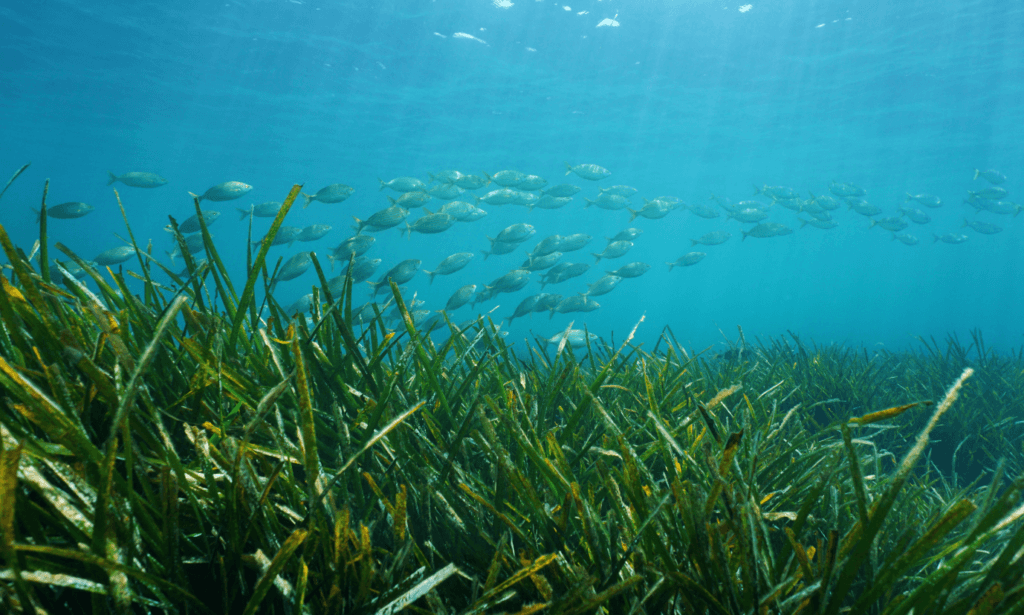
Seagrasses are among the most widespread coastal ecosystems worldwide and range from the tropics to boreal margins of the Ocean.
They are flowering plants that live in shallow waters that can sometimes be seen from space.
The name seagrass stems from the many species with long and narrow leaves, which grow by rhizome extension and often spread across large “meadows” resembling grassland; many species superficially resemble terrestrial grasses.
These deep-rooted meadows cover over 300,000km2, roughly the size of Italy, spanning 159 countries and six continents. They do not exist in Antarctica.
Sometimes referred to as ‘lungs of the sea’, seagrasses play a multi-functional role to both human well-being and marine life, while being a globally significant carbon sink.
Seagrasses are a climate change solution
According to UNEP, despite occupying just 0.1% of the Ocean floor, seagrasses store up to 18% of the global Oceanic carbon, which is estimated to be 38,000 billion metric tons.
What’s more:
– They can store twice the amount of carbon per hectare when compared to terrestrial forests.
– The carbon is stored almost entirely in the soils, measuring up to four metres deep.
– They can act as a buffer for Ocean acidification, depending on environmental conditions, which benefits calcifying organisms like corals and shellfish.
But that’s not all!
How seagrasses support marine life
Seagrasses are biologically rich and diverse habitats where species come together for many reasons.
Some organisms – primarily large grazers like manatees, dugongs, green sea turtles and geese – eat the living leaves directly, and seagrass forms a major component of their diets.
For example, an adult dugong eats about 64 to 88 pounds (28 to 40 kg) of seagrass a day, while an adult green sea turtle can eat about 4.5 pounds (2 kg) per day.
Apart from being a food source, seagrass meadows provide protection for burrowing anemones, bivalve molluscs and burrowing urchins that lie buried in the sand beneath.
They also act as crucial nursery grounds for species like the European eel. It is estimated that 17 species of coral reef fish spend their entire juvenile life stage solely on seagrass flats.
Four ways seagrass meadows benefit humans
There are numerous ways in which seagrasses benefit us outside of their climate change mitigation potential. Benefits include:
– Food Security – They support global fisheries, acting as nursery habitats for commonly consumed species like crustaceans and molluscs.
– Coastal Protection – Seagrasses have an extensive root system that stabilises the sea bed, similar to terrestrial grasses preventing soil erosion. In this way, they protect coastlines from flooding and storm surges.
– Tourism – Whether its swimming with green turtles (Akumal, Mexico) or diving with dugongs (Marsa Alam, Egypt), seagrass meadows are a great place to positively interact with the diverse marine life it hosts.
They are also important for historical heritage, from shipwrecks to submerged ancient cities.
– Disease Control – Seagrasses can control diseases by reducing bacterial pathogens from harming humans, fish, and invertebrates.
Why are seagrasses threatened?
According to one report, since 1990, there is a 7% decline in seagrass cover area globally per year, which is equivalent to a football field of seagrass every 30 minutes.
The main threats to seagrasses are:
– Climate Change (for example, heat stress through increases in temperature) – Pollution (urban, industrial, and agricultural run-off) – Coastal Infrastructure Development (incl. dredging) – Overfishing (incl. bottom trawling), and – Boating Activities
…but all hope is not lost!
The role of policy is a crucial top-down approach to restore and protect seagrasses at a broader scale.
With the widely accepted Global Biodiversity Framework, 30% of coastal and marine ecosystems need to be protected, including blue carbon ecosystems like seagrasses. Although, at present, mangroves and coral reefs are better protected under MPA’s than seagrasses.
The variety of ecosystem services that seagrasses provide has resulted in increasing knowledge of their value in recent years. However, there are still large knowledge gaps among the general public.
The best way to protect seagrasses is to understand them within local environments and manage threats effectively.
Restoration Spotlight: Seagrasses in the Eastern Shore of Virginia
The Virginia Institute of Marine Science and The Nature Conservancy have been conducting an extensive seagrass meadow restoration for almost 20 years, creating 3,612 hectares of new seagrass beds.
To achieve that, the team of researchers and volunteers had to actively plant more than 70 million seeds of eelgrass on a 200-hectare plot just off the southern end of Virginia’s Eastern Shore.
Within 10 years, the seagrasses covered an area that would naturally take over 100 years to grow. The scientists also noted increased water quality, nitrogen storage and carbon sequestration.
This initiative offers a glimpse into the benefits of resilient seagrass meadows and its importance in addressing climate change.
“Seagrasses can help us solve our biggest environmental challenges.
They purify water, they protect us from storms, they provide food to hundreds of millions of people, they support rich biodiversity, and they efficiently store carbon.
In light of everything seagrasses do for people and nature, protecting and restoring them is vital.”
Ronald Jumeau Permanent Representative to the United Nations and Ambassador for Climate Change Republic of Seychelles
What can I do to help protect seagrasses?
Be a considerate tourist –
Exploring tourist-friendly seagrass meadows can be a great way to develop an appreciation for these wonderful plants and all that they hold. But please don’t pluck them or hurt any marine species when visiting.
Become a citizen scientist –
Furthering scientific knowledge is not a one-person effort and so, public participation in citizen science projects are a fantastic way to contribute.
The SeagrassSpotter project has been created by Project Seagrass in association with Cardiff University and Swansea University. Using SeagrassSpotter, you can help locate seagrasses which will be used by scientists for research including the prediction of locations for restoration.
The fashion industry pushes the idea that more is better — more trends, more products, more shopping; but who benefits from this? Certainly not consumers who feel the pressure to constantly stay on trend, or the environment struggling to keep up with the growing landfills and increased plastic count in our Ocean.
So, how do we break free from this craze? We slow down.
A mindful approach to fashion
What is “slow fashion”?
Slow fashion is a mindful look at clothing from environmental factors to health implications and ethical working conditions for those that make the clothing. It is bringing fashion in harmony with our world.
Five simple ways to transition from fast fashion to a slow fashion wardrobe
When selecting new pieces of clothing, look for products made out of fibers such as cotton or linen .
Many times, brands will claim their items are natural, but in fact are mostly synthetic with only a small percentage of natural fibers.
The tag on the inside of the item is the place to go to confirm what the fabric is made of — think of it as the garment’s ingredient label. Choose pieces that are a majority natural — the closer to 100% the better!
In addition to fabric type, look for GOTS (Global Organic Textile Standard), OEKO–TEX®, and bluesign® certifications to be sure that the all-natural clothing is truly organic and not processed with toxic chemicals and dyes.
How to choose clothing created in ethical working environments:
Beyond fabric composition, there are certifications indicative of a sustainable brand.
Fairtrade certified brands follow criteria that create ethical working environments for farmers and garment workers, support eco-friendly practices and prioritise fair pay.
B Corporations adhere to levels of transparency, ensure ethical employee treatment and charitable giving, and demonstrate positive environmental impacts. Look for these when shopping to support brands that support their workers and the environment.
Building a sustainable wardrobe starts with investing in quality pieces for everyday wear based on your style, known as a capsule wardrobe.
Think of the 3–5 items that you wear most often and feel the best in. Then, invest in all-natural items that will complement the staples you already own.
The goal is to have a closet that can be paired countless ways without having to own a lot of clothing.
4. Buy less, wear more
This brings us to the mantra, buy less, wear more. When you need to shop for something new, ask yourself these questions:
Will this pair well with what I already own?
Will I wear this for more than just one occasion?
Sometimes an outfit is specific to an event, such as a party, graduation, or a wedding. But, if more often than not you are making the most of your wardrobe, then you are participating in this more mindful approach to fashion.
When you feel that an item no longer fits in your wardrobe but is still in good shape, donating to a shelter is a great option.
Many brands offer buy-back programs where you can send back your pre-loved item from their brand, and they will recycle it properly for you.
Try thrifting or renting wardrobe items
Thrifting and renting clothing have become popular options, thrifting for its lower cost point and unique finds, and renting for when you need an outfit for a specific occasion.
Do your friends also have clothes they are bored with? Hold a clothes swap where you each bring a few pieces and trade off.
There are endless ways to extend the lifetime of clothing and bring mindfulness into fashion – which all contribute to better caring for our Ocean and planet. Have fun with it!
Lydia Dupree is a biochemist and author of peer-reviewed articles in her field. She dives deep into the literature to explore the impact the fashion industry has on our health and environment, and shows how to easily implement sustainable fashion into our lives.
The Ocean is a vital life-support system to all life on Earth
Everything that we rely on in our day to day lives – from our water, food, and every second breath – leads back to the Ocean.
Somewhere along the way, we’ve become disconnected from our blue planet.
Why is our Ocean so important?
If we were in space and looked down at Earth, we would mostly see the colour blue.
Our Ocean covers over 70% of the planet, which is why we call it our Blue Planet. It produces over 50% of the oxygen we breathe; meaning that every second breathe we take comes from the Ocean.
Our Ocean helps regulate the temperature on land and is responsible for global weather patterns like storms and heatwaves (which we’ve been seeing more of in the recent years).
It absorbs the sun’s heat, transferring it to the atmosphere and distributing it around the world – warming in the winter and cooling in the summer. Our Ocean is a key driver of how our world functions and yet it’s usually low down on governments agendas.
How many of these Ocean facts do you know?
Containing roughly 97% of the world’s water, our Ocean supports all life on Earth.
It is home to thousands of plants and organisms. And yet, scientists estimate that 91% of species are still to be discovered. Should we stop looking for aliens on Mars and start looking for our own E.T in the Ocean?
From the oldest species in the entire world to the largest living animal in the world – the blue whale – the Ocean’s biodiversity is astonishing.
With only roughly 5% of the Ocean explored until now, we are only just beginning to scratch the surface of the mystical world that exists below the surface of our deep blue sea.
For all of our reliance on the Ocean, a majority of it is a vast, underwater realm that remains unmapped, unobserved, and unexplored. It’s time to unlock more of the Ocean’s secrets.
How the Ocean supports all life
Our Ocean provides us with food and facilitates pleasure, as well as livelihoods for millions, if not billions of people.
But it’s not just a commodity. The Ocean is restorative. It calms and connects us. The positive impact it can have on our wellbeing is incredible.
As humans, we depend on the Ocean for a huge part of the oxygen, water and food we need to survive.
Did you know that 17% of animal protein that is eaten around the world comes from the Ocean?
To this day, many people’s jobs rely on fishing and water-based transport. The Ocean is a crucial component of entire global economies.
5 ways the Ocean helps our wellbeing:
The movement of gentle Ocean waves and fish in an aquarium is known as Heraclitean Motion. These peaceful, repetitive movements are psychologically calming.
Studies have shown that people perceive nature as a positive, and spending time amongst it is known to improve mood.
Various studies have shown improved mental and physical health in those who spend time near the coast.
When swimming, breathing patterns affect the brain and increase positive hormones.
The sounds of waves support meditation techniques.
So, why are so many of us so disconnected from the Ocean?
Do you think of the Ocean as something you only see while on holiday? Or perhaps you live in a city or town, so you feel it’s too far away for you to feel connected to it?
You may be shocked to know, 1 out of every 2 people in the world live near coastal areas.
And because the Ocean provides every second breath, the Ocean has an impact on our lives no matter where we live. Our actions have an impact on the Ocean too.
Did you know that there is now new water made on Earth? The same water cycles around. This water cycle is a closed loop that has existed for billions of years.
We are deeply connected to this global water body, influencing our everyday lives in so many ways, like every single thing we eat, breathe and drink.
Without a healthy Ocean, we will not have a healthy future.
We all need to understand how important the Ocean is to our daily lives to be continually motivated to protect it.
Want to learn about the Ocean? Join the Ocean Generation.
To provide the best user-experience for our website, we use cookies. Consenting to these allows us to process data such as browsing behaviour on our site.
Functional
Always active
Technical storage or access strictly necessary for the legitimate purpose of enabling the use of a specific service on our site.
Preferences
The technical storage or access is necessary for the legitimate purpose of storing preferences that are not requested by the subscriber or user.
Statistics
Technical storage or access that is used exclusively for statistical purposes.The technical storage or access that is used exclusively for anonymous statistical purposes. Without a subpoena, voluntary compliance on the part of your Internet Service Provider, or additional records from a third party, information stored or retrieved for this purpose alone cannot usually be used to identify you.
Marketing
Technical storage or access is required to create user profiles to track the user on a website or across several websites for similar marketing purposes.