
- Science: Explained
The lonely whale: The story of the 52Hz whale
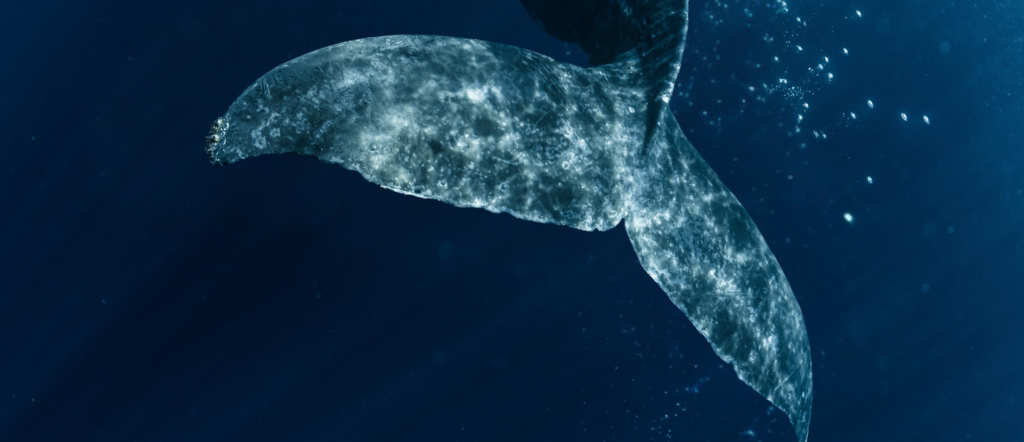
There is a unique whale song echoing through the Ocean, sung by the loneliest whale in the world. What kind of whale is it, and is he actually lonely?
The Ocean used to be thought of as noiseless. Legendary Ocean explorer Jacques Cousteau’s first book was named The Silent World. Swimming comes with ears full of water, muffling the familiar noises of the airy world above.
Only recently, and mostly by accident, have we begun to realise that the Ocean is far from silent. Noisy coral reefs call in larvae to settle, fish grunt and whistle at each other, and snapping shrimp fill the water with a white noise any focus app would be envious of.
The most famous of the Ocean songs is that of the whales.
How we discovered sounds in the Ocean
In the second half of the 20th century, the Ocean became the frontline of the Cold War. Submarines glided through the depths, carrying enormous destructive power but hidden from sight. In the Ocean, sound matters more than sight.
We began listening to the sounds of our Ocean, to keep track of those sneaky submarines, and discovered a new world we didn’t understand.
In March 1949, R/V Atlantis from Woods Hole Oceanographic Institution picked up some strange noises off the coast of Bermuda that couldn’t be identified. A haunting, eerie noise that could be mistaken for a wolf’s howl over the mountains. The noise was archived, unidentified.

1949 also saw bio acousticians William Schevill and Barbara Lawrence record beluga whales in Saguenay River, Canada. This was the first time that cetacean (whales and dolphin) noise had been identified.
William Schevill was later credited with diverting geopolitical catastrophe:
“Bill helped defuse a tense moment between the USA and Soviet Union during the Cold War. The US military suspected that low frequency blips were being used by the Soviets to locate American submarines, whereas Bill showed these were produced by fin whales (Balaenoptera physalus) hunting prey.”
He wasn’t the only one battling misunderstood Ocean sounds. You can read about how herring farts nearly ended the world here.
In a naval listening station from the late 1950s into the early 1960s, engineer Frank Watlington was listening out for the sounds of submarines in the Atlantic. He would regularly hear rich and emotive melodies echoing around the Bermudian waters. He recognised the sounds as biological and recorded them, hoping to one day identify the singers responsible. He didn’t have to wait long.
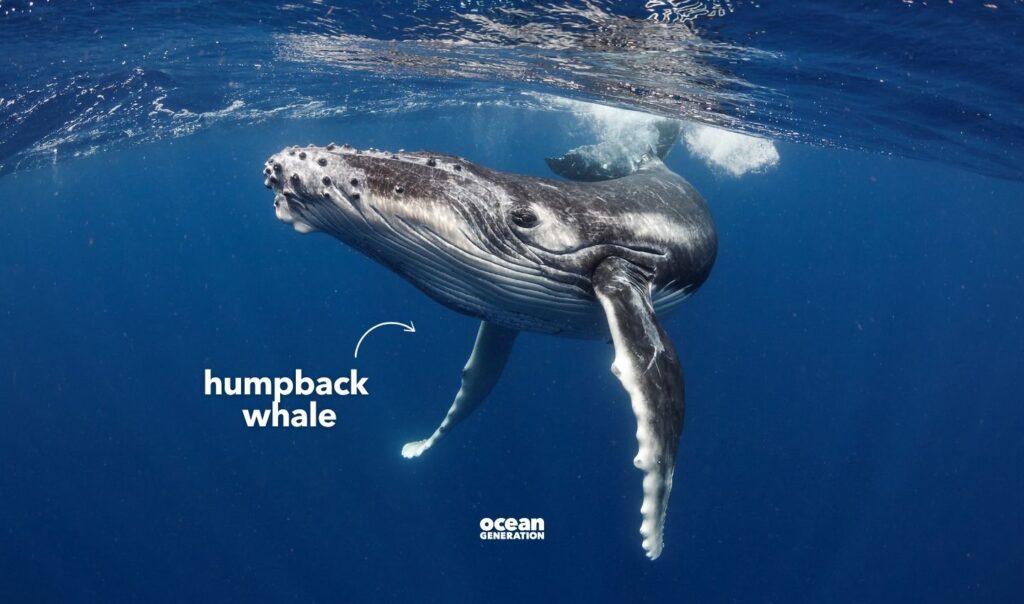
Who identified humpback whale song?
In the mid-1960s, a biologist who had focused on echolocation in bats and the hearing of owls turned his attention to Frank’s recordings. His name was Roger Payne, and he was the man who would take the songs of the sea to ears around the world.
Payne analysed the recordings and identified the singers: humpback whales. He published a scientific description of the songs Frank had recorded in 1971, revealing their complex structure and rhythm. But a peer-reviewed scientific paper wasn’t going to make big enough waves (pun intended).
In August 1970, before that paper had been published, Roger Payne released the Songs of the Humpback Whales, a vinyl record just under 35 minutes long of simple, unaltered whale song. The sound took the world by storm.
But even this record paled in comparison to a further honour, bestowed two years earlier in 1977. The Voyager spacecraft left the Earth’s atmosphere with a golden record – a phonograph filled with details about humanity and life on Earth, should the spacecraft ever reach distant life. Track 3 on the record was: “United Nations Greetings/Whale Songs (Various Artists)”.
The songs of the humpbacks were part of the exclusive package: the first man-made materials to leave the solar system, which it managed in 2012. Cetacean song was cemented as a defining element of our planet.
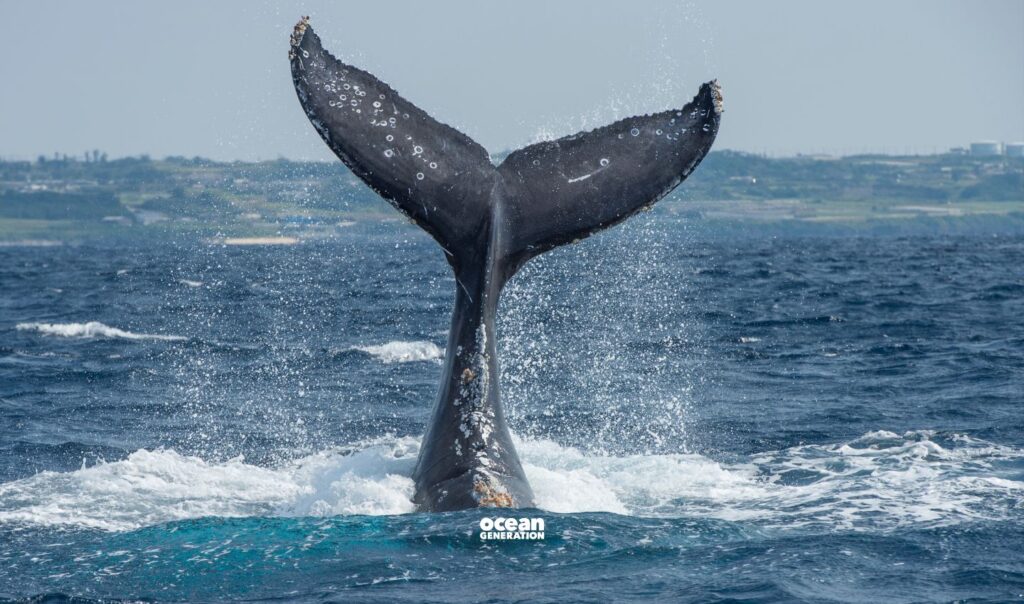
When was the 52 Hz whale first heard?
The wonder of the whale song increased as we listened and learned more – they evolve and spread culturally between and across populations.
Looking through a human lens, we can see similar cultural transmission. Gangnam Style had people trying to sing Korean around the world in 2012, and schools across the Western world are currently shouting “six-sevvvan”. Orcas? They have fashion cycles of wearing salmon as hats.
For humpbacks in the South Pacific, the song writers are off the eastern coast of Australia. Their songs can travel across the largest part of the Ocean to be sung by whales off the coast of Ecuador.
In 1989, a song was recorded that piqued the curiosity of biologist William (Bill) Watkins. The singer became known as the 52 Hertz whale, or as we will use, 52.
To understand why it stood out, we need to first explore sound.
What is sound? What can humans hear?
Sound has two basic properties: frequency and volume. Frequency translates as the pitch we hear – higher pitched sounds have higher frequencies. Frequency is measured in hertz (Hz).
Different animals have different ranges of hearing – some can hear higher frequencies, some lower. Humans are credited with a hearing range of 20Hz-20,000Hz, most sensitive from 2-5,000 Hz. Human speech is approximately 90-135Hz for an adult male and 160-240Hz for an adult female.
You can test your hearing range by listening to this video going through different frequencies – see how high you get.
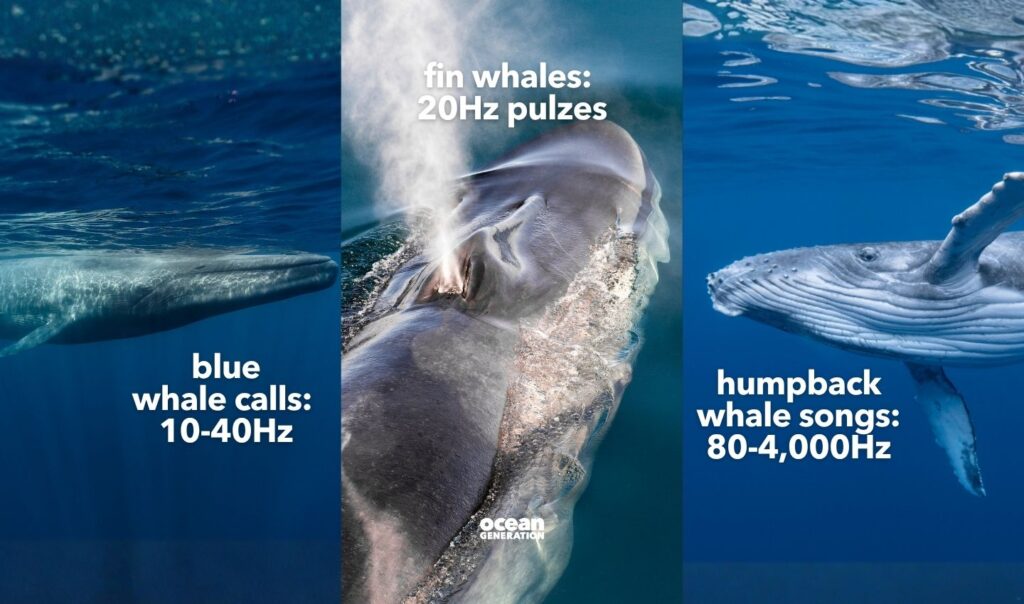
The humpback whales typically sing in the range of 80-4,000Hz, perfectly within our auditory range. Different animals use different frequencies to communicate: there is a whole world of noise that exists outside of our range of hearing.
Blue and fin whales produce songs of much lower frequency, slipping below our range of hearing (known as infrasound). Others, such as sperm whales and bottlenose dolphins, will use higher frequency clicks in echolocation that we can’t hear (known as ultrasound).
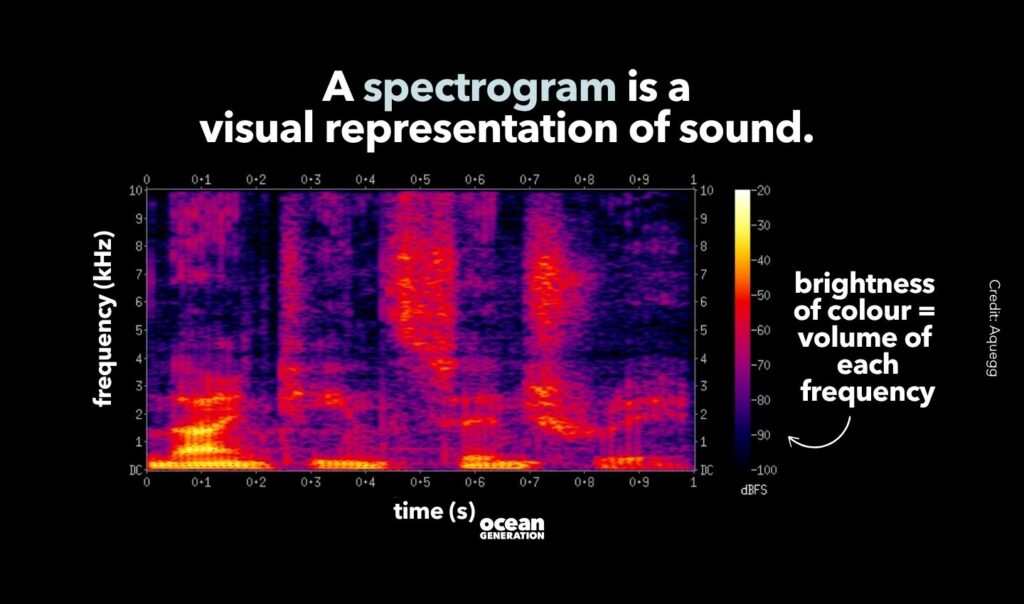
Why is the 52 hertz song so special?
The song we played earlier has been sped up by 10 times so we can properly appreciate it in our range of hearing. It would ordinarily be at the very bottom end of our hearing.
Blue whales will typically call between 10 and 40 Hz, soulful moans that would vibrate your entire body. Fin whale vocalisation is focused around 20Hz pulses, low chirps echoing through the blue.
So when the hydrophones picked up a call focused around 51.75Hz, it didn’t fit. Too high for blue and fin whales, but too low to be a humpback. This whale was singing its own tune.
Audio courtesy of NOAA PMEL.
For 12 years, Bill Watkins tracked the whale he had dubbed the 52Hz whale, or 52.
What do we know about the 52 Hertz whale?
He published his findings in 2004, tracking the source of the unique song. He made some intriguing discoveries:
- Daily travel distance: 52 was a mover. Across the 12 years of seasonal tracking, the whale averaged 47 kilometres every day, and up to 69 km per day.
- Seasonal travel distance: A real mover. In the 1992/93 season, 52 travelled just 708km. But across all the tracked seasons, the average distance travelled was 5,518km. In 2002/03, 52 travelled 11,602km. If you ran a marathon every day, it would take you 275 days to cover that distance.
- Time spent with other whales: 52, whether intentionally or not, is a solo rider most of the time. The calls were separate from other closely monitored whale species – blue, fin and humpback.
- Time spent in one place: 52 is a true nomad. In Bill’s words: “There were no apparent repeated patterns to the whale’s travel”.
- Deepening singing: As is normal with whales (and humans) the distinctive voice of 52 deepened by about 2Hz over the study period.
- Daily singing time: On some days, 52 sang for over 20 hours.
The Symbol: The story of 52 captured the imagination far beyond the scientific community.
The paper caught the eye of a young science journalist, Jon Copley, who covered it in the New Scientist magazine, with the title “Lonely whale’s song remains a mystery”.
A New York Times article by Andrew Revkin built on this theme, painting the picture of a whale roaming the Ocean, calling out in a voice none could recognise, its song going unanswered.
To add melancholia of the whale’s song, Bill Watkins, the great listener and tracker of 52, died in 2004, a month before his paper was published. He would never see the impact his work had.
And it certainly had impact. The idea of a lonely, misunderstood whale resonated (sound joke) with the wider public.
A quick search of lonely whale will uncover endless articles, Facebook groups, TikToks, Reels, and videos exploring the legend of 52 (not all accurately). So, what do we know about this whale?
The Symphony: Is the 52 Hertz whale actually lonely?
Is 52 Hertz lonely? The short answer: we don’t know, but probably not.
The tracking study from Bill Watkins suggests 52 didn’t tend to hang out with other whales, preferring to meander and migrate on their own. But we don’t know how unusual that behaviour is. 52’s unique calls have allowed one of, if not the most detailed long-term tracking studies of any single great whale. It might not be unusual for a whale to spend a lot of time alone.
To clear things up – the other whales can still hear 52. They might just sound a bit strange, like a human talking after inhaling some helium at a birthday party.
One of the lead theories behind the 52 hertz whale is a hybrid between a fin and blue whale. These hybrids have been documented, and fin and blue whales are known to aggregate together on the west coast of North America.
The documentary The Loneliest Whale: Search For 52 set out to find the maverick cetacean singer. The team didn’t prove that 52 was a hybrid but did document a hybrid whale in amongst other blue and fin whales.
This hybrid was documented 20 times over a 16-year period, and at times with over 30 blue whales. IF this is our whale, they have plenty of friends.
Another twist – in 2010, two separate listening stations picked up calls in the 52 hertz range. Could there be another whale hitting the same notes out there? We don’t yet know for sure, but we like to think so.
What’s next for the whales?
52 is certainly not alone in his sound-based struggles. The Ocean is a much noisier place than it used to be. Ships criss-cross the Ocean carrying food and goods between countries, and they are not subtle. Huge air guns fire, sounding out the seabed to find reserves of oil and gas. Piledrivers pound foundations for offshore constructions such as wind turbines.
The noise they produce creates an acoustic fog, making it harder for whales to communicate. One study estimated that North Atlantic Right Whales have lost over 60% of their communication space. Another shows that they have to ‘shout’ over the noise of propellers churning the whale’s waters. In the aftermath of 9/11, there was a significant drop in ship traffic and thus the noise they produce. Researchers examined whale poo and found less stress-related hormones in the excrement during this time: less noise = less stress.
Our noisiness is making all whales a bit lonelier (and a bit more stressed).
Fortunately, noise is one of the easiest pollutants to fix. Engines and propellers are getting quieter, and shipping slowdown areas where there are whales have reduced the acoustic intensity by 70%. We could see an Ocean far less impacted by our noise in the near future.

How has whale song connected us to the Ocean?
The discovery of whale song connected us to these Ocean giants like never before. The Songs of the Humpback Whale helped launch the Save the Whales campaign, ending industrial whaling.
52 has prompted songs, such as 52 Whalien by K-pop band BTS, tattoos, sculptures and stories. Wherever the story goes, there is an outpouring of sympathy and empathy. So many have found empathy, understanding and connection with 52.
The more we have listened to our Ocean, the more we have discovered, and the deeper our connection has grown. 52 has been a focal point for the misunderstood and unheard. But, as his popularity has shown, we aren’t as lonely or misunderstood as we may believe – and maybe 52 isn’t either.
Quick questions.
What kind of whale is 52 Hertz?
We don’t know for sure. Scientists have suggested a hybrid of a blue and fin whale, or one of those species with a slightly different morphology.
Where does the 52 Hertz whale live?
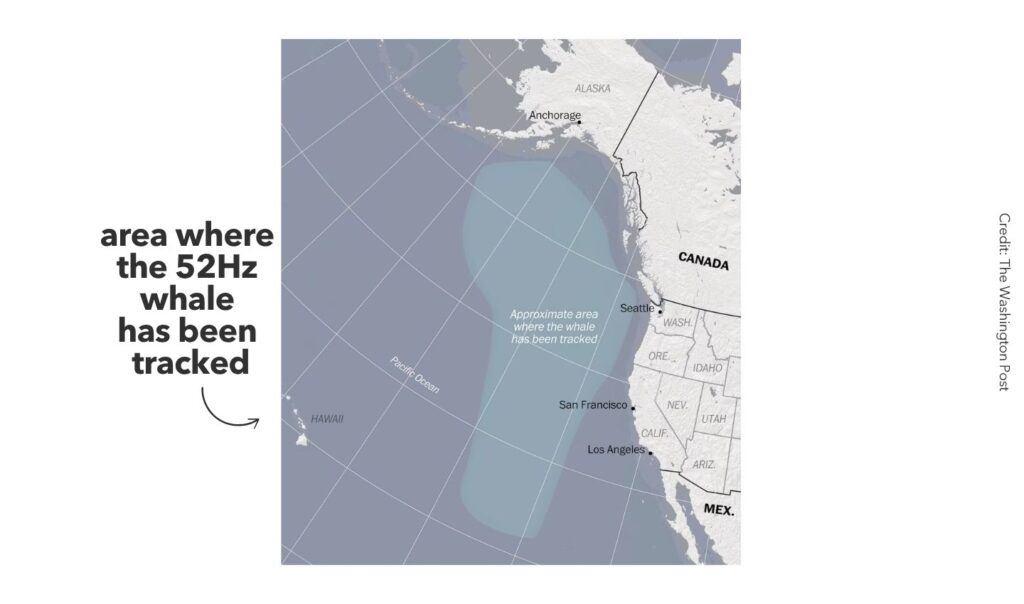
The calls of the 52 Hertz whale have been recorded off the west coast of North America, from Alaska to California and further south to Mexico.
Is the 52 Hertz whale alive?
Most likely. We first heard these calls in the 1980s, and whales live a long time. Blue and fin whales can both live over 100 years, and we likely don’t know just how long they can live because industrial whaling lowered the life expectancy of whales considerably.
Is the 52 Hertz whale lonely?
We don’t think so, although loneliness can be difficult to spot. Check in on your friends.