
- Science: Explained
How did fish farts nearly end the world?
Fish don’t even fart. Let’s talk about the time that not knowing about the Ocean, or herring (a fish), nearly kicked off World War 3.
The Cold War was dotted with moments that brought humans closer to annihilation than ever before. Checkpoint Charlie, the Cuban Missile Crisis and various satellite proxy conflicts all presented opportunities for humanity to self-destruct.
1981 was witness to one of the best named incidents – the Whiskey on the rocks incident.
What happened during the Whiskey on the rocks incident?
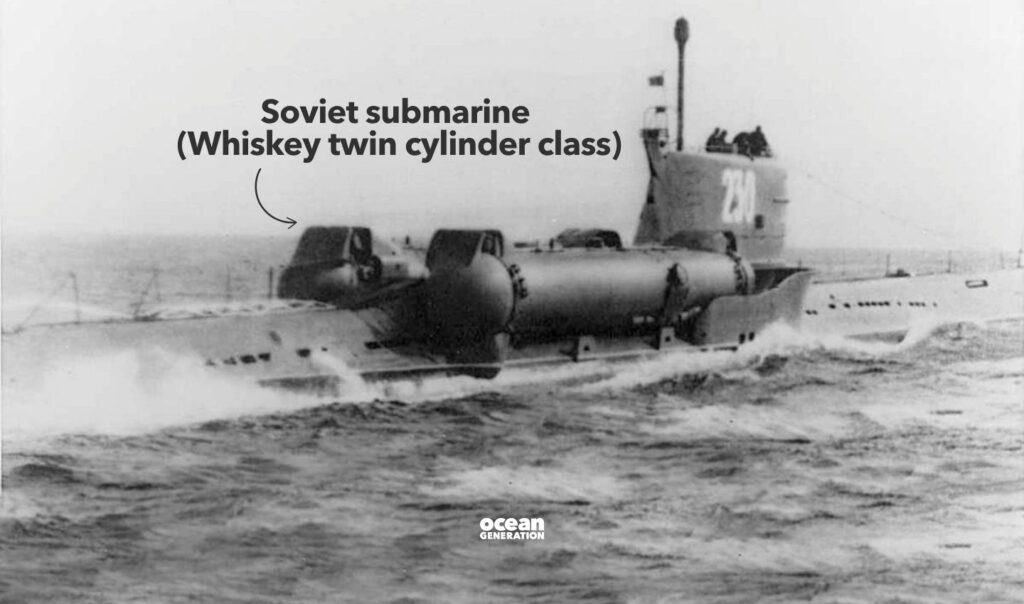
On 27 October 1981, S-363 – a Whiskey-class submarine from the Soviet Union – ran aground in Swedish waters.
The defence presented by the Russians emerging bashfully from the beached boat was navigation failure. One that had mysteriously taken them through the complex topography (seabed features) and within ten kilometres of one of the most important naval bases in Sweden.
The Swede’s were (understandably) sceptical. Later, the Soviet story changed, claiming the vessel entered Swedish waters due to being in distress.
Increasing the tension, Swedish radiation detectives concluded a high likelihood of the submarine carrying nuclear weaponry – a challenge the Soviets did not deny.
Whether or not they intended to be there, with whatever weaponry, the incident showed Sweden and the world that Soviet submarines were active within Swedish waters. Where there was one, there could be more.
Listening for danger
As a result, the Swedish Navy were on high alert, listening and watching for more intruders. Intruders they kept finding.
Finding submarines isn’t an easy business, especially in the often-murky waters around Sweden. When you can’t rely on your eyes, use your ears. Sound travels four to five times faster (and further) in water than it does through air, due to the increased density of water.
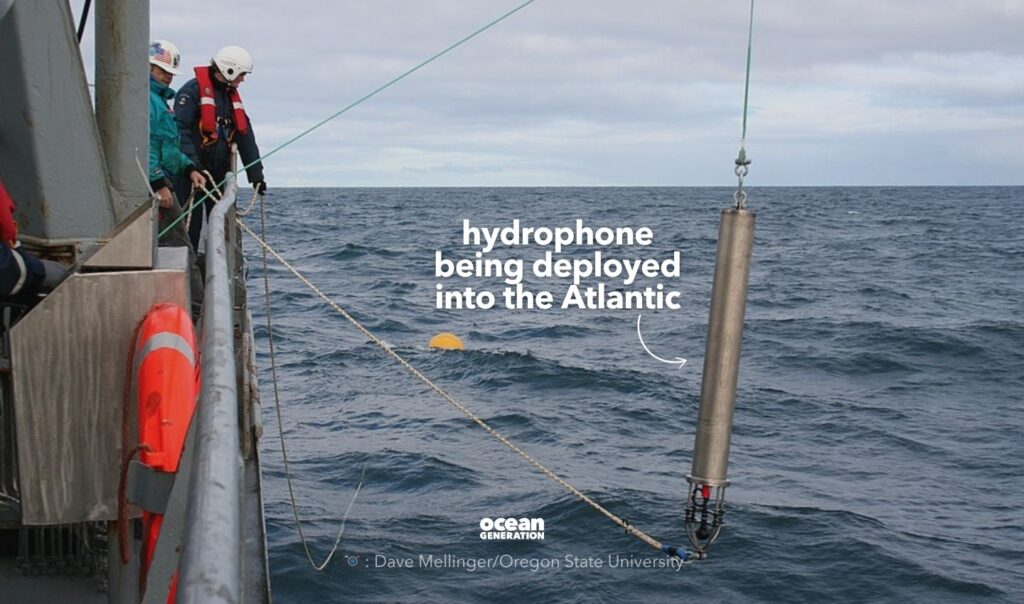
Submarine warfare led to the development of underwater listening technology, using underwater microphones: hydrophones.
A hydrophone is a microphone specially designed to listen to and record sound waves underwater.
Over the next decade, there were several high-profile submarine hunts, as hydrophones picked up the sounds of a submarine, which were chased, cornered and showered with depth charges (bombs set to explode at certain depths).
But no hits were recorded, and no traces of the underwater invaders were found. The Russians maintained: there were no submarines.
The fall of the Soviet Union in 1991 saw a global de-escalation in tensions. The Swedes expected a let up in their little hide and seek game.
Yet the Swedish navy continued to chase Russian submarines they could hear in their waters.
By 1994, the Swedish prime minister had enough and sent the President of Russia, Boris Yeltsin, a complaint, asking him to reign in his navy. Yeltsin maintained that there were no Russian submarines entering Swedish waters.
The Swedes began to question – what if the Russians were telling the truth?
How were the Swedes detecting submarines the Russians swore weren’t there?
The listening stations in Sweden had two sounds that signalled the presence of a Soviet submarine:
- kavitationsljud or “cavitation noise”, produced by a propeller ripping up the water, making air bubbles that pop as they collapse;
- typljudet, or “typical sound”. The typical sound was a crackling sound, likened to that of frying bacon, thought to be produced mechanically.
If either of those noises were heard, it was labelled a sure-fire incursion. The producer of the noises, however, was no nuclear submarine.
The Discovery: Fish farts that nearly caused WW3
In July 1994, another Russian sub was detected by a sonobuoy – specifically, the cavitation noise was heard.
A sonobuoy is a small floating device that has a radio transmitter above water and a hydrophone array below, able to listen and transmit what it hears.

This time, another vessel was in the area to investigate immediately.
What did they find? A small, otter-like animal called a mink was observed swimming near the sonobuoy. The cavitation noise had not been the four-bladed propellers of Russian submarines, but the four legs of exploring mustelids swimming between isles of the Swedish archipelago.

Following this, in 1996, the military invited some bio acousticians (experts that listen to nature) to analyse the typical sound.
Magnus Wahlberg and Håkan Westerberg were the academics brought in, the first civilian ears to hear the sound that had haunted the Swedish Navy for fifteen years.
The noise coupled with reports of bubbles seen at the surface when the typical sound was heard gave the scientists an idea. To test it, they went to the local fishmonger.
They bought a herring, a small, schooling fish. The herring was immersed in a bowl of water alongside a hydrophone and squeezed.
From the rear end of Sweden’s national fish came nothing other than the typical sound.
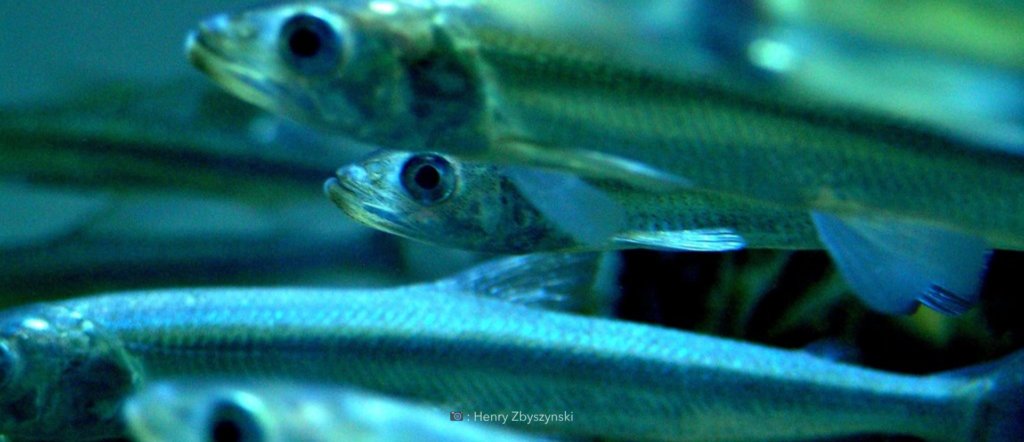
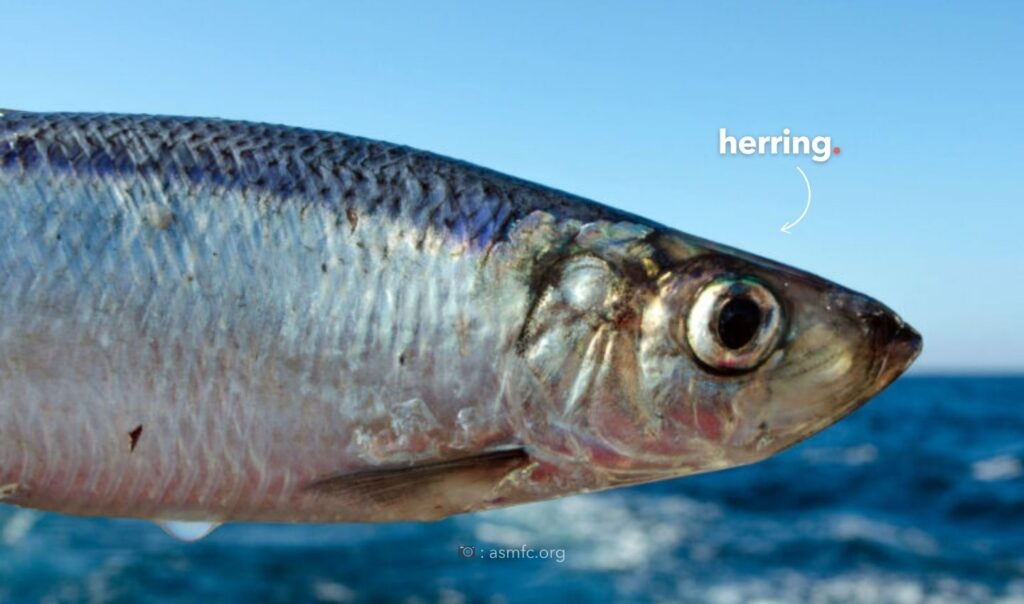
The Swedish Navy had been depth charging some chattering fish: Clupea (see below).
What are herring?
Herring (Clupea harengus) are among the most abundant fish in the world. Their name may be sourced from the Old German heri meaning “host, multitude”, reflecting their habit of gathering in vast shoals.
Herring reach up to 45cm long and can live for up to 25 years. They typically stick to coastal waters up to 200m deep. The fifth most-caught fish by weight globally, herring have been an important source of food for humans for a long time.
Interestingly, herring have a very good sense of hearing. Initial theories were that this could help them avoid cetacean predators such as orca and dolphin who use echolocation to hunt.
How do herring make noises like a submarine?
In 2004, researchers set out to find out more about the herring and the noise from their rear end. They captured some wild Pacific and Atlantic herring and recorded them using hydrophones.
The scientists recorded and categorised the typical sound: bursts of 7-65 pulses lasting between 0.6 and 7.6 seconds, with frequencies ranging from 1.7Hz to 22kHZ. This herring harmony was named: Fast Repetitive Ticks, or FRTs for short. Who says scientists have no sense of humour?
To investigate the reasons for the noise, they ran several scenarios. Some fish were being fed and some deprived food. There was no change to the number of FRTs between the groups.

So: these noises are not “farts” at all.
Listen to the noisy herring here.
Researchers then blacked some of the fish from access to the surface, to see if the FRTs were from gulped air being pushed through.
On the first night, there was no significant change, however when the trials progressed for a second and third night, FRT production dropped significantly. It seemed the herring did need air access eventually to ‘recharge’ their FRT tanks.
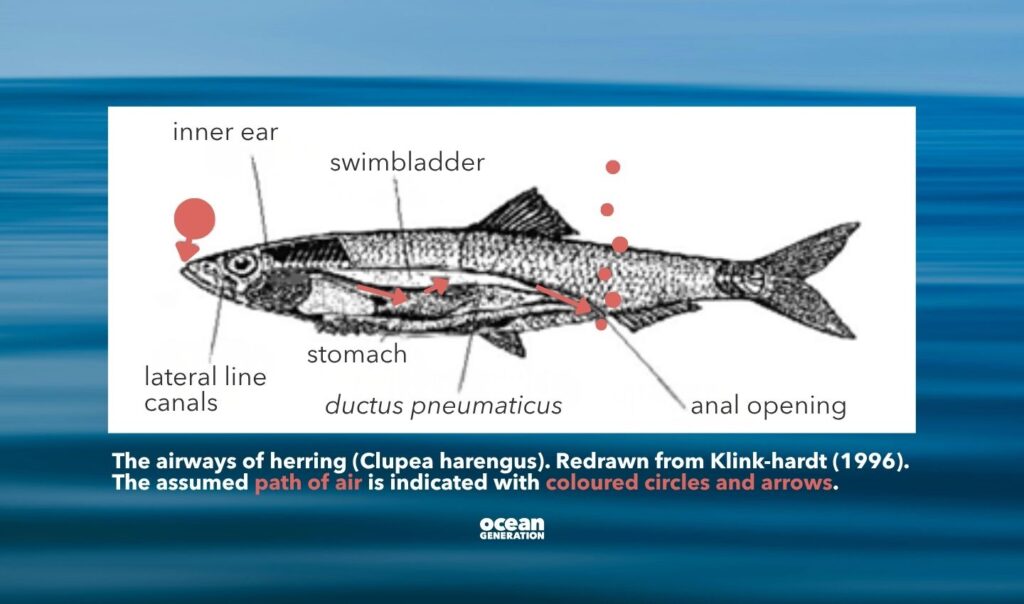
The tanks themselves were surprising. The researchers concluded that the FRTs were produced through expelling air from their swim bladder out of their anus: “a form of sound production not… previously described in fishes.”
Why do herring ‘fart’?
Not a by-product of digestion, so why would some small fish squeeze air out of their swim bladder?
Buoyancy regulation was suggested, as the swim bladder is predominantly used to adjust how ‘floaty’ a fish is – more air will mean it floats closer to the surface. However, fish kept in shallow tanks had no need to alter their buoyancy yet were merrily FRT-ing. It wasn’t buoyancy either.
Herring have long been known for their exceptional hearing. Maybe, then, they produced this noise for each other’s benefit? The fish were not in breeding condition, so they knew it wasn’t a mating function. Researchers separated them into tanks with different numbers, from 1 to 30. The number of FRTs each fish produced increased when they were around more herring, implying that there was a social function.
They dug even deeper. They found FRTs were mostly produced at night (specifically between 23:00 and 00:00). Was it a stress signal? The herring produced no FRTs during tank maintenance, but to make sure they took it a step further.
The researchers took water from another tank, one that contained a “high density” of spiny dogfish (Squalus acanthias) and added it to the herring tanks, filling them with sharky smell. It did not draw even a startled squeak.
Off this evidence, the researchers suggested that FRTs are not a stress or mating response, but purely for social contact – particularly maintaining cohesion in darkness.
In many ways we are lucky that it was the Swedes combating these ephemeral Russian submarines. This peaceable country hasn’t fought a war since 1814 and has never had nuclear weapons (although had a programme exploring the possibility until 1968). A more hot-headed geopolitical player could have taken things more personally and escalated beyond a strongly worded letter. Fish “farts” really could have ended the world, and we never would have worked out they aren’t even farts.
Thankfully, Sweden put curiosity first and went from a stranded submarine to bubbling butts to a deeper understanding of communication and social structure in the humble herring. Who knows what more listening in the Ocean could reveal?
Cover image by Henry Zbyszynski