
- Science: Explained
The oldest things in the Ocean: Explained.
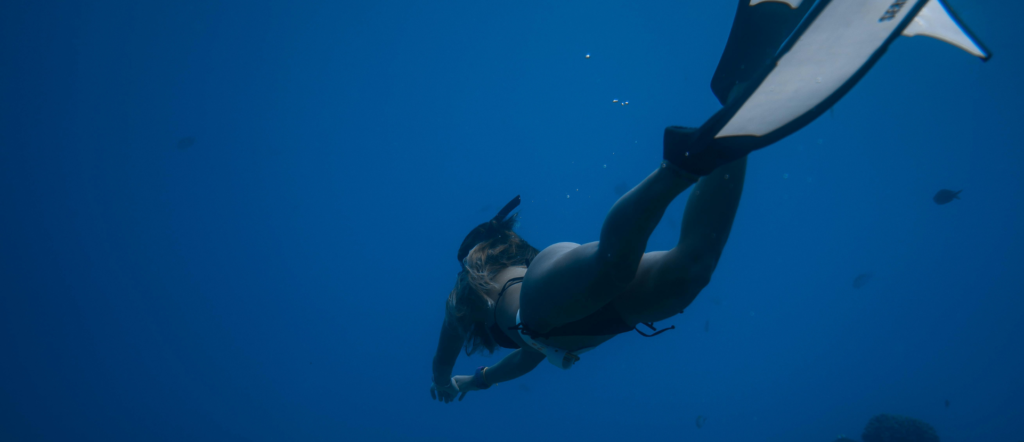
What do we mean when we say the “age of the Ocean”?
It could mean many things, from the oldest living thing in the Ocean to the time at which the Ocean first formed. Since there is no official definition, we can have some fun with stretching the definition of “age of the Ocean” by looking at some of the oldest things in the Ocean.
What are the very young things in the Ocean?
First, we stop off what I will call the “very young” section. These are on timespans of one to just above one thousand years. While these things are by no means short on a human timescale, they definitely are relative to the oldest things on this timeline. Most of this section is made up of animals, though not all.
We can interpret the “age of the Ocean” as meaning the oldest living thing in the Ocean.
What’s the oldest vertebrate in the Ocean?
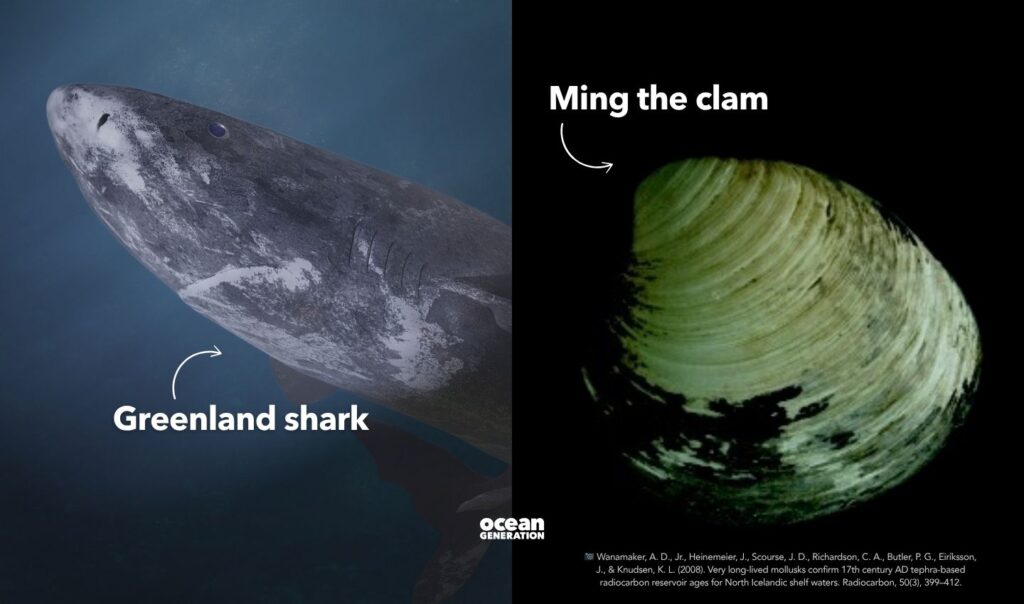
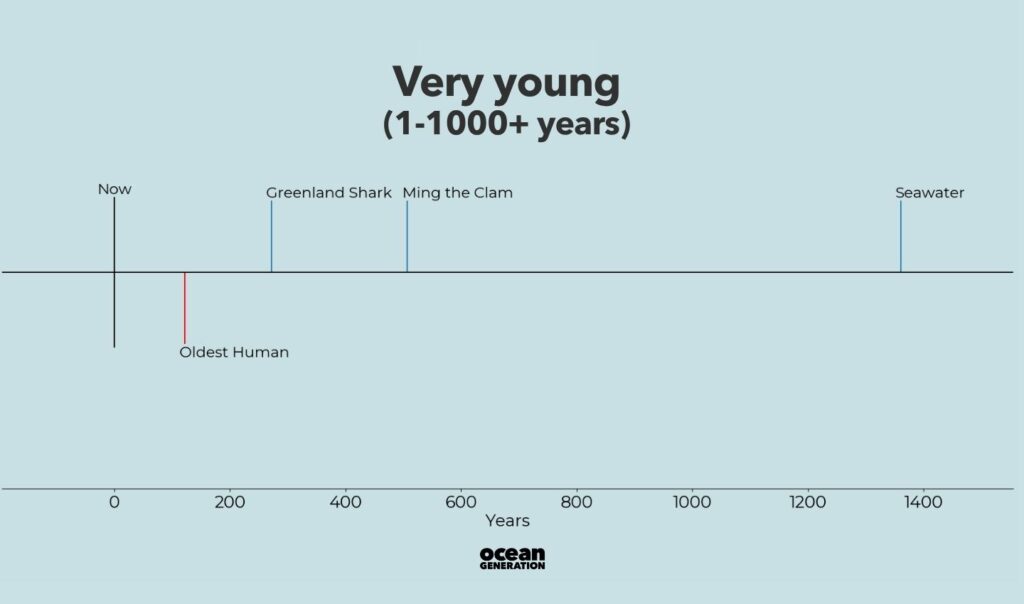
One contender is the Greenland shark. The oldest measured was 272 years, but they are thought to be able to live to 500 years. For perspective, the oldest person ever lived to 122 years old. The Greenland shark can be found in the North Atlantic, being the largest fish to live in Arctic waters. The females of the species can grow to 4-5 metres, about the length of a small car!
These animals grow incredibly slowly and live for a long time. However, this age takes us nowhere near even the oldest living animal. We can still give the Greenland shark the title of “the oldest vertebrate” though.
One of the oldest living Ocean animals is a clam!
A similarly long-lived animal is Ming the clam. Ming was 507 years old, being born during the Ming Dynasty of China (hence the name), or the Tudor period of the UK (it was born in the same decade as Henry VIII). The story of Ming ended quite sadly and unexpectedly, as to measure the age of clams, they must be killed. The scientists doing this experiment hadn’t realised how old Ming was until it was too late, and so in an unfortunate turn of events, Ming had its life cut short.
Ming still gets the title of “the oldest animal with a precisely measured lifespan” though. While this may seem like a long-winded title, the next animal, in the “young” section, will give an idea as to why it’s important.
Before we get onto the next animal, we move to the “age of seawater”.
How old is Ocean water?
The “age of water” is essentially a measure of how long water has gone since its last exposure to the atmosphere. This age depends on the speed of Ocean circulation, as faster circulation means younger overall water. The oldest water on Earth can be found in the deep Pacific, currently around 1400 years old.
Looking at our timeline:
What are the young things in the Ocean?
We now head into the “young” section; the things that date from one thousand to one million years. While it is definitely weird to describe these as young, one million years old is less than 0.1% of the age of the oldest thing on this list.
What’s the oldest animal?
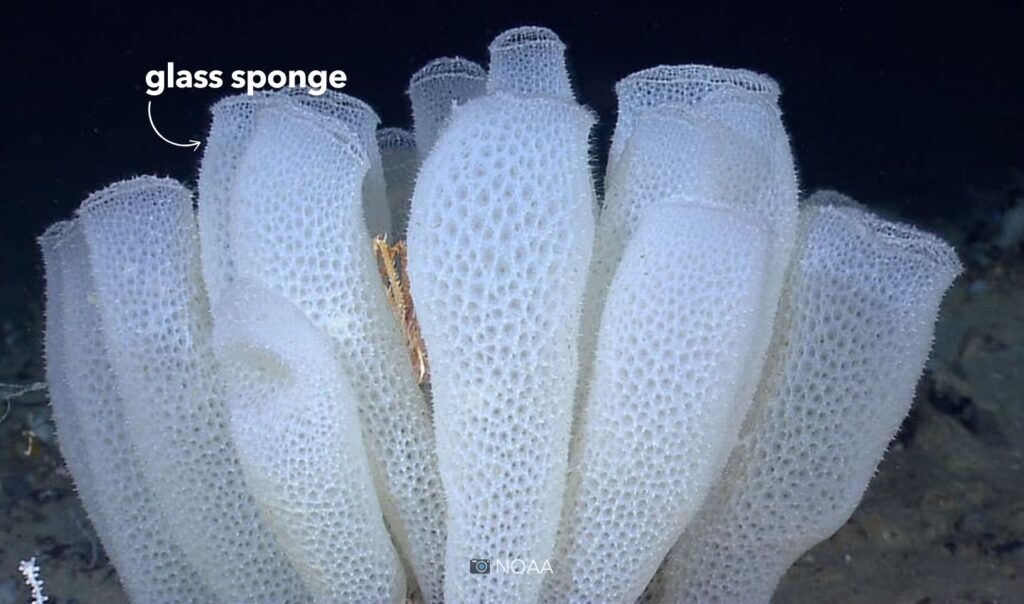
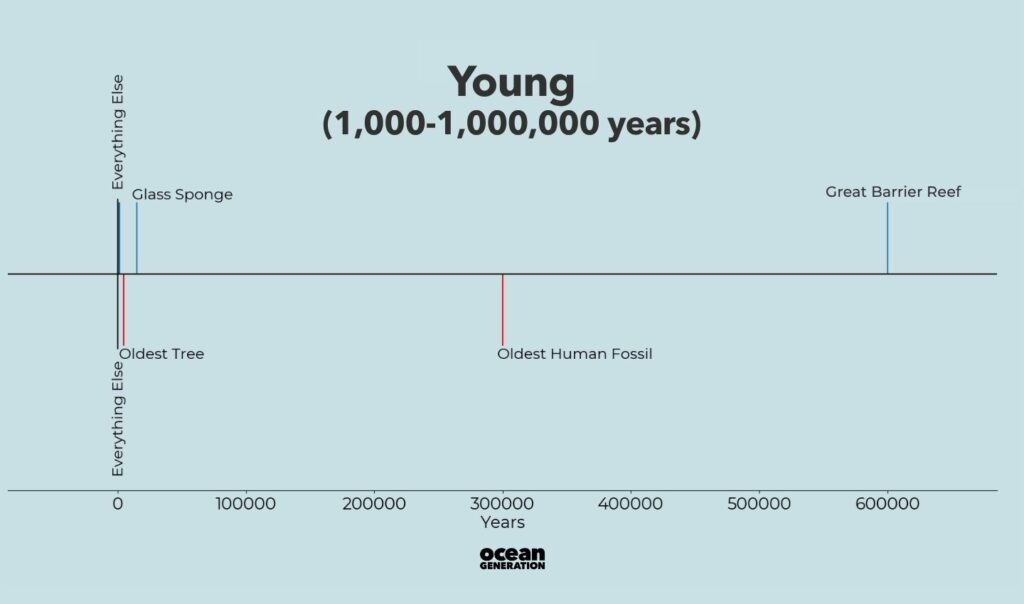
The title of oldest animal goes to the glass sponge (yes, sea sponges are animals). The oldest of these lives up to about 15 kyr (thousand years) old. That’s more than three times as old as the oldest (verified and non-clonal, it gets complicated) tree (about 4,900 years old) ever.
As a quick aside, this tree had a very similar story to Ming the clam, as the scientist who measured its age cut it down to count the rings, as other methods were not working.
The uncertainty on the age of these organisms is large (13 kyr – 40 kyr), due to the measurement method, there is a useful upper constraint on the sponge’s age. We know how sea level has changed in the past, and that the sponge lives at a certain depth below sea level. This means that the sponge cannot have been born below sea level at the time, and so must have been born after the sea level was at its current position.
This pick for oldest animal may be controversial, as some animals are functionally immortal (jellyfish). Despite this, this is a theoretical age limit, which is not what we are looking at. Either way, the oldest animal is in the Ocean.
One of the oldest and largest coral ecosystems
Making a big skip from 15 kyr to 600 kyr, we find ourselves in Australia, in the Great Barrier Reef. While the individual corals aren’t necessarily 600 kyr old, the ecosystem started growing that long ago. For perspective, the oldest human (Homo sapiens) fossil was 300 kyr old.
This means that it’s possible for the Great Barrier Reef to have been around for twice as long as modern humans have been on the planet. It’s uncertain whether this age makes the Great Barrier Reef the oldest living reef in the world, as there isn’t enough literature on reef ages. Despite this, the reef is still significant in age and has definitely been going for a long time.
Our updated timeline:
What is middle-aged in the Ocean?
We finally break a million years, and we’re only into the “Middle-aged” territory.
How old can ice get?
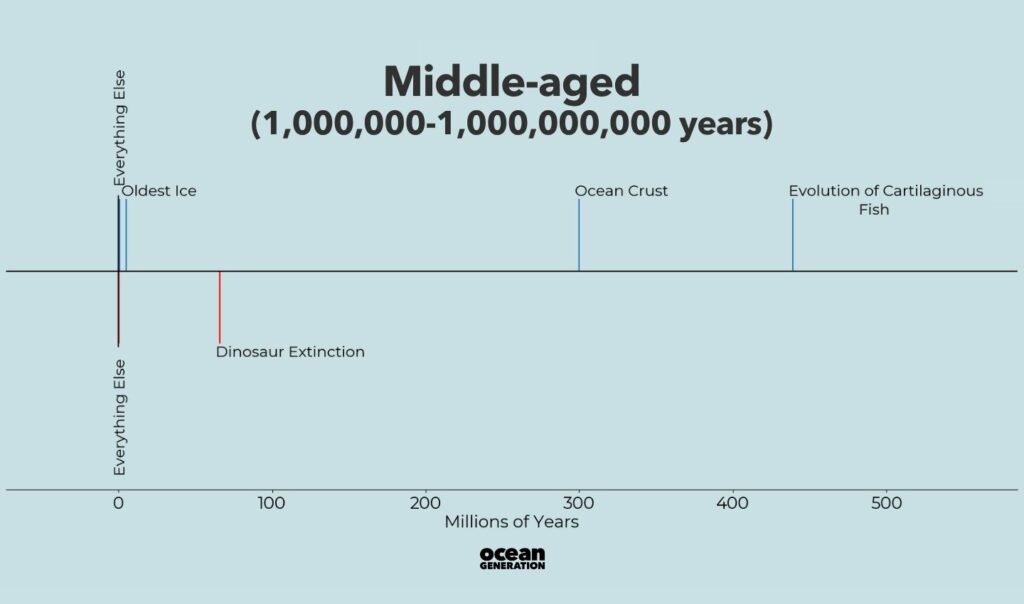
We start off with the oldest ice found on Earth, which is about 5 Myr (millions of years) old. You may think that this ice should have melted, as this ice predates the start of the last glaciation event. However, the way that this ice was preserved was being insulated under sediments and rocks, which kept it cool for long enough to be found in the modern day. Imagine trying to keep a block of ice frozen for a single year, never mind five million. That’s impressive!
How old is the Ocean crust?
Next, we pass through the K-Pg mass extinction (66 Myr ago, read about what happened here), where all the dinosaurs died, into the birth of the oldest Ocean crust, 300 Myr ago. If we’re looking for the “age of the Ocean”, then surely the rocks that hold the Ocean can count in that definition.
The Ocean crust is the supporting basin underneath the Ocean but does not last forever. New crust is constantly being made, while old crust is being removed (called subduction), and so the maximum age of Ocean crust is limited. This oldest crust is thought to have been from a past Ocean that has now closed (yes, regions of the Ocean close up) and is found in the Mediterranean.
Ancient fish fossils
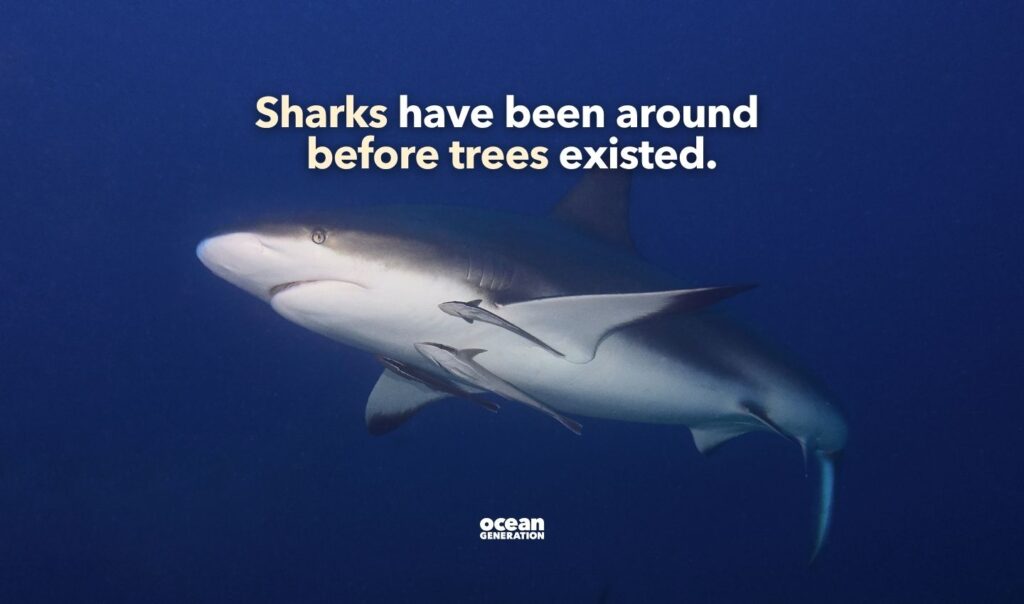
Rounding out our middle-aged section, we have the oldest fossil of cartilaginous fish, the group including sharks and rays. A fun fact is that the common ancestors of rays and sharks were around before grass and trees were on land. The fossil has been dated to be about 440 Myr old. While these may not be a part of the definition of “age of the Ocean”, they’re still fun to think about.
Our new timeline:
What are the oldest things in the Ocean?
Now onto the very oldest parts of the Ocean, we look at things that are billions (with a b) of years old.
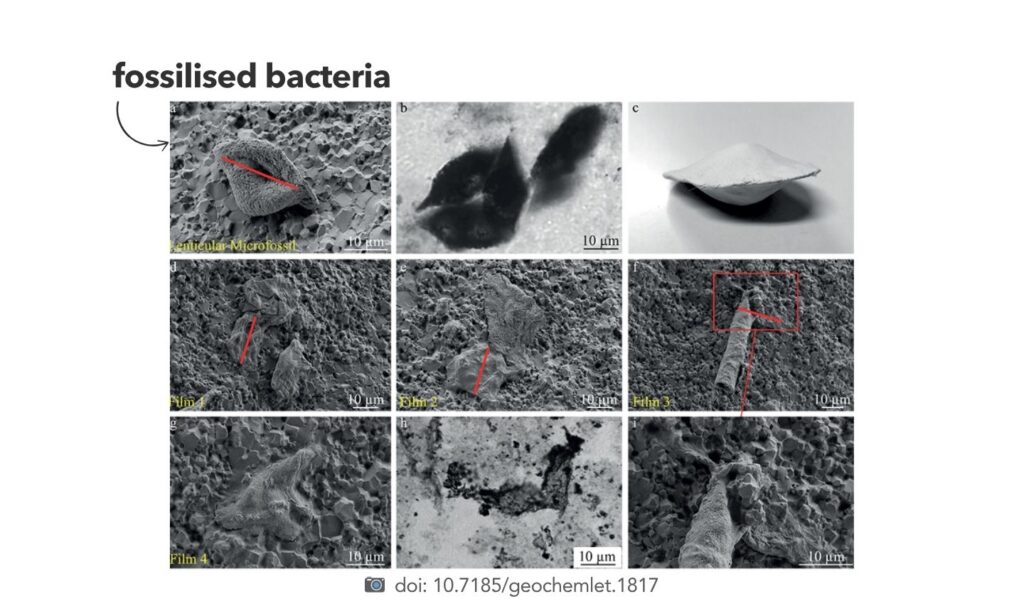
We have talked a couple of different fossils, but the very oldest of these fossils are found at the Strelley Pool Formation in Australia, dating back to 3.4 Gyr (billions of years) ago. These are fossilised bacteria, which predate even oxygen being on Earth in significant amounts (the Great Oxidation Event, 2.4 Gyr ago). They even had a hand in filling the atmosphere with oxygen! Finding the first fossil evidence of life is a challenge, as early life was made up of bacteria, which are difficult to preserve.
The Strelley Pool fossils are the oldest (largely) undisputed fossil evidence of life. As life is theorised to have started in the Ocean (around hydrothermal vents), perhaps we can say that the “age of the Ocean” is how long life has been in the Ocean for.
How long has water existed on Earth?
The very last definition of how old the Ocean is, is naturally how long water has existed on Earth as pools of water.
To see this, we can look at some of the oldest rocks on Earth, again from Australia. These rocks from Jack Hills contain minerals which date back 4.4 Gyr ago, which was quite early into the Earth’s lifetime (4.567 Gyr). Looking at the composition of these minerals, it’s possible that these minerals interacted with liquid water upon formation, suggesting the presence of at least liquid water at the time.
This water wouldn’t have been in the shape of the Ocean that we’re familiar with, rather taking a different shape due to plate tectonics. This fact emphasises that we have one Ocean that has been with us for billions of years.
The final timeline:
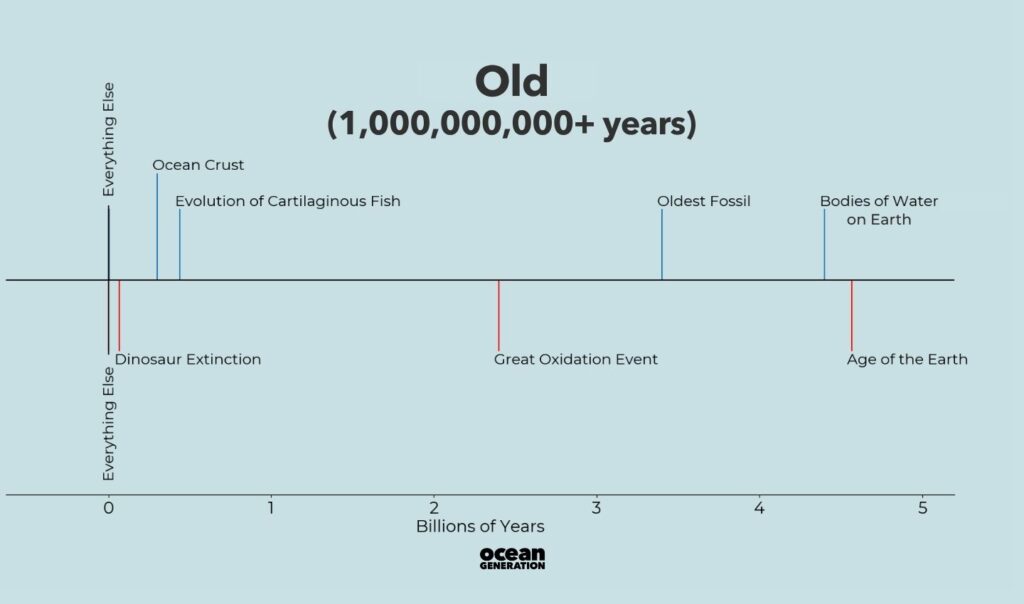
It should be noted that even though this seems like a complete list, these are only the oldest that we know of in each of their categories. The Ocean is largely unexplored in space (and time, for the cartilaginous fish), and so all ages should be taken with a pinch of salt.
How do we know the ages of things in the Ocean?
A question arises from all of these – how do we know all of these ages? Well, there are many different methods of what we call “dating”, which is measuring the age of something.
Counting growth lines
The simplest, and possibly the most familiar one to you, is counting growth lines. Trees famously grow rings for every year of their life, making counting their age relatively easy. Trees aren’t the only organism that this is useful to, with Ming the clam having a similar dating method.
Ming had annual growth lines that could be found on the inside of its shell (hence the scientists’ need to kill it to measure its age). This helped it be “precisely measured”.
Radiometric dating
With the simple method out of the way, we turn to “radiometric dating”, which uses the behaviour of radioactive atoms to see how old a specimen is. There are several atoms that are useful to us, depending on the timescale that we are working on.
Carbon-14 is an isotope (type of atom) of carbon that is radioactive. This means that the number of carbon-14 atoms decreases over time, with half of the carbon-14 in a sample decaying over 5730 years. We say that carbon-14 has a half-life of 5730 years. This means that we can use it as a clock. Carbon-14 dating is particularly useful for dating life, as all life contains carbon, therefore in some small amounts, carbon-14.
This was particularly helpful when figuring out the age of the Greenland shark, as they have a part of their eye that is formed on birth and does not change afterwards, meaning that from measuring the age of the eye, the age of the shark can be found. This method is also useful in finding the age of seawater, as seawater contains dissolved carbon within it.
A similar method can be done with uranium. The difference between uranium and carbon-14 is that uranium’s half-life is much longer, reaching billions of years. This means that it is useful in dating our very oldest samples. For the Strelley Pool fossils, we know the ages of the rocks around the fossils, and so can infer the age of the fossils, and for the Jack Hills minerals, we can directly find their age with uranium dating.
Correlative or model-based dating
The last method of dating is “correlative” or model-based dating. For this one, we set up a model, effectively a link between an aspect of a sample and its age and figure out its age from that model.
The Greenland shark age also uses this method of dating. A link between the size and age of the sharks that have had their eye ages measured can be made. This can then be applied to other Greenland sharks. The advantage of this method is that it is much easier to measure the size of a shark than to carbon date its eye age. A model is also used for the glass sponges.
Why is the age of the Ocean important?
While stretching the definition of “age of the Ocean” may be for fun, each individual story in this article is important.
Diving deeper into the oldest members of each category can lead us to many conclusions. Understanding why some animals live longer than others can give us insights into why some creatures live as long as they do.
The age of seawater gives us an idea about Ocean circulation, while Ocean crust tells us about plate tectonics. The big story of the “age of the Ocean” lets us explore the smaller stories important to different aspects of science.