
A lot of people know about the meteorite that killed the dinosaurs, but how were marine creatures affected by this event?
66 million years ago, the age of the dinosaurs came to an end, becoming the known as the K-Pg (the geological abbreviation for Cretaceous-Palaeogene) Mass Extinction. A meteorite impact sent the world into darkness, leading to the downfall of the once dominant dinosaurs and many other creatures. Despite the fame of this event, little thought is given to the effects on the past Ocean.
How did the dinosaurs become extinct?
The famous driver for the extinction of the dinosaurs was, of course, the meteorite that struck the Chicxulub Impact Site in Mexico. But this wasn’t the only cause for extinction. The volcanoes of the Deccan Traps in India were violently erupting too, spewing massive amounts of lava. Together, these two events were the drivers for the mass extinction. However, the meteorite and eruptions themselves didn’t directly cause the extinction, instead it was their aftermath. So, what happened?
The world – 66 million years in the past
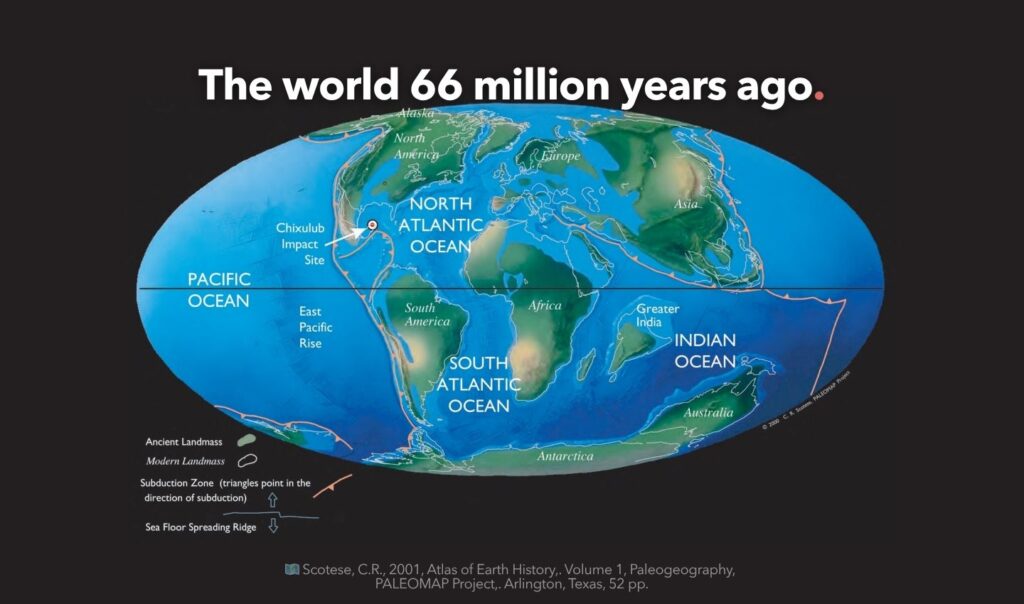
Due to plate tectonics, the world looked slightly different 66 million years ago (Ma) compared to now. Despite the similarities, the world, and so the shape of the Ocean, were different. Firstly, there were more connections between Oceanic bodies, for example from the Atlantic to the Pacific. Next, the Atlantic was much younger and much narrower. Lastly, as there were no ice caps and the climate was warmer, sea level was higher by about 200m.
What is plate tectonics?
The Earth is made up of multiple large sections called “plates”. Plate tectonics is the idea that these plates move around and past each other very slowly. This means that over many millions of years, they can move into completely different arrangements and positions.
What did Ocean life look like before the extinction?
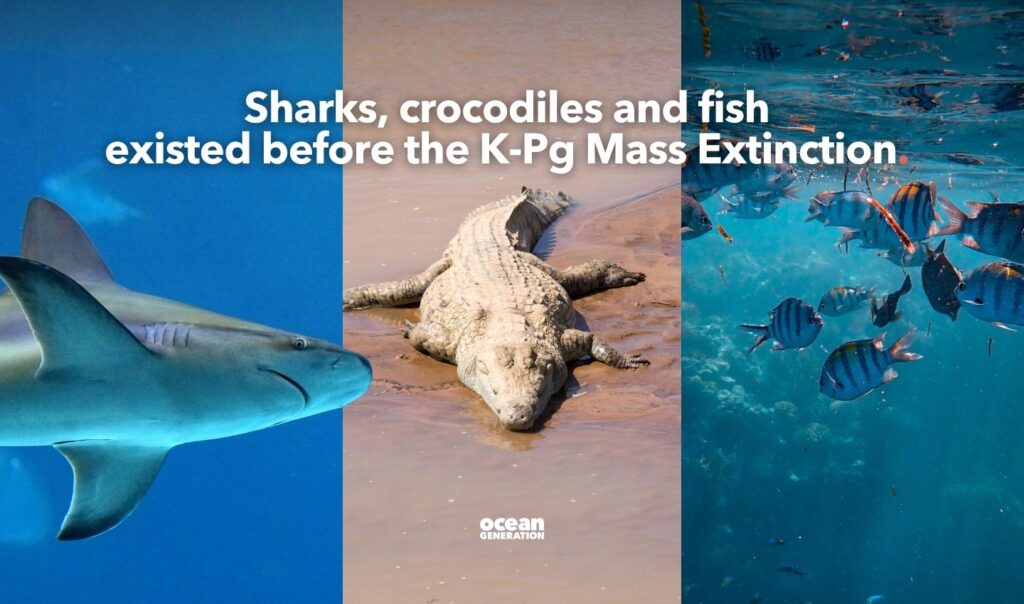
The life found in this Ocean of the past was quite different to the present, but we do see some familiar faces. Sharks, crocodiles and fish still existed, while algal ecosystems (the photosynthesisers of the Ocean) supported the food chain. These weren’t the only things found in the marine world of the Cretaceous period, though.
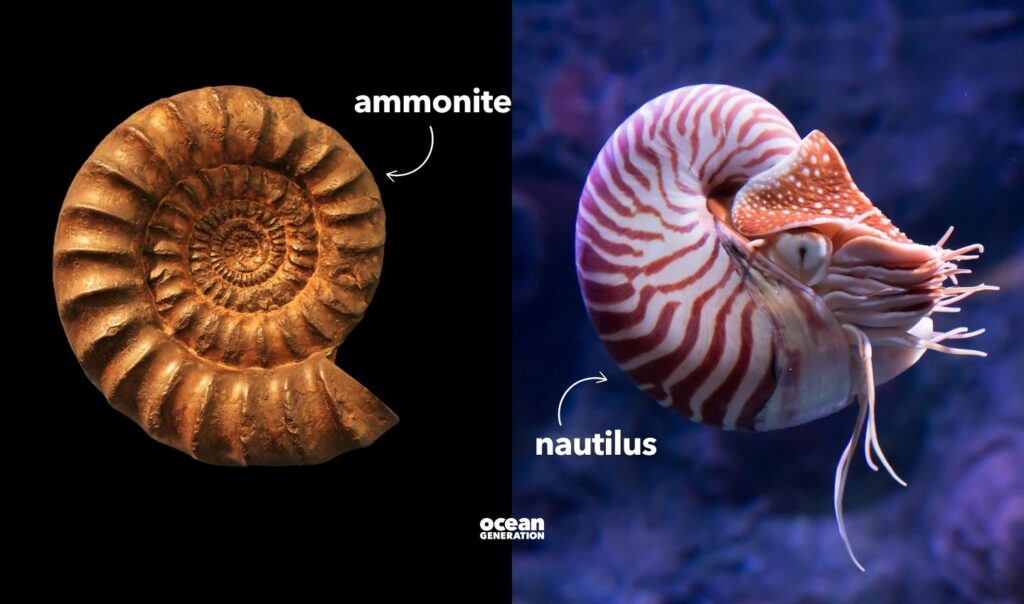
Cephalopods, which are the group containing modern octopuses and squids, had multiple representatives. Ammonites had been abundant before the extinction, although were on a gradual decline in diversity towards the extinction. These animals had a spiralled shell shape a little like their living cousins, the nautiluses, and lived throughout the Ocean. Alongside them, the nautiluses were also present but made it through the extinction.
Of course, there were also the famous predatory marine reptiles of the time, commonly (incorrectly) included when referring to dinosaurs.
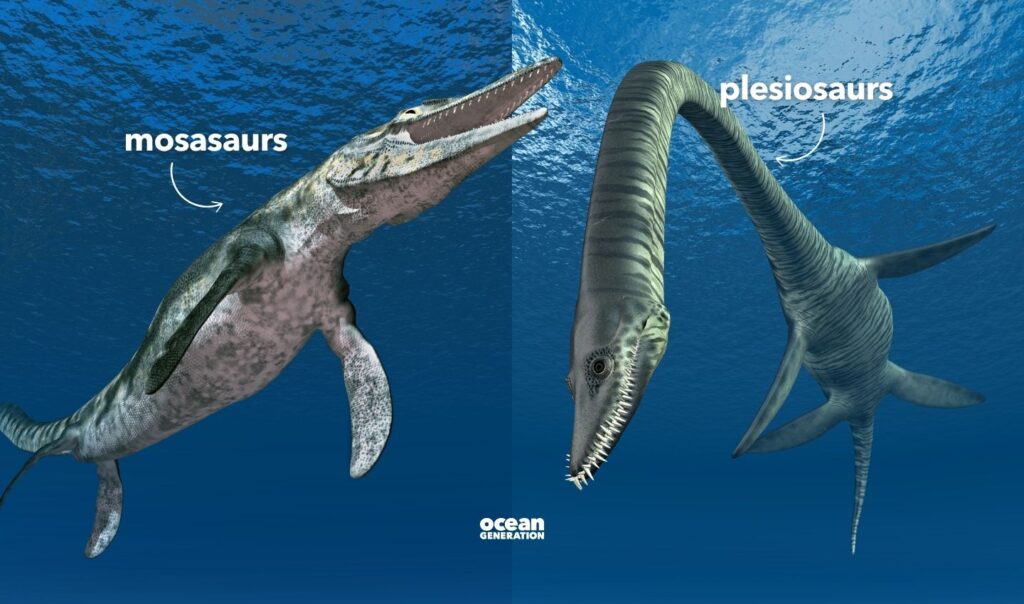
The relatives, the long-necked plesiosaur and the short-necked pliosaur, were two notable groups, the former having a nearly complete fossil discovered by Mary Anning. However, pliosaurs didn’t die in the K-Pg extinction, instead going extinct over 20 million years before (still considered the “late Cretaceous period”, the geological periods are long!).
Instead, the dominant predator at the K-Pg was the mosasaur, which were predatory marine reptiles, like the pliosaur. The difference was that the mosasaurs were better suited to live in the Ocean, as they could adapt better to changes in conditions, becoming more successful and thriving until the extinction.
What happened to Ocean life during the Extinction?
As per the name “K-Pg Mass Extinction”, a lot of species went extinct. It’s estimated that around 76% of all species died, being about the same for marine species, from the results of the meteorite and volcanism.
The meteorite and volcanoes weren’t the direct causes; the impact and the lava were nowhere near global scales. Instead, secondary factors caused by the impact and eruptions led to the extinction. The main effect of each was their effect on the food chain, with the death of algae.
The death of algae was a main cause of the marine extinction
When the meteorite hit the Earth, it sent high amounts of dust and debris into the atmosphere, leading to a sort of “curtain”. This curtain of dust blocked out the Sun for a considerable time, leading to an “impact winter” (a period of extreme cold, due to the meteorite blocking the Sun), and darkness. This period of darkness decreased both plant and algae numbers, with both requiring the Sun for energy.
Just as plants are the bottom of the food chain (what we call “primary producers”) on land, algae are the primary producers in the Ocean. The decrease in numbers means that the animals that eat algae would have less food and die, meaning the animals that eat those animals would have less food and die. This knock-on effect up the food chain is one of the main causes of the mass extinction, both on land and in the Ocean.
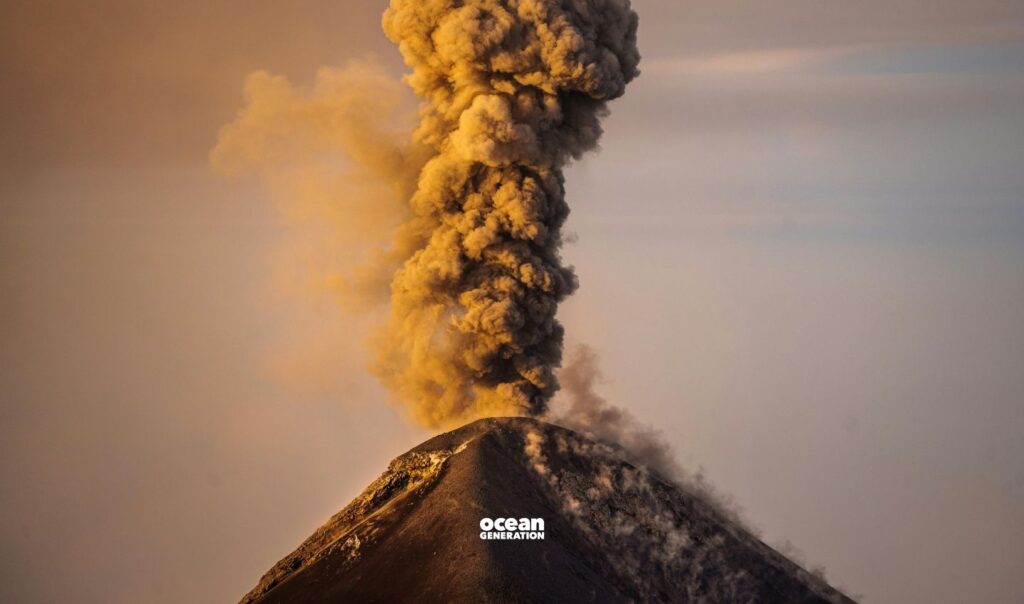
The volcanoes of the Deccan Traps, along with releasing vast amounts of lava, released considerable amounts of volcanic gases too, notably carbon dioxide and sulfur dioxide. Carbon dioxide, along with being the infamous greenhouse gas, can lead to Ocean acidification and carbon dioxide poisoning. Sulfur dioxide is a potent ingredient in acid rain, also contributing to Ocean acidification.
The reason this is so important is that some algae are dependent on the Ocean being a certain acidity to live. This fast, significant change in acidity led to the death of these algae, having an impact on the marine food chain.
What happened to Ocean life after the extinction?
If all of this happened, why did anything survive at all? A key player in the extinction of animals was starvation. The longer an animal could survive without food, or the more accessible food that an animal had, the more likely it would be to survive.
Mammals and fish: the survivors of the extinction
This applies to both land and the Ocean. Mammals were able to outlive the dinosaurs as they could live off of insects and dead plant matter, paving the way for their domination.
In the Ocean, the major surviving group was the “ray-finned fish”, which make up the vast majority of fish species today. They were able to survive due to some algae thriving shortly after the extinction, leading to the success of these fish.
What happened with marine predators?
For the predators, replacement with fish also occurred. The mosasaurs and plesiosaurs that lived in the Cretaceous period had disappeared, with sharks surviving into the modern day.
The advantage that sharks had on the marine reptiles isn’t well researched, but it could have been to do with the reptiles being warm blooded, hence needing more food than the cold-blooded sharks.
How did algae survive?
Some algae also had the adaptations required to survive the extinction, with some having an inactive state that they can go into when water conditions aren’t ideal. This means they could live through the cold and lack of light from the impact winter.
Also, reproduction methods likely influenced their survival, as some algae could reproduce by themselves, but others required a partner to reproduce. During times of reduced population numbers, like the extinction, it is more efficient to not require a partner.
Different survival strategies of young cephalopods
Finally, between the ammonites and the nautiluses, they have different survival methods when young. The young nautiluses are birthed in eggs with a yolk to feed from, but young ammonites were thought to have had eaten algae, rather than having a ready food source. Reduced algae decreased the young ammonites’ survival.
How do we know what happened during the extinction?
There is uncertainty about details of the past, because we are 66 million years in the future of the event. This means we must take logical guesses at what happened because we can’t observe events directly. To do this, we look at the rocks and fossils from the past, called the geological and fossil records.
A useful inference we can make is that if a fossil appears in rocks of a certain age, but not in younger rocks, it is likely that the animal has gone extinct. We have applied this to many of the organisms of the K-Pg extinction, like the dinosaurs, which tells us around when they went extinct.
This method is not foolproof though, as this assumption is susceptible to misinterpretations and mistakes. For example, there was a group of fish called the coelacanths that were thought to have gone extinct during the K-Pg, as it hadn’t appeared in the geological record since. However, modern relatives were later found, leading to the realisation that they hadn’t gone extinct, but just happened to not preserve as fossils after the K-Pg extinction.
Why does this matter?
It may seem like studying the past life is just for fun, and while it’s fun, it’s also useful. Understanding the mechanisms and effects of past mass extinctions, especially for the Ocean, can help us prevent a human-made one. Lots of the present-day organisms affected by modern extinction, like whales and corals, live in the Ocean.
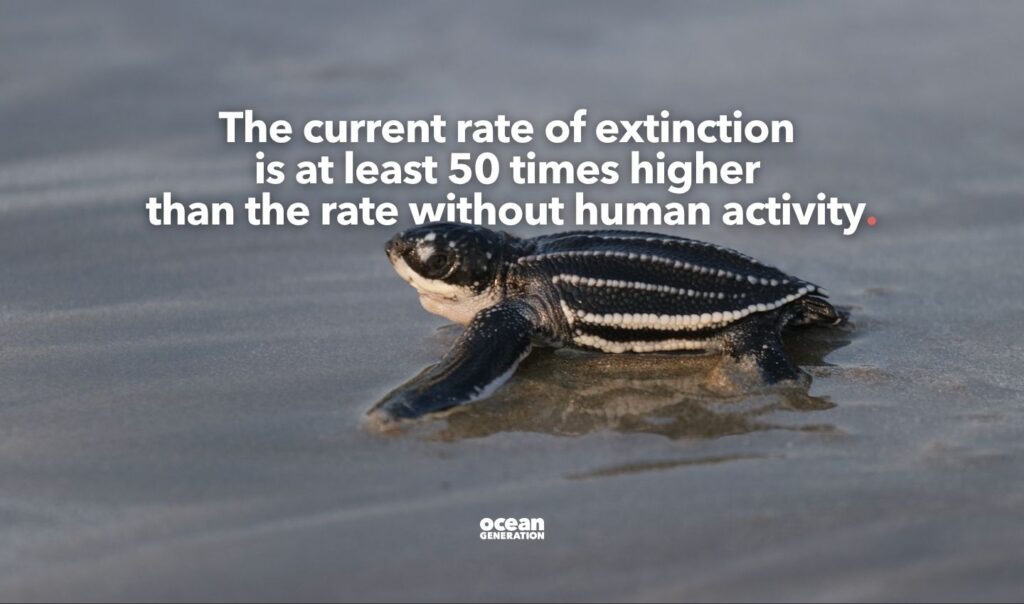
Many species could and have disappeared due to human activity, with the current rate of extinction being at least 50 times higher than the background rate (i.e. the rate without human influence). By studying the past, we can understand the effects of our actions and possibly prevent another mass extinction.
The other side of this is that the Ocean is largely unexplored in space, but also in time. Exploring past life can tell us what has once lived on our planet and the environments that they lived in telling us more about our Ocean and Earth.